Tag: Douglas Booth

Noah (2014)

Russell Crowe is getting ready for action as the rains come to Noah

Director: Darren Aronofsky

Cast: Russell Crowe (Noah), Jennifer Connelly (Naameh), Emma Watson (Ila), Ray Winstone (Tubal-Cain), Logan Lerman (Ham), Douglas Booth (Shem), Anthony Hopkins (Methuselah), Marton Csorkas (Lamech), Nick Nolte (Samyaza), Frank Langella (Og)

Everyone kind of understands what they are going to get when watching a Biblical epic right? A lot of “thous” and “thees”, sandals and swords, priests with long beards, sweeping musical scores and an actor like Charlton Heston (ideally just Charlton Heston) at the centre, standing tall with the word of God behind him. Obviously Darren Aronofsky must have been unfamiliar with this formula as he put together Noah, without a shadow of a doubt the weirdest Biblical epic you are ever going to see.

Set at a time that could be thousands of years either in the future or the past (with a steam-punk aesthetic and timeless mix of ancient and medieval technology with hints at modern ruins), God has had enough of man wrecking the world. He sends a cryptic vision to Noah (Russell Crowe), last descendent of Abel, telling him that a flood will take out the world. Noah will build an ark to protect the animals – but Noah also becomes convinced that God’s will is that mankind will not survive the flood. After Noah and his children die that’s it. This fanaticism is met with concern by his family, but also with fury from the rest of mankind led by descendant of Cain, Tubal-Cain (Ray Winstone). 

And that’s only scratching the surface of the film’s trippy eccentricity. The story of the ark is familiar to generations of children, and the image of Noah as a jolly bearded fella saving the animals like some sort of nautical Doctor Doolittle is one we all share. Aronofsky remixes this into a more adult mood by reminding us that this bloke was also happy to stand by and watch the rest of mankind drown, and followed the word of God with a fanatical monomania. Noah is, for large chunks of this film, not a nice bloke. As he tells son Shem “He chose me because he knew I would finish the job”. No hugs on this boat.

It makes sense that Noah is embodied by Russell Crowe at his most gritty. Going through a series of haircuts that reflect his journey from nature lover to chosen man of God to fanatical cult leader through to reborn family man, Crowe gives the role a blunt determination and earthiness ­– so much so you half expect him to address everyone as “mate”. But it’s essential for Aronofsky’s reimagining of the role as part environmentalist part cult leader. Noah is uncompromising, unshakeable and totally certain that all his decisions come direct from God, ergo they are unquestionable. As he shows time and time again in the film, he is willing to commit actions that are at best morally questionable, at worst down right bad, to do what needs to be done.

He’s the man who is willing to watch his crapsack world burn (or rather drown) and feel that, yes, it is good. Aronofsky’s vision of this wasteland of a world fits this perfectly. Resources are low, mankind has turned (it is heavily implied) partly cannibal, industry has destroyed nature, the law of man has become the law of the strong. There is a clear modern parallel here with environmentalism, and Noah himself is strongly reimagined as a man with a deep respect for nature – and the balance mankind must make with it; and the danger of us burning through our resources with no regard for the future is a major theme throughout the film. 

Evil mankind is represented by Ray Winstone as Tubal-Cain. Greedy, selfish, ambitious and a demagogue, Winstone is at his most physically imposing and dangerous here, a fitting obstacle for this reimagined muscular Noah. Aronofsky does however acknowledge that, for all his faults – and his unashamed embracing of violence – Tubal-Cain does have a point: it’s not fair for all of mankind to be sentenced to oblivion with no chance to save itself, regardless of their personal morality.

This uncomfortable darkness behind the story of Noah – and the destruction of mankind by their creator – is one of many things that made some Christians uncomfortable with the film. The Creator (as he is referred to throughout the film) is noticeable by his silence, speaking only to Noah through dreams and everyone else, not at all. Noah’s hardline interpretation of God’s plans (extinction) is enforced by him with all the obsession of a fanatic (a large chunk of the second half of the film is given over to the danger of an expectant mother sharing a boat with a man who has stated his intention to end the race with his immediate family). Of course the film shows Noah eventually changing his mind (and getting royally pissed in self-disgust at his lack of will), but it’s a way darker tone to take for a story more familiar to people through children’s playsets.
Aronofsky places this film at a hinge point of what sort of race are we. It’s expressed in several scenes that mankind is still fighting the struggle between Cain and Abel. Is it violence and strength that wins out? Or are there better qualities in man that can end the cycle of destruction? What sort of world has man built – and what sort of world does Noah believe could emerge from the floods? Striking imagery accompanies this musing throughout, not least a flashback to Cain killing Abel in silhouette against a blue dappled starry night sky – an image that shifts and changes at one point to replace the brothers with antagonists from our entire history of warfare.

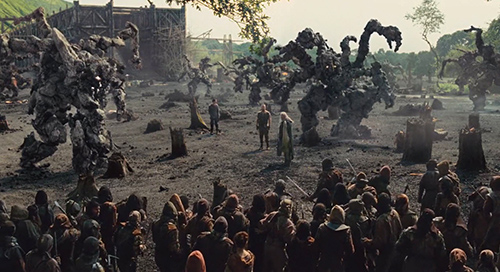
There are miracles and divine power in this film, but its actions seem to be based around inspiring fear and obedience rather than devotion. Forests spring from the ground for Noah to build from. Geysers of water take out mankind. Fires take out armies. There are moments of gentleness – a woman given back her ability to have children, rainbows etc. – but the Creator is a hard taskmaster. Noah is assisted by a gang of fallen angels – the Watchers – who, as punishment for siding with mankind when Adam and Eve were expelled from Eden, were thrown to the ground and encased in stone, turning them into freakish, gangly, giant rock monsters. Despite this, they retain their devotion to their creator – and their assistance is essential for the construction of the ark.

The inclusion of Giant Rock Monsters shows you again how far off the Biblical beaten track Aronofsky goes. This same embracing of unconventional oddness is seen throughout the film’s aesthetic – dirty clothes that have been cobbled together from several different eras, hints of metalwork and industrial ruins throughout Tubal-Cain’s kingdom, blasted wastelands – it’s miles away from The Ten Commandments. But it all sort of works because, regardless of his eccentricity, Aronofsky is a unique and intelligent director of visuals and his work is full of striking images and staging that draws inspirations from all over the shop, from old films to classical children’s story book images from Biblical tales.

Noah ain’t perfect. It’s overlong and its genre defying oddness occasionally feels a little too much. It suffers from the fact that the visuals and themes are so overwhelming that they crush most of the characters: Jennifer Connolly has little to do as Noah’s wife, while Emma Watson et al playing various Noah family members are left with just crusts to chew on. But embrace its bizarreness and the points it wants to make and you are left with a film that is quite unlike anything else you are likely to see. Aronofsky has made a Biblical epic unlike any that has ever, or will ever, be made. And that at least is worth some praise.

Loving Vincent (2017)

Douglas Booth becomes a painting in the unique Loving Vincent

Director: Doreta Kobiela, Hugh Welchman

Cast: Douglas Booth (Armand Roulin), Jerome Flynn (Paul Gachet), Saoirse Ronan (Marguerite Gachet), Helen McCrory (Louise Chevalier), Chris O’Dowd (Joseph Roulin), John Sessions (Père Tanguy), Eleanor Tomlinson (Adeline Ravoux), Aidan Turner (Boatman), Robert Gulaczyk (Vincent van Gogh)

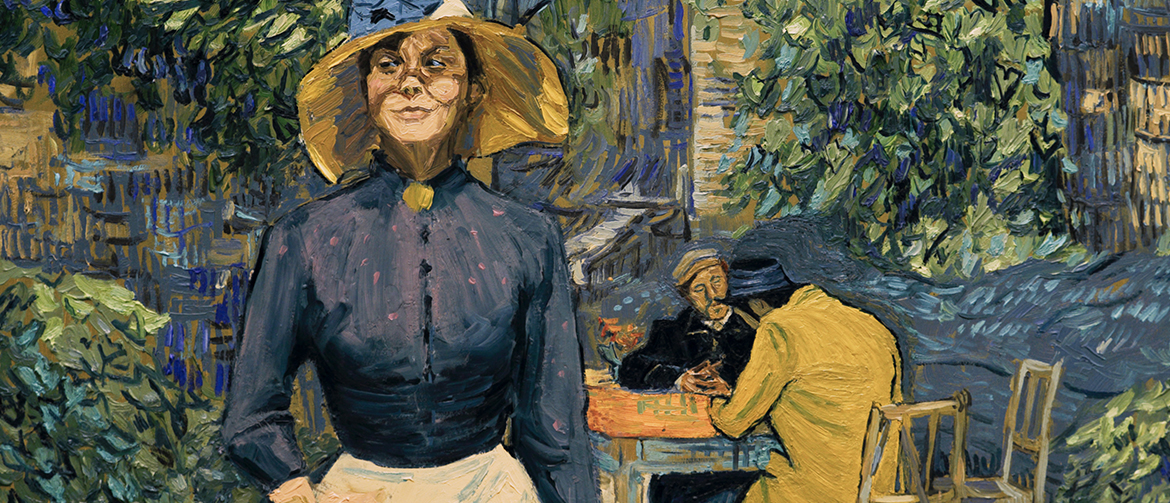
Now this is something very different. It’s a common turn of phrase to praise a well-photographed film by saying every frame looks like a painting. Well Loving Vincent is a film where every single frame is literally a painting. A beautifully painted pastiche collection of van Goghs, painted over a combination of motion capture and photographs of real locations. And, as you would expect, it is beautiful. 

The film covers events year after the suicide of Vincent van Gogh (Robert Gulaczyk). Armand Roulin (Douglas Booth) tries to deliver van Gogh’s last letter to his brother Theo. Roulin’s father Joseph (Chris O’Dowd) is also concerned that there is more to the death than meets the eye, as van Gogh had written to him that all was well in his life. Roulin travels first to Paris and then to Auvers-sur-Oise, where van Gogh spent his final days, talking to those who knew him, including his landlady Adeline Ravoux (Eleanor Tomlinson), his art supplier Père Tanguy (John Sessions), the daughter of his doctor Marguerite (Saoirse Ronan) and finally Dr Gachet (Jerome Flynn) himself. 

Loving Vincent looks simply beautiful. Its quality is astonishing. The film was shot on green screen with actors. Van Gogh’s paintings were then overlaid as backgrounds for the action. The film was carefully edited, then every frame in the final film was turned into a single hand painting – with real paint. 65,000 hand-painted frames. It’s astonishing – you’ve never seen anything like this before. The style, the homages to van Gogh, the respect and craft behind reproducing his distinctive look – it’s marvellous. Every single image in the film demands you linger upon it and soak it in.

I simply haven’t ever seen a film like this before. I can’t imagine any film like this being made again (for starters it took years to make). It demands to be seen if you have any interest in art or any interest in cinema as a visual artform. It’s so impressively done, you start falling in love with its artistry. It’s also got a poetic visual beauty to it. The flashbacks showing van Gogh’s last few days are put together with a black-and-white pencil-drawn style, which contrasts beautifully with the primary colours of the present day. The film walks a brilliant tightrope line between “real” and dreamlike wonder – final shots of van Gogh or sequences of Roulin dreaming feel like real visual expressions of inner thoughts in their greater expressionist vibrancy.

If there is a weakness to the film, it is that (whisper it) there isn’t much actually to it once you look past the visuals. It’s truly unique in look and feel but the story it delivers is fairly traditional and even (at times) a little flat. Despite being soaked in van Gogh I’m not sure you learn too much about him or his art from the film, and the film shies away from its more interesting topics. The dialogue or plotting rarely ventures above the average.

Perhaps one of the most interesting themes of the film is the struggle of the characters to understand and appreciate the difficulties of depression: that suffers can be optimistic one minute, and consumed with world-ending self-loathing the next. It would have been more interesting if the film had engaged more with this theme, rather than trying to build a rather flat murder mystery around van Gogh’s death. It also would have felt more true to the actual struggles of the artist – crikey, this material was spun out into an excellent Doctor Who episode, which feels like it managed to get more understanding of van Gogh than this film manages.

The acting however is pretty good – Douglas Booth anchors the film every well as the nominal detective figure, struggling with his own guilt over abandoning van Gogh. Saoirse Ronan is very good as a sad love opportunity lost for van Gogh, Eleanor Tomlinson radiant as his friendly hostess, Jerome Flynn tragically guilt-ridden and envious as Dr Gachet. It may not be a film that really gives actors the opportunity to let rip, but it’s still good.

The main question over Loving Vincent is whether there is enough to it to make it more than an art experiment, or a curiosity. Plot and storyline wise it’s a very traditional, rather straightforward film, but it carries a germ of depth in there. And then the film looks so uniquely marvellous that you can’t deny it a certain place in film history. Because you won’t see anything like this again, and if you have any love for the artist or art in general, you have to check it out. Every frame is literally a painting.

Pride and Prejudice and Zombies (2016)

Sisters doing it for themselves. As I’m sure the film would have said in the dialogue if it had the guts.

Director: Burr Steers
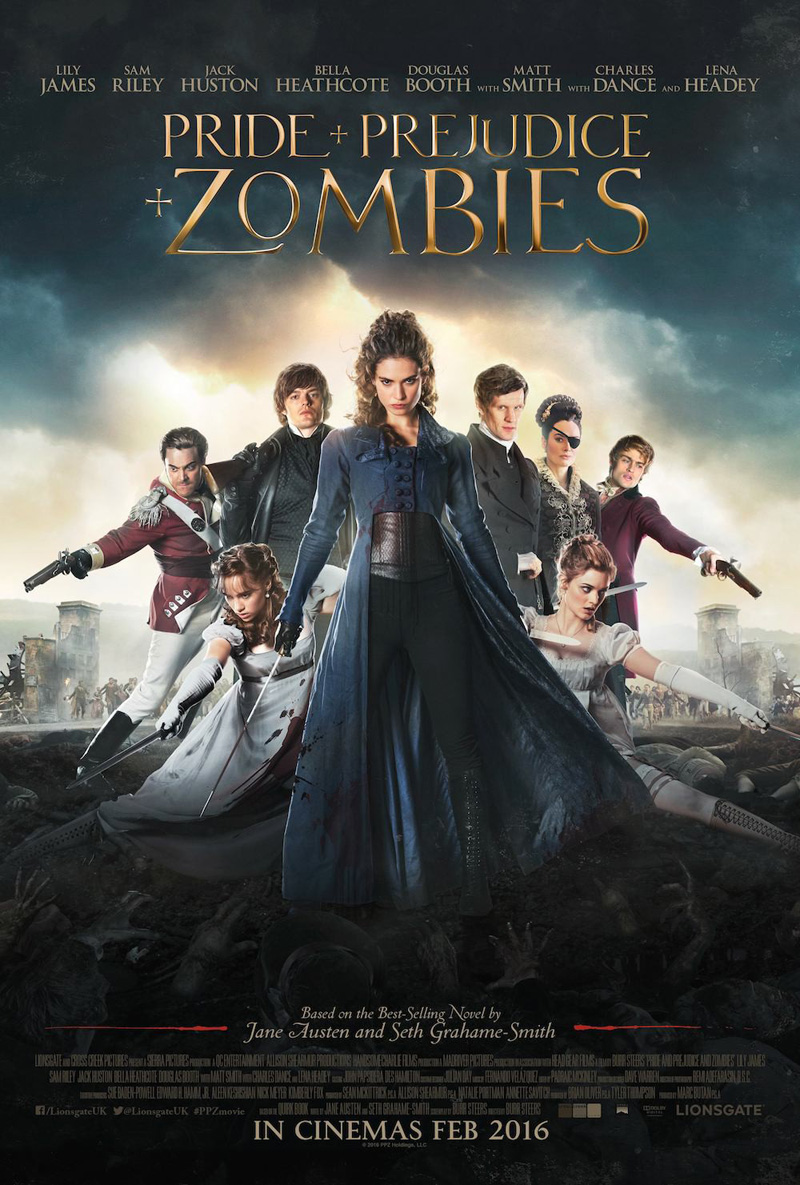
Cast: Lily James (Elizabeth Bennet), Sam Riley (Fitzwilliam Darcy), Jack Huston (Wickham), Bella Heathcote (Jane Bennet), Douglas Booth (Mr. Bingley), Matt Smith (Mr. Collins), Charles Dance (Mr. Bennet), Lena Headey (Lady Catherine de Bourgh), Sally Phillips (Mrs. Bennet), Aisling Loftus (Charlotte Lucas)

Back in the 1990s, Harry Enfield and Chums did a sketch in which The Terminator (played by Martin Clunes) arrives in early 20th-century England, and spends a weekend at a country house searching for his victim. His violent antics are met with po-faced, stiff upper lip responses from the Upper Crust members of the household and uncomplaining reserve from the servants. It’s very funny. It sticks in the mind. It brilliantly mashes up costume drama with sci-fi drama. It’s five minutes long.

This film is effectively the same gag but stretched far beyond any possible welcome to an agonising 104 minutes, in which the same comic beat is repeated over and over again. “Oh look! Those posh girls/blokes in frocks are discussing tea and table arrangements! And now they are slaughtering a herd of zombies! While continuing the conversation! What larks!”

Pride and Prejudice and Zombies was the poster child of a mercifully short-lived literary novelty: classic novels rewritten with genre elements. This trend also saw sea monsters inserted into Sense and Sensibility and hard-core sex scenes inserted into Jane Eyre (the worst of all, as the author had the cheek to suggest that Bronte would of course have got those scenes in if she could). It was a best-seller, but only in the sense that it was the ultimate ‘I-don’t-know-what-to-get-you-for-Christmas’ gag gift. But years after the moment had passed, the movie adaptation lumbered towards the big screen.

Morbid curiosity made me watch it (over several nights on Netflix, I hasten to add) and it’s exactly what it appears to be: a student sketch that is worthy of maybe a slight smile for the first few minutes, but then totally collapses the longer it goes on. Now I like Jane Austen films and I like zombie films but still I didn’t like this. Firstly it’s a terrible zombie film – the action moments are poorly shot and hard to follow, the action dull and the “laws” around the zombies in the movie are inconsistent (some zombies are super killers, others are lumbering brainless beasts). Secondly, all that Zombie stuff makes it a pretty bad Austen film. Worst of both worlds.

The Austen bits are (unsurprisingly) by far the best bits. There is a good cast here: Lily James and Matt Smith in particular would be very well cast in a proper adaptation. Anything interesting comes largely from Austen (the characters, the emotions, the bulk of the watchable stuff in the first half) anything dull from the source material (the zombies, the action, the final 30 minutes). The idea of society being fundamentally unchanged by a zombie invasion makes no sense at all (would money still be the driving factor in a world destroyed by the undead?). Much of the fighting involving the female characters has a slightly uncomfortable leering sexuality about it (“Look at those hot chicks pull knives from their undergarments! Phrroooaaahhh!!!!”) as well as being far too over choreographed.

Zombies is a pointless film of a forgotten fad. It’s one of the worst zombie films ever made. It wastes our chance to see some of these actors give decent performances in a proper adaptation. Pleasingly, it bombed catastrophically at the box office, probably because it appeals to no one: the zombie action isn’t anywhere good enough to interest the genre fan, the Austen fan is more likely to bung on their Firth/Ehle DVD than check this mess out. None of them are missing anything. Zombies isn’t the must-see abomination it needed to be to have any shelf life – it’s a blatant attempt to rake some more cash from a horse flogged to death. If you want to get a sense of it, save yourself 135 minutes and watch that Harry Enfield sketch instead. I guarantee you’ll laugh a heck of a lot more.