Tag: Ed Harris

A History of Violence (2005)

Viggo Mortensen: Hero or Villain? A History of Violence

Director: David Cronenberg

Cast: Viggo Mortensen (Tom Stall), Maria Bello (Edie Stall), Ed Harris (Carl Fogarty), William Hurt (Richie Cusack), Ashton Holmes (Jack Stall), Peter MacNeill (Sheriff Sam Carney), Stephen McHattie (Leland Jones), Greg Bryk (Billy Orser), Heidi Hayes (Sarah Stall)

Cronenberg’s films redefined ideas around body horror. And one of his most accessible – and perhaps one of his richest and finest – films takes these ideas to another level by looking at the lasting – and damaging – impact of violence. That’s not just the immediate, visceral impact either – and lord knows Cronenberg doesn’t shirk on that here – but also the intense, long-term psychological impact and how it shapes entire lives. A History of Violence is a brilliantly told and superb piece of film-making that mixes thought-provoking content with a gripping, Western-tinged plot. It’s got a claim to being one of the best American films of the Noughties.

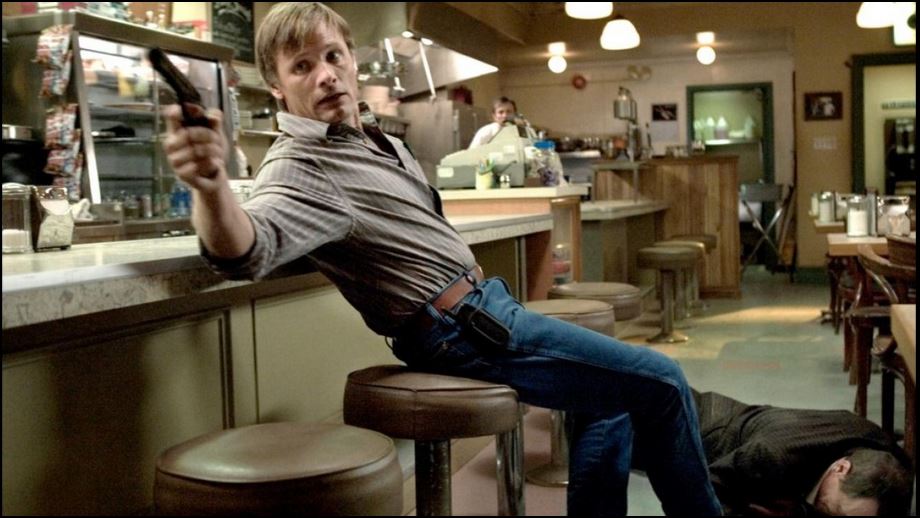
Tom Stall (Viggo Mortensen) is a regular Joe in a very small town in rural America. Running a small café, he lives a blissfully happy life of Americana with his wife Edie (Maria Bello), a lawyer, and their two children Jack (Ashton Holmes) and Sarah (Heidi Hayes). Their world changes forever though when Tom’s diner is held up late at night by two ruthless killers (Stephen McHattie and Billy Orser) and – with an instinctive ruthlessness – Tom ruthlessly dispatches the killers and saves the lives of his co-workers and patrons. His heroism makes him a local hero and brings plenty of excited press attention – but why does Tom seem so uncomfortable with this? Could it be linked to the swift arrival in the town of big-city criminal Carl Fogarty (Ed Harris) who claims Tom is none-other than Joey Cusack, psychopathic hoodlum from Philadelphia who gouged out Fogarty’s eye? Are Tom and Joey one and the same? And how will the doubts affect Tom’s family?

Cronenberg’s film brings brilliant tension to this question of identity, setting it in a very modern-feeling Frontier town, which has more than a sense of a classic John Ford western town, complete with disturbance from murderous figures from outside, shattering the peace. But the film adds that distinct Cronenberg touch by suggesting that, behind the quiet diners and picket fences, the real danger may already be at the heart of the town. Is Tom who he claims to be? Or is he a malignant dark force at the centre of the town (and his family) bringing destruction to everything? What other dark truths, you can’t help but think, might be hiding behind those shutters?

But then that’s what you get with violence. It taints and ruins everything it touches. Innocent lives are shattered. Families and loved ones are left mourning. But it also twists and shapes the personalities of its perpetrators. It marks them and changes them, washing out positive qualities and leaving those who use it the most drained, empty and uncaring. The film opens with a chilling long shot as McHattie and Orser check out of a motel. Cronenberg keeps the camera still and holds the camera still to study the casual body language and chilling lack of engagement of its killers (“Why the delay?” “I had a little trouble with the maid”). The scene continues for an agonising length, making us dread the reveal of what these clearly dangerous, amoral men have done in this motel – the reveal eventually shown with a clinical precision, which serves as an entrée to even greater horrors.

The final killing in the motel is the last time the film will shy away from the immediate horrors of violence. Even Tom’s heroic slaughter of the killers to save lives doesn’t shirk from showing us the impact on the bodies of the killers as Tom dispatches them – bodies torn apart by bullets, with McHattie’s killer left with most of his lower jaw destroyed beyond recognition. Later we’ll see the impact not only of bullets, but also the jerking death spasms of those who have had their noses smashed into their faces, necks snapped or bullets pass through their heads. Never is this glorified – and never are we allowed to simply categorise some killings as good or bad. No matter who it is, the human body will still suffer staggering trauma.

But violence’s impact isn’t only physical. As Tom’s increasing comfort with using his natural propensity for brutal killing (“Have you never asked, why is he so good at killing people?” Fogarty asks an Edie still in denial) grows, so violence takes over his family and starts to shape the actions and decisions of those around him. Arguments become more regular and more visceral. Tom’s gentle son brutally beats his bully at school. The loving father Tom suddenly slaps him across the face. Edie and Tom’s blissful life – we see them playfully making love on a date night – degenerates into conflict, distrust, flashes of violence and finally an angry, intense and passionate sex scene on the stairs that is an exact mirror image of their earlier love scene.

Edie is, for all her horror at Tom, partly excited by finding her husband has such a capacity for danger and brutality. That’s the dark attraction of violence in this film: it reveals secrets about ourselves. Tom seems to subtly shift within conversations from the gentle Tom into the chillingly distant Joey. Worst of all, the more that muscle is stretched the more Tom seems to take comfort and enjoyment in it. Taking what we want, with no regards for the consequences, is liberating and makes us feel strong. No wonder it’s so attractive. And no wonder violence has so shaped and defined humanity’s history. It tends to get people what they want and it can feel good. And it looks cool. Because despite the horrors of the impact of the violence, Cronenberg is also honest enough to admit that it’s exciting.

At the film’s centre is a superb performance of cryptic unknowability from Viggo Mortensen, in possibly his finest role. Mortensen uses micro expressions, small beats and body language that moves between casual and chillingly precise to show two personalities in one body. And Mortensen also demonstrates the struggle between these – between the man he wants to be and the man he might well be. He’s equally matched by Bello, wonderful as a woman who finds her whole life destroyed but can’t shake an unnerving attraction to this man of danger who has suddenly emerged.

The entire cast are pretty much faultless. Ed Harris gets a decent role of gruff menace, but the film is almost lifted in a final act cameo by William Hurt. Oscar nominated for (what amounts to) less than five minutes of screen time, Hurt is simply a force of nature as a Philadelphia crime boss kingpin, purring out his lines with all the fury of a caged lion, mixing a readiness for violence with a darkly comic menace. It relaunched Hurt’s career as a leading character actor – and arguably he should have nabbed the Oscar for it.

Cronenberg’s film engages with ideas of identity throughout. What defines us? The things we’ve done? The choices we’ve made? How many years need to pass before we can say that we’ve changed? What makes us better? And can we decide the sort of people we want to be? It’s impossible to say for sure. If your whole family life is founded on a lie, how do you know what about yourself is true or not? These are fascinating questions and the film offers no easy answers at all. Can Tom return to the life before a violent history shook everything up – perhaps he can, perhaps he can’t. But one thing’s for sure (and Cronenberg makes clear) it won’t be a simple overnight fix and a Hollywood ending. For all the hoodlums Tom dispatches, the real damage is on the workings of his family and the real casualty is the life his family thought they had. And those wounds don’t heal.

Gravity (2013)

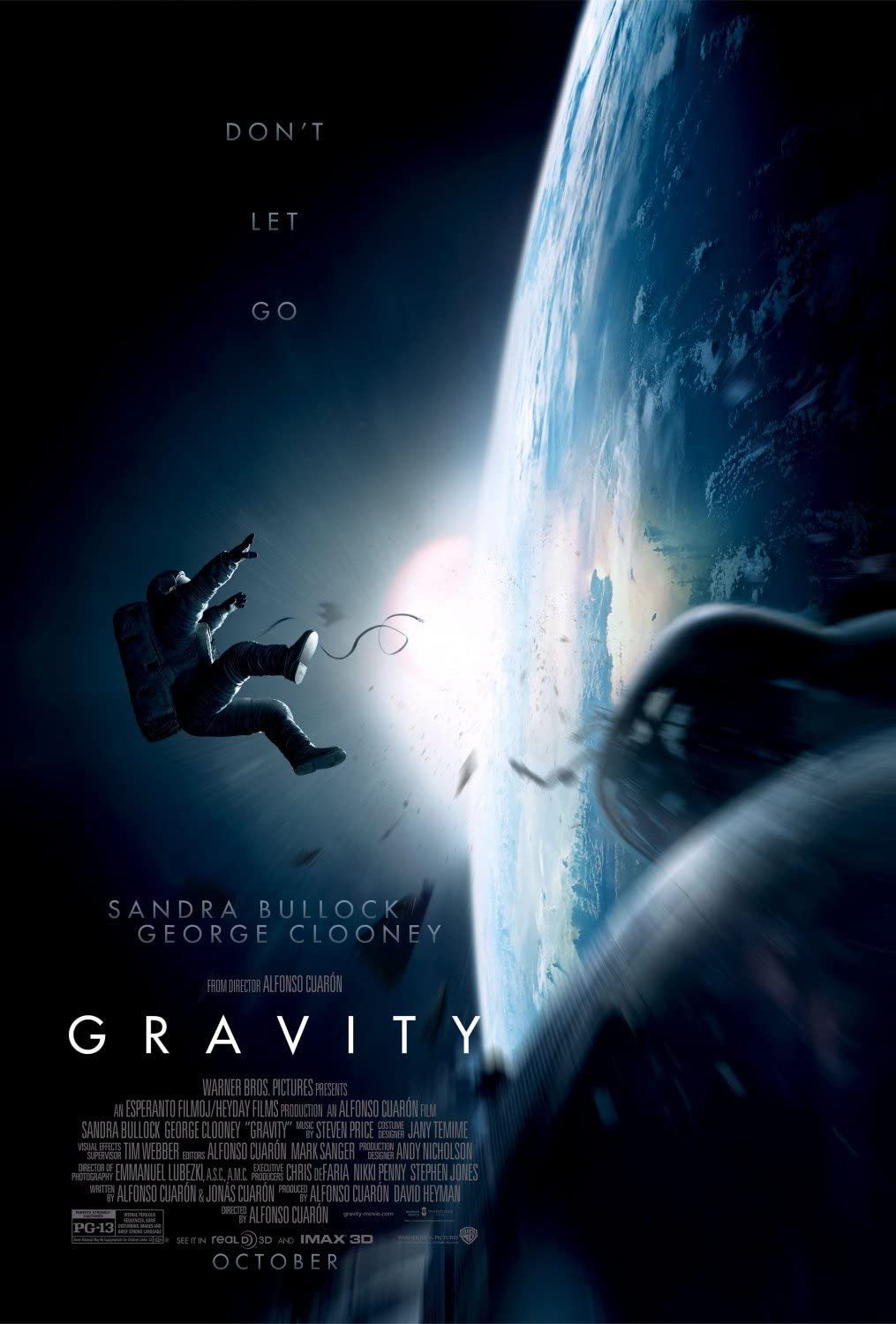
Sandra Bullock is stranded in space in Gravity

Director: Alfonso Cuarón

Cast: Sandra Bullock (Ryan Stone), George Clooney (Matt Kowalski), Ed Harris (Voice of Mission Control)

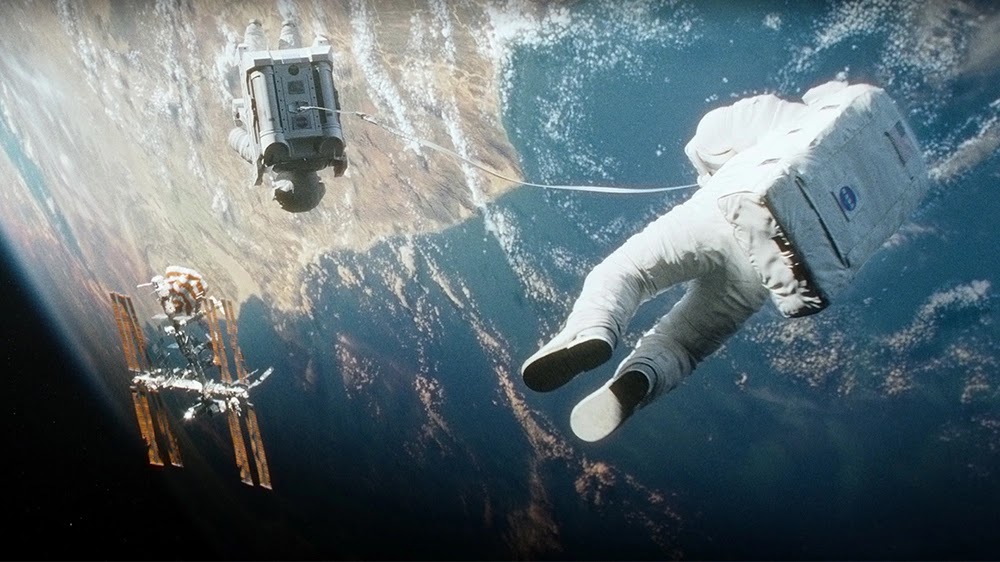
It’s often been said space is mankind’s final frontier. It’s beautiful and awe-inspiring. But it’s also a terrible place, a void where the normal rules that dictate how our bodies operate are completely suspended. We can only breathe what we carry with us and the lack of any atmosphere or gravity means a few metres might as well be a million miles. It’s in many ways the perfect conditions for a survival film – which, at its heart, is what Gravity is.

On a mission in space to repair the Hubble telescope, a collapsed satellite triggers a chain reaction of space debris hurtling in orbit at extreme velocities. Turned into a vast number of deadly bullets flying completing an orbit once every 90 minutes. This shrapnel destroys the mission, leaving specialist Dr Ryan Stone (Sandra Bullock) and mission commander Matt Kowalski (George Clooney) as the only survivors – and left with their only chance of return to Earth being to travel somehow to one of the other space stations in orbit and hitch a ride home on one of their escape pods.

Cuarón’s film is an engrossing and edge-of-the-seat 90 minute thrill ride, combined with a quietly meditative reflection on how our internal pain can make us drift through life. The film is titled Gravity but it’s there to draw attention to what is missing in the film. Not only the obvious – the lack of pull on her body – but also the lack of grounding in Stone herself. In mourning for the loss of a child, Stone has very little ties to earth or indeed anything. She is drifting through her life emotionally, much as she drifts through space itself. When asked why she likes it up in space, she replies “the silence”. She’s a woman untethered from life on earth in more ways than one.

So this is a film that is not just a survival but also a rebirth. We see Stone go through immense, dangerous moments of tension and terror, battling against all the odds to survive and return home. At the same time, the film carries an emotional weight because it’s also about Stone making a conscious decision to survive, to decide to re-engage with and commit to the world – to choose life if you like. Someone suffering from grief and depression as she does at the start of the film, may well have understandably embraced despair. Instead, the film is her coming to terms with the loss of her daughter, and a resolve to live her life for her.

All of this happens of course in the vast majesty of space, a vision beautifully captured by Cuarón. Filmed in an immersive style, with several long takes that don’t draw attention to themselves – a shot length that serves the purpose of the story not vice versa – and Cuarón is happy to use quicker cuts where needed. The camera follows the journey of Stone in epic and intimate detail, with shots exchanged between vast panamas of the astronauts as dots in space, to extreme close ups that bore into Stone’s eyes and capture her emotions from guilt, to hope, to terror. 

The long opening shot, that ducks and weaves around the weighless astronauts in space as they repair the Hubble telescope is of course a technical marvel, but it also brilliantly established the situation and the joy and fear of being an astronaut, of being allowing in the darkness and emptiness of space. It sets the scene perfectly from later shots that throw you into the adrenalin burning terror of spinning wildly in space with no resistance to slow you down or dodging debris moving at thousands of kilometres per second through space.

In fact the film is almost unbelievably tense – probably the most tense space film since Apollo 13 and in that we actually knew they were coming home alive (in a nice nod to that film, Ed Harris ‘reprises’ his role as mission controller in a voice-only cameo). With its brilliant immersive style, and the emotional bond it swiftly builds with the viewer, it means you will find you hardly draw breath along with the heroes. I’ve seen the film three times and each time after the first viewing I was sure it wouldn’t have the impact the first viewing had. But goddamn it, it works every time. The film is quick – at little under 90 mins – but you won’t feel it (in fact if anything you might be relieved).

Cuarón won the Oscar for direction, and the film is not just a load of flash and technical marvel (although it has a lot of both). It’s grounded in a very simple emotional story of survival, matched with an internal story (not overplayed) of resolving and dealing with grief. A lot of that works from the effectively unflashy performance from Sandra Bullock, who is very good in a part that requires not just physical but also emotional commitment. She’s well supported by George Clooney, who is perfect as the charming but calm and controlled mission commander who mentors her through the early stages of survival in space.

The film has a series of breathtaking set pieces – collapsing Hubbles, spinning astronauts in space, desperate space walks trying to grab any inch of objects to stop them drifting into space, collapsing space stations, burning up on re-entry – all of them shot with an elegance that marries technical excellence and dazzling camerawork and vision with a powerful story. A bag of tricks but one that is delivered with real heart.

Nixon (1995)

Anthony Hopkins triumphs as Nixon in Oliver Stone’s surprisingly sympathetic biopic

Director: Oliver Stone

Cast: Anthony Hopkins (Richard Nixon), Joan Allen (Pat Nixon), James Woods (HR Haldeman), Powers Boothe (Alexander Haig), Larry Hagman (“Jack Jones”), Ed Harris (E. Howard Hunt), Dan Hedaya (Trini Cardoza), Bob Hoskins (J. Edgar Hoover), Madeline Kahn (Martha Mitchell), EG Marshall (John Mitchell), David Paymer (Ron Ziegler), David Hyde Pierce (John Dean), Paul Sorvino (Henry Kissinger), Mary Steenburgen (Hannah Nixon), JT Walsh (John Ehrlichman), Sam Waterston (Richard Helms), Brian Bedford (Clyde Tolson), Tom Bower (Francis Nixon), Kevin Dunn (Charles Colson), Annabeth Gish (Julie Nuxon), Tom Goldwyn (Harold Nixon), Saul Rubinek (Herbert G Klein)

In 1995, there was one person the chronicler of the 1970s American experience, Oliver Stone, hadn’t covered: Richard M Nixon. The man who was the embodiment of the dark scar on the American consciousness, the grim, unlovable presence behind the war in Vietnam, the protests and the deep, never-ending wound of Watergate, who seemed to drag the country further and further into the abyss. The man who besmirched the office, the least popular president ever, the national shame. With Stone’s searing attacks on everything from Vietnam policy to the conspiracies behind the Kennedy assassination, you’d expect his film on Nixon to be a condemnation. What people didn’t expect was a film as strikingly even-handed as this, which recasts Nixon not as a gloating villain, but a Shakespearean figure, a Greek tragedy of a man destroyed by chronic character flaws.

Opening with a crushed Nixon, like a drunken Gollum cradling his precious, listening to his precious tapes in the bowels of the White House during his final days in office, the film is told in a fascinatingly non-linear style – loosely falling into two acts, cutting backwards and forwards in time. The first act covers most of Nixon’s career up to the presidency, focusing on his Quaker childhood and the influence of his mother Hannah (Mary Steenburgen), his defeat in the 1960 election to Kennedy and his years rebuilding his political standing. The second half takes a more linear approach, covering a Presidency becoming increasingly bogged down in the inept cover-up of Watergate and increasingly desperate attempts to save his presidency, intermixed with foreign policy successes.

What is really striking is that Stone’s movie finds a great deal of sympathy for this troubled and complex man. He’s a man who has greatness in his grasp, dedicated, intelligent and with vision – but fatally undermined by self-loathing, self-pity and a bubbling resentment about not having the love of the people. Like Lear raging against the storm, or Macbeth bemoaning the impact of his vile deeds, Stone’s Nixon becomes a sympathetic figure, even while the film makes no apologies for his actions, his aggressive bombing of Cambodia (the film notes at its end the bombing led directly to the massacres of the Khmer Rouge) or his failures to claim any responsibility for how he caused his own end.

Stone’s empathetic vision of Nixon is shaped largely by Anthony Hopkins’ titanic performance in the lead role. Hopkins makes no real effort – beyond teeth and hair – to look like Nixon, but brilliantly embodies Nixon’s awkward physicality and, above all, his angry, bitter, resentful personality. It’s not an imitation, but it totally captures him. Hopkins has got it, and the disintegration of Nixon over the course of the film into the shambling, miserable, twitching, even slightly unhinged mess he became in the final days of his presidency is astounding. 

It works because Hopkins never loses sense of the potential for greatness in Nixon – sure he’s socially awkward (Hopkins superbly captures Nixon’s awkward grin, his stumbling nervousness in conversation), but politically he’s assured, confident and has huge insight into realpolitik. His flaw is that he wants to be both the master politician and the people’s champ, to be Nixon and JFK, to have the people cheer him to the rafters. It’s a longing that turns to resentment, fuelling insecurity and fear, that causing him to be so afraid of being cheated that he cheats first and bigger.

It’s that potential for greatness that swims through Stone’s masterfully made, electric film. Stone’s love for mixing film stock, fake newsreel footage, snazzy camerawork, switching colour stock, stylistically eclectic sound and music choices and bombastic lecturing comes to the fore here – and I accept it won’t be for everyone. But for me it works. It’s a big, dramatic movie because it covers an epic theme. From its early echoes of Citizen Kane – the White House as Xanadu, those missing 18 ½ minutes of the tape Nixon’s “Rosebud” – through to the accelerated pace and film stock as events spiral out of the President’s control, it’s an explosion of style that really works, even if there are points which are too on-the-nose (a scene where Nixon’s dinner talk of war is interrupted by a steak that leaks gallons of blood as he cuts into it, is clumsy in the extreme).

Stone’s theories revolve around the true villain being the government-financial power system itself, a grindingly oppressive beast chews up and spits out the men who think they can ride it. Nixon may know about the danger of the system, but he’s as powerless as anyone else. Its tendrils extend everywhere, from the creepily domineering CIA chief Helms (Sam Waterston, unsettlingly intimidating in scenes restored in the director’s cut) to the shady Texan money interests (led by an excellent Larry Hagman of all people) who sure-as-shit want to get rid of that liberal, Cuban surrender monkey Kennedy, by any means necessary (“Say Kennedy dont run in 64?”). 

Nixon wants to control it, to do some good – and the film is excellent at stressing how Nixon’s poverty-filled Quaker background gave him a drive to achieve but also a chippy insecurity and moral standards from his imperious mother he can never hope to meet – but what hope does he have? In any case, his own deep moral failings doom any chance of forging his own goals, sucking him into a quagmire where long-running dirty deeds, shady deals and unedifying company consume him. “When they look at you they see what want to be. When they look at me they see what they are” Nixon complains to the painting of Kennedy, the rival whom he can never eclipse, the man born with all the advantages Nixon never had, the millionaire embraced by the people while the working-class Nixon is reviled. It’s these resentments that consume and destroy Nixon, and Stone presents this as an epic tragedy of a great politician, crushed by his fundamentally human flaws.

Around Hopkins, Stone assembles a brilliant cast. Joan Allen is superb as Nixon’s loving but insightful wife who won’t shy to speak truth to power. James Woods is perfect as the bullishly aggressive, fiercely loyal Haldeman. Paul Sorvino does a wonderfully arch impersonation of Kissinger, always keeping his distance. David Hyde Pierce makes a smoothly innocent but determinedly self-preserving John Dean, Powers Boothe a wonderful cold Alexander Haig. Only Bob Hoskins gives a performance slightly too broad as Hoover – but he still laces the role with a crackling menace.

Nixon is a great film, an explosion of style (perhaps at times a little too much), which painstakingly strips bare the President’s psyche – his doubt, guilt, bitterness, resentments and finally overwhelming self-pity. Powered by a titanically well-observed performance by Anthony Hopkins, who is just about perfect in every frame – every nuance feels real – Nixon is a wallow in the dark underbelly of America, which hints throughout at the even greater dangers that lie under the surface, the powerful system maintaining the status quo that sees presidents come and go, but never allows any real change. It’s a remarkable film.

Enemy at the Gates (2001)


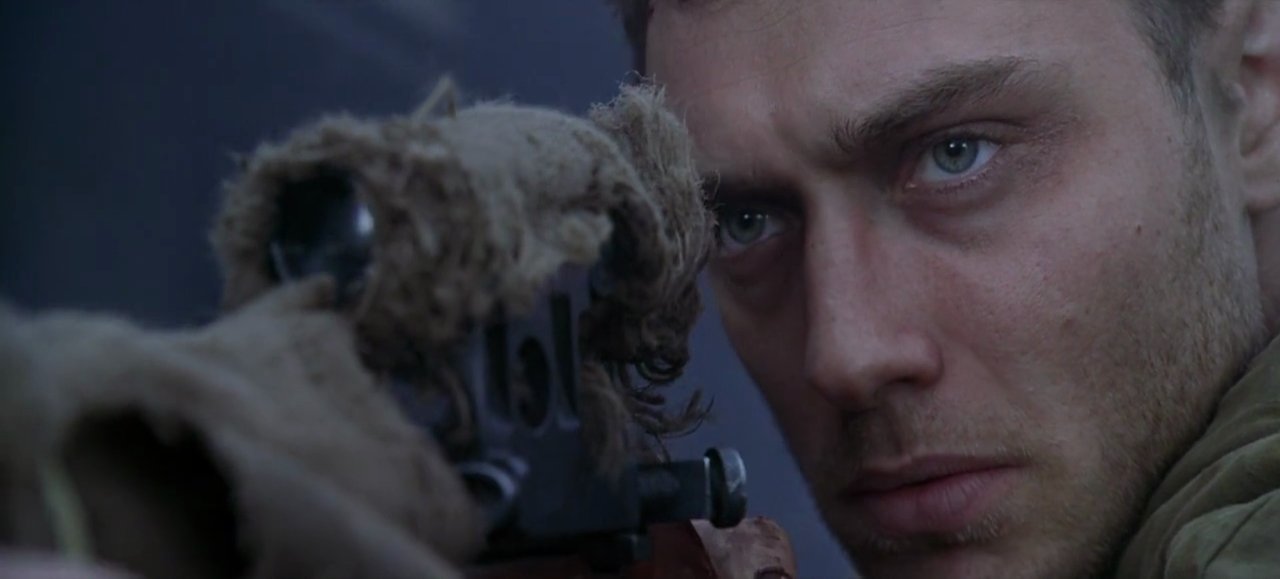
Jude Law takes aim in wonky Stalingrad drama Enemy at the Gates

Director: Jean-Jacques Annaud

Cast: Jude Law (Vasily Zaytsev), Joseph Fiennes (Commisar Danilov), Rachel Weisz (Tania Chernova), Bob Hoskins (Nikita Khrushchev), Ed Harris (Major Erwin König), Ron Perlman (Koulikov), Eva Mattes (Mother Filipovva), Gabriel Marshall-Thomson (Sasha Filippov), Matthias Habich (General Friedrich Paulus)

The Second World War in film almost always focuses on the heroics of the Western Front, where the rights and wrongs are usually pretty clear (the Western powers are noble, the Nazis savage). So it’s different to set a film on the Eastern front – where the Second World War was arguably really won and lost, and where morality is much more complex. The Nazis are terrible, but Stalin’s Russia was no picnic either.

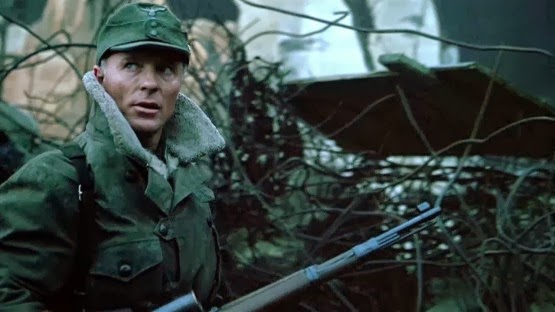
Stalingrad in 1942: Soviet tactics involve giving every other man a gun, and ordering the second man to follow his partner and take his gun when he is killed. Witnessing the sharpshooting skills of young soldier Vasily Zaytsev (Jude Law), political Commissar Danilov (Joseph Fiennes) decides to turn him into the romantic hero the Soviets need to help inspire them. He’s so successful in doing so that the Germans send their own expert sniper, Major König (Ed Harris), to find and kill Zaytsev. Meanwhile, the friendship between Danilov and Zaytsev becomes complicated when they both fall in love for the same woman, sharpshooter and German translator Tania Chernova (Rachel Weisz).

It’s quite something for a film to be denounced by both sides of the war it’s depicting: this probably means it’s doing something right, as it doesn’t deny the hellish atrocities carried out on both sides (even if many of these are implied). The real reason to be outraged is probably more to do with its general flatness and shoving of the great battle into the standard war-movie clichés. There are some attempts to suggest what we are seeing is a true story, but other than a man called Zaytsev existing, there is very little of truth on show. Instead we get a Hollywood view of Soviet Russia: where the characters we like are regular joes, while the ones we don’t are full-on Commie zealots.

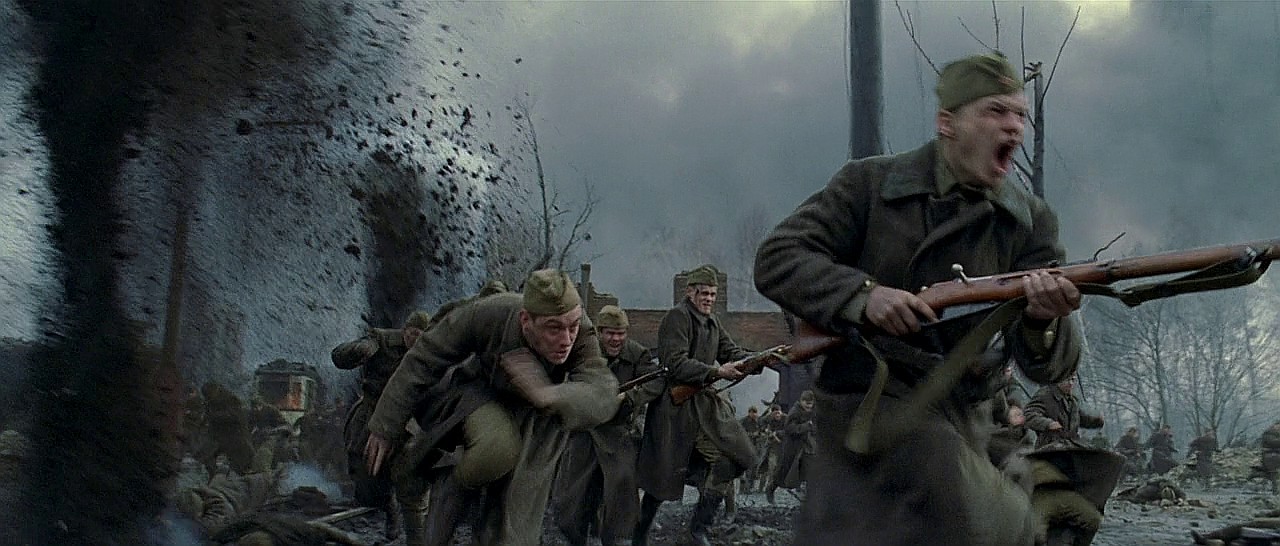
The film starts well, with an extended sequence that follows Zaytsev and several other soldiers boarding boats, crossing the river, arriving in Stalingrad and being marched immediately into the front line. Half the men are killed – the fleeing remainder are swiftly machine gunned by their officers for cowardice. It brings back memories of Saving Private Ryan and, while not as good, gives the impression we are going to see a “horrors of war” film – which the film doesn’t turn into.

Instead we get an increasingly melodramatic plotline around love triangles and sniper duels that never really feels like Russian lives at the time. In fact, the film fails to capture any real sense of Soviet Russia, other than its dirt and ruthlessness. Danilov and Zaytsev celebrate their newfound fame with a sort of giddy laddishness that just doesn’t fit any Russian’s understanding of what being noticed in Soviet Russia would surely mean. When the film does try to sound Soviet it stumbles: there is a painful (unintentionally) funny moment when Zaytsev talks about his dream job to be working in a factory, because factory work seems so noble.

The love triangle also seems ripped from Mills and Boon. Not a lot of it rings true, with Danilov turning into some sort of jealous head-boy. The romance blossoming between Zaytsev and Tania can’t decide whether it’s two souls coming together, or whether it has the air of a “last romance” with death around the corner. So it’s either overblown and overplayed, or not given enough room to build. It doesn’t help that there are a number of strange choices – not least a sex scene where Rachel Weisz seems more uncomfortable and in pain than in the throes of passion.

Maybe it’s that none of the performances of the lead actors feels either particularly Russian or soldierly. Jude Law fails to convince as a man from peasant hardship. He’s also saddled himself with a wooden “peasant” accent that not only makes Zaytsev sound like a mockney chancer, but also sound like a worse actor than he is. Joseph Fiennes is more school prefect than Soviet Commissar. Rachel Weisz is the most natural of the three, but her character makes little real sense: sometimes she’s gung-ho, others she talks about wanting this war to end. None of these actors really brings the right charisma needed – in particular Law looks as overwhelmed by the events around him as Zaytsev claims to feel.

The film belongs to the sniper sequences, and the duel of wits that develops between Zaytsev and König. Ed Harris’ part is as limply written as the rest, but Harris has a movie star charisma the others lack, and suggests a great deal of reserved arrogance and professional coldness. He’s the best thing about the movie. Annaud shoots the slow-burn waiting of sniping with a tension – and the film rather bravely stresses König’s superiority time and time again. As the film zeroes in on these two men trying to outmatch each other, it feels like it’s about something – and also that it’s relieved to leave the war at large behind.

Because for a film set in the Eastern Front, this feels unnerved by there being right and wrong on both sides. It even feels squeamish about sniper shooting. After his initial display of skill, we literally don’t see any sniper work from Zaytsev again – the “cowardly” killing from a distance of regular German soldiers is handed out to other characters. Russians are sorted into good and bad, with the good showing they are “just like us” by quietly denouncing their government. König can’t just be a professional, but the film has to try and nudge him into being a cold-hearted killer. It’s a film about the complex morality of war, that wants to make it as simple as possible.

It’s still well-made, but you wish that more time had been directed towards the script, to give us a story that was slightly better and characters that felt a bit more real. James Horner supplies a decent score (interestingly it also shows how much of film music is re-used, as key refrains in this film are strongly reminiscent of Willowand Troy). But the lead actors are all miscast (Bob Hoskins isn’t much more convincing as a bulldog Khrushchev) and it feels like a film that’s running away from a complex series of issues to try and present something as close as possible to goodies vs. baddies. The War on the Eastern Front was a hugely complex thing: this film hardly scratches the surface.

The Hours (2002)

Nicole Kidman’s Oscar winning role produced a gallery of nose based puns, everyone convinced they could sniff out comedy gold

Director: Stephen Daldry
Cast: Nicole Kidman (Virginia Woolf), Julianne Moore (Laura Brown), Meryl Streep (Clarrisa Vaughan), Stephen Dillane (Leonard Woolf), Ed Harris (Richie Brown), Allison Janney (Sally Lester), Claire Danes (Julia Vaughan), Jeff Daniels (Louis Waters), John C Reilly (Dan Brown), Toni Collette (Kitty), Miranda Richardson (Vanessa Bell)

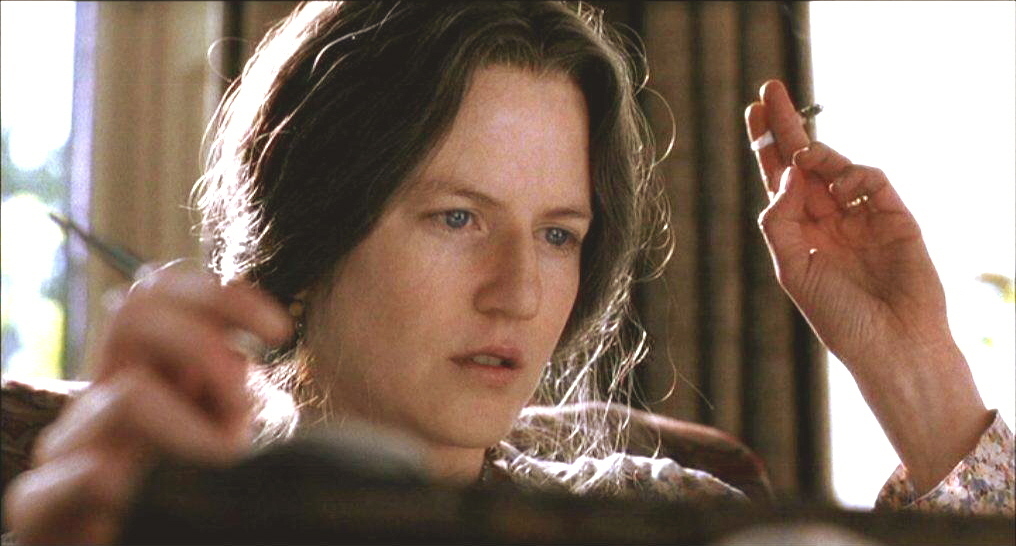
I remember when this film was released that it was garlanded with much praise as an intelligent and compassionate piece of filmmaking and a literate masterpiece. Well I’ve never seen it before and I have to say it holds up pretty well, even though it’s much more of a solid, impressive piece of professional film making than anything you might call a masterpiece.

The film covers three time periods each looking at one day in the life of three different women.  Inspired by Virginia Woolf’s novel Mrs. Dalloway, the day we see encapsulates in microcosm the life of each women. So we have Nicole Kidman as Virginia Woolf struggling to deal with depression while working on Mrs.Dalloway; Julianne Moore as a depressed 1950s housewife trapped in a suburban marriage; finally Meryl Streep as an editor in the 200s who has dedicated her life to looking after a poet friend who is dying of AIDS.

Each of these three plot lines are carefully intercut with both sharp scriptwriting and patient direction (Hare and Daldry’s stage experience here is a real boon for a concept that is actually quite theatrical). Although the opening sequence of the film suggests we might be in for a dizzying series of intercuts (the time period in this sequence switches almost every shot) it soon settles down into some well structured conversation scenes, moving almost in a cycle from our plot lines to another and only rarely directly cutting mid scene from time line to time line.

Of the plot lines I found Meryl Streep’s more modern day plot the most engaging and that Streep’s performance as the patient martyr carried the heart of the film. This was despite Ed Harris’ overblown performance as the dying poet, one of those two scene cameos that draw far more praise than they deserve. But this story has a tragic simplicity and Streep brings a lifetime of vicarious hopes and dreams out from every beat of the day.

Nicole Kidman however won the notice and awards as Woolf. Well deserved as these notices were, this is a more traditional part with clearer “award worthy” acting moments. While these are excellently done (Stephen Dillane is terrific as Leonard Woolf), the Woolf parts don’t quite link with the two other plot lines and, for me, didn’t carry the same emotional force that the tragedy of normal lifes did in the later plot lines.

Julianne Moore also does great work as a depressed housewife who lacks the emotional articulacy to fully understand her feelings, though the decision to introduce a direct link between the 1950s and 1990s plot lines later in the film does mean that the Woolf plot line feels even more like a slightly disconnected story. But this section of the film crackles with claustrophobia and Moore demonstrates the confused sexuality below the surface of Americana.I feel like I’ve been hard on this film, which is a very professional piece of work with some great performances and some real emotional high points. There are some great cameos from classy actors like Toni Collette, Jeff Daniels, Miranda Richardson, John C Reilly, Claire Danes and Allison Janney. It also is a very sensitive exploration of the pressure sexuality and emotions can press on people – even in the 1990s where homosexuality isn’t a dirty secret, Streep’s character still has more than enough confused emotional hang ups to sort out.

It’s a very good film but it’s so professionally done and smoothly assembled, the acting so sharp and on the money, that I’m not sure if there is as much heart behind the scenes in its making than appears on screen.