
Tag: Edward Arnold

All That Money Can Buy (1941)

All That Money Can Buy (1941)

The Devil sure knows how to tempt a man in this beautifully filmed morality tale

Director: William Dieterle

Cast: Walter Huston (Mr Scratch), Edward Arnold (Daniel Webster), James Craig (Jabez Stone), Anne Shirley (Mary Stone), Jane Darwell (Ma Stone), Simone Simon (Belle), Gene Lockhart (Squire Slossum), John Qualen (Miser Stevens), HB Warner (Judge Hawthorne)

Sometimes life can be a real struggle. With debts, failed crops and animals getting sick, what’s a guy to do? That’s the problem New Hampshire farmer Jabez Stone (James Craig) has in 1840. What he wouldn’t give to find a bundle of buried gold that could solve all his problems. Fortunately, charming old rogue Mr Scratch (Walter Huston) knows exactly where to find one – all he wants in return is for Jabez to sign away his soul seven years from now (signed in blood of course). Jabez gets fortune, prestige, the son he always wanted – but when ‘Mr Scratch’ comes to collect, can Jabez’s friend, famed orator, lawyer and congressmen Daniel Webster (Edward Arnold) save his soul?

All That Money Can Buy is a richly atmospheric piece of film-making from William Dieterle, adapted from Stephen Vincent Benet’s short story and full of gorgeously filmed light-and-shadow with a haunting score by Bernard Herrmann. (The story was originally titled The Devil and Daniel Webster, also the film’s original title before RKO changed it to avoid confusion with their more successful Jean Arthur comedy The Devil and Miss Jones.) It’s a neat morality tale, full of dark delight at the devilish ingenuity of Mr Scratch, with lots of dark enjoyment at seeing a weak-but-decent man corrupted into being exactly the type of greedy, cheating cad to whom he was deeply in debt to from the beginning.

It’s nominally about James Craig’s Jabez Stone, but Jabez is a shallow, easily manipulated passenger in his own life, pushed and pulled towards and away from sin depending on who he’s talking to. Stone’s fall is swift: moments after meeting Scratch, he’s digging hungrily into a meal while his wife and mother say grace, hugging his newfound bag of gold. As his wealth goes, he drifts from his pure wife (Anne Shirley, effective in a dull part) becoming easy prey for demonic (literally) temptress Belle (a wonderfully seductive Simone Simon). By the time the seven years are up, he’s skipping church for illicit card games and crushing the farms of his neighbours to fund his dreamhouse-on-a-hill.
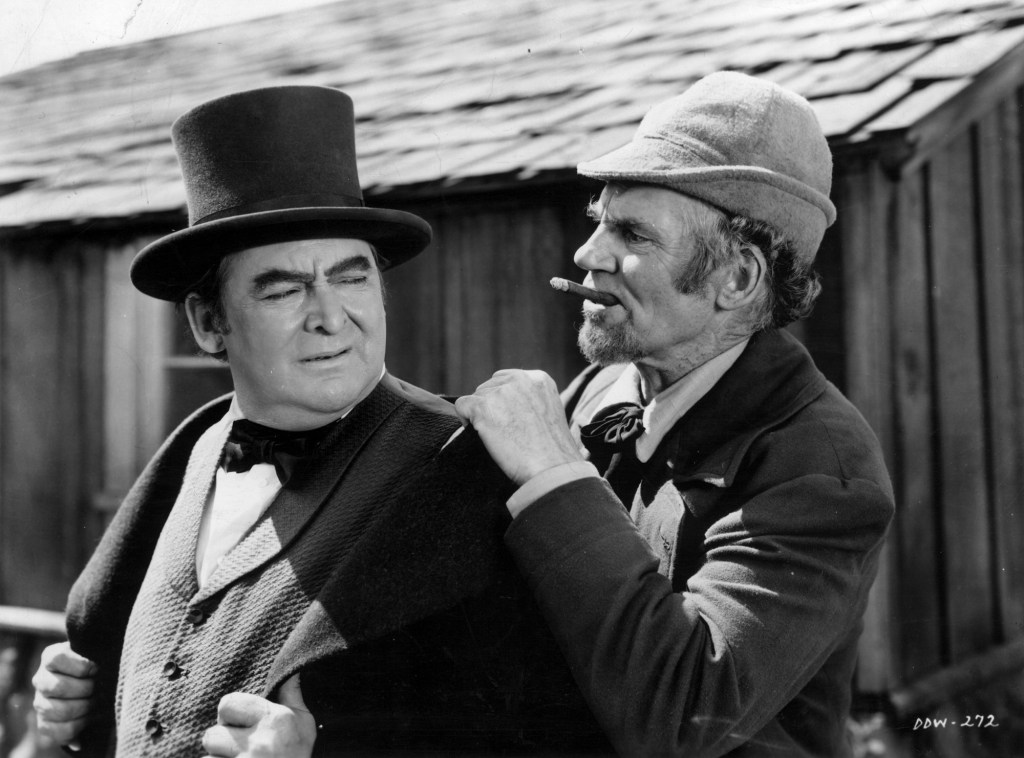
Stone is really the Macguffin here. The real focus is the big-name rivals: The Devil and Daniel Webster. It’s implied these two have fought a long-running battle for years: our introduction to Webster sees him scribbling literally in the shadow of Mr Scratch, who whispers to him tempting offers of high office. Later Webster is unflustered when Scratch suddenly appears to place a coat on his shoulders, treating him as familiar rival. You could argue Scratch is only prowling the streets of New Hampshire because he’s looking for a way to nail the soul of his real target, Daniel Webster.

As Mr Scratch, the film has a delightful (Oscar-nominated) performance from Walter Huston. With his scruffy clothes and twirling his cane, Scratch pops up everywhere with Huston’s devilish smile. It’s a masterclass in insinuating, playful malevolence, with Huston playing this larger-than-life character in a surprisingly low-key way that nevertheless sees him overflowing with delight at his own wickedness. Huston has the trick of making Scratch sound like someone trying to sound sincere, while never leaving us in doubt that everything he says is a trap or lie, only showing his arrogance and cruelty when victory is in his grasp. It’s a fabulous performance, charismatic and wicked.

Edward Arnold makes Daniel Webster both a grand man of principle and a consummate politician, proud of his reputation and all the more open to temptation for it. He also has the absolute assurance of a man used to getting his own way, and the arrogance of seeing himself as an equal to the Devil rather than a target. These two form the ends of a push-me-pull-me rivalry.

The rivalry culminates in its famous ‘courtroom’ scene, as Webster – a little the worse for drink –argues for Jabez’s soul in front of a ghostly court of American sinners from the bowels of hell (lead among them Benedict Arnold). Its shot in atmospheric smoke, with the double exposure creating a ghostly effect for jury and judge. It’s another excellent touch in a film full of inventive use of effects and camerawork, Dieterle at the height of his German influences. The artificial New Hampshire scenery is shot with a sun-kissed beauty that bears Murnau’s mark. Striking lighting and smoke-play abounds in Joseph H August’s camerawork, not least Belle’s introduction backlit with an extraordinarily bright fire. Early scenes of Stone’s misfortune interrupted by a brief frames of a photo-negative Scratch laughing, quite the chillingly surrealist effect.

Politically, All That Money Can Buy backs away from any overt criticism of Webster’s support for the Missouri Compromise (this key piece of slavery protection legislation is so key to Webster’s view of American strength he’s even named a horse after it). But it’s quite brave for 1941 in allowing the Devil legitimate criticism of America’s ‘original sins’ saying he was there driving on the seizing of the land from the Native Americans and up on deck on the first slave ship from the Congo. (Especially as Webster can’t defend these actions). It’s also interesting that the film praises collectivism for the farmers over rugged individualism, a conclusion it’s hard to imagine being praised a few years later.

All That Money Can Buy is also filled with impressive practical effects, not least Scatch’s impossible catching of an axe thrown towards him, bursting it into frame. Both Scratch and Bell reduce papers to flaming ashes with a flick of the wrist. Horribly woozy soft-focus camera work accompanies Jabez’s nightmare visions of the damned. It’s tightly and skilfully edited, superbly paced, with montages used effectively for transitions (a field of corn growing is particularly striking) and wildly unnerving sequences, like Scratch’s fast-paced barn-dance with its whirligig of movement and repeated shots. It’s all brilliantly scored by Herrmann, from the pastoral beats of New Hampshire to the discordant sounds (some created from telephone wires) that accompany Scratch.

All That Money Can Buy concludes with a stand-out speech from Webster that perhaps settles matters a little too easily – and brushes away any of the film’s mild criticism of America’s past with a relentlessly upbeat patriotic message. But the journey there – and the performances from a superb Huston and excellent Arnold – is masterfully assembled by a crack production team working under a director at the height of his powers. A flop at the time, few films deserve rediscovery more.
Mr Smith Goes to Washington (1939)

James Stewart campaigns for truth and justice in Capra’s classic Mr Smith Goes to Washington

Director: Frank Capra

Cast: James Stewart (Jefferson Smith), Jean Arthur (Clarissa Saunders), Claude Rains (Senator Joseph Harrison Paine), Edward Arnold (Jim Taylor), Guy Kibbee (Governor Hubert “Happy” Hopper”), Thomas Mitchell (“Diz” Moore), Eugene Pallette (Chick McGinn), Beulah Bondi (Ma Smith), H.B. Warner (Senate Majority Leader), Harry Carey (President of the Senate), Astrid Allwyn (Susan Paine)

Capra’s film are known, above everything, for their fundamental optimism about life, friendship and the American Way. Few films cemented that opinion more than Mr Smith Goes to Washington, the quintessential “one man in the right place can make a difference” movie. And where else would that one man need to be, but Washington? Where laws are framed and ideals come to die. It’s our hope that those at the heart of the political system are there for the good of the people. Of course, even Capra knew most of them were there to line their pockets and do their best for powerful business interests. So who can blame Capra for a little fantasy where naïve, innocent but morally decent Jefferson Smith decides enough is enough?

In an unnamed mid-Western State (the story the film is based on named it as Montana), the junior senator unexpectantly dies. The Governor (Guy Kibbee) needs a new man. Should he go for a reformer or the latest stooge put forward by political power broker in the State Jim Taylor (Edward Arnold). A tricky choice, so he splits the difference by appointing Boy Rangers leader Jefferson Smith (James Stewart) – because he’s wholesome and clean but also naïve enough to manipulate. Jeff heads to Washington, under the wing of Senator Joseph Paine (Claude Rains) – but Paine is in the pocket of Taylor.

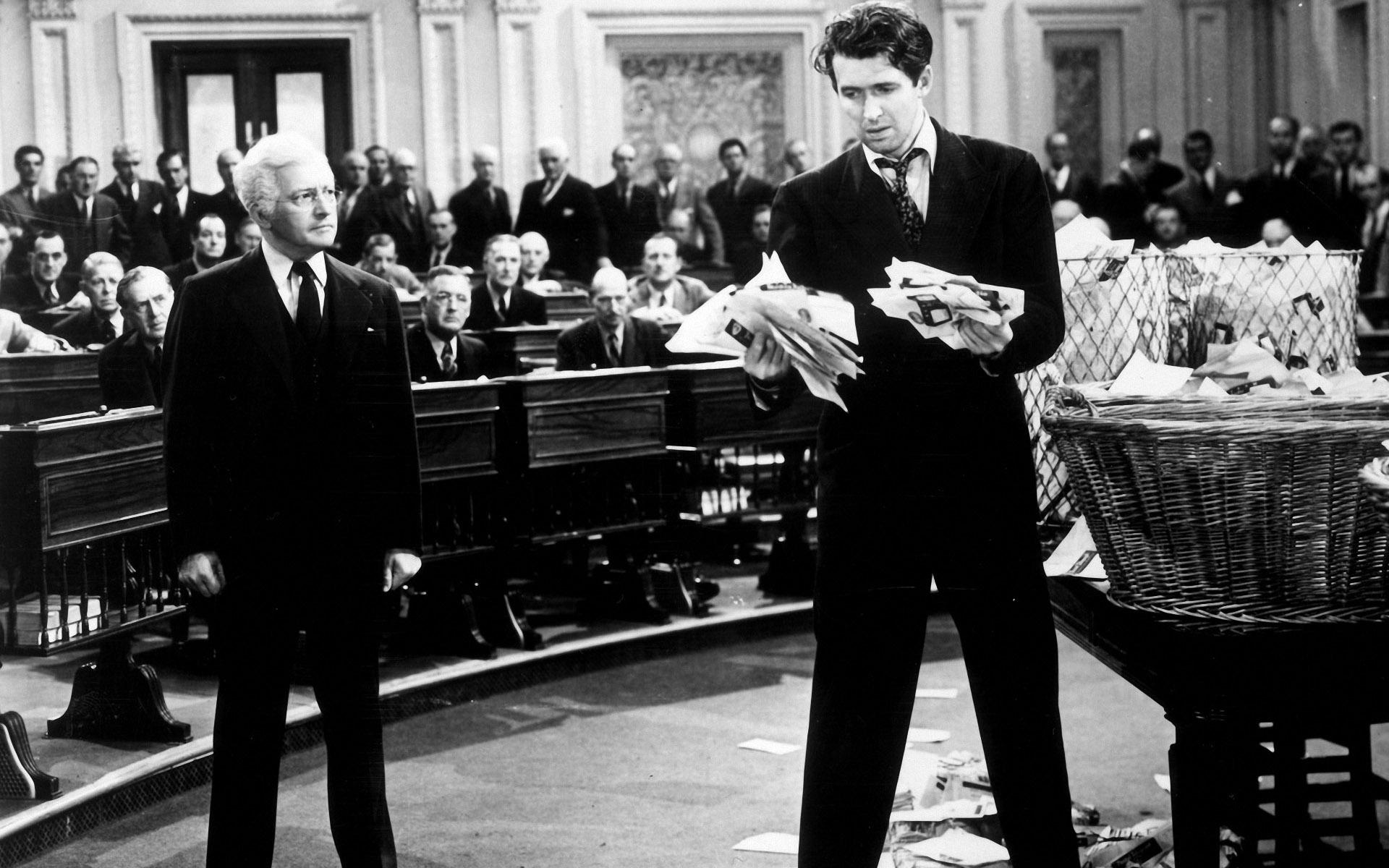
Taylor and his cronies want an appropriation bill forced through that includes a clause to build a dam in their state. The dam will be built on land secretly bought up by Taylor and others, making them a fortune from public money. When Jeff announces in the Senate a bill to host a national boy’s summer camp on that same land, it throws a spanner in the works. Despite threats and bribes, Jeff refuses to go along with the shady deal over the dam, so they set out to destroy his reputation. With the help of his secretary Clarissa Saunders (Jean Arthur), Jeff mounts an epic filibuster in the Senate to clear his name, stop the dam and reveal the political corruption in his state.

Capra’s film is earnest, well-meaning and at times even a little bit sanctimonious and preachy – but it gets away with it because it’s also so energetic, honest and fun. It’s strange watching it today to think that the Senate at the time responded so poorly to it. Leading public figures either denounced it’s view of government and even tried to have it banned. Ironically of course, it probably inspired more people to get involved in Government than any other movie.

That was bad news for the corrupt political machines that ran so many parts of America at the time. Capra’s film is remarkably open-eyed about how these machines worked. Powerful business interests at the centre, with a raft of politicians in their pay – from Governors and senators on down. Jim Taylor – very well played with a swaggering, crude, bullying tone by Edward Arnold – only has to snap his fingers to get things done. During the film he mobilises the press, the police, the fire service and an army of heavies to enforce his will in the state and suppress free speech. The Governor (a neatly tremulous Guy Kibbee) is so firmly in his pocket, he can barely tie his shoe-laces without Taylor directing it. Senator Paine is patrician, dignified and has every inch of respectability – but he is soaking in filth up his neck from contact with Taylor.

It’s this system the film has a quiet anger about. Whatever happened to having “a little bit of plain, ordinary kindness – and a little lookin’ out for the other fella too”? Capra’s sprightly film also makes clear that we both don’t look too closely at how our government is really run and are very quick to hoover up any story we get from our political masters and accept it as gospel. An honest, decent man in the middle of all this is as unlikely a sight as you can imagine.

But that’s what these people get with Jefferson Smith – and discover someone who should be easy to manipulate, but doesn’t understand the rules of the game he’s playing. Instead Jeff thinks they are all there to help other people, not to themselves. Now you can argue, as some critics have, that law-making is the art of compromise – and that once the dam is under way, the benefits it will produce to Jeff’s home State (in terms of employment and energy) will be huge. So why shouldn’t Jeff bow down and move his boys camp in order to let the Bill go through?

Well the point is that Jeff isn’t opposed to the dam – he’s opposed to the corrupt profiteering that will spring out of it, and the way the cesspool of Washington (amongst all those fine monuments he so adoringly looks at) doesn’t care. This is a filibuster campaign to put honesty and decency back into American politics – and what’s not to like about that? It’s a film that firmly believes that one good man in the right place (that’s both Jeff and the President of the Senate, who tacitly encourages him) can change the day and save the country from itself.

There was of course no one better for such a job than Jimmy Stewart (and surely it’s this film that made him “Jimmy” to one and all). Capra had James Stewart in mind from the start – and it’s a perfect role for him, an iconic performance that stands as surely one of his greatest roles. Stewart has the skill to make Jeff endearing but not saccharine, naïve but not frustrating, innocent but not a rube, gentle but determined. Despite its corniness (and some of the film is very corny) you relate to his reverence for Lincoln’s memorial and the Capital. Stewart’s homespun charm is perfect, but it’s matched with the steel he could give characters. There is an adamant quality to his filibuster, his refusal to back down and go along with injustice. The final quarter of the film that deals with the filibuster is quite superb stuff, Stewart delivering some very-well written speeches with commitment, passion and bravura. It’s no understatement to say the film would work half as well as it does without him.

But then the entire film is also a feast of great acting, all sparked by a superb script from Sidney Buchman which mixes razor-sharp dialogue with wonderful speeches. Jean Arthur (who actually gets top billing) is very good as a cynical Washington insider who rediscovers her ideals – and finds her heart melting – under Jeff’s honest influence. Claude Rains gives one of his finest performances as the patrician Paine, a man who tries to close his eyes to his own corruption, but swallows down his own guilt and shame every day. Harry Carey gets a twinkly cameo as an amused and supportive President of the Senate. (Both actors were nominated for the Oscar, but lost to Thomas Mitchell for Stagecoach who also appears here in a fun turn as the drunken but principled reporter Diz).

Capra keeps the pace up perfectly, and his direction handles both smaller scale scenes of romance and idealism, with the larger scale fireworks of the Senate (a superb set, that looks so convincing it’s amazing to think it was built on a sound stage). His biggest trick here is to create a film that, in many ways, is a political lecture, but never makes it feel like one. Instead it delivers it’s messages on truth, justice and the American way with such lightness – but yet such pure decency – that it all works. It helps a great deal that the film doesn’t shy away from the corruption and – apart from a final turn that saves the day – resists melodrama and contrivance. Charming, funny but also thoughtful and committed, Mr Smith Goes to Washington is one of Capra’s very best.