
Tag: Edward Binns

Fail Safe (1964)

Henry Fonda desperately tries to avert nuclear war in Fail Safe

Director: Sidney Lumet

Cast: Henry Fonda (The President), Dan O’Herlihy (Brigadier General Warren Black), Walter Matthau (Professor Groeteschele), Frank Overton (General Bogan), Fritz Weaver (Colonel Cascio), Edward Binns (Colonel Jack Grady), Larry Hagman (Buck), William Hansen (Defence Secretary Swenson)

In 1964 the classic film on nuclear conflict was released and became a landmark in Hollywood history. Also released was Fail Safe. Dr Strangelove has dragged Fail Safe through history like a sort of phantom limb. It’s reputation – if you’ve heard about it at all – is “Dr Strangelove but with no jokes”. That’s hugely harsh on a well-made, tense and fascinating film that sees nuclear war as less the blackly comedic theatre of MAD (Mutually Assured Destruction, the buzzword of the day), and more as a dark human tragedy where mistakes, suspicions and paranoia lead to disaster.

During a routine manoeuvre, a mechanical power surge at USAAF leads to a mistaken but correctly authenticated order being sent to a wing of bombers to drop their nukes on Moscow. Due to Russian jamming, USAAF has no idea this has happened until after the five minute recall window. After the five-minute window has passed, the pilots follow their training and ignore all subsequent orders no matter who gives them – even if it’s directly from the President (Henry Fonda) himself. Desperately the President works with the Soviet Union to stop the bombers (and prevent the inevitable full scale nuclear war they would provoke). Problem is national pride, mutual suspicion, subordinates who can’t stomach co-operation between enemies and those that an accidental first strike is the perfect way to start a nuclear war one side could win, keep getting in the way.

While Dr Strangelove saw the insanity of MAD – the willingness of the leaders of both sides to promote a type of war that could only lead to the destruction of all life on earth – as so darkly absurd it could only be a subject for jet-dark-satire, Fail Safe takes a more humane if equally chilling route. Shot mostly with a low-key documentary realism by Sidney Lumet, the action is restricted to no more than four main locations. Once the crisis starts we never go outside. We never even see the Russians, represented only by photos and their words given life by Presidential translator Larry Hagman. Bar from the odd piece of stock footage, we are in the bunkers with the characters. And we feel as powerless as they do, as events spin out of control.

The film could be seen as an attack on the replacement of humans from the system by machines. Sure, the strike is triggered by a faulty piece of equipment. But everything after that is the result of good old-fashioned human error. The US debate about shooting down the bombers that goes on for so long, the bombers get out of range. The Russian refusal to accept US help to shoot the bombers down, leading them to taking pot shots at radar ghosts. The attempted coups on both sides in the command room, as junior officers refuse to co-operate with the enemy. The mistrust between both sides that leads the Russians chasing a decoy attack run rather the real bombing plane, despite the pleading of the American General that it’s a decoy.

And above all, the crushing arrogant insanity of introducing a system like this in the first place. A system so regimented and drilled into its soldiers – removing any chance of independent logical thought – that the pilot of the bombers will even ignore his own wife pleading down the line that the first strike he believes he is retaliating against hasn’t even happened. A system where leading American advisors suggest that, because it’s so difficult to call back an attack like this, why not just launch everything else after it as well and claim victory. This system can destroy the world but has no leeway for human error and forbids any independent thought from anyone. Now that’s MAD.
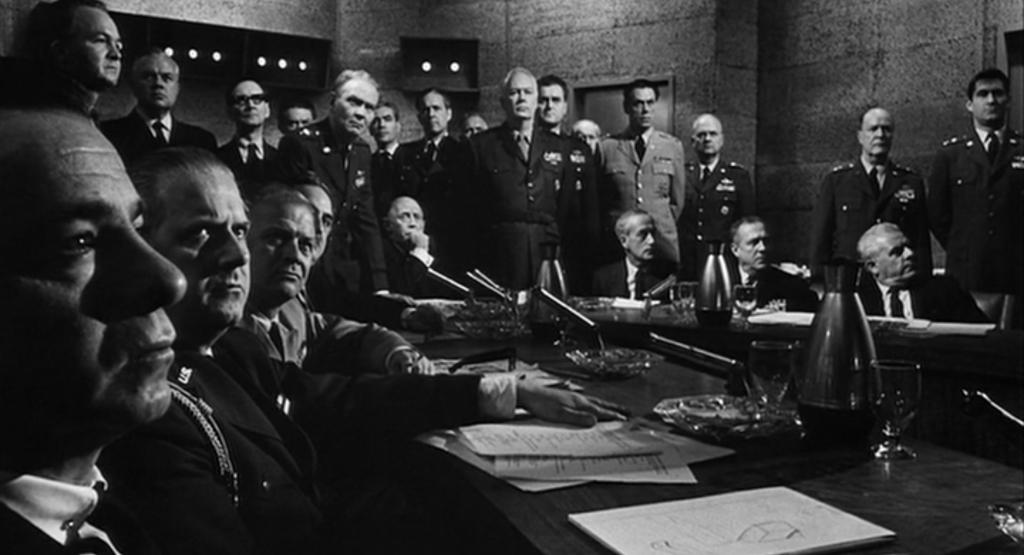
It takes a while for the film to get going, laying its groundwork slowly. Much of the first half hour introduces the characters – such as the family life of anti-Nuclear but loyal soldier General Black (a very good Dan O’Herlihy) and the chilling pragmatism of war theorist Professor Groeteschele (Walter Matthau) to whom nuclear war is just a matter of working out what the acceptable casualty rates are (he would agree with Stalin that one death is a tragedy, a million is a statistic). We tour the USAAF base where level-headed General Brogan (an excellent Frank Overton) and his twitchy number two Colonel Cascio (a slightly too fidgety Fritz Weaver) demonstrate just how fool-proof their systems are to a couple of congressmen – just as those systems fail.

From there the film plays out almost in real time, as the planes fly the two-hour journey to drop their bombs. Two hours when everyone tries to desperately tell themselves that this disaster can be prevented (or in some cases, can be turned into victory). Lumet’s film captures wonderfully the claustrophobic intensity of this. The Russians – despite never being seen – are skilfully humanised with snatches of conversation and photographs. The pilots are brave, resourceful, brilliantly trained – making their rigid determination to destroy the world for no reason (because their training doesn’t allow them to consider any other alternative) all the more tragic.

It all culminates in an impossibly bleak ending, the President’s only alternative to all-out nuclear war is one of terrifying magnitude. The inevitable build to this sacrifice is also executed with a low-key intensity. Fonda is perfect in the lead role – his tortured gravitas and decency pushing him towards ever more distasteful and finally appallingly bleak decisions.

Lumet’s film isn’t perfect – an overly impressionistic opening of General Black’s recurring dream of a matador smacks of someone who has watched way too many Bunuel films – and its slow start probably takes five minutes too long. But with its chillingly cold glaze on the flaws in the nuclear deterrent and the people who operate it, it deserves to be remembered as something more than Dr Strangelove Without the Jokes.

Patton (1970)

George C Scott triumphs as Patton in this excellent World War Two biopic

Director: Franklin J Schaffner

Cast: George C Scott (General George S Patton), Karl Malden (General Omar Bradley), Michael Bates (General Bernard Montgomery), Edward Binns (Lt General Walter Bedell Smith), Lawrence Dobkin (Colonel Gaston Bell), John Doucette (General Lucian Truscott), James Edwards (Sgt William Meeks), Frank Latimore (Lt Colonel Henry Davenport), Richard Münch (General Alfred Jodl), Morgan Paull (Captain Richard Jenson), Siegfriend Rauch (Captain Oskar Steiger), Paul Stevens (Lt Colonel Charles Codman), Karl Michael Vogler (Field Marshall Erwin Rommel), Peter Barkworth (Colonel John Welkin)

Patton was garlanded with eight Academy Awards in 1970, but rarely seems to get a mention when people list landmark best pictures. This is unfair, as Patton is a marvellous, intelligent, professional piece of film-making that rewards re-viewing: not least because, in George C Scott, it has one of those performances you simply must see, an extraordinary melding of actor and real man to such a great extent many people can’t believe they are seeing the real thing when watching newsreel footage of the actual Patton.

Patton is nominally a war film, but it’s actually an intriguing character piece. It follows the career of General George S Patton (George C Scott) during the course of the Second World War. Patton was a soldier’s soldier, a dyed-in-the-wool military man with a warrior’s instinct and a poet’s soul. The sort of man who berated men for not wearing proper uniform, then astounded them with thoughtful reflections on classical history. The film charts his command in Africa against Rommel, the invasion with Sicily (and feud with British counterpart Bernard Montgomery), his benching after striking a soldier suffering from shellshock in a military hospital, and his command of the Third Army during the Normandy invasion, including his pivotal role in the Battle of the Bulge.

With a script co-written by Francis Ford Coppola and Edmund North (later president of the Screenwriter’s Guild), Patton was a warts-and-all portrait of one of America’s most famous generals that came out amidst the country’s growing disillusionment with Vietnam. It was embraced by both sides of the argument because it very skilfully walks a tight-rope: for the hawks, there is enough of the “if we had more like him …” stance. For the doves, the film doesn’t shy away from Patton’s egomania, lack of tact and love of war (he even strongly advocates immediately turning on Russia – ‘cos they’ve already got all the men in Europe anyway – which you can interpret as visionary or insane depending on which side of the fence you are on).

At the centre of everything, George C Scott is quite simply a force of nature as Patton – I don’t think it’s an exaggeration to say this is surely one of the greatest Best Actor winning performances ever. Patton is in nearly every scene, and even the one’s he’s not in he’s the subject of every conversation, and Scott totally dominates the movie. You can’t put your finger on it, but he quite simply becomes Patton. It’s extraordinary, but the actor totally disappears and you feel you are watching some remarkable act of resurrection (fitting since Patton had a profound belief in reincarnation).

Scott’s Patton rages, he shouts, he goes into fits of childish egomania – but he’s also sensitive, intelligent and poetic. He can write a touching letter to the bereaved mother of his adjutant, expressing his sorrow, but also write how tragic it is that he will miss the wars to come. Scott is ramrod in his posture, and more than embraces the theatricality of Patton himself – when an adjutant tells the General sometimes his soldiers don’t know if he’s joking or not, the General softly replies “It’s not important for them to know. It’s important for me to know”.

It’s easy to eulogise over Scott at the expense of all else – but the film is so focused on Patton that he is intrinsically linked with the film’s success. The film is episodic, but every scene tells us something different about the man. Although since the film starts with one of the greatest opening scenes in movie history, we feel like we pretty much know him from the start.

It opens with an enormous American flag, in front of which Patton emerges in full dress uniform to encourage new soldiers to do their duty and, most of all, to “remember that no bastard ever won a war by dying for his country. He won it by making the other poor dumb bastard die for his country.” Scott famously refused to do this scene when told it would open the picture, as he felt nothing else in his performance could emerge from its shadow (they eventually told him it would go later in the film – no word on how he responded when he first saw the film!).

In a nut shell you get the whole movie. Is the giant American flag ironic or does the film really mean it? Patton is both strangely terrifying and also awe-inspiring, charisma, determination and force seeping from every pore of his body. Scott nails every detail of this speech, just as he nails every other part of the performance, while the camera work reinforces his mythic status (or his hubris depending on where you stand) as a symbol of Americana.

Schaffner’s direction of the film is easy to overlook, largely because it is refreshingly unflashy. It’s superbly professional –not a single scene falls flat. He marshals each scene with extraordinary effect, and manages the film’s difficult balancing act of sly satire and hagiography brilliantly. He also, within an epic canvas, works very well with actors – there are a host of great cameos in here, not least from Michael Bates as a preening Montgomery and Edward Binns as an exasperated Bedell Smith. Karl Malden is the only other really major character as Patton’s junior (later commanding) officer and he is perfect as the honest professionalism in contrast to Patton’s flash.

And the film gives us plenty of Patton’s flash. The man who loved war and combat, also loved performing – and does so with abundant skill. But the film isn’t afraid to show his warts: in Sicily he threatens to sack a general who refuses to risk his men’s lives on a risky operation, primarily motivated by Patton wanting to reach Messina before Montgomery. Later, when striking the scared soldier, his actions are tough to watch even as part of you sees his point about other men having been wounded in the line of duty (the playing of the soldier as a teary whiner probably doesn’t help). The film never fails to show that Patton’s worst enemy is his own arrogant lack of thought – he constantly shoots his mouth off with no thought for the impact.

The film is brilliantly constructed. The photography is excellent, the editing superbly marshals a long film of many individual scenes into a story that seems a lot tighter and forward moving than it probably is. Schaffner makes us feel we go on a clear journey with this character – helped as well by Jerry Goldsmith’s excellent score that conveys a great deal with ancient mythic weight, playing off Patton’s own belief in resurrection.

Patton is often forgotten a bit – but it is a great film, well made, brilliantly balanced, wonderfully written and directed. And at its centre: what a performance. George C Scott is simply astoundingly brilliant, completely transformed into the old general. His Oscar (which Scott declined, thinking awards phony) was as well-deserved as these things get. A wonderful film, a true epic, and a marvellous character study of an enigma – it deserves to sit near Lawrence of Arabia in the personal epic stakes (to which it has more than a few similarities).