Tag: Edward G. Robinson

The Ten Commandments (1956)

The Ten Commandments (1956)

DeMille’s massive, camp epic sets the table for what we expect from Biblical epics

Director: Cecil B. DeMille

Cast: Charlton Heston (Moses), Yul Brynner (Rameses II), Anne Baxter (Nefretiri), Edward G. Robinson (Dathan), Yvonne De Carlo (Sephora), Debra Paget (Lilia), John Derek (Joshua), Cedric Hardwicke (Seti I), Nina Foch (Bithiah), Martha Scott (Yochabel), Judith Anderson (Memnet), Vincent Price (Baka), John Carradine (Aaron), Olive Deering (Miriam), Douglass Dumbrille (Jannes)

“Let my people go!” Close your eyes and think of Moses. Chances are you’ll see an image of Charlton Heston, arms spread wide, parting the waves to lead his people to freedom. Heston had been partly chosen for his resemblance to Michelangelo’s sculpture of the famous law-giver. It’s also a tribute to how Cecil B DeMille’s slightly ponderous, very-very-serious Biblical epic pretty much defined what we expect from Bible stories.

The Ten Commandments would be DeMille’s final movie (and for all its many flaws, it’s way more deserving of the Best Picture Oscar than the valedictory pat-on-the-back his penultimate film got). It’s basically a triumphal capturing of his self-important style, with sonorously devout voiceover and a faultless hero chiselled from marble an excuse to fill the screen with action, campy scheming and lots of sexiness. The Ten Commandments became a massive hit because it’s a rollicking pile of nonsense and something you could persuade yourself was “good for you” because it’s about the Exodus.

It’s a BIG film. DeMille delivers an opening direct-to-camera address, dripping with pompous self-satisfaction, where he piously tells us about the level of historical and Biblical research he’s carried out. The credits list a stack of professors, historians, religious experts and, last of all, the Holy Gospels as sources (presumably the Gospels’ writers got no cut of the vast profits). DeMille, as per his style, marshals thousands of extras and some huge (and distinctly sound-stage looking) sets to play out a series of tableaux, many of them rooted in classic silent-movie framing and techniques. Special effects abound to create plagues (disappointingly the film skips seven of them) and parting of the Red Sea. DeMille narrates with the grandiose aloofness of a Sunday School teacher.

It’s almost enough grandeur to make you overlook this pageantry covers a rather camp, frequently silly piece of entertainment. The film is ripe with buff actors striking poses: Heston does a lot of this during the first half, matched by Brynner (who worked out at length so as not to be shown-up). Opposite them, gorgeous Israelite and Egyptian babes fawn and flirt. The film is at least as interested in the love/hate relationship between Moses and Nefretiri as it is in the Word of God, not least because DeMille knows that this soapy stuff really sells.

Perhaps that’s why Anne Baxter plays Nefretiri with a level of campy purring that would be almost laughable, if you weren’t sure that she’s in on the joke. Relishing the chance to play a sex bomb – in costumes designed to stress her assets – Baxter simpers, flirts, drapes herself across Heston’s ram-rod (in every way but one of course – he’s righteous man of God) Moses and gets to utter lines like “Oh Moses, Moses, you stubborn, splendid adorable fool”. She mocks and cajoles Rameses into rejecting Moses’ demands, partly because she can’t stand Moses is immune to her charms, partly because she can’t bear the idea of Moses leaving Egypt (and her) behind forever.

Ten Commandments elevated Heston to the rank of the immortals. Few actors could carry the weight of films like this as well as he. His performance is in two acts. The first is the visionary, egalitarian adopted son of the Pharoah: the guy who builds the best cities, turns rival kingdoms into allies, gives the stuffy priests’ grain to the slaves (even before he finds out he’s one of them) and whom Seti (a haughtily British Cedric Hardwicke) would rather took over the kingdom than Rameses. Discovering his roots, he morphs over a (long) time into the white-haired, broad-shouldered prophet, speaking most of his lines in sonorous block capitals (“BEHOLD. THE POWER. OF GOD” that sort of thing). Very easy to mock, but only Heston could have played such woodenly written silliness with such skilful conviction.

He generously said he believed Brynner gave the better performance. Brynner does have the more interesting material. A playboy monarch who is true to his word and seems (at first) torn with how he feels about this adopted brother who overshadows him at every turn, Brynner adds a lot of light and shade to a character written as a pretty much straight villain. Moses is presented as such an imperious stick-in-the-mud, it’s a little tricky not to feel a bit sorry for the put-upon, inadequate Rameses, for all he’s a tyrant.

Heston was the only actor who went on location for a few key shots (the others all perform on sound stages or in front of green screens). Keeping things sound stage based allowed DeMille to have complete visual control over the set-ups. This suited his conservative camera movements and editing – most of the scenes take place in a few carefully extended mid-shots, that allow us to soak up the pretty costumes and the theatrical acting. The Ten Commandments is partly a flick-book of devotional pictures – so much so that a tracking shot into Seti’s face when he banishes Moses stands out for the amount of camera movement.

That doesn’t stop DeMille throwing in plenty to look at in frame. With Heston spending half the movie as (in some cases literally) the voice of God, John Derek’s Joshua carries the action torch: chiselled of chest, he’s introduced zip wiring to save Moses’ mother from being crushed by a mighty stone. Like most of the “good” characters he gets very little to actually work with: the decent Jews are either excessively pure or aged men of physical weakness who commentate on the wonders around us. Still, it’s better than the hilariously cheesy dialogue of the regular Israelites (“We’re going to the land of milk and honey – anyone know the way?”) that contrasts laughably with the Biblical pastiche Moses and the other principals speak in.

DeMille has plenty of fun with the doubters and naughty among the Israelites. Edward G Robinson goes gloriously over-the-top as quisling Dathan, blackmailing Joshua’s girl Lilia (a timid Debra Paget) into years of servitude and taking every single opportunity to undermine Moses’ leadership. It works as well: no wonder Moses gets so peeved – the slightest set-back and the Israelites seem ready to stone him. Dathan leads the final act Golden Calf orgy (DeMille’s voiceover tuts constantly, while letting us see as much of the action as the censor would allow) while Moses is up the mountain picking up the Word of God.

Robinson has the tone right though: the cast is stuffed full of OTT actors. Vincent Price plays a perverted Egyptian architect with lip-smacking glee. Judith Anderson jumps over the top as Nefretiri’s nursemaid. Nina Foch (one year younger than Heston!) plays Moses’ adopted mother with grandiose gentleness. They know this is a big, silly, pose-striking pantomime passing itself off as a piece of devotional work.

But that’s why its popular. DeMille knows that people don’t want to see a devotional lecture – or even really have to think that much about the rights and wrongs of an Old Testament story that sees the Lord strike down a load of kids with a murderous cloud (even Moses is torn by this for a minute). The Ten Commandments is huge in every sense, full of campy nonsense, pose-striking acting and a mix of stuff it’s taking very-very-seriously and campy ahistorical nonsense. It’s a winning cocktail that doesn’t make for a great film (or even, possibly, a good one) but cemented it as a landmark everyone recognises even if they haven’t seen it. In a way, making it one of Hollywood’s most magic epics.

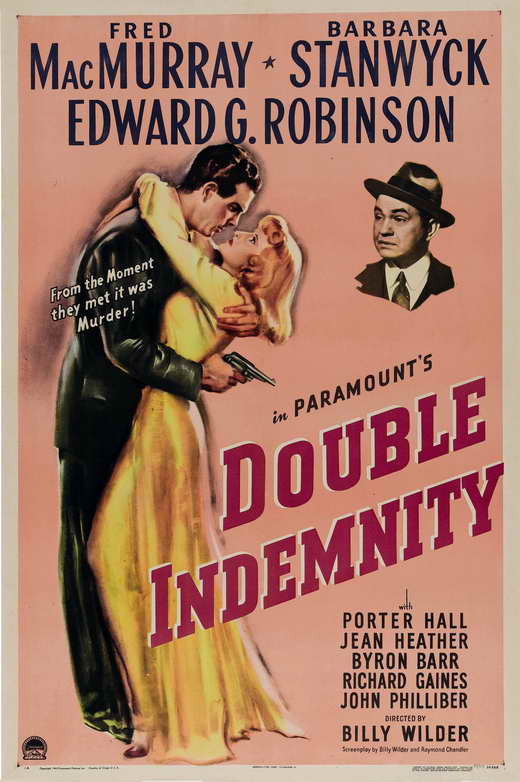
Double Indemnity (1944)

Barbara Stanwyck is the dark force beyond Fred MacMurray in Wilder’s classic Double Indemnity

Director: Billy Wilder

Cast: Fred MacMurray (Walter Neff), Barbara Stanwyck (Phyllis Dietrichson), Edward G. Robinson (Barton Keyes), Porter Hall (Mr Jackson), Jean Heather (Lola Dietrichson), Tom Powers (Mr Dietrichson), Bryon Barr (Nina Zachett), Richard Gaines (Edward Norton)

In the wake of the Second World War, morally complex and dark (in every sense of the word) stories spoke to a nation coming to terms with what it had been through. Out of this was born a new genre: film noir. Double Indemnity might just be the best example and one of Billy Wilder’s best films.

Walter Neff (Fred MacMurray) is a bored insurance salesman, smitten with the sexually alluring Phyllis Dietrichson (Barbara Stanwyck), wife of a potential client. When she suggests that, with his help, they could get rid of her husband and collect a massive insurance payout on his death, Neff is quickly won over. But murder is a hard thing to get away with – particularly when Neff’s colleague and close friend Barton Keyes (Edward G Robinson), the best investigator in the business, smells something amiss in the ‘accident’.

Double Indemnity is one of those films that it’s easy to forget was as influential as it was, precisely because it’s narrative and filmic techniques have been so comprehensively imitated in a host of films since. But imagine: this was one of the very first real film noirs. It was one of the first films that used shadows and darkness as effectively as this to reflect mood and atmosphere. It was the one of the first films to use a femme fatale as prominently (and unapologetically) as this. It’s also one of the first films where sex permeates almost everything you see in the picture.

Phyllis is a woman who understands the power of sensuality, who is well aware of how she can use her body and aloof mystery to get what she wants out of men. But even more than that, Stanwyck’s wonderfully cold performance suggests she hardly seems to care about anything at all: in fact the impression is almost that she is locked into moving forward, passing through husbands and lovers, leaving men dead on the wayside. That’s the magic of Stanwyck in this film: can you remember a character as unremittingly, unapologetically sinful, manipulative and conscience-free as this?

Of course Fred MacMurray’s Walter Neff is the perfect rube for this fiercely intelligent and determined woman. MacMurray’s slight B-movie blandness – his lack of star quality, his everyday, folky unimaginativeness – is perfect for the overconfident, slightly smarmy, laziness of Neff. It’s never said outright, but you suspect that the attraction of the danger Phyllis offers is escape from his own dull life. Does he love Phyllis? I would say almost certainly not – but is he horny for her? You better believe it. It’s a man on the cusp of a mid-life crisis getting a chance to throw himself into a sex-driven affair.

What do these two think of each other? Both of them seem barely capable of trusting each other, using sex and flirting almost as a filler between bouts of mutual suspicion. Does she care for him even a little behind her use of him? And does he feel anything like a bond with her inbetween the bouts of sex? They stumble so quickly into the plan that it almost feels like they are going through the motions – she is so used to manipulation and murder, it’s all she knows; he is so bored with his life that the excitement of violence and murder with his sex seems impossible to resist.

And Wilder lets sex run through this whole film. From Phyllis’ long descent down her flight of stairs at her first entrance to the irresistible anklet, everything about Stanwyck in this film is about the power of her sex. The dialogue exchanges between Neff and Phyllis crackle with magnetism. Later, Wilder skilfully shoots a sex scene without showing a thing: we cut from the two of them kissing on a sofa, to their positions shifted, Phyllis fixing her dress and Neff reclining smoking.

It helps that the dialogue is scintillating. Each exchange is packed with crackling and quotable lines. You get a perfect marriage here between Wilder’s acerbic cynicism and dry wit, and Raymond Chandler’s arch, spiky, carefully constructed dialogue, with its gritty poetry. I mean just watch the exchange here – perfection.

And they write some knock-out speeches too – but then you would if you had an actor as brilliant as Edward G. Robinson to deliver them.

Neff’s voiceover uses the technique where it should be used – not to tell us information any well informed viewer can already work out for themselves, but to allow us insight into Neff himself and his situation, that complements and develops our appreciation of the picture (it’s also beautifully well delivered by MacMurray). I’d also add it’s the same conceit as Sunset Boulevard – its lead character narrates the film mortally wounded – and it works just as well here, stressing the disaster that hangs over every action by our anti-heroes.

Added to this, the film looks beautiful. The shadows have an all-consuming inky depth. Cinematographer John Seitz is not afraid of turning the lights down and down, and the darkness absorbs and consumes the whole picture. It allows striking lighting effects – the blinds that seem to be in every room allow slits of light through them that draw lines across the faces and bodies of the actors (as many viewers have commented, it also has the effect of making half the characters appear like they are behind bars). The darkness looms in from the corners of the frame, trapping the leads into the action – and into their own disastrous decisions.

Wilder’s skilful camera placement is what makes this film really work. He presents action constantly in challenging and different ways, never doing the expected. During the actual murder (committed while Phyllis drives), the camera never looks at Neff committing the crime, but closely follows the look of almost sensual satisfaction on Phyllis’ face: she never once looks at what is happening in the seat next to her, but her face makes us experience the killing in an even more disturbingly intimate way than watching it would be.

But what makes this film truly brilliant and unique is that its main relationship isn’t even the one you expect. Neff and Phyllis may have an electric physical relationship, but the real romance in the film is between Neff and his colleague Keyes. These two share a deeply close and personal bond. Theirs is a friendship that skirts around a platonic romance – made sharper of course as Keyes is the only man who stands a chance of working out what exactly is going on. There is a fine visual motif throughout of Neff lighting matches (with his thumb!) for Keyes – a gesture that feels both manly and intimate.

Keyes is played by a career-best Edward G. Robinson. Robinson blazes through the big speeches – but with a confident skill that never makes them feel like showboating moments. He gives Keyes an eccentric brilliance, mixed with a delicate humanism. To be that good at sniffing out wrongdoing and deceit from his fellow men, you can’t help feeling that he must have a pretty good idea about what human fallibility feels like. It’s this warm human understanding that Robinson does so brilliantly. It’s also what helps to make this relationship so moving. It’s hard not to share the obvious awkward discomfort MacMurray gives to Neff when he feels as if he is letting down his friend, and betraying the trust between them.

It’s this that makes Double Indemnity stand out. It’s a film that’s actually about the relationship between two men – part friendship, part father-and-son, part romantic – their love for each other, which happens to have an irresistible femme fatale thrown into the middle. It feels like a very unique and different approach – a touch of Wilder magic if you will – that makes the film stand out. It’s also what lies behind the link it has with audiences, the human interest that makes you come back again and again to this film about two ruthless killers.

This is a film in which everyone was at their best. MacMurray never did anything again to match it, Stanwyck seized the part with such commitment that she spawned countless imitators, Robinson is just magnificent. Wilder’s direction is perfect, the film looks ravishing, the script is to die for. Double Indemnity may not only be the most influential film noir ever. It might also be the best.