Tag: Edward Zwick

Pawn Sacrifice (2014)

Liev Schreiber and Tobey Maguire recreate Spassky/Fischer in Ed Zwick’s pointless chess drama

Director: Ed Zwick

Cast: Tobey Maguire (Bobby Fischer), Liev Schreiber (Boris Spassky), Peter Sarsgaard (Father Bill Lombardy), Michael Stuhlbarg (Paul Marshall), Lily Rabe (Joan Fischer), Robin Weigert (Regina Fischer)
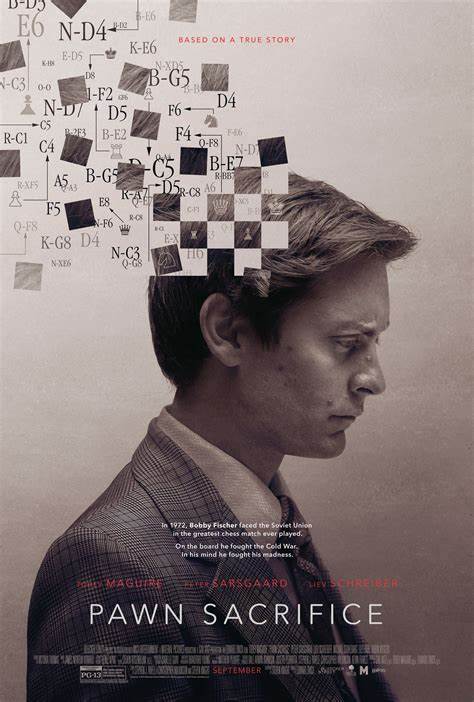
In the 1960s and 70s, Chess suddenly became world news. Like the space race before it, it was effectively a way for the USA and USSR to combat each other without the risky side effect of blowing up the whole world. The USSR had all the best players: until American chess prodigy Bobby Fischer emerged to shatter this monopoly. In 1972 the world seemed to come to a stop to watch the world championship clash between Fischer (Tobey Maguire) and Boris Spassky (Liev Schreiber) in Reykjavik. Ed Zwick’s film attempts to bring together the personal and the political – two superpowers using a game as a proxy for war – into an enlightening package. It fails.

The film opens with Fischer trashing his apartment in search for bugs on the eve of the 1972 final before flashing back in time. You’d expect the film to give us an idea of what bought our “hero” to this point. Zwick’s film utterly fails to do this. Now Fischer – very well played by an aggressively prickly Tobey Maguire – was a hugely troubled man. Though never formally diagnosed some combination of paranoia, OCD and a myriad other personality problems meant he was never more than a step away from self-destruction. Despite this he was deeply driven by an ambition to be the best chess player in the world. Its rich material, but the film never begins to get to grips with Fischer.

Could this be because it wants to tell an uplifting story – the film is really building towards the standing ovation Spassky gives Fischer in game 6 at the 1972 championship when Fischer whipped him in about 40 moves of perfect play – but is struggling with the fact that Fischer himself is deeply unsympathetic. A paranoid conspiracy freak who even by the standards of the 1960s was an aggressive, virulent anti-Semite (Fischer would later match Mel Gibson in his anti-Semitic tirades, blaming Zionism for everything from 9/11 down). A bully who refused to interact with anything except on his own terms, who cut all friends and family from his life for the most minor transgressions. There is no insight given here at all, or suggestion of what was wrong with Fischer.

It’s hard to hang a “triumph against the odds” structure – as Zwick’s unimaginative and conventional film tries to – around this. A far more interesting film would have used the 1972 tournament as an Act 2 triumph and then explored in more depth Fischer’s long spiral of self-destruction that would see him as a bearded eccentric ranting against Jews and America, in exile in Iceland. A film like that would also have then been able to properly do service to the idea of Fischer as a pawn of American state interests, who celebrate him when they want to rub the Soviet nose in it, but then drop him as soon as his purpose is served.

Instead, the film becomes formulaic and empty, leaving us with the impression that we learn nothing about Fischer at all. Why did this man of Jewish descent hate Jewish people so much? Was it self-loathing? What motivated him to seemingly self-destruct his own career so regularly? Was it a fear of being beaten? We have no idea. Instead that opening scene of Fischer destroying his apartment tells us everything we learn about the man over the course of the film. He remains an enigma – and since he’s also deeply unpleasant (the film skirts a little around how much) and we don’t get given any rich material to understand why he’s like this, he becomes a tedious figure to spend time with.

Zwick’s film also fails to communicate the cold war motivations behind this. Although there are the odd shots of the powers-that-be watching on TV in the Kremlin and the White House, we get no sense of how or why these powers are using chess to promote their own ideology. The film is endlessly reliable on vintage and reconstructed newsreel footage to constantly tell us directly things it can’t work out how to do with dialogue, from the political situation to chess moves. You learn nothing about the Cold War from this film. Michael Stuhlbarg’s lawyer turned promoter for Fischer states openly that he wants to use Fischer to show up the Russkies – but that blunt statement is it.

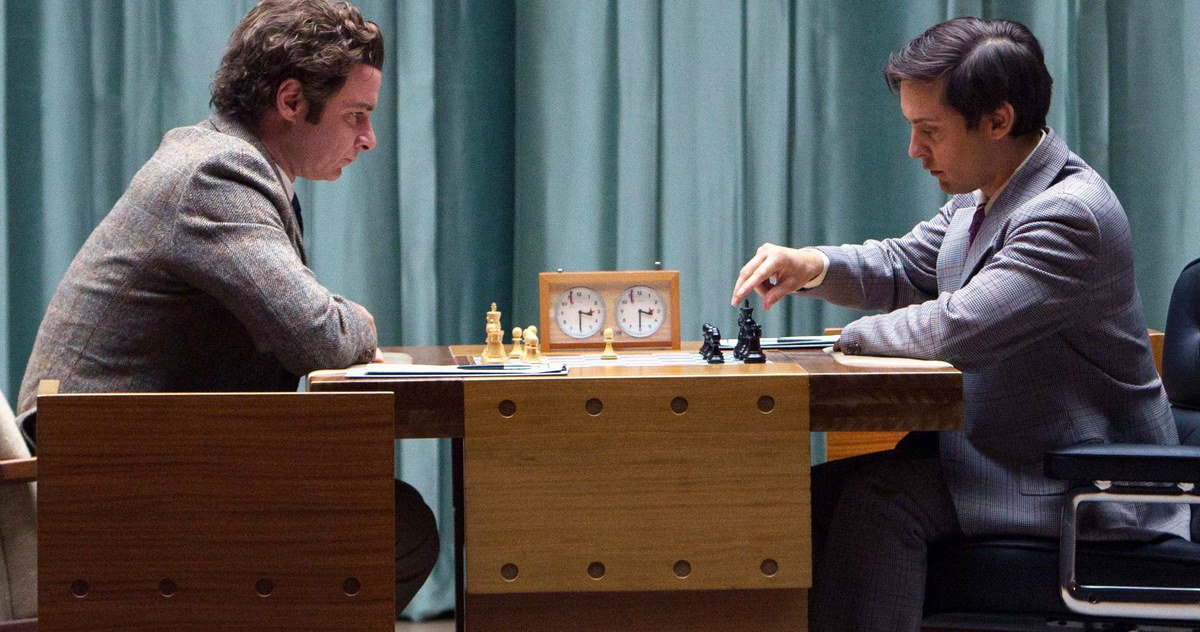
Instead the film is only really interesting when it is effectively recreating footage from the 1972 championship. And when a film’s strong points are recreating real events perfectly, you know you are in trouble. Zwick’s film lacks ideas, a compelling plot, insight or invention. It suffers badly today when compared to the far more dynamic and insightful The Queen’s Gambit (whose lead character is a heavily fictionalised female Fischer). Zwick’s film is him at his plodding, middle-brow worst, presenting a would-be epic shorn of anything of actual interest of controversy. The only thing that redeems it are decent performances from Maguire, Sarsgaard and Schreiber. Otherwise, this is an empty mess that tells you nothing at all about anything. You could checkmate it in about four moves.
Glory (1989)

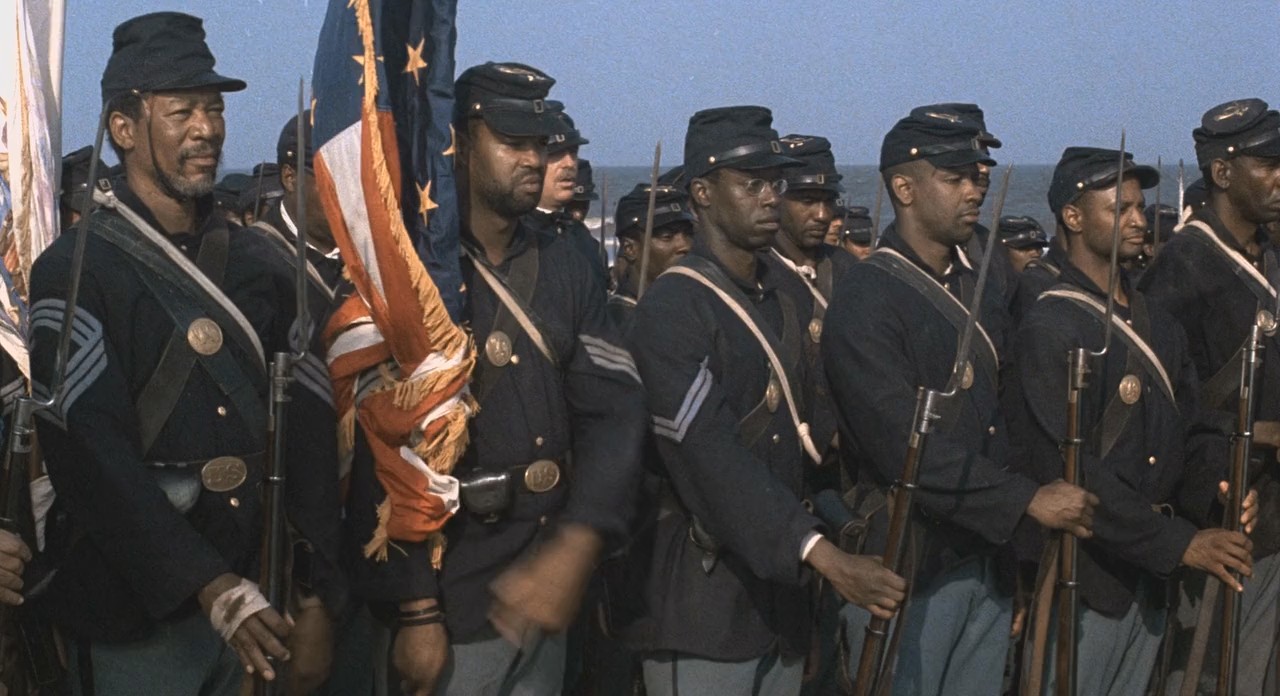
Morgan Freeman and Denzel Washington are among the first black American soldier in Glory

Director: Edward Zwick

Cast: Matthew Broderick (Colonel Robert Gould Shaw), Denzel Washington (Pvt Silas Trip), Cary Elwes (Major Cabot Forbes), Morgan Freeman (Sgt Major John Rawlins), Andre Braugher (Cpl Thomas Searles), Jihmi Kennedy (Pt Jupiter Sharts), Cliff De Young (Colonel James Montgomery), Alan North (Governor John Albion Andrew), John Finn (Sgt Mulcahy), Bob Gunton (General Charles Garrison Harker), Jay O Sanders (General George Crockett Strong)

The American Civil War started over slavery, but it took a long time for either side to admit it was a fight about slavery. Racism abounded on both sides, and it was a fight in which black Americans may have been the subject, but were rarely invited to join. Glory covers this point of history, and specifically the first all-black regiment and its struggle to be recognised as equal to the other regiments in the army. 

Wounded at the Battle of Antietam in September 1862, Robert Gould Shaw (Matthew Broderick) returns home to Massachusetts and accepts command of the first all-black regiment, which is currently being raised by abolitionists in the state. With his friend Cabot Forbes (Cary Elwes) as second-in-command (no one was progressive enough to actually allow black officers for the regiment), he recruits a wide range of black Americans, from free-man and bookish intellectual Thomas Searles (Andre Braugher) – an old friend of Robert and Cabot – to former slaves such as the wise John Rawlins (Morgan Freeman) and the resentful Silas Trip (Denzel Washington). Training is a struggle, with the army denying the regiment supplies and support, and it’s an equal struggle when they reach the front line to be recognised for duties other than looting and latrine digging. Will the Massachusetts 54th be given the chance to prove itself in the front line – and establish a black man can fight as hard and bravely as a white man can?

Edward Zwick’s beautifully filmed, carefully re-created historical epic set the tone for much of his future career. It’s an often overly-sentimental film straining for a very self-conscious sense of importance, weighed down by the pride at the “message” it is carrying. It often does hit the mark with presenting scenes that carry emotional force – but then seeing as it treats nearly every scene as being a “moment” that should move us (with James Horner’s choral manipulation working double time to get us experiencing feelings), it’s no wonder that it succeeds sometimes.

Which is not to say the message it presents isn’t an important one. Black Americans have often been pushed into the margins of American Civil War history. Or worst of all presented as the victims, reliant on the courage and bravery of the abolitionists of the North to save them from slavery in the South. Until Glory it was very rare for anything to push their stories front and centre – or to tell a story where former slaves were allowed to fight their own battles and choose their own destinies. 

It’s one of the strongest marks of the film: these are soldiers unlike any other, who enter battles with less concern about their own survival, and more about having the chance to live as freemen and to make a mark on the world. To show that they, and people like them, could do just as a white man could do. And if they had to die to do that, better to live a day on their feet as freemen then a lifetime on their knees. It’s the principle emotional message of the film, and something Zwick translates with some skill, even if he frequently overeggs the pudding while doing so.

However, with such a strong message, it’s a shame so much of the film is filtered through the experience of its white lead character. For many of the films of the 80s and 90s dealing with these issues – Cry Freedom, the Steve Biko biopic, with Biko as a supporting character to his white South African journalist friend, being perhaps the key example – it was essential to have a white man at the centre, as if worried that audiences couldn’t understand the story they were seeing unless they had it filtered through the perception of someone who looks a bit more like them.

Matthew Broderick takes on the lead role here of Shaw – with the film giving a significant slice of its running time to its coming-of-age theme of Shaw learning to become a leader of men – and while the character is meant to be callow and an unlikely Colonel, it doesn’t help that Broderick lacks the charisma for the part. Perhaps he is a little too lightweight an actor for such an enterprise, for a film that demands greater force of character (you can imagine Tom Cruise doing a much finer job in the role).  Similarly, the familiar beats of a young man learning how to lead feel trivial compared to the life-and-death issues facing his soldiers.

But too often Zwick’s film returns us to Shaw’s point-of-view, the narrative filtering so much of the action through his perceptions and decisions that the black soldiers become supporting actors in their own stories. Broderick is not helped by the soldiers being played by some of the finest American actors of the last 30 years. Braugher is fabulous in the thankless role of the bookish man who must grow a spine. Morgan Freeman established a persona – the wise and level headed older man, who will not let hate and fury define his life and his choices – that would last him for the rest of his career, and is superb (his Oscar nomination for Driving Miss Daisy is probably the only thing that led to him not getting a nod for this film).

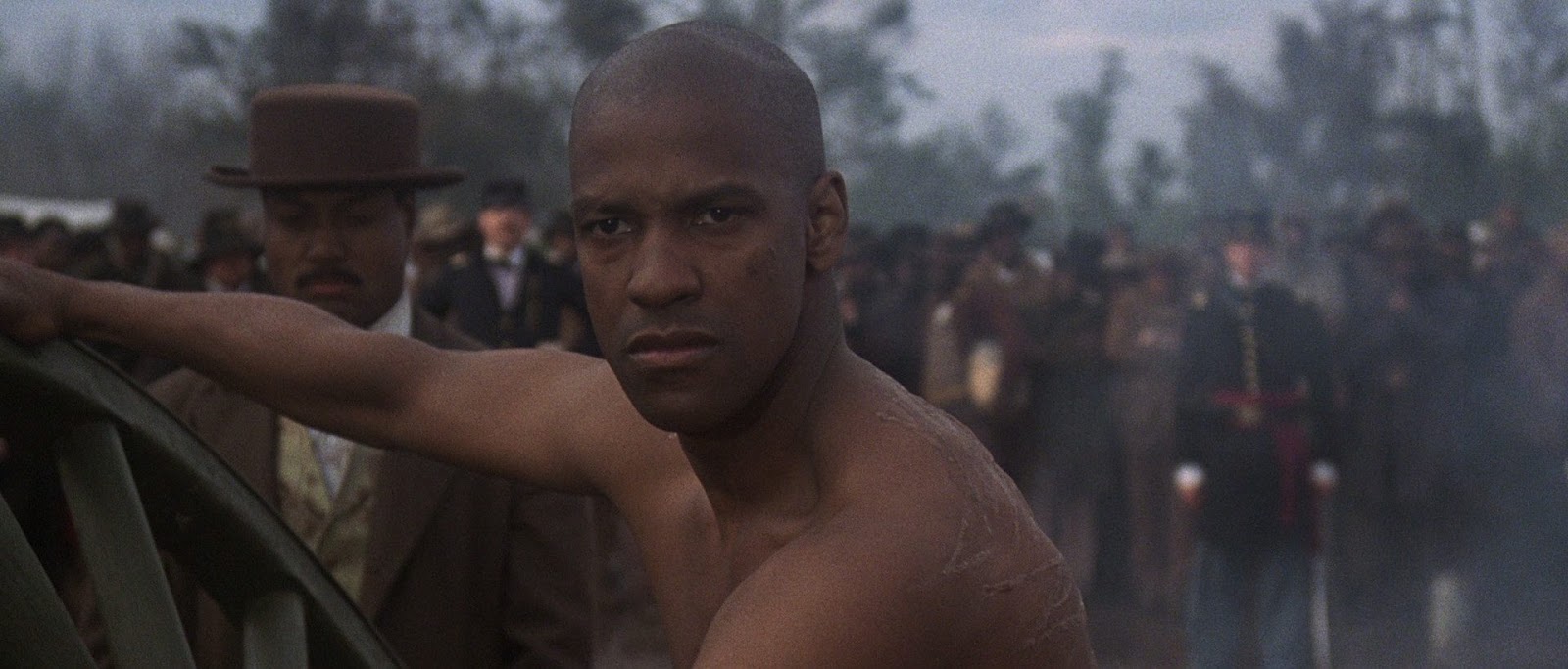
Denzel Washington took home an Oscar as the bitter, angry Trip – and it’s the sort of role an actor seizes with relish. Washington fills every frame with his rage at the system, his inarticulate, indiscriminate anger lashing out in every direction. It’s the fury of a man who has had all his choices taken from him in life, and would rather destroy things than run the risk of allowing himself to become committed to something, or form a bond. Washington probably won the Oscar alone for the astonishing scene where he silently, defiantly accepts a whipping (on a body covered with scars) for missing a curfew. He’s an elemental force of nature in the film.

There is plenty of strong stuff in Zwick’s work, but the film itself overplays its hand frequently. Moments of emotion are played so heavily to the hilt they sometimes fail to have an impact. It wants you to know at every turn that you are watching a film with an important social message – and the speechifying at points put into the mouths of the characters runs dry. While superbly made – veteran photographer Freddie Francis’ work is beautiful (and Oscar winning) – it’s a heavy-handed, overly pleased with itself film that knows all too well that it is about an important subject. While sometimes it lands – often in quieter moments, particularly those where Freeman and Washington are allowed to simply be human without overindulgent music cues hammering home the emotions – at others it comes across as too much.

Jack Reacher: Never Go Back (2016)


Tom Cruise and Cobie Smulders on the run – not as exciting as it should be

Director: Edward Zwick

Cast: Tom Cruise (Jack Reacher), Cobie Smulders (Major Susan Turner), Aldis Hodge (Captain Anthony Espin), Danika Yarosh (Samantha Dutton), Patrick Heusinger (The Hunter), Holt McCallany (Colonel Sam Morgan), Robert Knepper (General James Harkness)

Titling a sequel to any film Never Go Back is a real hostage to fortune. It’s not a great surprise that a quick internet search for reviews of this film throws up a plethora of puns around the film’s subtitle. It’s pretty obvious: but considering the general meh nature of this film, it’s also kinda fair.

Jack Reacher (Tom Cruise) travels back to Washington DC to visit Major Susan Turner (Cobie Smulders), a Military Police officer who has helped him with a number of problems in the past. He arrives, however, to find her under arrest for espionage – and after he starts asking questions, he quickly joins her in lock-up, under arrest for murder. Busting out of prison, they go on the run together to try and find out who has framed them.

Now I loved the first Jack Reacher film: I’ve seen it three times now and it has a brilliant combination of well-cut action sequences, witty lines, an involving plot and some interesting eccentric fringe characters (not least Werner Herzog’s Russian mobster mastermind), which fleshed the movie out into an entertainingly different man-gotta-do movie. This sequel shakes up the formula – but in doing so makes itself much more of an identikit movie, full of tropes we’ve seen before.

For starters, the main appeal of the first Reacher film was the character himself: a loner who plays by his own rules, operating like some sort of master-less samurai, was interestingly different; it was hard to predict how he might react in different situations. Here, teaming him up with Turner (good as Smulders is in the role) and a character who may-or-may-not-be his daughter turns Reacher into just another leg of a mismatched trio, an odd bunch on the run. Cruise tackles well Reacher’s conflicted reactions to taking on a father-child bond that has never crossed his mind before, but adding this parental element to the mix makes the movie start to feel like a high-class Taken reprise.

Secondly, Zwick’s direction doesn’t have the zing that the rather dry and uninvolving plot needs to bring it to life. There is very little of interest in the script, and no memorable lines at all. The best scene in the film is Reacher’s introduction – practically the only scene that captures the character’s slightly cocky defiance of authority, his seemingly omniscient awareness of how events will unfold and his simmering potential for violence coupled with a strong moral code. The storyline that built up to that opening scene sounds really interesting: I wish the film had been about that. No scene after that point really comes to life again. Zwick’s action directing is perfunctory and he can’t add the visual wit that Christopher McQuarrie introduced to such great effect in the first film.

Thirdly the story is just plain not that interesting. The conspiracy is hard to fathom (or care about) and the villains are poorly defined ciphers. In fact, outside of Smulders and Cruise, not a single actor makes an impression in this film: each supporting character is little more than a plot device, sketched with broad strokes. The family dynamic between Reacher-Turner-Dutton feels rather old-hat and robs us of Reacher’s most unique asset as a character – all part of turning the film into another run-of-the-mill thriller. For a fourth or fifth film in the series, doing something very different with the character might have worked: here we still want to explore the loner.

That’s really harsh: it’s not a bad film, just a disappointingly average one. There are some decent scenes and some grins. Cruise and Smulders give good performances. I’m glad they made a Reacher sequel. I just wish it had been a better one. I’m sorry, I can’t resist – this is one film that you will probably Never Go Back to.