Tag: Elias Koteas

Zodiac (2007)

Zodiac (2007)

A chilling chronicle of the hunt for a serial killer told with a superb mix of journalism and filmic flair

Director: David Fincher

Cast: Jake Gyllenhaal (Robert Graysmith), Mark Ruffalo (Inspector Dave Toschi), Robert Downey Jnr (Paul Avery), Anthony Edwards (Inspector Bill Armstrong), Brian Cox (Melvin Belli), Elias Koteas (Sergeant Jack Mulanax), Donal Logue (Captain Ken Narlow), John Carroll Lynch (Arthur Leigh Allen), Dermot Mulroney (Captain Marty Lee), Chloë Sevingy (Melanie Graysmith), John Terry (Charles Thieriot), Philip Baker Hall (Sherwood Morrill), Zach Grenier (Mel Nicolai)
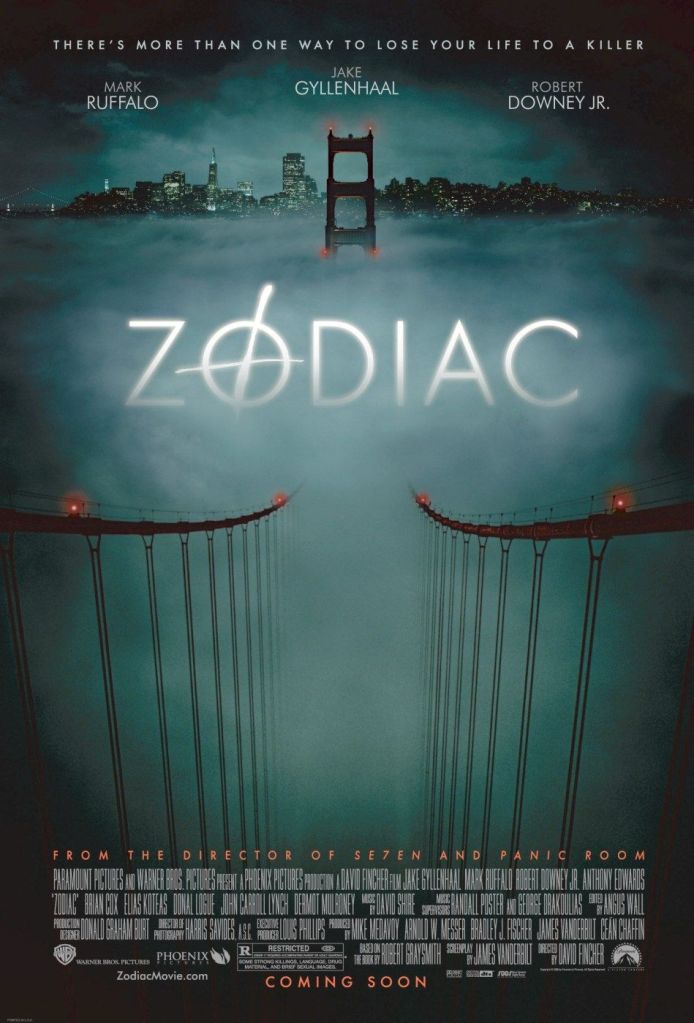
It’s one of the great unsolved mysteries of American history, like San Francisco’s version of Jack the Ripper. For a large chunk of the late 60s and early 70s, a serial killer known only as “the Zodiac killer” murdered at least five (and claimed 37) innocent people, all while sending mysterious, cipher-filled letters to San Francisco newspapers, taunting police and journalists for failing to catch him and threatening further violent acts. The investigation sifted through mountains of tips and half clues but only produced one possible suspect, Arthur Leigh Allen: though no fingerprint or handwriting match could conclude a case.

The story of the hunt for this elusive killer, stretching into the 1980s and concluding with another dead-end coda in 1992, is bought to the screen in a film from David Fincher that expertly mixes cinematic flair with journalistic observation. Channelling All the President’s Men and 70s conspiracy thrillers as much as it does the dark obsession of Fincher’s Seven, Zodiac is a master-class not only in the bewildering detail of large-scale investigations (in the days before computer records and DNA evidence) but also the grinding, destructive qualities of obsession, as those hunting the Zodiac killer struggle to escape the shadow of a case that grows to dominate their lives.

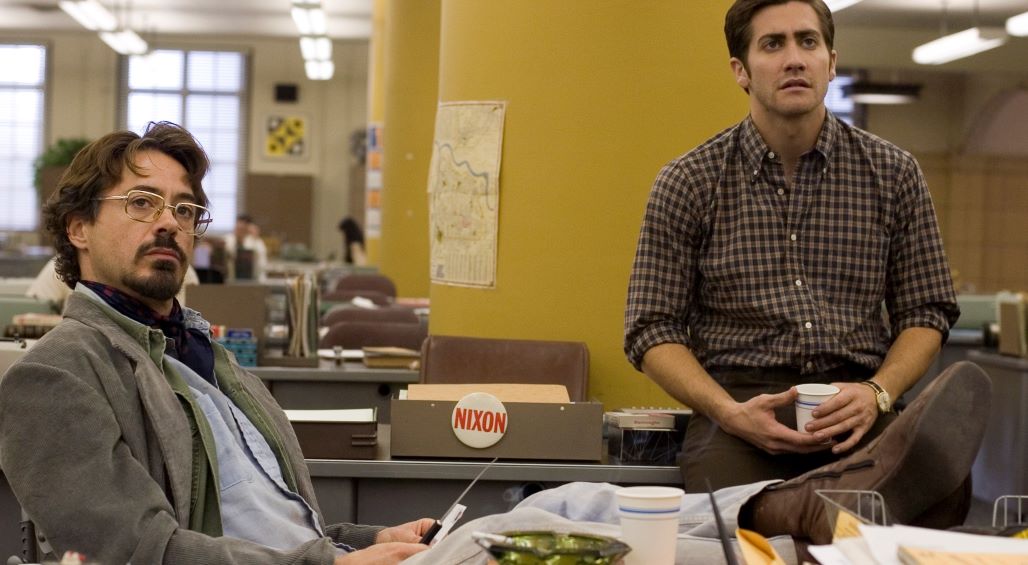
Zodiac focuses on three men, all of whom find their lives irretrievably damaged by their investigation. At first, it seems the drive will come from Robert Downey Jnr’s Paul Avery. Avery is the hard-drinking, charismatic, old-school crime correspondent on the San Francisco Chronicle. In a performance exactly the right-side of flamboyant narcissism, Downey Jnr’s Avery is a man who likes to appear like he takes nothing seriously, even while the burden of the case (and a threat to his life from the Zodiac killer) tips him even further into a drink habit that is going to leave him living in a derelict houseboat, in a permanent state of vodka-induced intoxication.

The second is Inspector Dave Tosci, a performance of dogged, focused professionalism from Mark Ruffalo. He’s confident he’ll find his man, and will go to any lengths to do it, staying on call night and day, and hoarding facts about the case like a miser. He relies more than he knows on level-headed, decent partner Bill Armstrong (played with real warmth by Anthony Edwards). Tosci’s self-image and belief slowly crumble as every lead turns dead end, every gut instinct refuses to be backed by the evidence. The killing spree becomes his personal responsibility, a cross he bears alone for so long that when a belated letter from Zodiac surfaces in 1978, his own superiors believe Tosci sent it in some vain attempt to keep a cooling case alive.

Our third protagonist, present from the arrival of the very first Zodiac letter at the door of the Chronicle, is Jake Gyllenhaal’s Robert Graysmith. A quiet, studious, teetotal political cartoonist who is literally a boy scout, Graysmith spent a huge chunk of the 70s and 80s trying to crack the case, eventually turning his investigation into a best-selling book. It’s Graysmith who becomes the focus of Fincher’s investigation of obsession. The glow of monomania is in Gyllenhaal’s eyes from the very start, as the cipher and its deadly message spark a mix of curiosity and moral duty in him. He feels compelled to solve the crime, but it’s a compulsion that will overwhelm his life. The Zodiac is his Moby Dick, the all-powerful monster he must slay to save the city. (“Bobby, you almost look disappointed” Avery tells him, when Avery suggests some of the Zodiac’s murderous claims are false, as if reducing the wickedness of the Zodiac also reduces the power of Graysmith’s quest.)

The real Graysmith commented when he saw the film, “I understand why my wife left me”. It’s a superb performance of school-boy doggedness, mixed with quietly fanatical, all-consuming obsession from Gyllenhaal, as the film makes clear how close he came (closer than almost anyone else) to cracking the case, but nearly at the cost of his own sanity. Graysmith pop quizzes his pre-teen children on the case over their breakfast (a far cry from, at first, his instinct to shield his son from the press coverage) and as he becomes increasingly unkempt, so his house more and more becomes a mountain of boxes and case notes.
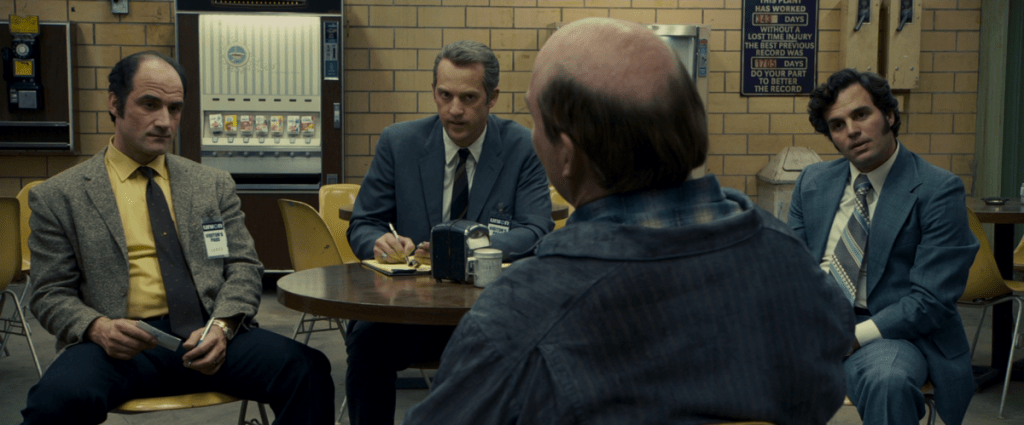
It’s the secondary theme of Zodiac: how obsession doesn’t dim, even when events and evidence drop off. The second half of the film features very little new in the case (which peaked in the early 70s) but focuses on the lingering impact of the ever more desperate and lonely attempts to solve it. Armstrong, the most well-adjusted of the characters, perhaps knew it was a hopeless crusade when he threw his cards in and left the table after a few years to spend time with his children while they grew up. Avery cashes out as well – even if his health never recovers. Tosci is cashiered from the game, and even Graysmith finally realises the impact on him.

That second half of the film is long. Too long. It also, naturally, leaves us with no ending – a sad coda that hints at the guilt of primary (only) suspect Arthur Leigh Allen, but gives us (just like the surviving victims) no closure. It’s fitting, and deliberate, but still the only real flaw of Zodiac is that, at 150 minutes, it’s too long. The deliberate draining of life from the case, like a deflating balloon, also impacts the narrative, which consciously drops in intensity (and, to a degree, interest – despite Gyllenhaal’s subtle and complex work as Graysmith). It’s even more noticeable considering the compelling flair with which Fincher delivers the first half of his scrupulously researched film.

Fincher and screenwriter James Vanderbilt spent almost 18 months interviewing everyone involved with the case. Nothing was included in the film unless it could be verified by witnesses. That included the crimes of the Zodiac: only attacks where there were survivors are shown, the only minor exception being Zodiac’s murder of a taxi driver (where only distant eye-witnesses were available) – even then, every event is confirmed by ballistics and no dialogue is placed into the mouth of the victim. The film also acknowledges the unknown nature of the Zodiac killer: each time the masked killer appears in recreations of his crime he is played by a different (masked) actor, subtle differences in build, tone of voice and manner reflecting the contradictory eye-witness statements. These chilling scenes are shot with a sensitivity that sits alongside their horrifying brutality. Fincher felt a genuine responsibility to reflect the horror of what happened, but with no sensationalism.

Instead, he keeps his virtuoso brilliance for the investigation. The newspaper room filling with the super-imposed scrawl of the Zodiac killer, while the actors read out the words. Restrained but hypnotic editing, carefully grimed photography, camera angles that present everyday items in alarming new ways, a mounting sense of grim tension at several moments that makes the film hard to watch. A superb sequence surrounding the Zodiac’s demand to speak to celebrity lawyer Melvin Belli (a gorgeous cameo from Brian Cox), first on a live TV call-in show, then in person (a “secret meeting” swamped by armed police, which Zodiac, of course, doesn’t turn up to). This is direction – aided by masterful photography (Harris Savides) and editing (Angus Wall) – that immerses us in a world (like drowning in a non-fiction bestseller), while never letting its flair draw attention to itself.

Zodiac was a box-office disappointment and roundly forgotten in 2007. It’s too long and loses energy, but that’s bizarrely the point. It implies, heavily, that Allen (played with a smug blankness by John Carroll Lynch) was indeed the killer, but doesn’t stack the deck – every single piece of counter evidence is exhaustingly shown. In fact, that’s what the film is: exhaustive in every sense. It leaves you reeling and tired. It might well have worked better, in many ways, as a mini-series. But it’s still a masterclass from Fincher and one of the most honest, studiously researched and respectful true-life crime dramas ever made. And just like life, it offers neither easy answers, obvious heroes or clean-cut resolutions, only doubts and lingering regrets.

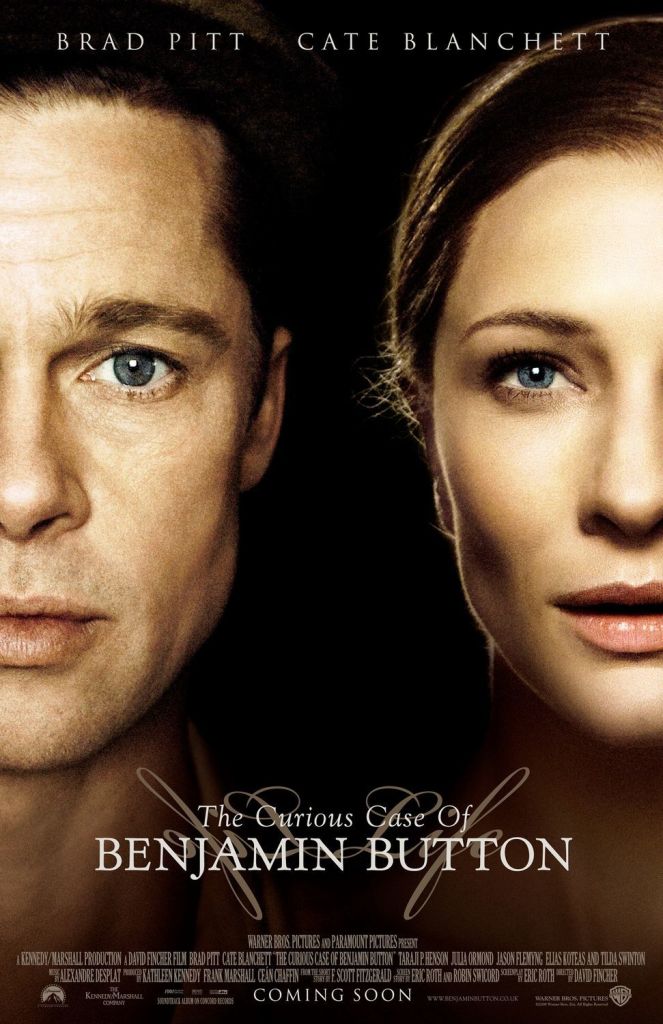
The Curious Case of Benjamin Button (2008)

The Curious Case of Benjamin Button (2008)

Ageing, romance and sentiment in Fincher’s handsome shaggy dog story

Director: David Fincher

Cast: Brad Pitt (Benjamin Button), Cate Blanchett (Daisy Fuller), Taraji P Henson (Queenie), Julia Ormond (Caroline Button), Jason Flemyng (Thomas Button), Elias Koteas (Monsieur Gateau), Tilda Swinton (Elizabeth Abbott), Mahershala Ali (Tizzy Weathers), Jared Harris (Captain Mike Clark)

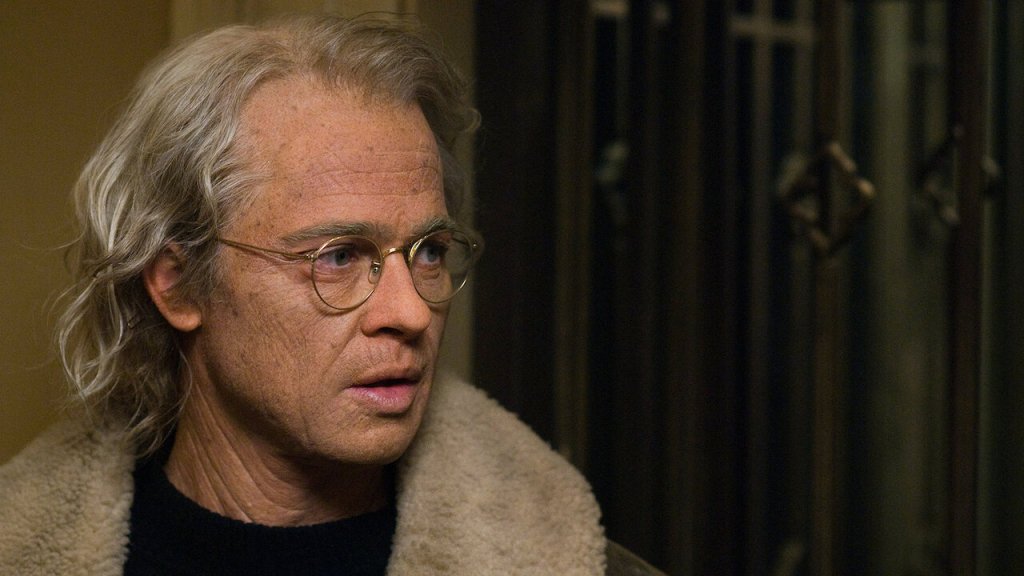
As the eleventh hour of the eleventh day of the eleventh month of 1918 strikes, a baby boy is born. A baby boy unlike any other, with the appearance and illnesses of a very old man. Discarded by his horrified father (Jason Flemyng), the boy is adopted by Queenie (Taraji P Henson), caretaker of a nursing home. There it becomes clear he is growing backwards: the older he gets, the younger he appears. Young Benjamin will eventually grow into Brad Pitt and spend his life watching those around him grow ever older as he grows ever younger. Most joyful, and painful, of all being his childhood friend Daisy (Cate Blanchett), the woman he will love his whole life.

Fincher’s film is a strange beast. A huge technical triumph, that uses cutting edge special effects and astonishing make-up to age – in both directions – Brad Pitt and Cate Blanchett throughout the course of the film (both taken from extreme old age to face-lifted youth), it’s also a whimsical shaggy dog story with elements of a fairy tale that does very little with its astonishing concept other than pepper the script with easily digestible homilies about the purity of the simple life, as if screenwriter Eric Roth was still gorging on the same box of chocolates from which he plucked Forrest Gump.

TCCoBB has a lot going for it: you can see why it was coated with technical Oscars. The ageing and deageing special effects are skilfully and even subtly done, the recreation of a host of periods – from the 1910s to the 1990s and beyond – flawlessly detailed. Claudio Miranda’s photography uses a host of film stocks – from sepia, to scratchy home movie footage style, to luscious technicolour beauty – to reflect time and era constantly. The assemblage of the film has been invested with huge care and attention and, despite its great length, Fincher cuts together (with Kirk Baxter and Angus Wall) an episodic film that manages to keep its momentum and drive going.

Also, it’s a far less vomit-inducing spectacle than the manipulative stylings that coat Forrest Gump. This is in part to Brad Pitt’s restrained and contemplative performance in the lead role: Pitt underplays with surprising effectiveness, capturing Benjamin’s “come what may” attitude and eagerness to go with the flow of the opportunities life offers him. He delivers the narration with an authority just the right side of portentous (for all his rather flat, uninteresting voice) and skilfully manages to invest his body with a physicality quite contrary to his physical appearance (his old body moves with a young man’s casualness, while his younger form carries a slightly world-weary hesitancy).

Benjamin’s mantra becomes one of living your life just as suits you best, not as others expect you to and never worrying about leaving it too late to take chances or make changes. Or at least something like that. To be honest, the weakest part by far of TCCoBB is the lightness and breeziness of its thematic impact. I’ve seen this film three times and, other than a slightly charming shaggy dog story, I’m not quite sure what point it is trying to make – other than straining for a star-cross’d romantic sadness.

This feels like a missed opportunity because there is so much that could be explored here. The film is a nearly unique opportunity to explore how much age – either physical or mental – defines us. A chance to see how our perceptions of a person are shaped as much by what they look like or how they sound, as by who they are. What sort of different perspective on humanity might Benjamin have? How might those around him evaluate, their own lives as they see this him getting younger?

Questions such as these are not touched, the film settling for Benjamin’s whimsical, first-do-no-harm philosophy crossed with a sort of saintly non-interference. The closest it gets to dealing with this is in Benjamin’s friendship and later relationship with Daisy. Old/young Benjamin is told off by Daisy’s grandmother for being a dirty old man, when they first met as children (or old man in his case). Later their lives will drift together and apart, until they form a relationship when both are “the same age” physically. But the film shirks really exploring the implications of this – and outright flees the idea of Benjamin as an increasingly younger man in a romantic relationship with an increasingly older Daisy.

Instead, it settles all too often for easy lessons, comforting parables and charming little vignettes. Benjamin grows up cared for by his adopted mother Queenie (an engaging, if straight forward, performance by Taraji P Henson) – but in the sort of 1920s New Orleans where a racial epithet is never even whispered. He travels the world with Jared Harris’ (rather good) salty sea-dog, falling in love briefly with Tilda Swinton’s lonely champion swimmer turned society wife. He reconnects happily with his father (after all it’s much easier to live a life of free choice if you are the heir to a massive button factory empire). Idyllic 1960s love hits Daisy and Benjamin – a brief shot of a cruise missile taking off is the only reference to those troubled times we see.

It’s all very easy, romantically toned, sweet and easily digestible. Even writing it down highlights how these are charming, eccentrically tinged, vignettes. All events and experiences come together with a vague “lessons learned” impact, as old Benjamin regresses into a teenager, a child and then an infant. But it could have been so much more. A real study of what makes us human, a real look at how events and perspectives define us. It isn’t. Heck, other than watching Pitt travel handsomely around the world on a motorbike in a late montage, we don’t really get much of a sense of how being young/old may impact him.

Which isn’t to say it’s not enjoyable. It all proceeds with a great deal of charm and love, much of which has clearly been invested in every inch of its making. The acting from (and chemistry between) Pitt and Blanchett is very effective. But it feels like a slightly missed opportunity, a film that settles for being a warm, reassuring cuddle when it could have sat you down and helped you understand your life. For all its slight air of importance, it’s a crowd-pleasing, if slightly sentimental, film.

Fallen (1998)


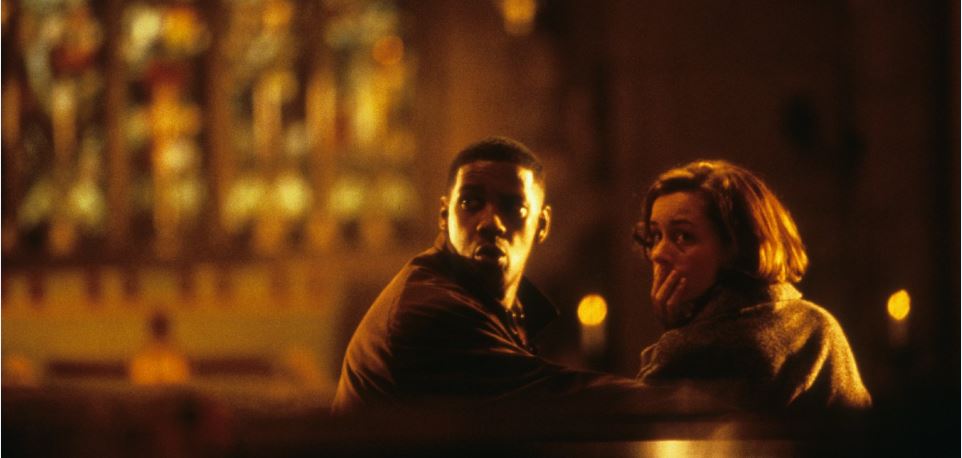
Denzel Washington and Embeth Davidtz on the run from a nasty Demon in Fallen

Director: Gregory Hoblit

Cast: Denzel Washington (Detective John Hobbes), John Goodman (Detective Jonesy), Donald Sutherland (Lt. Stanton), Embeth Davidtz (Gretta Milano), James Gandolfini (Lou), Elias Koteas (Edgar Reese), Gabriel Casseus (Art Hobbes)

Every so often, a film comes round that you know, while you watch it, is a fairly average, unspectacular piece of film-making. But for some reason something about the film just clicks with you and you end up enjoying something basically nothing special. For me, Fallen is one of those films.

What’s particularly nice about having this film as a bit of a guilty pleasure is, I’m pretty sure, most people have never heard of it. Detective John Hobbes (Denzel Washington) has recently been present at the execution of a notorious serial killer. Moments before his death, the killer grabs his hand and mutters a message in a strange language. As a copycat killer continues the crimes – and begins to frame Hobbes – the detective slowly realises his nemesis is no man, but a demon, able to possess humans by touch. He failed to possess Hobbes – and now wants to destroy his life.

There is nothing really new here: Hobbes is straight out of film noir, while the plotline of his mentally handicapped brother raising a son is pure TV-movie of the week. The demon possession idea is not exactly new (although it’s snazzily shot) and the demon quickly heads the way of most creatures in these films: foul-mouthed and delighting in sex and violence. There is a secret underground movement of those aware of the demons on Earth (fortunately we only see one of them) combatting their evil. Nothing really new.

But Fallen makes these elements seem somewhat fresh. The idea of the demon moving from person-to-person via touch is very interestingly presented. At one point Hobbes has a conversation with the demon, as it switches from host to host. Later Gretta (Embeth Davidtz) is pursued down the street by the demon, moving swiftly from person to person in a chain of touching hands. The various actors do a good job of conveying a single consistent character for the demon (fortunately he favours possessing recognisable character actors from US TV drama). Hoblit’s direction has plenty of these interesting new ways of presenting things. He’s also able to keep a good air of menace throughout the film.

It’s not perfect of course. The investigation of the demon’s background hits all the familiar beats from Dante to the Bible. Hobbes must be the only person in the world who (having decoded a message) has to ask A NUN whether the word “Apocalypse” means anything to her. A detective who has never heard of the word apocalypse? Times have changed: it’s the sub-title to a bad X-Men film now. At least one character is so obviously set-up as a candidate for long-term possession, you immediately suspect he’s innocent.

But the film has a fine closing scene, and a decent twist which plays with your initial expectations. It also gives you plenty of clues throughout (from the first shot of the film) about how the action might play out, more than enough for you to work it out for yourself. The idea of the “final confrontation in the wilderness” is again a familiar one, but the supernatural element makes this feel different. It’s actually a twist I didn’t see coming first time around (I was young at the time, not sure if I would be caught again today) – but it’s well presented and doesn’t cheat the audience.

Probably the main reason the film works so well though is Denzel Washington. Here is an actor giving a performance probably beyond the material, encouraging others to lift their game. He perfectly captures both Hobbes’ dedication and his purity of soul, with plenty of little touches that never feel heavy handed. He makes the plotline with his brother hugely sweet. He gets the balance just right between scepticism and dawning horror. It’s a real professional performance that plays off his charisma very well – imagine how awful it would have been with Keanu Reeves in the lead.

But I love that twist ending, and I’m a sucker for these demonic possession films (like disaster films or period epics) so I’ve seen this 3-4 times and really enjoyed it each time. As well as Washington, John Goodman and Embeth Davidtz give very good performances, and there is always enough mystery that you never feel you are racing  far ahead of the film (of course we know from day one it’s about demonic possession, but the characters never feel dense catching up with us). Fallen is a high quality piece of B-movie thrills. If you haven’t heard of it, do check it out.