Tag: Elizabeth Taylor

Father of the Bride (1950)

Father of the Bride (1950)

Gentle, well-made comedy is elevated by a star turn from Spencer Tracy

Director: Vincente Minnelli

Cast: Spencer Tracy (Stanley Banks), Joan Bennett (Ellie Banks), Elizabeth Taylor (Kay Banks), Don Taylor (Buckley Dunstan), Billie Burke (Doris Dunstan), Leo G. Carroll (Mr Massoula), Moroni Olsen (Herbert Dunstan), Melville Cooper (Mr Tringle)
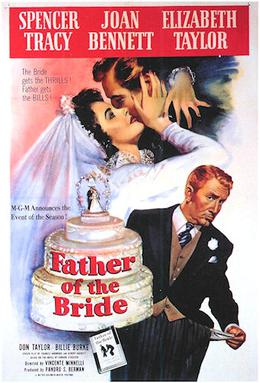
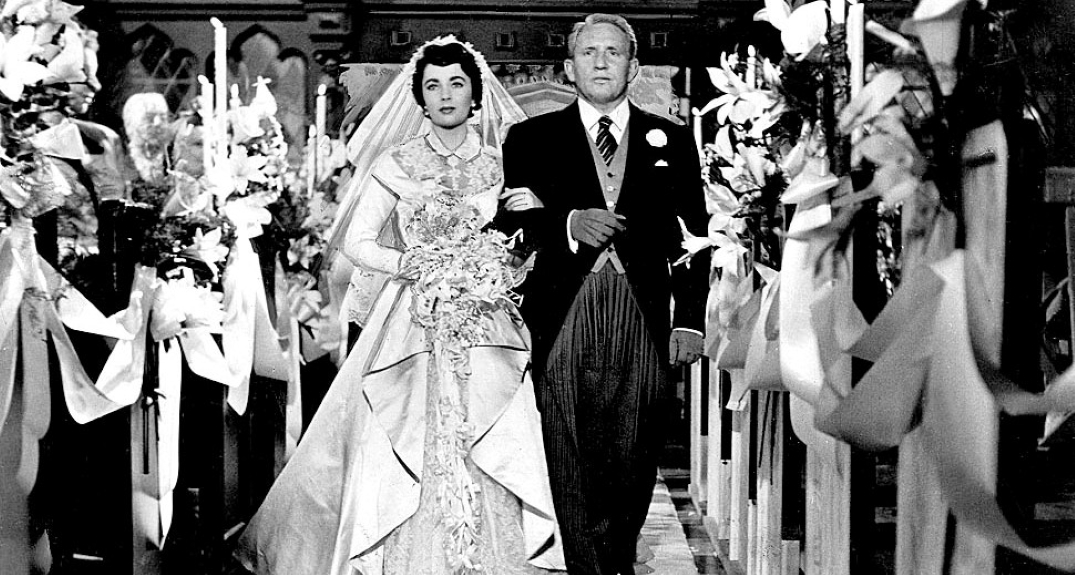
Apparently almost 70% of couples find wedding planning stressful. Perhaps they would be reassured to hear things haven’t changed much since the 1950s! Stanley Banks (Spencer Tracy) is a successful partner in a law firm whose domestic bliss is disrupted when daughter Kay (Elizabeth Taylor) announces she intends to marry boyfriend Buckley (Don Taylor). With the support of her mother Ellie (Joan Bennett), Kay dreams of a big church wedding – and Stanley is left counting the cost while struggling with his sadness at his daughter growing up and flying the nest for good.

Father of the Bride delightfully takes a simple idea and mines it for as much comic effect as possible. The structure is simple: the build-up to and staging of the wedding, with all absurdities of such things as fussy caterers and exacting church wardens pointed up. There are minor bumps and hiccups, but nothing that would make a viewer ever seriously worry that all will not turn out well. Instead, the film riffs on the constant exasperation of a father watching the plans (and cost) of the wedding spiral ever upwards, as more and more extras pile on top of others.

Much of its success is linked to Spencer Tracy, excellent as the eponymous father. The role was written for him and Minnelli demanded he should play it when producers suggested a more comic actor like Jack Benny might fit the bill better. (Katherine Hepburn did not take on the wife, though I can’t imagine she would found much to engage her in Joan Bennett’s underwritten role.) The entire success of the film revolves around our connection with Tracy, something never in doubt with his skill and assurance.

Minnelli cements this with an opening shot panning across wedding debris before craning up to introduce us to a fourth-wall breaking speech of resigned weariness from Tracy. His narrative voice is returned to again and again, as Tracy shares a wry and exasperated commentary. Father of the Bride is a testament to Tracy’s comic chops, his mastery of the micro-reaction providing constant laughs, from a look of disbelief across a dining table to one of shock as the latest bill flies in. It’s a hilariously effective performance, in which Tracy embraces the ridiculousness of farce. Like a practiced comedian he spays himself (three times) while attempting to open a coke or kids himself into believing he looks dandy in a morning suit several years too small for him.

But the performance – and the film – really works because Tracy also communicate its humanity. In his relationship with Elizabeth Taylor (suitably radiant as Kay, and full of a forceful personality she surely inherited from her father), Tracy makes clear his love for his daughter and his sadness at an end of an era: he won’t be ‘the man’ in her life anymore. Even with small inconsequential moments (such as Kay ignoring Stanley’s appeal to wear a coat before fetching it immediately when Buckley suggests the same), Tracy shows sadness dance across his face. The wedding is awash with bittersweet moments, with Tracy as harried host desperately attempting to speak with his daughter one last time before she leaves. Father of the Bride through Tracy’s performance mines a great deal of quiet, genuine emotion from a parent struggling with a child grown up.

It’s a bittersweet thread Minnelli’s film keeps pinging away under the comedy. Minnelli seems an unlikely choice (you’d expect a Cukor or Capra), but his skill with composition adds to the film without overwhelming the slender story with flash. The opening shot of wedding debris prepares us for the hustle and bustle of the big day, where a parade of carefully choreographed background events in the Banks’ house is as skilled as the bustling crowds of the event. Minnelli gives a Dali-inspired flair to Banks’ pre-wedding nightmare (his feet melting into the ground and clothes falling apart) and he plugs into Tracy’s reactive skill to frame these off-the-ball moments for maximum impact.

Editing also helps accentuate jokes. On hearing his daughter intends to marry, Banks reflects with horror on who this suitor might be, a montage of assorted suitors (from athletic, to bookish, to dancing) spooling past us. (The biggest joke now might be how utterly safe all these suitors are, the sort of lads you imagine fathers today would be desperate for daughters to bring home). Minnelli also fades in and out on blurry close-ups on glasses to communicate both the passing of time and Stanley’s rising inebriation (after a growing parade of martinis) when the Banks meet with Buckley’s parents.

This sort of comic energy helps carry the film very effectively. Of course it is all very simple – the 1991 remake added more moments of crisis and obstacles for the characters to overcome – and that can explain why events sometimes feel stretched out even over its slim 90-minute run time. For all the film’s tagline (“Bride gets the thrills; Father gets the bills!”) suggests frustration on Stanley’s part, moments where he weeds through a huge invite list (525!) or bemoans paying for an orchestra no one is listening to are generally underplayed (perhaps it was thought we could only sympathise so much before starting to think of Tracy as a penny pincher?)

But, overall, the film works very well indeed, mostly due to Spencer Tracy’s hugely effective performance – funny, endearing, likeable and hugely relatable with a perfect balance between comedy and emotional depth. It would have been nice to have had more of a contrast between Stanley and Buckley – when Buckley turns up to a heart-to-heart with father-in-law clutching a briefcase full of his work, I immediately thought ‘never has a woman more clearly married someone like her dad’. But what the film aims to do it, it succeeds at. And that’s to have some good-natured, heart-warming fun showing how even stars like Tracy can find weddings stressful.

Cat on a Hot Tin Roof (1958)

Cat on a Hot Tin Roof (1958)

Excellent acting almost saves a neutered, inverted version of Williams’ powerhouse play

Director: Richard Brooks

Cast: Elizabeth Taylor (Maggie Pollitt), Paul Newman (‘Brick’ Pollitt), Burl Ives (‘Big Daddy’ Pollitt), Jack Carson (‘Gooper’ Pollitt), Judith Anderson (‘Big Mama’ Pollitt), Madeleine Sherwood (Mae Flynn ‘Sister Woman’ Pollitt), Larry Gates (Dr Baugh), Vaughn Taylor (Deacon Davies)

There is a fun little anecdote of Tennessee Williams running into a crowd of people lined around the block to catch Cat on a Hot Tin Roof at their local multiplexes and loudly begging them “Go home! This movie will set the industry back 50 years!” You can sort of see why Williams was a bit pissed. It’s a miracle really that Cat on a Hot Tin Roof works at all. The studio snapped up this Broadway mega-hit and promptly instructed Richard Brooks to remove all the content that worked with a bunch of New York Times readers, but wasn’t going to fly in a mid-West fleapit. What we end up with is a curious, mis-aligned, neutered work that arguably inverts several of Williams’ points and is reliant on its incredibly strong, charismatic acting to work.

Brick (Paul Newman) is a former College sports star, now adrift in life, trapped in an unhappy marriage with Maggie (Elizabeth Taylor) who he resents and blames for the suicide of close friend Skipper. All Maggie’s attempts to rediscover any love is met with cold, blank disinterest as Brick hits the bottle big-time. Maggie keeps up the front of wedding bliss, as she is determined they will win their share of the inheritance from Brick’s father ‘Big Daddy’ (Burl Ives) who believes he’s merely under-the-weather, but is in fact dying. This news is also being kept from his devoted (but privately barely tolerated by Big Daddy) wife Big Mama (Judith Anderson), while Brick’s brother’s Gooper (Jack Carson) and his wife Mae Flynn (Madeline Sherwood) makes aggressive pitchs to cement Big Daddy’s fortune for themselves.

This simmering Broadway adaptation of a Southern family weighted down by lies (or mendacity as they love to call it), concealments and barely disguised resentments, was a smash hit but a very mixed film. It’s weighed down by both too much respect of the theatrical nature of the play, and too little interest in its actual message. Richard Brooks’ production largely restricts itself to interspersing wider shots with some reaction shots and sticks very much to its ‘same location for each act’ set-up. It’s a surprisingly conservative and safe re-staging of a hit play.

Despite Brooks’ liberal re-writing of the dialogue (of which more later), it remains a very theatrical rather than cinematic piece, largely devoid of imaginative editing or photography. The attempts to ‘open up’ the piece introduced by Brooks feel pointless or add very little (such as witnessing the accident where Brick breaks his leg or travelling to the airport to see the arrival of Big Daddy’s plane). Compared to the inventive and dynamic use of single-location shooting in Lumet’s 12 Angry Men, Cat on a Hot Tin Roof feels considerably more stately and reserved, and is far less successful in using the tricks of cinema to successfully build tension and conflict.

What it shares however with 12 Angry Men is the electric acting. Elizabeth Taylor gives one of her finest performances, her Maggie bubbling with sexual and emotional frustration, reduced to hurling physical and verbal punches at Brick in an attempt to get any sort of emotional rise out of him. She makes Maggie, for all her desperation and confusion, surprisingly sympathetic. Taylor manages to be both selfish and domineering while also showing how broken up Maggie is with shame and guilt. It’s a detailed, intense, passionate performance.

It also works perfectly opposite Paul Newman’s brooding intensity as Brick. This is the handsome, blue-eyed legend inverting his charisma into something insular, at times merely starring in self-loathing into the middle distance as other speak at him, only rarely rising to let rip at others with contempt and fury. Newman is a force of quiet, emotional anger, even if (stripped of his character’s primary motivation) he comes across at times like a spoilt child who never really grew up rather than the tortured man trapped in a lie of a life, that Williams intended (Brooks even frames him at one point with a high-school football of himself behind him, his past literally haunting him).

Burl Ives would certainly have won an Oscar for this, if he hadn’t won that year for The Big Country. Recreating his Tony Award winning role, he’s a whirligig force of nature as Big Daddy, bullishly insistent on getting his own way, shrugging off with irritation his wife’s affection (an effectively unsettled Judith Anderson) and hiding his own fear at oncoming death in a relentless pursuit of the future. Ives also nails Big Daddy’s outstanding late speeches, investing them with a deep sense of melancholy and sadness under the bombast and strength. It’s a great performance. Jack Carson is perfectly, anonymously uninteresting as ‘other son’ Gooper and Madeline Sherwood hits the beats of shrill hostility she’s asked for as his wife Mae Flynn.

That these performances work so well is a tribute to the underlying strength of a play that has been radically, almost disastrously, lobotomised by Brooks into something that flattens, blurs and (at points) radically inverts the intention. Putting it bluntly, Williams’ original used Brick’s unspoken (perhaps even subconscious) homosexual attraction to Skipper as the root cause of his disastrous marriage and booze-laden depression. Maggie, all too-aware of her husband’s sexual orientation, fumes in frustration at his lack of interest in making the inheritance-required babies. Even Big Daddy suspects this massive unspoken secret at the heart of a family. The fact this remains unspoken to the end, that the characters carry on with the fake fiction of the Pollitt dynasty is a damning indictment of the hypocrisy of American family life.

That wasn’t going to wash in Hollywood. No hint of Brick’s homosexuality could be allowed: in fact, Newman’s heteronormative virility is repeatedly stressed (at one point he even embraces Maggie’s dressing gown in romantic longing). It weakens both characters – for all the skill of Newman and Taylor, it makes both characters shallower, two people letting sulks and pride stand between happiness, rather than two people trapped into a doomed cycle. The film resolutely associates happiness with love and duty to the family unit, emphatically not what Williams’ play suggested.

No wonder he was pissed. A daring play about Southern family hypocrisy and buried secrets, where the burden of the family is a deadweight crushing people is turned into a straight (in every sense) celebration of it. It makes the play a conservative, reassuring lie, as much as a mendacity as the characters talk about. So maybe Williams was right to berate that crowd. Still it pissed Brooks off mightily: he pithily retorted it was a bit rich of Williams to kick up such fuss over a film which made him very wealthy. I guess at least there Brooks makes a strong point.

The Taming of the Shrew (1967)

The Taming of the Shrew (1967)

Burton and Taylor are perfect casting in this rollicking adaptation of Shakespeare’s most difficult comedy

Director: Franco Zeffirelli

Cast: Elizabeth Taylor (Kate), Richard Burton (Petruchio), Cyril Cusack (Grumio), Michael Hordern (Baptista Minola), Alfred Lynch (Tranio), Alan Webb (Gremio), Michael York (Lucentio), Natasha Pyne (Bianca), Victor Spinetti (Hortensio), Roy Holder (Biondello), Mark Dignam (Vincentio), Vernon Dobtcheff (Pedant), Bice Valori (Widow)

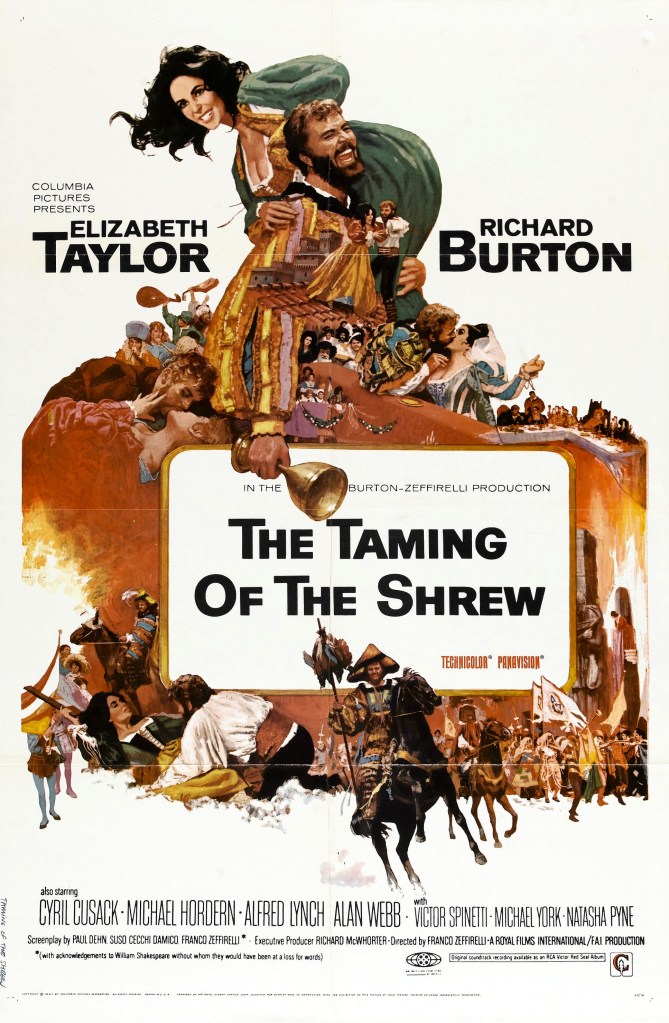
There’s a reason why the poster screamed “The motion picture they were made for!” Who else could play literature’s most tempestuous couple, than the world’s most tempestuous couple? After all, they rolled into this straight off the success of Who’s Afraid of Virginia Woolf? and, say what you like, a knock-about piece of Shakespearean farce is certainly more fun than two hours of Edward Albee. So, Burton and Taylor turned up in Italy, entourage in hand, to bring The Taming of the Shrew to life in a gorgeous explosion of grand sets and wonderfully detailed costumes.

The Taming of the Shrew actually translates well to the screen – and Zeffirelli’s high-octane style. Odd to think now, for a film soaked in elaborate period setting, that in the 60s Zeffirelli’s style was seen as border-line sacrilegious to the Bard. He actually escaped with less opprobrium from the critics than he faced for cutting two-thirds of Romeo and Juliet a year later, since most seemed to think Shrew was less of a holy text. Not that it stopped a lot of critics reckoning Zeffirelli should focus more on executing every pentameter to perfection and less on gags and visual story-telling.

But actually, that’s perfect for a story that was always a raucous farce at heart – so much so, even the original play presents it as a play-within-a-play told to a drunken Christopher Sly (cut here). The bawdiness feels fresh out of Chaucer and Boccaccio, a parade of people in period costumes slapping thighs, roaring with laughter, double taking and enjoying a series of cheeky jokes (did Pasolini watch this before making his lusty adaptations?). Padua is a city of sin, with prostitutes openly advertising their wares (and later, clearly, invited to Bianca’s wedding) and a wife-stealer is in the stocks.

Zeffirelli’s Shrew is full of rowdy wildness – in a nod to the cut Sly framing device, Padua is in the midst of a feast of fools, students turning a choral sing-along into a drunken celebration. Kate and Petruchio’s high-octane gunning for each other, feels fitting for a location where everyone is careering wildly towards the target of their immediate emotions, either horny beyond belief, desperate to marry off daughters or furious at supposed crimes or betrayals.

The age-old question you have when staging Shrew is what to do about its fundamental misogyny (and it’s hard not to argue, much as the bard’s defenders have tried, not to see it as a play deeply rooted in the patriarchy). Zeffirelli’s solution is an intriguing one: his Shrew is enigmatic, with Kate’s motivations, feelings and reasonings often left cleverly open to interpretation. It’s also helped, of course, by the natural chemistry between the two leads. If there is one thing we all know, it’s that Burton and Taylor were really into each other and drove each other up the wall. What Shrew does here is take that sexual force and exuberance of its leads and balances that with a subtle unreadable quality to Kate that leaves the relationship’s power-balance just open enough to interpretation.

In addition, the film makes clear Kate’s behaviour is unacceptable, introduced screaming abuse from a window and smashing up all the furniture in a room in a fit of furious pique. There’s a lovely touch where Petruchio stares into his own reflection, while planning his campaign – a nice suggestion that he will mirror her behaviour to show its unacceptability (indeed, on returning to their marriage home, he’ll also twice smash up a room’s contents in a pointless display of adolescent petulance). Kate has, to put it bluntly, anger management issues and if Petruchio’s methods are extreme you can see the twisted logic.

Their first meeting sets a pacey tone that will run through the whole film. It’s a wild chase through the Baptista home, through a connected wool barn, over a roof and back again. One in which they will bellow at each other, Kate will rip up planks and bannisters to throw at him, they’ll roll in the wool (hard not to see a sexual charge here) and eventually collapse through the roof to land back in the wool. Petruchio will then announce her consent to marry with an arm twisted round her back, just as he will cut off her refusal at the altar with a kiss (the wedding scene is a neat interpolation, showing something the Bard only reports). They are in a constant pursuit of sorts from here, from the back-and-forth at Petruchio’s house, to the journey to Padua and then finally through a crowd of women at the film’s end. But where does the power lie: pursued or pursuer?

At first, of course, with the pursuer. Burton’s Petruchio is a wild-eyed force-of-nature, permanently partly sozzled (Burton spends most of the film with a pale, damp drinking sweat that was probably not acting), his tights full of holes, his manners rude (he’s basically Christopher Sly in the lead role), focused on the money he’ll get from wooing Kate. But, while he’s a powerful alpha male, it’s remarkable how the balance slowly shifts to Kate. After their arrival at his home (she, soaking wet after falling in a puddle to Petruchio’s laughter), she puts her drunken husband to bed, has the house redecorated, the servants redressed and everything arranged to her liking.

Taylor’s performance here adds to the effect. It’s an intelligent, camera-wise performance which uses looks to convey Kate’s loneliness and pain. Locked in a room before the wedding, she glances out of a window with aching sadness. She looks with gentle envy at warm friendship in others. Taylor gives a wonderfully calm, genuine delivery of the famous closing speech of wifely piety. But it’s words are undermined in two ways: firstly by the suspicion it’s partly done to show-up the jokes against her throughout the wedding, and then by Taylor’s immediate departure after kissing a finally flabbergasted Petruchio, leaving our macho hero wading through a pile of laughing women in a desperate attempt to catch-up. Who might just rule here, long term?

Zeffirelli’s film moves the Lucentio (a wide-eyed Michael York) sub-plot even further to the margins – in a neat invention, Petruchio during the first chase, keeps barging in on rooms where different sub-plot scenes are all going on at the same time. As a result, this does mean a number of first-rate actors get very little to do: Cyril Cusack’s Grumio becomes a grinning observer of the chaos, Alfred Lynch’s Tranio (after some initial fourth-wall breaking) fades into the background, Michael Hordern has little to do but look aghast as a desperate Minola, Alan Webb barely registers as a rejected suitor while after an initial sight gag (his minstrel player disguise making him look like the fifth Beatle) Victor Spinetti gets similarly fades away.

But then audiences were here for the Burton-Taylor show, and they get that in spades: framed within a medieval setting inspired by classical painting (and which features an obviously fake backdrop for its countryside exteriors). And The Taming of the Shrew is rollicking good fun, which manages to work an interesting line on the play’s troublesome sexual politics, suggesting that all but not always be as it seems. And it nails the atmosphere of rollicking fun in this ribald Shakespeare yarn.

A Place in the Sun (1951)

A Place in the Sun (1951)

A great Hollywood romance obscures darker, more sinister implications that its makers seem unaware of

Director: George Stevens

Cast: Montgomery Clift (George Eastman), Elizabeth Taylor (Angela Vickers), Shelley Winters (Alice Tripp), Anne Revere (Hannah Eastman), Keefe Brasselle (Earl Eastman), Fred Clark (Bellows), Raymond Burr (DA Frank Marlowe), Herbert Hayes (Charles Eastman), Shepperd Strudwick (Tony Vickers), Frieda Inescort (Ann Vickers)

It’s based on Theodore Dreiser’s An American Tragedy, but in some ways it feels like very British. After all, few American films are more aware of class than A Place in the Sun and there is something very British about a working-class man pressing his nose up against the window of the wealthy and wishing he could have a bit of that. In some ways, A Place in the Sun’s George Eastman is a more desperate version of Kind Heart’s and Coronets Louis desperate to be a D’Ascoynes or a murderous version of Room at the Top’s Joe Lampton not wanting his girlfriend to get in the way of wooing a better prospect. The most American thing about A Place in the Sun it is that what would be a black comedy or a bitter drama in Britain, becomes a tragic romance in George Steven’s hands.

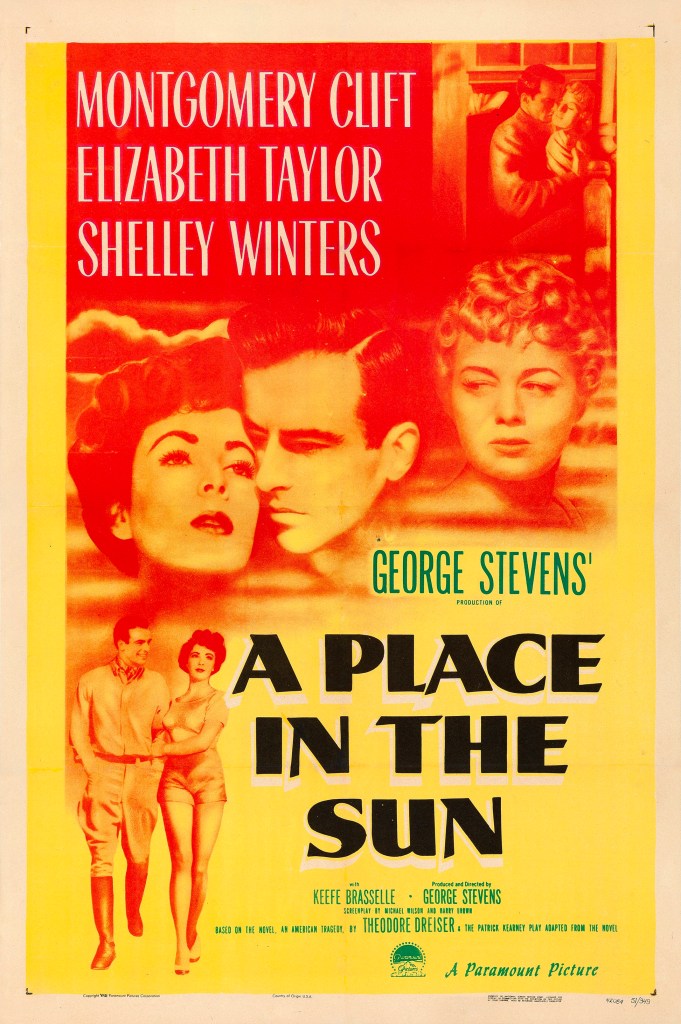
George Eastman (Montgomery Clift) is from the black sheep working-class side of the Eastman clan, rather than the factory-owning elite side who live among the city’s hoi polloi. George is gifted an entry-level grunt job in the factory but works hard for progression. He absent-mindedly dates production line co-worker Alice (Shelley Winters), who thinks he’s the bee’s knees. Unfortunately for her, George meets Angela Vickers (Elizabeth Taylor), daughter of the wealthy Vickers family, and they fall passionately in love. Just as Alice announces she’s pregnant and asks when George will do the decent thing. Can George thread this needle, rid himself of Alice and marry the willing Angela? Perhaps with the help of the Eastman’s lake side house and Alice’s inability to swim?

You can see the roots of a cynical tale of opportunism and ambition there, but A Place in the Sun wants to become a luscious romance. It is shot with radiant beauty by William C. Mellor, bringing us sensually up-close with Clift and Taylor whose chemistry pours off the screen. It’s soundtracked by a passionately seductive score by Franx Waxman. As we watch these two fall into each other’s arms, the film tricks us (and, I think, itself) into thinking these two lovers deserve to be together. And, by extension, everyone would be much better off if Shelley Winter’s gratingly needy Alice, who can’t hold a candle to Elizabeth Taylor’s grace, charm and beauty, just disappeared. Before we realise it, we and the film are silently rooting for a man with fatal plans to rid himself of this encumbrance.

What’s striking reading about A Place in the Sun is that Clift felt Eastman, far from a sympathetic romantic, was an ambitious social-climber (much like his role in The Heiress) too feckless, weak and cowardly to face up to his responsibilities. Clift’s performance captures this perfectly: at the height of his method-acting loyalty, Clift is sweaty, shifty and increasingly guilt-ridden with Alice, awkwardly mumbling platitudes rather than talking (or taking) action. It’s actually a superb performance of people-pleasing weakness from Clift. Eastman always says what those around him want to hear, whether it overlaps with what he believes or not. He can say sweet nothings to Alice and romantic longings to Angela. This is a great performance of an actor being, in many ways, more clear-eyed than the film about what the story is really about: a man who decides the best way to deal with the inconvenience of a pregnant girlfriend is to drown her.

What Clift didn’t anticipate is how much the power of photography and editing (not to mention the radiance of his and Taylor’s handsomeness) would mean many viewers would end up rooting for the selfish romantic dreams of this weak-willed heel. Steven’s film turns the Clift-Taylor romance into a golden-age Hollywood dream. Taylor, at her most radiant, makes Angela possibly the nicest, kindest, most egalitarian rich girl you can imagine. Their undeniable click is there from their first real encounter (Angela watching George absent-mindedly sink a cool trick shot at an abandoned pool table – how many takes did that take?). The sequences of these two together play out like a classic idyll, from slow-dancing at glamourous parties to lakeside smooching. Everything about what we are seeing is programming us to root for them – and I’m not sure Stevens realises the implications.

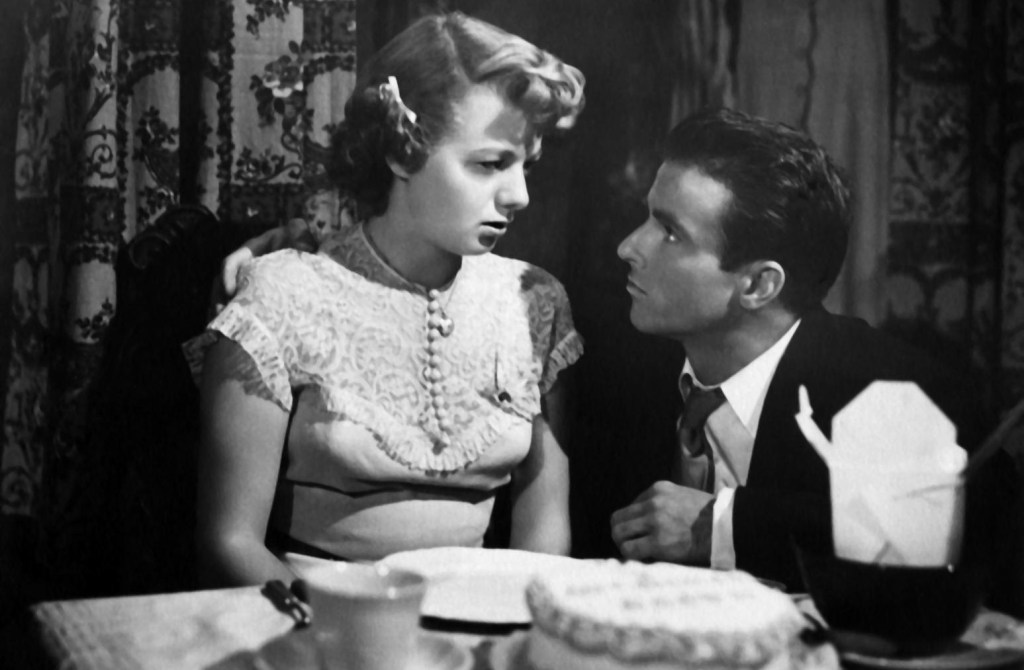
If we are being encouraged to relate to Clift and Taylor, everything in Shelley Winter’s Alice is designed to make us see her not want to be her. Winters lobbied for the part, desperate for a role to take her away from shallow romantic parts – ironically her success pigeon-holed her to dowdy, needy second-choice women, deluded wives and desperate spinsters. But she’s superb here, making Alice just engaging enough for us to imagine George would take a break from his self-improvement books, but also so fragile and needy we can believe she’d become both increasingly desperate and annoying. Angela, dancing radiantly at parties, is who we want to be: Alice, sitting up late in her cramped flat with a try-hard birthday dinner and carefully chosen gift waiting for the arrival of an indifferent George, is who we fear we are. If movies are an escape, we don’t choose her.

Steven’s film makes Alice’s pregnancy more and more a trap. (The film carefully skirts the much discussed but never named abortion option). When on the phone together, the camera tracks slowly into George as he huddles against a wall mumbling, the film’s world shrinking with his. In one of the film’s many beautifully chosen Murnau-inspired super-impositions, Alice appears like a ghost over George and Angela at the river. Alice’s increasingly fractious demands that George do his duty and marry her, with increasingly wild threats of social disgrace interspersed with her grating, desperate neediness makes us cringe with him. Possibly because we worry we’d be like her.

A Place in the Sun makes us root for a man plotting murder and guilty, at the very least, of manslaughter. That could make it the most subversive romance of all time – if it wasn’t for the fact that, even in the end, George is presented as the real victim. Even a priest gives him only a few words of criticism, while George is not even punished by losing the love of the faithful and trusting Angela. Even if George didn’t push Alice in, he also didn’t lift a finger to save her life. In the trial, Raymond Burr’s showboating DA helps us pity George as he presents a version of that fateful boat trip that we know isn’t true but is only a few degrees more horrible than what George actually did. Even his guards feel sorry for him, and Steven’s clunkily intercuts between George’s dutifully honest working-class family and the wealth of his rich uncle’s circuit to hammer home the tragedy.

Did Stevens realise all of this as he made the film? I’d argue possible not: that he was as much sucked into the romance as the viewing audience. But some American movies embrace optimism – and an American tragedy in that world is lovers kept apart. A British tragedy is an ambitious man destroying himself and others. There is a smarter, more ruthless film to be made from the material of A Place in the Sun. One where Clift’s George is a truly heartless go-getter and both Alice and Angela are different types of victim. And that would be American to: it would be one which consciously shows us how our longing for fairy tales and the American Dream can lead to perverse, outrageous outcomes. That film would be a masterpiece, rather than the unsettling work A Place in the Sun actually is.

Cleopatra (1963)

Cleopatra (1963)

The biggest epic of them all – and one of the most infamous – is a mess but at times entertaining

Director: Joseph L Mankiewicz

Cast: Elizabeth Taylor (Cleopatra), Richard Burton (Mark Antony), Rex Harrison (Julius Caesar), Roddy McDowell (Octavian), Pamela Brown (High Priestess), George Cole (Flavius), Hume Cronyn (Sosigenes), Cesare Danova (Apollodorus), Kenneth Haigh (Brutus), Andrew Keir (Agrippa), Martin Landau (Rufio), Robert Stephens (Germanicus), Francesca Annis (Eiras), Isabelle Cooley (Charmian), Jacqui Chan (Lotos), Andrew Faulds (Canidius)

One of the most legendary epics of all time – for all the wrong reasons. Cleopatra is the mega-budget extravaganza that nearly sunk a studio, years in its shambolic, crisis-hit making that turned its stars into a celebrity brand that changed their lives forever. Painfully long, it’s a rambling, confused film that feels like something that was filmed before anyone had the faintest idea what the story they were trying to tell was. Then, just when you consider giving up on it, it will throw in a striking scene or intelligent performance and you’ll sit up and be entertained. Just never quite enough.

In its four hours it covers eighteen years. Julius Caesar (Rex Harrison) arrives in Egypt after victory over his rival Pompey at the Battle of Pharsalus. There he quickly becomes enamoured with Cleopatra (Elizabeth Taylor), the cunning, intelligent witty sister of bratty Pharoah Ptolemy XIII (Richard O‘Sullivan). Caesar takes Cleopatra’s side in the civil war for the Egyptian throne and takes her as a second wife, having a son (and potential heir) with her. Made dictator for life, he and Cleopatra return to Rome – where is assassinated. A friendless Cleopatra finds herself drawn towards Caesar’s deputy Mark Antony (Richard Burton), the two of them starting a passionate affair that will tear the Roman world apart and lead them into a civil war against Caesar’s politically astute but coldly realpolitik nephew (and official heir) Octavian (Roddy McDowell).

Cleopatra’s shoot – and the hullabaloo of press interest around it – is almost more famous (and perhaps more interesting) than the film itself. After a long gestation, filming started in London under the direction of veteran Rouben Mamoulian, with Taylor on board (for a bank-busting fee) with Peter Finch as Caesar and Stephen Boyd as Antony. Then it all fell apart. Taylor caught meningitis in the cold conditions, nearly died and the film nearly collapsed. The script was rewritten (again), Mamoulian, Finch and Boyd all left. Joseph L Mankiewicz came on board to write and direct, London filming (and all the sets) was junked and production moved to Rome. This all took a year.

In Rome, Rex Harrison and Richard Burton joined the cast as shooting began again practically from scratch. The planning however had been so laborious that Mankiewicz hadn’t been able to finish the script. So, instead, he decided to start shooting what he had and write the rest as he went. Sets were built for unwritten scenes and money continued to pour down the drain. This also meant a huge amount of hanging around for all concerned, spare time Burton and Taylor used to start a tabloid-filling affair which became the talk of the world. After nearly two years of filming, the studio ended up with millions of feet of film, a feud over whether to release two films or one long one and no-one with any real idea why they had made the film in the first place.

And God you can tell watching it. Cleopatra is an over-extended, rather unfocused mess that feels like the compromise product it is. What is this film trying to say? No one seems to know, least of all Mankiewicz. Is this an elegy to the loss of the Roman republic? Hardly when Caesar is presented as sympathetically as he is. Was the film looking to explore Antony and Cleopatra as tragic lovers or deluded would-be emperor builders? God alone knows. Is Cleopatra a temptress or a genius, a chancer or a political genius? No idea. Her infinite variety here is basically to be whatever the scene requires at the time, all wrapped up in Taylor’s effortless charisma.

Mankiewicz’s script – presumably written and then filmed almost immediately in many cases – falls back onto what he was comfortable with. Dialogue scenes are frequently over-written and over-long, so intricately constructed it was impossible to cut them down and still have them make sense.  The man who rose to the height of his profession directing witty conversation pieces in rooms, tried to do the same with his three leads in these massive sets. Acres of screen time stretch out as combinations of three leads spout mountains of dialogue at each other, often to very little dramatic impact. To keep the pace up, the film is frequently forced to take huge time-jumps.

Empires rise and fall in the gaps between scenes, armies assemble and are defeated in the blink of an eye. At one point Caesar and Cleopatra find a murdered character in the garden – the impact rather lost on the audience as this character is never mentioned before or after this. Years fly by and characters swiftly report off-screen events of momentous import, from Antony’s marriage and peace with Octavian to Caesar’s victory over Ptolomy. Caesar himself is murdered – Kenneth Haigh leads a series of stalwart British character actors in glorified cameos – in a silent ‘vision’ witnessed by Cleopatra, that cuts to Antony’s briefly shouting (unheard) his funeral oration (this at least means we don’t need to hear cod-Shakespearean dialogue in either scene).

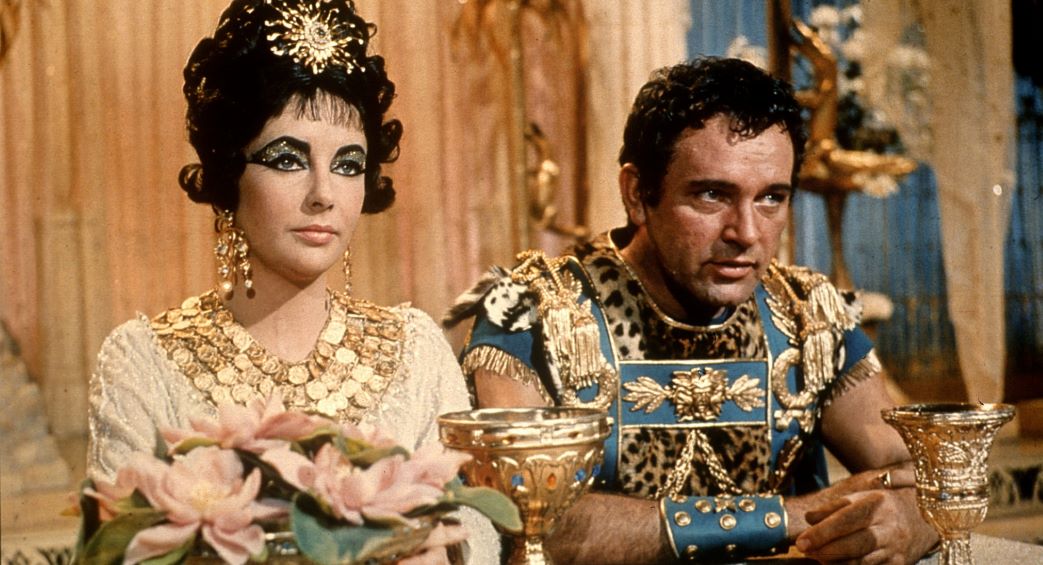
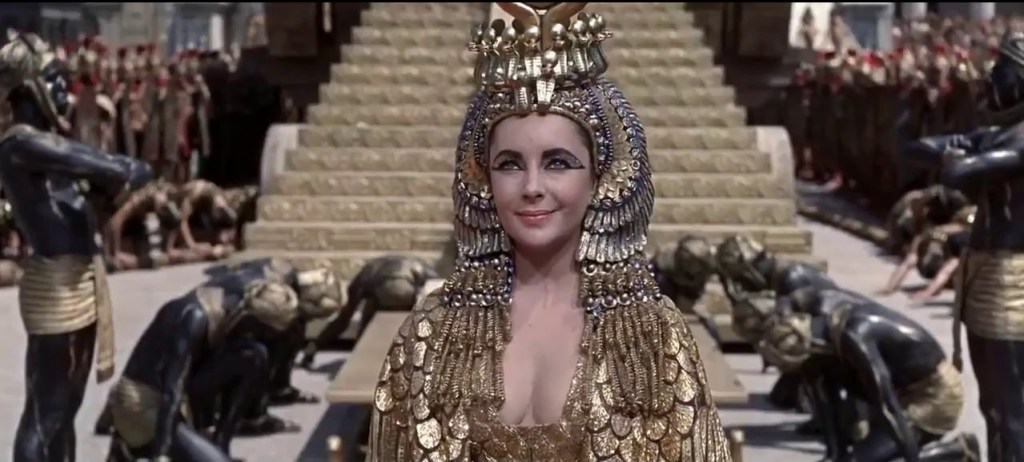
The other thing that couldn’t be cut was the film’s epic scale. Cleopatra’s entrance to Rome plays out nearly in real time, a never-ending procession of flights of fancy parading into the capital capped with Taylor’s cheeky grin at the end of it at Cleopatra’s panache. The battle of Actium looks impressive – with its boat clashes, flaming ships and colliding vessels – so much so that you almost regret we don’t get to see more of Pharsalus and Philippi than their aftermaths. The huge sets are striking, as are the legion of costumes Taylor has to change into virtually from scene to scene.

Of course, what people were – and always are – interested in is how much the fire off-stage between Burton and Taylor made it to the screen. I’ve honestly always felt, not much. Perhaps by this point both actors were too fed up and punch-drunk from the never-ending project. Perhaps they simply didn’t have any interest in the film. Burton falls back on grandstanding – he confessed he felt he only learned how to act on film from watching Taylor. Taylor is undeniably modern in every frame, but she somehow manages to hold a rather loosely defined character together, so much so that you forget she’s fundamentally miscast.

Of the leads Rex Harrison emerges best as an avuncular Caesar whose well-spoken wit hides an icy interior overflowing with ruthlessness and ambition. The film loses something when he departs just before the half-way mark. (It’s a mark, by the way, of the film’s confused structure that Burton only appears an hour into the film – and that for an inconsequential “plot update” chat with Caesar’s wife Calpurnia). There are decent turns from Cronyn as Cleopatra’ advisor, Pamela Brown as a Priestess, Andrew Faulds as a gruff Agrippa and even George Cole as Caesar’s trusted, mute servant. Best in show is probably Roddy McDowell’s ice cold Octavian – like a version of Harrison’s Caesar with all charm removed – who would have certainly been an Oscar nominated if the studio hadn’t screwed up his nomination papers.

Cleopatra still ended up with multiple Oscar nominations – even some wins – but took years to make back the money blown on it. At four hours, it bites off way more than it can chew and vey rarely comes together into a coherent shape. Scenes alternate between too short and way too long and three leads with very different acting styles struggle to make the best of it. You feel watching it actually sorry for Mankiewicz: it’s not really his fault, the scale of this thing would have sunk any director. Cleopatra has flashes of enjoyment, but much of it drags for the viewer as much as it did for those making it.

Who’s Afraid of Virginia Woolf? (1966)

Burton and Taylor play a feuding couple in Who’s Afraid of Virginia Woolf?

Director: Mike Nichols

Cast: Elizabeth Taylor (Martha), Richard Burton (George), George Segal (Nick), Sandy Dennis (Honey)

In 1966, Hollywood was only just emerging from the strict rules of the Hays Code. These governed everything from the themes a film could explore to the language you could use while doing it. But in the permissive 60s, it was finally beginning to crack – and Who’s Afraid of Virginia Woolf? was one of the first films to really push it over the edge. This film helped usher in 70s Hollywood, where filmmakers finally felt empowered to explore darker themes and to do so with sex, violence and bad language. Five years after this film came out, something like A Clockwork Orange could become a box-office smash and a Best Picture nominee. Talk about the changing of the guard.

Mike Nichols’ film debut is a faithful adaptation of Edward Albee’s Broadway smash, which had been controversial enough on stage for its full and frank exploration of a marriage consumed with bitterness, feuding and pain. Not to mention its open acknowledgement of extra marital sex, abortion and alcoholism all delivered with a literal “screw you!”. Elizabeth Taylor is Martha, daughter of the president of a small New England college, whose husband George (Richard Burton) is a failed associate history professor. The couple are locked into a dysfunctional marriage that mixes recrimination and a perverse, shared sense of humour. Drunkenly returning home after a party, they welcome a new professor (George Segal) and his wife (Sandy Dennis) to their home for a nightcap. There they quickly rope the couple into a series of increasingly personal “games” with an edge of cruelty and lashings of verbal abuse.

Today, Who’s Afraid of Virginia Woolf? has not always aged well, coming across at times as rather forced and overbearing, as is often the way with films that pushed the boundaries so effectively back in the day. Nichols has the confidence to avoid “opening up” the play too much – its single setting on stage is augmented here only with a brief drunken excursion out to a late night bar – and instead focuses on drawing out four superb performances from its actors (all Oscar nominated) and letting the camera move intricately around the confined rooms where the action takes place.

What Nichols really draws superbly from this film is the control of the film’s continual pattern of simmer, tension and release. The play is effectively a series of psychological games that George and Martha play between themselves. The film is like a drunken, truly mean-spirited version of Noel Coward’s Hay Fever, where the self-absorbed hosts similarly play elaborate ”games” with their confused guests. Most games involves Martha and George turning on each other, viciously attacking the other for everything from failure to drunkenness, with their guests used as the jury, mixed with “get the guests” interludes as the couple turn on the sexual and marital issues in their guests’ lives.

It makes for a series of compellingly delivered sequences – even if the constant thrum of tension and heightened half-mock, half-real fury Martha and George keep up for most of the film finally starts to bear down on the viewer. The film starts banging its points with a transgressive pride, which looks like increasingly like a lot of sound and fury over quite minor issues. But then that’s always the way with convention defying films – so many following films have buried these conventions, that the attention grabbing way this film does it looks quite tired and overworked today.

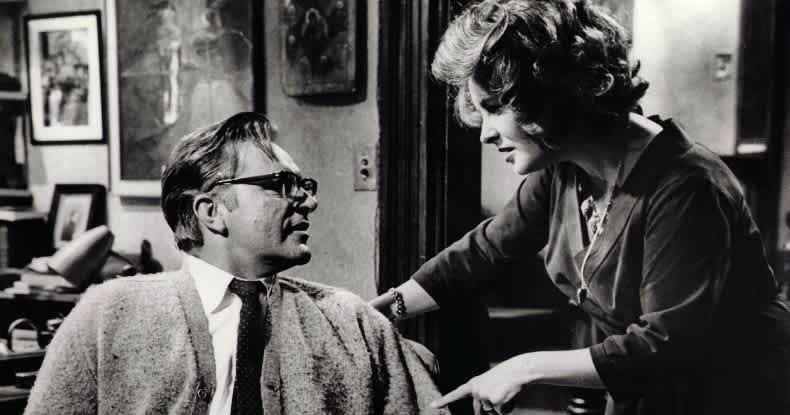
As Martha and George, Nichols was able to cast the most famous married couple on the planet at the time, in Elizabeth Taylor and Richard Burton. With these titanic personalities working – for perhaps the only time – with a director who had the skill and authority to tame them, the two of them delivered probably their finest performances on film. It also adds to the illicit sense for the audience – like Nick and Honey – that we are trapped into seeing a series of personal and intense conversations and arguments. 

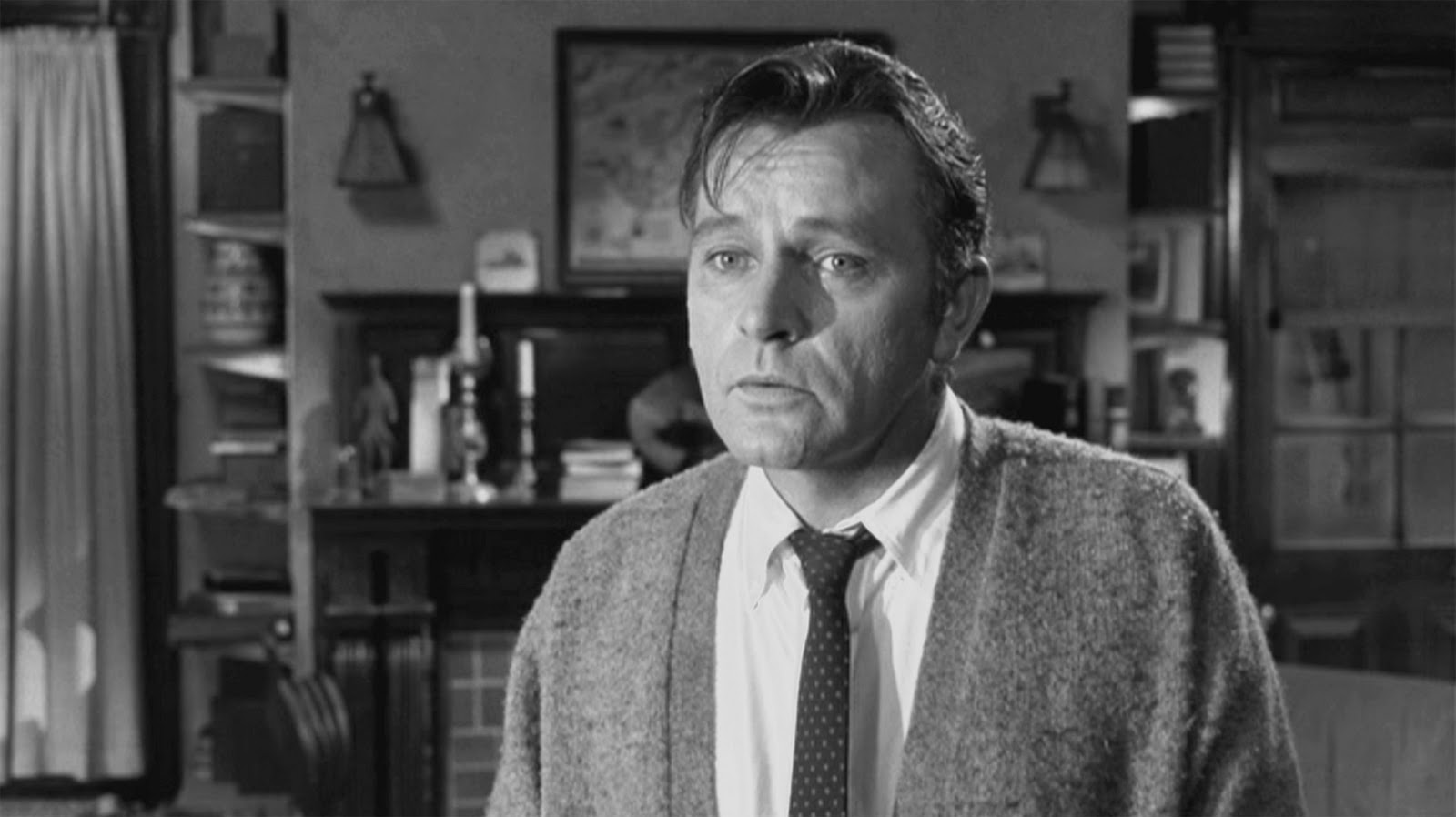
Finally accepting the sort of intense and challenging material he often overlooked for well-paid gigs, Burton is superb as George: a mass of passive aggression, condescending to everyone around him, capable of great cruelty but also a crushed, disappointed and vulnerable man, desperate for affection.

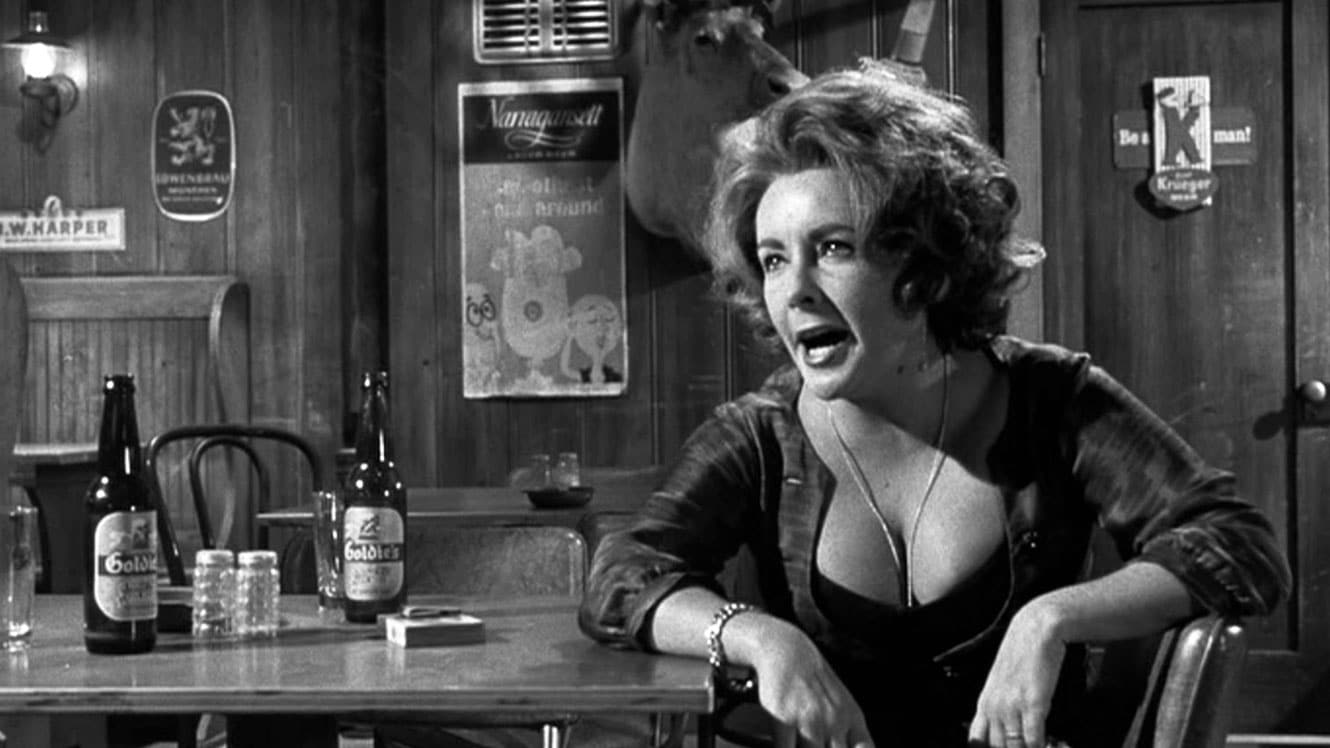
Elizabeth Taylor was similarly sensational – and Oscar-winning: puffy faced, blowsy and domineering as Martha, who similarly has buried her pain and loneliness under a never ending onslaught of aggression, mockery, tartiness and loudness. Brassy and bold, Martha at first seems the controlling, even abusive force in the relationship, but she is also isolated, scared and overwhelmed with pain. 

What’s brilliant about the relationship between the couple is at first it seems like George and Martha are a deeply unhappy couple, fuelled by hate. However, it becomes clear their feuding and contempt for each other is in fact part of a relationship grounded on mutual love and need (the final shot is their hands joined together), revolving around their mutual shared pain on their failure to have children. The couple’s primary “game” is a private one – a fictional child, invented to compensate for their mutual infertility – discussion of whom early on by Martha opens the door to the fury that follows. But it gives an insight into their relationship, actually kept fresh by their feuding.

By contrast, it’s the seemingly happier young couple who have serious problems. Nick, very well played by George Segal, is a dashing young buck who is actually selfish and, with a dream of sleeping his way to the top (despite his possible impotence), whose lack of depth is routinely savaged by both Martha and George. Despite this, Nick doesn’t seem to realise that this he’s in the middle of a series of games. He’s married his wife out of obligation for her pregnancy. Honey – an Oscar-winning turn by Sandy Dennis – on the other hand seems to be aware she’s out of his depth here, and reverts into an almost childish passiveness, mixed with awkward horror which slowly peels away to reveal her misery and depression. Slowly we realise Nick and Honey have nothing in common.

It’s a complex and intriguing play, brilliantly bought to the screen by Nichols whose camera (in stark black and white) bobs and weaves through the action, involving each actor in every scene (the camera often focuses on reactions as much as dialogue delivery). All four of the actors are great, but Burton and Taylor are nothing less than sensational (ironically their careers never seemed to recover from the amount they put out there, with more than a few speculating that their own marriage was but a few degrees different from George and Martha) and the film itself, while overbearing, is also still compelling in its complexity and stark insight into human relationships.

Ivanhoe (1952)


Robert Taylor and Elizabeth Taylor (no relation) fighting for Good Old England

Director: Richard Thorpe

Cast: Robert Taylor (Sir Wilfred of Ivanhoe), Elizabeth Taylor (Rebecca), Joan Fontaine (Rowena), George Sanders (Sir Brian De Bois-Guilbert), Guy Rolfe (Prince John), Emlyn Williams (Wamba), Robert Douglas (Sir Hugh De Bracy), Finlay Currie (Sir Cedric of Ivanhoe), Felix Aylmer (Isaac of York), Norman Wooland (King Richard), Basil Sydney (Waldemar Fitzurse), Harold Warrender (Robin Hood)

Adapted (very loosely) from Sir Walter Scott’s novel, Ivanhoe was another instalment in Hollywood’s battle to drag people away from their new-fangled TV sets. This rivalry meant technicolour spectacles like this were the most valued animals in a studio’s stable, which probably explains why Ivanhoe was the MGM film nominated for Best Picture in 1952, while The Bad and the Beautiful (which set a record for most Oscar wins for a film not nominated for Best Picture) and, almost unbelievably, Singin’ In the Rain were overlooked.

Noble knight Ivanhoe (Robert Taylor) finds Richard the Lionheart (Norman Wooland) locked up in Austria. Returning to England, he looks to raise funds to rescue the King – mostly by putting the gentle squeeze on Jewish banker Isaac of York (Felix Aylmer) while flirting with his daughter Rebecca (Elizabeth Taylor). He must also reconcile with his father (Finlay Currie) and his sweetheart Rowena (Joan Fontaine), and prevent wicked Prince John (Guy Rolfe) and his sidekick Sir Brian (George Sanders) from taking control of the Kingdom.

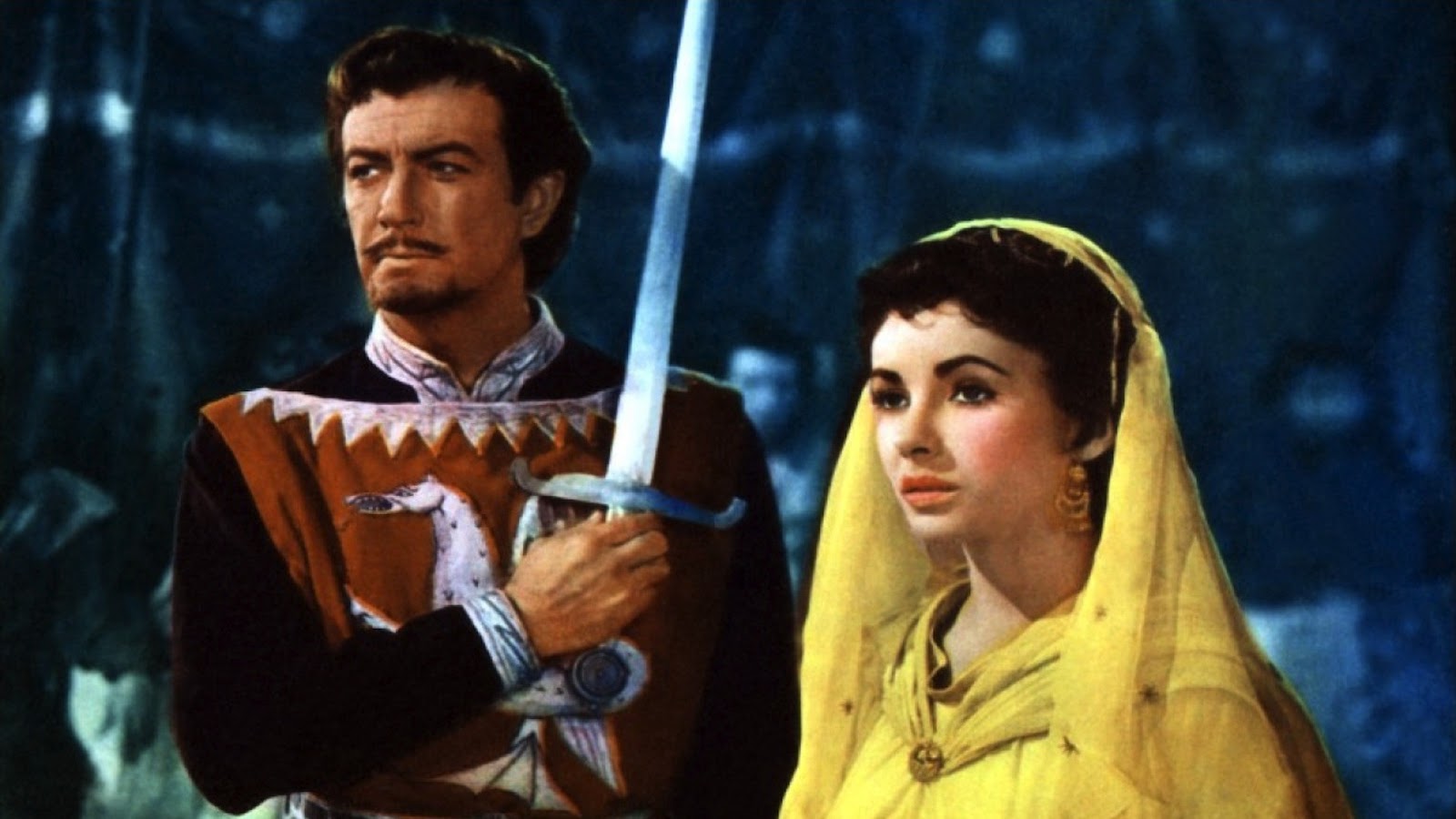
Bless, this film looks quite dated now. The bright primary colours of the costumes are endearingly sweet, with our heroes dressed in capes and tights with all the delight of primary school children in a play. You need to tune into its simplicity – failing to do so means you’ll struggle to watch the final battle scenes as characters go toe-to-toe with all-too-obviously bouncy rubber swords (at one point, a sword literally bends and snaps back into place after a strong blow). The film is crammed with fights, jousts, sieges and battles – there is precious little room for plot, dialogue or character, but at least you get a maelstrom of action (even if it rarely makes much sense).

At the centre of it all is Robert Taylor as Ivanhoe. As in his other roles, Taylor is as stiff and lifeless as a board, while his transatlantic vowels clang with even more painful obviousness amongst the cut-glass and ‘ever-so-’umble’ accents from the cast of jobbing British actors. Taylor squares his jaw and does his best with the derring-do – although, as per usual, he makes Ivanhoe such a dull person, you can hardly raise the slightest interest in him. Inexplicably every woman in the film (i.e. both of them) are head-over-heels in love with him.

But then all the heroes in this film are stick-in-the-muds. Harold Warrender is the most arrogant, least fun Robin Hood you’ll ever see. Finlay Currie gives swagger as Ivanhoe’s father, but is basically a pompous windbag. Emlyn Williams as comic relief “Wampa” is so tiresome you’ll breathe a sigh of relief when he burns to death in a fire. Joan Fontaine is so saintly opposite the balsawood Taylor that you find it unlikely that we will ever hear the pitter-patter of little Ivanhoes.

The bright spots are the villains. Guy Rolfe has huge fun as a moustachio-twirling, scheming Prince John. George Sanders gets the most out of Ivanhoe’s rival Sir Brian (can you think of any other film with a villain called Brian?), although the part (and the film) is far beneath him.

Brian is of course infatuated with the Jewish Rebecca (played with a radiant charisma by a very young Elizabeth Taylor). If the film has any claim to being a more than just a gaudy knight’s tale, it’s in its treatment of its Jewish characters and careful exploration of anti-Semitism in medieval England. Taylor and Felix Aylmer (as her father) give sensitive performances as put-upon, civilised people, ill-used by those around them and expected to lend support at the drop of a hat. Ivanhoe’s assumptions that they (a) have tonnes of money and (b) will feel duty-bound to help Richard are met with a quiet regret and a pointed comment that Richard’s own anti-Semitism track-record is hardly that good. Later Rebecca is placed on trial, her Jewishness central to accusations of sorcery. Persecution is an underlying theme of the film – and although it ends with all right as rain, the threat of it throughout much of the action makes the film feel more substantial than it is.

The main problem is it’s not made with any inspiration. Thorpe is a mediocre director, and the editing flashes through some parts of the story almost too fast to follow what’s happening. The ending suffers in particular from this economy: suddenly we cut from Brian and Ivanhoe fighting to the death, to Richard arriving with an army of knights, Brian being killed largely off-camera, a quick dying speech from him, then Richard announcing everything is fine in the kingdom. It’s all so sudden, it feels like they just ran out of film so needed to wrap it up quickly.

Still, Ivanhoe is fairly good fun despite all of this. It doesn’t require any concentration – and is hardly a minor-classic, let alone any other form of classic – and it has some truly hit-and-miss performing, but it barrels along ago. It may be workmanlike in the extreme, but its bright primary colours mean there’s always something to look at.