Tag: Ellen Burstyn

Alice Doesn’t Live Here Anymore (1974)

Alice Doesn’t Live Here Anymore (1974)

An engaging film explores the difficult choices faced by a generation of women

Director: Martin Scorsese

Cast: Ellen Burstyn (Alice Hyatt), Kris Kristofferson (David), Alfred Lutter (Thomas Hyatt), Diane Ladd (Flo), Vic Taybeck (Mel), Valerie Curtin (Vera), Jodie Foster (Audrey), Harvey Keitel (Ben), Lane Bradbury (Rita), Billy Green Bush (Donald Hyatt), Lelia Goldoni (Bea)

Alice Doesn’t Live Here Anymore takes a traditional ‘woman’s picture’, and firmly updates it to the concerns of the 1970s. It’s a successful mix of hope, romance and compromise, that manages to capture a sense of what a difficult and unusual time for a generation of women who grew up told being a wife-and-mother was the be-all-and-end-all only to find themselves in an era of possibilities with more options in life.

Alice (Ellen Burstyn), a wife-and-mother in a comfortable but largely romance-free marriage, is suddenly widowed. She realises she has a chance of becoming what she wanted to be when she was a kid: a singer. She and twelve-year-old son Thomas (Alfred Lutter) leave town, hoping to find this dream in Monterey, where she grew up. Their road trip is interrupted as Alice searches for singing jobs to pay their way, eventually stalling in Tucson where she works as diner waitress and finds the possibility of romance with softly-spoken divorced rancher David (Kris Kristofferson).

What’s striking about Alice is that you might expect it to be a story of feminist independence: a woman, striking out on her own, seizing her dreams. But it’s actually a more realistic – you might almost say quietly sad – film, where dreams are notoriously hard to achieve. Alice attracted ire at the time as she didn’t fit the bill of a feminist role model. For starters, at times she remains just as keen on finding a man as she does making it as a singer. Her talent is good but not stand-out – even she claims her voice is weak with an odd wobble. And she makes a host of dubious personal decisions out of a desire to be liked or to accommodate herself to others.

Burstyn captures this in her outstanding, Oscar-winning, performance. Alice is caught at that cross-roads of not being ready to let go of the traditionalist outlook she absorbed growing up, while dreaming of standing on her own two feet. It’s a problem you can imagine many women in 70s America, a country fumbling towards gender equality, struggled with. We grow incredibly fond of her as she strives for independence, while also sometimes wanting to shake out of her timid reliance on affection from others.

ADLHAM is a film about complexities and defies easy answers. Her marriage seems like one of mutual convenience. Then it surprises us: Alice’s tearfully silent realisation that they she and her husband have nothing to really talk about is met not with incomprehension but with a tenderly affectionate hug from her husband. Alice has an undeniable deep grief at his death – but she’s also quick to feel emotions, and you could argue her quickness to move on suggests she mourns the loss of an anchor in her life.

Her relationship with her son is an a mix of motherly care and a desire to be his friend. Alfred Lutter is very good as this slightly spoilt pre-teen who can switch from sulking playful laughter. ADLHAM shows plenty of fun and games between these two, like a water-fight in a motel. But it also makes clear Alice’s inability to control Tommy and her tendency to let take the lead. She rarely (if ever) corrects his bad behaviour or language, allows him to play music at top volume whenever he wants (to the intense irritation of others) and you feel her discomfort with being an authority figure (only once does she put her foot down, and is consumed with tearful guilt almost immediately after).

Similarly, her need to be close to a man leads to a parade of dubious choices. She is unable to pick up on signals that a seemingly charming man she meets at a bar (Harvey Keitel) is a married man with a hair-trigger temper. The gentler David might seem like a better prospect, but there is enough in Kris Kristofferson’s manner to suggest he has only so much patience for Tommy and that he might also be as flat and dull a man as Alice’s first husband was. ADLHAM could be suggesting some people are trapped into making similar mistakes over-and-over again.

Burstyn is the heart-and-soul of this look at the difficult balance between hope and reality. Alice is deeply emotional, her heart perilously close to her sleeve. Tears come incredibly easily, in juddering waves that shake her whole body. Burstyn makes her both defiant – “I don’t sing out my ass” she tells one leering bar-owner – but also vulnerable and needy. She’s can be playful and comic – she performs skits for David, throws herself into banter with Tommy and loves putting on voices – and then touchy and judgemental. It’s a performance that mixes rawness with insight and delusion, where Alice can go from cold-eyed realism at her singing to convincing herself all her problems will be solved the second she arrives in Monterey.

Scorsese, directing with subtle, classical grace, makes this goal feel like a chimera. In fact, the constant postponing of the journey suggests it will never happen. Scorsese opens the film with a 50’s style prologue (deliberately shot on a soundstage and filmed like a mix of The Wizard of Oz and Powell and Pressburger) showing the young Alice at Monterey that hardly makes it feel like a golden future. In fact, it looks more like a step backward when Scorsese cuts from it to a wide-angled, rock-n-roll sound-tracked panning shot over Socorro in a whip-sharp transition.

There is a slight unease in ADLHAM  that nothing is quite fixed, which Scorsese accentuates with the film’s subtle hand-held camera-work (every shot has some slight shaky movement in it). It’s balanced with some lovely old Hollywood touches (at one point Alice lights a cigarette for David in her mouth and passes it to him, a classic Hays Code metaphor for sex), genuine comedy and human connection. Lots of that comes from the Tucson dinner, either from Valerie Curtin’s hilarious inept waiter (introduced passing the same three meals between three people with increasing panic) and Diane Ladd’s (Oscar-nominated) turn as blousy but caring Flo, with whom Alice forms a surprising bond that surprises her. (It perhaps echoes the film’s complex message, that life-long waitress Flo, flirting for tips, seems more independent than Alice).

Alice is an interesting, refreshing look at how difficult this moment of time could be for people caught between two ways of thinking. It has a superb performance by Burstyn (who provided much of the drive behind making the film, including hiring Scorsese) leading a very strong cast (including a strikingly mature, relaxed performance from Jodie Foster as a precocious pre-teen tearaway). It’s ending breaks into something more reassuring and traditional, but it’s also soaking in hints that it is far from a full-stop: the possibility that Alice has entered into a new chapter in her life that might be more similar than she thinks to her old one.
The Exorcist (1973)

The Exorcist (1973)

Unimaginable horrors seep into your mind in Friedkin’s hugely influential terrifying shocker

Director: William Friedkin

Cast: Ellen Burstyn (Chris MacNeil), Jason Miller (Father Damien Karras), Max von Sydow (Father Merrin), Linda Blair (Regan MacNeil), Lee J Cobb (Lt William F Kinderman), Kitty Wenn (Sharon Spencer), Jack MacGowran (Burke Dennings), Father William O’Malley (Father Joseph Dyer)

Growing up in the 90s in the UK it was easier to get your hands on a porno than a video copy of The Exorcist. For 12 years the film was banned because its influence was considered so insidious that it would inevitably lead to the corruption of the children who would (of course) dig out a copy to watch. Why was The Exorcist considered so powerful? After all no-one banned The Omen. Perhaps because there is something existential – unknowable, unexplained and unstoppable – at the heart of The Exorcist, while The Omen is a pulpy slasher about imaginatively bumping off Brit character actors. The Exorcist has a poetic nihilism, that reaches into your soul and takes a long-hard squeeze.

Hollywood actress Chris MacNeil (Ellen Burstyn) has problems. Her daughter Regan (Linda Blair) is growing increasingly unbalanced, suffering mood swings and saying the unsayable in grotesquely crude, sexual language. Doctors can’t find anything wrong with her. Above all they can’t explain her increased strength, contortions, the shaking of her bed and the freezing conditions in her bedroom. Could it be that Regan is possessed by a force darker than any we understand? After an unexplained death, Chris has no choice but to consult psychiatrist turned priest Father Damian Karras (Jason Miller) who reluctantly agrees that Satanic forces have taken control of Regan – and that an exorcism by himself and experienced Father Merrin (Max von Sydow) may be the only option.

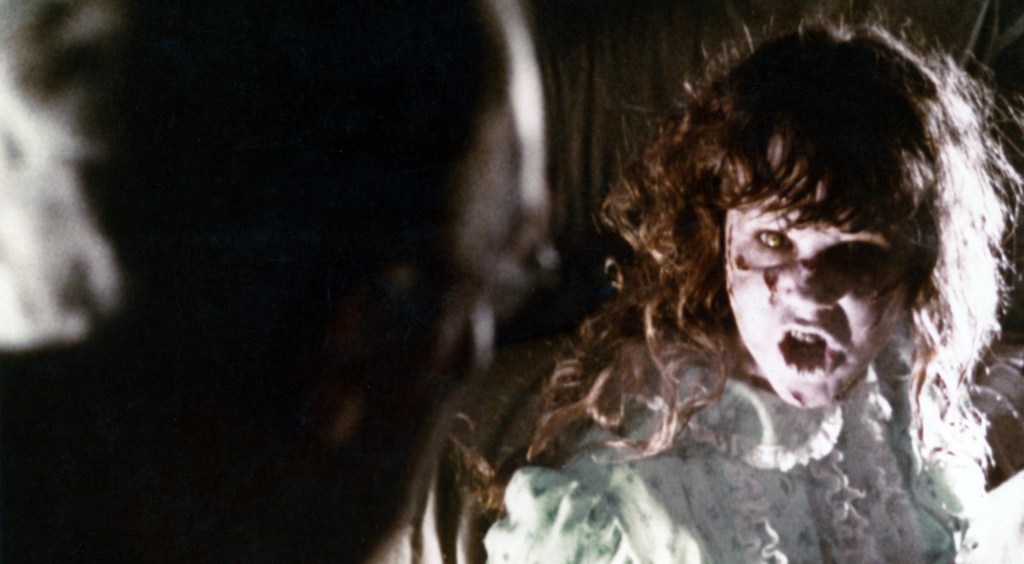
Adapted from a chilling novel by William Peter Blatty (who also wrote the screenplay and produced), The Exorcist is an all-consuming experience film, directed with immersive power by William Friedkin. Everything in it is designed to unsettle, disturb and dig deep into the fears of the viewer. What could revile us more than a child, her body twisted into the features of a revolting, malign spirit, spouting revolting, bile-filled rants and revelling in a twisted, macabre sexuality? All this wrapped inside a film that makes your skin crawl with its coldness, precision and drained out colours, where sound is unpredictable, discordant and unnatural and which offers very few answers.

The Exorcist does this in spades. It’s methodical and quietly repetitive in aspects of its editing and framing, constantly using visual and audio association to build dread. Friedkin’s prowling camera glides constantly through the MacNeil’s luscious townhouse, gliding up the stairs to Regan’s bedroom to reveal new horrors. Friedkin builds the dread, his camera first studying the shock and horror on the faces of the characters, before cutting to reveal the terrors they are looking at.

We move from subtle moments – Regan’s Ouija board, through which she communicates with imaginary friend ‘Captain Howdy’, whose glider jumps unprompted from Chris’ hands. The moments of chilling flatness in Regan, such as when she tells a visiting astronaut he “will die up there”. The violent, uncontrollable, impossible shaking of her bed. Regan’s astonishing strength that can hurl people across rooms. All this builds us towards the real grotesqueness: her deformity, her sex-obsessed rantings, impossible body contortions and her revolting sexual defilement of a crucifix. It increases in immediacy, graphicness and in its breaking of social convention, until you get the feeling you watching something that can only be classed as a revolting, all-pervading, all-corrupting evil.

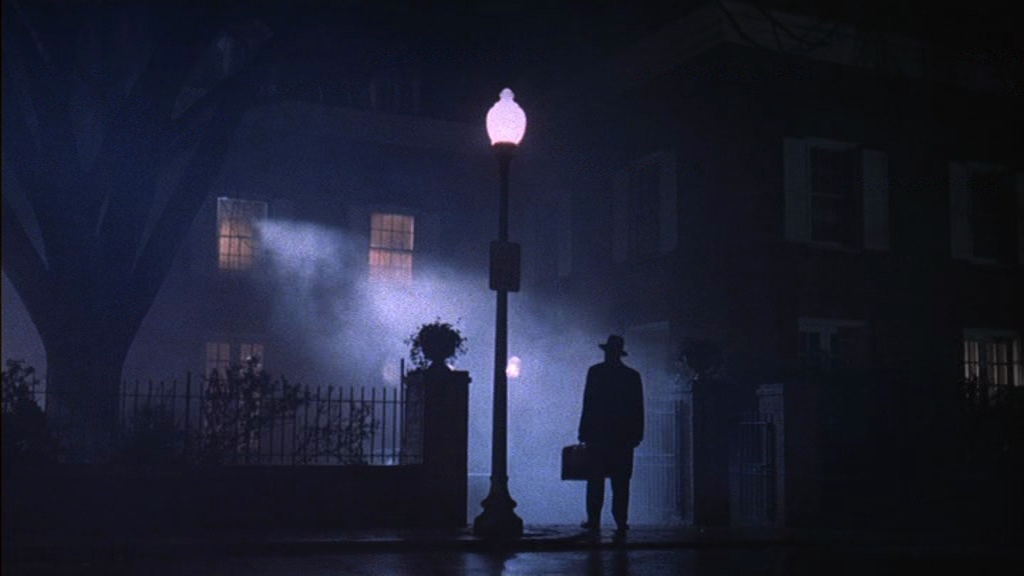
Evil is at the heart of The Exorcist. Friedkin superbly suggests a mystical, eternal clash between that and good at its heart. It’s opening sequence, with the discovery of the relics of the demon Pazazu in an Iraq is awash in suggestive menace: the percussive drum beat of the excavator’s tools, gusts of unexplained wind, the barking of battling dogs. A mist-filled skyline sees Merrin (and the granite faced von Sydow feels like a mythical figure) confronting a terrible statue of Pazazu. The moods –particular the audio features of this landscape – are echoed throughout the film, tying disparate locations together and subtly suggesting an age-long war that can never end.

That lies at the heart of The Exorcist’s ghastly appeal. Everything feels undefeatable, with regular streets and homes transfigured into places of inhuman dread. Little moments – a dog, a tramp, a train – take on echoes of sounds and sights associated with the demon. The brilliant repetitive use of Mike Oldfield’s Tubular Bells provides a mesmeric rhythm that always echoes the discordant tones of other sounds and sights. Friedkin plays this up with visual touches – subliminal imagery is used to flash horrors past us and the film plays with visions of suggestive unease. The demon similarly plays on underlying fears – of guilt, inadequacy and repressed desire – that it flings horrifically to the fore, through parroting the voices of others to changing its shape and appearance.

No wonder medicine is flummoxed. The Exorcist, considering its reputation, surprises for being such a slow-burn. It takes nearly two thirds of the runtime before the idea of the exorcism arises, during which we watch never-ending medical tests on Regan. Friedkin shoots these with a cold, impersonal professionalism (an angiography, with blood spurting from Regan’s neck, is almost unwatchable in its realism) which makes it feel even more powerless against the demon’s existential evil.

The Exorcist gently glides over narrative and logic gaps (not least the sudden onset of Regan’s worsening condition) because it retains a mystic power and the nightmare inducing dread of knowing exactly what is happening, but being unable to step into the film and tell the characters. It all leads perfectly into the exorcism scenes, when the film’s horror culminates in scenes of extraordinarily intensity, difficult to watch, with just the right amount of gore and suggestion.

Is The Exorcist about anything? That might be its greatest flaw. So enamoured is it with infecting us with dread, that it neglects to offer much that can give lasting spiritual or intellectual nourishment. Like a brilliantly constructed haunted house, it thrills but leaves you with little else to consider (other the costly struggle against evil). At heart, it’s a superbly well-made B-movie, a terrific horror-thrill ride where every single moment is masterfully designed to illicit an effect from the audience.

It’s helped by the superbly horrific make-up (not to mention von Sydow’s hugely convincing ageing) and effects whose practical realism increases their dread. Friedkin – at the height of his dictatorial auteurism – directed with little regard for cast and crew, focused on producing the desired effect. Guns were fired to illicit shocks. He slapped Father William O’Malley seconds before shooting a scene to make him look distressed. Burstyn and Blair both suffered lasting back injuries from being jerked around and the exorcism was shot in such refrigerator conditions, the actors couldn’t spend longer than fifteen minutes in the room.

But Friedkin’s determination to produce his vision through every means necessary worked. The Exorcist has a power few other films can dream of. The actors do their part: Burstyn’s increasingly raw pain and distress grounds it extremely well, Blair’s innocence makes her later horrors (voiced by a gravelly Mercedes McCambridge) even more disgusting, Miller is very good as the film’s eventual hero whose soul becomes a battle-ground, von Sydow invests Merrin with a rich hinterland.

They are framed with a film that is immediate, discordant and subtly grotesque. It leaves little to the imagination, but nevertheless encourages the mind to add its own horrors. It feels like the film itself can be a quiet demon, working its way inside to change you. It’s a horrific ride, and if it feels like it ends on a beat of grimness and desolation (despite Blatty’s intentions) that feels fitting for a film that may have little to truly say but affects viewers in a way few other films do. That’s why it was seen as having such power, because it invests deep, subliminal meaning and import to what could have been just (as its sequels are) an exploitation flick. That’s why it was banned.

The Last Picture Show (1971)

last picture show header
Timothy Bottoms, Jeff Bridges and Cybil Shepherd are making the best of small-time life in The Last Picture Show

Director: Peter Bogdanovich

Cast: Timothy Bottoms (Sonny Crawford), Jeff Bridges (Duane Jackson), Cybill Shepherd (Jacy Farrow), Ben Johnson (Sam the Lion), Cloris Leachman (Ruth Popper), Ellen Burstyn (Lois Farrow), Eileen Brennan (Genevieve), Clu Gulager (Abilene), Sam Bottoms (Billy), Randy Quaid (Lester Marlow), Gary Brockette (Bobby Sheen)

“Anarene, Texas, 1951. Nothing much has changed…” So went the tagline for Peter Bogdanovich’s The Last Picture Show. Change, or rather the lack of it, is the heartbeat of this film. It’s small time (fictional) Texas town isn’t a million miles from the Wild West dustbowls. You feel nothing has really changed for decades, the same faces in the town have just got older. But the tagline suggests that, in many ways, the 1950s were not that different from the progressive 1970s. Sex and scandal lie under the surface of the town, with the inhabitants having little to distract them from boredom other than seducing each other. Unlike the sort of traditional films shown in the picture show – Father of the Bride or Red River – this town is just drifting, a change in America both round the corner but also feeling like something that would slide off the town like water from a duck’s back.

The film largely follows three high schoolers are preparing for graduation. Sonny (Timothy Bottoms) and Duane (Jeff Bridges) are on the town’s useless high school football team (a uselessness no-one will let them forget). Duane is dating Jacy (Cybil Shepherd), a woman just discovering the power of her looks – and Sonny longs for her himself. Instead, Sonny starts an affair with Ruth Popper (Cloris Leachman), the overlooked, lonely housewife of his football coach. Romantic entanglements abound, but life drifts on with the younger generation thinking sometimes of the future, but really repeating the mistakes of the older generation – people like Jacy’s cynical mother Lois (Ellen Burstyn) and the owner of the town’s pool-hall, cinema and diner, the fading conscience of the town Sam the Lion (Ben Johnson).

Bogdanovich’s film was a sensation when it was released, a key part of the New Wave films in Hollywood. It has lasted, in the way other films from the period haven’t, because it has a subtly simple but compelling story, shot as a perfect fusion of French New Wave styles with John Ford and Orson Welles inspired classicism. Bogdanovich’s film buffery is obvious from every frame – not just from the film posters announcing what is being shown at the picture palace, but also from its loving use of French-style realism and lack of glamour, set and framed in the Fordian style, often stressing isolation, intercut with homages to Kane, The Magnificent Ambersons and Touch of Evil.

And in it we have a series of young people who seem to have no idea either where they, or the world is heading. Timothy Bottoms acts with such effortless naturalism, it’s easy to forget he is even acting at all. It’s a perfectly judged performance of a very normal young man, low on aspiration and inspiration, selfish in the way the young are but full of passion and regret. Jeff Bridges is similarly brilliant, playing a not-particularly smart (or particularly successful) school sports star in a performance completely free of any condescension or camera winking, but played with a charming honesty. These are supremely normal young men. Generally decent, well-meaning and naïve, not knowing what it is they want or need from life. They would fit as neatly into 1971, with their dreams, as they do in 1951. Especially as Duane packs off to head to Korea (no real difference from Vietnam).

And a lot of these dreams revolve around sex – and often sex with Jacy. Cybil Shepherd was a sensation on the film’s release, seen as the ultimate late-teen temptress and sexpot. But in fact, Jacy is (in her way) as much of an innocent as the others. She’s a woman only just discovering her own passions and longings. Who doesn’t want to become the jaded figure her mother has become – but working out the easiest way to get what she wants (be that a better boyfriend, better chances or even just some attention) is through using her physical attributes. Her sexual experimentation is, in a way, liberating – and just another attempt to find an answer to her own aimlessness. Sure – encouraged by her mother – she doesn’t invest anything emotionally in these entanglements. But is it really all that different from Sonny’s own using of Ruth Popper?

Ruth Popper is emblematic of the sadder older generation in the town. You can imagine they must have had hopes and dreams – or were once as breezily uncaring – as the younger generation. But they’ve found out, just as they will, that things don’t change. That you can blink and find yourself twenty years down the line, unhappy and lonely in a place you can’t seem to escape.

Cloris Leachman is outstanding as Ruth (she won an Oscar), the only person in the all the film’s couplings that we see expressing tenderness and vulnerability (in a film full of sexual encounters, the most intimate thing we see is her combing Sonny’s hair). She dares to slowly open herself up emotionally to believing in Sonny – to seeing their affair as more than just the booty call it starts as, but as something with a future. From the tearful fragility of her first scenes – her buttoned up matronly appearance, making her look far older than she is – she blossoms into a warmer, excited, person. It makes her inevitable betrayal by Sonny all the more heart-wrenching – along with her self-loathing fury that closes the film.

All the adults are drifting through the same disappointing life. Ellen Burstyn (also nominated) is wonderful as Jacy’s mother, who continually defies expectations. This mother is unfazed by her daughter sleeping with her lover, suggests that she might as well experiment sexually so she can find out it’s not all that and carries a revelation of deep loss and personal tragedy that only comes to light late in the film but is there in the character from the start. Other adults seem equally aware of their pointlessness: the coach is a repressed homosexual, the English teacher seems resigned to teaching Keats to bored students, Jacy’ father is a blow-hard nobody, Sonny’s father is a stranger to him. Only Eileen Brennan (excellent) motherly waitress still seems to have some hope.

Sonny’s surrogate father – and the heart of the film – is local businessman Sam the Lion. Johnson is superb, gifted a surprisingly small number of scenes but which establish both his moral force and his position as a link to a halcyon days past in America that might not really exist. Bogdanovich gives Johnson a knock-out speech (surely what won him the Oscar) – an Everett-Sloane-in-Kane inspired remembrance of a relationship from long ago, where the world seemed full of hope and opportunity, that perhaps get closest to defining the film’s sad reflection on how little those two things actually seem to exist in the present.

But it’s also about the temptation of memory. Bogdanovich’s masterpiece (it was all downhill in his career from here), The Last Picture Show knows only too well how quickly we realise life is a confusing, compromised mess. And the film, for all its old-school Hollywood style, is all about the past being just as a confusing, empty, sex-filled place of loss as the present is. Things have always been like this – and they probably always will. Welcome to Anarene. Nothing has changed.