
Kozintsev’s masterful version of Hamlet is one of the greatest Shakespeare films ever made
Director: Grigori Kozintsev
Cast: Innokenty Smoktunovsky (Hamlet), Mikhail Nazvanov (Claudius), Elza Radziņa (Gertrude), Yuri Tolubeyev (Polonius), Stepan Oleksenko (Laertes), Anastasiya Vertinskaya (Ophelia), Vladimir Erenberg (Horatio), Igor Dmitriev (Rosencrantz), Vadim Medvedev (Guildenstern), Aadu Krevald (Fortinbras)
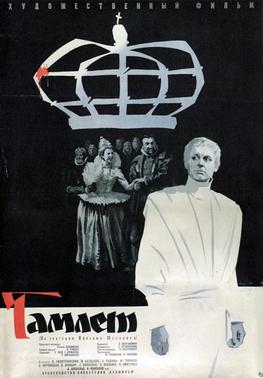
One of the main reasons Shakespeare remains timeless is that he can be shifted and adjusted through any society or perception and new riches will be discovered in his work. That’s why the, perhaps, greatest film version of Hamlet doesn’t even have an actual word of Shakespeare in it: Grigori Kozintsev’s epic, paranoia-tinged Hamlet with the dialogue translated into robust, poetic Russian by Boris Pasternak, takes huge liberties with the text but creates a richer, commanding and, above all, cinematic version of Elsinore than almost any other version yet made.
Kozintsev was a leading Russian theatre director who had written extensively on Shakespeare. He bought to his film both a brilliantly cinematic eye but also a comprehensive understanding of the play. Kozintsev’s Hamlet is filtered through Stalinist Russia. Where other Hamlets of the era focused on Freudian themes and the poet Prince, his Hamlet would be starkly, strikingly political.
Here Elisinore is a place devoid of privacy, where every word is overheard and every action watched. It’s controlled by Claudius as an eminence grise turned king, a smooth and assured political player who understands the machinations of power and the importance of appearance. Koznitsev’s rearranges Claudius opening speech into three discrete chunks. The first sees a herald reading out Claudius’ announcement of his wedding and the new regime to a crowded courtyard of peasants. We then cut to crowded room of Ambassadors of various European powers roaming, where we hear snippets of conversation each delivering a separate line from Claudius’ oration. Finally, the conclusion of the speech, and his plans for Fortinbras, is delivered by the king himself to a room of nodding courtiers. That’s imaginative cinematic translation of Shakespeare right there.
This is a Hamlet that lives and breathes the fear of living in an oppressive regime, under the thumb of a smiling autocrat. Mikhail Nazvanov’s Claudius charms but has a resolute, ruthless coldness behind his eyes. The court is drenched in paintings of the great leader – including one grand armoured horseback painting that looks like a Claudius head has been swiftly painted over his brother’s. Claudius controls all privacy in the castle: Koznitsev fills the film with shots of closing doors, lowered portcullises and a constant stream of background observers for every conversation. Only Claudius can gain solitude – tellingly he is the only character who speaks his soliloquy out loud, because he is the only character who knows for sure his words are for his ears alone.
This Elsinore is a castle where knowing too much is dangerous and the threat of being wrapped up in the wrong side of a purge is a very real one. Laertes’ aborted rebellion may see him forgiven – but the citizens who follow him to charge into the castle are escorted way, hands bound, never to be seen again. Claudius’ soldiers are increasingly visible presence in every doorway and corridor. When Hamlet unsettles the King with the Player’s performance, the courtiers practically fly away from the would-be dissident, as if worried that even the faintest contact could infect them with the same danger of exile and death that Hamlet is flirting with.
In this authoritarian production, our Hamlet is not the poet prince that so many Western productions at the time presented him as. Instead, portrayed with a chilling intensity by Innokenty Smoktunovsky, Hamlet is a dangerous man, filled to the brim with suspicion and resentment, who trusts nothing and confides to no-one. Rarely alone in this crowded Elsinore, he strikes a lonely figure, who finds isolation only on the cliffs staring out to the sea. His soliloquies are all internal voiceover monologues – less due to their internalised nature, and more that you feel he cannot risk speaking his feelings out loud (an impression created by his voiceover of his “Too, too solid flesh” speech delivered while Smoktunovsky moves through a crowd of courtiers).
Hamlet’s destructive bitterness is sparked by the Ghost. Cutting the first scene, Koznitsev introduces Hamlet and us to the Ghost at the same time. Unlike the smooth, ornately collared Claudius, the Ghost is an armour-clad rigid behemoth, his face almost completely obscured by his helmet. (There is a brief shot of his eyes which I would have removed – better that it had been kept completely distant from us). The camerawork stresses both its deliberation and size while Dmitri Shostakovich masterful score helps to build its sense of power and might (so effectively, that only a reprise of its theme is enough to suggest its reappearance to Hamlet later). It is a terrifying, other-wordly figure.
Smoktunovsky’s Hamlet barely ever raises his voice but has the intense determination of a man of natural action. Koznitsev has removed virtually every line that dabbles in doubt, uncertainty or hints even vaguely at delay. Smoktunovsky is merely biding his time for his chance at taking a hit at Claudius – a chance that will rarely come, in a court crowded with military protection for the King. He never forgives and even the slightest delay rouses him to anger rather than self-analysis. Koznitsev has trimmed out most of his lines with Horatio, who becomes an almost silent, scholarly observer and makes Smoktunovsky even more of a distant figure, liable to break out into dangerous violence at any moment, with no regard for the consequences.
The most visible of those consequences is Ophelia, who Smoktunovsky’s Hamlet uses coldly as a tool for probing the weaknesses of his enemies. Portrayed with a touching vulnerability by Anastasiya Vertinskaya, Ophelia is likewise never alone, unable to escape a crowd of duennas, who train her in dancing like a clockwork toy. Polonius (here an arch and scruple free political fixer, played by Yuri Tolubeyev) shows almost no interest in her at all, bluntly dismissing her and her distress when his need for her is done. After his death, she is literally locked into a metallic corset by her maids and covered by a gauzy funeral dress – even her clothes are cages. Her madness scene inevitably takes place in a room full of soldiers: even at the end she cannot escape the eyes of strangers.
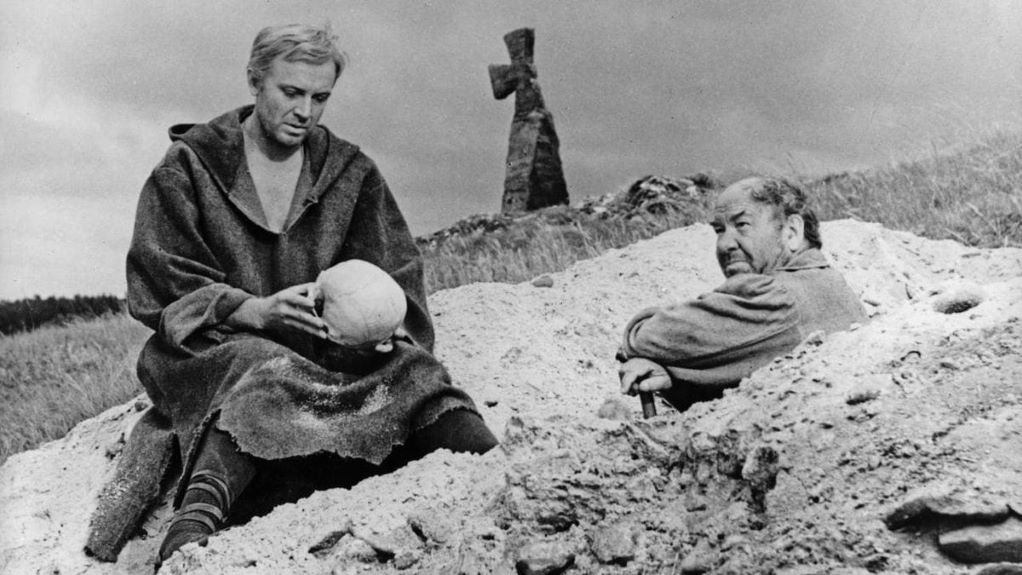
In the cold, Bergmanesque quality of Koznitsev’s film (the players, in particular, look like they have rolled in from The Virgin Spring), the stoney castle on the cliff (despite its renaissance, wood-lined interiors) is an imposing, terrible place. After the death of Polonius, Hamlet is dragged into (essentially) a show-trial (including a stenographer) before being dispatched to England. Rosencranzt and Guildernstern are empty-headed, ambitious minor officials who Hamlet displays not a moment’s hesitation in dispatching to their deaths. The only moment of reflection Smoktunovsky affords Hamlet is over Yorick’s skull – and even then, the cut suggests his focus is on the lost opportunities of great men. Certainly, Smoktunovsky’s grief over Ophelia is as much motivated by Laertes’ ostentatious show of public grief as sadness (and certainly not guilt, which he lacks entirely).
Koznitsev’s supremely visual film, beautifully designed and shot, reorders and reworks the text to maximum effect to continuously stress Hamlet’s highly political nature. It does mean characters like Gertrude fade into the background, but it repositions Elsinore highly effectively as a dangerous, ruthless place where life can be cheap. Like Stalinist Russia, the wrong word can condemn you and even our hero is as much a potential dictator as our villain. Hamlet is the most imaginative, revelatory and intelligently distinctive reading of the play on film, a production that interprets the play rather than just presenting it. It is a masterclass in adapting the Bard for the screen.
Watch the film here!
 Movie Musings