Tag: Emil Jannings

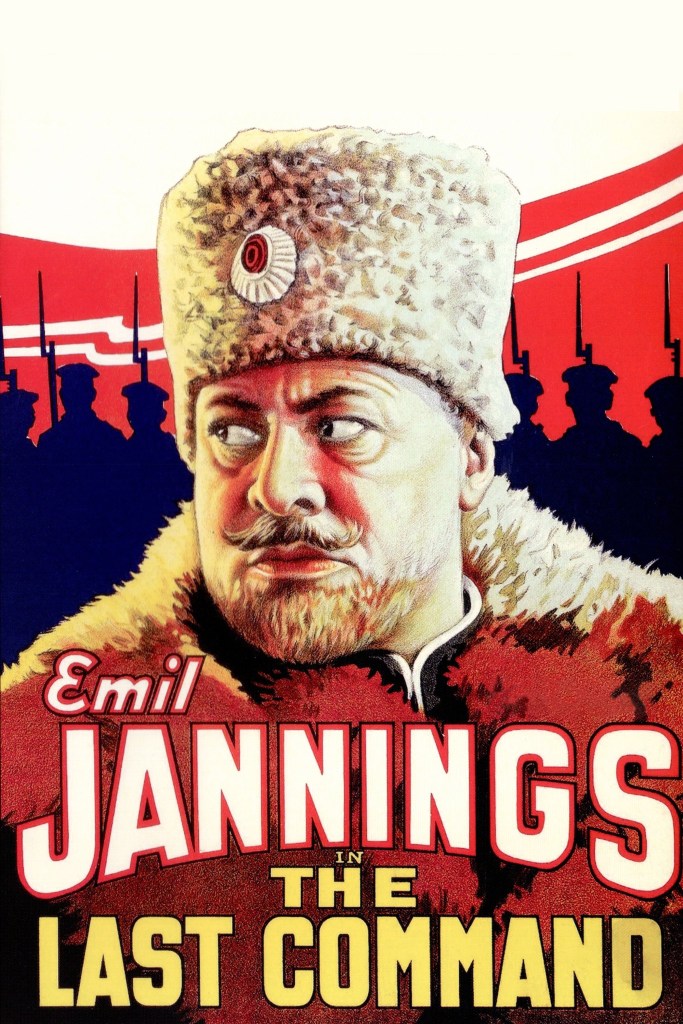
The Last Command (1928)

The Last Command (1928)

Hollywood and the revolution meet in von Sternberg’s sympathetic look at White Russians

Director: Josef von Sternberg

Cast: Emil Jannings (Grand Duke Sergius Alexander), Evelyn Brent (Natalie Dabrova), William Powell (Lev Andreyev), Jack Raymond (Assistant director), Nicholas Soussanin (Adjutant), Michael Visaroff (Serge)
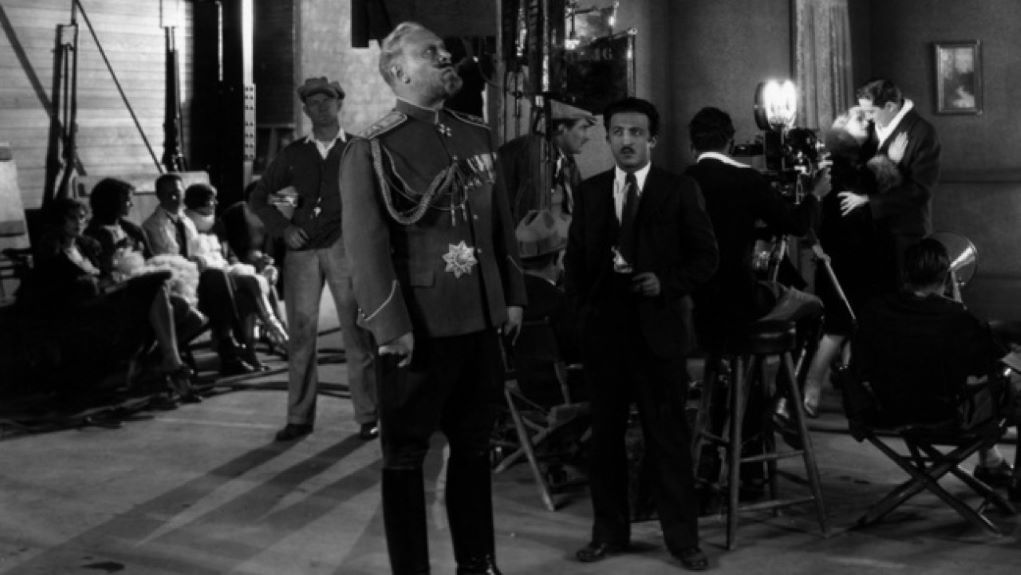
Hollywood director Lev Andreyev (William Powell) flicks through photos of extras, searching for someone to play the Russian General in his WW1 epic. His eyes light up – the perfect face! Sergius Alexander (Emil Jannings) is summoned. But Andreyev has ulterior motives: Sergius Alexander is a former Grand Duke who clashed with the revolutionary Andreyev in Russia ten years ago and this is the chance for revenge Andreyev has longed for. A cousin of the Tsar, Sergius Alexander was commander of the Western Front. Imperious but noble, deeply patriotic, he gave everything for Russia, despite falling in love with revolutionary Natalie Dabrov (Evelyn Brent). The revolution turned Sergius into a traumatised shell and kitting him out in uniform again impacts his sanity.

Von Sternberg’s The Last Command is two films mixed into one. It’s partly a satire on Hollywood, a machine specialising in creating artificiality that chews extras up and spits them out with little regard for their well-being (rather like the trench system the film is set in). The other – and more dominant – part is a classic melodrama of a noble Russian lost and powerless as his world collapses around him. It’s this second part that dominates the film, almost an hour of its ninety-minute run-time being taken up with its Russian flashback sequence. Like many von Sternberg films it’s charged with a mix of sex and sadomasochism, while also being a sympathetic, white-Russian look at the revolution.

Emil Jannings received the first ever Best Actor Oscar for this (and the now lost The Way of all Flesh). At the time Jannings was seen as one-of (if not the) greatest actor in the world, based on his mastery of the expressive arts of silent cinema. Janning’s physicality, his emotion-filled piercing gaze is duly showcased. Jannings effectively plays two parts: the Sergius Alexander of the Russian era, the Russian aristocrat who emerges as a man of honour, dignity and patriotism; and the Sergius Alexander of the present day, a timid, broken man, forever twitching, scared to look people in the eye. In both cases, von Sternberg’s camera constantly pulls back to Jannings whose ability to transform and twist his body – from ram-rod officer to broken husk – is executed perfectly.

Von Sternberg’s gives the bulk of the film’s run-time over to the build-up of the Russian revolution. While The Last Command gives some criticism to the ancién regime – our first shot is of a poverty-stricken mother and baby sitting in the snow, while the Tsar is a paper king more interested in parades than reality – von Sternberg’s affection is clearly for the decent nobles trying to make the system work. The revolutionaries are largely violent or shadowy manipulators (we get a brief scene with obvious Lenin and Trotsky stand-ins, presented as hypocritical middle-class looking schemers focused on power). On the contrary Sergius Alexander is interested only in the good of Russia.

It’s that which wins him the unexpected respect of feared revolutionary Natalie Dabrova, well played by Evelyn Brent. Dabrova is a power-keg whose fire and passion seizes the fascination of Sergius. Their initial meeting is the only time von Sternberg presents him as a tyrannical figure, sitting in an office questioning potential revolutionaries for his own amusement (including a whip across the face for Andreyev). But from there Sergius’ essential decency emerges – his politeness, his old-school chivalry. He treats her like a lady and (eventually) courts her with a Victorian gentility.

That contributes to Natalie’s shift towards seeing Sergius as a man trying his best in difficult circumstances rather than the ogre she assumed. Von Sternberg masterfully shoots the pomp and pageantry of the old Russia, full of military parades, fine dining and smart uniforms using this pageantry to show how it disguised the real threat facing the country. There are also elements of the sado-masochistic in the relationship between Natalie and Sergius. This bastion of the system is attracted to this woman who wants to burn the whole thing down. Visiting her in her bedroom, spotting a hidden pistol, is there an air of debased excitement when he turns his back on her and all but invites her to shoot him? In turn, Brent is almost a prototype of the classic Dietrich character, a strong, imperious woman, who dominates men, torn between conflicting desires.

There is a neat series of contrasts and contradictions in all the characters in The Last Command. Sergius is both a Tsarist bully, a decent man interested only in his country and a shattered husk in Hollywood. Lev is a firebrand revolutionary and an aristocratic Hollywood director. Natalie is a fascinating mix: a banner-waving anarchist who fits neatly into Sergius’ cocktail parties, who despises and loves the General. Duality and hidden identities hints at hidden desires within all the characters in a world tearing itself apart.

That collapse of order is the stunning heart of von Sternberg’s film. The seizure of Sergius’ train by revolutionaries, the final act before his exile, is superb in its vibrant tracking shots and Eisenstein-inspired energy. Jannings is placed at the heart of the crowd in a series of tracking-shot marches through baying crowds all pulling, spitting, pushing and abusing him that is part walk to calvary, part fantasy of humiliation. There are moments of understanding for the masses – a scene shows Tsarist soldiers machine-gun down a mob – though it’s balanced by the ruthless shooting they carry out on wounded soldiers. Sergius is reduced to the lowest-of-the-low, a humiliated figure shovelling coal for his revolutionary masters while they conduct (what looks like) an orgy in his state compartment.

Humiliation is also the name of the game in Hollywood. While The Last Command is more about its sympathetic look at good White Russians let down by the system (fitting von Sternberg’s imperialist sympathies), it throws in to its first and final act an uncomfortable look at Hollywood. Extras crowd at the studio door as another sea of desperate humanity (Sergius’ buffeting here in this crowd, must remind him of that humiliating walk through the mob in Russia). Costumes are flung at people identified only by tickets. Assistant directors treat people like dirt and extras are seen only as props.

But the satire is blunted by the fact that the treatment on set is motived by personal animosity. After all this is Lev – William Powell, rather good and clearly channelling von Sternberg – living out his own revenge fantasy. A sharper satire would have had no link between director and extra, merely seen the heartless system exploit a past trauma for its own benefit – with terrible consequences.

The Last Command is less a satire on Hollywood and more a rose-tinted look at the decent figures in the Tsarist system, with touches of satire on revolutionaries who are either power-mad middle-classes or working-class simpletons seduced by the temptations of drink and sex. It’s also a subtle smuggling in of the director’s own sexual fascinations, with Jannings a superb vehicle for this fantasy of humiliation with Brent shot with the sultry imperiousness of a potential dominatrix. For all this it’s a fine film, a visual marvel and a fascinating character study.
Faust (1926)

Faust (1926)

Murnau’s gorgeous masterpiece is a technical wonder and a painterly visual treat

Director: FW Murnau

Cast: Gösta Ekman (Faust), Emil Jannings (Mephisto), Camilla Horn (Gretchen), Frida Richard (Gretchen’s mother), William Dieterle (Valentin), Yvette Guilbert (Marthe Schwerdtlein), Eric Barclay (Duke of Parma), Hanna Ralph (Duchess of Parma), Werner Fuetterer (Archangel)

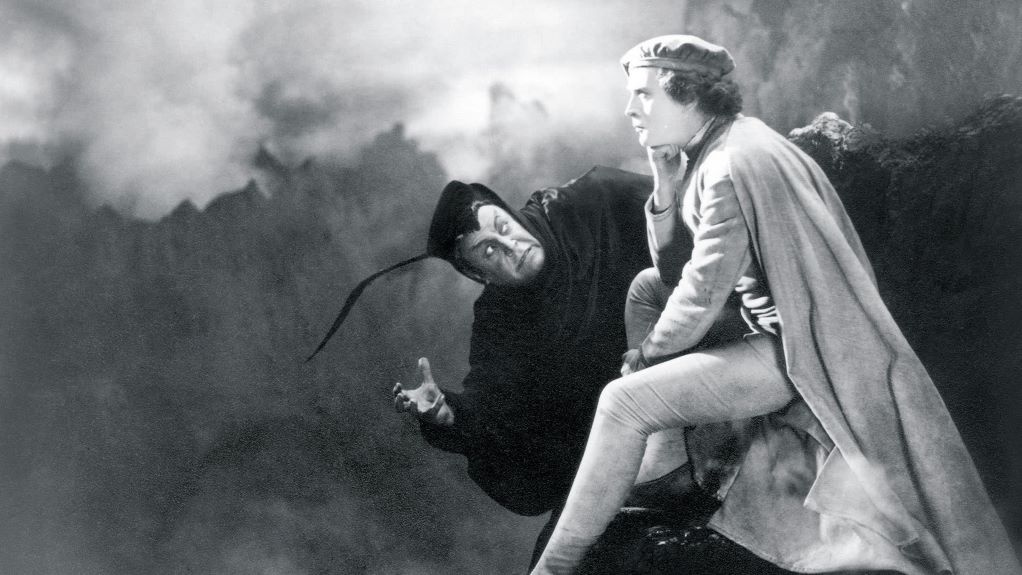
It’s a story that has fascinated for generations: is any deal worth your soul? Murnau’s breath-taking Faust myth throws in an extra wager: can evil corrupt a man so absolutely that not a single trace of good can be left? That’s the opening deal Mephisto (Emil Jannings) makes with his Archangel (Werner Fuetterer) counterpart. Their battleground? Faust (Gösta Ekman), an elderly alchemist, who has lived a life of faith and good works.

Faust was (until Metropolis) the most expensive German film ever made. Like Metropolis it was designed to help Weimar challenge Hollywood as the centre of the filmic universe. Murnau had direct control and several versions were made for distribution to key markets around the world. Faust was filmed over a huge period, partly for the all the multiple re-takes needed for those different versions, but also due to Murnau’s quest for perfection. Throw in cutting-edge special effects and luscious sets and you had Murnau’s own Faustian pact for success.

The film – as carefully restored today – that emerged is a work of expressionist genius jammed, particularly in its opening and closing acts, with a series of striking images balanced between fantasy and horror. Murnau used models, double exposure and transitional editing tricks to gorgeous, revelatory effect and crafted stunning images of supernatural horrors. Faust’s opening shot shows the horsemen of the Apocalypse riding through the clouds before a confrontation between a giant, satyr-like Jannings with huge wings and a similarly winged Archangel with flaming sword (the actors were strapped into stunning giant wings and Janning’s porcine like make-up is particularly demonic).

From there Murnau plays the first of his games of scale by showing Mephisto towering, mountainous, over Faust’s town, unleashing a black cloud of plague. Mephisto’s powers are demonstrated with a host of cinematic tricks: circular light then fire engulfs Faust when he summons him, Mephisto’s eyes are pinpricks of burning light (created by damaging the negative), he appears at every turn Faust makes and later shifts size, appearance and even duplicates himself while performing magic (always with gusts of terrible smoke).

The cinematic tricks continue as Faust is taken on a sort of magic carpet ride across Europe, Murnau’s camera dizzyingly flying over a series of highly realistic models of towns, forests, mountains and storming seas. The launch of this flying carpet is achieved by a miraculous double exposure shot that shows Mephisto and Faust flying out of a small window (standing upright on a cape) in one uninterrupted shot. The dizzying array of effects and visual imagination help us immediately understand why Faust is so tempted to harness the powers of this seemingly scruffy beggar (though Mephisto soon translates himself into a sharply dressed courtier).

It also ties in with extraordinary beauty of Murnau’s expert use of light and shadow. Faust is introduced as an old man, lecturing on astronomy to a room full of rapt students, lit by the glow of his astrolabe. Faust’s rooms are a light tunnel of instruments and books. His town turns from a thriving market, to a towering collection of shadowy buildings, holding a mass of swarming, panicked humanity, running in fear of the plague. Pools of light frame action: twice in the film, Murnau captures dying figures in perfectly composed outlines of light against a sea of black, the first (a priest) lying dead at his altar while smoke drifts up past the light he rests in.

Faust could almost be seen as a film about light. Murnau’s camera is continually artfully framed around painterly compositions with streaks of shadow and light. But it is also a thematic issue. Mephisto uses fog and smoke to power his magic, as if trying to obscure the light that represents the good. In Murnau’s world, light is frequently offers the possibility of hope – even the film’s closing fire offers a chance of redemption. Smoke becomes an obstruction, allowing evil to flourish.

Faust frames its hero initially as man using evil in desperation for the greater good against the plague. Faust is played Gösta Ekman, a Swedish actor in his thirties flawlessly made-up (the make-up is extraordinarily convincing) as the wizened alchemist before Mephisto restores his youth. Ekman is equally convincing in both roles, his angry rejection by the townspeople driving his descent into gred. Opposite him Jannings is a viciously cruel ball of scheming greed, under a surface of joviality.

Needless to say – after all this is a morality tale – it is the allure of sex that eventually brings Faust down. He surrenders his virtue for a night of passion with the beautiful Duchess of Parma. (The cruel Mephisto, having given Faust the sort of entrance to the court of Parma that inspired Disney’s Aladdin’s entry into Agahbar, maliciously murders the Duke after stealing his wife). Murnau’s Faust is all about the awful temptations of worldly pleasures over the hard graft of good works.

Faust also understands that temptation can come in reclaiming the moments we have lost. Faust longs for the sort of excitements he never had as a young man – too many books not enough bonks – but also for the simplicity of youth, where the possibilities of the future and happiness of home were everything. Faust’s middle section – and its weakest, an oddly farce-tinged dark-romantic-comedy – revolves around Faust’s courtship of Gretchen (Camilla Horn – in a part originally intended for Lillian Gish). Murnau raises the possibility that Gretchen’s feelings for Faust are controlled by Mephisto – via a magic necklace – but this idea is largely forgotten, possibly because Murnau’s film needed something uncorrupted by the Devil.

That incorruptible is what powers the final act of Faust as consequences – many caused by Mephisto, who cheats and abuses Faust’s trust and subtly works to destroy the lovers while bringing them together – come home to roost for its characters. Murnau’s film is very strong on the brutality of medieval justice – burnings and public executions are only moments away – but also on the spiritual strength from true love. Love is of course the answer, in Faust’s sentimental resolution, but there are worse answers to the question of what makes us human.

Faust returns to its heights in the torch-lit terror of its final section and the raw emotionalism of Ekman’s desperate, guilt-ridden performance, forcing his way through an enraged crowd hoping-against-hope that he can save the day. Faust is at its finest when centring Murnau’s extraordinary technique, a series of technical and visual marvels that makes you fall in love with cinema. At times it works best as a collection of extraordinary visuals and concepts – and I could do without some of that long middle act between Faust and Gretchen – and some of the acting is sometimes a little too broad. But it’s an extraordinary and unique piece of cinema – and a startling visual expression of the power and temptation of evil.

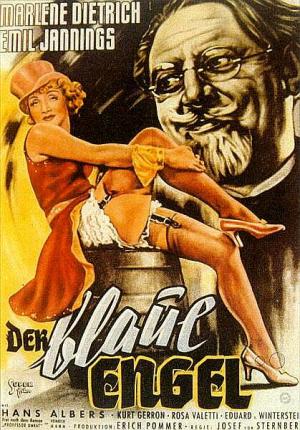
The Blue Angel (1930)

The Blue Angel (1930)

Dietrich lights up the screen in von Sternberg’s first fliration with sound but not his last with obsession

Director: Josef von Sternberg

Cast: Emil Jannings (Professor Immanuel Rath), Marlene Dietrich (Lola Lola), Kurt Gerron (Kiepert), Rosa Valetti (Gueste), Hans Alberts (Mazeppa), Reinhold Bernt (Clown), Eduard von Winterstein (School director), Rolf Muller (Angst), Roland Verno (Lohmann), Carl Balhaus (Ertzum)

Love and lust can be dangerous, all-consuming forces. Just ask Josef von Sternberg. It’s a rare film on his CV that isn’t about the self-destructive nature of longing. The Blue Angel is about obsession and its deadly consequences: but it’s also the birthplace of an obsession that would define von Sternberg’s own career. It’s the film where he discovered Dietrich. Did von Sternberg guess that, in time, he might himself become a version of the lovestruck Rath? I’d guess not, but the stench of sadomasochist excitement from complete prostration comes out of every frame of this classic.

Immanuel Rath (Emil Jannings) is a professor at the local gymnasium, preparing his students for university. Problem is, they are more interested in the goings-on at the seedy nightclub The Blue Angel than with Rath’s pompous lessons about Hamlet. Specifically, they are obsessed with Lola Lola (Marlene Dietrich), the erotic head-line singer. Rath tries to catch his students in the act – and instead finds himself smitten by Lola, leaving his career to marry her. Five years later, and Rath has lost every ounce of self-respect, regularly debased by the cabaret company and reduced to doing humiliating chores for his wife.

The Blue Angel was one of the first major sound movies made in Germany. Jannings – winner of the first Best Actor Oscar – was the biggest star in Germany and handpicked von Sternberg, who had directed him to that Oscar in Hollywood’s The Last Command, to make the film. Plans to make a film about Rasputin were ditched in favour of an adaptation of Heinrich Mann’s story about a professor who becomes infatuated with a cabaret singer. It’s a tragic tale of a man bought low by an unsuitable woman: however, von Sternberg (with Mann’s agreement) rewrote the plot into a parade of humiliation for the professor. Rather than a tragic figure, he would be a pompous man turned into a submissive, emasculated figure of mockery.

Is this what Jannings had in mind? Surely not. Von Sternberg was critical of the actor, believing his overly-expressive movements and facial expressions – so perfect for silent cinema – looked crude and ridiculous with sound. Jannings certainly seems more comfortable throughout The Blue Angel with reactions than dialogue: but even then, his wide eyes, double-takes and shocked mouth often seem too much. In art imitating life, he feels like the self-important “actor” being taken down a peg, marginalised in the frame and (by the end) smeared in clown make-up with the yolk of raw eggs running down his face.

Jannings was certainly unhappy with the focus of the film shifting powerfully to Dietrich. He was the star, but it’s Dietrich you remember. And no wonder, since von Sternberg’s camera can hardly take its eyes off her. Dietrich’s cabaret performances – recorded live – were a sensation. Just as much was her brooding sensuality, with Dietrich’s rawness as a performer guided by von Sternberg into an unforced naturalism. Where Jannings is large, she is small. Where he double takes, she raises a single arched eyebrow. Where he blusters, she quietly sits and cocks her head. Von Sternberg’s camera frequently centralises her in the frame as if trying to unwrap the enigma of this intriguing woman.

Who is Lola? You can watch in detail and never be sure. At times she’s a coquettish tease. At others a contemptuous dominatrix. But then she is also playful, sensitive and (at first) seems to find the idea of possible security and fatherly protection from Rath desirable and alluring. Dietrich’s performance constantly keeps us on our toes. Does she at expect to be protected by Rath, but finds his increasing submissiveness arousing (does Rath find the same?). Or was she – as she hints in her cold and manipulative second rendition of Falling in Love Again – always a manipulator of men? (I like to think the other clown in Act One is some sort of former lover of Lola, the sad eyes he uses when staring at Rath seeming to say “don’t make my mistakes”.)

Sex is central to The Blue Angel. Von Sternberg’s camera constantly catches Lola’s legs in frame – in one striking shot on a spiral staircase directly above Rath’s head. Dietrich swaggers and dips, her hips moving, her legs curled sensually. She’s lit like a mix of an angel and a Caravaggio-esque temptress. She takes a sort of twisted pleasure in demeaning Rath – reduced to cooling her curling iron and rolling her stockings on so she can head out to “entertain” more men. But, just as telling, Rath keeps coming back for me. Sure, he might shout and rage – but then he’ll humbly take his place on his knees in front of her.

The Blue Angel is strikingly decadent. While Rath’s classroom has a hide-bound Victorianism – with himself as a puffed-up Thomas Arnold – the nightclub is seedy, crammed with loutish clientele swigging beer. Lola’s dressing room is rundown, the pay is poor and the glamour almost non-existent. This is the underbelly of Weimar Germany, already feeling the pinch. Rath is reduced to selling dirty postcards of his wife – his dishevelled frame hawking these around the punters after her performances – and allowing her to entertain “private admirers”.

Humiliation becomes the heart of this beautifully made film. Shot by von Sternberg with his signature artistic richness – the unnamed town feels like a Dickensian blow back more than Germany of the time – with beautiful halos of light and a frame that constantly fills itself with dynamic movement, The Blue Angel culminates in high tragedy laced with farce. Rath, forced into performing a humiliating clown routine in his hometown, watches as his wife watches him while clasping her new lover to her lips. Is she seeing how far she can push her pet in his humiliation? Will nothing make him stand up to her? Is this always what she wanted or just what she finds she likes?

Either way, you can see here the formation of fascinations that von Sternberg would only let go further in future films (think of The Scarlet Empress which reimagines Catherine the Great as the ultimate dominatrix). It humiliates Jannings both textually and meta-textually – making him look like a hammy relic, next to the sensual naturalness of Dietrich. But it’s also one of the great films about the erotic desire to be belittled. It was von Sternberg’s calling card and it cemented his desire to work with Dietrich again and again. Make of that what you will.

Note: The Blue Angel was of course made in the shadow of the rise of the Third Reich. Dietrich narrowly beat out Leni Riefenstahl for her role. Goebbels later banned the film for being “Jewish”. Of its three stars: Dietrich was a passionate anti-Nazi campaigner. Emil Jannings became the most famous actor to support the Nazis (which ended his career after the war). And, tragically, Kurt Gerron and his wife were murdered in Auschwitz.