Tag: Emilia Clarke

Solo: A Star Wars Story (2018)

Alden Ehrenreich tries his best in Solo: A Star Wars Story

Director: Ron Howard (Phil Lord, Christopher Miller)

Cast: Alden Ehrenreich (Han Solo), Woody Harrelson (Tobias Beckett), Emilia Clarke (Qi’ra), Donald Glover (Lando Calrissian), Thandie Newton (Val), Phoebe Waller-Bridge (L3-37), Joonas Suotamo (Chewbacca), Paul Bettany (Dryden Vos), Erin Kellyman (Enfys Nest), Jon Favreau (Rio Durant)

Solo did the impossible. No not the Kessel Run in 12 parsecs. It showed you could release a Star Wars film that lost money. How could this happen? Well the easy solution is to point at the film’s disastrous shooting. Lego Movie directors Phil Lord and Christopher Miller were originally announced as its directors, making their live-action debuts. But Lord and Miller lacked experience, and a litany of complaints – poor direction, a demand for constant improvisation slowing shooting, failing to get enough angles to allow options in editing – led to them getting fired and replaced with Ron Howard. 

Unfortunately, even though large parts of the film had already been shot, Howard still needed to go back and reshoot large chunks (and recast, with Paul Bettany replacing the Michael K Williams as the film’s villain due to a scheduling clash). The budget ballooned to nearly $300million, a sum (with marketing costs) the film didn’t stand a chance of hitting with its poor initial buzz and mixed word of mouth. Not to mention the general (misguided) poor reaction from the core fanbase to Last Jedi, which had literally only just left theatres as this film prepared to launch.

If it seems a little unfair to open a review of the film with an anecdote about its making, that’s because the film’s tortuous journey to the screen is more interesting than most of the things that actually ended up in it. It’s an origins story for Han Solo (gamely played by a trying-his-best Alden Ehrenreich), which traces his early days towards becoming the smuggler we know, with the background given for virtually every aspect of the character: meeting Chewie, how he got his surname, where he found his blaster, how he did he win the Millennium Falcon from Lando (Donald Glover, who with his charisma and cool is the only one who manages to reinterpret his character to feel both fresh and a natural predecessor of Billy Dee Williams’ interpretation) and just how did he do that Kessel Run in 12 parsecs? 

If that sounds a bit like the film is a series of nostalgic box ticks… that’s kind of because it is. The impact is made worse by the fact that nearly all its events – from Han meeting his “mentor” Beckett through to the end of the film as he jets off to do a job for Jabba the Hutt – seem to take place in a week. As so often, the modern Stars Wars films manage to make its universe as small as possible. The sense of wearying accumulation as every half reference ever made in the old films is given a backstory, makes you wonder how boring the rest of Han’s life must have been if everything he ever talks about is connected to this one job.

The telescoped timeline also has a serious impact on much of the film’s relationships. Han and Chewie get by fine because we’ve already invested in that friendship – and Ehlenreich and Suotamo do a good job of building the regard between these two, one of the best beats from Howard’s direction. But other relationships get short-changed, particularly Beckett. Played with a maverick gusto by Woody Harrelson, this character is meant to be a model of the sort of heartless mercenary Han Solo starts A New Hope as. But the relationship of the two characters never works, because there is no sense of bond – they’ve known each other a week or two at best, and the emotional trust between them doesn’t exist, so the inevitable betrayal (when it comes) means nothing.

The other principle relationship between Solo and his childhood sweetheart, the equally mercenary Qi’ra, similarly suffers from getting lost in the shuffle of ticking off iconic references. It’s not helped by the total lack of chemistry between Ehlenreich and Emilia Clarke. Clarke herself feels painfully miscast in a role that doesn’t use any of her brightness and wit, instead pushing her into the sort of fantasy-genre, fanboy’s-dream woman she might find herself trapped into playing. This links in strongly with a terminally uninteresting criminal gang plot in which a wasted Paul Bettany – playing someone who barely seems to manage to have a personality – is the mysterious crime lord manipulating everyone.

The film goes from set piece to set piece, but none of them really stand out, and all are shot and edited together with a sort of bland competence that perhaps you could expect from a master craftsman like Howard, who works better with actors than he does special effects. The film clearly wants to go for a Firefly vibe (with its heists, mismatched criminal gang, double crosses and damaged hero not wanting to get involved in the problems of others) – and there is something quite sad that this film about an iconic character feels the need to rip off a TV show that ripped off a lot of the vibe of that original iconic character.

But then that’s the problem perhaps. This is a wallowing in nostalgia that depends on your affection for Harrison Ford’s masterful Han Solo – but which will only serve to remind viewers that, for all his work, Ehlenreich is no Ford. It also doesn’t help that the film, by its very nature, can allow no development for Solo. This is a character that spends all of Star Wars as a cynical and selfish hired gun, who acts without thinking and has no interest in helping others if there is nothing in it for him. Since Solo basically starts this origins story like this, he therefore must end the film in the same way – so other than becoming a bit more competent and worldly-wise, he’s stuck not developing in any way. This makes for a film that feels even more like a slightly pointless exercise in nostalgia.

For all that, it has its moments and is fun enough – and certainly not the worst film in the franchise. But it’s the first sign, that Disney should have heeded, that nostalgia and retelling familiar stories over and over again was not a guaranteed box office smash any more. By rooting another film in things introduced in the first two Star Wars, it reminds us again that this is a small and incestuous universe, where we see the same faces over and over again. With a film where every scene is a homage and every possible piece of trivia is laboriously given a back story, that feeling grows even more.

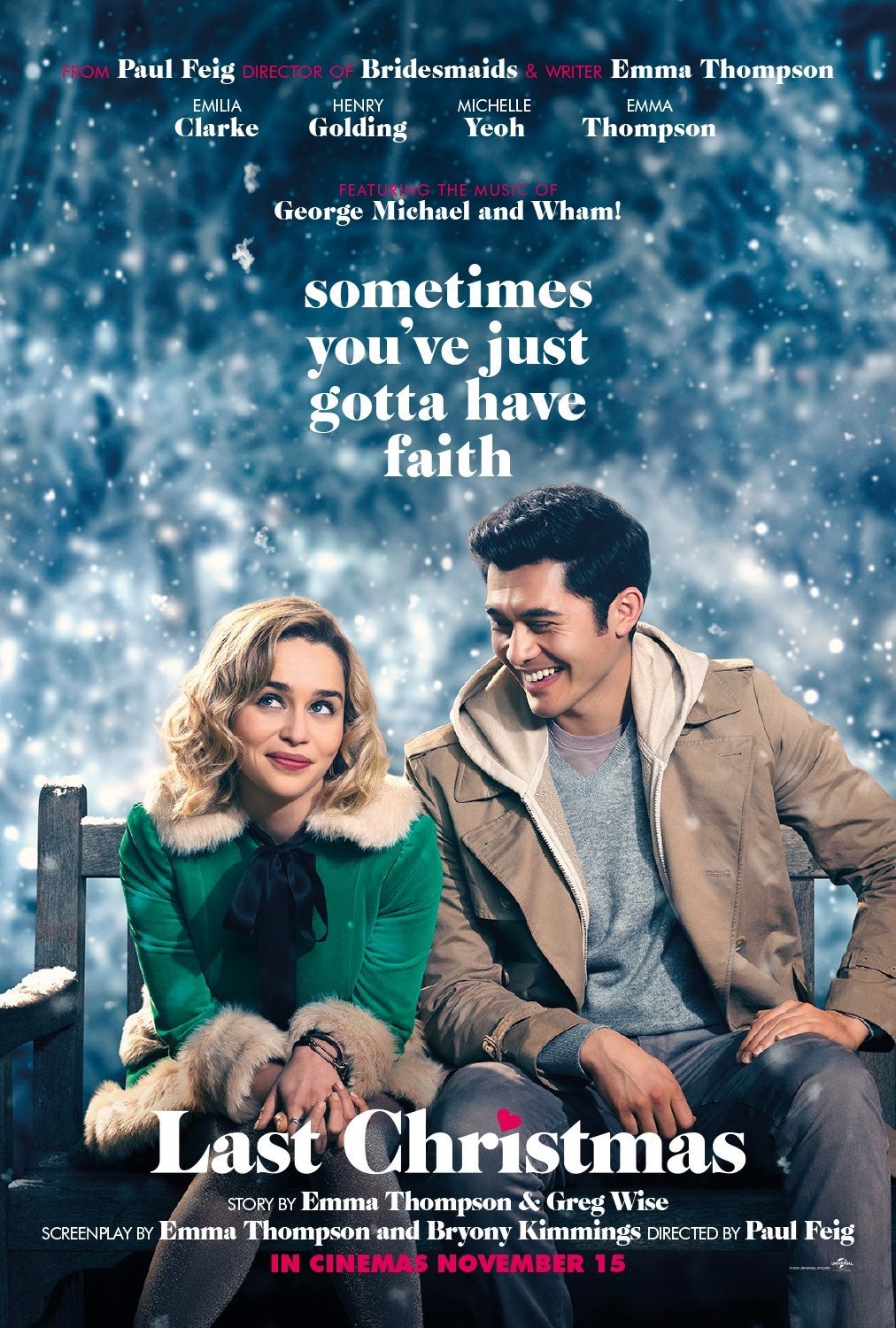
Last Christmas (2019)

Emilia Clarke and Henry Golding in a Christmassy romance with a twist

Director: Paul Feig

Cast: Emilia Clarke (Kate), Henry Golding (Tom Webster), Michelle Yeoh (“Santa”), Emma Thompson (Petra), Lydia Leonard (Marta), Peter Mygind (“Boy”), Rebecca Root (Dr Addis), Patti LuPone (Joyce), Ingrid Oliver (PO Crowley), Laura Evelyn (PO Churchill), Rob Delaney (Director), Peter Serafinowicz (Producer)

Last Christmas has been savaged by critics and held up by many like it was some sort of embodiment of everything that’s wrong with cinema. Jeez louise guys, take a chill pill why don’t you? Feig’s London based comedy, working with an Emma Thompson script, does exactly what it says on the tin – an It’s a Wonderful Life-inspired Christmassy story, that ticks all the Christmas boxes. It has no pretentions for doing anything else. And there is nothing wrong with that!

Kate (Emilia Clarke) is recovering from a heart transplant last year, and she’s heading off the rails. She takes no responsibility for anything, she’s selfish, lazy, demanding and making a car-crash of her life and health. Working as a full-time Elf in a Covent Garden Christmas store (run by Michelle Yeoh as “Santa”), Kate’s life is heading down the toilet until one day she meets Tom Webster (Henry Golding), an almost supernaturally decent guy, kind, considerate, friendly and caring. With his guidance can Kate start to turn her life around?

Well there is a twist in Last Christmas and, to be honest, it’s pretty easy to see coming. Anyone with half an eye on costumes or numbers of interactions will see it coming and anticipate what they are going to get. But you know, that’s fine. This is a film that knows what it is, a fairly unchallenging rom-com that’s spiced with a little touch of Capra-esque whimsy and a conventional morality tale of a selfish person turning round their life.

There are some good jokes, there are some reasonably charming performances, there is a good sense of fun driving through the whole film and it manages to capture at least a little touch of that Christmas-movie alchemy (a la Love Actually) where you can imagine people happily sitting down to watch it, in a light, fun, unchallenging way, for years to come. Its Feig’s offering for the Christmas movie cannon and it’s a perfectly acceptable entry. In fact its cosy predictability and familiar structure is pretty much a key part of its appeal. Because at Christmastime we don’t really want anything that’s going to stretch us or demand things from us. We kind of want to sit around and watch something a little predictable, a little fluffy but basically well-meaning and fun.

Emilia Clarke does a terrific job as light comedienne in the lead role, a role perhaps far more suited to her quirky, klutzy, off-the-wall charm than years of playing Daenerys Targaryen on Game of Thrones ever was. She throws herself into it here, happy to be silly, and shows both a good skill for pratfalls and also for drawing out a vulnerability from her character as well as being extremely charming. Henry Goulding makes a very good match as a character who could very easily tip over into smugly perfect, but again remains just the right side of charming.

Thompson writes herself a decent role as Kate’s Yugoslavian mother, a typical sort of nightmare domineering mother from films of this time, but laced with a sadness and isolation in the modern world and her adopted country. Moments that show the reaction of the characters to Brexit and the growing hostility to immigrants sometimes lean a little too heavily on the liberal conscience of the audience, but it fits in with the generally gentle, liberal attitudes of the film.

It’s a film that knows it’s a guilty pleasure, but it seems to have been designed to give you a sort of pre-Christmas glow. Catch it in the wrong mood and you will consider it one of the worst things you have seen. Take it in the right mood and you might even be charmed by it.

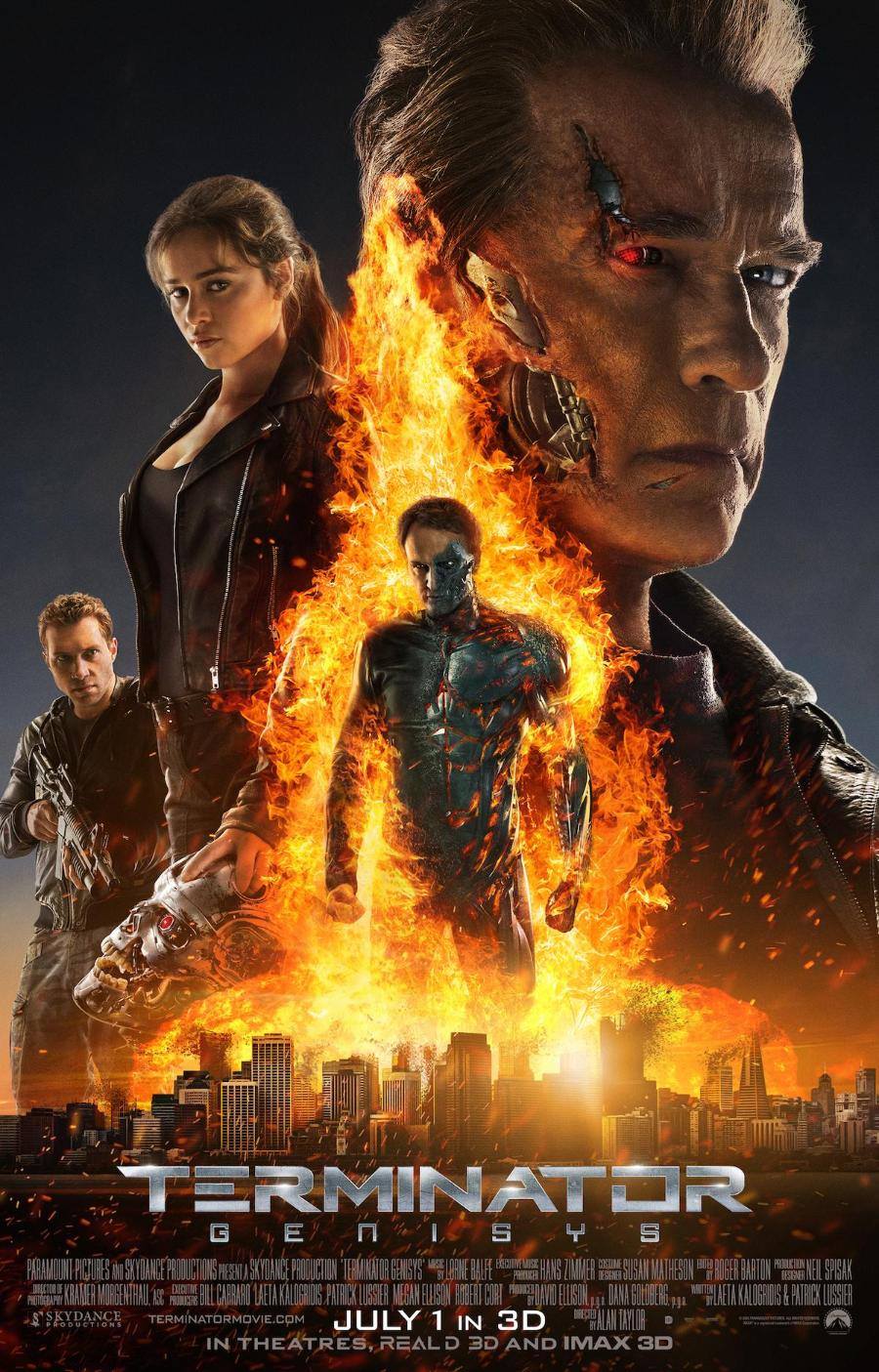
Terminator Genisys (2015)


Arnie saddles up (again) as The Terminator, this time with Emilia Clarke in tow. Reboot or remake?

Director: Alan Taylor

Cast: Arnold Schwarzenegger (Pops), Jai Courtenay (Kyle Reese), Emilia Clarke (Sarah Connor), Jason Clarke (John Connor), JK Simmons (O’Brien), Dayo Okeniyi (Danny Dyson), Matt Smith (Alex/Skynet), Courtenay B Vance (Miles Dyson), Byung Hun Lee (T-1000)

Every few years, Hollywood convinces itself the Terminator franchise is a licence to print money just waiting for exploitation. Since the late 90s, three movies and one TV series have attempted to relaunch the franchise. Each has underperformed, and left plans for sequels abandoned. Terminator: Genisys is the latest in this trend, the first in a planned trilogy that will never be made. As such, it’s a type of curiosity, a film that sets up a new timeline and introduces mysteries never to be answered.

Once again, the film starts with John Connor (Jason Clarke) sending Kyle Reece (Jai Courtenay) back in time to save his mother Sarah (Emilia Clarke) from deadly Terminators sent to destroy her and prevent Connor from being born. But when Reece arrives, he finds the past he was expecting altered and that Sarah was already saved years before from a first Terminator, by a re-programmed one nicknamed Pops (Arnold Schwarzenegger). Our heroes find themselves adrift in a timeline dramatically altered from the one they expected, and transport themselves to 2017 to combat Skynet once more.

It says a lot that the most original and daring thing about this movie is that no-one at any point says “Hasta La Vista, Baby”. Aside from that, the film is a Frankenstein’s monster, assembled from the off-cuts of previous franchise entries. The familiar lines are trotted out once more: I’ll Be Back, Come With Me if You Want to Live, Get Out and many more. The structure of the film limply settles into the same basic set-up we’ve seen since Terminator 2, while the big set pieces have an air of inevitability about them. This is a lazy, half-baked claim to re-invent the franchise that essentially copies and repeats everything from previous films with only a few small changes of angle. You can admire briefly the skill that has re-created moments from the original film, and be impressed by the effects that show a newly-young Schwarzenegger fighting his grizzled future self – but it will largely just make you want to watch the first film again.

This stench of familiarity is despite the huge, seemingly-inventive loopholes that the film, Bourne Legacy like, jumps through in order to try and justify its existence. The Terminator franchise has become so scrambled with alternative timelines, paths not taken, and film series cancelled that it spends almost the first hour carefully recreating events from previous movies, with some major tweaks and changes to allow a new “timeline” to burst up and act as a jumping off point for this movie. By the time the complex timeline politics has been put in place, the film has barely an hour of its run time left – at which point it needs to introduce its two antagonists and give our heroes a mission. The timeline is truncated, the villain is under-developed and the mission the dullest retread of the plot of Terminator 2 possible: a race to get to a building to blow it up. Yawn.

Is it any wonder that people shrugged at this movie? Even it can’t imagine a world outside the confines of its franchise rules. It reminds you what a small world the Terminator universe is. There’s little more than 3-4 characters, Skynet is always the adversary, time travel always seems to involve variations on the same people, the future is always the same blasted wasteland. The films always degenerate into long chases, compromised by our heroes’ attempts to change the future. So many Arnie Terminators have been reprogrammed by the resistance now, you wonder if any of them are left fighting for Skynet. What seemed fresh and daring in the first two films, now feels constrained and predictable. To find life in this franchise, it needs to do something genuinely different, not go over the same old ground over and over again.

The tragedy of this film is that the one unique thing it had – the identity of its main villain – was blown in the trailer of the film. Taylor was apparently furious at this undermining of a twist his film takes time building up. It ought to have been a shock for audiences to find out the franchise’s saviour-figure, John Connor, was instead the film’s villain – instead anyone who’d seen a trailer knew all about it before the opening credits even rolled. They even put it on the flipping poster! On top of which, the trailer carefully checks off all the major set pieces up to the final  30 minutes. Is it any wonder so many people gave it a miss at the cinema? Shocks left unspoiled, such as Matt Smith (strangely billed as Matthew Smith) revealed to be the embodiment of Skynet, are so dull and predictable they hardly counted as twists.

There is little in there to bolster the plot. The action is shot with a dull efficiency. The film is edited together with a plodding mundanity. Schwarzenegger once again goes through the familiar motions, but surely we have now seen enough of this character, which could in fact be holding the franchise back. Emilia Clarke looks bored, Jai Courtenay (an actor who came to prominence with a warm and intelligent performance in Spartacus: Blood and Sand) is again cast as a charisma free lunkhead, with attempts to add shading to his character only adding dullness. Jason Clarke lacks the charisma for the cursed role of John Connor (every film has seen a new actor take on the role).

Reviews claimed the plot was too complex for the audience: not the case. The plot is clear enough – it’s just dull and engaging. It never gives the viewer a reason to invest in the story. Terminator: Genysis is a ploddingly safe, predictable and routine piece of film-making, from a franchise that desperately needed reinvention. But so long as average and uninventive filmmakers – Jonathan Mostow, McG, Alan Taylor – are entrusted with its future, it will always be a franchise with no future. It’s time it was terminated. Hasta La Vista, Baby.