
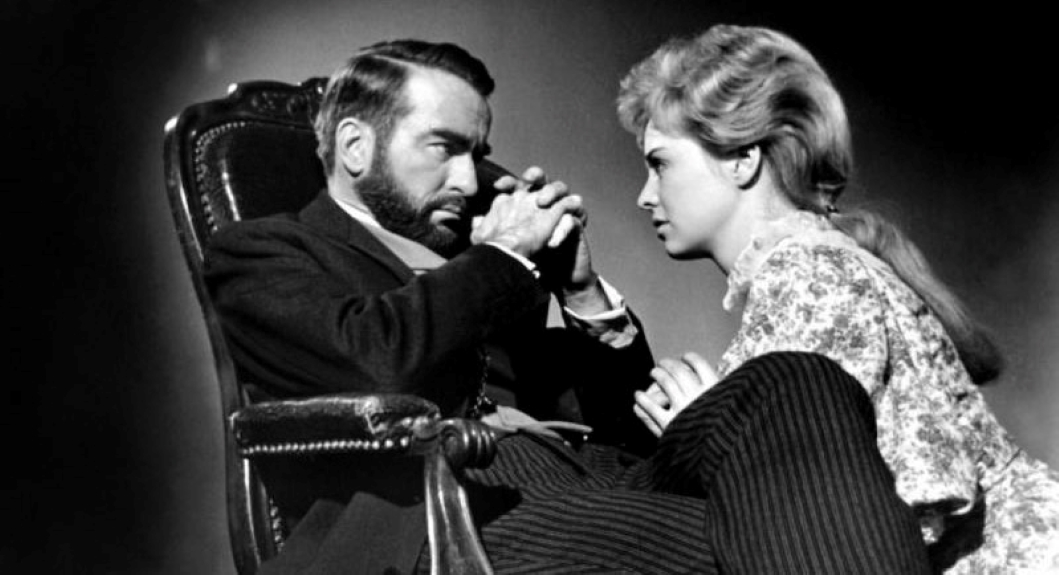
This intriguing film makes an excellent attempt at exploring the nature of thought
Director: John Huston
Cast: Montgomery Clift (Sigmund Freud), Susannah York (Cecily Koertner), Larry Parks (Dr Joseph Breuer), Eric Portman (Dr Theodore Meynet), Susan Kohner (Martha Freud), Eileen Herlie (Ida Koetner), Fernand Ledoux (Dr Charcot), David McCallum (Carl von Schlosser), Rosalie Crutchley (Amalia Freud)

Few thinkers had as much impact on the 20th century as Sigmund Freud. For generations, Freud’s theories on psychology and sexuality were defining texts shaping perceptions of our inner world. John Huston was fascinated by his work, translating its spirit into this thought-provoking, if at times clinical, film that focuses on a few key years in Freud’s life and does its very best to communicate the thought behind the theory, while being careful to never delve too far into thornier matters. (Despite the poster’s blaring tagline “He dared to search beyond the flesh!”).
Freud is played by Montgomery Clift, whom we meet in 1885 Vienna as a young doctor. Freud’s theories that physical ailments might have a psychological cause are widely dismissed by the medical establishment, represented by smug Dr Meynet (Eric Portman). However, Freud is convinced the secret of treating neurosis lies within – not least since he recognises symptoms of neurosis in his own dreams, haunted by half-memories of his mother and complex feelings for his father. Working with his mentor Dr Joseph Breuer (Larry Parks), Freud explores hypnosis to access patients’ repressed feelings, working closely with Cecily Koertner (Susannah York), a young woman who has inexplicably lost the ability to walk. Slowly Freud begins to form a theory of sexuality in children, as well as discovering guided discussions and word association to be more effective than hypnosis.
Huston’s film is shot in luscious black and white by Douglas Slocombe, composed of a mixture of images that balance painterly influences with surrealist nightmares. Freud and Koertner’s dream sequences are shot with a grainy intensity, a series of chilling images ranging from Freud being dragged towards his enthroned mother by a roped dwarf to Koertner’s mother domineering a beach from a grand tower. These surrealist touches tear through a film that otherwise presents a more earnest exploration of Freud’s theorising. It serves as a necessary contrast to the constraining formality of 19th-century Vienna, where inner passions and feelings are routinely stamped down.
Freud studiously explores the evolution of its subject’s thinking, in particular through his analysis of the fictional Cecily (standing in for several patients). Played with gusto by Susannah York, the film carefully structures her psychological make-up as a detective mystery to be slowly peeled away, with wrong-turns, false dawns and incorrect assumptions abounding. Initially treated with caring patience by Breuer’s hypnosis, slowly Freud replaces his mentor first as a doctor and then (to his subtle discomfort) as the subject of Cecily’s transposed attractions. These interior searches, eventually culminating in Freud’s first experiments of psychoanalysis and word association, are fascinating moments that pivot the film, with convincing false conclusions regularly introduced to constantly challenge the viewer’s assumptions.
It leads to the formulation of Freud’s Oedipal theories that cross a Rubicon his mentor cannot. In that, Breuer is joined by most of the medical profession. Huston’s film is strong on the stuffy self-confidence of the establishment, too hide-bound by its own ideas to recognise genius in their midst. Portman’s grandiose Dr Meynet gently, but firmly and devastatingly, rubbishes any nascent idea that neurosis patients are anything other than idlers and whingers. Meetings where Freud presents papers offer choruses of raucous boos and naked fury (at one point a dignified doctor literally stands up and spits at Freud’s feet in disgust). Hypnosis, with its vague medical support for its method is used as something close to a parlour trick by an otherwise supportive Dr Charcot (Fernand Ledoux) to pass physical symptoms from patient to patient, demonstrating the symptom is psychological even as he does nothing to understand the cause.
The path to decoding the human mind – as the film firmly believes Freud’s theories have done, hammered home by Huston’s narration which opens and closes the films and intermittently provides an internal monologue for Freud – is a bumpy one. Freud is frequently disturbed by the implications of his investigations. A young solider – a fragile David McCallum – alarms him when, under hypnosis, he reveals a deep, sexual longing for his mother via the fondling of a mannequin (naturally concealed under his father’s uniform). Freud’s closeness to his mother – a marvellous Rosalie Crutchley – becomes wrapped up in his theories, his dreams and memories haunted by half-remembered encounters and longings that cause him great unease.

Much of the clarity of this unease – and the tension as the unsettling implications of Freud’s nascent beliefs become more apparent – owes its success to Clift’s performance in the lead role. Clift was in extremely poor health at the time, still suffering from the effects of a near fatal car crash (including cataracts that affected his vision). An addiction to painkillers and alcohol had shot his memory to pieces. He struggled to remember lines (so much so the studio attempted to sue him for the film’s many delays), but his soulfulness appears to glorious effect. He makes Freud a profound and troubled but artistic thinker, a humanitarian full of empathy which also makes him a conduit for guilt and shame. His impassive face makes him the perfect listener but does not hide his own torment. It’s a marvellous performance, one that manages to convey the power of thinking.
Unfortunately, its genesis is also bound up in the story of the film’s making, that has often dwarfed the film itself in discussions about this intriguing movie. Huston – increasingly angry at Clift’s unreliability, compounded by his alpha-male disgust at Clift’s homosexuality – bullied the actor relentlessly during the film’s making, forcing him into take-after-take after every line flub to the increased anger of the other actors (York, in particular, was outspoken in her disgust at this). Huston had also originally written a script with Jean-Paul Sartre but, not surprisingly, the two were incompatible, Sartre eventually having his name removed from the credits.
It’s a shame these stories have dominated the discussion of the film, as it is a rich, intriguing work directed with a thoughtfulness by Huston that helps it become a thoughtful and patient film, rather than a triumphalist one (the film lacks either a eureka moment or a closing triumph, leaving Freud still rejected by the establishment and quietly visiting his father’s grave, having come to terms with his own feelings). With a marvellous performance by Clift – even if his treatment on set was shocking – it’s an intelligent, intriguing and well-handled exploration of a complex theme. It’s more than a curiosity, it’s a measured and serious film with flashes of surrealism that engages intelligently with important themes.
 Movie Musings