Tag: Ernest Thesiger

Bride of Frankenstein (1935)

Bride of Frankenstein (1935)

Whale’s sequel is a masterclass in how more can sometimes be more, a delightful black-comedy

Director: James Whale

Cast: Boris Karloff (Frankenstein’s monster), Colin Clive (Baron Henry Frankenstein), Valerie Hobson (Elizabeth Frankenstein), Ernest Thesiger (Dr Pretorius), Elsa Lanchester (Mary Shelley/The Bride), OP Heggie (Hermit), Gavin Gordon (Lord Bryon), Douglas Walton (Percy Shelley), Una O’Connor (Minnie), EE Clive (The Burgomaster), Dwight Frye (Karl), Ted Billings (Ludwig), Reginald Barlow (Hans)
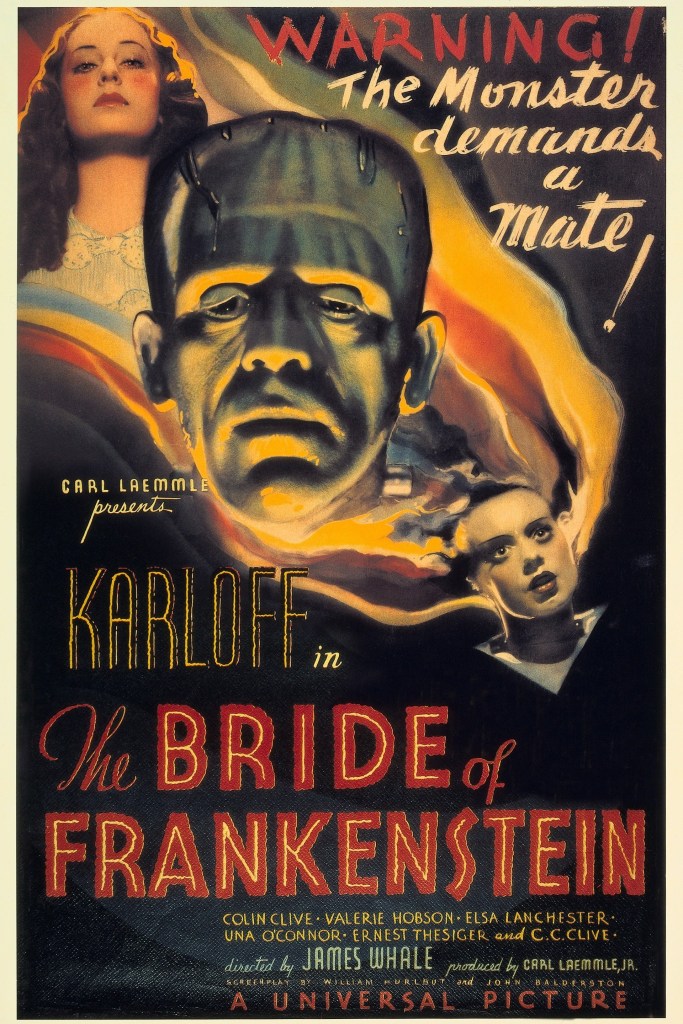
What does every studio want after a mega hit? A sequel of course! Directors are never more powerful then when studios will let them do pretty much whatever they want so long as they get another shot at capturing body-sparking lightening in a bottle one more time. James Whale and gang came back for Bride of Frankenstein and produced a classic, more entertaining than the first film, a barmy, balls-to-the-wall piece of nonsense where logic is thrown out, sly jokes abound and the meter is dialled well up to camp. Bride of Frankenstein is exactly the “memorable hoot” Whale wanted to make, and proof that perhaps he had not “drained the well” after all.

Bride of Frankenstein kicks off pretty much where Frankenstein left off – requiring some fast thinking since the creature (Boris Karloff) ended that film incinerated in a burning windmill. Turns out he actually hid in the water-logged basement, emerging to stumble into violence from villagers terrified at this bolt-necked giant’s existence. Meanwhile, a chastened Henry Frankenstein (Colin Clive) swears he’s out of the reanimation game… only to be dragged back in by his old mentor (presumably a different one to the first film’s Waldmann) the creepy Dr Pretorius (Ernest Thesiger). Pretorius has been experimenting with creating life, and he wants a whole race of these people – so he’ll need a bride for the creature, to get that ball rolling. While the creature fights and flies, Pretorius and Frankenstein fire up the generator and get ready to stitch.

There is more than a little bit of black humour to Bride of Frankenstein, a film Whale clearly never intended to be taken seriously. It’s combined with more than a touch of camp and sprinklings of the absurd with general utter indifference to any rules of time, setting or location. Whale’s gothic world is whatever and whenever he needs it to be at any point. If that means the creature is chucked in a medieval cell one minute and Dr Pretorius is using a telephone to call his underlings the next, that’s fine. Logic is already all over the place, since it opens with Mary Shelley, her husband Percy and Bryon in full period costume recapping the first movie, despite that film being littered with no-end of what would be to them unimaginable technical possibilities.

Whale buttresses his fantasia on Frankenstein by pruning out, probably, the last couple of elements of the book he liked but hadn’t used: the creature’s ability to speak, it’s time out at the secluded hut of a blind man and (of course) the concept of a bride being resurrected. But then Whale also pours all his love into Ernest Thesiger’s sinister and delightfully eccentric Dr Pretorius, the sort of larger-than-life character who leaves all reality behind. Thesiger has a whale of the time, sucking on the sarcastic dialogue like a lemon and delighting in playing the sort of amoral mad man (he even makes Frankenstein look sane) who brings a picnic to a grave-robbing and uses a tomb as a table.

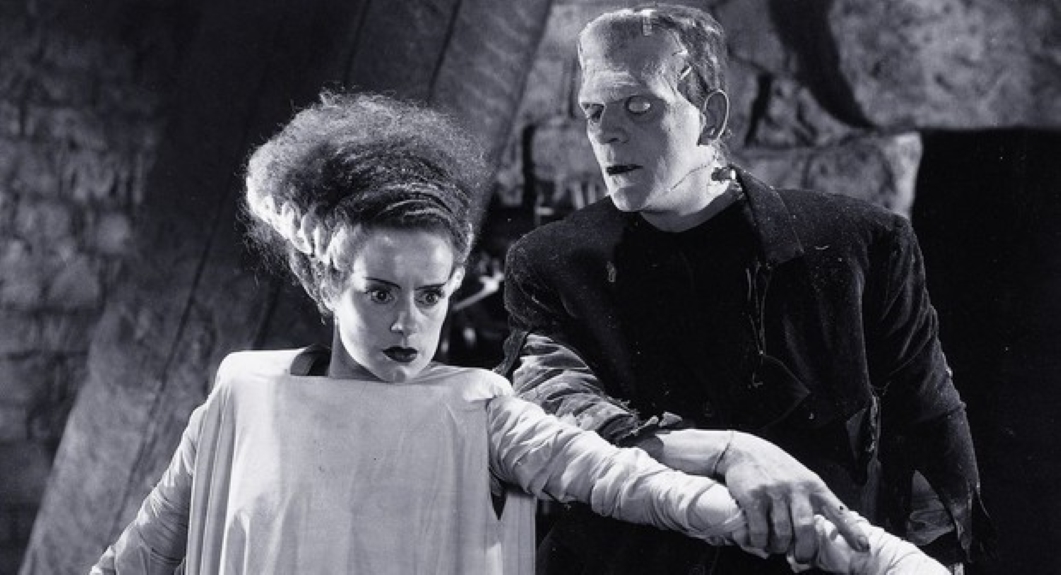
Pretorius’ swiftly brow-beats Frankenstein into saddling back up. Colin Clive – who broke his leg shortly before filming, requiring him to do nearly all his scenes sitting down – is surprisingly restrained, with the old madness only coming to the fore in the Bride’s birthing scene. That birthing scene is a brilliant expansion of the first film, Whale using the increased budget to expert effect to take us up onto the roof of the laboratory, expanding the detail shown of the mechanics of the experiment (Whale uses Dutch angles to dial up the general air of creepy weirdness and clearly was inspired by Metropolis) and launching a creation even odder than the original. As before the design work is exquisite: the Bride – wonderfully played with a ear-piercing screech (based on the swans near her London home) by Elsa Lanchester, her white high-lit hair a masterpiece of memorable, blackly-comic imagery. The Bride makes such a lasting impression, it’s a shock to realise she’s in it for less than five minutes.

Did Whale intend anything to be taken seriously? He tips the wink with Una O’Connor’s opinion-dividing performance of shrieking, Oirish panic as the villager who discovers the surviving creature. Pretorius is introduced showcasing his collection of miniature living people in jars (a bishop, a devil, a mermaid, a queen and a randy Charles Laughton-channelling Henry VIII) the sort of head-turningly bizarre scene that leaves you both delighted and shaking your head in amazement. There is something hilariously odd about the creature being introduced to those human vices, smoking and drinking. Whale was surely chortling to himself at the thought of the creature contentedly blowing smoke circles with the blind hermit or eagerly knocking back a glass with Pretorius.

It’s remarkable that despite this strong leaning into comedy, Bride of Frankenstein still manages to find the humanity in the persecution of the monster. Chased down (once again) by a wild, the creature is tied down to a pole and lifted up, his body unmistakenly in a crucifixion pose. The film’s emotional centrepiece is his sojourn with the blind hermit. It’s impossible not to see more than a touch of Whale’s experience of persecution for his homosexuality in the tender staging of these scenes, two men living contentedly together only to have their partnership condemned the moment the real world intrudes. The gentleness of these scenes becomes very affecting, not least since this is the first (and last) time the creature is treated like a person rather than a monster.

Karloff is, as before, excellent in the lead role – despite his worries about the creature’s mystery being sacrificed on the altar of his fumbling, toddler-like speech. He makes the creature, even more than before, someone reaching out for warmth and connection, disgusted at his own monstrous nature and whose delight at the idea of a bride is strangely touching. (Bride of Frankenstein – a title even name checked at one point by Pretorius – cemented the popular confusion about whether the creature or his creator is ‘Frankenstein’). It’s the monster who also emerges at the film’s conclusion as the closest thing we have to a moral force.

Really Bride of Frankenstein shouldn’t work as half as well as it does. It’s part horror, part black comedy, part farce with scenes that shift from tragedy to knock-about satire. But it’s superbly assembled by Whale – at the top of his game here – and barrels along at such speed (sustained by superb performances, in particular from Karloff, Lanchester and Thesiger creating a portrait of monstrously soft-spoken camp for the ages) and with such full-blooded commitment at every moment that the film never once sinks. It is such a gloriously entertaining, wildly committed piece of pulpy film-making that it’s hard to imagine it could have been done better. And it certainly was the last word in what to do with the monster on-screen, that saw him embrace fear, love, comedy and tragedy all in one go. He probably should have stayed with the dead.
Henry V (1944)

Once more unto the breach with Laurence Olivier as Henry V

Director: Laurence Olivier

Cast: Laurence Olivier (Henry V), Renée Asherson (Princess Katherine), Robert Newton (Pistol), Leslie Banks (Chorus), Felix Aylmer (Archbishop of Canterbury), Robert Helpmann (Bishop of Ely), Nicholas Hannen (Exeter), Ernest Thesiger (Duke of Berri), Frederick Cooper (Nym), Roy Emerton (Bardolph), Freda Jackson (Mistress Quickly), George Cole (Boy), Harcourt Williams (King Charles VI), Russell Thorndike (Duke of Bourbon), Leo Genn (Constable of France), Francis Lister (Orleans), Max Adrian (The Dauphin), Esmond Knight (Fluellen), Michael Shepley (Gower), John Laurie (Jamy), Niall McGinnis (MacMorris), Valentine Dyall (Burgandy)

Olivier’s pre-eminence as the leader of the acting profession in Britain for a large chunk of the last century probably found its roots in his imperiously sublime production of Henry V, the first time he directed a film, but also the point where it seemed that Olivier and the country of Britain seemed to be almost one and the same. Filmed as a propaganda piece, heralding the indomitable spirit of the British in the face of foreign wars, Olivier’s film is a triumph that also set the tone for what the public expected from Shakespeare films for decades to come. 

Originally Oliver balked at the idea of directing the film, approaching William Wyler to take the job on. But Wyler, rightly, knew he could never bring the Shakespearean understanding to it that Olivier could, so the soon-to-be Sir Laurence took the job on himself – meaning he directed, co-produced, co-adapted and starred in the film. I’m not sure anyone else could have done it – or invested the entire project with such certainty, such confidence, such power of personality that the entire project flies together into a sweeping, brightly technicolour treat of pageantry and theatre.

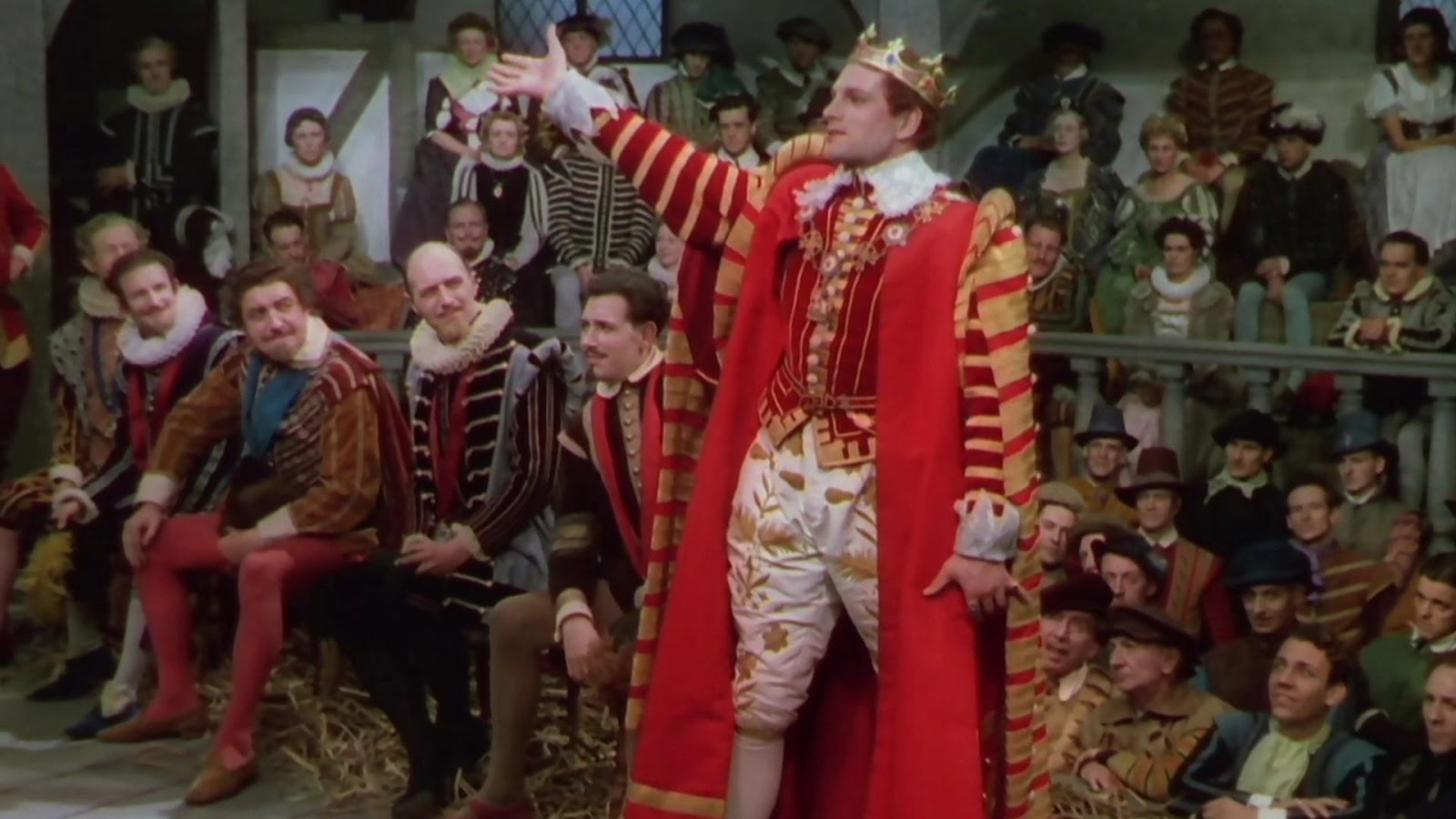
Olivier’s concept for the film is ingenious – and influential. Taking as its cue the words of the chorus (delivered with a archly bombastic confidence by Leslie Banks), the call to “let your imaginary forces work”, the film is set initially in a genuine Elizabethan era staging of Henry V (including unfortunate rain downpour after the first scene).Slowly, it develops over the course of the film from set to cinematic sound stage (still designed with influence from medieval illustrations) and finally into a realistic location setting for the Battle of Agincourt, before turning heel and repeating the journey back until the film ends again in the Globe theatre, with the actors taking their bow (and the female characters now played by fresh-faced boys). It’s marvellously done, and a neat play on the limitations of both film and theatre, and a testament to the powers that imagination can have to expand the world of what we are presented with.

The style of the play develops as we watch it, becoming more natural and restrained as we get closer to Agincourt, then progressing gently back the other way. The opening scenes play Canterbury and Ely’s long-winded legal argument in favour of war for laughs (with neat comic timing by Felix Aylmer and Robert Helpmann), with an avalanche of papers across the stage, Canterbury frequently lost in his exposition and Ely (and even Henry) having to prompt him with precise points. This is a nice set-up for the comic characters of the play, Falstaff’s old retainers here are the very picture of high-spirited, rowdy common folk (though I must say Robert Newton’s high-energy, gurning Pistol is a bit of a trial, even if it perfectly captures the playing-to-the-cheap-seats mania the role seems to require). 

This comic exuberance (and the stuff with Canterbury is genuinely quite funny) gives a perfect counterpoint for Laurence Olivier to perform Henry at his imperious best. Olivier was an actor who invested his Shakespearean delivery with far more naturalism than he is often given credit for, and his Henry here has more than enough true feeling, emotion, determination, courage, bravery and nobility behind his almost sanctified greatness. And of course you get Olivier’s outstanding delivery, that wonderfully rich voice with just a hint of sharpness, delivering the lines not as just poetry, but as true moments of invention. Olivier also has the mastery of the small moments – and Henry doesn’t get much of those – with two particular favourites being the small cough in the wings to clear his throat before entering for his first scene, and that satisfied, exuberant smile at the curtain call at the play’s end. His Henry – the true warrior king of virtue – cemented perception of the character for decades to come.

True, Olivier never touches on Henry’s darker side. Olivier neatly cut anything that could introduce any shades of grey into the character: gone is the summary execution of the traitors at Southampton, cut are the references to naked newborn babes being spitted on pikes before Harfleur, nowhere do you hear the order to execute all prisoners at Agincourt. This is film-making with a purpose, to pushing the message of England, for good, against all. 

As a director, Olivier revelled in the possibilities of cinema, marrying it to theatre. For the large speeches, Olivier invariably starts small and close, and then pans sharply and widely out to turn the cinema into a theatre – also allowing the actors (often to be fair, himself) to not feel restrained by the intimacy of the camera, but to deliver the speeches as intended, larger than life and bursting with impact. Olivier’s confidence with the camera is striking, his film a celebration of sweeping shots, of carefully placed tracking shots, of well-delivered acting. The camera work in the Globe is beautifully done, a series of carefully selected angles and shots. The long panning shot over a model of London leading to the Globe that book-ends the film is beautifully done, and the confidence with which Olivier slowly transitions from artifice to reality is superbly well done.

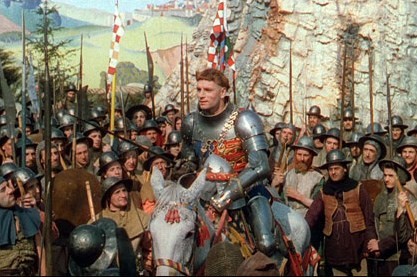
The style of the piece is extraordinary, with its primary colours like a medieval book brought to life. There is some pleasing comic mileage from the French court, reduced almost to a man to being a bunch of camp moral weaklings. The courting of Princess Katherine (Renée Asherson, in a role intended for Vivien Leigh) has a playful charm to it (even if, as in the play, it’s probably a scene too far after the highpoint of Agincourt). But the heart of it is that long build to the campaign, for Agincourt to be brought to life (at huge expense at the time), a beautiful rendering and explosion of reality after the careful artificiality of the rest of the film, as if we really have got our imaginations working and brought it to life before us as the Chorus instructed.

The film established a regular Olivier company that would work with him on films to come. William Walton’s score seems to capture that mood of England at war and believing it was in the right. The cast – plucked from English theatre by Olivier – give striking performances, from Leo Genn’s stern Constable to Max Adrian’s bitter Dauphin, with Esmond Knight’s pernickety Fluellen leading the way for the English. Olivier is of course at the centre as the master conductor, a man who fitted so naturally into the role of leader that he basically seemed ready to take it on for the whole country, never mind just the film. Is there an actor around who was more suited and natural in positions of authority than Olivier? Who was so easily able to inspire and dalliance with genius? 

Turning Henry Vinto a patriotic celebration of England was what was needed, but turning Shakespeare into something that worked on film, that married the theatrical qualities with the cinematic sweep of the camera was exactly what the Bard needed to find a life on screen. Olivier’s daring was to strip down the play and work out what would work on screen and how to make that come to life. Doing so, he defined Shakespeare films for a generation.