
Archetypal early horror, that presents a sympathetic view of the creature and its creator
Director: Paul Wegener, Carl Boese
Cast: Albert Steinrück (Rabbi Loew), Paul Wegener (The Golem), Lyda Salmonova (Miriam), Ernst Deutsch (Loew’s assistant), Lothar Müthel (Squire Florian), Otto Gebühr (Emperor), Hans Sturm (Rabbi Jehuda), Max Kronert (Gatekeeper), Greta Schröder (Lady), Loni Nest (Little Girl), Fritz Feld (Jester)
In the Jewish Ghetto of 16th century Prague, persecution is an every-day event under the capricious rule of the Emperor (Otto Gebühr). To protect his people, Rabbi Loew (Albert Steinrück) creates the Golem (Paul Wegener), a forbidding clay giant, granted life by the magic words of a demon, placed in an amulet on his chest. At first, the Golem seems the harbinger of a new prosperity to the Jewish people, but the envy of Loew’s assistant (Ernst Deutsch) risks twisting the Golem into dark deeds that imperil everyone.
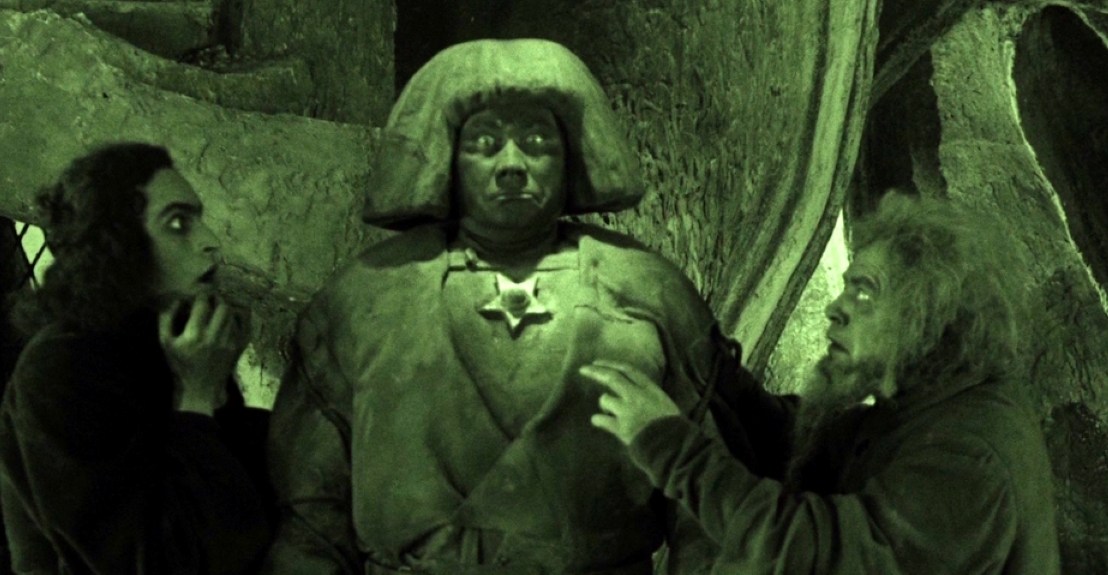
The Golem was co-director and star Paul Wegener’s third attempt to bring the legend to the screen (the first to be set in the correct period, so it’s also a form of prequel). It arrives as an atmospheric masterpiece with touches of Murnau and Lang and advance signs of Caligari, a richly filmed exploration of early horror on a set full of deliberately disjointed angular buildings adding to the unsettling unease. There are flashes of inspired visual magic throughout, while the concept of man’s creation struggling to understand its own humanity (or otherwise) and its place in the world inspired several films, not least James Whale’s Frankenstein (clear echoes of the creatures unfortunate meeting with a child at the lake can be seen in the Golem’s final encounter with a child).
But The Golem is not really a horror piece, more a tragedy of a newly born creature who, due to abuse of its powers, becomes a force of destruction despite its curious nature. Paul Wegener’s Golem is a restrained, even gentle creature, whose subtle glances suggest an intriguing, questioning mind eager to learn more about his surroundings. Whatever dark magic led to his creation, the Golem never feels like a creature of natural violence, even while it can cause great destruction through its relentless, blade-resistant body. The real villains are men, and the dangers their desires cause.
The Golem walks a fine line in its portrayal of Jewish culture. It’s easy to see old antisemitic tropes in the Jewish population’s robes and wild eyes (and in their rapturously cult-like praying, shot from a series of unsettling images) and while Rabbi Loew’s experiment may be about protecting people, it’s powered by dark magic – exactly the crimes the Emperor believes Jewish people to be guilty of. But, this is a film where the Jewish people are the innocent victims of persecution. With the persecutors at court, portrayed as spoilt and shallow, giggling at parties and living the high life.
Similarly Lothar Müthel’s Squire, a gentile secretly wooing the Rabbi’s daughter, may or may not be sincere in his intentions, but is certainly presented as a manipulative and secretive seductor. It’s just another sign of how Jewish people in The Golem are, exploited and powerless in the hands of others. Rabbi Loew is doing all he can to build a better life for his people and the film holds his motives up for praise, even as it shows the dark compromises he makes for it.
Because, even if the Golem is benign and only harms when ordered, it comes from dark powers. In a striking sequence, the demonic head of Astaroth (looking very much like Nosferatu) swirls spectrally around the bodies of Loew and his assistant (encased in a ring of fire), offering up the dark words to give life to the clay man. When corrupted by dark intensions, the Golem is a terrifyingly relentless character, sending bodies flying, twirling flaming logs around like they are matches, punching through doors and pursuing those it’s ordered to destroy with Terminator-like determination.
But the Golem can equally be a force for good. It’s strength saves the Emperor and court from a falling building – a neat camera effect that sees it push aside falling debris and fracture a falling ceiling (a truly striking visual image). On its own devices, it yearns for a sense of freedom and purpose. It starts to clamp its hand over its chest to prevent the amulet that gives it life from being removed whenever the Rabbi doesn’t need it and its eventual downfall comes from its concern for children. What seems to anger it is being taken for granted as little more than a tool by those abusing its strength.
This comes neatly to life in Wegener and Boese’s exceedingly atmospheric film in its impressively constructed Gothic set, where the ghetto is somewhere between a rickety shanty town and a nightmarish fairy tale parlour. It contrasts well with the grandness of the court, full of decadent feasting, while Loew’s cave-like home features a winding staircase like a spiralling trap. The imagery is beautifully done in its simplicity and cinematographer Karl Freund’s eye for the simple, affecting moment alongside the grand horrors: a close-up of subtle facial expressions humanising the Golem is as memorable as the grand flame-spreading ruin havoc it wreaks on the ghetto.
The Golem is in many ways a sort of fairy tale, with fairy tale logic, where Loew makes a terrible bargain and pays a price. It makes conventional romantic decisions, not least suggesting that the Squire may be sincere in some of his expressions of love and falling shy of condemning Loew’s assistant’s love for his daughter as a destructive piece of possessiveness. There is a truly odd sequence where Loew uses his magical powers to effectively screen a home-movie of the history of the Jewish people (met with sniggering mockery from the court) which feels like its popped in from a very different film, and a reminder of the film’s sometimes helter-skelter relationship with logic.
But it’s a film that largely wants to tell a humanitarian message. And it reminds you that Wegener may have spent the war making theatre for the Nazis, but he also spent it hiding Jewish friends. It’s told with a true visual beauty and it creates, thank to Wegener’s fascinating performance, an intriguing and sympathetic monster.
 Movie Musings