Tag: Florence Bates

On the Town (1949)

On the Town (1949)

Hugely enjoyable musical, fast-paced, funny and crammed with excellent song-and-dance routines

Director: Stanley Donen, Gene Kelly

Cast: Gene Kelly (Gabey), Frank Sinatra (Chip), Betty Garrett (Hildy Esterhazy), Ann Miller (Claire Huddesen), Jules Munshin (Ozzie), Vera-Ellen (Ivy Smith), Florence Bates (Madame Dilyovska), Alice Pearce (Lucy Shmeeler)
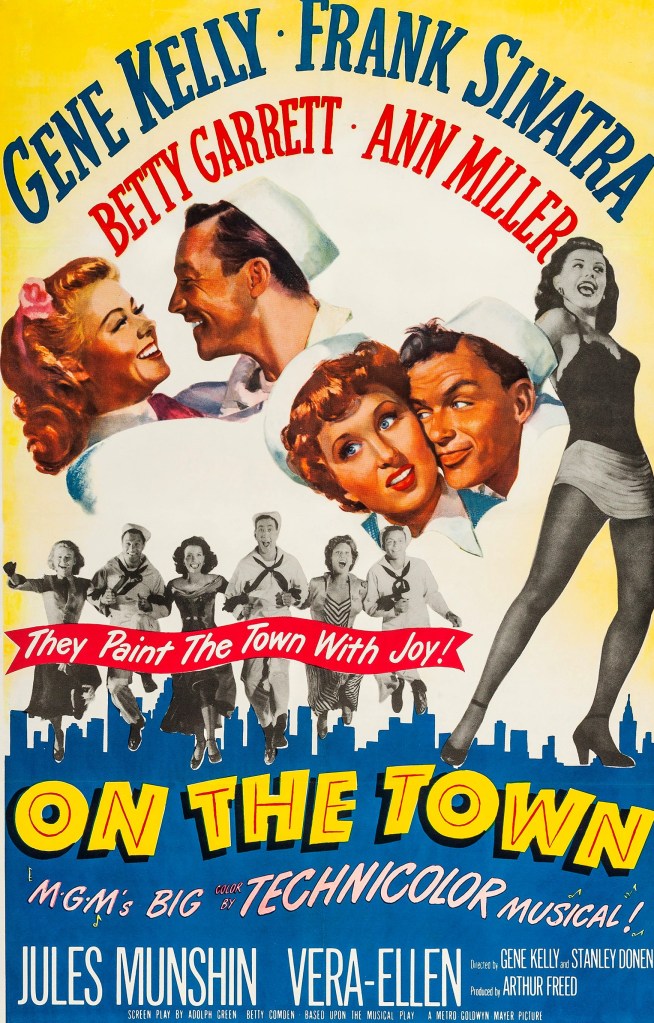
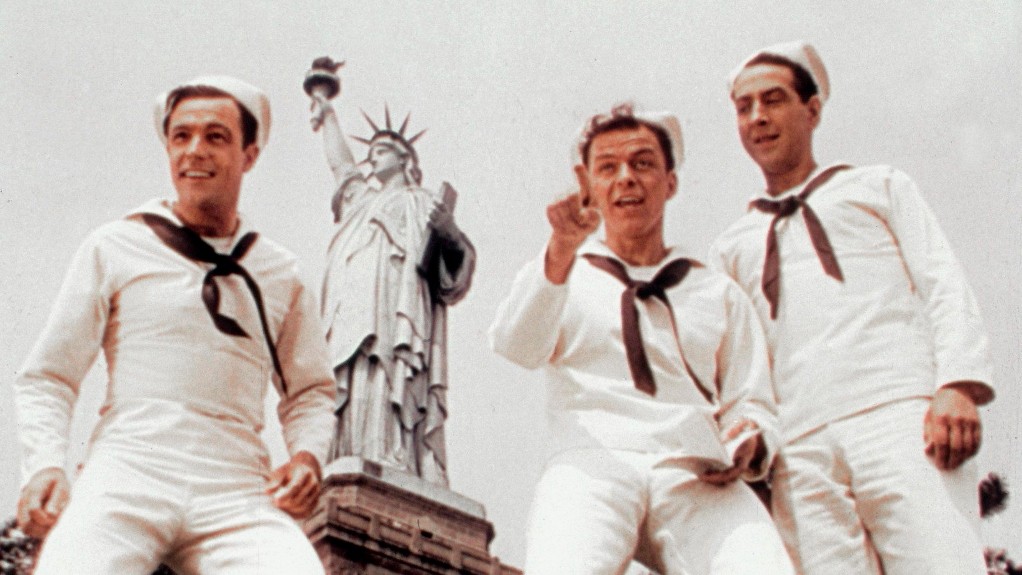
I assume Freed, Donen and Kelly re-watched Anchors Aweigh and said ‘There’s a good idea in here… but we can do better’. They certainly did with On the Town – and it surely helped that they seized on Leonard Bernstein’s hit Broadway musical with its book by Betty Comden and Adolph Green, for a pacier, funnier, more focused version of a very similar story. Once again, Gene Kelly and Frank Sinatra (now accompanied by third banana Jules Munshin) are sailors enjoying leave (this time in New York) and looking for romance. And they find it, with Gabey (Kelly) star-struck by Vera-Ellen’s Ivy Smith (who he mistakes for a celebrity), Chip (Sinatra) falling for flirtatiously voracious taxi-driver Hildy (Betty Garrett) and Ozzie (Menshin) inexplicably charming glamourous anthropologist Claire (Ann Miller). These three couples spend a fab 24 hours, getting in-and-out of scrapes and falling in love.

It’s all gloriously entertaining, zipping by in 90 pacey minutes with assured, dynamic and engaging direction by Stanley Donen that crams the film with zip and an enormous sense of fun. Donen’s first credit saw him handling much of the visuals and camerawork, while co-director Kelly took on the choreography. It made for a fantastic teaming, and it’s striking how much energy and visual panache Donen bought to the musical (again, compared to the more staid direction and visual compositions of Anchors Aweigh). Donen cuts the film tightly, never lets scenes out-stay their welcome, cuts tightly to the beat (the opening song New York, New York shifts excitingly from location to location during its performance) and crafting visual set-pieces that were exciting to watch (crane shots, tracking shots) while never compromising the view of the dancing.

On the Town also had the advantage of some fabulous source material. Interestingly, Freed and musical director Roger Edens were sceptical about whether Bernstein’s original score (with its artful repeated refrains) was accessible enough to appeal to audiences (not to mention many of the numbers in the musical were not a good fit for their cast). It was decided to junk a huge portion of Bernstein’s score (only four songs remain), a decision that led to him boycotting the film – but meant they could combine the best of his work with the sort of song-and-dance material that played to its star’s strengths.

And the film has several stand-out sequences, most notably of course that ‘New York, New York’ opening. Kelly and Donen pitched heavily to be allowed to shoot on location in New York and were granted ten days of location footage. It makes a huge impact to the number, allowing Donen to give it a grounded and vibrant mood. On the Town helped set the template for future films for fast-paced location shooting in bustling locations: driven by the fact Sinatra’s fame meant inconspicuous camera set-ups for quick shots was essential to avoid attracting crowds. (The only scene that shows the problems the film had with longer set-ups was the shot of the gang dancing in front of the Rockefeller centre, the balcony above the statue packed with rubber-necking fans).

There are also great song-and-dance scenes which utilise the strength of all the film’s performers. ‘Prehistoric man’ is suitably zany, ‘You’re awful’ a lovely song-showcase for Sinatra and Garrett, ‘On the Town’ and ‘You Can Count on Me’ fantastic toe-tapping showcases. It’s a parade of hugely engaging, dynamic musical numbers which are immensely fun to watch. It’s more than enough to make you forgive Kelly’s continued desire to prove himself a ballet dancer (On the Town shoves in a day-dream, silent ballet set-piece ‘A Day in New York’ which is an impressive showpiece for Kelly, even if it’s the only number that slows the film down rather than keeping the comic and narrative pace up).

On the Town also has a punchy series of funny lines, clever comic set-pieces and jokes from Comden and Green (it’s Dinosaur/Dinah Shaw mishearing gag is a real stand-out). Of course, narratively On the Town is completely barmy, much of the drama revolving around Ozzie’s accidental destruction of a Brontosaurus skeleton in the Natural History Museum and a resulting on-and-off again Keystone Kops style series of chases. The film zips along with such pace and wit that you happily swallow bizarre ideas (such as Ozzie, in a surprisingly vertigo inducing moment, hanging off the side of the top of the Empire State Building) and shameless coincidences.

But it’s knock-about fun and zany, nonsense plotting actually makes it all the more entertaining to watch. The film’s constant reminders of how far we into this strange 24-hour leave period works very well to give a sense of momentum to events and there is a more than a bit of Hays Code baiting naughtiness, not least in the clear implication that Chip and Hildy (in particular) and Ozzie and Claire spend most of the afternoon going at it great guns while claiming to Gabey that of course they spent the time searching the libraries and museums of New York for Ivy.

On the Town has its cast of musical stars nearly at their peak. Kelly’s dancing and choreography is energetically perfect as always and he fully embraces the charismatic romantic naivety of this would-be player Gabey. Sinatra is much more assured and comfortably witty than in many other musical roles. He also has excellent chemistry with Betty Garrett’s hilariously eager Betty. Ann Miller is wonderfully endearing and funny as Claire. Alice Pearce is surprisingly affecting in a role that initially suggests it might be a one-joke loser, as Ivy’s blousy single flatmate. Vera-Ellen may not have the charisma the role needs but is very sweet. Only Jules Munshin is trying too hard with some aggressively enthusiastic gurning.

Kelly later said On the Town might not have been the best musical they ever made, but it was the one when pretty much everyone involved was at the peak of their powers. He might well be right. On the Town is a slick, sleek and highly enjoyable confection that makes for perfectly entertaining Sunday afternoon viewing.

Rebecca (1940)

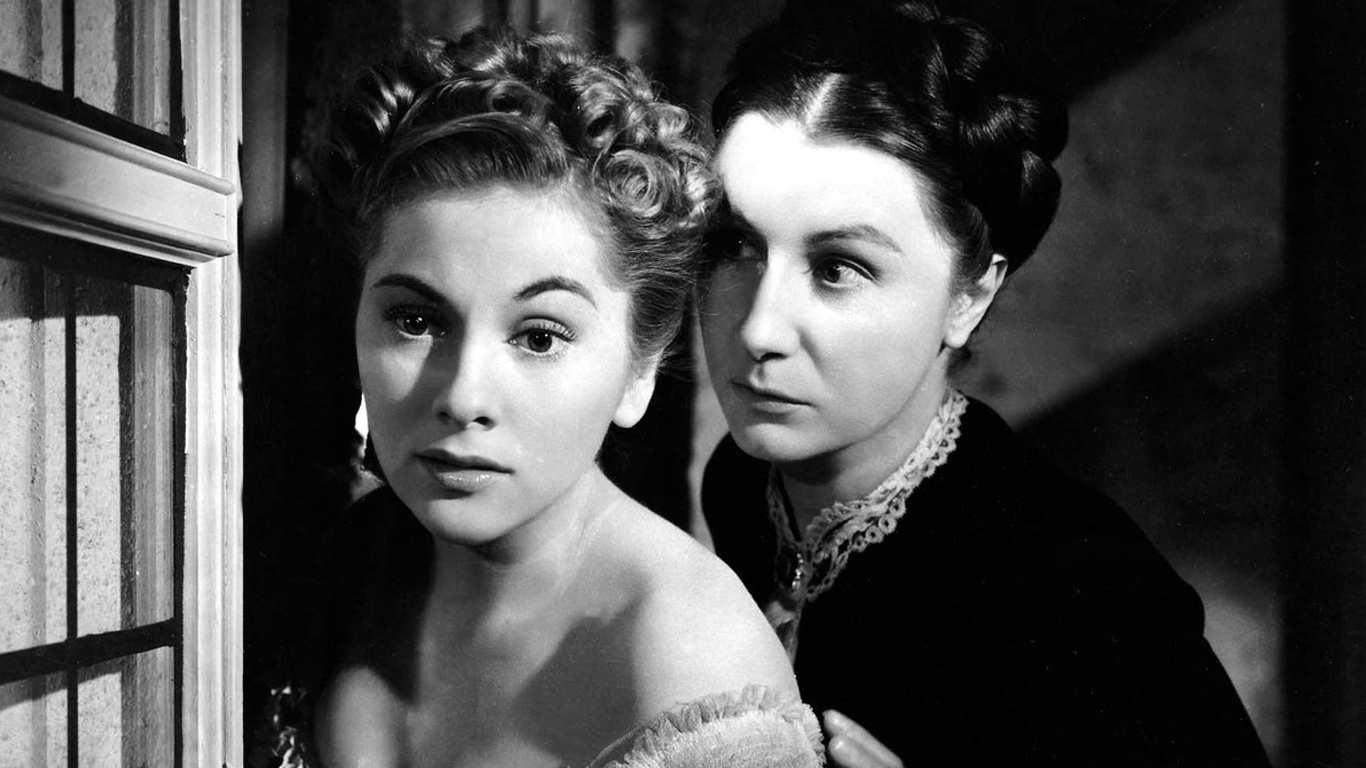
Joan Fontaine and Laurence Olivier find married life isn’t a bed of roses in Rebecca

Director: Alfred Hitchcock

Cast: Joan Fontaine (The second Mrs de Winter), Laurence Olivier (Maxim de Winter), Judith Anderson (Mrs Danvers), George Sanders (Jack Favell), Reginald Denny (Frank Crawley), Gladys Cooper (Beatrice Lacy), C. Aubrey Smith (Colonel Julyan), Nigel Bruce (Major Giles Lacy), Florence Bates (Mrs Edythe Van Hopper), Edward Fielding (Frith), Leo G. Carroll (Dr Baker)

It’s impossible to know what people are really thinking isn’t it? Rebecca is a film all about secrets and misconceptions, the biggest enigma of them all being that title character, the deceased wife casting a ghostly shadow over every scene. Adapted from Daphne du Maurier’s best-selling novel, Rebecca was Hitchcock’s first American picture and a masterclass in atmosphere with a vulnerable and deeply sympathetic lead, packaged into a wonderfully entertaining film combining the best of producer David O. Selznick’s sense for literary translation with Hitchcock’s filmic virtuosity.

On the French Riviera, a naïve young woman (Joan Fontaine), working as a paid companion for widower Mrs Van Hopper (Florence Bates), meets and becomes engaged to the aristocratic Maxim de Winter (Laurence Olivier). Maxim is a widower, whose previous wife Rebecca drowned. Becoming the second Mrs de Winter, our heroine quickly finds herself out of her depth in Manderley, Maxim’s colossal country home. Every where she goes there are memories of Rebecca, her husband still seems to be in love with his first wife and the housekeeper Mrs Danvers (Judith Anderson), still fanatically loyal to Rebecca, takes every opportunity to subtly remind the second Mrs de Winter of her own inadequacy. But is there a darker mystery behind the death of Rebecca?

Hitchcock’s Oscar-winning film (his only one, although he didn’t get the Director award) is a gothic delight. The action takes place in a mist-filled Cornwall, in a house where every nook and cranny has a dark secret. From its opening sequence, with the camera tracking through a fogbound forest before emerging in sight of a the intimidatingly grand Manderley, this is a film swimming in atmosphere and a dread of dark, psychological secrets, wrapped up in a dynamic melodrama.

At its heart is the vulnerable second Mrs de Winter – so timid we never even learn her name – beautifully embodied by Joan Fontaine. Nervous, awkward and shy, her hands often clasped together and shoulders (under a parade of unglamourous cardigans) tense, she rarely (if ever) looks comfortable. Fontaine’s wonderfully judged performance makes her bashful and deferential but also kind and guileless. Her polite eagerness to do the right thing and help people makes us warm to her instantly. And it’s impossible not to empathise with this gentle middle-class girl, parachuted into being the grand mistress of a huge house. Everyone seems to find her wanting – even Maxim’s decent sister (a droll performance by Gladys Cooper) good naturedly criticises everything from her lack of hobbies to poor dress sense.

That house would make anyone feel inadequate. Hitchcock frequently shoots Fontaine dwarfed by Manderley’s huge interiors, with its walls which seem to stretch on forever. She looks like a small frightened rabbit, as hopelessly oppressed by the building as she is bewildered by the procedures involved in running a house like this. Plus, there are all those reminders of Rebecca – everything seems to carry a monograph and not an item in the house seems to be without her personal touch. In many ways Rebecca is a ghost story without a ghost, where Rebecca’s presence (or lack of it) dominates the entire world of the film.

And our heroine (so uncertain of who she is, she tells a phone caller “I’m sorry Mrs de Winter has been dead for some time” before she suddenly remembers that is now her) won’t be allowed to escape that legacy. Not least because Mrs Danvers is there to remind her. In a superbly cold, calculating and chilling performance of barely repressed obsessiveness, Judith Anderson is outstanding as this housekeeper from your nightmares. Mrs Danvers is determined to turn Manderley into a mausoleum to her lost mistress – and ideally the new Mrs de Winter into a human sacrifice. Hitchcock manages to suggest more than a hint of sexual obsession into Mrs Danvers – she fondles with awe Rebecca’s negligee, drapes herself in Rebecca’s fur coats and remembers her with a breathless intensity. It’s an obsession that makes her subtly unbalanced and deeply dangerous.

Rebecca contains many of the themes that would run through Hitchcock’s work. Obsession obviously has a dark hold over Manderley, not least over Maxim who has the air of a man capable of violence. Unspoken, unknown crimes haunt over Manderley. The death of Rebecca is constantly bought back to us, not least with the film’s continual visual reference to crashing waves. The second Mrs de Winter feels isolated and watched at every turn, a stranger (and potential victim) in her own home. Several shots hammer home giddy, vertigo-inducing heights – from Maxim’s introduction on the cliffs, to the long drop from the heights of Manderley which Mrs Danvers urges a distraught Mrs de Winter to consider taking.

But what’s superb about Rebecca is that the reveals we expect to find are of course totally different to the reveals we get. A lot of this hinges on Olivier’s complicated and fascinating performance as Maxim. In many ways a man of total self-assurance – he barely breaks away from his breakfast to phone Mrs Van Hopper and inform her he will marry her companion – the more time we spend with him, the more his vulnerability, insecurity becomes clear, as does his patrician pride which leads to a self-damaging bluntness. When the secrets are revealed, its striking how this scion of the upper classes becomes suddenly lost – just as finally receiving some answers and reassurance turns Fontaine’s Mrs de Winter into someone more sure of herself than we have ever seen.

The film’s final act spools out a well-paced, intriguing courtroom drama, turned reversed murder-mystery. While some of the original novel’s developments are changed for code-related reasons (the usual provisos on crime and punishment), it makes very little impact on the compelling nature of the vice that seems to be trapping Maxim and his wife. Much of this is powered by George Sander’s superbly hissable turn as a preening playboy (and total shit), purring lines such as “I say marriage to Max is hardly a bed of roses is it?” with a near sadistic glee. It builds to a denouement straight out of horror, with Mrs Danvers taking rightful place as a demonic lord of misrule.

Rebecca was a product of the collaboration between Selznick and Hitchcock: two strong personalities who knew their own mind. Their relationship was fraught and troubled – they basically agreed on almost nothing – but the clash produced a work that stands as some of their best. Selznick demanded Hitchcock stick to the book – he had wanted to name the lead character ‘Daphne’, and introduce a running joke of sea sickness and a Jane Eyre-ish ‘mad woman in the attic’ – and in turn Hitchcock refused to film Selznick’s suggested flourishes (such as a smokey “R” filling the night sky for the final shot). Goes to show that conflict can produce great art.

Rebecca is an outstanding gothic melodrama, superbly acted (there is not a weak link in the cast) and brilliantly directed with a mist-filled flair and sense of heightened tension. A fascinating psychological puzzle while also being superbly gripping entertaining, it’s one of the finest Best Picture winning films of all time.