Tag: Francesca Annis

Cleopatra (1963)

Cleopatra (1963)

The biggest epic of them all – and one of the most infamous – is a mess but at times entertaining

Director: Joseph L Mankiewicz

Cast: Elizabeth Taylor (Cleopatra), Richard Burton (Mark Antony), Rex Harrison (Julius Caesar), Roddy McDowell (Octavian), Pamela Brown (High Priestess), George Cole (Flavius), Hume Cronyn (Sosigenes), Cesare Danova (Apollodorus), Kenneth Haigh (Brutus), Andrew Keir (Agrippa), Martin Landau (Rufio), Robert Stephens (Germanicus), Francesca Annis (Eiras), Isabelle Cooley (Charmian), Jacqui Chan (Lotos), Andrew Faulds (Canidius)

One of the most legendary epics of all time – for all the wrong reasons. Cleopatra is the mega-budget extravaganza that nearly sunk a studio, years in its shambolic, crisis-hit making that turned its stars into a celebrity brand that changed their lives forever. Painfully long, it’s a rambling, confused film that feels like something that was filmed before anyone had the faintest idea what the story they were trying to tell was. Then, just when you consider giving up on it, it will throw in a striking scene or intelligent performance and you’ll sit up and be entertained. Just never quite enough.

In its four hours it covers eighteen years. Julius Caesar (Rex Harrison) arrives in Egypt after victory over his rival Pompey at the Battle of Pharsalus. There he quickly becomes enamoured with Cleopatra (Elizabeth Taylor), the cunning, intelligent witty sister of bratty Pharoah Ptolemy XIII (Richard O‘Sullivan). Caesar takes Cleopatra’s side in the civil war for the Egyptian throne and takes her as a second wife, having a son (and potential heir) with her. Made dictator for life, he and Cleopatra return to Rome – where is assassinated. A friendless Cleopatra finds herself drawn towards Caesar’s deputy Mark Antony (Richard Burton), the two of them starting a passionate affair that will tear the Roman world apart and lead them into a civil war against Caesar’s politically astute but coldly realpolitik nephew (and official heir) Octavian (Roddy McDowell).

Cleopatra’s shoot – and the hullabaloo of press interest around it – is almost more famous (and perhaps more interesting) than the film itself. After a long gestation, filming started in London under the direction of veteran Rouben Mamoulian, with Taylor on board (for a bank-busting fee) with Peter Finch as Caesar and Stephen Boyd as Antony. Then it all fell apart. Taylor caught meningitis in the cold conditions, nearly died and the film nearly collapsed. The script was rewritten (again), Mamoulian, Finch and Boyd all left. Joseph L Mankiewicz came on board to write and direct, London filming (and all the sets) was junked and production moved to Rome. This all took a year.

In Rome, Rex Harrison and Richard Burton joined the cast as shooting began again practically from scratch. The planning however had been so laborious that Mankiewicz hadn’t been able to finish the script. So, instead, he decided to start shooting what he had and write the rest as he went. Sets were built for unwritten scenes and money continued to pour down the drain. This also meant a huge amount of hanging around for all concerned, spare time Burton and Taylor used to start a tabloid-filling affair which became the talk of the world. After nearly two years of filming, the studio ended up with millions of feet of film, a feud over whether to release two films or one long one and no-one with any real idea why they had made the film in the first place.

And God you can tell watching it. Cleopatra is an over-extended, rather unfocused mess that feels like the compromise product it is. What is this film trying to say? No one seems to know, least of all Mankiewicz. Is this an elegy to the loss of the Roman republic? Hardly when Caesar is presented as sympathetically as he is. Was the film looking to explore Antony and Cleopatra as tragic lovers or deluded would-be emperor builders? God alone knows. Is Cleopatra a temptress or a genius, a chancer or a political genius? No idea. Her infinite variety here is basically to be whatever the scene requires at the time, all wrapped up in Taylor’s effortless charisma.

Mankiewicz’s script – presumably written and then filmed almost immediately in many cases – falls back onto what he was comfortable with. Dialogue scenes are frequently over-written and over-long, so intricately constructed it was impossible to cut them down and still have them make sense.  The man who rose to the height of his profession directing witty conversation pieces in rooms, tried to do the same with his three leads in these massive sets. Acres of screen time stretch out as combinations of three leads spout mountains of dialogue at each other, often to very little dramatic impact. To keep the pace up, the film is frequently forced to take huge time-jumps.

Empires rise and fall in the gaps between scenes, armies assemble and are defeated in the blink of an eye. At one point Caesar and Cleopatra find a murdered character in the garden – the impact rather lost on the audience as this character is never mentioned before or after this. Years fly by and characters swiftly report off-screen events of momentous import, from Antony’s marriage and peace with Octavian to Caesar’s victory over Ptolomy. Caesar himself is murdered – Kenneth Haigh leads a series of stalwart British character actors in glorified cameos – in a silent ‘vision’ witnessed by Cleopatra, that cuts to Antony’s briefly shouting (unheard) his funeral oration (this at least means we don’t need to hear cod-Shakespearean dialogue in either scene).

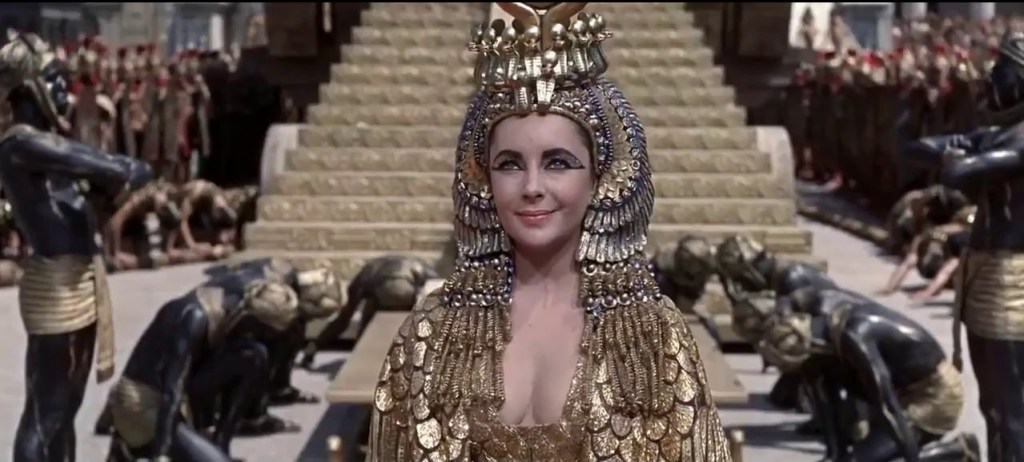
The other thing that couldn’t be cut was the film’s epic scale. Cleopatra’s entrance to Rome plays out nearly in real time, a never-ending procession of flights of fancy parading into the capital capped with Taylor’s cheeky grin at the end of it at Cleopatra’s panache. The battle of Actium looks impressive – with its boat clashes, flaming ships and colliding vessels – so much so that you almost regret we don’t get to see more of Pharsalus and Philippi than their aftermaths. The huge sets are striking, as are the legion of costumes Taylor has to change into virtually from scene to scene.
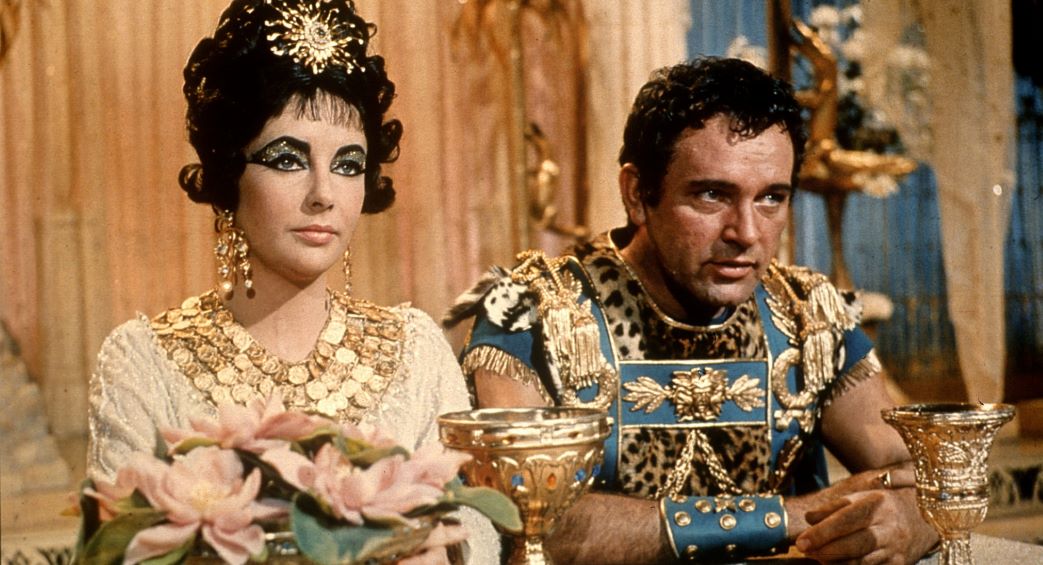
Of course, what people were – and always are – interested in is how much the fire off-stage between Burton and Taylor made it to the screen. I’ve honestly always felt, not much. Perhaps by this point both actors were too fed up and punch-drunk from the never-ending project. Perhaps they simply didn’t have any interest in the film. Burton falls back on grandstanding – he confessed he felt he only learned how to act on film from watching Taylor. Taylor is undeniably modern in every frame, but she somehow manages to hold a rather loosely defined character together, so much so that you forget she’s fundamentally miscast.

Of the leads Rex Harrison emerges best as an avuncular Caesar whose well-spoken wit hides an icy interior overflowing with ruthlessness and ambition. The film loses something when he departs just before the half-way mark. (It’s a mark, by the way, of the film’s confused structure that Burton only appears an hour into the film – and that for an inconsequential “plot update” chat with Caesar’s wife Calpurnia). There are decent turns from Cronyn as Cleopatra’ advisor, Pamela Brown as a Priestess, Andrew Faulds as a gruff Agrippa and even George Cole as Caesar’s trusted, mute servant. Best in show is probably Roddy McDowell’s ice cold Octavian – like a version of Harrison’s Caesar with all charm removed – who would have certainly been an Oscar nominated if the studio hadn’t screwed up his nomination papers.

Cleopatra still ended up with multiple Oscar nominations – even some wins – but took years to make back the money blown on it. At four hours, it bites off way more than it can chew and vey rarely comes together into a coherent shape. Scenes alternate between too short and way too long and three leads with very different acting styles struggle to make the best of it. You feel watching it actually sorry for Mankiewicz: it’s not really his fault, the scale of this thing would have sunk any director. Cleopatra has flashes of enjoyment, but much of it drags for the viewer as much as it did for those making it.
King of Thieves (2018)

Michael Caine leads the Old Lags on one last hurrah in the misjudged King of Thieves

Director: James Marsh

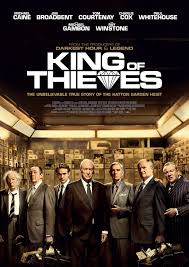
Cast: Michael Caine (Brian Reader), Jim Broadbent (Terry Perkins), Tom Courtenay (John Kenny Collins), Charlie Cox (Basil/Michael Seed), Paul Whitehouse (Carl Wood), Michael Gambon (Billy “The Fish” Lincoln), Ray Winstone (Danny Jones), Francesca Annis (Lynne Reader)

In 2015, a group of old lags robbed a safety deposit company in Hatton Garden. Over the Easter weekend, the gang broke while the facility was empty, drilled through a wall, climbed into the safe and cleared out almost £14 million in cash, diamonds and other goods. The crime captured the public imagination largely because the robbers, bar one member of the gang, were all over 60. This country has a certain nostalgia for rogues, and a tendency towards a condescending affection for the aged. In real life, the only thing remotely charming about these hardened criminals, many of them with extremely violent backgrounds, was their age.

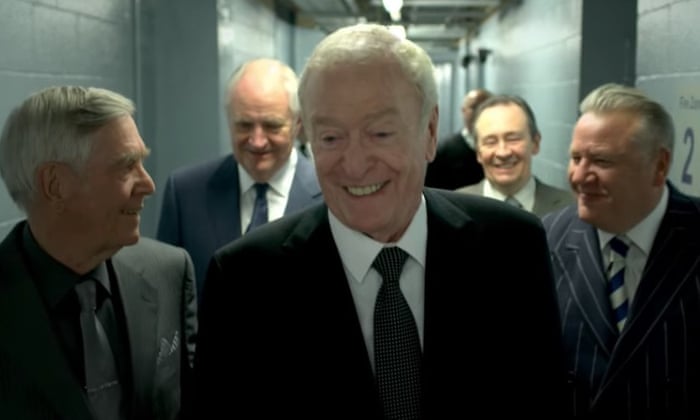
James Marsh pulls together a great cast of actors for his heist caper. Brian Reader, the brains behind the operation, is played with gravitas by Michael Caine. Terry Perkins, the man who cuts Reader out of the profits, is played by Jim Broadbent. Tom Courtenay, Ray Winstone, Paul Whitehouse and Michael Gambon play the rest of the lags while Charlie Cox is the young tech expert who brings the possibility of the heist to Reader’s attention. With a cast like this, it’s a shame the overall film is a complete mess from start to finish.

I watched this film after first watching ITV’s forensically detailed four-part series, Hatton Garden, covering the heist in full detail. That drama was far from perfect, but it was vastly superior to this. The main strength of Hatton Garden was that it never, ever lost sight of the fact that this was not a victimless crime. Real-life small businesses went bust due to property lost in the heist. Families lost priceless, irreplaceable heirlooms. Items of hugely sentimental value have never been recovered. Lives were damaged. On top of that, Hatton Garden stresses the grimy lack of glamour to these thieves, their greed, their paranoia, their aggression and their capacity for violence. Far from charming rogues, they are selfish, greedy old men who fall over themselves to betray each other and are clueless about the powers and abilities of the modern police force.

King of Thieves occasionally tries to remind people that these were hardened career criminals. But it also wants us to have a great time watching actors we love carry out a heist against the odds, like some sort of Ocean’s OAPs. James Marsh never manages to make a consistent decision on the angle he is taking on these men or the crime they carried out. It’s half a comedy, half a drama and the tone and attitude towards the burglars yo-yos violently from scene to scene. The end result, basically, is to let them off with a slap on the wrist.

“It’s patronising” rages Reader at one point at the media coverage of the crime, annoyed at how it stresses their age as if that somehow makes it a jolly jaunt. Never mind that the film does the same. The score contributes atrociously to this, a series of jazzy, caperish tunes that echo the 60s heydays of these violent men (Reader and Perkins had both stood trial for murders, and were lucky to get off) punctured with some cheesily predictable songs. Tom Jones plays as our heroes comes together, and Shirley Bassey warbles The Party’s Over as things fall apart. The old men banter and bicker about the confusions of the modern world like a series of talking heads from Grumpy Old Men and the general mood is one of light comedy.

The film does try and darken the tone in the second half, post-robbery, as things start to fall apart and tensions erupt in the gang. Here we get a little bit of the mettle of the actors involved in this. Jim Broadbent, in particular, goes way against type as Perkins’ capacity of violence (even at a diabetes-wracked 67) starts to emerge. Tom Courtenay’s Kenny Collins emerges as manipulative liar, playing off the robbers against each other. Ray Winstone sprays foul language around with a pitbull aggression. Even Michael Caine roars a few death threats, furious at being betrayed by the gang.

But it never really takes, because the film never throws in any sense of the victims of this crime. Blood is never drawn in this slightly darker sequence of the film. Even the clashes between the gang are played at times for light relief. Anything outside the gang is ignored. The victims? Who cares. The cops? There is barely a policeman in this film who has a line.

The film undermines the whole point it might be trying to make – that these were dangerous men – by succumbing to romanticism at its very end. As the captured old lags await trial, we first see them laughing and joking with each other as they prep for court and then, as they walk towards the dock, the film throws up old footage of the actors from the 60s, 70s and 80s, stressing their romanticism. Look, the film seems to be saying: these were criminals, but they were old fashioned criminals, remember when Britain used to make its own underdog crims instead of being awash with hardened, violent gangs? It’s hard to take. And it’s like the whole film. A tonal mess that finally absolves the robbers who ruined lives and who still haven’t returned almost £10 million of ordinary people’s goods. King of Thieves isn’t charming. It’s alarming.

Macbeth (1971)


Francesca Annis and Jon Finch as the murderous Macbeth’s in Polanski’s dark Shakespearean adaptation

Director: Roman Polanski

Cast: Jon Finch (Macbeth), Francesca Annis (Lady Macbeth), Martin Shaw (Banquo), Terence Bayler (Macduff), John Stride (Ross), Nicholas Selby (King Duncan), Stephen Chase (Malcolm), Paul Shelley (Donalbain), Richard Pearson (Doctor), Diane Fletcher (Lady Macduff)

Roman Polanski is always going to be a controversial figure. If he wasn’t also a gifted film maker, his reputation would be even lower than it is. His life has been a parade of misfortunes and misdemeanours. Macbeth was filmed a few years after his wife, Sharon Tate, was brutally murdered by Charles Manson. Hard not to read something into the director’s decision to film Shakespeare’s most infamous murderer. Certainly it was hard for reviewers at the time to disconnect the two. Throw in the fact that the film was made by Playboy Productions’ short lived film-making arm (with Hugh Hefner as Executive Producer) and you’ve got a film ripe for a poor reputation.

However, Macbethis actually a dynamic, well-filmed, surprisingly textually savvy production of this shortest and most intense of Shakespeare’s tragedies. While there is no doubt that this very much Polanski’s personal vision of Macbeth, it’s a fascinatingly dark, grim and horror-inflected production that really gets to grips with the darkness at the play’s heart – and also with the slightly empty, little-boy-lost quality in Macbeth himself (until then a character seen on screen largely as the brooding thane, laid low by his evil wife).

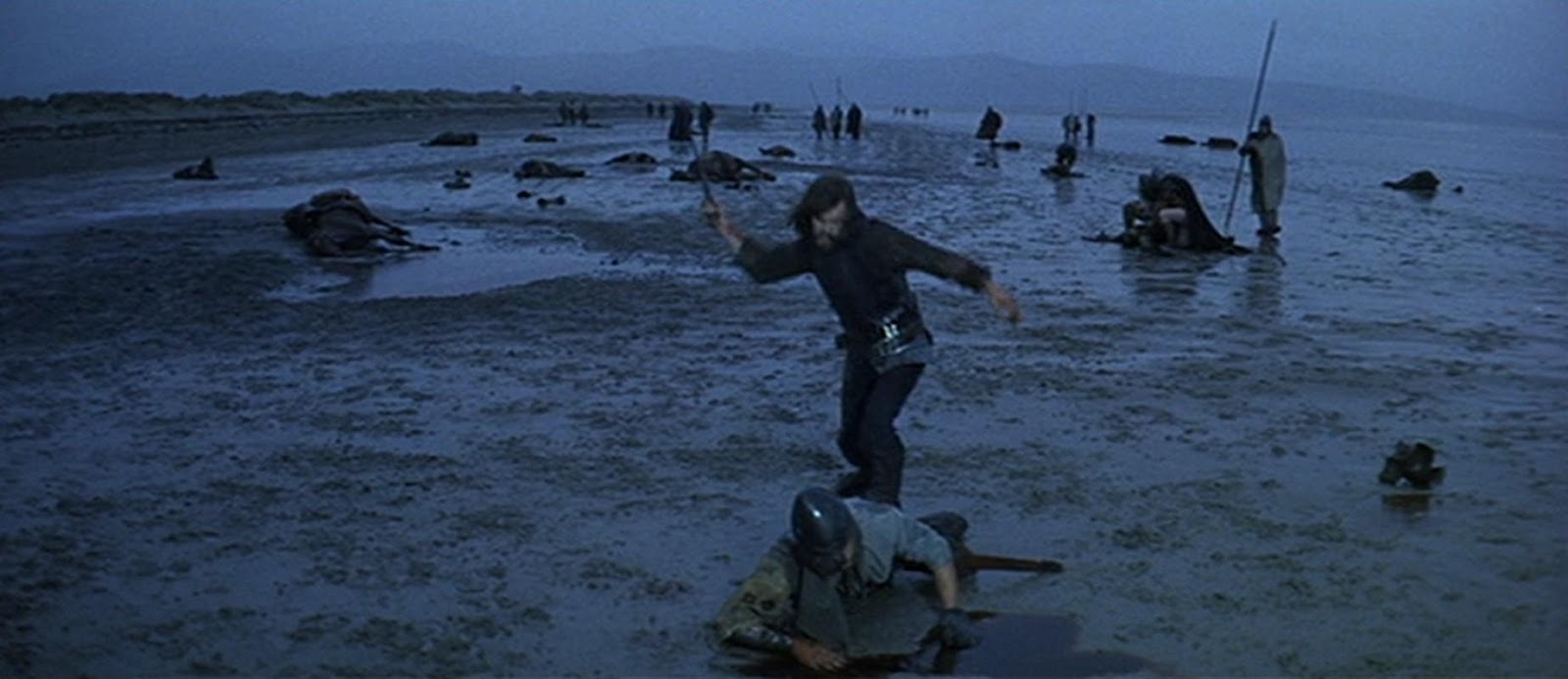
Polanski’s Macbethtakes place in a world where violence is second nature, life is cheap and grim slaughter is around every corner. One of the first acts we see is a soldier checking bodies on the battlefield. Finding a wounded soldier, he breaks his spine with two sickening blows from a flail. That’s just a precursor for the violent mood that will follow. Mangled bodies and bleeding corpses constantly appear, from Duncan’s guards to the twisted corpses of the Macduff children. Even when relaxing at the court, the Macbeths set up a bear baiting (kept off-screen) – the bear’s corpse (along with a few dogs) is later dragged through the palace corridors, leaving a trail of blood. 

Polanski’s Scotland is a savage, medieval, uncivilised place. Macbeth’s castle is a more like an elaborate farm, with wooden huts and mud-stained floors, than a mighty fortress. Every character looks swarthy, run-down and dirty. Colour has been drained out of the film in favour of muted greys and browns. There is precious little hope here, just a terrible onslaught of violence and murder that never seems to stop.

The brutality is constant, and Macbeth is up to his arms in it. Even the murder of Duncan doesn’t pass off without a hitch – the King awakens and has to be dispatched with panicked desperation. Banquo is finished off with a sickening axe thud in the back, his body dropping lifelessly into a stream. Even Macbeth’s faithful factotum Seyton is brutally lynched while trying to prevent his soldiers from deserting Dunsinane. The assault on the Macduff family is hideous in its fierceness: the house is burnt down, the servants (and its implied Lady Macduff) raped, while the children are brutally murdered (thankfully off-screen in most cases). It’s a harrowing slaughter that brings to mind World War II atrocities – and of course Polanski’s own recent tragedy. 

In this world, Macbeth is intriguingly presented as far less of a noble poetic hero than audiences at the time would have expected. Jon Finch’s Thane is low-key and lost, a puppet in the events happening around him. He’s almost like a slightly at-sea kid, who’s stumbled into power and has no idea what to do with it. His poetic soul is revealed as flashes of inspiration in an otherwise empty man. With many of the speeches internalised in voice-over, Macbeth’s sound and fury is deliberately toned down – by the end he seems weary and finished in a way few other Macbeths feel. His isolation throughout the play is complete – he’s incapable of relating to other people.

Similarly, Francesca Annis presents a fresher view of Lady Macbeth than a cartoon villain. While clearly still alluring (there was much controversial, Playboy-related, buzz to her famous naked sleepwalking scene) she’s equally as adrift as Macbeth is, totally unprepared for the psychological impact of murder. Excited and perhaps even a bit turned on by power, she falls apart as the impact of her actions grabs hold – it seems to be happening from the very start, her swooning when seeing the corpses of Duncan’s guards seems genuine rather than forced. Polanski even places her suicide on screen – her despairing leap accompanied by screams of terror from her waiting women.


In this grim world, there is a paganish, primitive feeling. Macbeth is crowned in a strange ceremony that involves him standing bare foot on the stone of scone. The Thane of Cawdor is executed by being hung by a metal chain (he defiantly jumps from the battlements rather than being pushed) while the court stares on. The witches are a crazed harem of naked women of all ages, engaged in bizarre, sadistic ceremonies in a secret subterranean den. The opening shot of the film uses a bright, bleached yellow sun that seems to stretch over a desolate coast-line, where the witches are burying a human hand clutching a dagger. Macbeth’s visions are a series of surreal and disturbing images, while Banquo’s ghost is an increasingly bloody and terrifying image as the scene progresses. There is a sense of strange powers hanging over everything.

And maybe that power is fate. This is also a fatalistic film, which runs with the theory that Shakespeare’s tragedies are almost circular in nature (very much inspired by Polish writer Jan Kott in his excellent book Shakespeare: Our Contemporary) with fate as a machine that traps people into an endless cycle of repetition. This feeling runs throughout Macbeth’s increasingly fatalistic disengagement with the world – the (excellent) sword fights at the end even see him fight with a certainty in advance of the results. The cyclical nature of this world is hammered home at the end, as Donalbain sneaks away from the celebrations of Malcolm’s crowning to consult with the witches in their hovel – hold onto your horses, the cycle is all set to begin again.

The film is also creative in its use of Shakespeare, in particular in its expansion of the character of Ross. Polanski and his co-screenwriter, famed theatre critic Ken Tynan, again followed Kott’s theories by repositioning Ross as the ultimate political opportunist. Helped by John Stride’s expressive performance, Ross is a constant figure of vileness, allying himself eagerly with whoever is on the rise. Ross assists in the murder of Banquo, murders the murderers and aids the destruction of the Macduff family. Overlooked for a chain of office in favour of Seyton, he swiftly reverses his stance and flies to Malcolm (much to Macbeth’s later fury) and then loudly leads the cheers for Malcolm’s crowning. It’s a neat side story, done with camera asides and no dialogue changes, but it adds a lot of interest to the film.

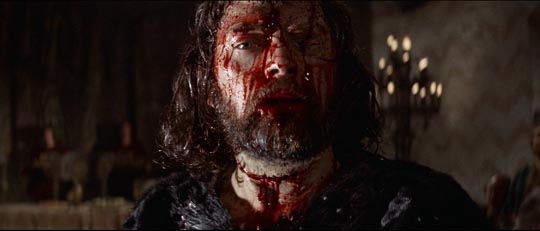
Macbeth ends with a gruelling beheading of Macbeth – and stylish angles gives the impression that we are experiencing Macbeth’s final moments of consciousness as his head is passed around Malcolm’s soldiers. It’s a neat way to end a violent and dark production of the play, shot through with Polanski’s personal awareness of the darkness of the human soul. The film sometimes loses its pace a little bit, and most of the performances leave very little impression – there is a reason why virtually no one in this film had a really established film career. Even the language of Shakespeare isn’t central here: it’s the experience of a brutal, dark and grim world that matters. It’s the images and visuals that stand out. It’s very much Polanski’s Macbeth.