Tag: Francis Lawrence

Hunger Games: The Ballad of Songbirds and Snakes (2023)

Hunger Games: The Ballad of Songbirds and Snakes (2023)

Terminally dull prequel, full of backstory you won’t care about at all

Director: Francis Lawrence

Cast: Tom Blyth (Coriolanus Snow), Rachel Zegler (Lucy Gray Baird), Josh Andrés Rivera (Sejanus Plinth), Viola Davis (Dr Volumnia Gaul), Peter Dinklage (Casca Highbottom), Jason Schwatzman (“Lucky” Flickerman), Hunter Schafer (Tigris Snow), Fionnula Flanagan (Grandma’am), Burn Gorman (Commander Hoff), Ashley Liao (Clemensia Dovecote)
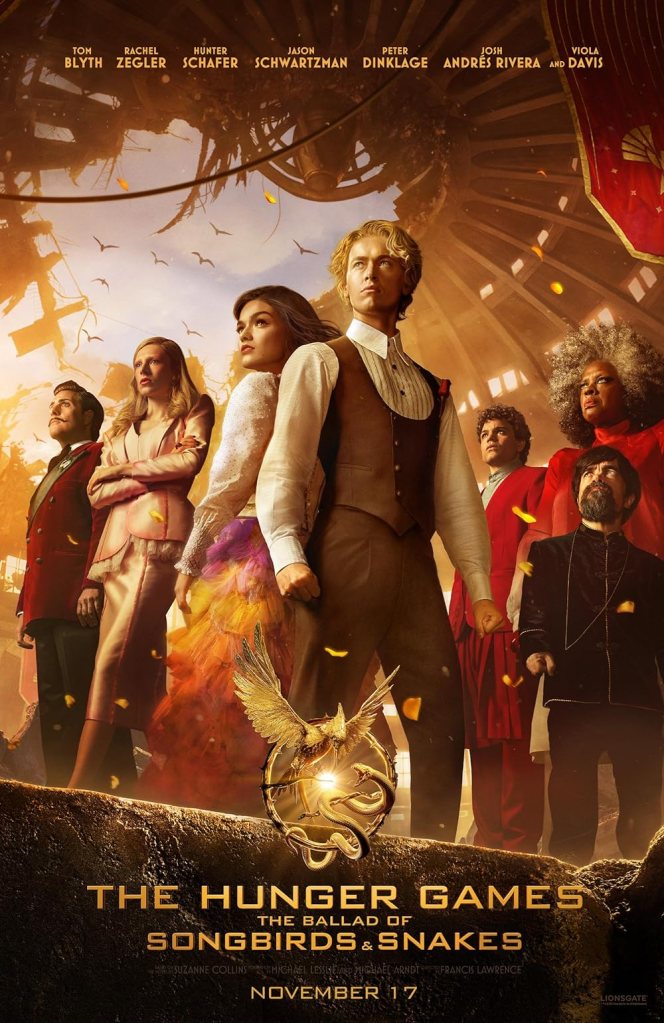
Did you watch Hunger Games and wonder – ‘this is great and all but where did that guy Coriolanus Snow come from, eh’? Not sure I did. And I’m not sure I really needed to know, now that I’ve sat through all interminable 158 minutes of Hunger Games: Ballad of Songbirds and Snakes or Hitler: The Early Days. Imagine, if you will, the original Hunger Games movie – but if it was much longer, had an utterly uninteresting lead character and took itself so seriously you’d think it was offering a solution to third world debt and climate change all at once. Ballad of Songbirds and Snakes worst crime isn’t that it goes on forever, that it retreads old ground with no new ideas or that it feels like a pointlessly over-extended footnote. It’s that it is overwhelmingly, crushingly, dull.

People didn’t care about the back story: they cared about Katniss Everdean, a perfectly crafted character, hugely engaging and relatable on every viewing. I cared about her struggle to protect the people she loved not the backdrop of Panem politics. Did anyone? If I was interested in anything in Panem politics it was the way the Games both terrified the huddle masses of the districts and gave them hope. Unfortunately, this film either didn’t understand that, didn’t care or assumed we’d happily invest in the original’s villain if he was buff and had a dreamy girlfriend.

Young Coriolanus Snow (Tom Blyth, doing his best to sound like Donald Sutherland) is one of the leading students in Panem, selected to mentor a tribute through the 10th Hunger Games. Young Snow’s loins heat-up when his tribute is manic pixie dream-girl Lucy Gray (Rachel Zegler) from District Twelve. But what excites him more: a tumble with a girl from the sticks, or persuading outlandishly loopy games master Dr Volumnia Gaul (Viola Davis, the only person having fun) he knows how to turn this gladiatorial deathmatch into ratings gold? You got one guess what he picks.

Though it takes him a very, very, very long time to pick it. We watch this Proto-Hitler embrace his inner sociopath, through a weary trudge in Hunger Games lore with the origins of virtually every prop in the original movies lovingly laid out for us. Ever wondered why Snow wears that buttonhole? This is the film for you and then some. Almost every single thing in Ballad of Songbirds and Snakes is linked to something in the original movies. It’s the sort of unimaginative, world-shrinking yawn-fest where nearly every character shares a surname of a character from the original films – but of course Caesar Flickerman’s dad has exactly the same job, personae and style as he does!

You could let this go if Ballad of Songbirds and Snakes had an interesting story of its own. But it’s tedious, self-important plot makes Attack of the Clones look like Tolstoy. It chucks in a little bit of arena slaughter, but inexplicably makes it unclear how many of Coriolanus’ suggestions for improving the show are actually changing things. When the tributes perform for ‘favour’ is that something they always did (as most people behave like it is) or because Coriolanus scrawled memo suggested it (as the film implies)? The wider impact is also lost: are people bonding with Lucy Gray or having their child-killing-urges ticked in brand new ways by Coriolanus? Who knows.

It doesn’t help that Ballad seems shy about making Coriolanus himself a villain. It gives Tom Blyth a difficult act to pull off and he’s left playing his cards so close to his (inevitably) buff – his future sadism doesn’t stand in the way of a good topless scene in this film – chest that rather than wondering what will top him into sociopathy, he instead becomes a flat, boring character, with even his lust for Lucy fizzling rather than sizzling.

Rachel Zegler gets a bit more fun as this irritating mix of idealist and realist (she is pretty much whatever the plot needs from scene-to-scene – one minute angrily slapping away offerings of food, the next cowering in shocked fear when danger comes calling), with Ballad at least a good vehicle for Zegler’s vocal talents. But Lucy Gray remains too enigmatic – and, to be honest, just as dull in her unknowability – to ever become someone you care about. And never, for one minute, in her flower-crafted dress and perfect make-up do you believe she is a child of the ghetto in the way you did with Jennifer Lawrence.

Honestly the film misses a hero as complex and multi-layered as Katniss and splitting facets of her into two other characters just creates to incomplete characters. Throw in a plot that lacks any energy – it’s lackadaisical second half, with Coriolanus chucked into the wilderness as a Stormtrooper in District 12, goes on forever – and which gets bogged down in an utterly unengaging and confusing rebellion plotline with is resolved with a nonsensical narrative flourish – and it’s a recipe for disaster. It never, ever get the pulse racing as it stumbles, yawningly, to its end.

The stuff that actually is interesting gets shunted to the sidelines. A bored Peter Dinklage gets a late monologue on the creation of the Hunger Games that you desperately want to hear more about it, but don’t. Viola Davis, barrelling over-the-top under a mountain of demented hair, weird contact lenses and bizarre costumes, keeps talking about ‘the purpose of the Hunger Games’ in a portentous way that sounds like its leading somewhere but never does (so much so, I wondered if the filmmakers even understood the bread-and-circuses-as-control metaphor going on here).

Francis Lawrence directs as if this background-filling pamphlet from Suzanne Collins was a newly discovered Testament. The film is slow, stately and gives even the smallest, most inconsequential moments an unbearable level of self-important significance. It lacks pace and interest – so much so that even the slaughter of eleven scruffy, malnourished children and teenagers feels tired and ‘seen it all before’. There is no mystery, no sense of roads-not-taken, not even any peril . Just small elements of a more interesting later story being slotted dutifully in place, you realise you never wondered where Coriolanus Snow came from because it never mattered in the first place.

The Hunger Games: Catching Fire (2013)

Jennifer Lawrence and Josh Hutcherson head back into the area in The Hunger Games: Catching Fire

Director: Francis Lawrence

Cast: Jennifer Lawrence (Katniss Everdeen), Josh Hutcherson (Peeta Mellark), Liam Hemsworth (Gale Hawthorne), Woody Harrelson (Haymitch Abernathy), Elizabeth Banks (Effie Trinket), Lenny Kravitz (Cinna), Philip Seymour Hoffman (Plutarch Heavensbee), Jeffrey Wright (Beetee Latier), Stanley Tucci (Caesar Flickerman), Donald Sutherland (President Coriolanus Snow), Sam Claflin (Finnick Odair), Lynn Cohen (Mags), Jena Malone (Johanna Mason)

It’s a year on from Katniss (Jennifer Lawrence) and Peeta’s (Josh Hutcherson) victory at the 74th Hunger Games. They and the other victors live a life of relative luxury in the dictatorship of PanAm. Problem is Katniss’ humanity and defiance of the ‘rules’ from her victory have started to inspire whispers of discontent into open mutterings. When a “victor’s tour” fails to impact on her lustre, President Snow (Donald Sutherland) follows the suggestion of Games Maker Plutarch (Philip Seymour Hoffman) – let’s celebrate the 75th Anniversary by chucking two victors from each district back into the ring. As the only female victor from District 12, this means Katniss will either wind up dead – or be put into a position where she has to abandon her humanity to become the killer she never wanted to be. But is there another game going on inside the game?

Catching Fire is an entertaining, fast-paced, well made sequel to The Hunger Games that successfully broadens and deepens the franchise. Far from being a difficult middle chapter, it’s well structured to tell a pretty self-contained story that riffs on events from the first film without being enslaved to them. It also very sharply deepens the social and political commentary from the first film, widening our knowledge of PanAm and our understanding of its corrupt, murderous system.

Lawrence’s direction is punchy, pacey and provides plenty of emotional depth and scope. It’s a film that skilfully balances questions of trauma and the horrors of murder-for-entertainment, with poundingly exciting action sequences in the games themselves. In some ways Catching Fire is the only film in the series that ends (more-or-less) with a triumphant bang, and it’s possibly why the film is the most satisfying of the lot, with the cleanest structure. It also has the advantage of widening the outer edges of the world of the film, while still largely operating within the self-contained world of the games arena.

Within that, it also manages to keep us on our toes. Many of the same set-ups – both in the build-up to the games and the action in the arena itself – echoes or reflects what we’ve seen before. The film uses this to throw at us moments the surprise us – as allegiences are revealed – or provide opportunities for dark humour (such as the setpiece Katniss decides to use to showcase her skills this time round, markedly, darkly different from her archery display in the first film).

The film is entertaining and also thought-provoking. Within the confines of its 12A certificate, it doesn’t flinch from the oppressive horror of PanAm in the districts, where sudden executions and brutal beatings are an everyday occurrence. Similarly, it demonstrates even more the heartless opulence of the capital, a world of hedonism where no questions are asked about what props this whole system up.

And at the heart we have Katniss. Wonderful played, with a full-blooded emotional commitment from Jennifer Lawrence, Katniss is slowly become aware of her iconic status, but hasn’t changed dramatically from the at-times judgmental, prickly, abrasive loner she was at the start. She’s a reluctant figure-head for a new movement, but that’s what makes her both so effective and so moving. She’s not pretending or playing a hero – she simply does the right thing, because that’s what she believes she should do. Sure she makes a host of poor character choices, but that’s what genuine people do.

Lawrence’s grounded emotional realism in the lead, helps sets the tone for the whole franchise as something surprisingly gritty, dangerous and at times quite emotionally challenging. Hutcherson does fine work as the true heart of the film series, a decent, kind man who not only sees but also brings out the best in other people. Claflin is very good as a matinee idol victor who keeps us guessing on his motivations. Harrelson and Banks provide skilled depth to characters that could have been flamboyant cartoons. Sutherland enjoyably quietly munches some scenery as the dastardly Snow, while Hoffman coasts showily but effectively.

Catching Fire bursts along with a great deal of flair and lets us really see how despotic regimes like this operate. Katniss is manipulated into situations designed to fit a narrative that will cement the position of the regime. Ordinary people are corrupted by the wickedness around them. Humanity is seen as a dangerous quality. It’s intriguing and way more insightful than you might expect from a YA blockbuster. And its treated with a profound respect by everyone involved.

And it works because it also tells a cracking, entertaining story, revolving around richly drawn characters with fully fleshed out hinterlands and personal story arcs. For all it takes place in a dystopian future, it feels a real and grounded story. And its hard not to relate to a film where the central character, for all her flaws, is fighting for her right to not kill, maim and slaughter those around her for entertainment: who clings to her humanity despite all temptations to the contrary.

Catching Fire is also blessed with being the neatest, most straight-forward and cinematic of the stories (it’s the only film in the series that ends with anything near a triumphant bang rather than a searching question – for all that it’s a compromised triumphant bang). Told with verve, smoothness and pace it’s a very entertaining movie – and surprisingly rewarding.

Red Sparrow (2018)

Jennifer Lawrence tries but fails with dismal material in the dreadful Red Sparrow

Director: Francis Lawrence

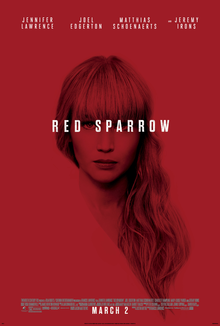
Cast: Jennifer Lawrence (Dominika Egorova), Joel Edgerton (Nate Nash), Matthias Schoenaerts (Ivan Vladimirovich Egorov), Charlotte Rampling (Marton), Mary-Louise Parker (Stephane Boucher), Ciaran Hinds (Colonel Zakharov), Joely Richardson (Nina Egorova), Bill Camp (Marty Gable), Jeremy Irons (General Vladimir Andreiovich Korchnoi), Thekla Reuten (Marta Yelenova), Douglas Hodge (Colonel Maxim Volontov)

Dominika Egorova (Jennifer Lawrence) is in trouble. After an act of sabotage by her dance partner, her career in ballet is over. Out of options, she is forced into enrolling at the elite FSB Sparrow School by her uncle Ivan (Matthias Schoenaerts). There young men and women are trained, under the tutelage of its controlling Matron (Charlotte Rampling), to sacrifice all their pride and their bodies for the good of Mother Russia. Thrown into the field, Dominika finds herself entangled with the CIA Agent Nate Nash (Joel Edgerton), whom she has been ordered to seduce.

Red Sparrow is a bad film on several levels. Firstly, it’s at heart a trashy espionage movie that confuses being about intelligence with actually being intelligent. A few late twists doesn’t suddenly make this a work of genius. Secondly, its attitude of being about this damn dirty business of spying manages to make it so grim it’s not even fun to watch. Finally, it’s the sort of film that thinks constantly telling us it has a strong female lead at its heart is the same as actually having a strong female lead at its heart.

To take that final point last… Poor Jennifer Lawrence. Surely only the $20million she was paid for this film attracted her to this. I’ll start by saying she feels miscast in a role that requires a ruthlessness and capacity for viciousness that is not a natural part of her range. But this film struggles to make her feel like a character with real agency. During the course of this film, she has her leg broken, nearly gets raped (twice), strips down in front of a group of people (twice), gets smacked in the face, beaten, tortured, stabbed, shot… And a few sudden last minute gear reversals which suggest that she has been playing her own game this whole time don’t shake the impression that the film is wallowing in the torture and violence that runs through the film.

Anyway, the film is reliant on that because it’s not sharp or clever enough to really have anything else in there in its place. So we stumble from violent set piece to violent set piece, while the characters talk incessantly about macguffins and characters we care almost nothing about. The film has an almost impenetrable plot, not because it’s complex, but because it’s poorly explained and impossible to care about. Actors who are way too good for this material – and I mean the whole cast – struggle to put fire and energy into a shaggy dog story that never goes anywhere.

This all serves to make it a dull film. It really should be a guilty pleasure. All the right material is in there. Spy thrillers make for fun films. It’s interesting to have a woman at the centre of it. It’s got good actors. But too many scenes and set pieces veer towards the overly violent and sexual. For a film that is about a silly spy training school turning out honey trap agents, this film seems determined to ram the grimness of spying in our faces at every turn. This makes sense for a high brow Le Carre adaptation. It makes no sense for silly high-concept Jennifer Lawrence star vehicle.

Who really needs to watch poor Jennifer being slapped about and ill-treated for over two hours? Who has the patience for it? Who is going to enjoy it? The film struggles to get across the idea that Dominika is good at this spying game so it needs other characters to say it openly. Its rug pull towards the end lacks all signposting so gives no satisfaction whatsoever. By the time it comes round you’ll have long ceased stop caring about anything in it as well. A tedious, grimy and rather unpleasant film from start to finish that leaves a sour taste in the mouth.

I Am Legend (2007)


Rush hour is a lot easier to beat when its just you and your dog.

Director: Francis Lawrence

Cast: Will Smith (Robert Neville), Alice Braga (Anna Montez), Charlie Tahan (Ethan), Salli Richardson (Zoe Neville), Willow Smith (Marley Neville), Emma Thompson (Dr. Alice Krippin)

If you’re going to make a movie that involves the viewer watching one person, alone with just a dog, for well over an hour, you’d better be sure that the person you recruit to play that role can actually hold the viewer’s interest for that time. Factor in, for Hollywood, that the person you pick needs to be capable of getting big box-office, and you ain’t got a lot of choices. But casting Will Smith in this was a choice the studio largely got right.

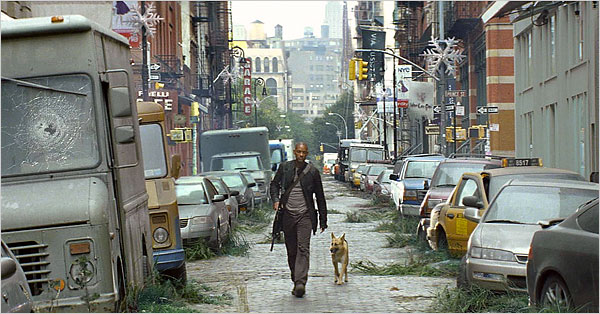
The year is 2012 and the world has ended. Robert Neville (Will Smith) is a military virologist, the last surviving human in New York. A miracle cure for cancer went disastrously wrong three years before and killed 94% of the world’s population, mutated 5% into feral “darkseekers” who attack anything living at night, leaving just 1% of the world’s population immune. Neville lives alone in New York, with only his deceased daughter’s dog for company, and works to find a cure for the disease by capturing and experimenting on the darkseekers.

In a remarkably brave and unusual move for a blockbuster, Will Smith is essentially alone on screen for a solid hour. The film takes a measured, well-paced delight in following his daily routines, covering everything from his work in immunology to scavenging for supplies, hunting deer (escaped from the zoo), hitting golf balls off aircraft carriers, and having free run of a video store he has filled with mannequins. His Washington Square house is heavily fortified, but also remarkably homely and certainly not that bad a place to watch the end of the world from.

Following this daily routine is, by far and away, the most interesting part of the film, as it is one of the few parts that actually feels unique and original. In fact, you wish it could go on longer and that the film didn’t need to revert back its more predictable “one man against the monsters” theme. The ingenuity of survival in extreme circumstances, and the eerie freedom of the busiest city in the world completely empty, makes you wonder not only “could I do that” but also, secretly “would it be fun for a while to drive a fast car around Times Square or whack golf balls off the wing of a stealth bomber?”.

“For a while” is the key thing here, as the film also explores the deeply damaging effect extreme isolation has had on Neville’s psychology. It’s here that Smith earns his chops. He’s an extremely engaging actor, so you’re happy to spend time with him, but he’s also skilled enough to play a cracked psyche without going overboard. Neville chats (and flirts) with mannequins, knows Shrek so well he can speak in perfect unison (inflections and all) with the film, and keeps up a regular stream of conversation with his dog Sam, including asking her what she is planning to do for his birthday. Much of this is played lightly, but at key moments Smith allows Neville to snap. He also plays the tragedy gently – his reactions to Sam’s death are genuinely quite moving because they are quiet and restrained.

This is all interesting stuff. Less interesting are the “darkseekers” and the film’s final resolution. Firstly, the darkseekers themselves are bog-standard zombie monsters – screaming, running, deadly creatures with their one quirk being their fear of UV light. Other than that, it’s nothing you haven’t seen in half a dozen movies before (better). Turning them into zombie creatures does make Neville even more isolated but makes encounters with them fairly predictable, mostly inspired by films past. Most of the film’s big confrontation set pieces have a slightly tired familiar feeling to them. I’m already struggling to remember them, and I only saw the film two days ago.

The major problem with this film is its ending. I Am Legend had its ending re-shot after test audiences saw it. Originally, a reveal would have been that the darkseekers were far more intelligent than appeared, and their motivation was to prevent Neville’s experimentation on them. Two scenes still make a point of discussing Neville’s Mengele-like wall of photos of dead darkseekers, killed by his cure experiments, and other hints remain through the film: the traps they set , the presence of an “Alpha” leader among the monsters, repeated shots of the tattoo on Neville’s last captured darkseeker, which was intended to be a crucial clue that she was the mate of the Alpha.

But test audiences weren’t having that. So in the final version, all this build-up and suggestion is shoved aside as Neville grabs a grenade and blows himself and them to hell to allow a cure to be taken to the rest of mankind. As the cure is taken to an idyllic community in the country (church and all) mankind’s future is his “legend” or some such guff. It’s a major loss of nerve that makes the film just another run-of-the-mill monster flick. It doesn’t match with hints that remain in the whole film and it doesn’t tie in with the more successful first hour of the film. It doesn’t question the possible rights and wrongs of Neville’s actions (at best comprehensive animal experimentation), but fully endorses them.

It’s a shame as this has ideas, its vistas of New York being reclaimed by nature are interesting and memorable, and Will Smith is pretty good in a straight acting role. But instead it settles for being a schlocky monster pic, where we can unquestioningly cheer as everything is neatly tied up with a bow and everything we thought about all of its characters is confirmed. As such, this film isn’t a classic and it hasn’t had the sort of life it might have been able to have. Despite good moments, it’s definitely not a Legend.