Tag: Francisco Rabal

Belle du Jour (1967)

Belle du Jour (1967)

Buñuel’s sensual mix of fantasy and reality, asks intriguing and searching questions with ambiguous answers

Director: Luis Buñuel

Cast: Catherine Deneuve (Séverine “Belle de Jour” Serizy), Jean Sorel (Pierre Serizy), Michel Piccoli (Henri Husson), Geneviève Page (Madame Anaïs), Pierre Clémenti (Marcel), Francisco Rabal (Hyppolite), Françoise Fabian (Charlotte), Macha Méril (Renée), Maria Latour (Mathilde), Marguerite Muni (Pallas), Francis Blanche (Monsieur Adolphe), François Maistre (The professor), Georges Marchal (Duke)
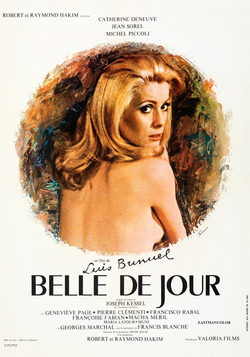
Desire can be a scary thing; a deep dive into the things that excite and titillate us can be deeply unnerving. That’s the heart of Buñuel’s compellingly intriguing Belle de Jour, where dreams and fantasy merge with confused and repressed desires struggling to find an outlet. It makes for a fascinating, unsettling and erotic film, powered by a fearlessly superb performance by Deneuve. Buñuel’s film avoids judgement, frequently inverting lazy moral judgements in a film that flirts with playfulness and dark dangers.

Séverine (Catherine Deneuve) is happily married to Pierre (Jean Sorel) but seems unable to find any sexual satisfaction with him. Sleeping in separate beds, the couple are supportive and loving but chaste. Séverine’s fantasy life though is awash with day-dreams of erotic, sadomasochistic desires in which she is degraded and humiliated, scenarios clearly alien in her marriage. Séverine finds an outlet for her desires by taking an afternoon job as a prostitute in Madame Anaïs (Geneviève Page) high-class brothel, where she can experience an erotic thrill in debasement that she barely understands herself. But can her secret survive the probing of sinister Husson (a brilliantly creepy Michel Piccoli) or her confused fascination with gangster Marcel (Pierre Clémenti).

Belle de Jour explores the dark desires many of us hold but never acknowledge – either to the world at large or to ourselves. It’s told with Buñuel’s masterful control, moves with smooth narrative economy and throws our expectations off kilter with carefully controlled switches from reality to fantasy. Buñuel’s unsettling opening shows Séverine and Pierre riding in a carriage through a tree lined country lane, their conversation tinged with hostility. We wonder what film it might be – we probably don’t expect Pierre to order the carriage to stop, demand the drivers drag Séverine from it, take her into the woods, flog her bare back and then allows one of his burly men to have his way with her. Just as we don’t expect the look of pleasure on Séverine’s face.

Fantasies like this re-occur time-and-time again throughout the film, as Séverine’s only way of truly explore sexual fantasies her husband is (presumably) unable to fulfil. In her fantasies she is abused, tied up, has mud flung at her and services men in the full knowledge of her husband. Buñuel presents this, as you might expect (for a man whose foot fetish has become something of a running joke) with a striking lack of judgement or moral ticking off. Instead, it feels more like Séverine is a woman trapped between two stools of seemingly knowing what she might want, but struggling to find the sexual and emotional confidence to acknowledge it. None of this, in any case, has any impact on her love for her husband or the importance she places on their marriage.

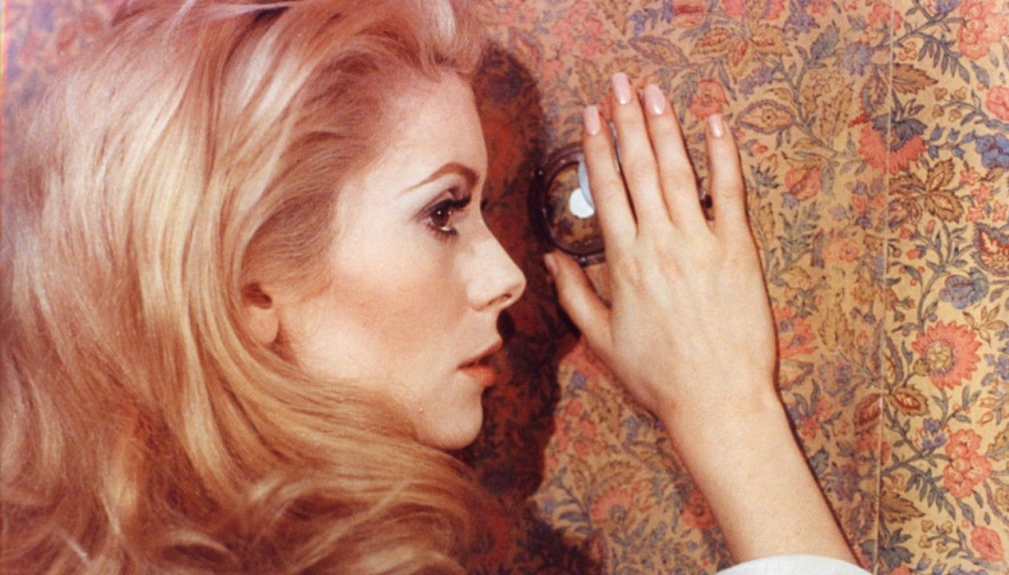
Buñuel captures this brilliantly with her hesitancy to follow through on her desire to knock on the door of hostess Madame Anaïs (an excellent Geneviève Page). We watch Séverine dawdle outside the apartment block, doubling back, staring blankly at shop windows and waiting until she cannot be seen and then shuffling up the stairs and back-and-forth outside the door. Buñuel repeats the trick later (with a shot focused on her feet) as she hesitates about whether to push her way through the door again next week.

In the bedroom, Séverine frequently feels awkward and uncertain (even a little embarrassed), which is striking until you realise this is less of the fear factor and more a kink one. She’s fails utterly with the Professor (François Maistre), a client who desires to be punished, a lust completely counter to her own desires. However, she ends a session with a burly Japanese customer, whose physicality terrifies the other girls (he also carries with him a mysterious buzzing box – Buñuel joked he was asked more about the content of this box than anything else in his films), exhausted but with a look of reclining, feline satisfaction on her that we don’t see before or since.

Buñuel’s film slips and slides ever more intriguingly into oblique uncertainty as Séverine explores the further reaches of her sensuality. A fascinating sequence tips uncertainly between dream and reality. Séverine encounters a mysterious nobleman (an austere Georges Marchal) during a casual café pick-up. But his coach drivers are the same as those from her earlier dream (tellingly, Buñuel also makes a Hitchcockian cameo as a café customer –tipping the wink this might not be reality). At the Duke’s home, Séverine lies in a coffin (in another dream call back, the butler is ordered to keep the cats out, the same bizarre cry Séverine made during her woodside thrashing) while the Duke masturbates under the coffin before flinging her out of the house like trash. Fantasy or reality? Is exposure to wider sexual desires expanding Séverine own dreams?

How much has she told Pierre about what happens in these dreams? It’s hard to believe Jean Sorel’s straight-shooting doctor would be as blasé as he appears about a recurring fantasy of his wife on a carriage ride followed of sexual humiliation. Did she just tell him about the first part? Séverine seems determined to shelter Pierre from her desires, part of compartmentalising her inner and outer lives. You could argue the general autonomy and respect he gives her not only powers her love for him, but also runs so counter to her inclinations that she finds it represses all desire for him.

Belle du Jour sees no contradiction between a desire for casual, need-filling sex with strangers and a loving marriage. You could argue Buñuel’s film suggests Séverine’s problems only start when she finds emotional bonds blurring in a fascination with Pierre Clémenti’s brutal, scarred gangster Marcel, who arrives like the violent embodiment of her dreams and who she longs to see again and again. Only when genuine feelings start to intrude, does what she is doing even begin to feel like any sort of betrayal. Buñuel presents Marcel as a destructive raging id, impulsively violent. But he also plays with our expectations of moral punishment for Séverine, throwing in a moment of Pierre studying an abandoned wheelchair with such jarring foreboding it’s easy to see it as a subtle joke on our expectations for Séverine’s expected narrative punishment.

The ending tips back into fantasy, presenting us with a choice of how much we choose to believe is real or not. While Séverine fears Pierre’s discovery of her secret, you can also imagine the shame and humiliation she would feel would also satisfy many of her deeper fantasies, with her fantasies of Pierre routinely berating her as a slut. Buñuel’s brilliant merging of fantasy and reality, with audio and visual hints and call backs that intrude into and loop back over both worlds is brilliantly suggestive.

Belle de Jour also owes a huge part of its success to the sensitive, non-judgemental performance of Catherine Deneuve which is brilliantly subtle and ambiguous, never presenting us with a constantly shifting range of possibilities about Séverine’s emotions. Deneuve is compellingly sympathetic and frustrating in equal measure, perfectly attuning herself to Buñuel’s complex canvas. That is a picture of puzzles and possibilities, that asks us to take deep and unsettling looks at ourselves and our own desires. Buñuel’s gift here is to take what could be red-light zone smut and turn it into something profoundly, challengingly opaque and intriguing.

Viridiana (1961)

Viridiana (1961)

Luis Buñuel’s brilliant, multi-layered satire is a superb, darkly hilarious, masterful film

Director: Luis Buñuel

Cast: Silvia Pinal (Viridiana), Francisco Rabal (Jorge), Fernando Rey (Don Jaime), Margarita Lozano (Ramona), Victoria Zinny (Lucia), Teresita Rabal (Rita), José Calvo (Don Amalio), José Manuel Martín (“El Cojo”), Luis Heredia (“El Poca”), Joaquín Roa (Don Zequiel), Lola Gaos (Enedina), Juan García Tiendra (“El Leproso”)

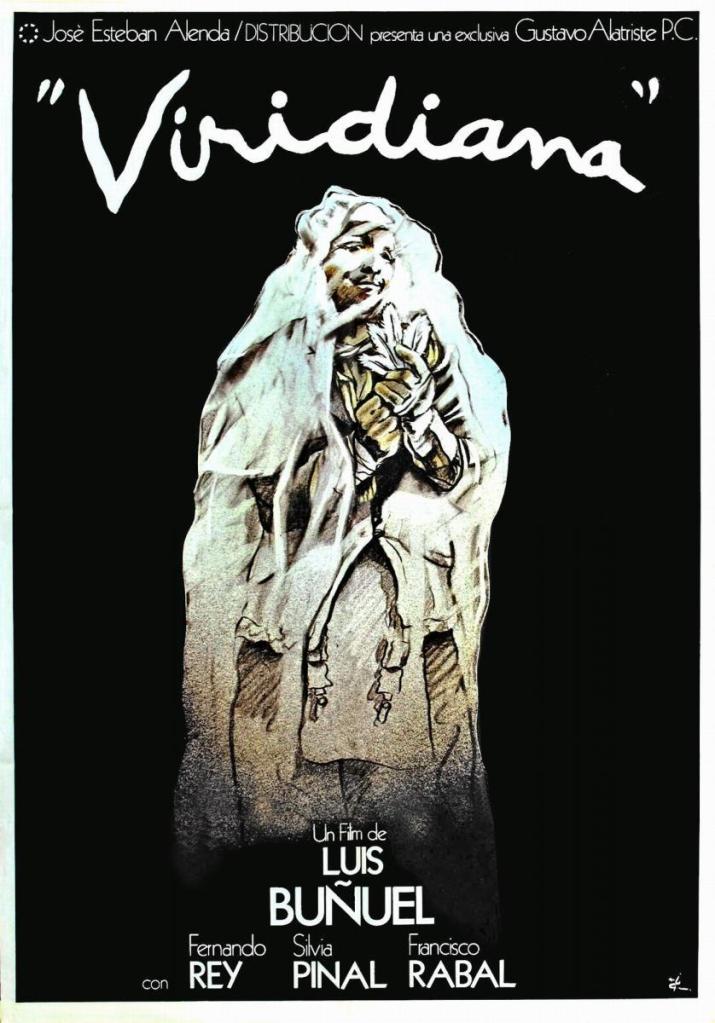
In the 1960s, Luis Buñuel was invited back Spain after years of creative exile to spearhead a new wave of Spanish filmmaking. He produced a film that not only bit the right-wing hand that fed it, it snapped it clean off and chewed it up. Viridiana must have been the last thing the authorities had in mind. Gloriously exposing the guilt and vanity of the upper classes and charity, it was lambasted by the Catholic church for blasphemy and showed an organised world teetering on the brink of chaos, with the powerful either perverts or playboys, the poor singularly ungrateful for the paternalistic patronage they receive and our lead character a hopelessly naïve former nun. Not surprisingly it was instantly banned and Buñuel never made a film in Spain again.

Viridiana (Silvia Pinal) is our naïve nun, called to her uncle Don Jaime’s (Fernando Rey) home for one last visit before her confirmation. Don Jaime though has plans: Viridiana has an extraordinary resemblance to his late wife and Don Jaime intends to first get her to cos-play his wife and then marry him. Or failing that, to drug her and rape her. Guilt stops him from the rape – but doesn’t stop him from claiming he did it, a lie he instantly (fatally) regrets but which leads her to abandon her dreams of becoming a nun. In the aftermath, Viridiana and her cousin (Jaime’s bastard son) Jorge (Francisco Rabal) divide the estate, with Viridiana aiming to continue her religious ideals through excessively generous charity with quietly resentful local paupers, who she has a vision of turning into a religious commune. It does not turn out well.

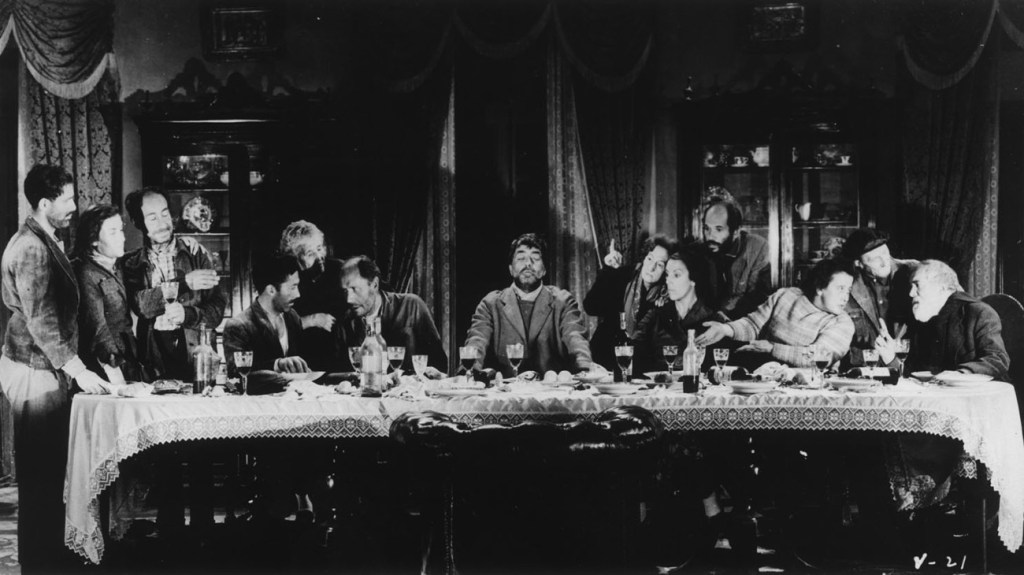
Viridiana benches much of the surrealism of Buñuel’s most famous work, but it loses none of his acute social satire and ability to inject the absurd with sharp dark humour. It makes Viridiana a startingly complex work, brilliantly assembled by an artist where every frame has a different idea, all of which comes together into a darkly entertaining whole. Its not hard to see why the strictly Catholic Fascist Spain found the film so outrageous, with its mocking of religious imagery (from the crucifix that becomes a flick knife to the famous scene of the paupers forming a drunken, pose-perfect, tableau of Da Vinci’s The Last Supper), it’s acknowledgement of a host of fetishes and perversions among the upper-classes (orgies, feet, hinted necrophilia, incest) and the utter ineffectiveness of any system, no matter how charitable, to control the human spirit, with the poor frequently resentful under their veneer of deferential gratitude.

Viridiana splits neatly into two acts, both revolving around a complex relationship with guilt and how it guides our actions. Don Jaime (a superb performance of corrupted grandeur from Fernando Rey) is a lonely man, plagued with guilt and regret over his wife’s death, locking himself away in a time-locked country pile like a perverted Miss Havisham. In private he fetishistically admires her clothes (which he blasphemously keeps like holy relics) and admires his feet in her shoes. He’s fascinated by Viridiana’s resemblance to his late wife and fantasises that she might be persuaded to renounce the cloth to live as his wife.

With the convenience of his servant Ramana – an equally lonely, repressed soul tenderly played with a burgeoning sexual desire by Margarita Lozano – he guilt-trips Viridiana into dressing for one night in his wife’s bridal clothes, drugs her drink and takes her to bed. He even arranges the sleeping Viridiana into the exact pose his wife had when she was before him, adding hints of necrophilia to an already disgusting assault. Shame stops him from committing the deed and guilt then corrupts both of them. Don Jaime at his selfish lie, Viridiana at her indirect role in her uncle’s death and the forced abandonment of her vocation.

Inheriting her uncle’s home, alongside playboy cousin Jorge (Jaime’s bastard son, who he has barely met), Viridiana redirects this guilt into a commune for the poor and needy, where charity, work and faith sit side-by-side. Her efforts to essentially introduce a benign feudal church-system contrasts with Jorge’s modernising efforts, introducing electricity and other mod-cons. Buñuel demonstrates the discomfort of these two worlds with a beautifully assembled scene where Viridiana’s leads a group pray intercut with a series of shots of acts of manual labour (hammers smashing walls, cement splatted on bricks etc.), making he prayer meeting (which we know the attendees think is a pile of bunkum) seem even more outdated and ineffective.

Viridiana isn’t cruel about these characters though – it looks at them as real people, with faults and virtues, some good some bad. It’s also remarkably clear-eyed about charity. There is something performative about Viridiana’s efforts, as well as a clear sense it is as much for her (subconsciously – she’s too naïve for cynicism) as it is the welfare of the beneficiaries. Those beneficiaries are a brilliant series of pen portraits of people who take offered charity, but resent the paternalistic attitudes that come with it. The working classes are not passively grateful for religious charity – but they are smart enough to take a meal ticket. No wonder the church was furious: Viridiana ruthlessly exposes the lip-service the downtrodden give religious charity, while refusing to reshape their lives and views according to instruction.

The peasants remain earthy, irreverent and full of their own pleasures and prejudices. Despite Viridiana’s best efforts they abuse a (possibly leperous) beggar, tying a cowbell to him so they can hear him coming. When left alone in the grand house, they do what many of us might well do in their place: like teenagers resentful at their parents, they throw a drunken party and trash the place. Viridiana’s ‘dinner-party’ scene is Buñuel’s masterclass in riotous joy that slowly turns darker and more dangerous. Mockery leads to over-indulgence, anger and eventually violence. Viridiana will discover to her cost her attempts at kindness has done nothing to change their basic characters and it is as likely for someone to be downtrodden and deeply unpleasant as it is for them to be decent.

Charity in Viridiana doesn’t really change the world. It can improve lives, but not the system. And using it to shape people into what you want them to be is doomed to failure. The peasants are (mostly) not bad people, they just don’t feel want to reshape themselves into pious substitute nuns for Viridiana as a pay-off for room and board. Jorge is distressed to see a working dog tied to a cart and forced to run alongside it. He impulsively buys the dog – which to its original owner is not a pet but a working animal that must own its keep. Jorge clearly feels good about saving this dog: but seconds after he walks away with it, Buñuel pans across to another identical dog running behind a cart. Who was this charity for? The dog or for Jorge? The peasants of Viridiana? And did this one act change anything? And for some charity is entirely self serving: Viridiana visits Don Jaime solely out of thanks for his charity in paying for her time in the convent – surely an act only carried out for Jamie’s own perverted reasons.

None of this is what the Church or Spanish state wanted to hear. A downtrodden class that isn’t grateful to its leaders for lifting them up, but resents them for their patronising strictures. Lords of the manor, one of whom is a lonely pervert, the second a libidinous playboy who sleeps with multiple women. A deeply religious woman, who is completely naïve and fails utterly. And an ending – an ending Buñuel was ordered to change from the script and in doing so made even more suggestive and blasphemous – that implies the household will settle into a sexual menage.

It’s brilliantly, pointedly not what he was asked for – and stunning condemnation of the flaws in an entire system, caught in a brilliant parable. It’s superbly directed by Buñuel, by now a master of camerawork and editing with a beautifully judged performance by Silvia Pinal who makes Viridiana someone we deeply admire even as every decision she makes seems doomed for disaster. It’s a fiercely challenging, involving and complex work and infinitely rewarding for reviewing and patient consideration – no wonder Spanish critics later named it the greatest Spanish film ever made.