Tag: Frank Finlay

The Three Musketeers (1973) / The Four Musketeers (1974)

The Three Musketeers (1973) / The Four Musketeers (1974)

A film of two halves, in more ways than one: the swashbuckling original and its dark sequel

Director: Richard Lester

Cast: Michael York (d’Artagnan), Oliver Reed (Athos), Frank Finlay (Porthos/O’Reilly), Richard Chamberlain (Aramis), Raquel Welch (Constance Bonacieux), Jean-Pierre Cassel (Louis XIII), Geraldine Chaplin (Anne of Austria), Charlton Heston (Cardinal Richelieu), Faye Dunaway (Milady de Winter), Christopher Lee (Count de Rochefort), Simon Ward (Duke of Buckingham), Spike Milligan (Bonacieux), Roy Kinnear (Planchet), Georges Wilson (Captain de Treville)
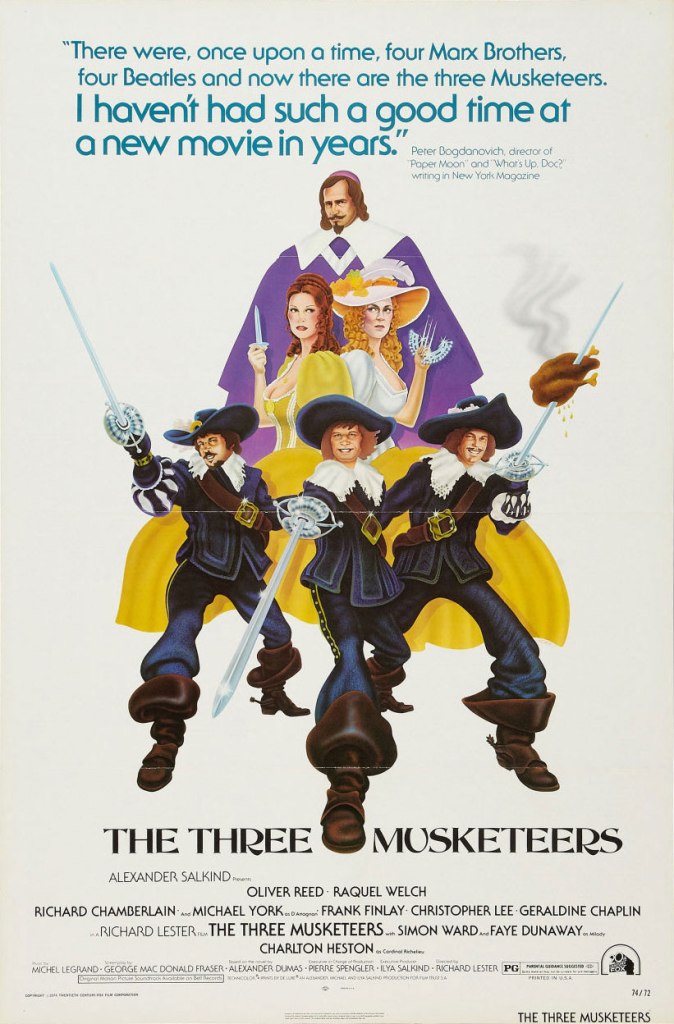
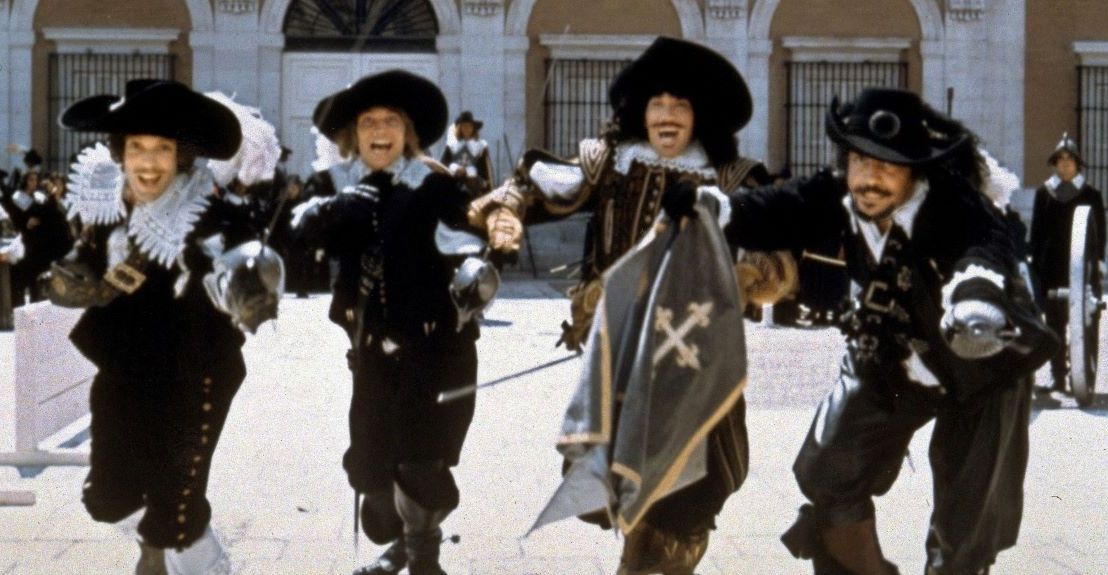
All for one and one for all! The Three Musketeers is probably the greatest adaptation of Dumas’ rollicking classic, a wonderful mix of swashbuckler, romance and Hellzapoppin comedy, that never takes itself particularly seriously and is crammed with actors having a whale of a time. It’s not quite a send-up, but it’s also not quite a straight re-telling either. Instead, it’s gunning all-out for entertainment – and it succeeds most of the time.

d’Artagnan (Michael York) arrives in Paris in 1625 desperate to join the musketeers. After various adventures along the way – including a rivalry with suavely villainious Rochefort (Christopher Lee) – the impulsive young man forms a friendship (after bumps in the road) with the famed musketeers Athos (Oliver Reed), Porthos (Frank Finlay) and Aramis (Richard Chamberlain). Falling in love with the unhappily married Constance (Raquel Welch), maid to Queen Anne (Geraldine Chaplin), d’Artagnan and his friends are dragged into foiling a plot by the ambitious Cardinal Richelieu (Charlton Heston) to use the ingenious Milady de Winter (Faye Dunaway) to expose the Queen’s infidelity with the Duke of Buckingham (Simon Ward). Will our heroes manage to foil the scheme in time?

The Three Musketeers adapts the first third or so – the most famous and by far the most enjoyable part – of Dumas’ novel. With an irreverent script by Flashman author George MacDonald Fraser, its framed as a rollicking romp with a tongue-in-cheek humour. Richard Lester, famed for his cheeky Beatles comedies (and the film was originally envisaged as a vehicle for the Fab Four), added his trademark scruffy, opportunistic comedy.

The film is awash with muttered asides – many of them well delivered by Roy Kinnear’s exasperated servant Planchet – that are only just picked up by the sound mix. My favourite? d’Artagnan bursting into a room full of guards, yanking a rug with a yell in an attempt to upend them, succeeding only in tearing the corner off it, then immediately jumping out of a window, leaving the bemused guards one of whom plaintively mutters “He’s torn our carpet” – I find this funny on multiple levels, from York’s all-in energy to the stillness of the shot, to the underplayed sadness of the punchline.
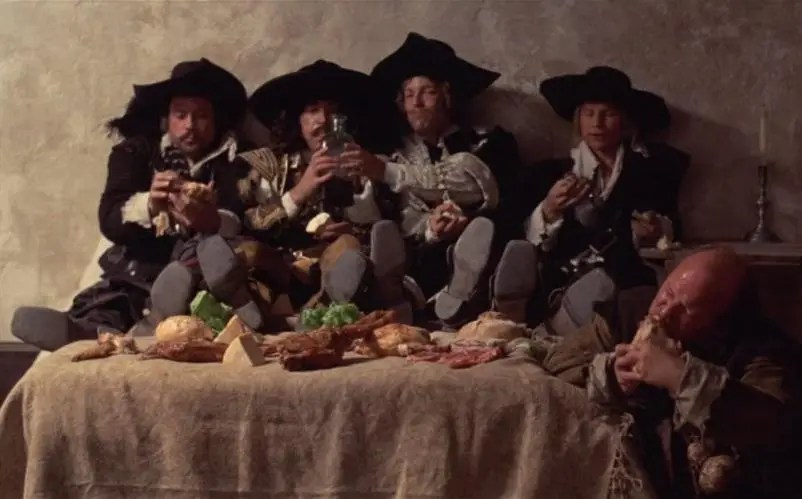
Lester’s film is full of long-shot gags – passengers in litters being dropped in a lake, d’Artagnan swinging on a rope to knock someone off a horse, missing and falling in the mud or his jump from a third storey window only to immediately reappear having landed on a (anachronistic) window cleaner cart. While the film does have its moments of drama, danger and intensity, it doesn’t ease up on visual humour, or gags (“This ticket is for one man” “I am one man. This is a servant”). It’s all part of Lester’s plan to make a fast-paced, pantomimic entertainment in which nothing is intended to ever be too serious.

It’s all played with maximum commitment by the cast, all of whom buy into the films’ tone. Michael York leaves very little in the locker-room with a performance full of youthful bravado, lusty hurrahs and naïve, winning eagerness. It’s a very hard balance to get right but he is never overbearing, but provides a relatable, likeable lead. He’s physical commitment to a series of Buster Keaton style gags is also commendable. He sparks a rather sweet romance with Raquel Welch, who is not the world’s strongest actress, but gamely delivers a series of pratfalls as the eternally clumsy Constance.

Around these two, a series of experienced actors delight in larger-than-life roles. Reed brings a surly intensity to Athos, a reminder of how great a career this charisma laden actor could have had. Finlay gives a Falstaffian joie de vivre to Porthos. Chamberlain (with little to do) strikes a gamely romantic figure as Aramis. As the baddies, Heston clearly enjoys subverting his grandiosity as the scheming Cardinal, Dunaway has a kittenish sensuality as Milady and Christopher Lee is so perfect as the debonair Rochefort that his eye patch (unmentioned in Dumas) has become de rigour for every Rochefort performance afterwards.

The Three Musketeers is crammed with swashes being buckled. The sword fights come thick and fast and are all shot in a series of impressive locations (the camera work of David Watkin, design of Brian Eatwell and costumes of Yvonne Blake do a wonderful job creating a sumptuous period setting). At times they do look a little ragged today – producers the Salkinds ran a tight budget, and there are multiple reports of the slightly-under-rehearsed fights leading to near-serious injury (this slapdash preparation would lead to tragic consequences when Roy Kinnear was killed on the belated second sequel 15 years later). But the actors enter into them with a firey commitment (a little too much so in Reed’s case according to the terrified stuntmen) and rumbunctious energy that really sells these as gripping action. They are also give a certain air of peril that gives just enough weight to the film.

The Three Musketeers has moments of dated clumsiness – the bizarely arty slow-mo opening with blurred motion feels totally out-of-keeping with the rest of the film – and not all the jokes land (Spike Milligan in particular is completely over-indulged in the film’s least successful comic moments). Not every performance works – Chaplain in particular is weak as Anne of Austria – and not all the jokes pay off. The musical score by Michael Legrand, catchy as it is, sometimes overeggs the “isn’t this all such fast-paced fun” angle. But the stuff that lands, really does well and there is more than enough fun, action, adventure and rollicking good humour to keep you entertained on a weekend afternoon.

And then there were two (or rather four)
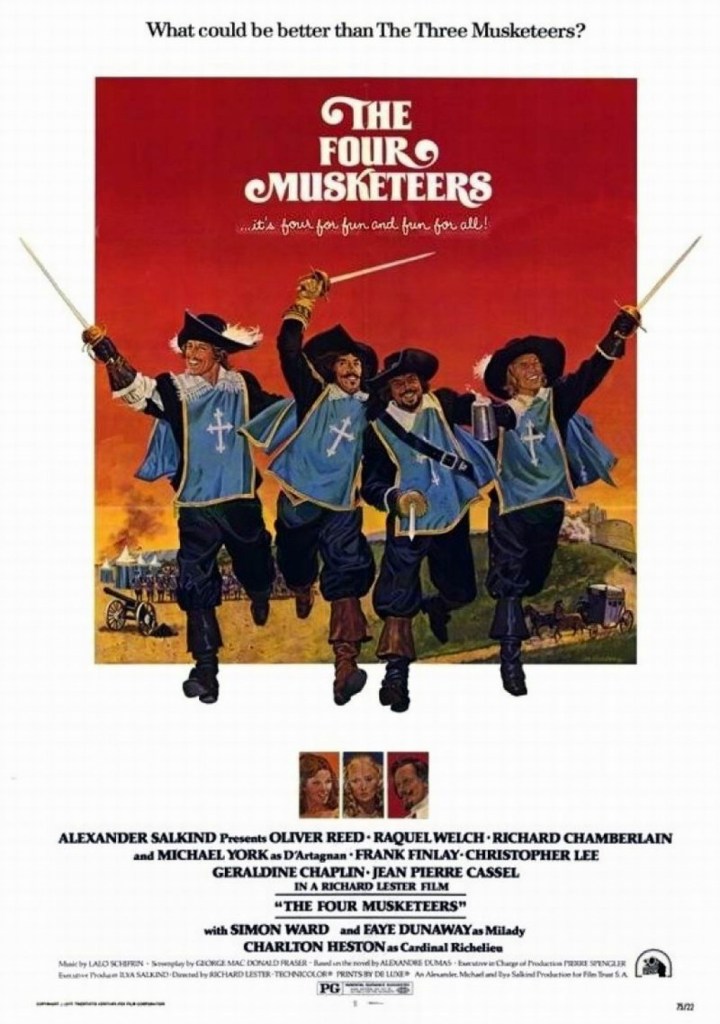
There is always a twist in the tale. At some point while making The Three Musketeers the Salkinds realised they would never get it ready for the Paris premiere. But they could get half the film ready. So, they released that and cheerily announced at the end a sequel was already in the can. Problem was no one had mentioned it to the cast, who discovered they had shot an entire movie for free. A court case exploded, which the Salkinds lost, settling with actors and leading to a new clause being inserted into all contracts for actors preventing such a dodge happening again.

The Four Musketeers covers the second, less famous, much less fun part of Dumas’ novel. Rather like novel, it’s a rambling affair that lacks the compelling narrative thrust (We’ve got to get those diamonds and save the Queen!) which made The Three Musketeers so entertaining. It doesn’t help that its also considerably darker, serious and bleaker as bodies pile up and things get serious.

This makes the sequel a very different beast to the first. Energetic heroism prevented villainy in the first film, but here it often fails . Milady (Faye Dunaway) has sworn revenge and is ordered by Cardinal Richelieu (Charlton Heston) to assassinate Buckingham (Simon Ward). Along the way she kidnaps Constance (Raquel Welch) and seduces d’Artagnan (Michael York) seduced. The Musketeers rescue Constance, fight at La Rochelle and do their best to defend Buckingham – but nothing goes to plan, especially after Athos (Oliver Reed) realises Milady and his criminal ex-wife (thought dead) are one-and-the-same.

The Four Musketeers keeps up the humour, but it is frequently at odds with the darker film it sits in. Gone is the high-paced musical score of Michel Legrand, replaced with a lyrical series of melodies by Lalo Schifrin. It’s telling that Welch – whose comic clumsiness was a large part of the first movie – appears only briefly here. Similarly, Cassell’s shallow monarch (dubbed by Richard Briers) pops up just once, Roy Kinnear’s Planchet isn’t in the first hour and Spike Milligan’s free-wheeling improvisation is missing completely (in that case, no bad thing).

The film feels tonally at odds with the first film and even, at times, with itself. The Three Musketeers was full of sword fights but no deaths – here sword strokes are lethal. As the Musketeers comically bounce around at La Rochelle sight gags abound – but it feels at odds with a film where the death is very real. The more realistic feel means some set pieces – such as Rochefort and d’Artagnan fighting on an inexplicably frozen lake in the height of Summer – become harder to swallow.

Some performers do flourish. Oliver Reed comes into his own as an increasingly dark and vengeful Athos, giving into temptations of shocking revenge. Faye Dunaway laces her role with cold, murderous fury. They have most of the film’s most compelling scenes – but the incredibly dark ending (which involves our heroes actively perpetrating judicial murder with a terrified victim) while loyal to the book, feels far too heavy for a pair of films that started with Buster Keatonish comedy.

The loyalty to the book and the commitment to follow it is partly to blame. There is a reason why most adaptations chuck away this section of the book. It lacks a clear narrative line for emotional connection and is highly episodic. d’Artagnan, in the book, does indeed sleep around after Constance disappears – but when the film requires their relationship to be the emotional heartbeat, is it a good idea to have him jump into bed with two women within days of her disappearance?

Lester announces the more sombre parts by filming them in a very framed, artful way inspired by the old masters, with a static camera and medium shot, reliant on Schifrin’s maudlin music. He’s far more at home with the comic business delivered by Finlay (very good) and Chamberlain (still with nothing to do). At other points he surrenders initiative to legends like Heston (suavely menacing), Lee (whose Rochefort steps up a level in lip-curling contempt) and Dunaway.

The finest thing on display are the sets and the sword fights, which are even more desperate, ragged and violently dramatic than last time (when Rochefort and d’Artagnan stop in one to take a breath, you are not remotely surprised given the total commitment we’ve seen). The action set pieces all look really impressive and staged with confidence and brio. It’s just a shame that much of the rest of the story feels like its being told by a natural comic trying hard to be King Lear, but not able to resist throwing a few gags in. It makes for an entertaining, but tonally messy film that feels it has come from a totally different place than its flawed but fun predecessor.
Murder by Decree (1979)

Murder by Decree (1979)

Sherlock Holmes investigates Jack the Ripper in this overlong but enjoyable Doyle pastiche

Director: Bob Clark

Cast: Christopher Plummer (Sherlock Holmes), James Mason (Dr John Watson), David Hemmings (Inspector Foxborough), Susan Clark (Mark Kelly), Frank Finlay (Inspector Lestrade), Anthony Quayle (Sir Charles Warren), Donald Sutherland (Robert Lees), Geneviève Bujold (Annie Crook), John Gielgud (Lord Salisbury)

In the world of Sherlock Holmes pastiches, it’s a popular sub-genre: Sherlock Holmes vs Jack the Ripper. How would Holmes have taken on the murderer who has baffled generations since those brutal Whitechapel killings in 1889? Murder by Decree explores the idea, mixing Conan Doyle with a deep dive into (at the time) the most popular theory in Ripperology, the Royal Killings (Murder by Decree indeed!).

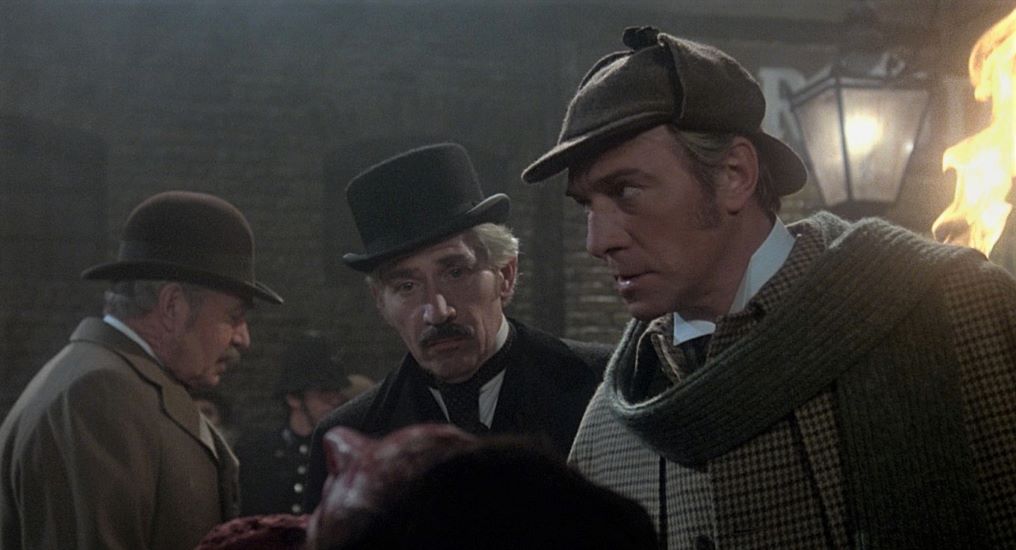
It’s all pulled together into a decent, if over-long, film, shot with sepia-toned stolid earnestness by Bob Clark. With its fog-ridden Whitechapel sets (carefully built but always strangely empty), heavy-duty actors sporting large sideburns, wavy-screen flashbacks and carefully unimaginative framing, there is something very old-fashioned about Murder by Decree. That also extends to its Ripper theory, steeped in a very 70s class-conscious conspiracy. The film pads out its two-hour run time with many a POV shot of the Ripper prowling the streets, which bring to mind Jaws and slasher horror films of the time.

Where Murder by Decree does stand out is in its imaginative characterisation of Holmes and Watson. They are presented as affectionate friends – Mason’s older Watson has a sweet indulgent elder-brother feeling to him, giving Plummer’s sparkly Holmes plenty to tease and bounce off. They split the casework between them – Watson is an equal partner, even if Holmes does the brainwork – and use their strengths to complement each other (notably, Watson frequently distracts people so Holmes can interrogate a witness more closely). They genuinely feel like long-term friends (there is a delightful sequence where Holmes is so distracted by Watson’s attempt to fork a pea, that he squashes it onto the fork – to be met with a forlorn “you’ve squashed my pea” from Watson, who likes the peas intact so they “pop in my mouth”).

They are dropped into the middle of a very much of-its-time Ripper theory. Murder by Decree centres on the theory that the murders were ordered (the film reluctantly suggests tacitly) by the establishment to cover up the secret marriage of Prince Edward, Duke of Clarence to a Whitechapel woman, Annie Crook. This alleged marriage produced a baby, and a royal doctor, sheltered by a Masonic conspiracy, sets about eliminating everyone who knows the truth. Of course, it’s almost certainly bollocks – but with its mix of secret societies, Royals, a lost heir and the rest, it’s an attractive story.

It gains a lot from the performances of the two actors. James Mason flew in the face of then popular perception by presenting a quick-witted, assured Watson, more than capable of looking after himself (he bests a blackmailing pimp in a street fight and is very comfortable with guns – far more than the reticent Holmes). He’s still the classic gentlemen, who loves King and Country, but also shrewd, brave, loyal, able to win people’s trust and look at a situation with clear eyes.

With Christopher Plummer, Murder by Decree has one of the all-time great Sherlock Holmes. Plummer’s Holmes is refreshingly un-sombre, twinkly with a ready wit, who loves teasing Watson (cleaning his pipe with Watson’s hypodermic needles) and delights in his own cleverness. But Plummer takes Holmes to places no other film Holmes goes. The case as a devastating effect on him: he weeps at the fate of Annie Crook (consigned by conspirators to a slow death in an asylum) and furiously attacks her doctor. When the conspiracy is unmasked, he emotionally confronts the Prime Minister and berates himself for his failures. There is a depth and humanity to Plummer’s Holmes unseen in other versions, a living, breathing and surprisingly well-adjusted man, unafraid of emotion.

Sadly, the film takes a little too long to spool its conspiracy out. Rather too much time is given to an extended cameo by Donald Sutherland as a pale-faced psychic who may or may not have stumbled upon the killer. There are a lot of unfocused shots of that killer, all swollen black eyes and panting perversion. It relies a little too much on a Poirot-like speech from Holmes at the end explaining everything we’ve seen. But there are strong moments, best of all Geneviève Bujold’s emotional cameo as the near-catatonic Annie Crook, cradling in her arms a memory of her stolen child.

There are many decent touches. The film is open in its depiction of the filth and squalor of life in Whitechapel – a pub is an absolute dive, and the women pretty much all look haggard and strung out. It has a refreshingly sympathetic eye to the victims, with Holmes denouncing the attitudes of both Government and radicals (looking to make political hay from the killings) who see them as lives without intrinsic worth. Holmes places no blame or judgment on them, or the choices life has forced on them, which in a way puts him (and the film) quite in line with modern scholarship (even if there is the odd slasher-style shot of mangled corpses).

The main issue is the film never quite manages to come to life. It’s a little too uninspired, a bit too careful and solid where it could have been daring and challenging. There are good supporting roles: Finlay is a fine low-key Lestrade (at one point persistently raising his hand to ask his superior permission to speak) while Gielgud sells the imperious Lord Salisbury. There is enough here for you to wish the film just had a bit more of spark to lift it above its B-movie roots. But in Plummer and Mason it has a Holmes and Watson to treasure – and for that alone it’s worth your time.

The Pianist (2002)

Adrien Brody is outstanding in the compelling The Pianist

Director: Roman Polanski

Cast: Adrien Brody (Wladyslaw Szpilman), Thomas Kretschmann (Captain Wilm Hosenfeld), Frank Finlay (Samuel Szpilman), Maureen Lipman (Edwarda Szpilman), Emilia Fox (Dorota), Ed Stoppard (Henryk Szpilman), Julia Raynor (Regina Szpilman), Jessica Kate Meyer (Halina Szpilman), Ronan Vibert (Andrzek Bogucki), Ruth Platt (Janina Bogucki), Andrew Tiernan (Szalas)

Few directors have as personal a link with the Holocaust as Roman Polanski. As a boy, he witnessed his parents deported to their deaths, surviving only by chance, escaped the Krakow Ghetto and was sheltered by a Catholic family. The lasting impact is clear to anyone who has seen a Polanski film and he avoided Holocaust projects for decades (including Spielberg’s offer to direct Schindler’s List). The Pianist was the film he made on this trauma. Perhaps because the experience of Wladyslaw Szpilman was, in many ways, similar to his own.

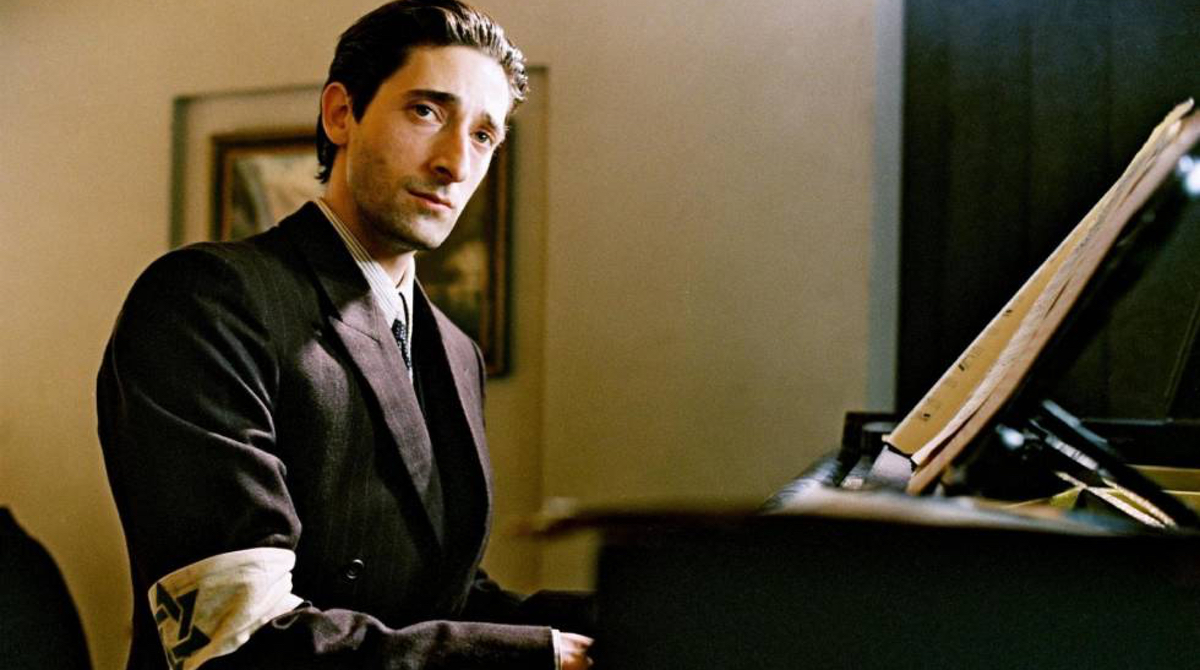
Wladyslaw Szpilman (Adrien Brody) is a famous Polish concert pianist. As the German occupation begins, Szpilman and his family face the cruel downward spiral of the new regime’s anti-Semitic policies. Very quickly, laws move from a ban on Jews in public places, to wearing Star of David badges to herded into ghettos. In the ghettos, life is a terrifying struggle, as the German occupiers shift from simple bullying to acts of random, indiscriminate murder. The whim of a German soldier decides whether you live or die. Szpilman’s family are eventually deported to Treblinka, but by a twist of fate Szpilman escapes – and finds himself hiding in Warsaw for years, sheltered by the Polish resistance, desperately trying to survive until the war ends.

Polanski’s film is heart-breakingly sincere and the documentary matter-of-factness it presents appalling, unjustifiable crimes gives great power to the whole film. It never blinks or looks away, and never offers false hope or sentiment. Only the terrible realisation that nothing can have any impact on whether you live or die: death could come from as little a thing as dropping a brick. People are plucked from lines and shot, speaking at the wrong moment is a death sentence and people in wheelchairs are tipped out of fifth storey windows.

There are moments where Polanski seems to be commenting on Schindler’s List’s touches of melodrama: that film featured a Jewish man saved from death by a German officer’s gun jamming – when the same thing happens in here, the German officer calmly stops, carefully reloads the gun, checks it and shoots his victim in the head. That’s the reality. The Pianist tracks all this with a traditionalist, stable camera and a marked restraint. There is no flair, or immersion, to any of this film. Instead, it grimly and calmly shows you each horror.

There is also no sense of fate or destiny. Szpilman survives – while every other Jewish character he encounters does not – not because of things he does himself, but because of chance, luck and risks taken by others. There is a powerful will to survive in Szpilman, but you can say the same for thousands of others. And, as the film demonstrates time and again, determination and desire to live won’t save you if a German officer decides to make an example of you.

Polanski’s film is honest and shocking in its presentation of the descent into brutality in the ghetto. The film chillingly presents the viciousness of what starts as bullying – the German officers who smack Szpilman’s father (a dignified Frank Finlay) around and force him to walk in the gutter – into killing-for-sport. Literally so: German officers turf out the occupants of a building, just for the ‘fun’ of shooting them down like rabbits in their car headlights as they run away.

While the first half of the film covers the horrors of the Ghetto – from over-crowding, to deportations to the increasingly open and random violence – the second half becomes a survival tale that owes a lot to the unsettling horror films of Polanski’s early career. Hiding in a series of apartments, knowing discovery will lead to instant death, Szpilman find himself in a terrifying city where the slightest sound will condemn him. After the noise of the ghetto, the silence of these apartments – and the long periods of silence from Szpilman himself – become increasingly overbearing, while also helping build the dread of discovery.

The only sound we hear are the piano concertos Szpilman is reduced to playing in his head. Frequently Szpilman’s hands move to play an imaginary piano. In one apartment, there sits a piano he can never play: nevertheless his first act is to open it and let his hands dance perfectly above the keys, imagining the music they produce. It’s a brilliant reminder of the ordinary life he has been forced to leave behind – and how, even when things are at their worst, we cling to the things that make us human.

As Szpilman weakens and grows pale in his apartment prisons, he witnesses both the Ghetto uprising of 1943 and the Warsaw uprising of 1944. Polanski treats this urban war with the same chilling matter-of-factness as the rest. From Szpilman’s window we see bodies fall and buildings burn. People slump dead in unusual, un-cinematic positions – a woman, shot in the back, falls to her knees and slumps forward – and with an abrupt, horrible finality. Only someone who has seen death in war, could film it like this.

When Szpilman finally emerges into Warsaw – a city Polanski has only let us see as Szpilman sees it, a few buildings, a street or two – he finds the city a burned-out ruin. It’s the first crane shot of the whole film, that until then has kept its formal angles down at the level Szpilman has experienced. The wreck of the city also matches Szpilman, now an emaciated, mute Beckettian tramp, clutching his only food, a can of pickles.

Despite all this, the film is full of good, brave people who help Szpilman, many of them in the Polish resistance. Most affectingly of all is the touch of hope the story offers – the last to help is a German pfficer (affectingly played by Thomas Kretschmann). The motives of this character are left vague – is it kindness, weariness with war, disgust at Nazism or just another whim – perhaps because all we know is this man, who helped many others as well, died in 1952 in a Soviet prison camp. For all that, seeing a good man in a uniform worn by so many murderers,  gives you hope something can come out of this wreckage.

At the heart is Adrien Brody, who gives a transformatively superb performance as Szpilman. Wry and dry at first, the film sees him being hollowed out into someone scared, desperate and finally emaciated and traumatised. Brody’s brilliance is in stressing there is nothing out of the ordinary to Szpilman beyond his piano playing. He has to learn to bear the guilt of having no choice but to walk away while his family are killed. But he never loses his humanity and dignity – even as a frazzled tramp, when finally allowed to play a piano, after a pause he launches into a performance of breath-taking cathartic release. It’s a superb performance.

The Pianist showcases the sadistic whim that drove the Holocaust. Death is not operatic, but functional, everyday and comes without warning. The film is unflashy, almost classical in its approach, carefully paced and un-melodramatic. But that reflects the lack of romance in war and the grinding terror and suffering of just surviving. By focusing on a single man’s story and experience, it helps us begin to appreciate that his story was just one of millions. That helps make The Pianist one of the most compelling, moving and brilliant Holocaust dramas ever made.

Cromwell (1970)

Cromwell image
Richard Harris let loose the revolution in Cromwell

Director: Ken Hughes

Cast: Richard Harris (Oliver Cromwell), Alec Guinness (King Charles I), Robert Morley (Earl of Manchester), Dorothy Tutin (Queen Henrietta Maria), Frank Finlay (John Carter), Timothy Dalton (Prince Rupert), Patrick Wymark (Earl of Strafford), Patrick Magee (Hugh Peters), Nigel Stock (Sir Edward Hyde), Charles Gray (Earl of Essex), Michael Jayston (Henry Ireton), Douglas Wilmer (Sir Thomas Fairfax), Geoffrey Keen (John Pym), Stratford Johns (President Bradshaw)

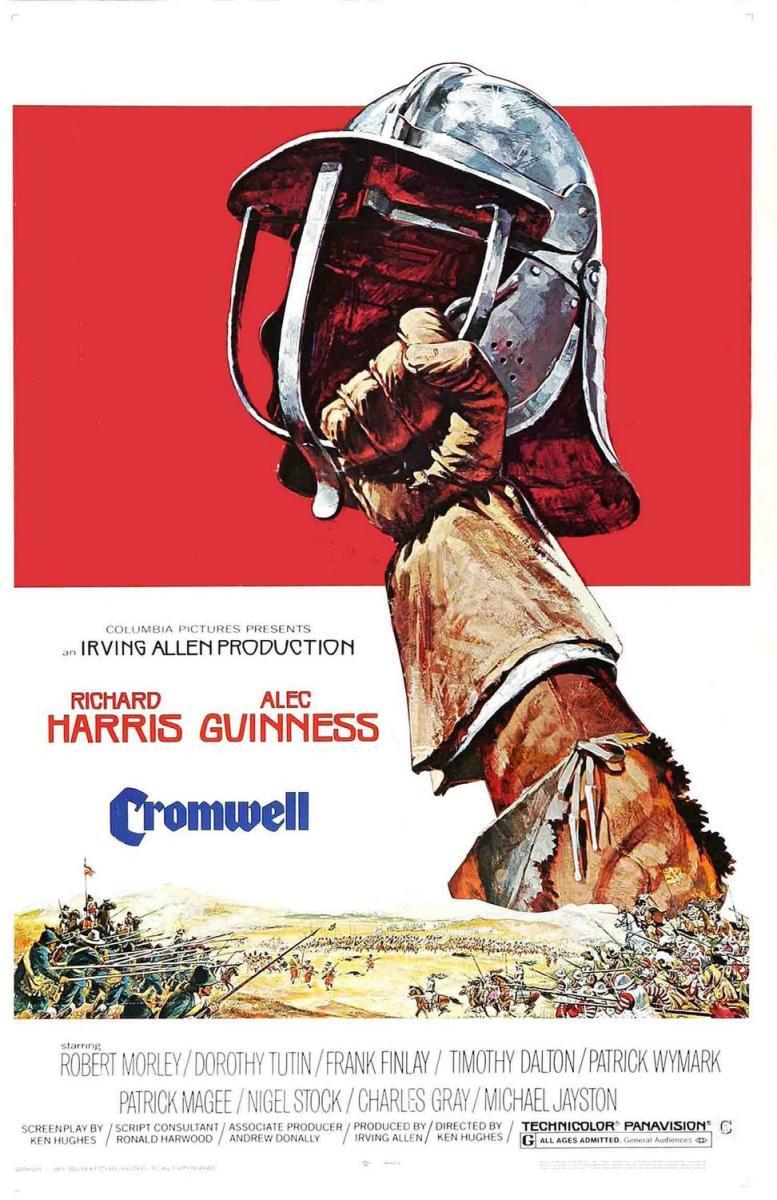
How much does history actually matter when you watch a historical film? We all know we aren’t watching a documentary don’t we? It’s worth bearing in mind when watching Cromwell a film which would probably be in the running for “least historically accurate film of all time”. But despite that, it’s entertaining and gets quite close to some of the spirit of the times – even if it changes most of the facts. It probably as well deserves notice for being one of the very few films to offer a sympathetic portrait of Oliver Cromwell – not a guy it’s easy to like.

It’s the 1640s, and England is a mess. Charles I (Alec Guinness) has been ruling the country directly, without involving Parliament, for over ten years. But now the money is gone and he needs Parliament to raise some more cash. Problem is, Parliament is more interested in pushing a defence of its own prerogatives rather than simply putting more money into the King’s pocket. Among the leaders of the Parliamentary campaign is Oliver Cromwell (Richard Harris), and he is not the man to take any false promises from the king. Before we know it, the country has tipped into civil war – and now it’s up to Cromwell to create a Parliamentarian army that is capable of defeating the King and bring democracy to the nation.

Ken Hughes film offers some plenty of scope and drama, even if is old-fashioned (even a little Victorian) in its Wrong-but-Wromantic Cavaliers and Right-but-Repulsive Roundheads (to mis-quote 1066 And All That). It’s a strange topic for a historical epic (it took years to get the funding) – but it looks fabulous and has a wonderful score that really embraces the religious music of the time.

What it gets right is the passion and the fire that people felt at the time for questions of politics and religion. The film frequently features heated debates (even if the dialogue is often more ticking boxes than inspired) that the actors invest with real force. Its view of events is of course truncated and at times simple (it is, after all, trying to cover around ten of the most tumultuous years in British history in about two hours), but it focuses on trying to get the spirit of things right.

A large part of this is Richard Harris’ firey performance in the lead role. There is, it has to be said, a cosmic irony in Cromwell, the least popular British leader in Irish history, winds up being played so sympathetically by one of the most famous Irish actors of all time. Sure, the real Cromwell would have hated being played by an Irishman and a Catholic (Cromwell was surprisingly inclusive at the time, but had no truck with either group). But then Cromwell would also have loved being portrayed as a mixture of George Washington and Cincinnatus (the Roman general who left his plough to assume supreme command when the nation needed him, only to retire again to obscurity). This Cromwell is bullheaded, but determined to do what’s best for the nation, with personal ambition not even a consideration. He’s the one true, selfless man in a revolution of violence.

In fact, Cromwell was sorely tempted by the eventual offer to be King (something he laughs off here). He also undoubtedly was touched heavily by ambition, while his attempt to turn the Protectorate into a hereditary office was a disaster that doomed the Republic (surely George Washington learned a few lessons from him). But, deep down, Cromwell was sincere – a guy who largely said, and did, what he meant. It’s that sense of morality that Harris gets very well here. And, while its easy to poke fun at those hoarse tirades Harris is frequently called on to deliver, this sort of intemperate ranting (laced with Biblical language and a strong sense of moral superiority) were pretty much central to Cromwell’s personality.

It makes for a very different hero, even if the film is determined to turn Cromwell into the only decent man in the Kingdom. Cromwell, in real life, never retreated from politics to return to his farm as he does in the latter part of the film (he actually spent this time on brutal campaign in Ireland, something the film mentions only vaguely in passing). But there is no doubt Cromwell would have believed he was the guy selected by providence to save the nation – and that idea the film channels very well. In fact, Cromwell gives you a pretty decent idea of what Cromwell might have been like – and a pretty accurate picture of who Cromwell wanted to be – even if the things it shows you only have a passing resemblance to what happened.

It’s a key directive throughout Ken Hughes’ film, which feels free to distort historical events willy-nilly (see more below). But there is a sort of truth in spirit, if not in fact – from the heated debate in Parliament, to the mixture of frantic panic and regimented order in the battles (one particularly good shot positions the camera under a charging horse, which makes a cavalry charge suddenly feel horrifyingly visceral). Sure it’s arranged into a much more simple black-and-white story, but it works.

A similar trick also works for its portrayal of Charles I. This is probably one of Guinness’ most over-looked performances. His Charles is a weak, indecisive man who confuses stubbornness and pride for moral strength. Softly spoken when calm, he collapses into heavily Scots accented rage when riled and his politeness is a only a shield for bitterness and vexation. He routinely shirks responsibility for his actions and spreads the blame around everyone but himself. Again, it might not all be accurate, but you can’t imagine this is far off from the actual King.

Historically though, so much of the film is wildly inaccurate. Many of these changes are done to increase the importance of Oliver Cromwell early in the Parliamentarian campaign. To scratch the surface: Cromwell – a minor figure until quite late into the war – was not one of the five members Charles marched to Parliament to arrest (neither was Henry Ireton). He certainly didn’t – and neither did anyone else – remain sitting when the troops arrived and set a motion in place protecting MPs. He never met the King before the war. Cromwell is later made C-in-C of the Parliamentarian army – an office actually given to Fairfax. The film’s depiction of the Battle of Naseby flips the numerical advantage exactly to favour Charles rather than Cromwell. Far from providing the key damning evidence at Charles’ trial, Hyde fled the country with Prince Charles.

But this is a fiction, rather than drama. Even if the facts it presents are largely nonsense, it gets a lovely sense of the divided loyalties and tensions that existed during this period. The performances are often quite broad – Robert Morley simpers and sneers as an opportunistic Manchester, Patrick Wymark growls and splutters as Strafford while Timothy Dalton goes way over the top as a foppish Prince Rupert – but some, such as Michael Jayston’s firebrand Ireton or Nigel Stock’s tortured Hyde (historical nonsense as his storyline is) are rather good.

And it’s hard not to like a film where the lead actor is going at it such great guns that you can actually hear his voice disappearing into a rasp. Cromwell doesn’t have much relation to the facts, but deep down it does seem to understand the man Cromwell wanted to be. And, on that level, it feels truthful and heartfelt – and that’s partly why it remains entertaining and why I remain rather fond of it.

Gumshoe (1971)

Fulton Mackay and Albert Finney in charming Liverpool set Chandler spoof Gumshoe

Director: Stephen Frears

Cast: Albert Finney (Eddie Ginley), Billie Whitelaw (Ellen Ginley), Frank Finlay (William Ginley), Janice Rule (Mrs Blankerscoon), Carolyn Seymour (Alison), Fulton Mackay (Straker), George Innes (De Fries), Billy Dean (Tommy), Wendy Richard (Anne Scott), Maureen Lipman (Naomi)

Film noir is a genre beloved by many, and – with its many conventions and, in particular, its hard-boiled Chanderlesque style – it’s also ripe for parody. That’s what Gumshoe does here, transplanting the rough, grimy mysteries of Philip Marlowe and Sam Spade to Liverpool in the 1970s. In doing so, it allows Albert Finney to let rip with the sort of hugely enjoyable personality performance that plays to his strengths.

Finney plays Eddie Ginley, a would-be comedian and entertainer in his thirties, obsessed with Chandler and Hammett. Placing an advert in the paper offering his services for private investigations in the spirit of a lark, he finds himself hired to look into a decidedly complex affair concerning a female lecturer, a fat South African, an occult bookshop, an unhappy South African political refugee and quite possibly his brother William (Frank Finlay) and his old flame and now sister-in-law Ellen (Billie Whitelaw).

Gumshoe is a an enjoyable, small-scale, cine-literate drama, with a playful script by Neville Smith that has a wonderful ear both for the style of Hollywood detective drama, and the streets of Liverpool – and knows how to mix them together. Shot simply by Stephen Frears (who rather sweetly claims on the blu-ray documentary to not have had a clue what he was doing), the film rattles along with a few good jokes, some decent set-ups and an actually rather good mystery. It largely falls just the right side of parody – not too smarmy, affectionate enough but never taking itself too seriously. It’s a very well judged pastiche – and it’s also a pretty damn good mystery itself.

The film was somewhat of a passion project for Albert Finney (his production company put up much of the funding).  And you can see why, as Finney is excellent – relaxed, smart and funny. Eddie Ginley is part dreamer, part realist trying not to see the truth around him. He knows this world of detecting is partly a game, partly dangerous, partly a fantasy – but he wants to enjoy while it he can. Finney also clearly enjoys the sort of Marlowesque dialogue, just as he gives real emotional depth to a man who has always been looked down on by his brother, and jilted by his girlfriend for said brother. It’s one of his best performances, he’s outstanding – a charming, playful, warm and also super-smart and cunning performance.

The rest of the film gives playful highlight moments for a number of performers, wrapped up in the enjoyment of the material. Finlay does a decent job as a stuffed-shirt straight man, Billie Whitelaw enjoys a sly parody of any number of femme fatales from 1940s movies, and Janice Rule is intimidating as a very different type of suspicious female. The best supporting performance however comes from Fulton Mackay as a brusque but wry Scottish hitman, tailing Ginley throughout the film to reclaim money he feels is owed to him. 

It’s a shame that a fun, playful and engaging film has in some places dated so badly. Not least in its language aimed at a black heavy Ginley gets into a scrap with. Intimidated and off-guard, Ginley falls back onto banter aimed to put the heavy off balance – but which listened to today is basically a string of vile racial slurs using words like jungle, bananas, trees etc. etc. etc. And the attitudes are repeated time and again in the film, with the character constantly referred to in the most derogatory and racialist terms. Mind you at least Oscar James as the butt of this gets a neat dig at Ginley hardly being “the Great White Hope” after a brief bout of fisitcuffs.

It’s an interesting sign of how dated the film is that the villains are racist apartheid South Africans, Finney was at the time a leading campaigner against Apartheid, but neither he nor the film clearly  put calling a black man a monkey into the same bracket as that bigoted system. No one involved really is a racist, not even the characters – it just wasn’t deemed a problem to say those things in the 1970s. (Even the booklet in Indicator’s excellent blu-ray dwells on this uncomfortable dated material).

But, bench that from your mind, and you’ve got a charming, fun pastiche that pokes a lot of fun at Bogart and Chandler. The make-believe fun of Eddie’s Marlowesque hard-boiled dialogue is constantly punctured by him having to explain what he’s trying to say. The film has a lot of fun with the details of a mystery, but still keeps that smart sense of tongue-in-cheek. It’s packed with some excellent lines and some sharp performances. Finney is superb. It’s a pastiche and an affectionate homage of a whole genre – and, although it is old-fashioned and feels a bit dated, it will I think stand up to re-watching.