Tag: Frank Vincent

Casino (1995)

De Niro gets sucked into temptation and vice in Scorsese’s Casino

Director: Martin Scorsese

Cast: Robert De Niro (Sam “Ace” Rothstein), Sharon Stone (Ginger McKenna), Joe Pesci (Nicky Santoro), James Woods (Lester Diamond), Don Rickles (Billy Sherbert), Alan King (Andy Stone), Kevin Pollak (Philip Green), LQ Jones (Pat Webb), Dick Smothers (Senator), Frank Vincent (Frank Marino), John Bloom (Don Ward)
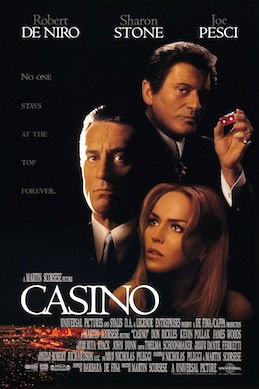
Scorsese’s Casino often gets overlooked in the master’s CV. Marking his first gangster film since Goodfellas, Casino is a very different film, a sort of combination history lesson and slice of violent gangster interplay, in which Las Vegas first gives these gangsters all their dreams coming true before chewing them up and spitting them out like all the other hopeless gamblers. And in doing that, it’s a perverse sort of nostalgia for the little guys being allowed to run the show – even if they did that by putting heads in vices – before they were shunted out by the even more ruthless efficiency of the mega-corporations. Because a world like Las Vegas only makes it easier for basic greed and personality flaws to take hold and ruin everything that’s good.

Sam “Ace” Rothstein (Robert De Niro) is a gambling and odds fixer, a man so expert at what he does and how he does it, so skilled at working the odds to spin out a profit for the Mafia, that the Chicago mob hires him to run their casino in Las Vegas. Rothstein turns the casino into the ultimate money making machine, understanding the odds of every bet and squeezing money out of every pore of the operation. While Sam takes care of the money, childhood friend Nicky Santoro (Joe Pesci) handles the other side of the Mafia business – increasingly abusing his position to make his own fortune on the side. Sam is further undermined by the only “against the odds” bet he ever made in his life: falling in love with Ginger (Sharon Stone), a selfish, self-destructive former hooker who is happy to take Sam’s money but will never offer him the love he craves. Disaster awaits.

Part of the reason perhaps why Scorsese’s Las Vegas epic (and the film is nearly three hours long) doesn’t have the warm regard of many of his other films is its focus on an intricate – although fascinating – explanation of how a Las Vegas casino operates, and the film’s reliance on voiceover to convey a vast amount of backstory, personal motivation and character insight. The opening hour of the film is almost entirely narrated (largely by De Niro and Pesci, although other characters occasionally intrude), as Scorsese shows exactly how a mob-skimming operation works in a casino, as well as nearly every detail of its operation, from day-to-day workings to dealing with cheats. The mechanisms of Las Vegas – along with its corruption, violence and blatant theft – are what fascinates the film. These sequences are assembled with the expected grace and skill of Scorsese and his regular editor Thelma Schoonmaker, but they lack the emotional connection of Goodfellas.

In fact, Casino might almost be some sort of tribute to silent film, so much of it is images accompanied alone by voiceover and well-chosen pop songs. It’s a film where imagery is all, with the camera prowling along the red-lined interiors of the casino itself (where daylight never intrudes), or lovingly following the progress of coins from slot machines to counting rooms to bags stuffed with cleaned bills for gangsters to carry away to their masters. It all makes for a rich and fascinating social history, even if you do feel slightly distanced from it by its near-documentary style voiceover.

But then, this voiceover does allow for a surprisingly rich character study once you plug into it. With the design stressing the demonic red-lined rooms and lights of Las Vegas – and the Saul Bass designed title sequence of a man falling through flames into a neon lit underworld – the idea of this place as some sort of hell is there all the way through. This context allows us to see three characters who are corrupted and destroyed by the pressures and temptations of five years running an operation in America’s capital of temptation and excess. And as the film goes on, everything gets bigger, from the garish colours and clothes to the music to the increasingly graphic violence.

And this film is astonishingly violent. Heads are placed in vices, people are brutally murdered by everything from pens to baseball bats, hits happen with a gruesome immediacy. And the person carrying out most of these acts is Pesci, a demonic imp lacking any sense of charm. Pesci retreads his role from Goodfellas, but even worse if possible, a man for whom violence is as second-nature as breathing. 

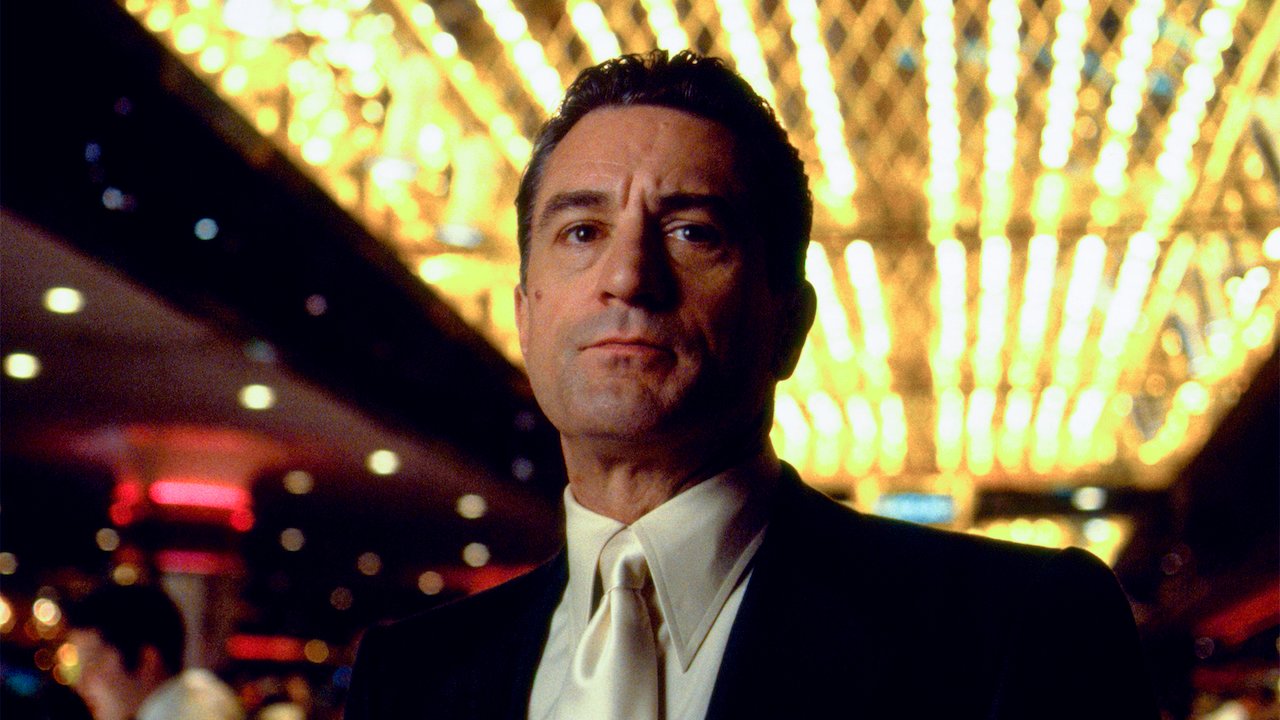
It makes a neat contrast through with De Niro, who dominates the film (and either appears in or narrates almost every minute). It’s one of De Niro’s calmer, most reflective performances ever in a Scorsese picture (arguably until The Irishman). He’s a quiet, meticulous, fastidious professional gambler, who never takes a chance professionally but takes huge gambles with his personal life. De Niro brings the film a calm centre, and the precision of a man who both loves what he does but is so obsessed with making things perfect he gets no pleasure from it. Unlike many De Niro roles in Scorsese, Sam is the closest you can see as a regular guy, someone who works in a world of theft and violence but sees that as a cost of doing business rather than a career choice.

It’s why he remains sympathetic, despite the destruction around him. Perhaps also helped by his simply appalling wife. Sharon Stone gets her finest part ever (she received the film’s only Oscar nomination, for Best Actress) as the self-destructive, greedy addict Ginger who doesn’t want to change anything about her life and marries Sam solely for his money, but continues her relationship with her pimp Lester (a sleazy James Woods) and snorts cocaine in front of her five-year-old daughter. But Sam takes the chance because he loves her – and this Jewish outsider, who moves in circles of Italian mobsters and Southern societies that control the state, wants nothing more than to be loved and accepted. It’s what keeps him close to Nicky – for all his horrific impulsiveness – because Nicky is the closest thing he has to a genuine friend.

It’s a theme that runs throughout the whole film. The Mafia allowed its “street” operatives to run this operation in Las Vegas – and would never allow such regular soldiers such power again – and Las Vegas itself closed its doors to these more “independent” operators in the future to give the riches to corporations and insiders. It’s part of what makes Casino such a fascinating history lesson – this is the Las Vegas we all kind of think of, dirty, corrupted and sexily run by gangsters (even if the film makes clear that these guys would crush your head for looking at them the wrong way). But it’s now a circus, an entertainment ride.  Because our heroes here make the same mistakes as the guys that go through their casino – “the longer they play, the longer they lose”.

Raging Bull (1980)

Robert De Niro takes to the ring in Scorsese’s marvellous Raging Bull

Director: Martin Scorsese

Cast: Robert De Niro (Jake LaMotta), Joe Pesci (Joey LaMotta), Cathy Moriarty (Vickie LaMotta), Nicholas Colasanto (Tommy Como), Theresa Saldana (Lenora LaMotta), Frank Vincent (Salvy Batts), Lori Anne Flax (Irma LaMotta)

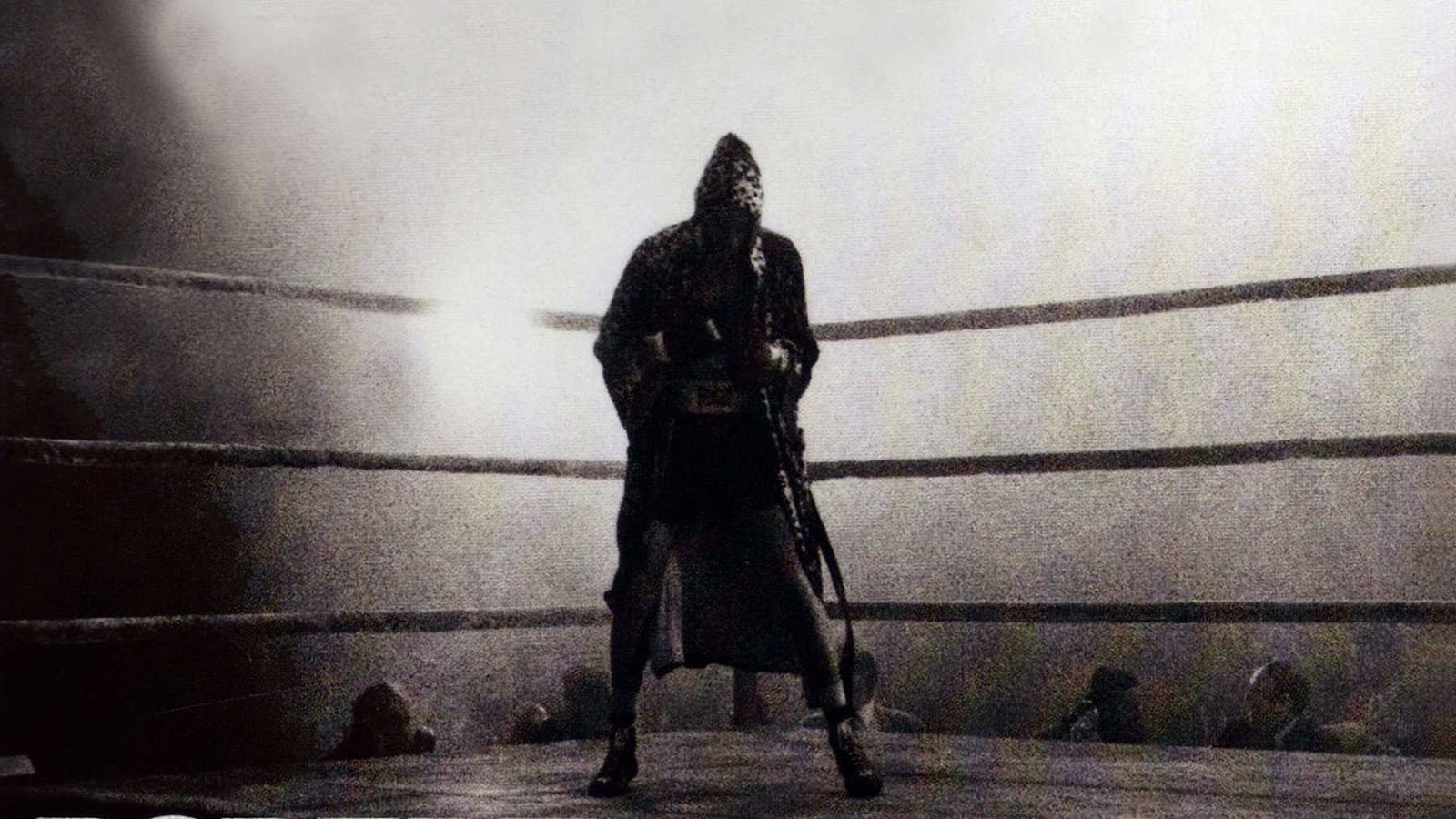
On the surface, Raging Bull seems an unusual topic for Scorsese. A sports biopic? For this, the least sports-engaged director in Hollywood? Even in Scorsese’s most masculine works, sports are always noticeable for their absence. But Raging Bull is a masterpiece, a film whose legacy has seen it named as the greatest film of the 1980s, showcasing possibly Robert De Niro’s most famous performance. A brilliant combination of art, searing personal drama and boxing, Raging Bull may not always be the easiest watch in the world, but it’s a scintillating piece of cinema.

Opening in 1964, we see the overweight, ageing Jake LaMotta (Robert DeNiro) preparing for a comic stand-up routine. From there, the film flashes back to the younger Jake in the ring, with the film following LaMotta’s boxing career. However, the real drama is in his out-of-the-ring relationships, with his brother and manager Joey (Joe Pesci) and his second, younger, wife Vickie (Cathy Moriarty). LaMotta inside the ring is a bull, a man who can take unbelievable levels of punishment. Outside the ring though he is a fragile, paranoid, self-loathing man with a sharp self-destructive streak, whose envy and jealousy systematically destroys every relationship he touches.

Watching the film, its clear Scorsese knows very little about boxing but fortunately he knows everything about filmmaking. Raging Bull is a marvel, a superbly made and directed marvel. Scorsese’s triumphant decision was to shoot the film in black-and-white (some truly beautiful work from Michael Chapman). This gives the film both the classic, gorgeous feel of a 1940s Hollywood movie, but also allows the boxing matches themselves to take on an almost impressionistic artistry, with powerfully emotive monochrome images. The photography also creates a stark, documentary like sense of reality for the many scenes of domestic disharmony and violence, while later shots brilliantly allow LaMotta (lost in self-loathing and disgust) to almost disappear into the inky darkness of the frame. Raging Bull would be half the film it is, if it was in full colour.

Recovering from a cocaine addiction that nearly killed him, Scorsese was intimately familiar with self-destruction – and its perhaps this that drew him towards LaMotta’s jealousy, possibly the film’s major theme. LaMotta is a self-loathing individual, who sees little value in himself, who treats pummellings in the ring like just punishments and believes everyone is betraying him. It’s one of the finest films about the green-eyed monster ever made. Obsessed with his younger wife – whom LaMotta first encounters at age 15 and whom he marries as soon as she is legal – LaMotta also earnestly believes she is sleeping with every man around. It’s clear that these paranoid fantasies stem from his own disgust at himself, LaMotta’s own conviction that there is nothing of value in him.

It’s this jealousy that really destroys LaMotta, his trigger-happy temper seeing him able to switch on an instant from a calm – but monomaniacal – insistence that he just wants to know the truth about his wife, to indiscriminate violence. LaMotta is an impulsive, excessive creature who does everything to a huge degree, from doubting his wife, to shovelling food into his guts. Scorsese’s camerawork – particularly it’s La Dolce Vitaish love of Cathy Moriarty – reflects LaMotta’s internal dysfunction. It worships Moriarty in the same way LaMotta does, but also reflects his obsessive possessiveness.  

All of this is further captured in Robert De Niro’s iconic performance. De Niro won the Oscar for this stunning tour de force. Raging Bull became almost as famous for De Niro’s all-consuming preparation: he trained for months to achieve the physique and skill of a professional boxer (he even entered some professional bouts, winning two out of three). He then went completely the other way, the entire film going on a four month hiatus while De Niro went on an eating tour around Italy to pile on the pounds for the ageing, overweight LaMotta. At the time it seemed like no other actor had gone to such levels.

This focus on De Niro’s preparation sometimes obscures in the mind the genius of the actual performance, as if we have almost been blinded by the training and technique behind it. De Niro’s energy, his fury, his intelligent understanding of the fractured mind of the paranoid brilliantly brings LaMotta to life. So intense is the actor’s understanding of the disgust that lies at the heart of LaMotta’s personality that, even at his worst, the man is never completely unsympathetic. De Niro rages through scenes of jealous outbursts and violence, but he also has a childish gentleness of the man unable to understand the world around him, twice in the film collapsing into bursts of affecting tears. The older LaMotta is perhaps wiser, but just as inarticulate in emotions as his younger version and as unable to fix the damage. It’s a masterful performance, a physical and emotional tour-de-force.

De Niro also worked closely on the choreography of the boxing scenes, which allowed Scorsese the freedom to shoot these with an imagination and brilliance that had never been seen before. Each fight has its own unique feel, with Scorsese understanding that this sport is a neat parallel for how LaMotta sees life, a series of brutal clashes with pride and self-regard on the line. Scorsese’s fights are elemental clashes – the soundtrack frequently uses slowed sounds to create an animalistic roar.

The camera is frequently thrown into the ring with the pugilist – and LaMotta here is really more of a pugilist than a boxer, there is very little sense of tactics – with low angles and tight camerawork. Scorsese puts the camera – and the viewer – into the ring, making us part of the fights. Every punch and blow carries impact, and this is perhaps the most blood drenched boxing film in history, with the darkened liquid covering the faces of the fighters and dripping from the ropes of the ring. The fights reflect LaMotta’s mood, with one late fight seeming like an almost medieval battle, mist rolling in and the fighters flying at each other with a reckless abandon. There is nothing romantic about boxing here, it’s a grimy reality of violence with a purpose and brute strength, endurance challenges that only the strongest can emerge from.

LaMotta’s confidence and mastery of the ring is contrasted throughout with his lack of nous and understanding in the real world, and his ability to destroy everything he touches. Joe Pesci excels as his supportive brother who realises far too late the uncontrollable anger at the heart of this fighter, while Cathy Moriarty is also excellent as a young woman whose only real mistake is to want to live some part of her own life. Scorsese charts LaMotta’s destruction of both of these relationships, culminating in the washed up boxer pounding the walls of a jail cell weeping and screaming “Why! Why! Why!”, hatred for his self-destruction dripping from every pore.

Raging Bull looks unlike any other boxing film, instead like a perfectly formed art piece, its soundtrack full of classical tunes and its photography adjusting between the beauty of neo-realism and the cold realities of documentary film making. It’s superb, a masterful film, a work of art and also a profound understanding of the destructive impact of jealousy and self-loathing. Showcasing career defining work from De Niro, it’s no wonder this is still hailed as the greatest film of the 1980s and one of the greatest of all time.