
Tag: Fred Ward

The Right Stuff (1983)

The Right Stuff (1983)

Patriotic heroism subtly retold as shrewd satire – no wonder the film bombed

Director: Philip Kaufman

Cast: Sam Shepard (Chuck Yeager), Scott Glenn (Alan Shepard), Ed Harris (John Glenn), Dennis Quaid (Gordon Cooper), Fred Ward (Gus Grissom), Barbara Hershey (Glennis Yeager), Kim Stanley (Pancho Barnes), Veronica Cartwright (Betty Grissom), Scott Paulin (Deke Slayton), Charles Frank (Scott Carpenter), Lance Henriksen (Wally Schirra), Donald Moffat (Lyndon B Johnson), Levon Helm (Jack Ridley), Mary Jo Deschanel (Annie Glenn), Scott Wilson (Scott Crossfield), Kathy Baker (Louise Shepard), David Clennon (Liaison man), Jeff Goldblum (Recruiter), Harry Shearer (Recruiter)
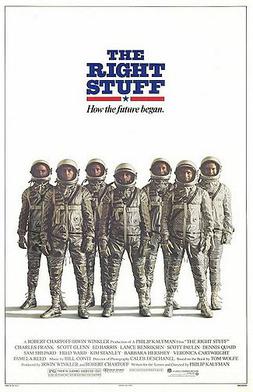
During the Cold War, the US and Russia had to fight with something – from proxy wars to chess, but most famously with Space: the competition to go further, faster and higher among the stars. The Right Stuff focuses on the Mercury Seven pilots at the centre of the US response to Soviet success including Alan Shepard (Scott Glenn), John Glenn (Ed Harris), Gus Grissom (Fred Ward) and Gordon Cooper (Dennis Quaid), a mix of the cocksure and the confident. But in a space programme where a monkey is an acceptable “pilot” for this human cannonball, do any of them have “the right stuff”? Could any of them match the skill of legendary test pilot Chuck Yeager (Sam Shepard) – one of the guys who scorned this astronaut programme for being “spam in a can”?

The Right Stuff, adapted from Tom Wolfe’s book, seemed destined to become a patriotic smash-hit. Despite its eight Oscar nominations (and four wins) it was, in fact, a catastrophic bomb. Perhaps that was because it subverted its patriotism so well. The Right Stuff is, in fact, a subtle, anti-heroic satire (told at huge length) masquerading as a patriotic yarn. It’s marketing avoided that meaning those most likely to enjoy didn’t go and see it, and those who went for that felt alienated. While largely respecting the astronauts, it suggests space race triumphalism was a sort of mass hysteria, with limited results, inflated into something mythic by political expediency, media spin and industrial might. Not the happy, flag-waving message Reaganite America expected or wanted.

Kaufman’s sympathy instead lies with an older, “truer” America. The Right Stuff is an intensely nostalgic film: but for a completely different time. It is in love with Frontier America, where men-were-men and the daring proved themselves in taming the frontier, in this case the sky itself. Our tamer is Chuck Yeager, played with a monosyllabic Gary-Cooper-charisma by Sam Shepard. Yeager is the last of the cowboys (even introduced riding a horse in the desert), taking to the skies like an old frontiersman hunting down that “demon” who lives at the sound barrier.

This is the sort of America The Right Stuff celebrates, and Yeager is the guy who has it. Unlike the Mercury programme, Yeager isn’t interested in showbiz and self-promotion (his reward for breaking the sound barrier? A free steak and a press embargo), just the quiet satisfaction of having done it. It’s the old, unflappable, quietly masculine confidence of a certain kind of American tradition and it’s totally out of step with the world the media is now celebrating with the astronauts. Instead, these effective passengers in the rocket will be hailed as the great pilots.

Kaufman’s film is a long, carefully disguised, quiet ridicule of many of the aspects of the Mercury programme. It’s conceived, in a darkened room, by a group of politicians so clumsy they can’t even work a projector. It’s head, Lyndon B Johnson (Donald Moffat on panto form) is a ludicrous figure, at one point reduced to an impotent tantrum in a car when he doesn’t get his way. The NASA recruiters are a comedy double act – Goldblum and Shearer sparking wonderfully off each other – who first suggest (in all seriousness) circus acrobats as pilots and then fail to identify Yuri Gargarin. The programme begins with a series of failed launches that travel tiny distances before exploding, culminating in one attempt ending with an impotent pop of the cap at the top of the rocket.

NASA is slightly ramshackle and clueless throughout. Far from the best and brightest, Kaufman is keen for us to remember that many of the scientists fought for the Germans in the war, that decisions were often made entirely based on what the Russians have just done, that the astronaut recruitment tests are a parade of bizarre physical tests because no one has a clue what to test for, and that the final seven selected aren’t even the best just the ones who persevered through the tests and (crucially) were small enough to fit in the capsule. That doesn’t stop the media – played by a San Francisco physical comedy troop – from turning them overnight from jobbing pilots to superstars.

The astronauts status is frequently punctured. Scott Glenn’s granite-faced Shepard is strapped into the cockpit for hours on his first flight, until finally he begs to pee (followed by a montage of coffee being slurped, hose pipes blasting and taps dripping) before being instructed to release his bladder into his suit, meaning he heads into space sitting in a puddle of his own piss. Dennis Quaid’s cocksure Cooper has an over-inflated idea of his skills and is prone to dumb, blow-hard statements (arriving at Yeager’s Air Force base he non-ironically states he’ll soon have his picture up on the deceased pilot’s memorial wall). Fred Ward’s Gus Grissom is a slightly sleazy chancer – controversially The Right Stuff presents him as panicking on re-entry from his first mission, blowing his hatch and sinking his ship, something he categorically denied (and was later proved not to have done).

Even John Glenn, played with a sincerity and decency by Ed Harris (if this had been a hit, Harris’ career of playing hard-heard would have been totally different), is subtly lampooned. So straight-laced he literally can’t swear (his attempt to say ‘fuck’ never gets past a strained Ffff), he’s introduced via a ludicrous TV quiz show and his square-jawed morals frequently tip into puritan self-importance. Undergoing physical tests, Kaufman even cuts from his grimacing face to a grinning chimp on the same test (and who will beat him into space). Compared to Yeager, who can correct a plane on a desperate nose dive and beat the skies into submission (and has the only outright heroic refrain in Bill Conti’s Oscar-winning score), none of them have that right stuff.

Do they get it? In a way: but their triumph is establishing their character, not their skills. Kaufman uses Yeager to point us towards this (his seal of approval is vital for the film): after Grissom’s debacle, he defends him in the bar and praises their courage in essentially sitting on top of a massive bomb.
Tellingly, the astronauts’ most courageous moment in the film isn’t in the cockpit at all: it’s Glenn supporting his stammering wife’s refusal to go on air with LBJ, despite the pressure from NASA bigwigs – and the other astronauts uniting in fury when Glenn is threatened with being dumped from the next flight. The others become more noble through maturing and casting aside fame’s temptations.
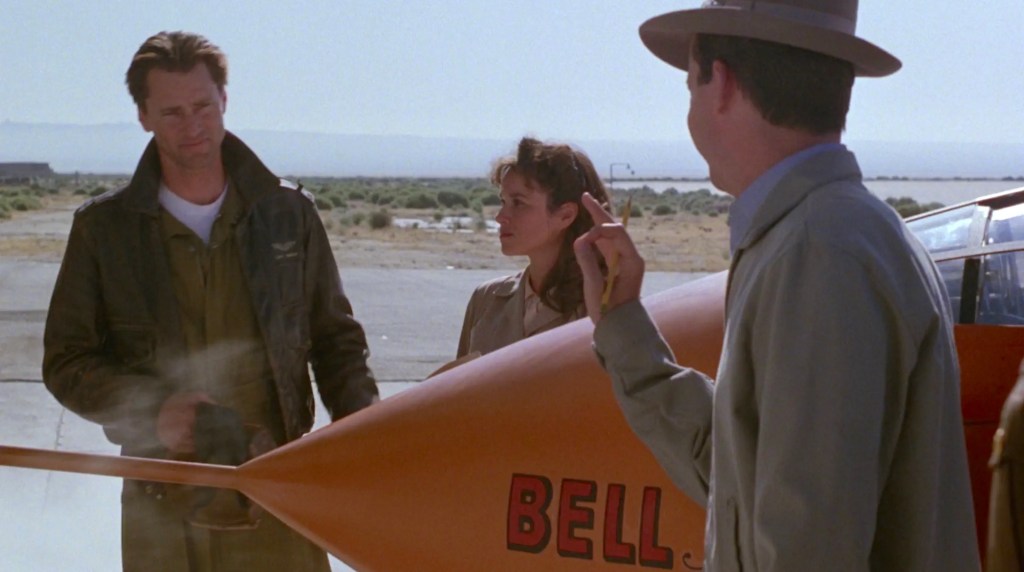
In a way they prove their spurs, even if Kaufman’s film makes clear none of them can match Yeager’s traditional values. The film ends with Yeager, maverick to the last, undertaking an unauthorised test flight in a desperate attempt to keep funding for his jet programme going. Even with this final flight – dressed in a bastardised version of a space suit – Yeager shows he’s not lost it, a man so undeniably superhuman in his American resilience that even a bit of fire won’t slow him down.

The Right Stuff celebrates Yeager, but he’s the B-story – and the film frames him as a forgotten figure, left behind by a world obsessed with the bright and shiny. The Right Stuff has to centre the astronauts but it doesn’t focus on the missions (which, apart from Glenn’s, barely receive any screen time – certainly not compared to the time given to Yeager’s flights) or the glory, only quietly implies there was a slight air of pointlessness about the whole thing – that the space race was perhaps just a dick-waggling competition between superpowers. It makes for interesting – if overlong – viewing, but as punch-the-air entertainment, no sir. No wonder it bombed.

Escape from Alcatraz (1979)

Escape from Alcatraz (1979)

Siegel’s quietly observed prison break drama masters the small details

Director: Don Siegel

Cast: Clint Eastwood (Frank Morris), Patrick McGoohan (The Warden), Fred Ward (John Anglin), Jack Thibeau (Clarence Anglin), Larry Hankin (Charley Butts), Frank Ronzio (Litmus), Roberts Blossom (Chester “Doc” Dalton), Paul Benjamin (English), Bruce M Fischer (Wolf Grace)

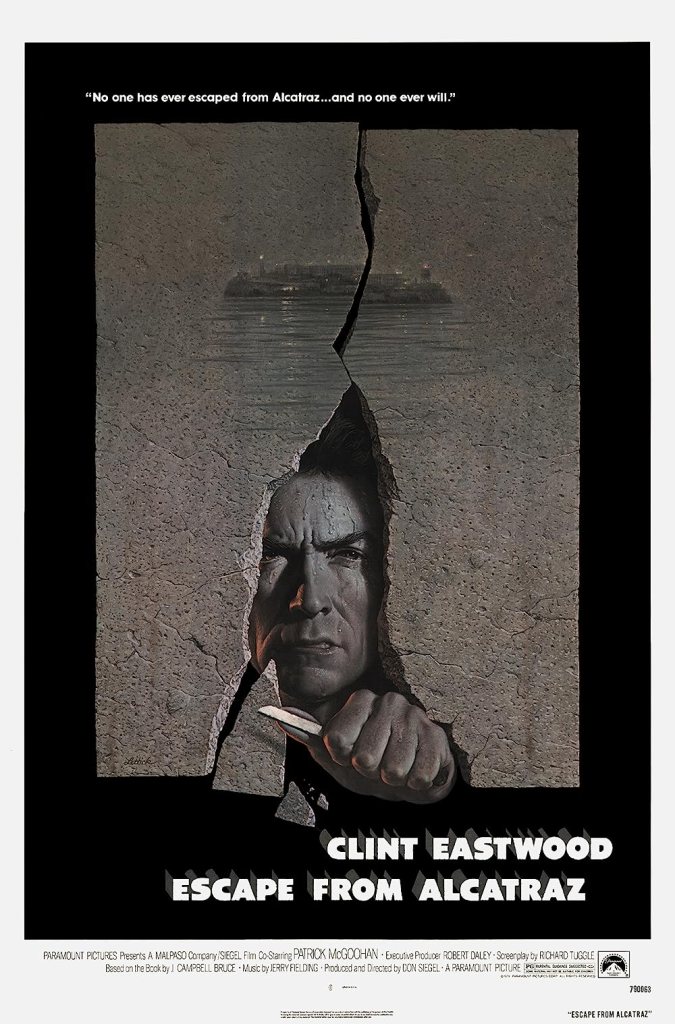
In 1962, three men dug their way out of the cells in Alcatraz, climbed into a raft made of raincoats and sailed into San Francisco Bay and mystery. Not a trace was ever seen again of Frank Morris (Clint Eastwood), John Anglin (Fred Ward) or Clarence Anglin (Jack Thibeau), but their story became a cause celebre. Some say they disappeared to South America – many more believe they drowned in the freezing cold water of the Bay. Siegel’s film covers the details of the escape attempt – and leaves more than a hint that they escaped.

Escape from Alcatraz is a quintessential prison movie. It’s got the complete genre checklist: sadistic wardens, bullying in the courtyard, the threat of rape in the showers, solitary confinement, boring routines and jobs, unfair access to privileges, cagey alliances, the little details of a plan coming together, hair’s-breadth escapes from being caught and a “we go now or not at all” climax. It’s all mounted extremely well by Siegel, shot on location with such a searing coldness you can practically feel the chill the prisoners suffered all the time.

Alcatraz is made up of two things: quiet and time. Siegel’s film therefore delves into both of these things. From its opening montage detailing Morris’ arrival at the prison – on the boat, checking-in, cavity searches and tramping naked down to his cell – images and silence tell their own story. For the guards, words are formulaic and repetitive. Eastwood as Morris is barely ever out of shot but doesn’t speak for ten minutes. It’s the same for many other sequences, detailing prison life: quiet conversations in the yard, the pointless moves from place to place, the grinding procedure.

Time stretches without meaning in Alcatraz, so it’s no great sacrifice for Morris to work out that he can scratch away the brickwork around the drain in his cell and create a hole large enough to allow him to get to the unguarded ventilation corridors on the other side. (He works out it connects – eventually – to the outside by observing a cockroach crawl out of his cell.) Morris then reckons he’s got nothing better to do than to scratch away at that wall with a stolen nail pick, a labour that will take him months to extend the hole to something he can climb through.

Siegel also makes a great deal of this through his long-earned knowledge of how best to work with his star. This is one of Eastwood’s finest performances, a slate of determined, dry-witted stillness that communicates great thoughtfulness and ingenuity behind a stoic exterior. Morris maybe a compulsive thief, but he’s no fool – and he doesn’t suffer them either. He’s contemptuous of the self-importance of many of the warden and unrelenting in his determination to use whatever he can lay his hands on to help facilitate his escape attempt.

You’d be desperate to escape from Alcatraz too. Grim, very cold and crowded with bullies like Wolf (Bruce M Fischer), a puffed-up psychopath looking for a new punk (though as Quentin Tarantino said in a recent book, no one alive would look at Clint Eastwood and believe he’d be an easy shower victim). Meals are vile and the punishment of solitary is beyond tough: pitch black cells, only interrupted by the door being flung open so a high-pressure hose can ‘shower’ you with cold water (even Morris is reduced to something close to trembling wreck after a month of this treatment in the hole). It all leads into his determination to use anything he can to get out.

Siegel’s film loves the tiny details of small, inconsequential items converted into the means to escape. Unwanted magazines from the library become papier-mache to craft dummy heads to disguise the gang’s absence from their beds while they make preparations the other side of their wall. An accordion case smuggles goods around the prison. Makeshift candles are assembled. A set of portrait paints are used to paint the dummies and create a cardboard fake wall to place over the newly created hole. We see the painstaking effort to assemble enough coats to create their life-raft, the puzzling out of what is needed to get them from the ventilation roof to the other side.

Escape from Alcatraz presents these Herculean labours with simplicity but a patient eye for detail that makes them become strangely noble and hugely tense. You put aside your knowledge that these are hardened criminals – the film does everything it can to downplay their offences – and instead focus on them as victims of an unjust system, with “the man” crushing any hope from them.

As such, Patrick McGoohan has a huge amount of fun in a lip-smacking role as the prison warden. (It’s fun to see the world’s most famous Prisoner as the man handing out the numbers.) McGoohan’s unnamed warden has everything the men have not – not least words. He’s not starved by silence, but pontificates at pompous length about his theories of incarceration and the inevitable pointlessness of rehabilitation. Just to make sure our sympathy for the prisoners is complete, he’s also a vindictive bully, stripping prisoner “Doc” (Roberts Blossom) of his painting privileges because he doesn’t like a portrait made of him (tipping Doc into depressive self-harm), then provoking old-timer Litmus (Frank Ronzio) into a risky physical altercation. He’s unjust, unfair and mean.

So when he says at the end that he’s certain the prisoners died, of course we don’t want to believe him. Not least since we’ve been with the prisoners every minute of their desperate throw of the dice. In real life, they almost certainly froze to death in the Bay, their raft not being strong enough to help them complete the mile long swim before the icy water paralyzed them. But Escape from Alcatraz makes you want to believe they could have got away.

The Player (1992)

Tim Robbins is the ultimate heartless Hollywood exec in Altman’s vicious satire The Player

Director: Robert Altman

Cast: Tim Robbins (Griffin Mill), Greta Scacchi (June Gudmundsdottir), Fred Ward (Walter Stuckel), Whoopi Goldberg (Detective Susan Avery), Peter Gallagher (Larry Levy), Brion James (Joel Levison), Cynthia Stevenson (Bonnie Sherow), Vincent D’Onofrio (David Kahane), Dean Stockwell (Andy Sivella), Richard E. Grant (Tom Oakley), Sydney Pollack (Dick Mellon), Lyle Lovett (Detective Paul DeLongpre), Gina Gershon (Whitney Gersh), Jeremy Piven (Steve Reeves)

Hollywood: it’s a hell of a place. Sharks ain’t got nothing on studio power-brokers, hunting product to sell. After all, not a single letter of “Art” appears in “Hollywood”. Griffin Mill (Tim Robbins) hears 50,000 pitches a year and gives the green light to ten or twelve. Mill is plagued with death threats. Confronting the writer (Vincent D’Onofrio) he believes responsible, he kills him in a fight. Can he get away with murder and successfully romance the writer’s artist girlfriend June (Greta Scacchi)? And, even more importantly, can he protect his job from hotshot executive Larry Levy (Peter Gallagher)?

Robert Altman had been working outside of the studios for well over two decades after negative experiences creating his critically acclaimed but hard-to-digest masterpieces (including McCabe and Mrs Miller and The Long Goodbye, the sort of films only Altman could make). His career had drifted during the 1980s, as his edgy, ‘disciplined ill-discipline’ approach (with overlapping sound and roving cameras) moved out of fashion. The Player was not only his payback expose on the studio system, with the exec a sociopath, but also his triumphant comeback to the frontline of film-making (he earned several awards, including a nomination for Best Director).

The Player is nominally a comedy, but in the way of Altman it also fits half a dozen other labels: from film noir to corporate satire. Above all it’s a maverick’s view of a system designed to produce product (Mill constantly speak of his films like this – he would love our modern age of “content”). The studio’s offices are lined with posters from classic Hollywood – but the studio produces the most crowd-pleasing cookie cutter movies you can imagine. It’s all about squeezing in all the ideal elements a film must have: “Suspense, laughter, violence. Hope, heart, nudity, sex. Happy endings. Mainly happy endings.” (In a neat subversive twist, these are of course all present in The Player – but then it’s to be expected when what we are seeing might actually be a film within a film).

Film pitches all have an air of desperation, every idea boiled down to simple, easily digestible slogans. It’s nearly always a combination of two other films – “Out of Africa meets Pretty Woman!” – or involves the biggest stars (“Julia” and “Bruce” were those two stars – and both actors hilariously spoof themselves in the film’s climactic sequence). Ahead of its time, the film even features a pitch (from a cameoing Buck Henry) for The Graduate 2, a nostalgia tinted exploitation of the IP with all the original cast, that basically sounds like the sort of thing they’d actually make today.

There is no place for film-making as an art – any idea that can’t be compressed into 30 seconds is worthless. Mill’s knowledge of film is patchy at best, his attempt to make small talk about Bicycle Thieves boiling down to “Perhaps we should remake it?”. The film (possibly the film within a film within a film), Habeas Corpus, pitched by Richard E Grant’s pretentious writer (“No stars! No pat Hollywood endings!”) is only attractive because it has the wisp of Oscar about it (and Oscars mean Big Bucks). Even then, Mill plans to rework the whole film into exactly the sort of pat-Hollywood romantic thriller Grant’s character claims to hate (no character will support this decision more than Grant’s sellout writer). The only person who seems to actually watch films is Fred Ward’s studio head-of-security – and at least half of his references are met with blank incomprehension. When Griffin makes a speech donating the studio’s old films to a cultural library, his words about art and culture are incredibly hollow.

This vicious satire of the shallow culture of Hollywood – Larry Levy’s up and coming executive attends AA solely to network, not because he has a drink problem – is wrapped up in a beautiful noir framework, that’s brilliantly a few degrees off reality (for reasons that later become clear). Deluged by death threats from (he surmises) a disgruntled writer, Griffin meets the man he suspects – a pretentious holier-than-thou wannabe, played with chippy fury by Vincent D’Onofrio – who he beats to death in a neon-lit carpark, after a dig too far about Mill’s job security (as nothing threatens these guys more than the prospect of being drummed out of town).

Altman’s film wonderfully echoes the neon lit shadows of classic noir, while building a homage filled trap around Mill, desperate to escape punishment. Mill of course has killed the wrong man – and his stalker knows it – and his own heartless-but-effortlessly-cool business dealings are contrasted with his efforts to avoid the dogged pursuit of a police department (led, in a curious but just-about-effective piece of casting, by Whoopi Goldberg) correctly convinced he is guilty. The film asks, how much does morality intrude on Mill, when he’s led his whole life trampling people: isn’t literally killing someone only the next step up from all that metaphorical killing he’s been doing?

His one weakness is falling in love with his victim’s girlfriend, an artist played with a breezy sexiness by Greta Scacchi. Scacchi’s June is intriguingly unknowable – how much does she suspect Mill, and how much does she even care? – and the dance of seduction and suspicion between them is highly effective, culminating in a tastefully, imaginatively but highly sensually shot sex scene (built from Scacchi’s refusal to do a nude scene – instead the nudity comes from a full frontal of Robbins emerging from a mud bath).

Scacchi’s June feels like halfway between a real person and a movie construct – and that’s a deliberate effect in a film which, the ending suggests, may well have been a movie within a movie. Mill takes a pitch in the final moments from his actual blackmailer, who outlines the very film we have been watching, a pitch Mill accepts on condition the film (he?) gets a happy ending: cue Mill arriving home to June and the two of them using the same pat Hollywood pay-off lines to greet each other, we just saw Bruce Willis and Julia Roberts mouth in Mill’s happy-ending for Habeas Corpus. Apply the logic of a film to all the action and it suddenly makes sense on a whole new level, as a beautifully judged exploration of the very crowd-pleasing elements Mills praises, repackaged in a sharp and bitter satire.

Tim Robbins performance of restrained amorality is vital to the film’s success. In his career, any weakness is deadly – a mantra he applies to his interactions with the police and with June. Mill is so eerily controlled – fear is the only emotion he categorically shows, guilt never crosses his mind – you start to wonder if he even has a real personality. But, in the movie’s structure, he’s both a real person and also a construct whose life echoes scenes from the movies whose posters fill his office.

Altman balances these ideas of truth and reality perfectly within the studio satire. The film is astonishingly well-made, all Altman’s trademarks of overlapping dialogue and roving camera present and correct. It opens with a hugely confident seven-minute tracking shot around the studio, which feels like a real “I’m back!” statement – and is beautifully and wittily done. The film is crammed with dozens of celebrities playing themselves (they were given no dialogue and encouraged to improvise scenes), all of them keen to show they were in on the joke.

The Player is dark, witty and very clever, one of Altman’s sharpest and most enjoyable films. Crammed with echoes of film noir and a brutal expose of Hollywood business practice, it’s very well performed and keeps just enough lightness and humanity (it encourages to empathise, but not sympathise, with Mill, for all his amorality) to also be entertaining. One of the great films about Hollywood.