
Iconic monster film, dark expressionist nightmare that totally reinvented the novel’s public image
Director: James Whale
Cast: Colin Clive (Henry Frankenstein), Mae Clarke (Elizabeth Lavenza), John Boles (Victor Moritz), Boris Karloff (The Monster), Edward van Sloan (Dr Waldman), Frederick Kerr (Baron Frankenstein), Dwight Frye (Fritz), Lionel Belmore (The Burgomaster), Marilyn Harris (Maria)

Has any film shaped the popular idea of a book more than Frankenstein? Ask anyone to describe the monster or the book itself, and you’ll not have to wait too long until you start to hear about bolts in the neck, thunder-struck gothic castles, hunchbacked assistants and labs stuffed with bizarre electrical equipment. Of course, none of that is actually in Mary Shelley’s The Post Modern Prometheus. But it is a key part of James Whale’s creative vision in this Hollywood hit. In fact, so much of a hit that it and its army of sequels led to whole generations convinced Frankenstein was the name of the monster, not his creator.
Frankenstein in fact bears almost no similarity to the original novel at all, checking off a few plot points and duplicating some character names. Other than that, it’s very much its own thing, a big expressionistic nightmare, with everything dialled up as high as those lightening-catching electrical machines can cope with. Henry Frankenstein (Colin Clive) – you’ll note the film even changes his name to the more relatable Henry, with Victor given to his dull-as-dish-water pal Moritz (John Boles) – won’t settle down and marry fiancée Elizabeth (Mae Clarke). Instead, he dreams of creating life, to become like God! And to follow that dream, he’ll dig up bodies, steal laboratory brain specimens from his mentor Dr Waldmann (Edward van Sloan) and stitch them together into a creature (Boris Karloff). But then misunderstandings and ill treatment leads to a series of terrible events.
James Whale’s film is a triumph of atmosphere; its images and visual creativity so haunting it’s not a surprise it effectively overwhelmed the novel. Inspired by German expressionist cinema – you can see the fingerprints of Cabinet of Dr Caligari and Fritz Lang all over it – Whale sets this monster tale in a world of towering, angular buildings, looming shadows and vast steampunk (long before it came into fashion) labs in damp-lined medieval castles. There is a strange timeless quality to Frankenstein: it opens with a shadow-laden graveyard dug up by Henry and his assistant Fritz (Dwight Frye), but the village feels like it is set in almost any time from the late nineteenth to early twentieth century (the costumes in particular are a real hodgepodge). Perhaps this was part of Whale’s intention, to create a timeless metaphor for man’s reach exceeding what’s sensible, to disastrous consequences?
It’s also interesting that, for all the warning of the terrors to come the film opens with from Edward van Sloan (who also portrays Waldmann), we actually end up siding with the creature. A lot of this is due to Boris Karloff’s excellent performance. Without a word of dialogue, Karloff makes this lumbering result of stitched together bits and pieces, into something vulnerable, frightened and child-like, whose violent acts only emerge from tragic misunderstandings or gross provocations. Karloff’s physicality is frequently gentle and timid, the few strangled sounds he makes sound almost scared, and his awkward stumbling resembles a deadly, confused toddler. He needs parenting, not chasing down by a mob.
The film’s key moment is Frankenstein introducing the creature to the daylight – the camera following those towering vertical lines of the set up to into a skylight, with the enchanted creature reaching his arms up to try and touch this magic ball of light. Then Frankenstein smugly slaps it shut and Fritz shoves a torch into the poor creature’s face. The monster may be introduced with all the elements of dread – Whale’s classic introduction a series of striking cuts that pull us closer and closer to the reveal of his restitched head – but it doesn’t take long before you feel really sorry for it. Even if it does have a ‘criminal mind’ stitched into it (a development so out of tone with the treatment of the monster, it feels like a fig leaf to reassure the producers it must be the baddie).

Not least because Frankenstein himself is hardly that sympathetic. Colin Clive – a long-term collaborator with Whale – grabs this larger-than-life part and runs with it, oscillating from scenery-chewing self-aggrandizement (his celebratory screaming has rightly passed into cinematic legend) to self-pitying excuses. It’s telling he never takes a jot of responsibility for either creating the monster, or for his inattention and poor treatment of it directly causing the tragedy it unleashes. Unlike his book counterpart, his arrogance requires witnesses – Elizabeth, Victor and Waldmann – to his experiments, entirely due to his arrogant fury at Waldmann’s questioning his sanity. His first solution, as soon as the creature becomes challenging, is to euthanise it and he never confesses to the lynch mob that take on the creature in the film’s final act that he is its creator.
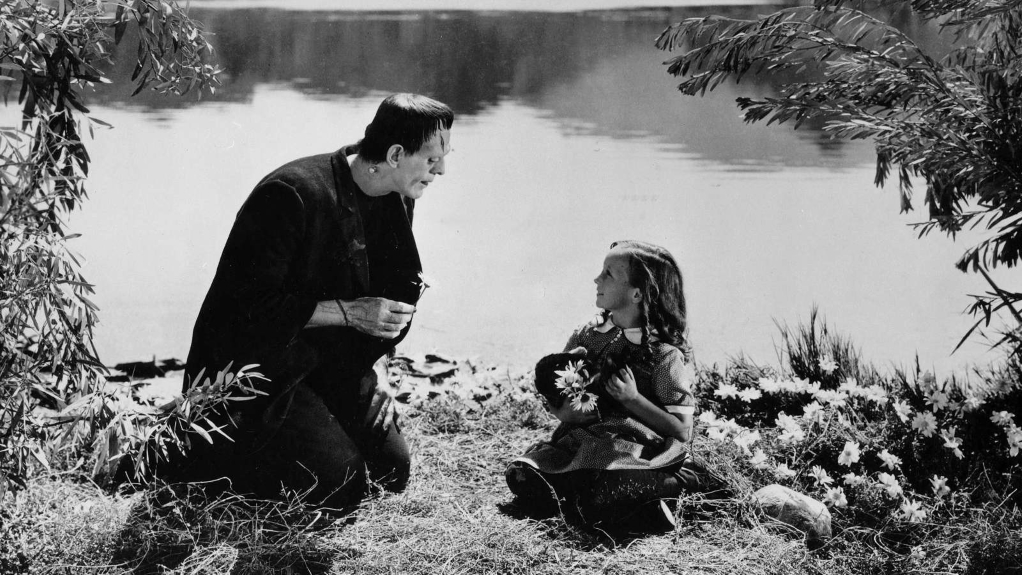
The lynch mob is responding to the creature’s accidental drowning of a small girl. Again, this killing stems from a misunderstanding. Young Marie – the only person in the film who doesn’t react with horror when she sees the creature, suggesting she instead sees a kindred spirit – invites the delighted creature to join her in a game, tossing flowers into the river. Clapping his hands in delight, the creature joins in for a scene directed with bucolic beauty by Whale – right up until the flowers run out and the creature tosses Marie in instead, only to find she doesn’t float artistically.
As the creature flees in confused panic, Whale cuts to the raucous wedding celebrations in the Frankenstein village, which comes to a crashing close as Marie’s father walks with her body through the crowd, that turns from joy to shock around him. It’s one of several striking moments of fluidic camera work in Frankenstein, Whale employing a tracking shot that follows and partially rotates around the father, while keeping him tightly central in the frame as he walks through the crowds. There are similar moments of dynamic camerawork throughout the film, Whale using every opportunity to make this gothic nightmare world as immersive as possible.
The hyper reality of Frankenstein means it doesn’t really matter that much of the skylines are all too clearly cloth (I like to think Whale deliberately kept the multiple points where the cloth has bunched up in shot to stress the artificiality), since everything about this is dialled up to eleven, from performances, to setting to the grandly staged windmill-finale, hugely impressive in its flame-licked excitement. In fact, it’s all so overblown and gothic, in its set design, shooting and performance that the most grounded, human thing in it is Karloff’s beautifully played creature himself. That feels like no accident and makes Frankenstein a surprisingly subversive film. And also perhaps, even though it strips the creature of much that makes him a character in the novel, made him a modern icon.
 Movie Musings