
Whale’s sequel is a masterclass in how more can sometimes be more, a delightful black-comedy
Director: James Whale
Cast: Boris Karloff (Frankenstein’s monster), Colin Clive (Baron Henry Frankenstein), Valerie Hobson (Elizabeth Frankenstein), Ernest Thesiger (Dr Pretorius), Elsa Lanchester (Mary Shelley/The Bride), OP Heggie (Hermit), Gavin Gordon (Lord Bryon), Douglas Walton (Percy Shelley), Una O’Connor (Minnie), EE Clive (The Burgomaster), Dwight Frye (Karl), Ted Billings (Ludwig), Reginald Barlow (Hans)
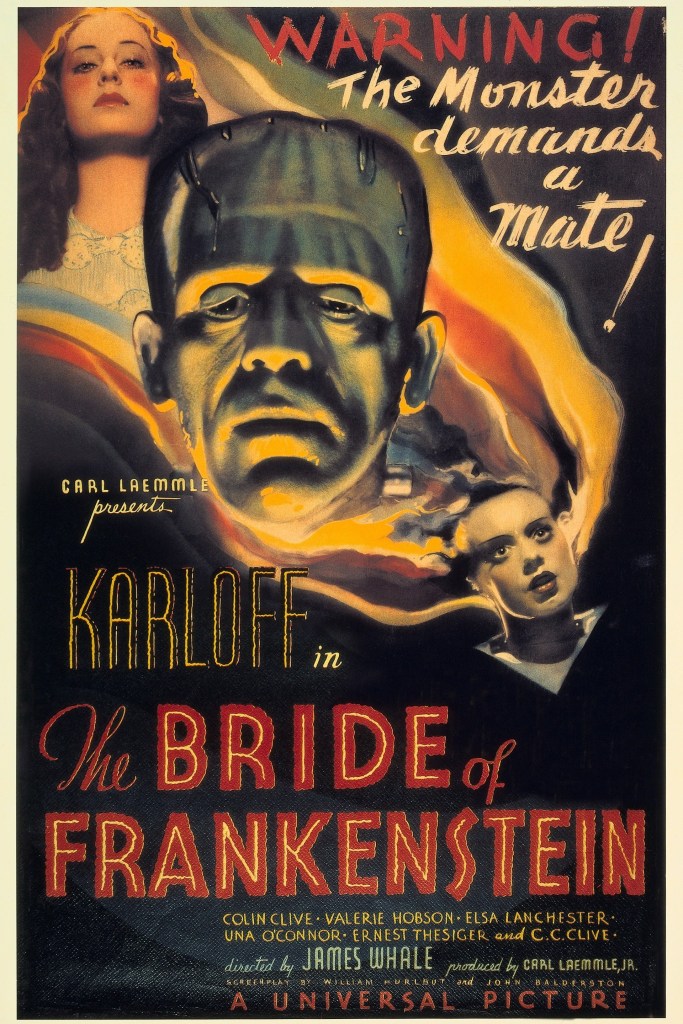
What does every studio want after a mega hit? A sequel of course! Directors are never more powerful then when studios will let them do pretty much whatever they want so long as they get another shot at capturing body-sparking lightening in a bottle one more time. James Whale and gang came back for Bride of Frankenstein and produced a classic, more entertaining than the first film, a barmy, balls-to-the-wall piece of nonsense where logic is thrown out, sly jokes abound and the meter is dialled well up to camp. Bride of Frankenstein is exactly the “memorable hoot” Whale wanted to make, and proof that perhaps he had not “drained the well” after all.
Bride of Frankenstein kicks off pretty much where Frankenstein left off – requiring some fast thinking since the creature (Boris Karloff) ended that film incinerated in a burning windmill. Turns out he actually hid in the water-logged basement, emerging to stumble into violence from villagers terrified at this bolt-necked giant’s existence. Meanwhile, a chastened Henry Frankenstein (Colin Clive) swears he’s out of the reanimation game… only to be dragged back in by his old mentor (presumably a different one to the first film’s Waldmann) the creepy Dr Pretorius (Ernest Thesiger). Pretorius has been experimenting with creating life, and he wants a whole race of these people – so he’ll need a bride for the creature, to get that ball rolling. While the creature fights and flies, Pretorius and Frankenstein fire up the generator and get ready to stitch.
There is more than a little bit of black humour to Bride of Frankenstein, a film Whale clearly never intended to be taken seriously. It’s combined with more than a touch of camp and sprinklings of the absurd with general utter indifference to any rules of time, setting or location. Whale’s gothic world is whatever and whenever he needs it to be at any point. If that means the creature is chucked in a medieval cell one minute and Dr Pretorius is using a telephone to call his underlings the next, that’s fine. Logic is already all over the place, since it opens with Mary Shelley, her husband Percy and Bryon in full period costume recapping the first movie, despite that film being littered with no-end of what would be to them unimaginable technical possibilities.
Whale buttresses his fantasia on Frankenstein by pruning out, probably, the last couple of elements of the book he liked but hadn’t used: the creature’s ability to speak, it’s time out at the secluded hut of a blind man and (of course) the concept of a bride being resurrected. But then Whale also pours all his love into Ernest Thesiger’s sinister and delightfully eccentric Dr Pretorius, the sort of larger-than-life character who leaves all reality behind. Thesiger has a whale of the time, sucking on the sarcastic dialogue like a lemon and delighting in playing the sort of amoral mad man (he even makes Frankenstein look sane) who brings a picnic to a grave-robbing and uses a tomb as a table.
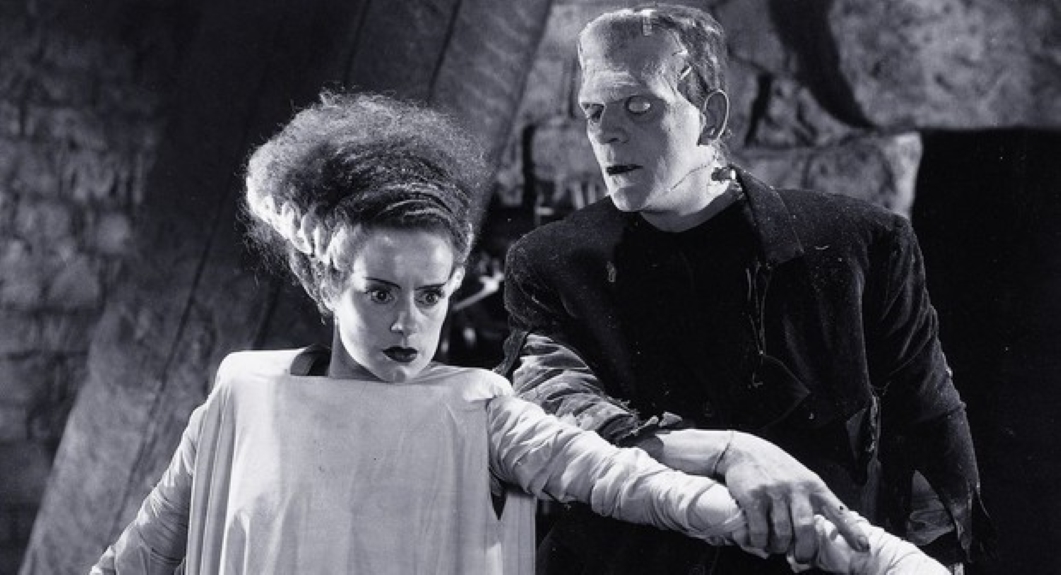
Pretorius’ swiftly brow-beats Frankenstein into saddling back up. Colin Clive – who broke his leg shortly before filming, requiring him to do nearly all his scenes sitting down – is surprisingly restrained, with the old madness only coming to the fore in the Bride’s birthing scene. That birthing scene is a brilliant expansion of the first film, Whale using the increased budget to expert effect to take us up onto the roof of the laboratory, expanding the detail shown of the mechanics of the experiment (Whale uses Dutch angles to dial up the general air of creepy weirdness and clearly was inspired by Metropolis) and launching a creation even odder than the original. As before the design work is exquisite: the Bride – wonderfully played with a ear-piercing screech (based on the swans near her London home) by Elsa Lanchester, her white high-lit hair a masterpiece of memorable, blackly-comic imagery. The Bride makes such a lasting impression, it’s a shock to realise she’s in it for less than five minutes.
Did Whale intend anything to be taken seriously? He tips the wink with Una O’Connor’s opinion-dividing performance of shrieking, Oirish panic as the villager who discovers the surviving creature. Pretorius is introduced showcasing his collection of miniature living people in jars (a bishop, a devil, a mermaid, a queen and a randy Charles Laughton-channelling Henry VIII) the sort of head-turningly bizarre scene that leaves you both delighted and shaking your head in amazement. There is something hilariously odd about the creature being introduced to those human vices, smoking and drinking. Whale was surely chortling to himself at the thought of the creature contentedly blowing smoke circles with the blind hermit or eagerly knocking back a glass with Pretorius.

It’s remarkable that despite this strong leaning into comedy, Bride of Frankenstein still manages to find the humanity in the persecution of the monster. Chased down (once again) by a wild crowd, the creature is tied down to a pole and lifted up, his body unmistakenly in a crucifixion pose. The film’s emotional centrepiece is his sojourn with the blind hermit. It’s impossible not to see more than a touch of Whale’s experience of persecution for his homosexuality in the tender staging of these scenes, two men living contentedly together only to have their partnership condemned the moment the real world intrudes. The gentleness of these scenes becomes very affecting, not least since this is the first (and last) time the creature is treated like a person rather than a monster.
Karloff is, as before, excellent in the lead role – despite his worries about the creature’s mystery being sacrificed on the altar of his fumbling, toddler-like speech. He makes the creature, even more than before, someone reaching out for warmth and connection, disgusted at his own monstrous nature and whose delight at the idea of a bride is strangely touching. (Bride of Frankenstein – a title even name checked at one point by Pretorius – cemented the popular confusion about whether the creature or his creator is ‘Frankenstein’). It’s the monster who also emerges at the film’s conclusion as the closest thing we have to a moral force.
Really Bride of Frankenstein shouldn’t work as half as well as it does. It’s part horror, part black comedy, part farce with scenes that shift from tragedy to knock-about satire. But it’s superbly assembled by Whale – at the top of his game here – and barrels along at such speed (sustained by superb performances, in particular from Karloff, Lanchester and Thesiger creating a portrait of monstrously soft-spoken camp for the ages) and with such full-blooded commitment at every moment that the film never once sinks. It is such a gloriously entertaining, wildly committed piece of pulpy film-making that it’s hard to imagine it could have been done better. And it certainly was the last word in what to do with the monster on-screen, that saw him embrace fear, love, comedy and tragedy all in one go. He probably should have stayed with the dead.


 Movie Musings