
Tag: Gene Wilder

The Producers (1968)

The Producers (1968)

A funny gag sits at the heart of a film that’s more cheeky than really funny or clever

Director: Mel Brooks

Cast: Zero Mostel (Max Bialystock), Gene Wilder (Leo Bloom), Dick Shawn (Lorenzo St. DuBois (L.S.D.), Estelle Winwood (“Hold Me! Touch Me!”), Christopher Hewett (Roger De Bris), Kenneth Mars (Franz Liebkind), Lee Meredith (Ulla), Renée Taylor (Eva Braun), Andreas Voutsinas (Carmen Ghia)
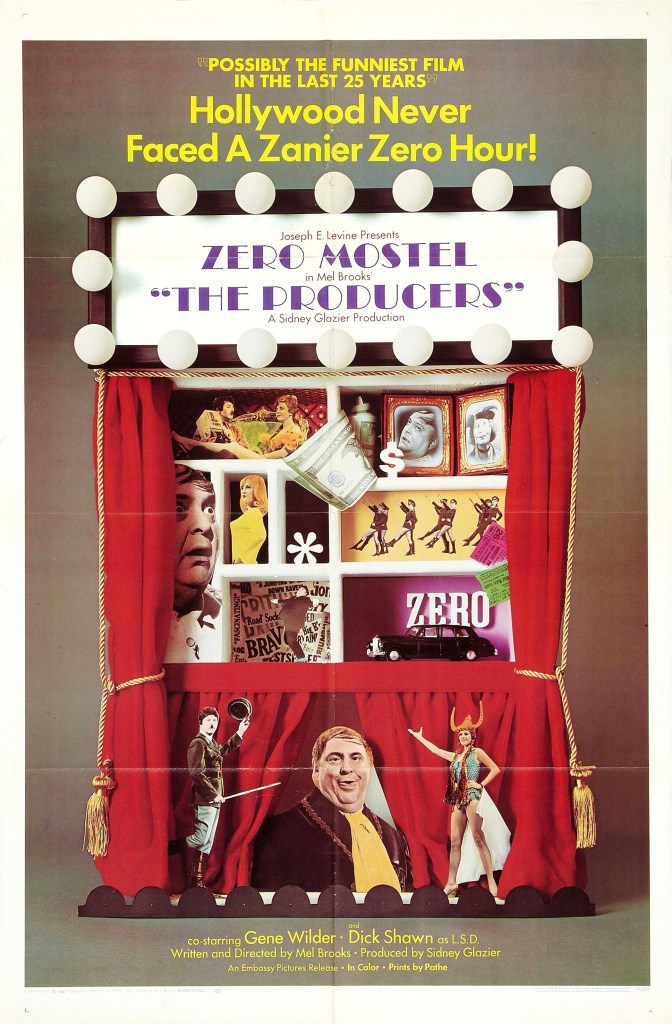
“Don’t be silly, be a smartie/Come and join the Nazi Party!” The cheek of a knockabout musical Hitler musical is the sort of stroke of genius only Mel Brooks might have come up with (and got away with). It’s the saving grace of The Producers, an otherwise rather pleased with itself, slight film whose cheeky gags look like they are taking a pop at sacred shibboleths but actually conform rather neatly with common (at the time) perceptions of women, homosexuals and randy old people. So much so, the film looks more braver and cheekier today when its relatively innocent sexism and homophobia comes across as cheeky tasteless fun rather than pretty much being par-for-the-course.

Max Bialystock (Zero Mostel) is the least successful producer on Broadway. But perhaps he can turn that to his advantage when neurotic accountant Leo Bloom (Gene Wilder) points out that overselling shares of a guaranteed flop can make way more money than a hit. They just need a play that will definitely bomb: what better choice than Springtime For Hitler, a ludicrous musical tribute to Hitler written by dim Nazi Franz Liebkind (Kenneth Mars). Just to make sure they get the bomb they need, the duo hire talentless camp director Roger de Bris (Christopher Hewett) and stoned hippie lead (Dick Shawn). What could possibly go wrong? Or, rather, right?

There is a wild comic zaniness to The Producers epitomised by Zero Mostel’s manic energy as Max, a sleazy, sweaty mass of greed and self-obsessed vanity, totally devoid of any sense of shame. The Producers gets away with a lot because, like Max, its utterly shameless and frankly doesn’t give a damn what you think. Whether you find it hilarious or not depends on how much you are taken by provocative humour and scattergun cheekiness. There is an end-of-the-pier quality at the heart of The Producers (in the UK it would have been Carry On Up Broadway). Brooks doesn’t miss an opportunity for smutty postcard humour. It’s all so naughty he gets away with the ridiculousness of a Hitler musical.

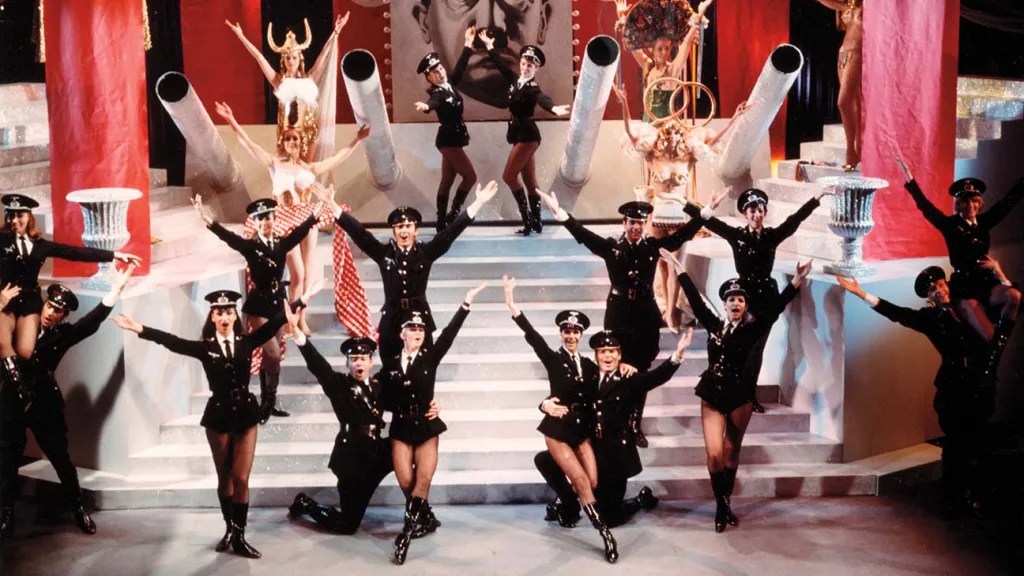
A Hitler musical that wisely satirises the Nazi’s Riefenstahl showmanship via ludicrous Broadway choreography (including tap dancing stormtroopers forming themselves into dancing swastikas). Of course, Brooks is clever enough to keep the actual content of the musical purely on a surface level (no talk about what the Nazis actually did beyond aggressive militarism) – combined with Hitler portrayed as a bumbling Hippie full of the streetwise slang of pony-tailed sixties counter-culture. At heart, Springtime For Hitler doesn’t really do anything really more shocking or provocative than put blackshirts into 42nd Street. It also carefully distances itself from the antisemitic elephant-in-the-room by having Bialystock and Bloom rip off the swastika armbands they agreed to wear while wooing Liebkind, throwing them in a bin and spitting on them. It’s a neat balance that allows the film to get away with as much as it does, while never touching the nightmareish darkness of the regime.
Of course, it helps that Brooks is one of Hollywood’s most famous Jews – and that Mostel and Wilder delight in leaning into a very Jewish comedy about a couple of shmucks enjoying being rogues. Wilder in particular is fantastic. While Mostel is at times be a bit much, Wilder’s hilarious snivelling childish timidity (he’s obsessed with a comfort blanket, the loss of which turns him into a mass of bleating despair) ‘blooms’ into the delight of an eternal good-boy finally allowed to be naughty. Wilder gets the balance just right between something larger-than-life and something real and when he talks about Bialystock being his first and only friend, it’s strangely moving.

Wilder, alongside the scenes taken from Springtime For Hitler, provides most of the humour. I’ll be brutally honest – I’ve never found much of the rest of The Producers funny. Nearly every other joke in the film relies on smut and cheek. Bialystock makes what money he does from pimping himself to randy octogenarians (never men obviously, that would be too risqué), and The Producers buys heavily into the idea that the sex lives of anyone over the age 60 is hilarious. It’s a cheap and rather repetitive joke, made over-and-over that Zero Mostel just about manages to sell because he embraces Bialystock’s utter lack of restraint. But it’s a one-note joke that outstays its welcome.

The Producers similarly makes rather obvious, one-note, jokes about all its female and gay characters. (Again, at the time much of this would not have been out-of-the-ordinary, so it actually looks more bizarrely more boundary pushing today). Ulla, Bialystock’s Swedish secretary, is a blonde sex-bomb whose recurring joke is her oblivious sexiness and willingness to burst into erotic dancing at the drop of a hat. She’s explicitly hired by Bialystock as a glamourous piece of eye candy ‘toy’ as a reward for his self-pimping and it’s not particularly funny. Also not particularly funny is the play’s director, a cross-dressing, mincing figure of camp satire played by Christopher Hewett, the main joke being he is a ridiculously overblown queer who wears a dress. Kenneth Mars’ Franz Liebkind – a ridiculous relic of the Reich, incompetent at pretty much everything he attempts – is slightly more amusing, if only because he’s utterly oblivious to his complete uselessness.

Brooks’ film is, you suddenly realise, rather slight. At around 80 minutes, it’s heavily reliant on its show-stopping glimpses of the Nazi musical (and even in that Dick Shawn’s Hipster swagger isn’t as funny as the Broadway parody) and aside from that relies on predictable farce, cheek and smut. Only Gene Wilder really transcends the material with a perfectly timed, strangely touching performance. Other than that, it feels like a film trying very, very hard to be a little bit-naughty, like an over-extended student revue sketch. But “Don’t be silly be a smartie/Come and join the Nazi party”? That is funny.
Bonnie and Clyde (1967)

Faye Dunaway and Warren Beatty are the shallow, violent romantics Bonnie and Clyde

Director: Arthur Penn

Cast: Warren Beatty (Clyde Barrow), Faye Dunaway (Bonnie Parker), Michael J Pollard (CW Moss), Gene Hackman (Buck Barrow), Estelle Parsons (Blanche Barrow), Denver Pyle (Marshal Frank Hamer), Dub Taylor (Ivan Moss), Gene Wilder (Eugene Grizzard), Evans Evans (Velma Davis)

Bonnie and Clyde can lay claim to being one of the most influential American films ever made. It came out of a seismic cultural change in America, as old style Hollywood royalty faded out and a new generation stormed the barricades to make films that felt rougher, rawer and told complex stories in shades of grey. 

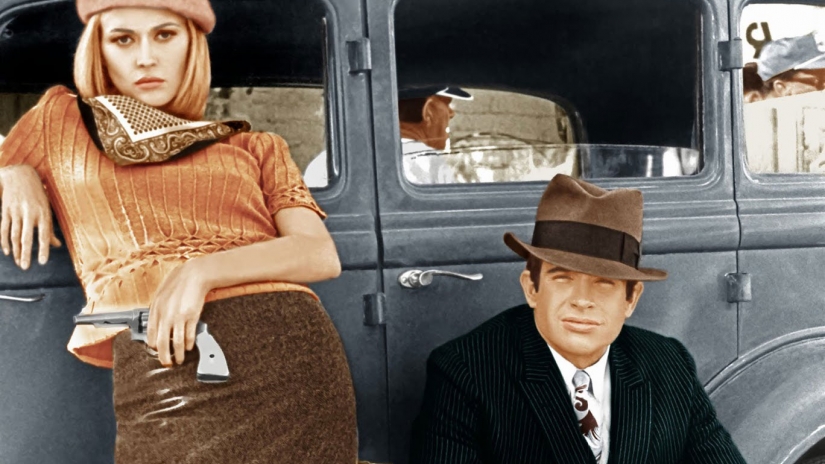
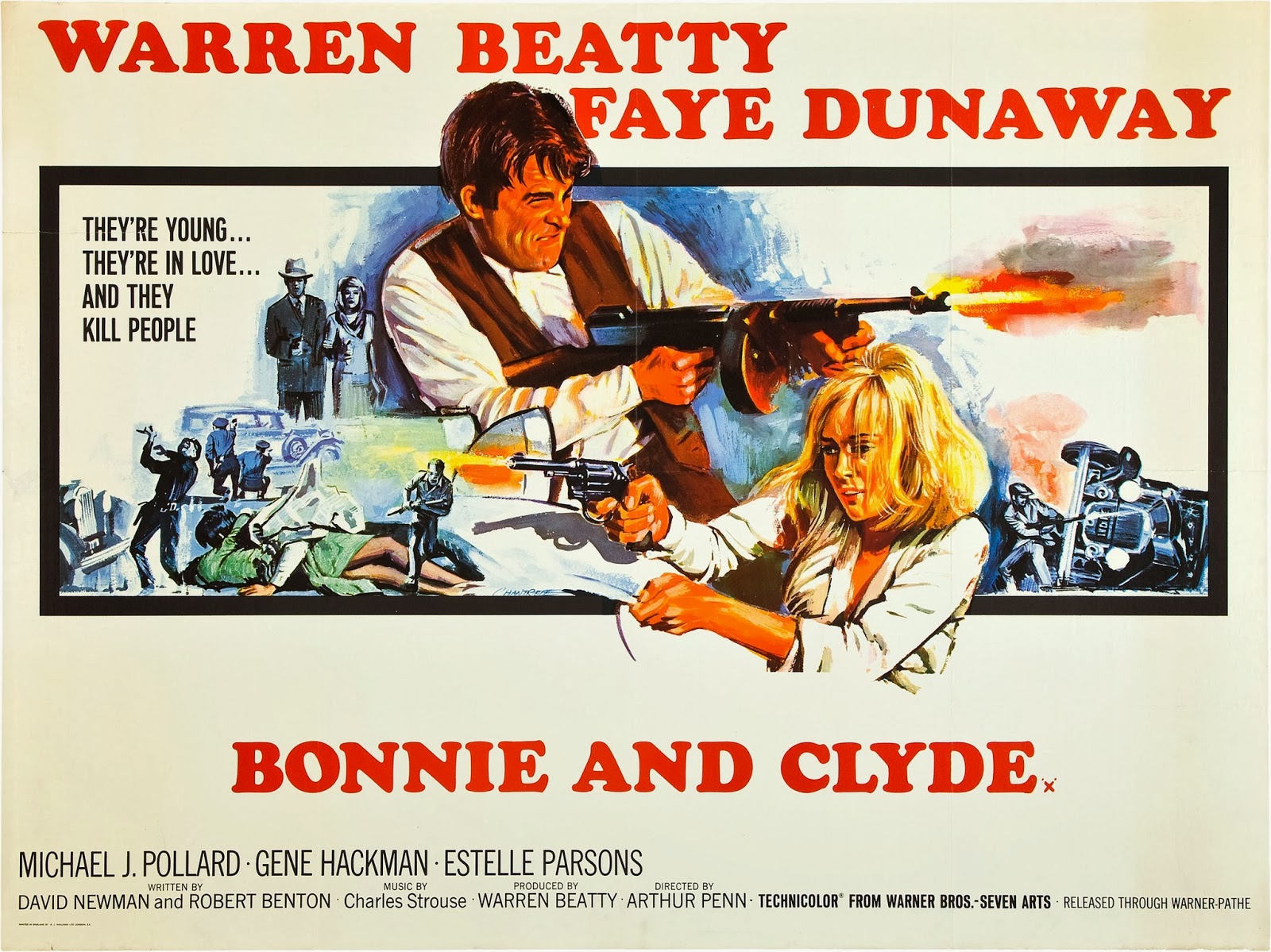
Clyde Barrow (Warren Beatty) and Bonnie Parker (Faye Dunaway): drifting youngsters, not interested in accepting a conventional life. They want to go where they please and take what they please. And if some people get hurt – well they can justify that to themselves. As the poster famously said: “They’re young. They’re in love. And they kill people”. In a deliberately disjointed narrative, where time is unclear, the two meet, head out together, commit crimes, stay on the run and are eventually killed by law enforcement. The story is simple – it’s the telling of it that matters.

Bonnie and Clyde latches on to a counter-culture vibe that was growing in strength at the time. But what the film does so brilliantly is subvert this. It invites us to identify to with the romantic, Byronic yearnings of its heroes, who see themselves as free spirits, living a life of idealistic, unconstrained excitement. But the film also has a clear eye on the trail of violence they leave behind them, their lack of regard for this and the impact on the victims. Because make no mistake, these dreamy killers get more and more violent as they go on.

The film turns these two killers into would-be celebrities – guys who want to project a certain image of themselves to the world (down to mailing the papers photos and poems about themselves). They enjoy the notoriety and their self-proclaimed mythology. Clyde walks into banks and gleefully announces he’s with the “Barrow gang”, as if half expecting someone to ask for his autograph. Later in the film, as Clyde reads their press coverage out loud, with CW Moss like a star-struck groupie, the film never forgets the two of them were basically nobodies, who wanted to feel like somebodies.

And it lets you enjoy the romance of this. There is something fairy-tale like in the film about Clyde picking up Bonnie from outside of her home, taking her into town for flirting and robbery. The whole film continues this dreamy logic, with time jumps and scenes that don’t necessarily link up directly with each other. 

But then the violence takes over. Wow is Bonnie and Clyde a film that lets you know about the impact of bullets. Gun shots don’t just maim or wing, they rip bodies apart. The japey feeling of their bank robberies gets dispelled about half an hour into the film when Clyde shoots a bank teller in the head from point blank range (“him or me”, he later tells his brother). The gang are so incompetent, that the film is frequently punctured by shoot-outs in which no mercy is shown to anyone. 

This is of course hard for the gang to reconcile with their self-image as Robin Hoods, so they mostly forget about it. Clyde won’t steal money from ordinary people (though he’ll happily steal cars, or beat a grocery store clerk into a coma). They playfully tease and taunt a captive US Marshal – until he spits in Bonnie’s face at which point violence ensues. Only at points do the gang seem to have the slightest idea of the dangers: after kidnapping Gene Wilder’s nervy car-owner and his fiancé, a happy-go-lucky Evan Evans (both excellent), merry conversations in the car with the gang are suddenly halted when Wilder admits he’s an undertaker – Bonnie immediately demands they are thrown out and the next shot is her weeping in a field. She doesn’t seem to understand the connection, but we can.

The film is superbly put together. Warren Beatty produced the movie practically from its inception. Robert Benton and David Newman’s script was intended as a French New Wave film – evident in its looseness, its lack of old-school values, its violence, its focus on naïve dreamers who choose the easy way out – but Beatty took the script, re-crafted it with Robert Towne (billed as special advisor) and decided the film needed an American director, not a Truffaut or Godard. He brought on board Arthur Penn, and the two worked together (fought together) closely to bring this radical, edgy, jittery, electric film to the screen. 

Penn and Beatty pushed themselves to some of their best work. Beatty is terrific as the vainglorious Clyde – whose determination in crime is matched by his impotence in the sack (the film wisely doesn’t overplay Clyde’s impotence as an ironic theme, but lets the audience draw its own conclusions). He also produced the film expertly. Penn’s direction is sublime, marrying the finest elements of French New Wave cinema with old-style Westerns.

The film is restless and energetic, and intermixes moments of fun and frivolity among the gang with ominous danger and violence. The camera jitters and shakes, while throwing us into the action – the film is masterfully edited – while at other points sailing on like a neutral observer. The film has a neat satiric edge, and Penn uses banjo music masterfully to ironically contrast with much of the action we see on the screen. The characters – all of them – seem to spend so much time talking about their press coverage because they have so little to say to each other. Even the lovers only really seem to find a moment of quiet devotion shortly before their death. It give you violence as entertainment, but also tells you effectively and quietly how appalling and dangerous violence is.

The acting is similarly extraordinary. Beatty is wonderful, as is Dunaway as an impossibly young, romantic Bonnie who adapts with alarming swiftness to killing and robbing. Michael J Pollard is excellent as the slightly simple, eager young car mechanic who hero-worships the couple. Hackman and Parsons are both excellent as Barrow’s older-but-not-wiser brother, and his wife who seesaws between resentment, fear and an imperious delight in her new-found infamy.

Penn’s brilliant film deconstructs the mythology of criminals to show the emptiness underneath, their shallow self-regard and lack of insight. It does this while still managing somehow to remain affectionate towards these two murderous dreamers. Bonnie and Clyde is a sublime modern Western, a commentary on fame, a dissection of violence and a great black comedy. Shot with youthful energy and an influential lack of traditionalism, it’s a film that always feels modern and necessary.