
Tag: Geneviève Bujold

Murder by Decree (1979)

Murder by Decree (1979)

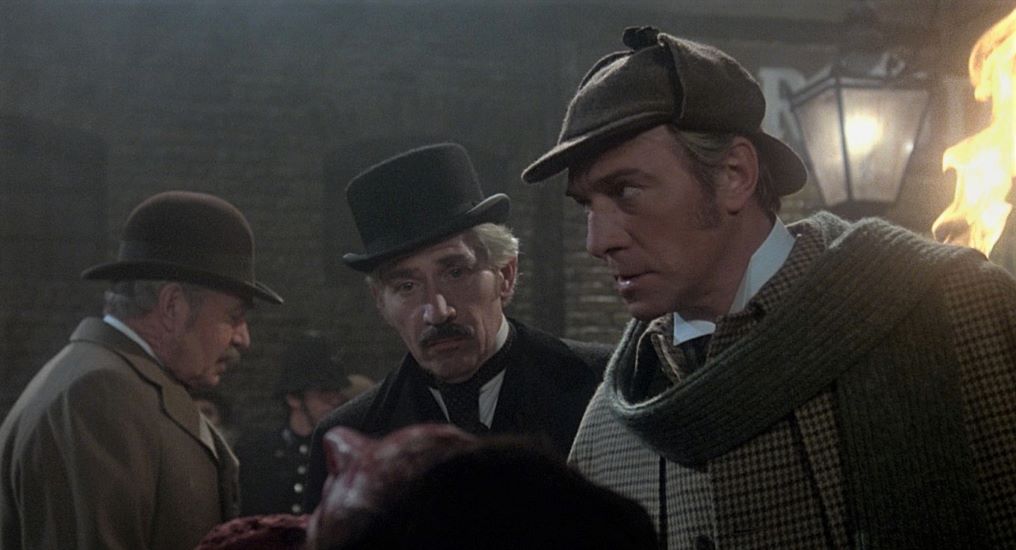
Sherlock Holmes investigates Jack the Ripper in this overlong but enjoyable Doyle pastiche

Director: Bob Clark

Cast: Christopher Plummer (Sherlock Holmes), James Mason (Dr John Watson), David Hemmings (Inspector Foxborough), Susan Clark (Mark Kelly), Frank Finlay (Inspector Lestrade), Anthony Quayle (Sir Charles Warren), Donald Sutherland (Robert Lees), Geneviève Bujold (Annie Crook), John Gielgud (Lord Salisbury)

In the world of Sherlock Holmes pastiches, it’s a popular sub-genre: Sherlock Holmes vs Jack the Ripper. How would Holmes have taken on the murderer who has baffled generations since those brutal Whitechapel killings in 1889? Murder by Decree explores the idea, mixing Conan Doyle with a deep dive into (at the time) the most popular theory in Ripperology, the Royal Killings (Murder by Decree indeed!).

It’s all pulled together into a decent, if over-long, film, shot with sepia-toned stolid earnestness by Bob Clark. With its fog-ridden Whitechapel sets (carefully built but always strangely empty), heavy-duty actors sporting large sideburns, wavy-screen flashbacks and carefully unimaginative framing, there is something very old-fashioned about Murder by Decree. That also extends to its Ripper theory, steeped in a very 70s class-conscious conspiracy. The film pads out its two-hour run time with many a POV shot of the Ripper prowling the streets, which bring to mind Jaws and slasher horror films of the time.

Where Murder by Decree does stand out is in its imaginative characterisation of Holmes and Watson. They are presented as affectionate friends – Mason’s older Watson has a sweet indulgent elder-brother feeling to him, giving Plummer’s sparkly Holmes plenty to tease and bounce off. They split the casework between them – Watson is an equal partner, even if Holmes does the brainwork – and use their strengths to complement each other (notably, Watson frequently distracts people so Holmes can interrogate a witness more closely). They genuinely feel like long-term friends (there is a delightful sequence where Holmes is so distracted by Watson’s attempt to fork a pea, that he squashes it onto the fork – to be met with a forlorn “you’ve squashed my pea” from Watson, who likes the peas intact so they “pop in my mouth”).

They are dropped into the middle of a very much of-its-time Ripper theory. Murder by Decree centres on the theory that the murders were ordered (the film reluctantly suggests tacitly) by the establishment to cover up the secret marriage of Prince Edward, Duke of Clarence to a Whitechapel woman, Annie Crook. This alleged marriage produced a baby, and a royal doctor, sheltered by a Masonic conspiracy, sets about eliminating everyone who knows the truth. Of course, it’s almost certainly bollocks – but with its mix of secret societies, Royals, a lost heir and the rest, it’s an attractive story.

It gains a lot from the performances of the two actors. James Mason flew in the face of then popular perception by presenting a quick-witted, assured Watson, more than capable of looking after himself (he bests a blackmailing pimp in a street fight and is very comfortable with guns – far more than the reticent Holmes). He’s still the classic gentlemen, who loves King and Country, but also shrewd, brave, loyal, able to win people’s trust and look at a situation with clear eyes.

With Christopher Plummer, Murder by Decree has one of the all-time great Sherlock Holmes. Plummer’s Holmes is refreshingly un-sombre, twinkly with a ready wit, who loves teasing Watson (cleaning his pipe with Watson’s hypodermic needles) and delights in his own cleverness. But Plummer takes Holmes to places no other film Holmes goes. The case as a devastating effect on him: he weeps at the fate of Annie Crook (consigned by conspirators to a slow death in an asylum) and furiously attacks her doctor. When the conspiracy is unmasked, he emotionally confronts the Prime Minister and berates himself for his failures. There is a depth and humanity to Plummer’s Holmes unseen in other versions, a living, breathing and surprisingly well-adjusted man, unafraid of emotion.

Sadly, the film takes a little too long to spool its conspiracy out. Rather too much time is given to an extended cameo by Donald Sutherland as a pale-faced psychic who may or may not have stumbled upon the killer. There are a lot of unfocused shots of that killer, all swollen black eyes and panting perversion. It relies a little too much on a Poirot-like speech from Holmes at the end explaining everything we’ve seen. But there are strong moments, best of all Geneviève Bujold’s emotional cameo as the near-catatonic Annie Crook, cradling in her arms a memory of her stolen child.

There are many decent touches. The film is open in its depiction of the filth and squalor of life in Whitechapel – a pub is an absolute dive, and the women pretty much all look haggard and strung out. It has a refreshingly sympathetic eye to the victims, with Holmes denouncing the attitudes of both Government and radicals (looking to make political hay from the killings) who see them as lives without intrinsic worth. Holmes places no blame or judgment on them, or the choices life has forced on them, which in a way puts him (and the film) quite in line with modern scholarship (even if there is the odd slasher-style shot of mangled corpses).

The main issue is the film never quite manages to come to life. It’s a little too uninspired, a bit too careful and solid where it could have been daring and challenging. There are good supporting roles: Finlay is a fine low-key Lestrade (at one point persistently raising his hand to ask his superior permission to speak) while Gielgud sells the imperious Lord Salisbury. There is enough here for you to wish the film just had a bit more of spark to lift it above its B-movie roots. But in Plummer and Mason it has a Holmes and Watson to treasure – and for that alone it’s worth your time.
Anne of the Thousand Days (1969)


Henry won’t be happy with that girl: stagy adaptation of the Anne Boleyn story Anne of the Thousand Days

Director: Charles Jarrott

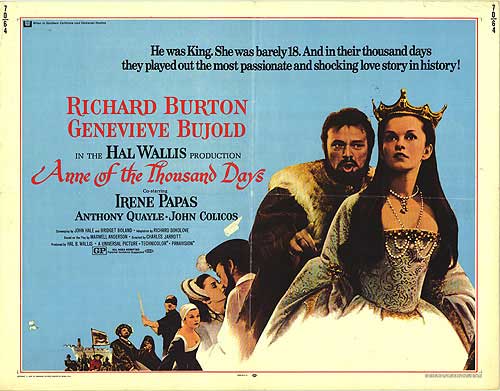
Cast: Richard Burton (King Henry VIII), Geneviève Bujold (Anne Boleyn), Irene Papas (Queen Catherine of Aragon), Anthony Quayle (Cardinal Wolsey), John Colicos (Thomas Cromwell), Michael Hordern (Thomas Boleyn), Katharine Blake (Elizabeth Boleyn), Valerie Gearon (Mary Boleyn), Peter Jeffrey (Duke of Norfolk), Joseph O’Conor (Bishop Fisher), William Squire (Sir Thomas More)

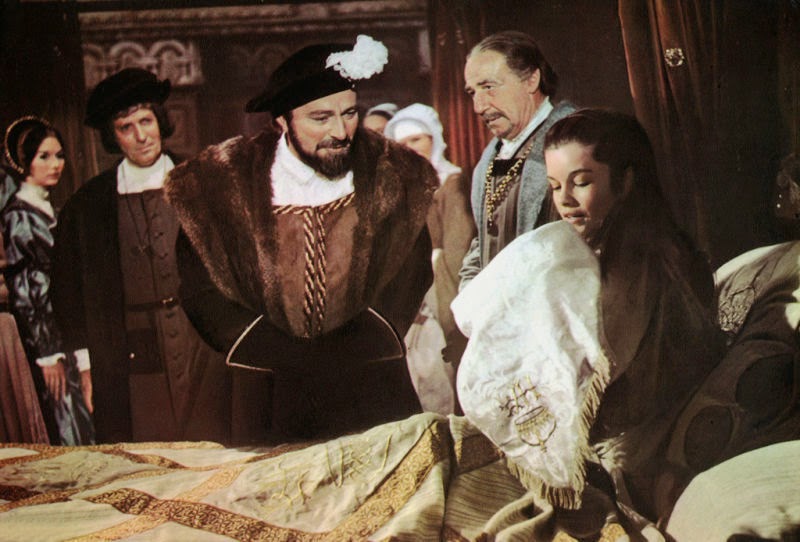
Anne of the Thousand Days fits neatly into Hollywood’s obsession of the 1960s: the grand British historical epic, crammed with costumes, old locations and leading Brit actors in beards mouthing “olde English” style dialogue. Some of these films are of course marvellous – A Man For All Seasons being clearly the best – some are merely competent. AotTD falls very much in the latter category. It’s a solid but dry and rather self-important piece of entertainment, more interested in wowing you with its pageantry than moving you with its emotion.

As the film opens, Henry VIII (Richard Burton) considers whether or not to sign Anne Boleyn’s (Genevieve Bujold) death warrant. The film then flashes back to tell us the story of Anne’s rise and fall. Along the way, the usual figures from Tudor history are wheeled out: Wolsey, Catherine, More, Cromwell and assorted Boleyns.  And of course, the whole thing ends with Anne proudly proclaiming her daughter will one day be the greatest queen of England, with quite exceptional clairvoyance given how unlikely that would’ve actually looked at the time.

The main problem is it isn’t sure what it wants to say about its central character. It wants to simultaneously position her as a strong, “modern” woman with her own ambitions but as a woman succumbing to passion. Essentially, it wants to have its cake and eat it: for Anne to understand Henry is far from love’s ideal vision, while not wanting to lose their “Great Romance”. So we have scenes where Anne questions why anyone would want to marry Henry or talks of her desire for peace, and later scenes where she demands the judicial murder of all who refuse to accept the marriage.

And it may want to show Anne as a modern woman, but – frustratingly – it’s only actually interested in her as a romance object. Her modernity is solely expressed in defying her family to try and marry someone other than Henry, and having spirited “I hate you/I love you” sparring matches so beloved of Hollywood. But the film has no interest in her intelligence, her involvement in the Reformation, or how this led into dangerous conflict with the increasingly powerful Thomas Cromwell (here her downfall is solely down to her inability to produce a son, and being jealous of love rival Jane Seymour, here playing the sort of minxy temptress Anne is often accused of being).

And even this simplified, Mills-and-Boon Anne is inconsistent– one minute she’s a sweet young girl bravely resisting her unwanted royal suitor. Then, she’s delighted with the power that comes with allowing the King to court her. Equally suddenly, she falls in love with him (though that scene is so confusingly written it’s initially unclear whether this is genuine or simply a ploy to win back the attention of Henry). Even away from the central “romantic” relationship, her character oscillates – she schemes revenge against Wolsey, but then is too nice to take Hampton Court from him.

Despite this, Genevieve Bujold delivers an excellent performance. The film successfully plays up her youth early on, and she brings the role a lot of passion, fire and intelligence. Her French-Canadian accent also makes perfect sense considering Anne was largely brought up at the French court. Bujold does her best to hold together an inconsistent character and delivers a real sense of Anne’s independence and intellectual strength. Not even she can completely sell the competing visions of Anne the film has, but she does a very good job with what she is given.

Richard Burton was allegedly fairly scornful of his performance, but he is terrific. One area where the film does succeed is repositioning Henry as a proto-tyrant, who literally cannot conceive he is wrong. In a memorable scene, Henry explains that, ruling as he does through God, any thoughts in his head must have been placed there by God, ergo he can never be wrong. If that isn’t a tyrant, I’m not sure what is. Burton’s charisma is perfect for a man who can flip on a sixpence from bonhomie to fury. While Anne’s intellectualism is overlooked, the film does a great job of demonstrating Henry’s intellectual fakery, via his bland and overbearing musical compositions (met with a rapturous response from the court). Lords literally breathe sighs of relief after they leave his presence. Burton may not be an ideal physical match, but embodies Henry’s ruthless selfishness and towering ego.

It’s a shame that, despite having strong performances, the film is not only so confused, but also so flat and dry. Charles Jarrott frames the film with a dull conventionality, carefully letting costumes and production design fill the screen like a dutiful workman. Has he got any really interesting ideas for shooting this stuff, or presenting a routine plot with any freshness? Not really. Instead we get spectacle, and inevitable rundown of events, but no real sense of novelty. It turns the whole thing into a rather slow, reverent slice of British history, dry and stodgy, ticking off events as it goes.

Those events come and go with a confused focus. The foundation of the Church of England is under explained. The fates of several characters are left unresolved – in particular Cardinal Wolsey (an otherwise excellent Anthony Quayle) simply disappears. The final condemnation of Anne is rushed and confused (you would be forgiven for not really understanding who she has been accused of sleeping with, and the alleged incest between her and brother is almost thrown away). Other characters are simplified (despite good performances from their actors):  so William Squire’s More is upstanding and honest, while John Colicos’ Cromwell is dastardly and scheming.

Anne of the Thousand Days is rather old fashioned and probably best watched now as a Sunday afternoon film. It tells a very, very familiar story (how many times have we seen Henry/Anne’s romance on screen before and since) without too much originality, and largely fudges putting together a clear sympathetic portrait of its central character. Having said that, it is well acted and looks wonderful. It’s just also rather dry and far too aware of having an “important” story to tell.