
Tag: George Baker

The Spy Who Loved Me (1977)

Bond finds himself in another pretty pickle in The Spy Who Loved Me

Director: Lewis Gilbert

Cast: Roger Moore (James Bond), Barbara Bach (Anya Amasova), Curd Jürgens (Karl Stromberg), Richard Kiel (Jaws), Caroline Munro (Naomi), Walter Gotell (General Gogol), Bernard Lee (M), Desmond Llewelyn (Q), Lois Maxwell (Miss Moneypenny), Geoffrey Keen (Frederick Gray), Robert Brown (Vice-Admiral Hargreaves), George Baker (Captain Benson), Michael Billington (Sergei Barsov), Vernon Dobtcheff (Max Kalba), Nadim Sawalha (Fekkesh)

Roger Moore had made two Bond films before he made The Spy Who Loved Me – but this is the one when he finally hit upon the formula that works for him. It’s also probably the moment where the Bond films became – once for all – comedy adventure capers. It was but a few more degrees from here until Bond was telling a tiger to “sit” or racing past a double-taking pigeon in the middle of St Mark’s Square. And the public loved it. For better or worse, Moore’s Bond here helped define the franchise for a whole generation.

Anyway, the story. It’s eerily familiar in many ways to Thunderball and You Only Live Twice: a power-crazed lunatic (Karl Stromberg) running a secret organisation wants to destroy the world. His plan? To capture one American and one Soviet submarine and use them to fire nuclear missiles at the nation’s two capitals, to kickstart a nuclear war, leaving only his underwater kingdom intact. Just as well then that an over-keen Stromberg (Curd Jürgens) first captures a British sub, meaning James Bond (Roger Moore) is called in to investigate. Bond will work with the USSR’s finest agent – Anya Amasova, Triple X (Barbara Bach) – to find out what’s going on and why.

TSWLM is a lot of fun, possibly the ultimate expression of what a lot of people think Bond is. It’s hugely silly, rather exciting and has almost no connection with reality whatsoever. Moore goes through the whole thing with his eyebrow forever arched, tipping the wink at the audience – “You do know, dear boy, this is all dreadfully silly stuff”. Sometimes in Bond this humour gets a bit much – but here it’s pretty much pitched perfectly. And Moore looks like he is having the time of his life.

The film is crammed with action set pieces in striking locations: the Alps! The pyramids! A converted oil tanker base! Nothing is left to the imagination, and everything is thrown at the screen. It gets the sense of excitement right from the pre-credits sequence, with Bond’s high-speed ski chase across the alps from Russian would-be hitmen. Fools – what chance did they have? I don’t know what I like most about this scene: is it the wild ski stunts? The way music and camera action combine so well? The fact that it’s crystal clear Moore probably spent precisely zero days on location for this sequence? What am I talking about, it’s got to be that insane parachute jump at the end – with the camera leaving it just long enough for you to start to think “is Bond going to get out of this one?”. (Spoilers he does.)

That’s almost nothing compared to the famous Lotus-turned-submarine car chase, which pretty much set the standard for all the car-based action (not to mention gadget filled cars) that would follow in the franchise. The idea of a car that turns into a submarine: it’s both brilliant and so overwhelmingly silly that, like Bond at its vibrant best, it seems to transcend class and logic into a higher plane of excitement.

And all this with a plot that is almost staggeringly stupid. Jurgens has a lot of arch, naughty fun as scheming monomaniac (with subtle webbed hands) Stromberg, a pompous arsehole and a great villain. Of course he wasn’t a physical threat – hence the invention of Jaws, surely the most popular henchman ever invented for Bond. Jaws is a lunking, vicious but strangely endearing brute – it’s hard to put your finger on why he’s strangely likeable, maybe it’s just the totally absurd idea of a hitman whose killer tools are metal teeth. Maybe it’s because Richard Kiel has such a dorky sense of humour – and is as good at the glance at the camera as Moore himself is.

Of course it is a dated film – and it’s always the women that show it. If this set a lot of good Bond archetypes, then it also helped to cement a few bad ones. Anya Amasova is (allegedly) the greatest agent Russia has. Not that you would know it, as she stumbles in this film from moments of staggering incompetence and stupidity to victimhood and damsel-in-distress. There is a hint of character development – Bond offs her boyfriend in that alpine chase literally without a backward glance – but that’s soon forgotten by the end under Bond’s charms. The poor woman can’t even drive stick (“That’s reverse, let’s try again shall we” says Bond with smackable smugness) and by the end of the film she’s bikini-clad and being rescued by Bond. It says a lot when the strongest thing about her character is that her name isn’t an innuendo.
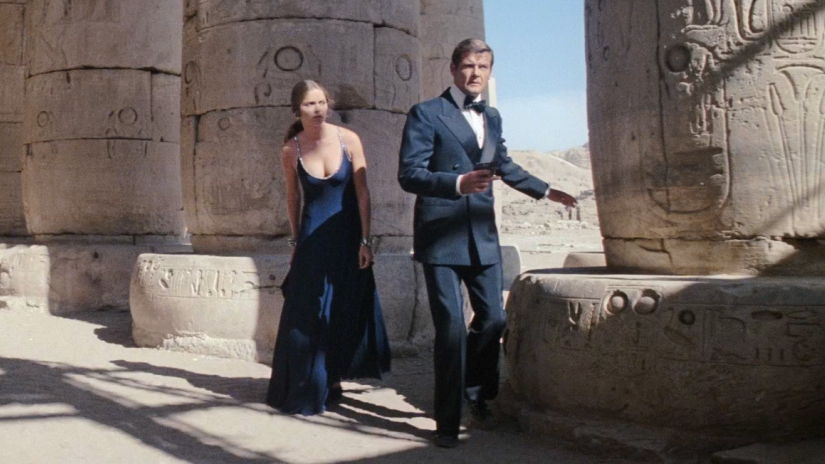
But you can let it go, because the rest of the film is such good fun. Everything is nonsense of course, and you could steer a submarine through the plot holes. If Stromberg only needs two submarines to start his evil plan, why on earth does he grab a third one at the start of the final act? (Just as well he does, of course, as otherwise Bond would never get on board his base.) Stromberg is ruthless enough to eliminate three underlings and to set up a nuclear war to wipe out the world – but those captured submarine crews he keeps alive, imprisoned, with a small guard, next to the armoury on his base. Ooops. His plan is almost effortlessly undone with a radio message from Bond. But never mind. It doesn’t matter.

The point is that this is all great fun and basically set the tone for the next ten years of Bond films – until Dalton shifted gears. Moore is really good in it, as a sort of ringmaster of silliness – and he’s clearly enjoying it wildly. The Spy Who Loved Me is his best film – and for all its dumbness, its leaning into cheap humour, its ludicrous plot and sexist attitudes, it’s still up there at the top of the franchise. Because for a lot of people, all those negatives are exactly what they now expect from Bond.
On Her Majesty's Secret Service (1969)


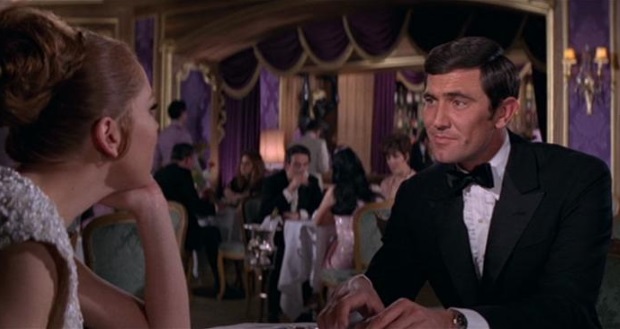
George Lazenby flirts with Diana Rigg. If only he was James Bond.

Director: Peter R. Hunt

Cast: George Lazenby (James Bond), Diana Rigg (Tracy di Vicenzo), Telly Savalas (Ernst Stavro Blofield), Gabriele Ferzetti (Marc-Ange Draco), Ilsa Steppat (Irma Bunt), Bernard Lee (M), Lois Maxwell (Miss Moneypenny), George Baker (Sir Hilary Bray), Bernard Horsfall (Shaun Campbell)

After You Only Live Twice, Sean Connery was through with Bond. Despite the producer’s pleas, Connery was off. The producers were hit with a conundrum – should they recast and start again? Or recast and pretend nothing has changed? They went with the second option and spread the net among the world’s actors, and hired… a man whose only screen work was in a chocolate advert.

Bond (George Lazenby) is on the hunt for villainous SPECTRE head Blofield (also played by a new actor, Telly Savalas). Following a lead, he meets and begins to fall in love with daughter of a Count, Tracy di Vicenzo (Diana Rigg), before infiltrating Blofield’s alpine HQ disguised as an expert in heraldry (seriously that is the plot). There he uncovers a plot for world domination that involves a dozen attractive young women, a deadly virus and the usual collection of inept SPECTRE henchmen.

It’s become a bit retro-cool to reassess OHMSS as the finest James Bond film. This always seemed odd to me: this series, more than any other, is so closely tied in with the personality and skills of the lead actor – and this film has the weakest of the lot. But compared to the two slightly tired films that came before it (YOLT and Thunderball), this one does have more narrative ambition and offers a freshness and sweep in its filming, as well as a compellingly filmed series of action pieces.

Really though you can’t talk about OHMSS without mentioning the Lazenby-sized elephant in the room. Poor George. Watching Lazenby you can never forget this is a guy who landed Bond on the basis of (a) he looked good in a tuxedo and (b) he broke a stuntman’s nose when he auditioned.  But let’s start with the positives. Well he can fight – jeez louise this guy can fight. Lazenby’s Bond is possibly the most physically aggressive until Craig. He’s totally at his ease in the fast-paced fisticuffs that fill the movie. He looks very believable when he’s asked to do anything athletic or dangerous looking. I’ll also cut him some slack that he is given a terrible wardrobe of clothes here (could he look more camp?) and that he spends a significant chunk of the film disguised as a camp heraldry expert.

It’s just a shame that anything involving acting is a bit too much of a stretch for him. His delivery of his dialogue is flat and lifeless. For a large chunk of the film, his voice is all too obviously dubbed (by George Baker). He’s frankly not that funny, despite having several gags (including of course “This never happened to the other fellow”) which are actually pretty good. He can’t bring any real emotional depth to the romance. His chemistry with Diana Rigg is pretty middling, although he does a decent job of his grief at her (spoilers!) death. But it’s the voice that you keep coming back to. It’s grating – flat, dull and monotone. Even though the material makes Bond more human than ever, Lazenby’s underwhelming performance doesn’t make us feel any closer to him.

The producers were clearly aware of the problem, so crammed the film with as many references back as they could manage, as if to reassure audiences “Yes Connery has gone, but don’t worry it’s still Bond!”. So we get a scene of Bond flicking through a desk full of knick-knacks from previous films (the film even plays snatches of the scores). M, Q and Moneypenny work overtime to treat Bond exactly the same. All this attention to continuity of course only goes so far – despite the fact they both spent a fair bit of time with each other in the previous film, Blofeld doesn’t even remotely recognise Bond when he rocks up at Blofeld’s base pretending to someone else, disguised by nothing but a pair of glasses. For a film determined to hammer home the continuity more than any other in the series (until Spectre) this doesn’t make a lot of sense.

So the real question: can you have a great Bond film, when Bond himself in it is pretty dreadful? Can you really enjoy the film when the whole time you almost force yourself to picture any of the other Bonds in place of the one you’re actually watching? Well OHMSS gets pretty close to success despite the fact it has a black hole at its centre, which is a tribute to it. This one feels closer to Ian Fleming than almost any other film in the series. It’s the straightest adaptation of the source since From Russia With Love. Lazenby’s more human take on the role (sentimental, scared at times) does feels closer to Fleming’s Bond than Connery’s Ubermensch. This doesn’t mean the plot isn’t utter bobbins – but at least it’s very Fleming-esque bobbins.

In fact the producers threw everything except the kitchen sink at this one. There’s a car chase (in the middle of a car rally), a helicopter-led storming of a SPECTRE base, no end of punch-ups, a barrage of battles, ski-chases down the alps, a final battle in a toboggan (surely the only film until Cool Runnings to build up to a climatic encounter in a winter-sports event). Many of these sequences are terrific, and Hunt films everything with a grounded realism (despite the ludicrousness of so much that happens) that makes everything immediate and exciting. He also combines this with an ability to shoot moments of epic action with sweep and majesty.

It’s also quite refreshing in how it treats its romantic lead. Diana Rigg is not only (by far and away) the best actress to play a Bond girl until the Craig years, but she is allowed to create a character who feels a worthy partner to Bond. Tracy is brave, determined, can take care of herself, rescues Bond at one point and gets to do all the driving (and is extremely good at it). Sure the film has its old-fashioned moments (when her father encourages Bond to court her, he charmingly states: “What she needs is a man… to dominate her! To make love to her enough to make her love him! A man like you!”. Okay…), but as far as it goes this is pretty advanced stuff for Bond at the time.

The plot is nonsense of course, and Telly Savalas feels like a strange choice for Blofeld (he’s far too gritty, aggressive and, above all, American!) but the action is really well counterpointed with the relationship between Bond and Tracy. Tragically, this film has exactly the rich, deep and emotional material Connery was crying out for. The love story – despite Lazenby’s limitations – feels genuine and sweet and the final tragic ending is, by far and away, the best bit of acting Lazenby gives in the entire film. But you keep imagining what it would have been like if Connery had been in this film, or indeed anyone who could actually act (even Moore could have made a lot more of this material).

That’s the problem with OHMSS. Bond films depend on their Bond – and when the Bond lacks any real charisma and struggles to deliver on anything other than the physical side of the business, your film is always going to be in trouble. Which is a real shame, because nearly everything else about this film is actually really good. It feels fresh, exciting and real in a way others felt tired and over familiar. It’s got some excellent action and excitement. It’s shot and edited with real vibrancy. The action set pieces are exciting. It’s got a sweet romance at its centre. You just don’t really connect with or care about the hero. And for a film series that rests so heavily on the lead, that is pretty terminal.