Tag: George Macready

Julius Caesar (1953)

Mason and Gielgud confront Brando in Hollywood’s faithful Shakespeare adaptation Julius Caesar

Director: Joseph L Mankiewicz

Cast: Marlon Brando (Mark Antony), James Mason (Brutus), John Gielgud (Cassius), Louis Calhern (Julius Caesar), Edmond O’Brien (Casca), Greer Garson (Calpurnia), Deborah Kerr (Portia), George Macready (Marullus), Michael Pate (Flavius), John Hoyt (Decimus Brutus), Douglass Watson (Octavius)
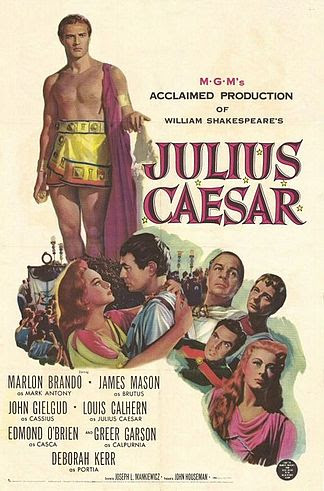
Hollywood has always been in awe of Shakespeare. For large chunks of Hollywood’s Golden Age, it was felt the Bard’s mighty words could only be performed in a certain way by certain actors and that it somehow besmirched the Bard to put him on celluloid. It’s partly why there are few truly radical productions of Shakespeare on screen. By 1953 Orson Welles had directed inventive, challenging productions of Macbeth and Othello that reworked Shakespeare for cinematic effect, but these had been met by horror by some critics (‘how dare he change things!’). Julius Caesar fit the mould in many ways for how Hollywood felt Shakespeare should be done – traditionally, respectfully and by a cast of trained theatre actors. Then they threw in a curve ball by casting Brando as Mark Antony.

It’s hard now to really understand the hesitancy (and outright snobbery) from many about the very idea of Brando doing Shakespeare. This was the mumbling Stanislavsky-trained star of Streetcar, the earthy, T-shirt wearing slab of muscle that yelled “Stella!” – who on Earth did he think he was? Shakespeare is for plummy accents, focused on poetry. Brando took a huge risk taking this role on. But, today, his performance feels fresh, vivid and in many places strikingly modern.

Brando bought a more relaxed, natural style – and, yes he also affected a slightly plummy Brit accent – and bought a emotional realism to the most exhibitionist of Shakespeare’s great roles. (Let’s not forget, most of Antony’s part is a massive public speech). Brando creates an Antony who is passionate, loyal, committed – but also cunning, manipulative and very aware of the effect he is attempting to generate in that famous speech. He delivers the speech with aplomb, but concentrated as much on the emotion of what he was saying as the poetry of how he said it. It makes for an excellent marriage between two different styles of theatre, and Brando’s powerhouse delivery (Oscar nominated) carries real energy and dynamism.

It sits within a very traditional production, carefully shepparded to the screen by Joseph L Mankiewicz. Mankiewicz was a two-time Oscar winner for Best Director – but his reputation was largely formed on his mastery with dialogue and actors, rather than any visual sensibility. Julius Caesar is intelligently and faithfully bought to the screen – albeit with little cinematic flourish – shot with a moody black-and-white (designed to ape news-real footage and add further dramatic urgency to the action) on sets that were leftover at the studio from Quo Vadis. (Some of the busts are hilariously out of place – pretty sure Brutus has a bust of the Emperor Hadrian in his home, quite something seeing as he died 160 years before Hadrian was born.)

Mankiewicz by and large lets the play speak for itself.  What Shakespeare wrote, he largely says, and there is little in the way of message in a play that has been reversioned to almost any oppressive regime you can imagine. A few flourishes diverge from the text. He radically simplifies Acts 4 and 5 of the play (particularly the Battle of Philippi and the consecutive suicides of Brutus and Cassius), reducing these down to little more than half an hour. Wisely he focuses on the more dramatic Acts 1-3. The scheming is tense and moody, the assassination swift and brutal. The crowd scenes in Rome bustle with an immediacy and vibrancy – the camera often sits among the plebians during the speeches, encouraging us to share their feelings and reactions to the speeches. Antony is made a calculating and cunning figure – consciously waiting for certain reactions: he even, in one directorial flourish, enters bearing Caesar’s corpse during Brutus oration.

Mankiewicz’s main strength is in working with actors. Although Brando claimed the plaudits, the play is actually centred around Brutus, the intellectual of good intentions drawn into a conspiracy for the best intentions who finds principles and coups make for impossible bedfellows. The film’s finest performance is from the simply superb Mason, who was born to play tortured decent patricians like this and creates a Brutus stuffed with doubt, pride, arrogance, uncertainty and a little touch of fear. His patrician voice is perfect for this “most honourable of all the Romans”, and he sets about murder as the deeply unpleasant task it is, guided by his assumption that he-knows-best. The little moments are brilliantly done: from his petrified nerves at the assassination to his pious sermons on morality to Cassius to his tenderness and care for his wife and servants. It’s a wonderful performance.

To complement him, Mankiewicz recruited one of the greatest Shakespearean actors living as Cassius. Gielgud hadn’t done a film for over ten years (he always felt the cinema to be a minor art), and Julius Caesar was the only opportunity he had to capture one of his great Shakespearean performances on film until Prospero’s Books nearly 40 years later. It’s fascinating to watch a film where the old school (in Gielgud) and new school of acting (in Brando), both bring their own approaches to Shakespeare. This is Gielgud’s finest Shakespearean performance on camera – he must surely have learned more about acting on camera from Mason and Brando – the first time his style moved away from ‘singing the verse’ towards something more emotional, his Cassius a bitter, manipulative man who starts the film holding all the cards and ends up with none of them.

Watching these three powerhouse performers work is a treat – and also to see their styles merging and playing off each other. Mason is the perfect fusion of the realism of Brando and theatricality of Gielgud. Brando learned huge amounts from Gielgud, frequently consulting him on delivery. Gielgud surely took as much from Brando on adding greater emotion and realism into his screen performances, shirking the declamatory style that often makes him grand but unconnectable. The other actors around them offer versions of these styles: O’Brien stands out best as a shrewd and cunning Casca, Calhern tries a little too hard to be grand as Caesar, Kerr and Garson are a bit too theatrical in thankless parts as “the wives”.

Julius Caesar as a whole though is a lean, pacey and intelligent staging of the play, directed unobtrusively but professionally, very well acted by the cast. While Mankiewicz does nothing radical here – look at Orson Welles Othello and there you’ll see how the language of cinema can add a whole new perspective to Shakespeare, in a way this film never does. But while not radical, it focuses on story and character really well. The set-piece moments – the speeches, the murder, the plotting – are staged with urgency, energy and drama. Mainstream Hollywood still wasn’t ready for radical reworking of Shakespeare (this got lots of Oscar noms, Welles Othello was a flop), still seeing him as someone best cast in marble – but with Julius Caesar Hollywood took baby steps towards suggesting there could be a different future.

Seven Days in May (1964)

Burt Lancaster and Kirk Douglas find themselves on opposite sides of a military coup in Seven Days in May

Director: John Frankenheimer

Cast: Burt Lancaster (General James Mattoon Scott), Kirk Douglas (Colonel Jiggs Casey), Fredric March (President Jordan Lyman), Ava Gardner (Eleanor Holbrook), Edmond O’Brien (Senator Ray Clark), Martin Balsam (Paul Girard), Andrew Duggan (Colonel Mutt Henderson), George Macready (Secretary of the Treasury), Whit Bissell (Senator Fred Prentice), John Houseman (Admiral Barnswell)

President Jordan Lynman (Fredric March) has completed his signature policy: a nuclear disarmament treatment with the USSR. Some are thrilled, others are horrified. In the latter camp are the Joint Chiefs of Staff, none more so than chairman General James Mattoon Scott (Burt Lancaster). General Scott has a plan: a coup to be launched in seven days time, during a training op. But word leaks to his assistant Colonel Casey (Kirk Douglas) who, however much he admires Scott, won’t be party to treason. Casey warns the President – and a race against time begins to stop the coup.

Seven Days in May opens with documentary style footage of clashing crowds outside the White House (one pushing for peace, the other for war) and then carefully balances that style with an unsettling sense of paranoia throughout. People suddenly disappear (once from frame to frame), most of the action takes place in confined spaces. When characters do head outside, they constantly seem to be looking over their shoulder, with the camera watching like a distant observer. The lack of music all adds the eerie feeling that this could just happen.

And, of course you, feel it could. Because we’ve not lost a tingling sense of unease at an over-powerful military. It’s a shame therefore that Seven Days in May doesn’t grip quite as much as it should. I think a large part of that is because the plot is exposed very early – and when Casey goes to the authorities with his suspicions, they are instantly acted on. Thrillers like this often work best with a “one man stands alone” vibe – it’s missing here, and instead we get the President and the cabinet laboriously investigating different elements of this conspiracy looking to turn up enough evidence to prevent the coup before it starts.

The drop in tension could have been counter-balanced if the film had more successfully explored the conflicts and contradictions in America. This is after all a country priding itself as being the home of freedom and democracy – but since George Washington, has had a fondness for installing military men in a job role pointedly called “Commander-in-Chief”. This is a film that could have explored how different parts of American society might admire either an Adlai-Stevenson-style intellectual or a blood-and-guts ‘simple’ soldier. But the film dodges this – and works hard to stress both men act within what they define as honour and the needs of the country. The film is to nervous about any suggestion that Scott’s coup could lead to a proto-dictator vetoing the electorate.

There is also a naivety about the film. A long subplot (not particularly interesting) features Casey being side-lined into uncovering evidence of Scott’s long-term affair. Ava Gardner does her best with a largely thankless part as the woman in question, but there is a touching faith that evidence of this will be enough to destroy Scott. It’s a faith in the system: while the public might be shaken slightly in their belief that Scott is like King Arthur reborn, finding out he’s actually Lancelot is hardly going to weaken his hold over many of his followers – or his military machine.  For a conspiracy film, Seven Days believes conspiracies are a relatively simple matter to defeat.

What’s best about the film – not surprisingly since it’s largely a chamber piece – is the strength of the acting. Produced by Douglas (who generously cast himself in the most thankless role as the decent-but-dull Casey), a cast of stars was assembled. Lancaster was perhaps the only choice as the holier-than-thou Scott, arrogant, morally-superior, cold, distant but capable of inspiring immense loyalty – it’s the perfect role for him and he plays it to the hilt.

The film’s finest sequence is a late confrontation between Scott – Lancaster oozing moral superiority and unhidden contempt – and Fredric March’s intellectual President. March is brilliant, a born negotiator and compromiser – all the skills you need to be a successful politician – with just the right edge of irritation, arrogance and pride for you to know that, even if he is right, he’s no saint. March also gives Lyman an old-school sense of honour and moral principle that makes him unable to cross lines Scott can leave behind him, while still be jittery and waspish to colleagues and friends.

Filling out the cast, O’Brien gives a wonderful (Oscar-nominated) turn as a hard-drinking, good-old-boy Senator who turns out to have principles of iron and the guts to match. Martin Balsam delivers one of his patented put-upon functionaries, struggling to keep stress at bay. Macready is great value as a bombastic cabinet member while Houseman glides above it all as an Admiral to smart to say anything certain either way.

Acting is eventually what powers Seven Days in May and if it never becomes the white-knuckle conspiracy thriller or the insightful political commentary it should be, it just about has enough entertaining scenes to keep you watching.

Paths of Glory (1957)

Kirk Douglas leads men into pointless battle in Kubrick’s Paths of Glory

Director: Stanley Kubrick

Cast: Kirk Douglas (Colonel Dax), Ralph Meeker (Cpl Philippe Paris), Adolphe Menjou (Major General Georges Broulard), George Macready (Brigadier General Paul Mireau), Wayne Morris (Lt Roget), Richard Anderson (Major Saint-Auban), Joe Turkel (Pvt Pierre Arnaud), Timothy Carey (Pvt  Maurice Ferol), Emile Meyer (Father Duprée), Bert Freed (Sgt Boulanger), Susanne Christian (German singer)

Kubrick’s fourth film is one that often gets overlooked when running over his CV – and it’s had less cultural impact than, say, A Clockwork Orange, 2001 or The Shining – but out of all of his films (except maybe The Shining) it’s the one I’ve come back to the most often, and is certainly his first stone-cold classic. This Word War One tragedy simmers with anti-war sentiment, and it’s so beautifully made and assembled you can see its influence in films right up to 1917.

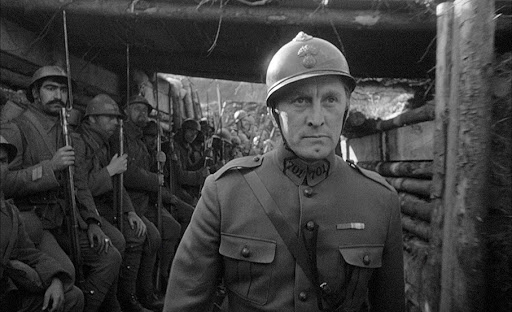
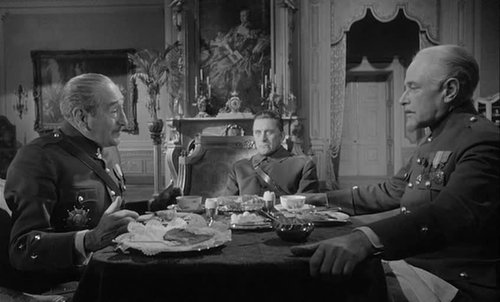
In 1916 the war is bogged down into trench warfare. Command wants results, an action they can point to, so General Broulard (Adolphe Menjou) is sent by the General Staff to instruct General Mireau (George Macready) to launch an attack on a well defended German position called “the Anthill”. Mireau says any attack would be suicide – until the prospect of his promotion being directly linked to it is mentioned, at which point he becomes the attack’s most passionate advocate. Mireau passes the order onto regiment commander Colonel Dax (Kirk Douglas), who protests that the attack is pointless, but is ordered to lead it or be relieved of his command. The attack is a costly farce, and the humiliated Mireau (with Broulard’s tacit agreement) demands a blood sacrifice – one man from each company will be placed on trial for cowardice and shot as an example for the whole French army. Dax deplores this injustice – but with the administrative meat-grinder as deadly as the one on the front, what hope does he have?

Kubrick believed passionately in the project but also needed a commercial hit in order to bolster his career. So he recruited Kirk Douglas to get the funding – Douglas took a third of the film’s budget as his salary, so it wasn’t all charity – and he rewrote the ending of the book to allow Dax to come up with a last minute solution to get the soldiers off. Douglas, to his credit, was having none of that and demanded a rewrite that restored the book’s original bleak ending. 

So it’s largely thanks to Douglas we get the shape of the film that we end up with – but it’s clear that it’s Kubrick’s genius that makes it the film it is. Actor and director were a perfect combination here, so much so that Douglas got Kubrick on board to direct Spartacus (an unhappy experience for them both). But Paths of Glory was where both actor and director were working in perfect partnership, both pushing the other to give of their very best. Dax is the perfect Douglas role – decent, intelligent, well-spoken, passionate, a natural leader, but the film undermines all this with his ineffectiveness. Each of his crusades goes wrong, and he fails at every goal he sets himself. Douglas brilliantly captures both sides of this in his generously low-key but committed performance.

He has a great framework of a film around him from Kubrick. The director uses several longs shots, extended takes and tracking shots to throw us into the world. The opening sequences at the military HQ, taking in the palatial setting of Mireau’s campaign office, have a stately construction and technical formality which then contrasts superbly with the lower angle, tracking shot-laden, POV sequences set in the trenches. Kubrick’s camera glides through these trenches, low angles seeming to make them tower over the viewer, the mud and filth only worse in the body-strewn no-man’s land that stands between the French and the Germans.

It culminates in the attack sequence, one of the greatest battle sequences ever placed on film. Following the doomed advance at a methodical pace, matching the speed of the soldiers, the camera tracks over no man’s land as explosions rend the ground and bodies are thrown to the mud under a hail of bullets. At the front is Dax, vainly blowing on his whistle and encouraging the men forward, while all around him devastation and slaughter win out. Any thought that this wasn’t a pointless enterprise from start to finish is completely dispelled, and our sympathies are completely with Dax and the soldiers, whose lives are superfluous to the ambitions of the generals.

Both generals cut appalling figures for different reasons. Mireau, played with a trumpeting, vain bombast by Macready, is a “blood and guts” soldier who never places his own blood and guts anywhere near the line. Proudly bragging about the skills of his soldiers, then furiously denouncing their cowardice, one telling shot has him in the trenches staring through binoculars at the German positions, oblivious to the wounded men filing past him. Later he orders the shelling of these very trenches in fury at their failure to advance far enough. Broulard is hardly better, Menjou’s “hail well met” bluster hiding a chilling lack of empathy.

The Germans are never seen, because the real enemies here are war itself (and we are kidding ourselves if the same thing wasn’t happening on the other side) and the authorities who push us into it. The film is almost like some sort of black satire, with the generals confidently telling their soldiers they are right behind them, before retreating several miles to the rear to watch the battle unfold. Dax is middle-management, caught between trying his best to deliver orders he knows are impossible, and protecting men he knows are doomed, and failing at both tasks.

The system demands blood sacrifices from the lowest possible rungs, so the hierarchy can reassure themselves they are not blamed (Dax’s offer to take all the blame is promptly rejected by Broulard – no question of any of the officers being at fault!), so the men are chosen by their company commanders. One is chosen by lottery (he of course is a decorated war hero, but that cuts no ice), one because he’s an “undesirable” and the third because he has witnessed his own commanding officer’s cowardice. None of them deserve it, but their guilt is “proved” in a kangaroo court that lasts less than 15 minutes, and in which Dax is barely allowed to put a defence case.

Kubrick’s film becomes a surprisingly fast (it’s less than 90 minutes) but inexorable march towards those three stakes in the ground and the firing squad. Questions of justice and courage are completely pointless – any brave acts in the film are pointless, two of the victims are cited for their courage and the most cowardly character in the film, Wayne Morris’ snivelling Lt Rouget, ends up commanding the firing squad – and the message we are left with is that the institution of war and man are the real villains here.

War has no heroes, only survivors. Victories are important to the generals only in the sense of being tools to jockey for position, and the common soldier is an expendable puppet who can be killed on a whim to fill any political reason. It’s a harsh and chilling view of the military – and leaves very little hope – but it’s superbly made and controlled by Kubrick, in a film surprisingly with more heart in it than any film he ever made before or since. It’s a film that leaks with sorrow and disgust at the victims of the military machine, a film with emotion as well as a technical marvel. It might be Kubrick’s most complete film.

The Desert Fox (1951)


James Mason rides into action as a sympathetic Nazi

Director: Henry Hathaway

Cast: James Mason (Field Marshal Erwin Rommel), Jessica Tandy (Lucie Rommel), William Reynolds (Manfred Rommel), Cedric Hardwicke (Dr Karl Strölin), Luther Adler (Adolf Hitler), Everett Sloane (Gen. Wilhelm Burgdorf), Leo G. Carroll (Field Marshal Gerd von Rundstedt), George Macready (Gen. Fritz Bayerlein), Richard Boone (Capt. Hermann Aldinger), Eduard Franz (Col Claus von Stauffenberg)

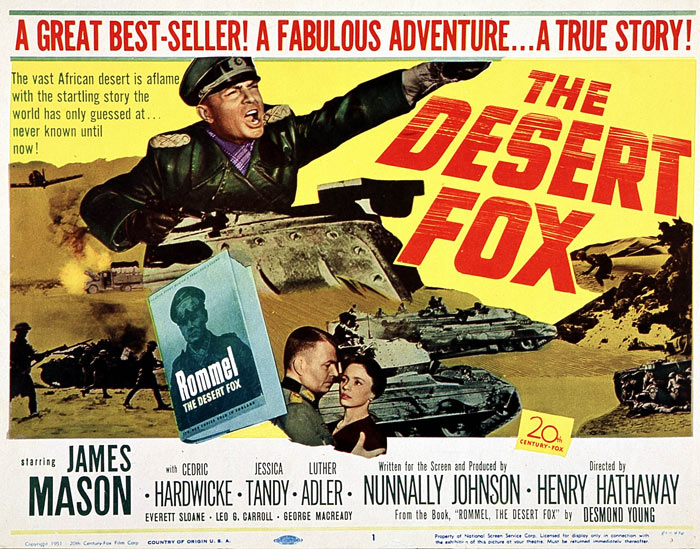
It’s pretty astonishing when you think about it that less than six years after World War II ended, Hollywood produced a film about one of Germany’s leading generals which painted him in a largely positive light. Even more of a surprise is that this was a box-office hit. But then this film was designed to be a step towards reconciliation – especially with one eye on the Cold War and the need for Germany as an ally.

James Mason (brilliant in one of his most iconic roles) plays Rommel, with the film beginning just as the tide of war turns in Africa at El Alamein. Of course, this allows a lot of talk of Rommel being a noble fighter and brilliant general, without having to awkwardly show him chasing the Sixth Army across Africa! From his defeat to Montgomery (unseen but often referenced), Rommel slowly loses his faith in Hitler, realising the Fuhrer cares little for the lives of his soldiers. Gradually he becomes closer to the conspirators of the July 1944 bomb plot to assassinate Hitler. When it fails, he is given the choice: suicide and a hero’s funeral or execution as a traitor for him and his family.

The film is notable for opening with an exciting James Bond-style action sequence, a 1941 raid by British commandos on Rommel’s HQ (codenamed Operation Flipper), designed to grab the viewer’s attention – and to provide the action in a war film that otherwise has virtually no combat in it. It’s a terrific opening that immediately establishes the importance Rommel holds. The Desert Fox was one of the first films to use this device of an action prologue to open the story – the sort of thing James Bond has since mastered.

From there, Hathaway’s journalistic film (much of the World War II footage is reused from newsreels) is very smoothly and professionally directed, turning the last few years of Rommel’s life into a classic morality tale. Whether this is completely true or not (more recent research on Rommel suggests he was a much more enthusiastic early supporter of the Nazi party than suggested here), there seems little doubt that he was at the very least sympathetic to the July 1944 bomb plot. Rommel here is a man who sees the light too late – and pays a heavy price.

Nunnally Johnson’s well-researched and tight screenplay focuses on conversations and political manoeuvering, with Rommel presented as apolitical and straight shooting, clumsily working through debates he lacks the political sophistication to understand. Johnson’s script also provides excellent opportunities for sparkling cameos. Leo G. Carroll is particularly good as Rommel’s frustrated and cynical superior, but there are also stand-out performances from Everett Sloane as a lackey from High Command and a memorable cameo of controlled ranting extremity from Luther Adler as Hitler.

The film, though, is carried by James Mason’s subtle and sympathetic performance. Mason has the charisma, his upper class manner perfect for the military man, but he isn’t afraid to play both positive and negative. So we get his arrogance and wilful blindness, showcased in scenes where is passionate defence of Hitler is as much an attempt to persuade himself as others. But we also see his loyalty to his men and the tenderness of his relationship with his wife (played well by Jessica Tandy). Mason’s performance is compelling and soulful.

It’s not a perfect film. There are some slightly clumsy links at the start back to the source book written by Brigadier Desmond Young, who served in North Africa. Young cameos at the start in reconstructions of his meeting-at-a-distance with Rommel and his post-war research. Narration from the book is a worked into the film – and having heard the real Young speak, its mid-Atlantic tone is rather jarring. The narration often serves as a transition from event to event, but this is never completely smooth, meaning there are some odd jumps.

But it’s a very decent, very professionally done piece of film making. Its version of Rommel isn’t seen as the whole story today (there is a whole historiographical argument about the “Rommel Myth” of the man as an apolitical soldier or willing accomplice), but it’s very consistent within the film. Very well acted and scripted and very professionally directed, it’s a political film cunningly disguised as a war film, which does a very good job of creating the atmosphere of Nazi Germany and in re-creating historical events and has an excellent lead performance from James Mason.