Tag: Gloria Grahame

The Greatest Show on Earth (1952)

Charlton Heston and James Stewart in the infamous (and rightly so) The Greatest Show on Earth

Director: Cecil B De Mille

Cast: Betty Hutton (Holly), Cornel Wilde (The Great Sebastian), Charlton Heston (Brad Braden), James Stewart (Buttons), Dorothy Lamour (Phyllis), Gloria Grahame (Angel), Henry Wilcoxon (Agent Gregory), Lawrence Tierney (Henderson), Lyle Bettiger (Klaus)
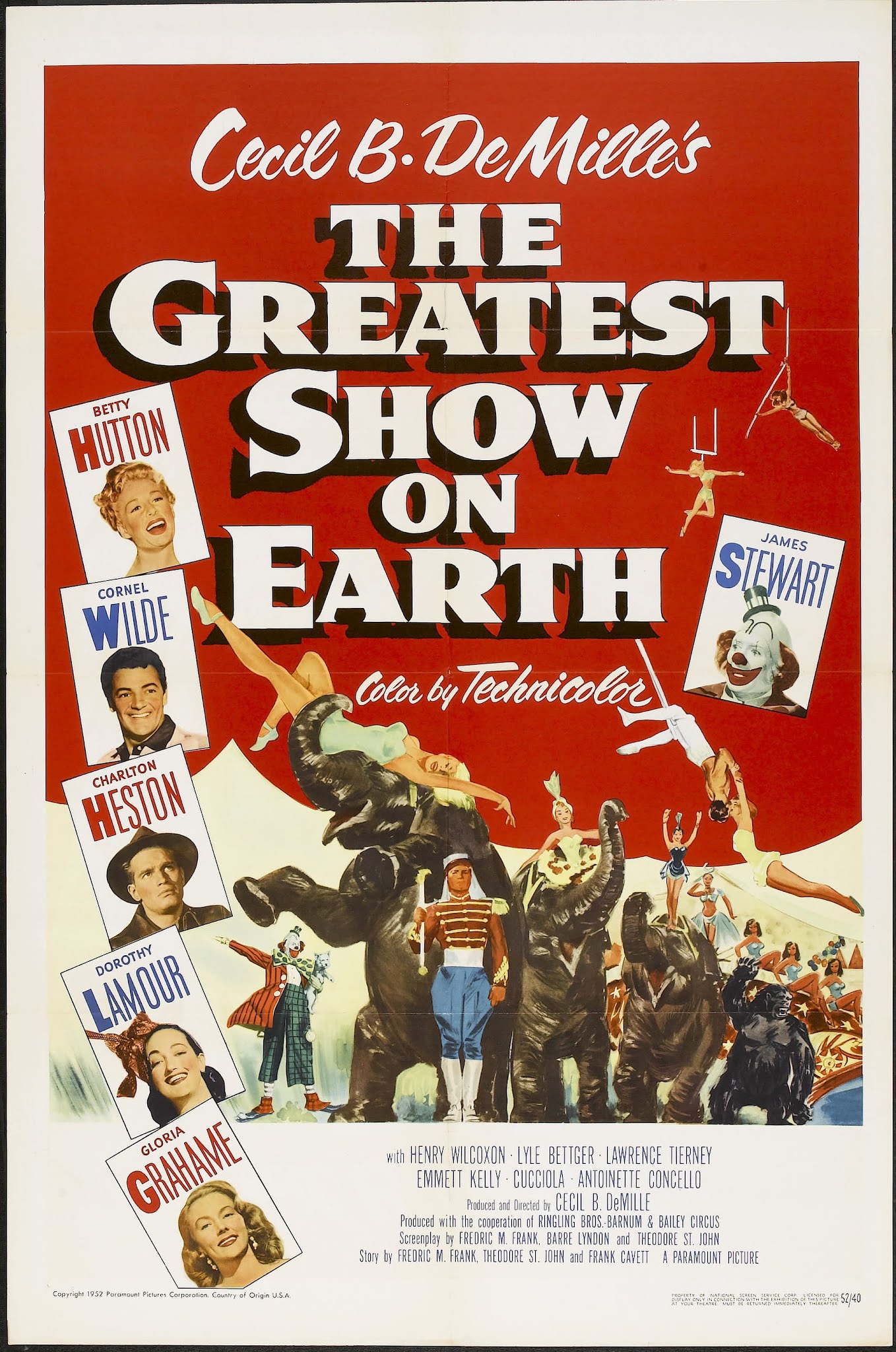
When Crash was named Best Picture, did The Greatest Show on Earth do a backflip of celebration? Finally, when the topic “What is the worst Best Picture winner of all time?” came up, the answer would no longer immediately be “Well The Greatest Show on Earth of course”. Now, there could be an actual debate. Hard to believe but this film was the biggest hit of 1952. Its reputation has been shredded since: it’s proof that winning Best Picture can destroy a film’s reputation as much as it can raise it. Greatest Show is, of course, a pretty bad film. But it’s not catastrophically atrocious. It’s merely pretty bloody awful.

Anyway, it’s all set in a Ringwood circus. Manager Brad Braden (Charlton Heston) is so in love with the circus, he has “sawdust in his blood” (drink every time some variation of this phrase comes up, and you’ll be pissed by the hour mark – which might be the best way to watch the rest). To bring in the crowds he hires famed acrobat The Great Sebastian (Cornel Wilde) – which means shunting previous acrobat star (and Brad’s girlfriend) Holly (Betty Hutton) to support act. It’s a rivalry – but wouldn’t you know it, sparks fly and a love triangle forms. In fact, it quickly becomes a love pentagon as elephant artiste Angel (Gloria Grahame) has past with Sebastian, is in love with Brad (who’s interested) and is fending off the interests of fellow elephant artiste Klaus (Lyle Bettiger). Oh, and James Stewart plays a clown who never removes his make-up because he is actually a doctor in hiding for euthanising his wife (“He killed the thing he loved!” a newspaper headline screams).

All this is packaged together with the puffed-up self-important portentousness that DeMille bought to his Biblical epics. Cecil himself even delivers a grand voiceover at life-changing events like the raising of the big top and the loading of a train. It’s packaged together with endless stagings of assorted circus acts (this film is very slim in plot, but very long in runtime), all accompanied by continual cuts to the circus audience “oohing” and “aahing” as appropriate, or asking such inane questions as “What’s going to happen next?” (a question no one watching the film is likely to be interested in asking). It makes The Greatest Show even more of a museum piece, a recording of a certain type of grand entertainment that doesn’t really exist anymore.

Away from the big budget and long filming of circus acts, we have a dull, derivative and tedious soapy plotline where ridiculous cliches abound and barely a line of dialogue escapes clunking to the floor with the same heaviness as the Great Sebastian when he (inevitably) falls from the trapeze. No single opportunity for heavy-handed foreshadowing is missed, from that accident to the film’s big train-wreck ending, to the numerous hints dropped about Buttons’ tragic background. It’s all packed into a crude series of homages to the glories of small town America (who appreciate the delights of the circus in the way the big city suits never can) and the glorious romance of not even letting death and a train wreck get in the way of the show going on.

At the centre you get the tedious love pentagon. The central figures of this – Hutton, Heston and Wilde – seem to be involved in a private competition for who can give the worst performance. Heston (in a very early role) is wooden beyond belief, the granite self-importance that made him a perfect Moses ridiculously overbearing for the job of circus manager. He and Hutton play most of their scenes with an absurd energy, throwing themselves into poses. Hutton’s performance is bubbly, chirpy and endlessly irritating. Betty is the worst kind of simpering mess, which culminates in her holding herself responsible for Sebastian’s decision to perform without a net. Wilde is saddled with a bizarre accent (where is he meant to be from? I guess “Europe”), and acts with all the comfort and skill of a vertigo-suffering acrobat.

But then to be honest pretty much everyone in this film is awful. I’ll cut a bit of slack for Gloria Grahame, who gives Angel more charm than all three of the leads put together, and James Stewart who can play the melodramatic crap he’s saddled with standing on his head. But literally everyone else in this film is dire: hammy, over-blown, cartoonish and mugging. There is not a single moment of performance or story-telling that is remotely memorable, and everyone is introduced with a clunky, trailer-friendly line of dialogue.

Nothing will remotely surprise you about the plotline – other than that they manage to stretch something as insipid and uninspired as this out for nearly 150 minutes. Though of course most of that is circus acts, or watching circus marches, or listening to Betty Hutton or Dorothy Lamour sing. (In what passes for wit in the film, while Lamour sings the camera cuts to Crosby and Hope, her old co-stars, watching in the stands hammily chewing popcorn.) There is a certain academic interest in watching these circus acts (performed by real circus artistes – although the actors trained so they could get involved), but after a while you are only reminded that it’s not as interesting or exciting as actually being there.

Maybe that’s why the plot becomes so overblown to try and compensate. Love triangles! Falls from a great height! Gangsters muscling in on the circus! A clown on the run from the cops, meeting his mother during the show once every year! A spurned lover who decides to destroy the circus in revenge! No wonder, after the opening scenes focus on the cost of staging the show and importance of staying in profit to continue the tour, our initial set-up, never gets mentioned again. How could it compete with this bizarre parade of nonsense?

It culminates in a train wreck – and of course Buttons is given “the terrible choice” of letting a man die or revealing his medical knowledge (and identity) to save his life. The train wreck has some decent model work. DeMille certainly looks happier dealing with that than attempting to make anything among his romantic sub-plots feel light, fun or natural.

The Greatest Show on Earth is all about show – and whenever it tries to do anything intimate, it invariably falls flat on its face. There are worse films out there, but attaching the mantle of “Best Picture” to this makes it feel worse than it actually is – and its pretty bad on its own merits. When all is said and done, still possibly the worst Best Picture winner ever.
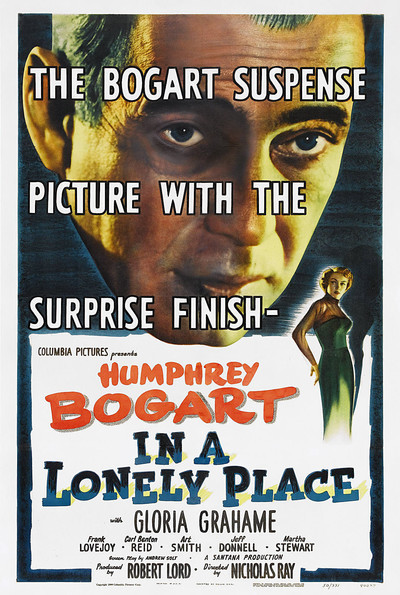
In a Lonely Place (1950)

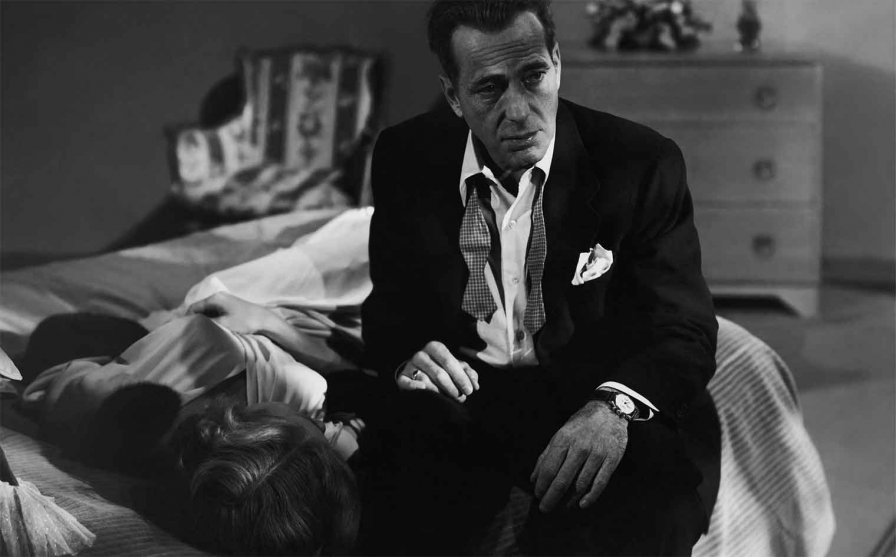
Humphrey Bogart struggles with a dark capacity for rage In a Lonely Place

Director: Nicholas Ray

Cast: Humphrey Bogart (Dixon Steele), Gloria Grahame (Laurel Gray), Frank Lovejoy (Sergeant Brub Nicolai), Carl Benton Reid (Captain Lochner), Art Smith (Mel Lippman), Martha Stewart (Mildred Atkinson), Jeff Donnell (Sylvia Nicholai), Robert Warwick (Charlie Waterman)

Hollywood: it’s a dark town. When movie makers turn their lens on themselves you’ve just as likely to see the dark underside of showbusiness, as you have a celebration. In a Lonely Place was made in the same year as Sunset Boulevard, and it’s even darker and less hopeful than that movie. It focuses on a person with a certain level of kudos, that has led others to overlook his deep personal flaws. In a Lonely Place reveals itself as a quite ahead of its time in its unflinching look at why people find themselves drawn into potentially abusive, controlling relationships with people who talk endlessly about how much they love you even while they try and control every aspect of your life. Overlooked at the time, it’s seen more and more as a classic.

Dixon Steele (Humphrey Bogart) is a successful screenwriter but has gone a few years since his list hit. Hired to adapt a plot-boiler he’s so contemptuous of the synopsis he invites a waitress at his favourite restaurant, Mildred (Martha Atkinson), to his flat one night to describe the story to him. Becoming as bored with her as he is with the cliched plot, he sends her home. When she is murdered later that night, Dixon is number 1 suspect. He’s alibied by his neighbour, aspiring actress Laurel Gray (Gloria Grahame) and the two start a relationship. But the pressure from the investigation and his writing assignments bring Dixon’s barely controlled rage more and more to the surface – with Laurel slowly fearing that he could be capable of anything if pushed to it.

It would be expected for a movie of this period – say something like Suspicion where of course Cary Grant is just misunderstood not a would-be killer – for all this to simmer and then resolve itself as a terrible series of errors (mostly of course from the woman). In a Lonely Place doesn’t do this. Instead, from the start we are given no reason to doubt Dixon’s capacity for near-murderous rage. Practically the first thing we see him do is assault a producer – albeit avenging an insult to an alcoholic actor friend. His first resort is violence. It’s something he’ll resort to time and time again, his capacity for anger joined with a self-pity that makes preemptive violence more likely.

It bleeds into the relationship with Laurel, which at first is all goodness and light. The two of them are well-suited, and an excellent tonic for each other: she’s a combination of muse and amanuensis, helping Dixon turn out his script; he opens doors in Hollywood she has spent years pushing against. But Dixon’s possessiveness, resentment and suspicion become clearer, accentuated by Laurel’s reserve and caution to emotional commitment. The relationship becomes tortured as Dixon resents any trace of suspicion against him, alternating with desperately possessive pleading for love. Any deviation from his idea of their relationship is seen by him as an act of betrayal.

Then there’s that temper. It’s there all the time, a sadistic streak that suggests a damaging lack of empathy. Dixon – while vaguely sorry for Martha’s death – is also perfectly happy discussing her demise with a clinical academic interest. He’s unphased by crime scene photos. He feels no guilt about not driving her home. Later, at the house of his friend (one of the detectives) he theorises how the crime was committed with an animation that turns into unsettling excitement. After a row with Laurel he drives a car (with both of them in it) with reckless fury and then nearly beats to death someone whose car he clips. Dixon follows these moments with futile half-apologies – anonymous flowers for Martha’s family, anonymous cheques to pay for car damages. But he never addresses his deep psychological problems.

This relationship becomes one ripe with the unspoken capacity for violence. Gloria Grahame is excellent as a careful, guarded woman who opens herself romantically, only to become terrified that the man in her life could just as easily kill her as kiss her. It’s a tension we feel too. Making breakfast, Dixon may talk about how they will be together always– but his vulnerable voice underlines his own doubts, and his furious insistence that they marry ASAP carries the capacity for fury if denied.

As Dixon, Humphrey Bogart gives one of (if not the) greatest performances of his career. Playing a character who, with his dark rages, allegedly had similarities with himself, his Dixon is a bleak figure. Capable of wit and charm, Bogart also makes him a cruel, seedy and sinister in his excitement at murder, while never preventing us finding him vulnerable and weak in his fear at being abandoned. But not sympathetic enough for us to worry he may end things by murdering Laurel. He’s never sympathetic – his late, motiveless, slapping around of his decent agent ends our chance of finding him that for good – but he’s understandable.

And he lives in a dysfunctional town. Where Hollywood intrudes on the action, Ray makes clear it is dark, unsettling, alien and unfriendly town – a truly lonely place. There are no confidantes or friends: only colleagues and potential rivals. You are only as good as your last credit: when your last few credits are poor, you’re no-one. On the other hand, rage and misbehaviour will be tolerated if you can produce the goods. It’s not a place for humanity or goodness.

Ray’s overlooked classic is a beautiful fusion of film noir and Hollywood insider movie. With superb performances from the two leads, it also feels way ahead of its time in looking at abusive relationships. Abusive partners don’t arrive twirling moustaches. They seem decent, loving and passionate – its only when you start to disappoint them they start to turn angry, controlling and abusive. By the time the film’s end come – and it’s a bleak one – you’ll be hard pressed to find some hope in it. But you will certainly find some great film-making.

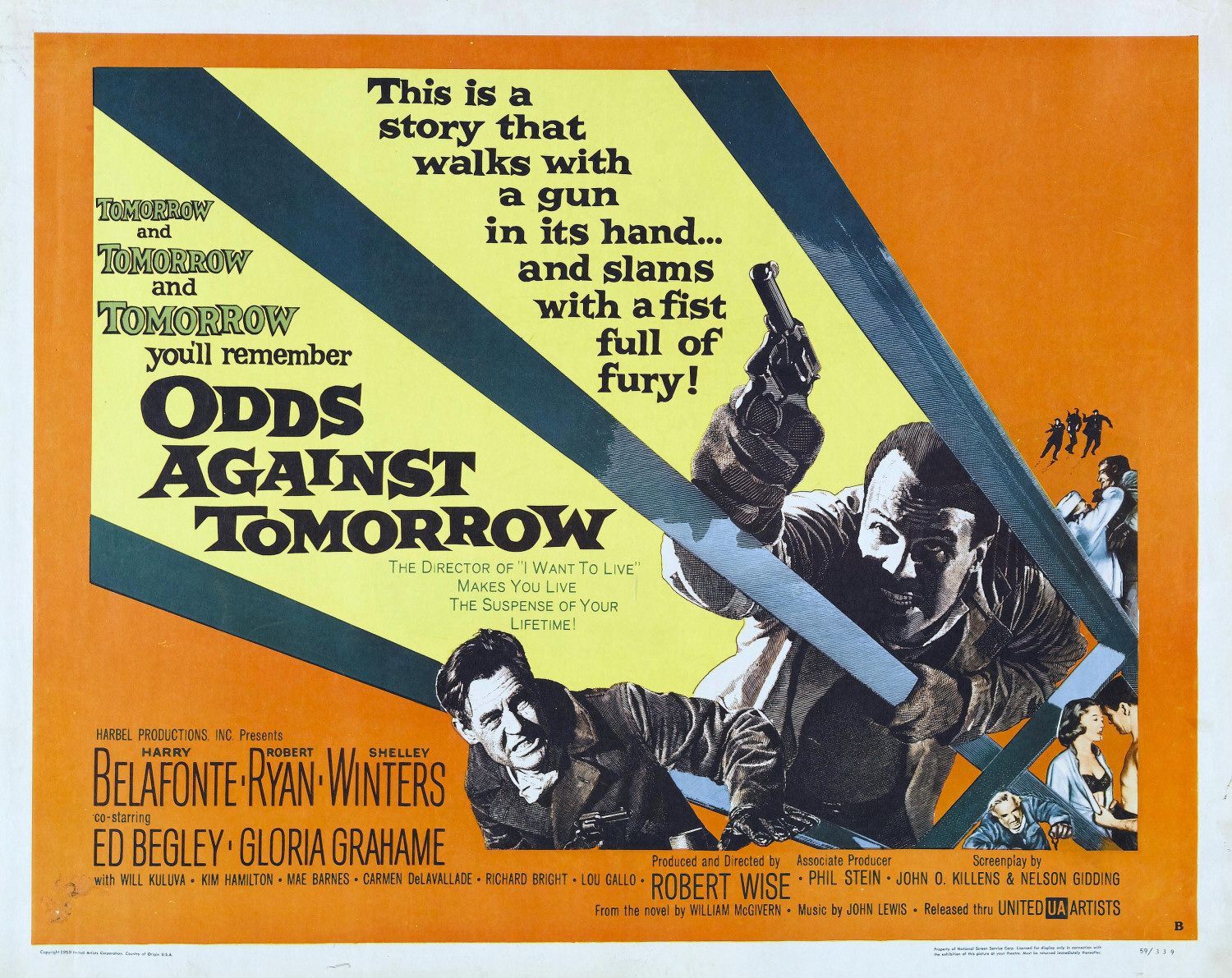
Odds Against Tomorrow (1959)

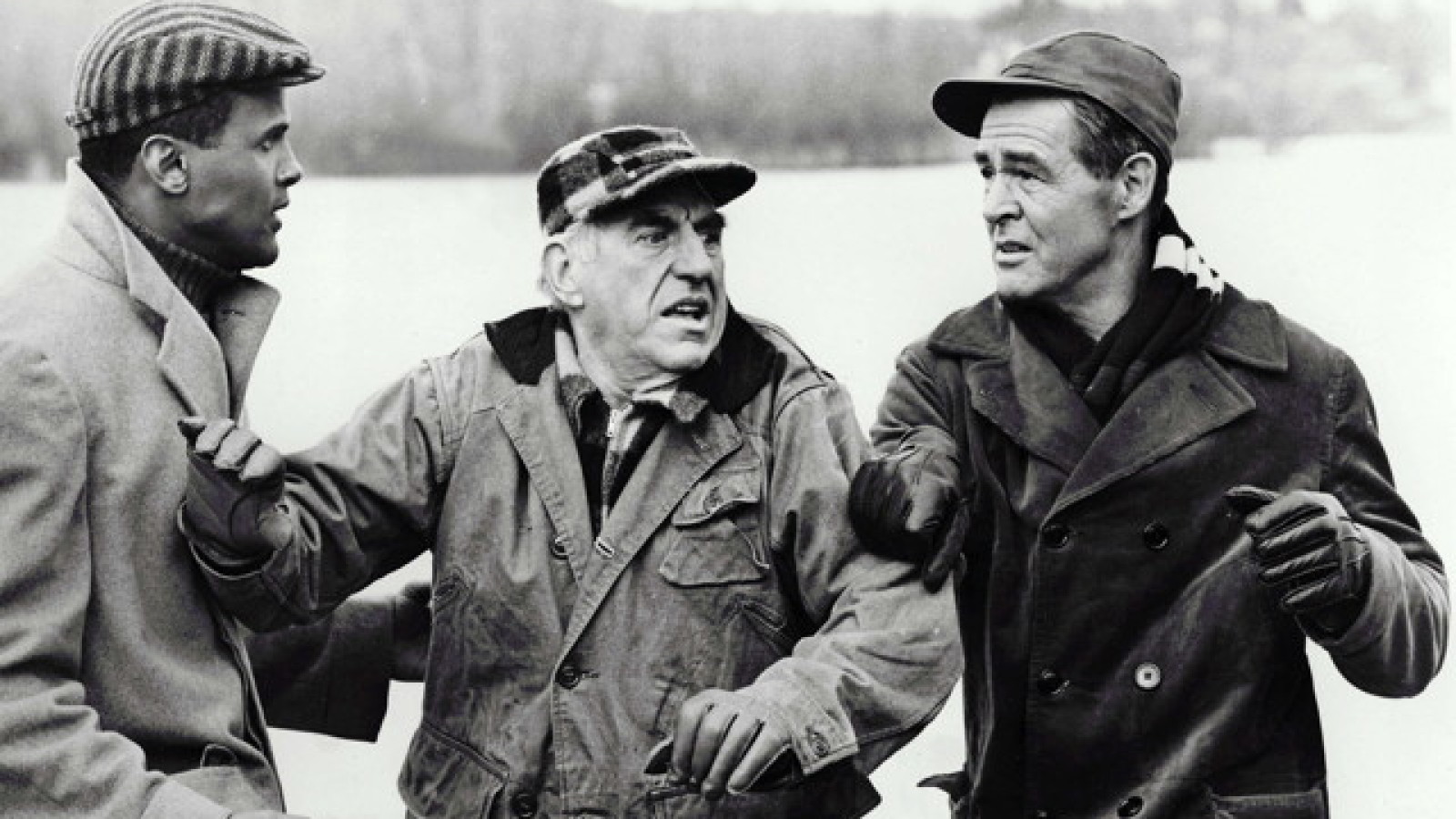
Harry Belafonte, Ed Begley and Robert Ryan are a mismatched crime team in Odds Against Tomorrow

Director: Robert Wise

Cast: Harry Belafonte (Johnny Ingram), Robert Ryan (Earl Slater), Shelley Winters (Lorry), Ed Begley (Dave Burke), Gloria Grahame (Helen), Will Kuluva (Bacco), Kim Hamilton (Ruth Ingram), Mae Barnes (Annie), Richard Bright (Coco), Carmen de Lavallade (Kitty), Lew Gallo (Moriarty)

Johnny Ingram (Harry Belafonte) life is on the skids. His career as a singer isn’t bringing in the money to fuel his gambling addiction or help support his ex-wife. Owing money to gangsters, he’s roped into taking part in a bank heist master-minded by bitter ex-cop Dave Burke (Ed Begley). It should all go smoothly. Unfortunately, Burke has also recruited Earl Slater (Robert Ryan) as muscle – and Slater has channelled all his own insecurities and resentments into virulent racism. Can Johnny and Slater work together to make the heist work?

Wise’s picture – with a script by the black-listed Abraham Polonsky – is on paper a crime drama. But it’s really hardly interested in the heist (which is almost laughably simple) the planning of which doesn’t even start until the film is nearly an hour old. Instead, the focus is on putting together a neat parable for racial divide in America. Because if even criminals are more preoccupied with feuding over the question of the colour of each other’s skin than making a score, why on Earth should we be surprised that such problems arise in every walk of life?

Attitudes are mapped out early in the film, largely thanks to Wise’s crisply efficient story-telling. Ingram playfully tips off a group of mixed-race kids to watch his car; Slater singles out a black child from this same group with a smilingly delivered racial epitaph. In the building, they both have strikingly different conversations with a black elevator attendant. Its clear tensions will abound – not least because Slater won’t work a job with a black man and Ingram is rightly disgusted with him.

Belafonte produced the film and he plays a very different type of black American than most films had seen. Black characters frequently fell into being either noble or deferential. Johnny is neither. He’s angry, bitter, drinks and has no interest in compromise of any sort. Johnny is a deeply troubled man, who seems to be making a mess of his life. Above all he doesn’t rise above racial abuse or shrug it off, but angrily confronts it. Fundamentally he’s a chippy screw-up, but he always retains sympathy because we can see he’s really a decent guy, for all his faults.

He’s just not one who’s willing to play the white man’s game to get ahead. He’s quite clear with his wife (very effectively played by Kim Hamilton) that he’s not willing to simply conform with a structurally unfair world. He’s also quite clear with Slater that he doesn’t want to hear whimsical memories of the South during the ‘good old days’. Belafonte does all this with a great deal of energy, even if you feel he doesn’t quite have the range and power for the role.

It’s interesting though that the film finds plenty of room to explore Slater. Played with a fragile self-loathing by Robert Ryan (one of Hollywood’s great liberals, whose career was made up of characters who persecuted minorities), Slater is deeply unsettled and insecure. He’s struggling to adjust to a more modern world where the man isn’t always the hunter-gatherer, and his wife (a rather sweet Shelley Winters) has the fixed job he can’t get. He doesn’t understand the world anymore.

All this makes Slater vulnerable, confused and even a bit pitiable – all qualities Ryan effortlessly brings out in the film’s finest performance – stumbling into bar fights where he responds with far too much violence. His face constantly seems to crumble into something a little like tears. He engages in a brief fling with a flirtatious neighbour (a blowsy Gloria Grahame) simply, it seems, to try and feel better about himself. The only thing that give him strength, it seems, is turning Johnny and all other black people into an alien “other” which he can lambast and attack.

This of course leads to barely concealed tensions during the robbery planning – where Slater repeatedly states he doesn’t trust Johnny to complete anything – and then during the robbery itself when the fundamental distrust between these two leads to a shoot-out and disaster. Caught in the middle, in a polished performance, is Ed Begley’s Burke, lacking the force of character to make this odd couple work together.

Wise’s film sometimes make some obvious choices – after the final climactic shoot-out, a policeman comments “which is which”, which is about as “under the skin we’re all the same” as you can get. But it’s told with a leanness and pace and by focusing on social issues rather than crime, it presents an intriguing snapshot of American attitudes. The vast majority of characters don’t share Slater’s kneejerk racism – but they also don’t even think of challenging it. No wonder Johnny Ingram’s so annoyed – and no wonder he sees that, for all the smiles, it’s a world run by and for the white man where your only chance of success is conform and shut up. Maybe the odds are against tomorrow.

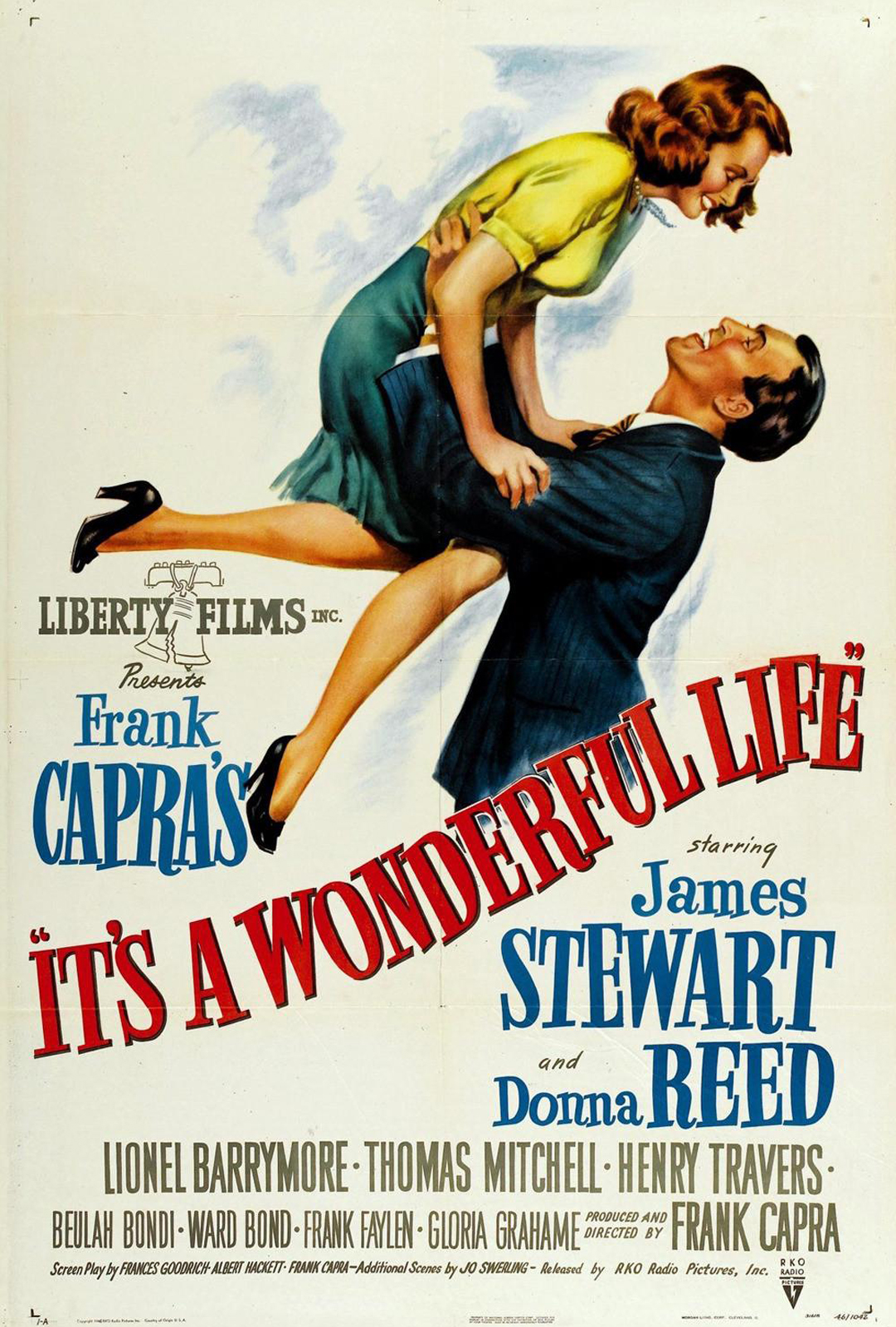
It's a Wonderful Life (1946)

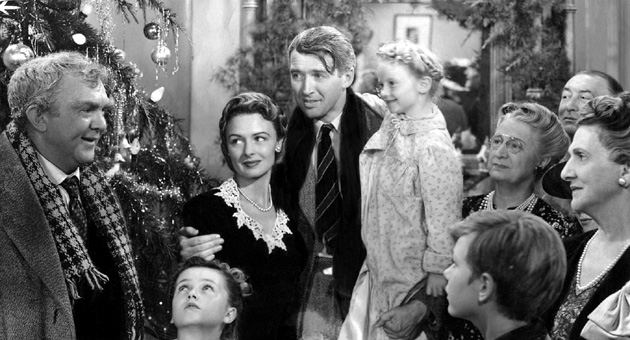
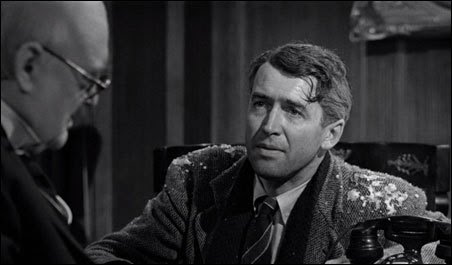
James Stewart discovers he has lived a good life in It’s a Wonderful Life

Director: Frank Capra

Cast: James Stewart (George Bailey), Donna Reed (Mary Hatch), Lionel Barrymore (Henry F Potter), Thomas Mitchell (Uncle Billy Bailey), Henry Travers (Clarence Odbody), Beulah Bondi (Ma Bailey), Frank Faylen (Ernie Bishop), Ward Bond (Bert), Gloria Grahame (Violet Bick), HB Warner (Mr Gower), Frank Albertson (Sam Wainwright), Todd Karns (Harry Bailey), Samuel S Hinds (Pa Bailey)

For many people it’s as much a part of Christmas as mince pies and Santa. Any list of the greatest Christmas films of all time – in fact any list of the most beloved films of all time – isn’t complete without It’s a Wonderful Life. Capra’s emotional, heart-warming, seasonal tale encourages us to take a breath and look at the riches in our life, to look past the surface frustrations and disappointments. It seems to have something to say to everyone. There’s a reason why it has been a staple of Christmas for decades.

The small town of Bedford Falls is a place George Bailey (James Stewart) has always dreamed of leaving for a life of adventure. However, circumstances always meant he has stayed in the town, running the family savings and loans business. He’s made a success of the business, raised a family with his wife Mary (Donna Reed – extremely good in an unshowy role), helped half the town into decent affordable homes, and changed his whole community for the better. So why is George standing on a bridge on Christmas Eve, contemplating throwing himself into the river? And will his guardian angel Clarence (Henry Travers) persuade him there are things worth living for?

Capra’s film is very easy to see as a wallow in sentimentality. Certainly, the film is in love with its image of small-town America, here a nirvana of folksy lightness where everyone knows everybody’s name. In reality, America as a whole, even at the time, probably had more in common with Potter’s grasping capitalism or the nightmare vision Clarence conjures of a neon-lit Potterville of loose morals and vice. But the film would never have worked if it was just sickly sentimental – or if it had been a cynical satire for that matter. Instead it works because it is overwhelmingly human, empathy dripping from every pore. It invests us deeply in this whole community and succeeds in making the viewer relate to them at every step.

This is partly because Capra has such a masterful skill for how the little touches can make a story come to life. The loose banister cap that Bailey keeps dislodging in his home. The drawing Donna has made of George’s offer to lasso the moon. The film is full of small moments of character, that create the over-whelming richness of a whole life. It’s also a story full of charm and genuine feeling for its characters, that understands the pain little griefs and small tragedies have.

Perhaps that’s also one of the reasons for the love people have for it. Because, let’s not forget, this is a film set on the darkest day of its lead character’s life, when he considers ending it all. One of the things I find the most touching about the film is that it never stigmatises depression, guilt or feelings of inadequacy. If someone as universally loved as George can look at his own life as a disappointment, and that this feeling is treated as both reasonable but also mistaken in the best way, it reassures as all not only that we shouldn’t feel guilty for feeling this but hopefully that we are as mistaken as George is. Failure is all in the perception – and It’s a Wonderful Life reminds us that perception is often unreliable when we turn it on ourselves.

Capra’s film relies strongly on our bond with George – so the casting of James Stewart in the role plays off perfectly. Stewart is quite simply superb, completely human and deeply moving. Capra provides Stewart with several striking set-piece speeches (all of which he delivers with aplomb). The entire film is essentially a riff on Stewart’s charm and likeability – but also his everyday quality, the sense that when we watch him we are looking at someone like us. Stewart makes Bailey honest, decent and kind. You can immediately see why people like him. His principles and sense of justice drive him every day to do the right thing – and what makes him such a deeply relatable character is that this so often flies in the face of his own desires and interests.

What Capra also understands – and taps into so well here – is the darkness in Stewart. Because someone so like us is surely as likely to suffer from  depression and disappointment as the rest of us. You can never forget this is a man who has dreamed his whole life of leaving this town, of making it as an architect, of forging a broader life for himself. He never wanted to be the pillar of the community and family man he becomes. There is disappointment in Bailey at every turn, however much he treats the world around him with warmth. This isn’t what he wanted. No matter if it has won him love and respect from all around him.

And who hasn’t ever felt that? But we know that deep down – even if he doesn’t always realise it – Bailey is happy with his lot. That if he didn’t care deeply about town, friends and family he would have left years ago. We know he’s a good man: that later he will deeply regret berating his poor befuddled Uncle Billy (a gloriously cuddly Thomas Mitchell) for losing $8k and losing his temper at his wife and children on Christmas Eve. There is a pain for us to see such a good man, a loving man, who we feel we understand, angrily ask his wife why they had so many children. Everyone has lashed out like George – and everyone has, at some time, looked at where their life is and felt “I could have been more than this”. Far fewer people have taken the time to look at all the good alone in their lives and what a good mark they have made on the world.

But that’s the genius of the film. Taking its cue from Dicken’s Christmas Carol (I’d also say Lionel Barrymore’s brilliantly hissable Potter is clearly a version of Bleak House’s vile moneylender Smallweed), effectively Clarence is the Ghost of Christmas Present, showing George what the world would have been like without him. Sure some of this is overblown – Potterville for goodness sake! – but the impact is those personal stories. The brother drowned as a child. The pharmacist imprisoned for manslaughter. The affordable homes never built. The family that never even existed. The mix of science fiction and classic morality tale helps us all to reflect – so many of us have people all around who care for us, whose lives would have not been as rich as they are without us, however much we may disappoint ourselves at times.

That’s perhaps behind the love for the film. It’s about hope, while never closing its eyes to despair. It recognises that sometimes we are not happy – and it tells us that that’s okay, so long as we don’t lose hope. It encourages us to take a look at ourselves in the round and to appreciate the whole picture, not just a part of it. You can call that sentimentality if you want – but at Christmas time this message of hope and love is sometimes exactly what you need.

The Big Heat (1953)

Lee Marvin, Gloria Grahame and Glenn Ford feel The Big Heat coming on

Director: Fritz Lang

Cast: Glenn Ford (Det Sgt Dave Bannion), Gloria Grahame (Debby Marsh), Lee Marvin (Vince Stone), Jeanette Nolan (Bertha Duncan), Alexander Scourby (Mike Lagana), Jocelyn Brando (Katie Bannion), Adam Williams (Larry Gordon), Kathyn Eames (Marge), Willis Bouchey (Lt Ted Wilks)

Films like Fritz Lang’s The Big Heat were generally seen at the time as easy-to-overlook pulp thrillers. Today however, they are seen as classics and few look as ahead of their time as The Big Heat, a skilfully constructed, almost nihilistic, revenge thriller that turns its view of America into that of a land big, grim and full of corruption.

Detective Sergeant Dave Bannion (Glenn Ford) is called in when a senior policeman is found to have committed suicide. All is not what it seems though: the wife Bertha (Jeanette Duncan) doesn’t seem as sad as she should, there are conflicting reports that the death might be suicide and the dead man’s possible lover is found brutally killed shortly after Bannion talks to her. Bannion is a stubborn, bull-in-a-China-shop type, so he quickly assumes smooth local gangster Mike Lagana (Alexander Scourby) is connected up in all this, not least after his wife Katie (Jocelyn Brando) receives a threatening phone call. But Bannion’s methods lead to tragedy, and he soon finds himself going rogue to find justice, with the eventual help of Debby Marsh (Gloria Grahame), gangster’s moll of brutal sadist and Langana lieutenant Vince Stone (Lee Marvin).

Lang’s film is a strikingly un-rose tinted view of America. The very first shot of the movie is a gun, and violence is endemic in this corrupt world, where justice is for sale. We barely see a character who doesn’t have some whiff of corruption. Bannion finds cops doing guard duty outside Lagana’s home while he throws a party and half the higher-ups in the department are either in the pocket of the gangsters, or determined to do as little as possible to rock the boat. The lives of the families of those causing trouble for this system don’t account for much either, with any unpalatable truths brushed firmly under the carpet.

Thown into the middle of this is Glenn Ford’s Detective Bannion. At first glance Bannion looks like exactly the hero we would want – a straight-down-the-line type who says what he thinks, and determined to let nothing stand in the way of, or water down, his investigation. Better known for comedies, Glenn Ford is very good as this bullish man, who very clearly thinks of himself as “the only good cop in town”, and whose determination to stop at nothing very soon tips over into recklessness. Because reckless is what he is: Bannion is fixated on revenge after a tragic attack on his family, and he has no compunction – or even it seems moral awareness – that this path causes danger and consequences for other people around him.

Bannion’s situation is largely self-inflicted – is it sensible going straight to the house of a leading local gangster and threatening and humiliating him? – and Bannion turns out to be largely a destructive force for those who meet him. Most affected are the four female characters he interacts with in the film. A mixture of innocent, corrupt, in denial and cruel, all four of these women find themselves thrown into often mortal danger, with Bannion barely stopping to consider the risks to them. Bannion, it becomes clear, is the ultimate ends-justify-the-means kind of guy, willing to accept collateral damage of almost any kind if it means he can take down the bad guys who have done him wrong. It makes for an intriguing anti-hero at the film’s centre, with Bannion increasingly resembling a sort of proto-type Dirty Harry, the hard-boiled cop who’ll do things his way and damn the consequences.

Mind you, it doesn’t mean he isn’t right about the corruption in this damn dirty town. Preening gangster Mike Lagana (played with a wispy arrogance by Alexander Scourby) has everyone in his pocket, and couldn’t give tuppence for any small fry causing him problems. First introduced lazily in bed setting in chain events that will cover up the reason for the suicide of a leading policeman, he has fingers in every pie. He’s also – the film economically suggests – sexually indiscriminate and a bit of a mummy’s boy to boot, sure signs of cadism in any 1950s detective story. His decadent home and personal cowardice (for all his speed in ordering deaths) make his corruption probably even more galling for straight-shooter Bannion.

In fact, I’m not sure Bannion can even accept Lagana as a “worthy foe” and he increasingly zeroes in on Lagana’s number two, the brutish Vince Stone as the man he intends to take down. Played with a star-making swagger by Lee Marvin, Stone is a force of nature, an act-first-think-next-week kind of guy, who terrorises people around him and will resort to anything from fists to pots of boiling coffee to exact obedience. Marvin scowls and prowls his way through the film like a caged bear, constantly on the verge of violence. It’s a brilliant performance.

It also makes clear why he’s pushed Debby – played with a wonderful fragility behind all her femme fatale looks by Gloria Grahame – so far under his thumb. As she says, why intercede against anything he does when she could be next to take a beating. Grahame is excellent as a woman who has suppressed her conscience about what is going on around her, and learned to use her sexuality as a tool for getting what she wants. Watching her slowly begin to come to life as a moral force provides one of the film’s finest stories – her desire to do the right thing and get revenge, a firm contrast with Bannion’s more hardline goals.

All of this is packaged neatly and without fuss by Lang into a superb indictment of America. Every official is at least shady, if not outright bent. Every scene bubbles with the possibility of violence and danger. The innocent are swiftly trampled and the heroes need to bring themselves down to the same brutal, intimidating rough and tumble as the villains to have any chance of cracking the crime. Bodies pile up, lives are ruined, but at the end you still wonder if any of it will have any lasting impact. For Lang it feels like America is a constant spiral of danger and corruption that begins and end with a gun. Either way The Big Heat is a true classic.