
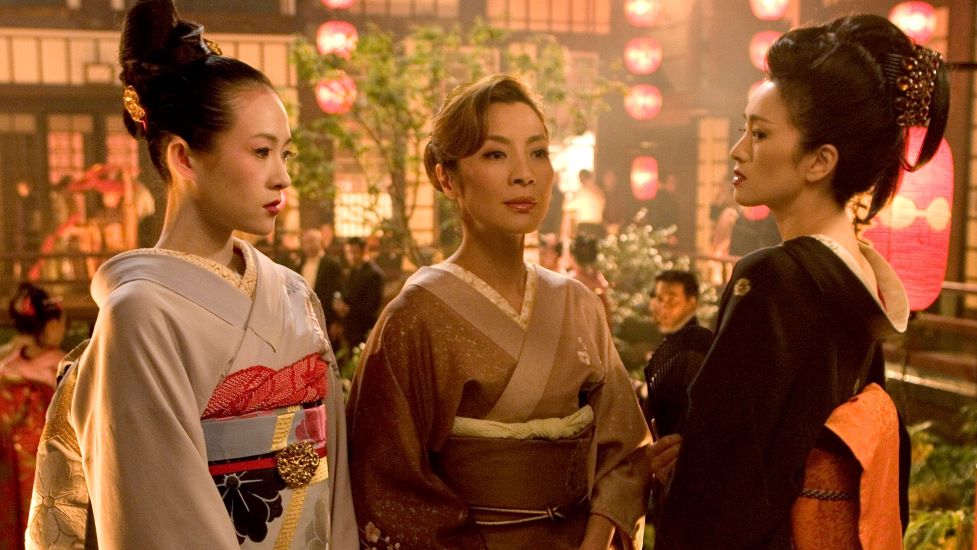
Tag: Gong Li

Memoirs of a Geisha (2005)

Memoirs of a Geisha (2005)

Lush romantic adaptation settles for tourism and pretty pictures instead of any emotional or narrative weight

Director: Rob Marshall

Cast: Zhang Ziyi (Sayuri Nitta/Chiyo), Ken Watanabe (Chairman Ken Iwamura), Michelle Yeoh (Mameha), Gong Li (Hatsumomo), Suzuka Ohgo (Young Chiyo), Kōji Yakusho (Nobu), Kaori Momoi (Kayoko Nitta), Youki Kudoh (Pumpkin), Kotoko Kawamura (Grandmother Nitta), Tsai Chin (Auntie), Cary-Hiroyuki Tagawa (the Baron), Samantha Futerman (Satsu Sakamoto), Mako (Mr. Sakamoto)
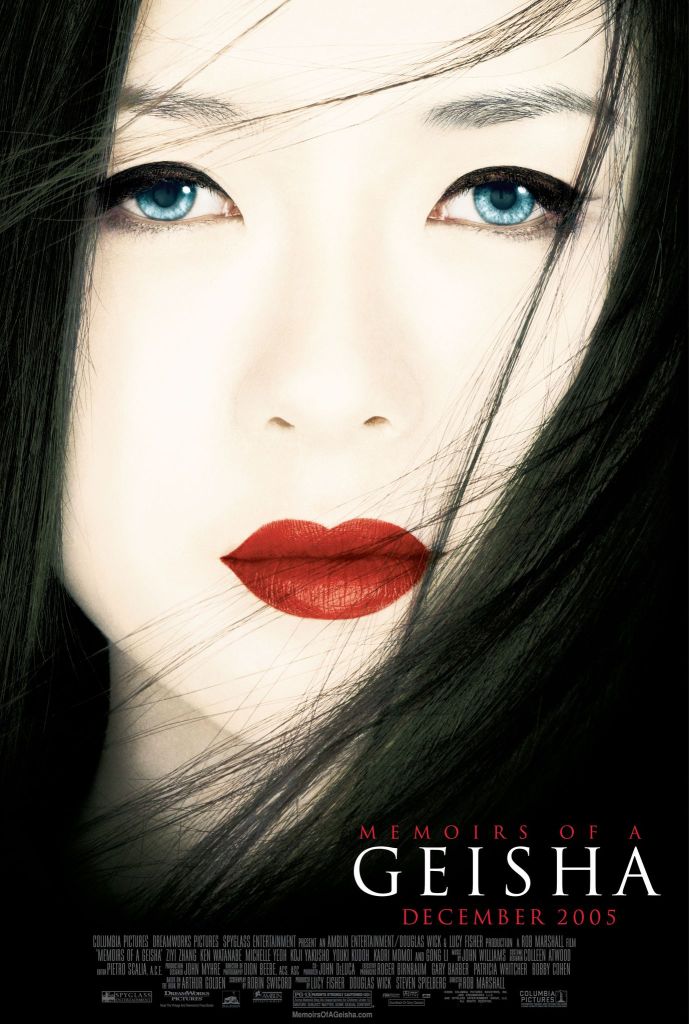
In 1920s Japan, 9 year old disgraced former geisha pupil Chiyo (Suzuka Ohgo) meets a businessman, Chairman Ken Iwamura (Ken Watanabe), who is kind to her. She resolves to one day become a geisha so she may see him again. As a young woman, Sayuri (Zhang Ziyi), as she is now known, masters the geisha arts under the tutelage of famous geisha Mameha (Michelle Yeoh). She encounters the Chairman again – but can she confess her love? And can she escape the attempts of her rival Hatsumomo (Gong Li) to destroy her?

Arthur Golden’s romantic novel was a major success in 1997, tapping into a fascination with Japanese culture. It was inevitable it would come to the screen. But in the journey, it has been stripped down into a beautiful but basically empty story, that seems trite and shallow and revolves around hard-to-invest in characters. By the time it’s finished you’ll wonder what the fuss was about.

The reconstruction of 1920s-40s Japan does look radiant, even if the film focuses on the most chocolate-box, touristy view of Japan you could possibly imagine (think of a Japanese item, event or object and it’s in the film). But it’s radiantly shot and intricately put together – the geisha costumes are a gorgeous, multi-layered, decorative treat – and it’s not a surprise the film lifted three Oscars for cinematography, production and costume design.

It’s not a surprise as well that it was overlooked in all the majors. It’s well-directed by Rob Marshall (juggling a multi-lingual cast and framing the film beautifully), but fundamentally a mix of the highly predictable and the deeply troubling. It’s basically Geisha Expectations or Jane Geishyre. Our heroine is a poverty-stricken youth who makes a series of key encounters in her childhood that shape her whole personality as she comes into wealth as a young adult. Similarly, this quiet girl’s obsessive love for a distant businessman (whom, yuck, she meets as a child – and he compares her to his own children), suffering quietly while sacrificing everything to help him.

But it’s all much less interesting than either of those novels. Despite the narration by an older Sayuri, we never get inside the young woman’s head. Ziyi Zhang is given very little to work with: she either looks distressed, simpering or sad, and frequently fades into the background of her own story. All we really learn about her is that the Chairman gave her an ice cream when she was 9, and that this event influenced her entire life. Equally dull is the Chairman himself, whom Watanabe struggles to make anything other a mute and inscrutable character, terminally dull.

It’s hard to invest in a love-across-the-ages (in every sense) romance between these two, because the film fails to build them up as characters we care about and gives them hardly any time to be together. By the time we reach a late confession, that the Chairman decided (when Sayuri was 9) to turn her into his ideal geisha (um, grooming anyone? Oh yuck) and they finally kiss each other, they still feel like complete strangers. She never matures into a woman who can fall in love past her childhood obsession and he seems more like an oddly manipulative sugar daddy.

Memoirs of a Geisha flounders on the empty plot and non-characters at its heart. It ends up relying on the visuals and lovely design work, because there is no drive or interest in its plot. The film’s most compelling performance is Gong Li’s Hatsumomo and when she walks out of the picture three quarters of the way through, it never recovers. Gong is superb as an envious, embittered geisha being replaced by younger faces. She snipes and growls like a relic from a Bette Davis Hag-thriller, but in the next scene her face will crumple with fear and sadness. She gets all the best lines and the most interesting scenes, from sniping, to lost love to pyromaniac revenge.

Memoirs of a Geisha disappointed at the box office. It’s clumsy casting didn’t help: fine actresses as Zhang, Yeoh and Gong are, they were all Chinese (in Yeoh’s case Malaysian Chinese) rather than Japanese, and there was an uncomfortable feeling that the producers didn’t think this was really an issue. It opened up a can of worms about lingering Chinese hostility over Japanese war crimes, leading to a ban in China. In Japan, the casting was condemned and the film seen as more interested in a tourist eye on geisha culture than a truly Japanese one (and it does appear the film consulted virtually no Japanese people during its making).

All the glorious design in the world can’t hide the emptiness at the heart of Memoirs of a Geisha. World War Two is skipped over in about two minutes (Sayuri spends the time working in the hills, and sums up her whole wartime experience in a couple of sentences, delivered in voice-over while Zhang looks beautiful and pained washing fabric in a river). Other than their external glamour, we don’t learn much about what being a geisha actually means. Its central romance goes from bland, to anonymous, to deeply troubling. It looks wonderful, but if there was anything deeper to the novel than a luscious, gorgeous setting and a predictable, traditional romance, it’s completely lost in translation.
Farewell My Concubine (1993)

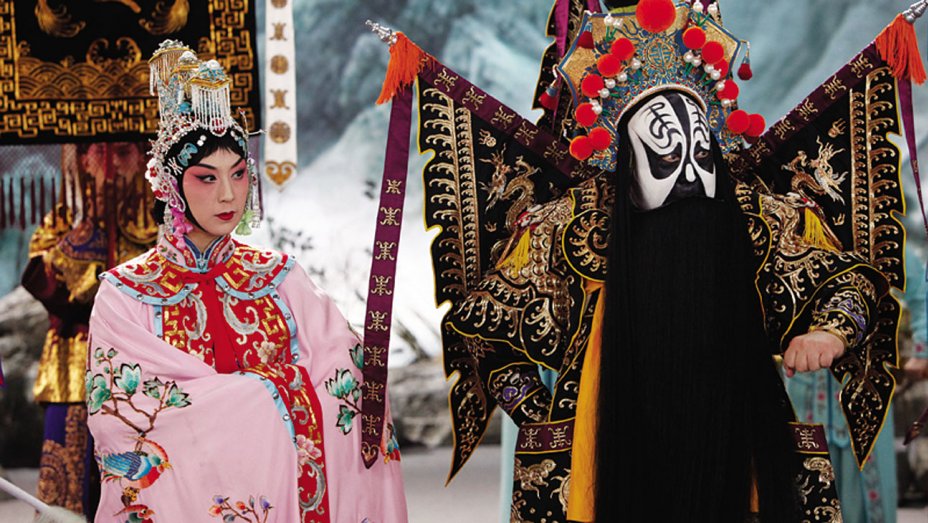
Leslie Cheung and Fengyi Zhang are the still centre for decades of Chinese history in Farewell My Concubine

Director: Chen Kaige

Cast: Leslie Cheung (Cheng Dieyi), Fengyi Zhang (Duan Xialou), Gong Li (Juxian), Ge You (Yuan Shquig), Lu Qi (Master Guan), Ying Da (Na Kun), Yidi (Eunuch Zhang), Zhi Yitong (Saburo Aoki), Lei Han (Xiaosi)

Chinese cinema isn’t well-known in the West. Maybe it comes from China so long being behind its own Red Curtain. Farewell My Concubine was pivotal to introducing Chinese cinematic culture to the West, winning a Palme d’Or and nominated for an Oscar. It’s surprising in a way, as Farewell My Concubine is a film that you almost need an intimate knowledge of Chinese history to truly appreciate (which I’m not sure I do!). But not surprising in another, as it is a glorious made, brilliantly acted and directed paean to the warmth of the human spirit.

Told over 52 years, from 1925 to 1977, the film follows two actors in the Peking Opera – Cheng Dieyi (Leslie Cheung) and Duan Xiaolou (Fengyi Zhang). Brought up in a brutally tough actor training school, the two become famous for their performances in the opera, Farewell My Concubine, about the suicide of a king’s concubine. Dieyi plays the concubine, while Xialou plays the king. The two actors are held together with a strong, almost unbreakable bond of brotherhood. But Dieyi also has a romantic longing for Xiaolou. Their relationship is made more complex after Xiaolou’s marriage to former courtesan Juxian (Gong Li) – but the three quickly find a relationship of tolerance, support and understanding that is tense but works. Around them China undergoes the Second World War, Japanese occupation, Mao’s seizure of power and the Cultural Revolution.

Kaige’s film is an epic that places an intimate and personal story at its centre and introduces global and national events which we largely understand from the perspective of our characters. This is a brilliant way of showing the seismic changes in China over this period – from the 1920s, which are so simple and Dickensian in their set-up that they might as well be the fifteenth century, to the increasingly brutal oppression of Mao’s regime. At the centre of all this is the relationship between the three core characters.

This relationship is almost impossible to define, so richly complex and human does it feel. It all rings immediately true – three people who are held very closely together by bonds of family, shared past and mutual dependency, but whose relationships are also rife with jealousies and regrets. Deiyi oscillates between vulnerability and guarded resentment against everyone around him. Xiaolou (brilliantly played by Fengyi Zhang, all warm-hearted charisma but easily led by others) is both annoyed and frustrated by Deiyi, but also goes to extraordinary lengths to protect him. Juxian (an enigmatic intelligent performance from Gong Li) at first seems to be a manipulative presence who wants to split the two of them apart, but comes to an unspoken accommodation with Deiyi that recognises they have a lot of shared interests and love.

All of this is simply beautifully done, subtle, un-obvious and brilliantly restrained, wonderfully acted by the three leads. Deiyi is a fascinating character, struggling with his sense of identity, trained from an early age to look and behave as much like a woman as possible. Is it any wonder that it has had an impact on his sexual identity? (The film’s openness about homosexuality – with Deiyi frequently being used for sex by his patrons – is one of many reasons it was nearly banned in China). Deiyi feels unable to express the feelings he clearly has, frequently falling back on imperiousness and pride. Leslie Cheung is just about perfect in this role: fragile, brittle but also harsh and unforgiving.

Kaige films all this beautifully in this visually striking film, using a host of brilliant images and wonderful lighting. The film’s opening hour covers the characters’ childhoods in the harsh training regime of the opera school, where beatings are common. Every character, by the way, accepts this as totally normal – in a striking later scene, the two adults meet their mentor again and immediately revert back to mutely accepting physical punishment for perceived wasting of their talent. One of the film’s striking commentaries on China in fact is the difference between their deference and the defiance of up-and-comer Xiaosi, who flat out refuses to take part in the harsh regime Deiyi tries to introduce and later becomes a leading light in the Cultural Revolution. It’s one of many ways the film uses the characters to demonstrate the changes in China.

The section covering the childhood of the characters is wonderfully done, a truly Dickensian series of events that will go on to define the lives and impressions of the two characters, skilfully built around the fate of a third friend – a more defiant joker who struggles far more to cope with the discipline of the camp compared to Deiyi’s stoic acceptance and Xiaolou’s matey deference. I truly loved this sequence and would happily have watched it for ever, every moment is so well observed, the child actors are marvellous and the claustrophobic world of the training school is immaculately observed (the outside world is so absent that the appearance of a car is actually a huge surprise as it makes you realise we are in the 20thcentury). 

But then this is a film that is set in a small interior world, which shifts and changes subtly as the wider Chinese world moves around it. The Japanese occupation seems to come from nowhere, a sudden interruption of a world where the two actors struggle to please patrons. The continued re-staging of the opera Farewell My Concubine is striking for how little it changes, a still centre of artistic conventionality (and it is conventional – every moment is handed down from previous generations, with Xiaolou constantly criticised for using five steps at one point where tradition demands seven). The imperious patrons rise and fall around the actors, victims to a China which is shifting quicker than they keep up. 

Kaige’s film also sharply criticises the excesses of the Cultural Revolution, that threaten this relationship and pressure the actors to denounce both themselves and each other. The Chinese government of Mao changes constantly in its views and demands, faster than many can keep up – and what is acceptable one year becomes a capital crime the next year. Deiyi is ordered to perform for the Japanese, and later nearly faces death for this. A patron pivotal in saving him is later a man condemned for having that kind of power. Welcome to China.

Farewell My Concubine works because it puts the sprawling history in the background of this personal story of the relationship between three characters who need each other in ways they can hardly understand, increasingly drawn together as fixed points in a changing world. When the rules of yesterday are the crimes of tomorrow, is it any wonder you cling closer to the few people around you who understand and remember what you were like and where you are from?

Deiyi, Xiaolou and Juxian are characters held together by bonds that seem unshakeable, which allow them to frequently anger and attack each other but constantly draw them back to each other to support and save each other. Kaige’s understanding of this – and his brilliant discipline in refusing to add moments of definition to the feelings between these characters, but allowing us to interpret and form our own opinions of how their relationship works – is brilliant, and Farewell My Concubine is a brilliantly made, fascinating and infinitely rewarding film.