
Tag: Gordon Jackson

Mutiny on the Bounty (1962)

Mutiny on the Bounty (1962)

Epic retelling that sticks with the same melodrama and nearly destroyed Brando’s career

Director: Lewis Milestone (Carol Reed)

Cast: Marlon Brando (Lt. Fletcher Christian), Trevor Howard (Captain William Bligh), Richard Harris (John Mills), Hugh Griffith (Alexander Smith), Richard Haydn (William Brown), Tarita Teriipaia (Princess Maimiti), Matahiarii Tama (Chief Hitihiti), Percy Herbert (Matthew Quintal), Duncan Lamont (John Williams), Gordon Jackson (Edward Birkett), Chips Rafferty (Michael Byrne), Noel Purcell (William McCoy), Tim Seely (Midshipman Ned Young), Henry Daniell (Admiral)

After the success of Ben-Hur, MGM thought it had cracked the mystery of making those cash-registers go ring-a-ding: massive historical pictures, with scale and run-time dialled up to “epic”. Mutiny on the Bounty was one of the most famous stories of all time and they’d had signed up Marlon Brando, universally seen as the greatest actor alive. It couldn’t go wrong, could it? Months of shooting and a disastrous box-office release later (despite a MGM campaign that landed this a Best Picture nomination), and Mutiny on the Bounty effectively destroyed Brando’s career for the next ten years and became a by-word for star excess.

Brando played mutineer Fletcher Christian – but in a manner completely different from Clark Gable (who, Brando disparagingly stated, only played himself minus the moustache). Brando’s Christian would be British and then-some: posh, foppish, a gentleman torn between the rules of society and those of fair play. Bligh – played with a constant sneer by Trevor Howard – would follow in the footsteps of Laughton, but Brando wanted to make something more serious, more historical. Less of a blood-and-thunder naval drama and more a character study that would give a fair crack of the whip (so to speak) to the Tahitian natives the mutineers lived among.

The film we ended up with though is no more historically accurate than the 1935 Best Picture winner. Part of the film’s disastrous reception might well be that this epic tells more-or-less exactly the same salacious story of a devilish sadist scowling as he whips men to death (far from the truth of the real Bligh, a poor leader but not a monster) until his noble number two steps up (the real Christian was a spoilt weakling) but in what feels like twice the time with half the fun. If you want to watch this version of the Bounty story, why would you want to choose this one? (We’d have to wait until the 1984 version for a more fair-handed telling.)

Not that Mutiny on the Bounty is as terrible as its reputation suggests. It touches – particularly in its thoughtful post-mutiny coda on Pitcairn island – on an interesting character study of the mixed motivations of Christian, filled with regrets and self-pitying sulking. It wants to explore where the balance lies between what is right by the letter of the law and by its spirit. Nothing Bligh does in the film is wrong as such, but his relish and zeal in doing it are. Christian isn’t a conventional hero, but a smirking, foppish character prone to snide remarks and affecting an air of disconnected duty for large chunks of the film. If the film had allowed Bligh more sympathy, rather than the two-dimensional monster he’s portrayed as here, it might have made for an interesting character clash.

Instead, it tends to be slow, self-important and pompous, not helped by Brando’s indulgent performance which sacrifices drama for portentousness. For all the film offers a cartoonish villain, it’s resolutely unfun and deathly serious. Shot with a professional, disengaged widescreen flatness by Milestone (called in from decades of retirement as a “safe-pair of hands”, after the sacking of Carol Reed), it’s uninspired and mistakes size for visual interest. The ship, in particular, is shot with a wide-angled spaciousness which feels completely wrong for a location supposed to be ripe with claustrophobic tension.

The drama attempts to make up for this with its parade of lashings, keel-haulings and bodies (or obvious dummies) tumbling to their death from the rigging. Trevor Howard delivers exactly what’s asked fork here, sneering and constantly in the wrong. It’s one of the film’s failings that it leans into psychological complexity in some places, while most of its events and its second lead are presented with cartoonish silliness. Its location shooting in Tahiti looks great (although the all-too-obvious intercutting of this with scenes on sound stages, sometimes from one cut to another, jars) but a widescreen image of glistening sea would look gorgeous in even the most workmanlike hands.

Perhaps the film is, at times, a chore because it all too clearly was for many involved. Reports of Mutiny on the Bounty have regularly focused on its disastrous making, with directors fired, location shoots awash with dysentery, shooting months over schedule. Above all, Brando rewriting the film on the fly, muscling a disinterested Milestone aside to direct certain scenes. Not a surprise that the studio decided all the blame would be dropped on him not them (they were also stung by the contract they gave him, at $5k a day overtime, Brando’s perfectionism becoming one of the main factors of the film going months over schedule), leaving him virtually unemployable for a decade.

But is that fair? Brando arguably become the awkward, unlikeable, misunderstood Bligh with the cast and crew as the mutineers, all of them intent on a voyage of mutual self-destruction. Put simply, this was a clash between Brando’s immersive, deep-dive acting style and Old Hollywood. To Brando “professional” meant something very different to the “hit-your-marks-say-your-words” attitude of Milestone and the crew: it meant searching over time for the heart of a character. The sort of psychological depth Brando was aiming for was just anathema to many of those he was working with, coming across as the unprofessional self-indulgence of a spoilt star. Combine that with Brando’s stand-offish shyness and professional selfishness and you had a recipe for disaster.

Severed from any director he respected (he made it all too clear he considered Milestone a hack studio Yes-Man) and with no-one having either the power or inclination to restrain him, Brando threw every idea he had at the screen, no matter how awful. So we got Christian with a ludicrous, giggle-inducing accent, a performance stuffed with foppish eccentric touches (and awful costume choices) that aims at thoughtful re-invention but comes across as a camp, bizarre mess. The tragic thing is Brando is clearly passionate about the project, putting more thought and commitment into this performance than he ever offered in barely-bothered turns in films like Sayonara.

Brando was also working with a group of Reed-recruited actors with no sympathy for him. This group of macho British and Irish heavy-drinkers (Hugh Griffith, in a crucial role, frequently disappears for no reason as his alcoholism eventually became such a burden he was fired mid-shoot) had no sympathy for the fey Brando or his acting style. Richard Harris’ loathing of his co-star – who responded to their open dislike with petty on-set power-plays, only making the whole problem grow – in particular is all too-clear. Brando looks most comfortable working with the Tahitian actors (he had long been a passionate anti-racist campaigner) and later married Tarita Teriipaia. It’s one of the few times where he makes Christian feel fully human rather than a mixed bag of conflicting actorly tricks.

Mutiny on the Bounty has its moments: unfortunately it’s all the wrong ones. For a film that wanted to be a more serious, historical exploration of the mutiny, its best parts revolve around Howard’s lip-smacking villainy, combined with flashes of its on-location shooting. Problem is, that’s not dissimilar from what we got in the 1935 original – and really you’d just be better off watching that.
The Great Escape (1963)

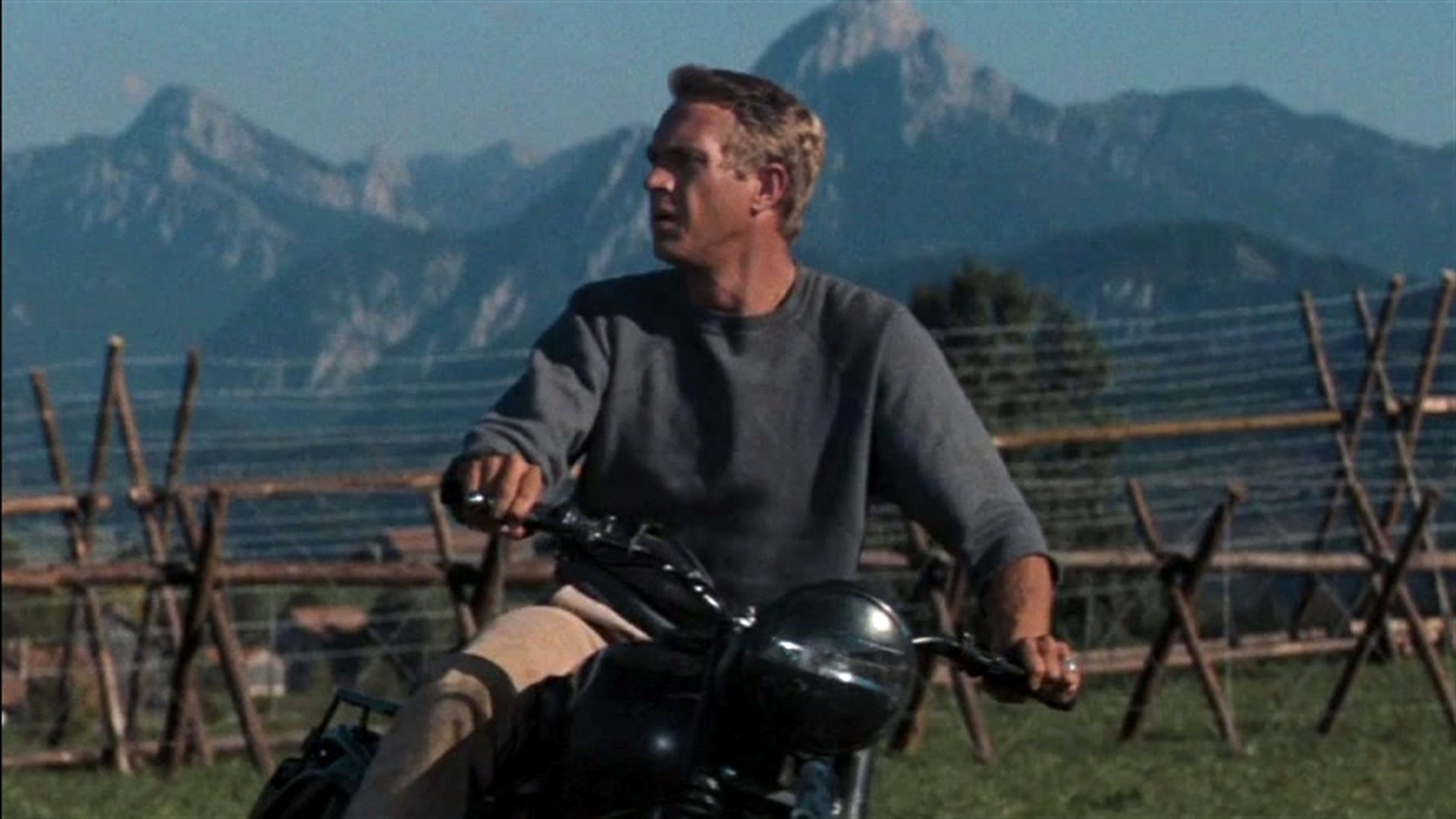
Steve McQueen is the Cooler King (King of Cool?) in The Great Escape

Director: John Sturges

Cast: Steve McQueen (Captain Virgil Hilts), James Garner (Flight Lt Bob Hendley), Richard Attenborough (Sqd Leader Roger Bartlett), James Donald (Group Captain Ramsey), Charles Bronson (Ft Lt Danny Welinski), Donald Pleasance (Flt Lt Colin Blythe), James Coburn (FO Sedgwick), Hannes Messemer (Oberst von Luger), David McCallum (Lt-Commander Eric Ashley-Pitt), Gordon Jackson (Ft Lt Andy MacDonald), John Leyton (Ft Lt Willie Dickes), Angus Lennie (FO Archie Ives), Nigel Stock (Ft Lt Dennis Cavendish), Robert Graf (Werner)

Is there a film in Britain more associated with holidays than The Great Escape? While I was growing up it felt like a day-off wasn’t complete unless the BBC screened it as part of their afternoon schedule. In Britain is has a status as a sort of cosy uncle, a part of the furniture of many people’s filmic lives. There is always something comforting and reassuring about The Great Escape. So much so, people forget it ends with a large bodycount and the majority of our heroes further away from freedom than when they started.

But it doesn’t really matter, because The Great Escape is one of the last hurrahs of effective, nostalgic war-films. The sort of hugely enjoyable caper that recognises the cost of war, but also celebrates the pluck, ingenuity and guts of Allied servicemen, running rings around those dastardly cheating Nazis. Where we would all like to look back and remember those days when men-were-men and worked together towards a common goal. Sturges has created a marvellous tapestry of a movie, that pulls together several striking scenes, characters and snippets of dialogue into a true ensemble piece that reflects the camaraderie and unity that exists between the prisoners as they work towards their escape.

In some ways, The Great Escape is such good fun, such well-packaged entertainment and telling such an exciting, uplifting and (in the end) moving story that it’s almost immune to criticism. You’d have to have a pretty hard heart not to enjoy it. And you’d have to be pretty cynical not to enjoy the way it presents a series of obstacles and then carefully demonstrates the fascinating and rewarding ways the prisoners resolve these. It’s also notable that, aside from the shadowy Gestapo types, the film doesn’t really have an antagonist. The enemy is that fence. Most of the Germans are just regular soldiers doing a job – it’s only the brutal final-act Gestapo who are aren’t playing this eccentric game. But this helps us sit back and enjoy the film as a caper – just as it makes the burst of machine-gun fire that (nearly) ends the film even more impactful and shocking.

Sturges’ gets the tone of the film spot-on, and also draws a series of perfectly balanced performances from his all-star cast. I think it’s fair to say a lot of the film’s success was connected to Steve McQueen’s casting in the crucial role of Hilts. McQueen channels a sense of 1960s anti-establishment cool into the film (unlike the rest of the POWs, he seems to be wearing basically his own clothes in t-shirt, chinos and bomber jacket). Iconically bouncing his ball against the wall in a cooler, a natural loner (who of course still does his bit), with a cocky sense of defiance and some exceptional motor-bike skills, Hilts is undeniably cool. He’s the face of the film – and the one you walk away wanting to be.

He also gets the film’s definitive claim to fame, with a series of daring motorbike stunts as he races across Germany to escape. Mostly performed by McQueen himself (although not the most famous fence jump, done by a stuntman) this last act chase is a gripping, action counter-point to the more cagey, paranoid runs of the other escapees. It’s so exciting and feel-good, it’s a surprise to remember that Hilts actually gets caught. But then, if he hadn’t, we’d have lost McQueen’s cool, wry shrug of acceptance as he and his mitt were sent back to the cooler in the camp for another 20 days.

The film tees up plenty of sub-plots for the rest of the cast, with Sturges’ spreading the love very effectively. Charles Bronson gets perhaps the best plot as “tunnel king” Danny Welinski who holds back his crippling claustrophobia almost long enough. I think this might be Bronson’s finest hour, giving a real vulnerability to Danny, with genuinely quite affecting whimpers and fear at confronting the tunnel – making his struggle all the more moving. Bronson makes a wonderful double-act with John Leyton as fellow tunneller Willie Dickes, the two of them forging an affecting bond of loyalty.

A similar bond also forms between James Garner’s suave and playful scrounger Jack Hedley and Donald Pleasance’s professorial forger Colin Blythe (has there ever been a more “Colin” Colin on film than Pleasance?). The final moments between this pair carry perhaps the biggest gut-punch of a film that has a surprising large number of them. Pleasance’s sad attempts to hide and combat growing blindness are genuinely affecting, while Garner is a master at conveying depth beneath a light surface. Sturges’ film taps into the nostalgic memories most of us have (or have picked up) of this war being one where life-long friendships were formed against horror and adversity.

Attenborough does most of the thankless heavy-lifting as Big X, but the film uses his Blimpish authority well. Gordon Jackson has a memorial role as the number #2 famously caught out by his own vocal trap (the sort of irony films like this love). Fans of the TV show Colditz can enjoy seeing David McCallum in a very similar role as a daring young escapee. James Donald channels British reserve as the senior officer. The film’s single truly bizarre performance is from James Coburn, with an Australian accent from the Dick van-Dyke school of ineptitude, so terrible even Sturges surely noticed it when cutting the film.

The Great Escape marshals all these cards extremely well. Any combination of any of these actors produces fireworks. It’s one of the best boys own adventure you can imagine. It in fact gets the perfect balance: you can spend a large chunk of the film thinking that being locked up in a German POW camp looks like the best time ever – and then it chillingly reminds you with its sad coda of the terrible cost of war. But it’s that first hour and half and its celebration of grit, guts, determination and ingenuity that really works – and it’s so entertaining that it solves immediately any mystery as to why any public holiday you’re 10-1 to find this popping up on your afternoon TV listings.

The Ipcress File (1965)

Michael Caine changes the face of spy films in The Ipcress File

Director: Sidney J. Furie

Cast: Michael Caine (Harry Palmer), Guy Doleman (Colonel Ross), Nigel Green (Major Dalby), Sue Lloyd (Jean Courtenay), Gordon Jackson (Carswell), Aubrey Richards (Dr Radcliffe), Frank Gatliff (Eric Grantby)

In the 1960s, the spy world was defined almost completely by the James Bond films. People had this idea of spies as glamorous, exciting people dealing with action and adventure in exotic locations. John Le Carré had started a counter-trend, but few alternative glances at the world of espionage landed with such skill as this adaptation of Len Deighton’s The Ipcress File.

Harry Palmer (Michael Caine) is a British agent in the secret service. Re-deployed to a section of the secret services headed up by Major Dalby (Nigel Green), he is tasked to investigate the disappearance of a number of leading scientists. But how does this link with mysterious Ipcress file?

The Ipcress File has dated very little – it’s still got a real sense of counter-culture cool, it’s engrossing and exciting, and it still makes comments that ring true about the lack of glamour in the world of espionage. It helps that it’s very well directed and designed, and that it has a star-making turn from Michael Caine (one of three he did in a row, with Zulu and Alfie). The Ipcress File looks and sounds great. It’s got an intriguing plot with twists and turns that still feel surprising and unexpected. It’s a great little spy thriller – and its deliberately small scale helps to keep it feeling fresh and inventive.

The British secret services are low-tech and underfunded. The offices are bare. Dalby’s operation is run out of what seems to a recruitment office. Cars are kept pretty basic. When Palmer is offered a new role, his first question is about a pay rise (he will get an extra £100 per year). There are no gadgets or glamour. Agents are partly selected not for their special skills but for their level of dispensability. The missions they undertake are confused or murky. The division line between allies and enemies is often unclear. Jobs are often boring or of minimal value (or both) – they’re more filing and paperwork than guns and glory.

Harry Palmer is about as opposite to Bond as you can get. He’s insolent. He’s chippy. He’s got a wry sense of humour. He struggles to hide his contempt for the toffs running the secret services. He’s a sergeant from the ranks. But he’s also cultured, well-read, intelligent and charming. He’s a great chef (surely the first film hero who cooks a detailed meal on screen – the shots of the hands were Len Deighton’s by the way). He cracks gags (more for his own amusement), often with a deadpan delivery. He has an eye for the ladies, but is hardly a Bond-style player. He’s a man of depth, who buys decent food, appreciates music and theatre, and carries a slightly bitter counter-culture grin just behind his eyes. He’s probably also the only film hero you’ll see shopping in a supermarket.

Michael Caine is perfect for this role (he went on to play it four more times). It’s a star-making role because he just drips charisma off the screen, while actually often doing very little. He underplays the role extremely effectively, using his natural calm and minimalism in front of the camera. It’s probably hard to appreciate how different it was at the time to see a man with a cockney accent play a lead role in a movie like this – other British film stars at the time had cut-glass RP accents. But Caine has a cheeky, insolent vibe that made him seem like the sort of hero you could relate to – the guy who is just working here, who could probably do a better job of running the show, but will never get that chance. Caine is also stubborn and bloody-minded, a squaddie at heart with a screw-you attitude just below the surface. He fits the role perfectly – and Palmer’s insubordination and sense of not being given his due matches up perfectly with Caine’s own (well publicised) attitudes to his place in this country’s film industry (who can forget his chippy collection of a BAFTA fellowship?).

John Barry’s score has a moody sense of cool that really helps to establish the tone of the film – its humour, its wry bitterness and its mystery thriller status. It’s an endlessly hummable series of refrains that perfectly matches up with the film’s part Third Man, part adventure fable structure. Sidney J Furie’s direction is very sharp and off-kilter, and he shoots many of the scenes as if from the perspective of an observer – the camera is positioned behind objects, or shots take place through cars or phone booths. Objects slightly obscure parts of shots. It gives us a constant feeling of being under surveillance. It increases the sense of tension and paranoia. And it makes the film look really distinctive.

If the film has a major flaw, it’s that its actual plot isn’t that strong. The reveal of the villain is made rather suddenly (and to be totally honest doesn’t really make a lot of sense). The plot line around the kidnap of the scientists is pretty unclear in both its intentions and the threat it poses to the country. The final sequence of Palmer captured and interrogated is a little underwhelming. The overall narrative never quite coalesces into something really compelling. But it somehow doesn’t quite matter, because the film is really a character study around a very cool leading character.


And it’s Caine himself who ends up carrying the movie. He’s a very different type of character. “What is he, some sort of fag?” producer Harry Saltzman apparently asked when he saw the sequence where Palmer gently cooks a proper meal for a potential girlfriend. Perhaps Palmer’s gently eyeing up of a number of women was added to counterbalance the fact that Caine plays him in this sequence as someone genuinely trying to form an emotional relationship. There are beats throughout of him as more Bond-style hero (he wakes up in his flat, and pulls a gun from the bedsheets, a visual slightly countered by the fact we’ve watched him make coffee and flick through the racing news). But really he’s a competent but slightly resentful professional, who knows he has hit a class-based glass ceiling.


The Ipcress File is a terrific movie, that looks unique and has a great soundtrack. It feels like a film that changed how heroes were perceived in British cinema – for all that films like Saturday Night and Sunday Morning had placed working class men at the centre of pictures, The Ipcress File not only made one a hero of a spy thriller, but did so while making him insubordinate and chippy rather than openly rebellious. Caine is quite superb in the lead role, and he never looked back after this – while Harry Palmer is surely a character who deserves some sort of place in a list of great film spies.