Tag: Graham Greene

The Green Mile (1999)

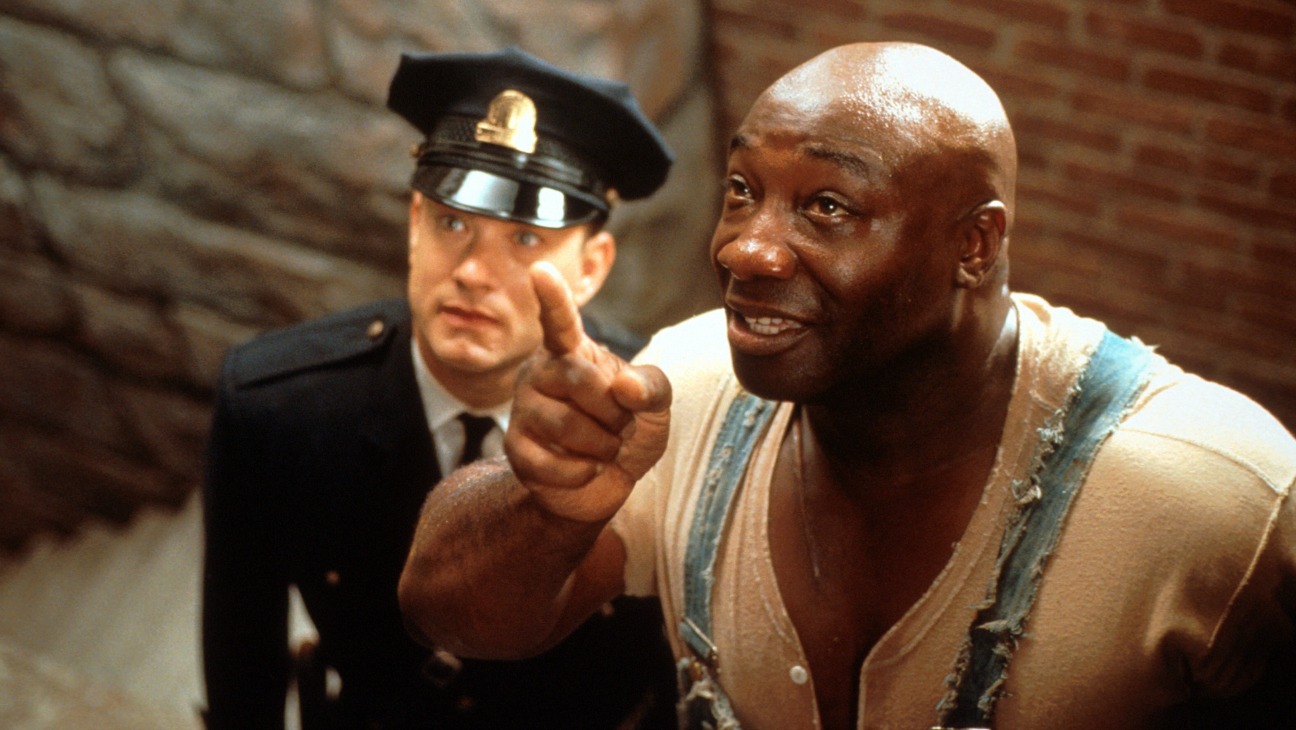
Tom Hanks and Michael Clarke Duncan excel in the over-long but moving The Green Mile

Director: Frank Darabont

Cast: Tom Hanks (Paul Edgecomb), David Morse (Brutus Howell), Bonnie Hunt (Jan Edgecomb), Michael Clarke Duncan (John Coffey), James Cromwell (Warden Hal Moores), Michael Jeter (Edward Delacroix), Doug Hutchison (Percy Wetmore), Sam Rockwell (William “Wild Bill” Wharton), Barry Pepper (Dean Stanton), Jeffrey DeMunn (Harry Terwilliger), Graham Greene (Arlen Bitterbuck), Patricia Clarkson (Melinda Moores), Harry Dean Stanton (Toot-Toot), Dabs Greer (Old Paul)

Stephen King’s novels are often thought of solely as horror novels – but that’s to forget that he also carries with him a profound sense of the human condition and a sharp ability to create moving and surprising human stories. That’s why his works can inspire films as diverse as The Shining and The Shawshank Redemption. The Green Mile, the second King novel bought to the screen by Frank Darabont, definitely falls into the latter camp – probably why it has continued to be met with warmth and regard decades after its making.

In present day Louisiana, Paul Edgecomb (Tom Hanks – played as an old man by Dabs Greer after Hanks’ make-up tests proved unconvincing) recounts his days in 1935, working as a prison guard on “the Green Mile”, the death row section of a prison. Paul’s life was changed forever with the arrival of a gentle giant, John Coffey (Michael Clarke Duncan), a seemingly simple-minded man found guilty of raping and murdering two young girls. However, John doesn’t match the personality Paul expects of a hardened criminal – and events soon prove he is far more than just an ordinary prisoner…

Frank Darabont’s adaptation of King’s novel – an adaptation King still lists as his favourite adaptation of his work – is long at almost three hours, and frequently takes its time. But it does so too carefully, and in detail, build the world it sits in – namely the prison – and the characters who live in it. Everything is carefully paced in order to create the sense of a real world, with (most of its) characters defying easy conventions or definitions. 

We know of course that the guards on this cell are largely decent, hard-working and respectful of the prisoners – not least because they are led by Tom Hanks at his most everyday, grounded and quietly moral. Darabont is very good at letting the world breathe – and, as a skilled scriptwriter, also in sketching character quickly and clearly. Both guards and prisoners are fully crafted characters, and while some of them do verge a bit more on the cartoonish villainy, their motivations and feelings feel real. 

You could criticise the film for the sentimental views built into this. All the guards are basically decent men – apart from Doug Hutchinson’s cowardly, whining bully Percy Whetmore, who owes his job to his family background, picks on the prisoners, reads porn and is motivated only by wanting to “see one cook”. While the film tries to give him some depth, a weakness of character, he’s basically easy for us to dislike. Similarly among the prisoners, all of them are polite, calm and resigned to the justice of their fate – minus an appalling, virulent racist hill-billy (played by Sam Rockwell with a manic intensity). There are very little doubts about who we are supposed to be rooting for here.

Racism as a whole gets only the barest of mentions. A few slurs are thrown at African-American John Coffey, but no real mention that in 1930s Louisiana there was little chance of a black man getting any form of justice at trial. Typically the only characters to espouse racist views fall squarely into the villain’s camp. Perhaps the intent is to show the prison as a melting pot of sorts – the final stop-off for people’s lives, where all men are basically equal, and the guards taking to heart their role as custodians for their final moments. But it’s also a bit of a cop-out.

We’re shown in detail the work Edgecomb and his team put into ensuring the prison is run smoothly and justly, and that the executions are committed as humanely as possible (frequent rehearsals – with Harry Dean Stanton rather funny as an eccentric stand-in condemned man – are called for). The good guards and good prisoners form bonds – and while this adds to the sentimentality, it perhaps makes sense in a system where the most extreme price is to be paid for their acts, and that any other judgement is unnecessary. We see three executions throughout the film, each carrying its own tone: one is a “how-it-should-be-done”, one is a horrifying, tortuous disaster, with Percy sabotaging the humane elements out of spite, the third sees Edgecomb finally questioning the role he has chosen for his life.

It’s not a film that touches a great deal on the morality – or otherwise – of legal executions, but it does use the setting to explore questions of faith and spirituality. Because what is going to put such things into your mind quicker than working in a place where life and death is literally your business? Some of this is more heavy handed than others – John Coffey’s initials should be a bit of a give-away – but the film does ask questions of what is important to us as people, and at what points should we question the decisions we take about how we live our lives.

These questions of faith don’t quite coalesce into something truly coherent, as it never quite feels if the film wants to deal with the implications of John Coffey’s gifts of healing. The possibilities of a wider world outside our understanding never really come together, and instead Coffey’s gift of healing by touch seems to be a blessed skill that he has developed rather than something more profound. There is also something troubling about the film’s sole black character (in 1930 a segregated Louisiana of all places) serving the purpose to heal white people and be sacrificed.

But when the film focuses on story and character rather than its rather unclear themes, it does well. Hanks is very good in the lead role – Darabont wrote the film specifically for him – with solid support from Morse, Pepper and DeMunn as the main “good” guard characters. Michael Jeter gives some heartfelt work as eccentric prisoner Delacroix. But the stand-out – in every way – is Michael Clarke Duncan, whose John Coffey is sweet, naïve, polite, gentle but also carries a suggestion of pain and guilt beneath his surface which is expertly sketched out.

The Green Mile may be overlong, but it’s hard to work out what you would cut as it’s a film that relies so strongly on mood, atmosphere and careful world creation. Well scripted and confidently directed by Darabont, it may be hard to work out exactly what it wants to say – but it has a richness and confidence to it, as well as an emotional force, that sometimes makes you feel that doesn’t really matter.

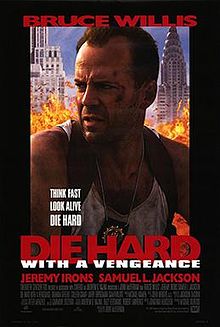
Die Hard with a Vengeance (1995)

Samuel L Jackson and Bruce Willis Die Hard with a Vengeance

Director: John McTiernan

Cast: Bruce Willis (John McClane), Jeremy Irons (Simon Gruber), Samuel L Jackson (Zeus Carver), Graham Greene (Detective Joe Lambert), Colleen Camp (Detective Connie Kowalski), Larry Bryggman (Inspector Walter Cobb), Anthony Peck (Detective Ricky Walsh), Nick Wyman (Mathias Targo), Sam Phillips (Katya)

The Die Hard franchise has spawned multiple imitators, all with the signature format of a hero taking on villains in a confined space: everything from a boat, to a train, to a plane to a bus. Of course the franchise itself had already started to head away from this in Die Hard 2, which takes place across an entire airport. Die Hard with a Vengeance pumps it up even further by setting the action in an entire city. Sure it loses some of the magic claustrophobia of the original, but then it’s got to do something different right? 

John McClane (Bruce Willis) is on suspension, with his marriage in ruins and his life on the skids. No change there then. But he’s dragged out of retirement when terrorist Simon (Jeremy Irons) detonates a bomb in New York and makes it clear he’ll keep doing so until McClane agrees to take on a series of games and challenges across New York – each with deadly penalties. In the first of these, with McClane wearing a very unfortunate sign in the middle of Harlem, he is saved by Zeus (Samuel L Jackson), a shop owner with his own problems with white people, who is forced to join McClane on Simon’s deadly game. After a bomb detonates in Wall Street, McClane starts to wonder: does Simon have an ulterior motive?

Die Hard with a Vengeance is probably most people’s second favourite Die Hard film, and it’s easy to see why. It’s got scale, bangs, loads of action and jokes. It largely takes the best things from the two previous movies and tries to replicate them: so we’ve got the bigger scale and stakes of Die Hard 2, matched with the battle of wits that powered Die Hard. At the same time, it avoids Die Hard 2’s habit of squeezing in as many references and characters from the first film as possible, and tries to make something fresher.

But yet, as I get older, I’m actually getting less keen on it. Guiltily, I think I prefer both entries 2 and 4. I just feel there is something a bit mean about Die Hard 3, something a bit brutal and vicious. Now I am no shrinking violet, but there is a lot (and I mean a lot) of angry swearing in Die Hard 3 – which actually makes it feel rather dated. Everything is “f this” and “f that”. But it’s symptomatic of a particularly 1990s action vibe about the film.Anyway it’s all angry – everyone in the film is angry most of the time. I mean sure they are stressed, but McClane was stressed in the last two films but it didn’t just project itself through fury.

McClane himself, in the first two films, may be hard as nails but he’s also a regular guy doing his best to save lives. But in this film he’s just extremely angry – probably because the character is hungover – and feels less like a police officer interested in preserving life than a vigilante acting above the law. Twice in this movie he executes people (one of whom is trying to surrender (in German)!) with no real warning. The blood and guts count seems a lot higher. The camera lingers on corpses and spurting blood. The character just feels harder to relate to. 

It’s no great surprise that the original intention of the script was for McClane to become actually more and more unhinged by events. It gets lost at the end, when the film settles for a more generic and triumphant ending rather than the unsettling, low-key one originally filmed (which feels like a much better thematic fit for the film you’ve just watched). It would have been interesting to make a film where the hero becomes as damaged and ruthless as the villain – but the studio didn’t want that, so we don’t get it.

McTiernan’s attempt to recapture the vibe of the first Die Hard film also doesn’t quite click. Simon is an odd character, who utilises brute force one minute and then inexplicably spares lives the next. His eventual heist on Wall Street is partly blood-free, partly a brutal slaughter of any resistance. McTiernan is obviously aiming for a battle of wits, but the original concept of Simon setting McClane a series of children’s riddles to solve gets lost half way through the film. Like Die Hard there is an attempt to get a sense of gleeful enjoyment from Simon’s actions, but Jeremy Iron’s character (despite his best efforts) isn’t devilishly charming enough for this to work.

But then things in the film do work. The chemistry between Willis and Jackson is very good, and Jackson really nails a character who is part cocksure, angry radical and half squeamishly out of his depth. The film’s at its most involving when it gets wrapped up in cat-and-mouse games. The first half of the film, which focuses on this, is by far the most interesting and offers the best twist on the action – from riddles about the man going to St Ives, to having to cross New York in a fraction of the time needed, or trying to defuse a bomb by putting four gallons into a five-gallon jug. The more these riddles die away in the second half and the film goes for more generic shooting and killing, the less interesting it becomes.

Not that this sort of stuff isn’t good fun. Although McClane seems more bad tempered and ruthless – and the baddies are mostly faceless goons rather than people – it’s still fun to see him take on the odds so successfully, and to see him being underestimated by the villains (the character is always smarter than he appears). McTiernan, with a huge budget, throws everything at the screen from bombs to fist fights to car chases. He doesn’t manage to create the magic sense of heroism that the first film has in such abundance, or that sense of one man doing what he must to save others, but the film still broadly works.

There is something very 1990s about this film, from its swearing to its violence to its general atmosphere of gritty comic book thrills. It is fun to hear jokes about Hillary Clinton (jokingly named as the next President – oops) and Donald Trump. But it’s that lack of moral purpose to McClane that proves the biggest problem – he’s motivated less by saving lives than by revenge. It’s a crueller film, sharper and meaner, which means for all the enjoyment it can bring, I can’t love it like I do the first film. It takes McClane to dark places, and presents a bad tempered hero it would be hard to like without the first two films. He’s already starting to feel less like a regular put-upon guy and more like an angry maverick dealer in violence. There is less to build on in this film, and perhaps that’s why we had to wait a while until nostalgia made John McClane a character we wanted to see again.

Molly's Game (2017)


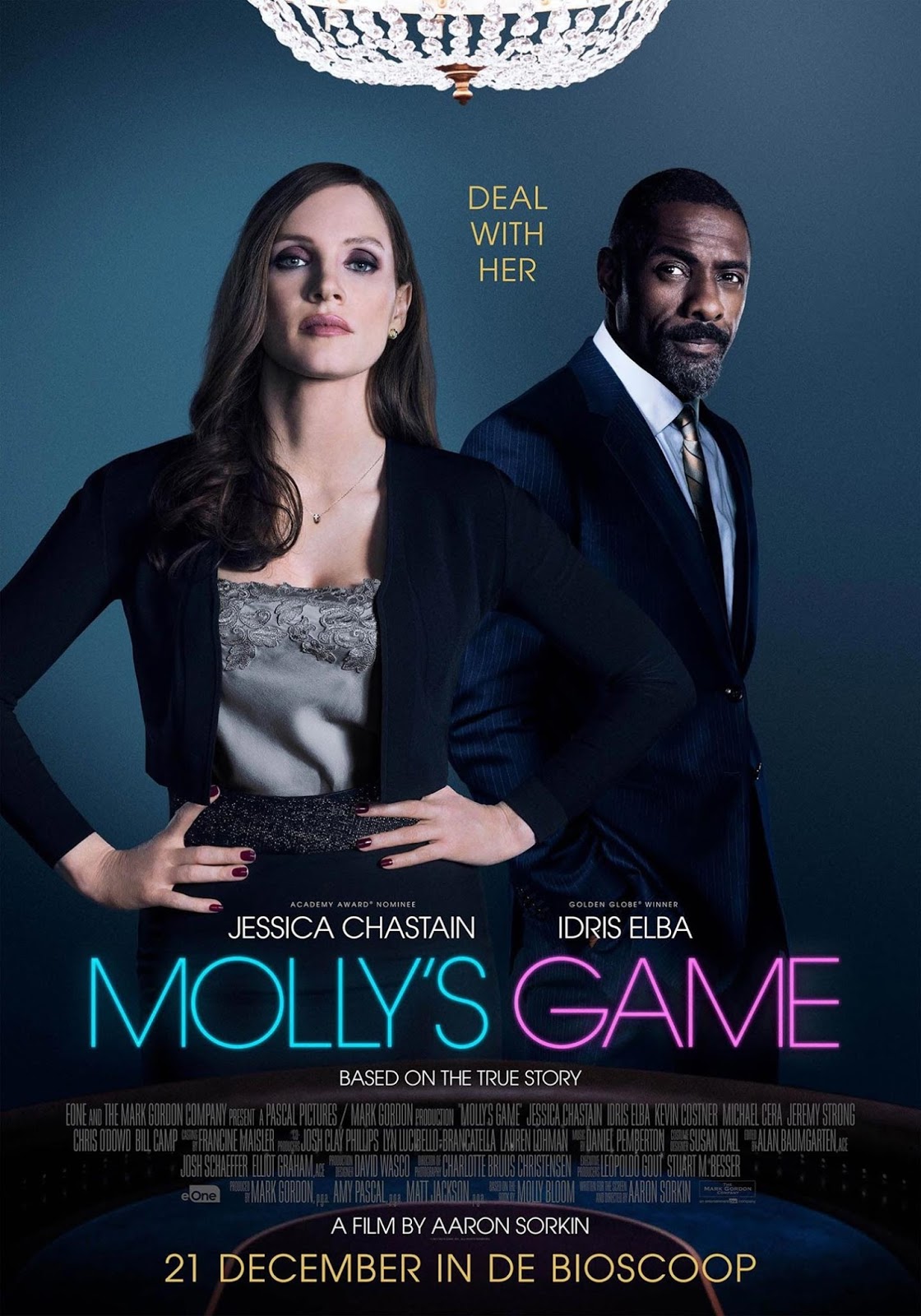
Jessica Chastain and Idris Elba excel in Aaron Sorkin’s dynamically scripted Molly’s Game

Director: Aaron Sorkin

Cast: Jessica Chastain (Molly Bloom), Idris Elba (Charlie Jaffey), Kevin Costner (Larry Bloom), Michael Cera (Player X), Brian d’Arcy James (Brad), Chris O’Dowd (Douglas Downey), JC MacKenzie (Harrison Wellstone), Bill Camp (Harlan Eustace), Graham Greene (Judge Foxman), Jeremy Strong (Dean Keith), Angela Gots (B)

Molly Bloom (Jessica Chastain) is all set to join America’s Winter Olympics team, under the guidance of her ultra-demanding psychiatrist father Larry (Kevin Costner), when a freak accident ends her career. So she heads to LA and becomes embroiled in the world of high-stakes poker, eventually setting up and running her own high stakes games in LA and New York, earning millions. But, over a decade later (in a parallel plotline) she has had a millions seized and is battling against imprisonment for her connections to the mob, with only lawyer Charlie Jaffrey (Idris Elba) on her side.

Sorkin’s zippy new drama has plenty of sparkling dialogue – as you could expect! Sure this film probably also proves he’s not really a director (it’s over-long, a little flabby, and structurally not very clean) but the guy can certainly put a speech together. My main issue with Molly’s Game is I’m just not quite sure what its point is. Maybe it only exists to entertain, but it feels like it wants to put together a touching story about family, faith and the value of your word. I’m not sure it really manages to achieve any of this. 

The parallel plotlines don’t always do the film a lot of favours. The present-day plotline of Molly and Jaffey working to clear her from the various charges she has been accused of, continually hints at some serious gangsterism set-ups later on: largely these never really transpire. Actually, the film heads into pretty standard “my-Daddy-didn’t-love-me” territory. It shy’s away from being something different and interesting about excess and punishment into psychiatry solving our problems.

Sorkin doesn’t always get the structure right, as if he hasn’t got the patience to actually make sure the fundamental plot information was clear enough, so eager was he to get on with the verbal pyrotechnics. Time is spent carefully exploring several poker hands – but the exact nature of the illegality of what Molly does running her poker games gets glossed over in seconds. 

But then this is a film that isn’t really that interested in plot dynamics, or even in over-arching themes. What it’s interested in is sizzling dialogue, and letting actors deliver it. The camera sits back and watches. So it’s not a surprise the most memorable scenes feature Jessica Chastain and Idris Elba (both superb) in a room, talking (or arguing) with each other. It’s the moments like these where the film really works – and Sorkin the director basically stays out of the way, using a two-camera set-up to record the scenes, like a filming of a Broadway play. 

Those two actors dominate the film. Chastain is excellent as Molly – ambitious, driven, playful but also vulnerable and ever-so-slightly bitter, who gets where she is through her own intelligence and hard work. Chastain also embraces playing a character with such a strong moral code – she’s terrifically warm and human in the part. Elba is equally fine, a wry professional with his own strong moral code (yup, The West Wing writer still loves those liberals of great conscience), an articulate (of course!), passionate advocate who is far warmer than he first appears.

The rest of the film never quite lives up to this, maybe because the poker games are never really that interesting, or because the life Molly leads among the rich and famous seems ill-defined (she has possibly the least impactful drugs addiction seen on screen). For someone who remains loyal to the end to her clients, we are never really clear why other than a suggestion of her basic sense of honour. Her projects are all set-up with ease, and the film builds towards a solution buried in psychiatry speak that similarly feels a little too easy.

Because while it is great that Molly is not defined by a romantic relationship – she is defined by men in virtually every other way. Her entire career is based on pleasing rich, middle-aged men (from whom she frequently has to bat away expressions of devotion or sexual interest). Three times she falls victim to senior male partners in business relationships. Above all, she is defined by her relationship with her overbearing father (well-played by a low-key Kevin Costner). The scene where this comes to a head, a father-daughter exchange late at night on a snowy New York bench, is so well-written and played you almost overlook its pattness.

Sorkin’s script is the most important thing here – and the film is built around it. Like Scorsese’s Casino(a film he must have seen a couple of times!) most of its opening act is structured heavily around Chastain’s expertly delivered voiceover. The actors get to enjoy delivering his engaging rat-a-tat dialogue, the expert playing and sharp dialogue ends up carrying a lot of uplifting moments in the film. It’s a film that embraces Sorkin’s scripting, and doesn’t worry about being too filmic about it: the zippiest moments of editing are so because the dialogue or voice-over demands it.

Some of the roles aren’t quite so well drawn: Michael Cera is just plain miscast in a role that needed a young Rob Lowe as an absurdly glamourous Hollywood poker addict (I can’t imagine people crossing a street let alone a continent to play cards with Cera). The rest of the women in the script get short shrift – even Molly’s mother is little more than a walk-on part. 

Molly’s Game is a lot of fun, even if it’s probably about 15 minutes too long. It’s got some great dialogue and, if Sorkin turns out not to be the best interpreter of his own work, he’s certainly no dud as a director. Overall, the themes and plot don’t quite come together as well as they should. But it’s very well acted – Elba and above all Chastain are absolutely terrific – and it has more than enough sparkle to it for an enjoyable Friday night.

Dances with Wolves (1990)

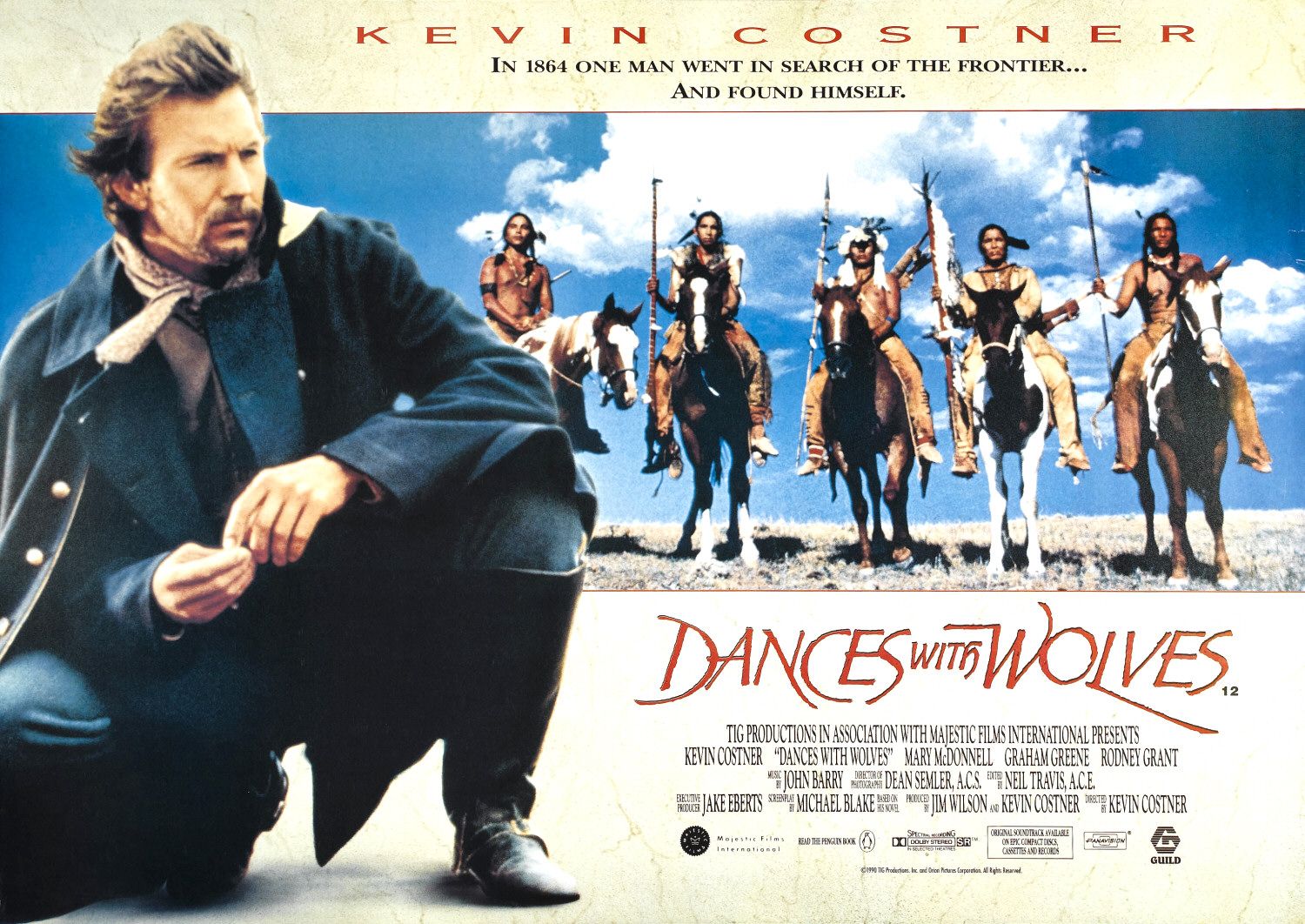
Kevin Costner finds his inner peace in Dances with Wolves

Director: Kevin Costner

Cast: Kevin Costner (John Dunbar/Dances With Wolves), Mary McDonnell (Stands With A Fist), Graham Greene (Kicking Bird), Rodney A. Grant (Wind In His Hair), Floyd Red Crow Westerman (Chief Ten Bears), Tantoo Cardinal (Black Shawl), Jimmy Herman (Stone Calf), Nathan Lee Chasing His Horse (Smiles A Lot), Michael Spears (Otter), Charles Rocket (Lt Elgin), Robert Pastorelli (Timmins), Tom Everett (Sgt Pepper), Wes Studi (Toughest Pawnee), Maury Chaykin (Major Fambrough)

At the end of the 1980s, Kevin Costner was the biggest film star in the world, with a string of hits behind him. So he did what Hollywood stars before and since have done: cashed in all his chips and made the film he had to make. It would be long, it would be mostly in a foreign language, it would have no stars (other than himself) and – most poisonous of all at the time – it would be a Western. When the funding started to dry up, Costner even paid for the overtime out of his own pocket. Not for no reason was the project dubbed “Kevin’s Gate” by the sceptical media, eagerly expecting Hollywood’s golden boy to land on his face.

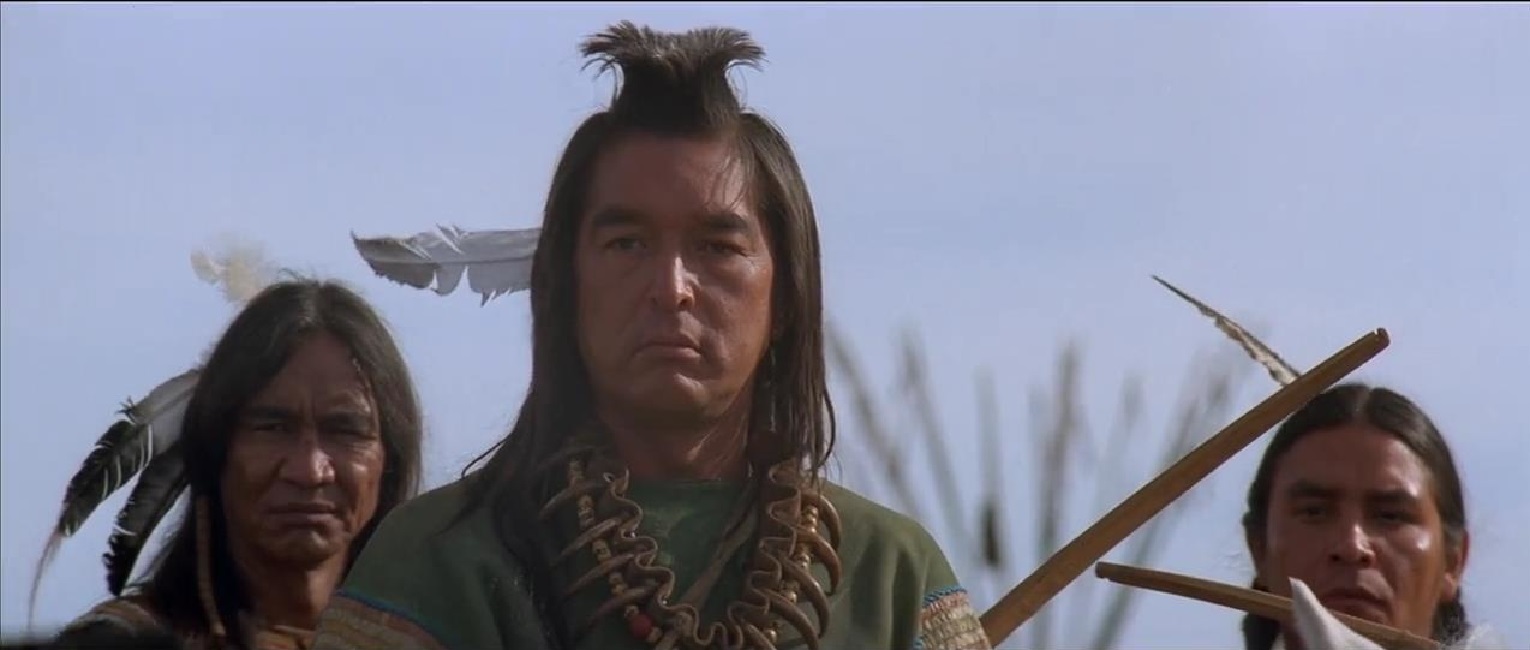
How wrong they were. Dances with Wolves not only made almost 20 times its budget at the box office, it changed many Americans’ perceptions of Native Americans – oh yes and it also won seven Oscars, including Best Director for Costner and Best Picture. Costner plays Lt. John Dunbar, a civil war veteran who (after an act of suicidal death-seeking foolishness to avoid having his leg amputated) chooses a posting to an abandoned fort in the middle of Sioux country. Forgotten by the army, Dunbar forages alone and comes to the attention of the Sioux. At first cautious around each other, Dunbar eventually befriends healing man Kicking Bird (Graham Greene) and finds himself cautiously welcomed into the Sioux tribe as a guest, finding love with Stands With A Fist (Mary McDonnell), a white woman raised by the Sioux. He begins to find the Sioux as kindred spirits.

Costner’s film is an expansive, heartfelt poem, a film in love with sweeping vistas and with an endearing, humanitarian view of the world, beautifully shot by Dean Semler and helped immensely by a wonderful, swelling lyrical score by John Barry – one of the best scores you are likely to hear. Costner dispels any doubts about his abilities to direct by throwing himself into a truly epic canvas – and some of the ideas here are reminiscent of Lean, in their beautiful use of the American plains. Within this large canvas, Costner tells an actually fairly simple, but also sweetly touching, story of the disillusioned man who finds himself in the wilderness.

If there is a flaw with Dances with Wolves it is that its story is so traditional and (in many ways) predictable. It’s understandable that the story introduces a white man to be our surrogate when encountering the Sioux. But it’s hard to shake the feeling of all that all-too familiar trope, the White Saviour. The primary good the Sioux serve in the film is to help Dunbar discover himself, to come to peace with himself. In turn, it’s Dunbar who increasingly becomes the tribe’s protector – helping them to find the buffalo, giving them guns and leading the defence against a Pawnee tribe attack, increasingly recognised as a “celebrity” in the tribe.

On top of that, Dunbar’s love interest becomes the only other prominent white character in the film. Again I understand that the film needed someone who was able to serve as a cultural and language bridge between Dunbar and the Sioux. But could there not have been some sort of narrative invention to make this female character a Sioux who had learned some English? It seems as if the film can only go so far – and showing a multi-racial relationship was probably that. Saying that, McDonnell is very good as the gentle Stands With A Fist, but it feels like a cop-out.

Costner’s own central performance gives everything the film requires. It’s a fairly simple role: the disillusioned soldier finding inner peace. The film plays very much into the attraction of the “noble savage” – the simplicity and honesty of the Sioux lifestyle being so much purer than the corruption of the “modern” world (needless to say, nearly all the white men in the film are truly awful people). But Costner brings his considerable charm to bear, delivering many of his lines with that slightly cocksure, shy grin he uses so well. The film suffers from its narration being delivered by Costner’s flat and unmodulated voice, but he’s perfectly fine in the role.

He plays it with an entirely straight honesty – and, for all its faults, this honesty makes the film work. The film goes overboard to humanise and provide empathy for the Sioux, as if wanting to correct generations of films that have cast Native Americans as dangerous savages. The Sioux are humane, generous, welcoming and dignified. Graham Greene has to carry much of this as medicine man Kicking Bird, and he gives a stirring, sympathetic performance, with equally fine performances from Rodney A. Grant and Tantoo Cardinal in particular.

The film delivers all its tropes and traditional structure with a straightforward, heart-warming simplicity – it really means that you go with the picture, and find yourself as drawn to the Sioux lifestyle as Dunbar is. Also, for all the criticism of the film’s narrative, it shouldn’t be forgotten what a warm reception it had from Native American groups, delighted to see their ancestors presented in such an empathetic light (the Sioux Nation later adopted Costner). And the film sensitively and brilliantly stages this way of life, with a series of beautifully done vignettes ranging from marriage to simple cooking and spending time around the fire.

The most stunningly filmed of these is the buffalo hunt, a soaring marvel of camera work, editing and horseback adventure. The film doesn’t let you forget the sequence before either, where the Sioux come across a series of buffalo killed for their hides by white hunters – in comparison to the complete use of the carcass (and limited numbers killed) by the Sioux. The buffalo hunt sequence is an exciting triumph – it’s probably responsible for several of the technical Oscars the film received – and it’s a tribute to Costner’s mastery of the visuals of the American West (even if, rumour has it, chunks of it were actually filmed by Kevin Reynolds).

Dances with Wolves is a very heartfelt and honest film – and its sincerity means it kind of gets away with its obvious flaws (and its great length). Costner wanted to make an important film and he does to a certain extent – but one which wears its importance fairly lightly, and makes a series of enriching humanitarian arguments that carry real weight. It’s in many ways an extremely accomplished retelling of a familiar story. But I found myself genuinely moved by the story it wanted to tell, and the questions it asks of its audiences. Is it a great film? Probably not, but it is a good one.