Tag: Greta Scacchi

The Player (1992)

Tim Robbins is the ultimate heartless Hollywood exec in Altman’s vicious satire The Player

Director: Robert Altman

Cast: Tim Robbins (Griffin Mill), Greta Scacchi (June Gudmundsdottir), Fred Ward (Walter Stuckel), Whoopi Goldberg (Detective Susan Avery), Peter Gallagher (Larry Levy), Brion James (Joel Levison), Cynthia Stevenson (Bonnie Sherow), Vincent D’Onofrio (David Kahane), Dean Stockwell (Andy Sivella), Richard E. Grant (Tom Oakley), Sydney Pollack (Dick Mellon), Lyle Lovett (Detective Paul DeLongpre), Gina Gershon (Whitney Gersh), Jeremy Piven (Steve Reeves)

Hollywood: it’s a hell of a place. Sharks ain’t got nothing on studio power-brokers, hunting product to sell. After all, not a single letter of “Art” appears in “Hollywood”. Griffin Mill (Tim Robbins) hears 50,000 pitches a year and gives the green light to ten or twelve. Mill is plagued with death threats. Confronting the writer (Vincent D’Onofrio) he believes responsible, he kills him in a fight. Can he get away with murder and successfully romance the writer’s artist girlfriend June (Greta Scacchi)? And, even more importantly, can he protect his job from hotshot executive Larry Levy (Peter Gallagher)?

Robert Altman had been working outside of the studios for well over two decades after negative experiences creating his critically acclaimed but hard-to-digest masterpieces (including McCabe and Mrs Miller and The Long Goodbye, the sort of films only Altman could make). His career had drifted during the 1980s, as his edgy, ‘disciplined ill-discipline’ approach (with overlapping sound and roving cameras) moved out of fashion. The Player was not only his payback expose on the studio system, with the exec a sociopath, but also his triumphant comeback to the frontline of film-making (he earned several awards, including a nomination for Best Director).

The Player is nominally a comedy, but in the way of Altman it also fits half a dozen other labels: from film noir to corporate satire. Above all it’s a maverick’s view of a system designed to produce product (Mill constantly speak of his films like this – he would love our modern age of “content”). The studio’s offices are lined with posters from classic Hollywood – but the studio produces the most crowd-pleasing cookie cutter movies you can imagine. It’s all about squeezing in all the ideal elements a film must have: “Suspense, laughter, violence. Hope, heart, nudity, sex. Happy endings. Mainly happy endings.” (In a neat subversive twist, these are of course all present in The Player – but then it’s to be expected when what we are seeing might actually be a film within a film).

Film pitches all have an air of desperation, every idea boiled down to simple, easily digestible slogans. It’s nearly always a combination of two other films – “Out of Africa meets Pretty Woman!” – or involves the biggest stars (“Julia” and “Bruce” were those two stars – and both actors hilariously spoof themselves in the film’s climactic sequence). Ahead of its time, the film even features a pitch (from a cameoing Buck Henry) for The Graduate 2, a nostalgia tinted exploitation of the IP with all the original cast, that basically sounds like the sort of thing they’d actually make today.

There is no place for film-making as an art – any idea that can’t be compressed into 30 seconds is worthless. Mill’s knowledge of film is patchy at best, his attempt to make small talk about Bicycle Thieves boiling down to “Perhaps we should remake it?”. The film (possibly the film within a film within a film), Habeas Corpus, pitched by Richard E Grant’s pretentious writer (“No stars! No pat Hollywood endings!”) is only attractive because it has the wisp of Oscar about it (and Oscars mean Big Bucks). Even then, Mill plans to rework the whole film into exactly the sort of pat-Hollywood romantic thriller Grant’s character claims to hate (no character will support this decision more than Grant’s sellout writer). The only person who seems to actually watch films is Fred Ward’s studio head-of-security – and at least half of his references are met with blank incomprehension. When Griffin makes a speech donating the studio’s old films to a cultural library, his words about art and culture are incredibly hollow.

This vicious satire of the shallow culture of Hollywood – Larry Levy’s up and coming executive attends AA solely to network, not because he has a drink problem – is wrapped up in a beautiful noir framework, that’s brilliantly a few degrees off reality (for reasons that later become clear). Deluged by death threats from (he surmises) a disgruntled writer, Griffin meets the man he suspects – a pretentious holier-than-thou wannabe, played with chippy fury by Vincent D’Onofrio – who he beats to death in a neon-lit carpark, after a dig too far about Mill’s job security (as nothing threatens these guys more than the prospect of being drummed out of town).

Altman’s film wonderfully echoes the neon lit shadows of classic noir, while building a homage filled trap around Mill, desperate to escape punishment. Mill of course has killed the wrong man – and his stalker knows it – and his own heartless-but-effortlessly-cool business dealings are contrasted with his efforts to avoid the dogged pursuit of a police department (led, in a curious but just-about-effective piece of casting, by Whoopi Goldberg) correctly convinced he is guilty. The film asks, how much does morality intrude on Mill, when he’s led his whole life trampling people: isn’t literally killing someone only the next step up from all that metaphorical killing he’s been doing?

His one weakness is falling in love with his victim’s girlfriend, an artist played with a breezy sexiness by Greta Scacchi. Scacchi’s June is intriguingly unknowable – how much does she suspect Mill, and how much does she even care? – and the dance of seduction and suspicion between them is highly effective, culminating in a tastefully, imaginatively but highly sensually shot sex scene (built from Scacchi’s refusal to do a nude scene – instead the nudity comes from a full frontal of Robbins emerging from a mud bath).

Scacchi’s June feels like halfway between a real person and a movie construct – and that’s a deliberate effect in a film which, the ending suggests, may well have been a movie within a movie. Mill takes a pitch in the final moments from his actual blackmailer, who outlines the very film we have been watching, a pitch Mill accepts on condition the film (he?) gets a happy ending: cue Mill arriving home to June and the two of them using the same pat Hollywood pay-off lines to greet each other, we just saw Bruce Willis and Julia Roberts mouth in Mill’s happy-ending for Habeas Corpus. Apply the logic of a film to all the action and it suddenly makes sense on a whole new level, as a beautifully judged exploration of the very crowd-pleasing elements Mills praises, repackaged in a sharp and bitter satire.

Tim Robbins performance of restrained amorality is vital to the film’s success. In his career, any weakness is deadly – a mantra he applies to his interactions with the police and with June. Mill is so eerily controlled – fear is the only emotion he categorically shows, guilt never crosses his mind – you start to wonder if he even has a real personality. But, in the movie’s structure, he’s both a real person and also a construct whose life echoes scenes from the movies whose posters fill his office.

Altman balances these ideas of truth and reality perfectly within the studio satire. The film is astonishingly well-made, all Altman’s trademarks of overlapping dialogue and roving camera present and correct. It opens with a hugely confident seven-minute tracking shot around the studio, which feels like a real “I’m back!” statement – and is beautifully and wittily done. The film is crammed with dozens of celebrities playing themselves (they were given no dialogue and encouraged to improvise scenes), all of them keen to show they were in on the joke.

The Player is dark, witty and very clever, one of Altman’s sharpest and most enjoyable films. Crammed with echoes of film noir and a brutal expose of Hollywood business practice, it’s very well performed and keeps just enough lightness and humanity (it encourages to empathise, but not sympathise, with Mill, for all his amorality) to also be entertaining. One of the great films about Hollywood.
Heat and Dust (1983)

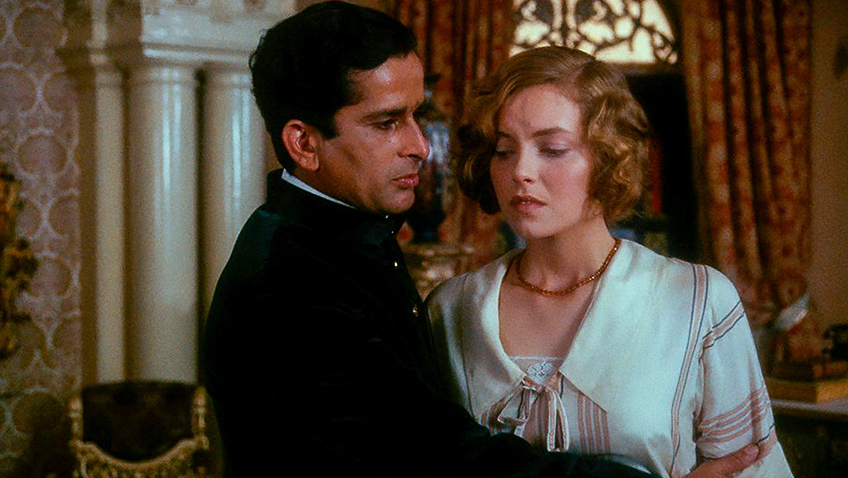
Shashi Kapoor and Greta Scacchi in a love across the divide in Heat and Dust

Director: James Ivory

Cast: Julie Christie (Anne), Greta Scacchi (Olivia Rivers), Shashi Kapoor (The Nawab), Christopher Cazenove (Douglas Rivers), Nickolas Grace (Harry Hamilton-Paul), Zakir Hussain (Inder Lal), Julian Glover (Crawford), Susan Fleetwood (Mrs Crawford), Patrick Godfrey (Dr Saunders), Jennifer Kendal (Mrs Saunders), Charles McCaughan (Chid), Madhur Jaffrey (Begum Mussarat Jahan), Barry Foster (Major Minnies)

Adapted by Ruth Prawer Jhabvala from her Booker-prize winning novel, Ivory-Merchant’s production of Heat and Dust is much like the source: precise, admirable and both faintly enigmatic and intriguingly slight. In 1982 Anne (Julie Christie) travels to India to discover more about the life of her great-aunt Olivia (Greta Scacchi). In 1923, Olivia lived in Satipur as wife to local official Douglas Rivers (Christopher Cazenove). The Nawab (Shashi Kapoor) is the local Indian prince, a charismatic man who may or may not be in league with local bandits. Enthralled by India, bored by British India but deeply in love with Douglas, Olivia still finds herself drawn to the Nawab. Scandal is round the corner.

Heat and Dust is a delicate, well-mounted adaptation, but it never quite engages as much as it should. Perhaps this is because its central plot – a white woman is fascinated by India – is a familiar trope in both novels and films of the Raj. It does take a different approach by intercutting between the present and the 1920s. This presents intriguing opportunities to show ways India has changed physically (the homes of the British Raj have become offices) but also ways it has remained the same culturally.

This carries across in the contrasting stories of two women, both of whom become intrigued by their surroundings and romantically entangled with Indian men. While Olivia is (eventually) disgraced and ostracised by her community, Anne has the freedom to make her own choices. Both women find themselves drifting into life-changes through male seduction. Perhaps this is one of the points of the film in the end – that women, no matter the timeline, are people that things (or men) happen to, rather than being the true owners of their own lives?

It seems the case with Olivia, who never feels in full control her own life, but instead moves inexorably towards a destiny she can’t really influence. Charmingly played, with a sparkle and playful innocence by Greta Scacchi in her film debut, Olivia’s motivations are almost deliberately obscured. Although Ivory uses a device at first of Olivia’s letters being dramatised by Scacchi addressing the camera, this device is swiftly dropped. The letters remain a presence, but we never hear from them. Instead most of Olivia’s actions are narrated by her friend Harry (Nickolas Grace), now an old man. It places a distance between the viewer and Olivia, making her actions harder to understand.

But then that is part of the enigma. India is a land of heat and dust, where normal rules don’t apply and people (particularly those from the West) find themselves reformed by. Olivia has no time for the stuffy, racist British population (especially the frightful woman). But she’s drawn to the Nawab partly because he’s a fusion of East and West, an Indian exotic with the charm of an English gentleman. For his part the Nawab, very well played by Shashi Kapoor, plans a seduction but his motives are as hard to read as Olivia. Is it attraction or revenge on the British for their contempt?

Perhaps it’s a film where we look for deep meaning and motivations, but it is in fact about how we don’t necessarily make grand decisions about our lives, but make a series of in-the-moment decisions. Both Anne and Olivia never seem to proactively make decisions, but instead events largely occur to them. Although this can make for a film sometimes lacking in energy, it does avoid making things obvious for the audience. Even if that can be frustrating when characters remain almost deliberately oblique.

What’s also oddly frustrating about the film is its more modern section. The commentary comparing the present and the past promises much but actually adds little. Anne is a curiously uninvolving character, played with a sweet tenderness by Julie Christie. Anne is hardly proactive and there is very little narrative drive behind her exploration of the past. Strangely the issues the more modern section deals with – including digs at Western cultural tourists – end up feeling less relevant than the issues of race and empire in the 1920s.

And its unfortunate that the 1920s plot line, although well staged and managed, seems extremely familiar – with echoes of A Passage to India and The Jewel in the Crown for starters. While it’s well acted (as well as those mentioned, Christopher Cazenove is very good) and creates an enigmatic atmosphere, you often feel you’re seeing something done better elsewhere. It starts as an investigation into the past, but becomes something more freeform, as if in the heat and dust of India, plans come to nothing. But its air of enigma and portrayal of characters buffeted by small events doesn’t come together into a compelling story or a rich insight into India.

Brideshead Revisited (2008)

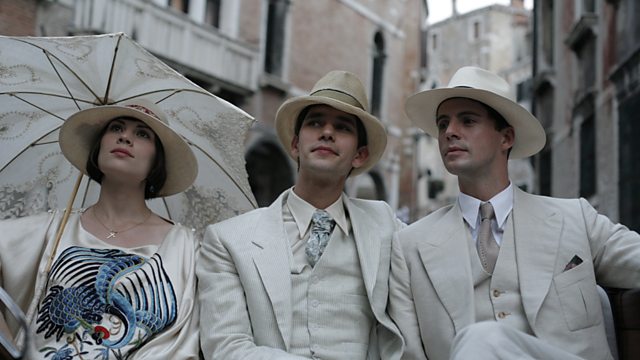
Hayley Atwell, Ben Whishaw and Matthew Goode make for a bad revisitation to Brideshead

Director: Julian Jarrold

Cast: Matthew Goode (Charles Ryder), Ben Whishaw (Lord Sebastian Flyte), Hayley Atwell (Lady Julia Flyte), Emma Thompson (Lady Marchmain), Michael Gambon (Lord Marchmain), Greta Scacchi (Cara), Patrick Malahide (Mr Ryder), Felicity Jones (Lady Cordelia Flyte), Ed Stoppard (Lord Brideshead), Jonathan Cake (Rex Mottram), Joseph Beattie (Anthony Blanche)

There are some books that have been filmed definitively and you feel just shouldn’t be touched again. Perhaps the most definitive case is Brideshead Revisited. An 11-part, almost 13-hours-long, series from the height of the mini-series era, ITV’s 1981 Brideshead Revisited dramatised literally every page and every event of the just over 300 page novel, and did it with a perfect understanding of the book’s richness and complexity. So what hope could a film have – even if it is written by that man who had such a triumph with that other definitive production, the BBC Pride and Prejudice – Andrew Davies himself?

In the 1920s in Oxford, aspiring artist Charles Ryder (Matthew Goode) falls in with the bohemian set of fellow student Lord Sebastian Flyte (Ben Whishaw). Sebastian takes Charles to his family home of Brideshead, a beautiful, entrancing family estate. But Sebastian is an unhappy man, increasingly prone to drinking, conflicted about his family’s strong Catholic faith and his own sexuality. He’s also tortured by the growing love between Charles and his sister Julia (Hayley Atwell). Their domineering mother Lady Marchmain (Emma Thompson) attempts to guide the family as she wishes, but Sebastian’s alcoholism leads to a crisis. Years later Charles and Julia restart their relationship, only to find Catholicism and fate once again intruding to complicate matters.

Brideshead Revisited is a rich, sweeping, heartfelt and profound look at so many themes it seems impossible to cover them all in a single sentence. It touches upon questions of faith, class, politics, friendship, sexuality, love – all of them sensitively and intelligently explored by Evelyn Waugh. The TV series captured all these themes with an acute, empathetic emotional intelligence. This film, forced to telescope action into two hours, simplifies and sexualises the novel to make it as boiled down and simple as possible. While this probably makes for a decent, but nothing new, film for those who don’t know the novel, for those of us who do it’s nothing less than a total travesty.

Everything is made as straight-forward and basic as possible. Subtle suggestions from the novel are turned into blunt, simplified assertions that clang out of the actors’ mouths and hit the ground. This is especially clear in the character of Charles Ryder, a fascinating observer in the novel, both a snob and a romantic, capable of great warmth and kindness and also a distant indifference. Here, he’s little more than a social climber (his lower middle class roots are stressed), constantly being asked “What do you really want?” by other characters. His attachment to Sebastian, and introduction to the Brideshead house, seems based less on a magnetic friendship and more on his unspoken desire to be part of an “in-crowd”.

Ah yes, that relationship with Sebastian. Ben Whishaw’s performance as Sebastian is, quite simply, one of the worst realisations of an iconic character you are ever going to see. The novel’s Sebastian, is an impossible glamourous, handsome, slightly effete, but magnetically charismatic figure who effortlessly wins admirers and friends everywhere – so much so, that his intensely vulnerability, sadness and self-loathing that lead to his alcoholism are spotted way too late, and then hideously mismanaged. The character Whishaw plays here is so different, he’s effectively Flyte in name only.

It all stems from the film’s longing to put the book’s suggestion of a homosexual bond between Charles and Sebastian to the forefront. So we are made perfectly aware of Flyte’s feelings, and Whishaw turns the character instead into a stereotypical, limp-wristed, effete, tragic gay man struggling with a hopelessly unrequited love for Charles that pushes him over the edge to depression. Oh yes, it has to be unrequited love because we can’t have Charles show any homosexual inclinations. Particularly as the film is desperate to reposition Charles and Julia into a “love-at-first-sight” romantic couple from the start. So of course we have Charles twice rejecting sexual advances from Sebastian (once with the cold shoulder, the second time with an angry push). 

But in sexing up the content on the surface, the film totally kills the bond between the two characters. There is, frankly, no reason for Charles and Sebastian to be friends. Sebastian is from the start a slightly pathetic figure, so you never get a sense at all why Charles is drawn towards him. This then magnifies the feeling that Charles main motivation is the house (and Julia) and that he sees Sebastian as someone he must tolerate (and whom he later feels guilty about) rather than as a friend. Sebastian himself loses all his complexity, instead becoming a slightly pathetic, tragic, overlooked figure reduced to screaming at Charles “You only wanted to be my friend because you wanted my sister!” By pumping up the subtext, the film kills the central relationship of the book – and completely undermines the tragedy of Sebastian.

But then Andrew Davies was keen – as he stated himself in interviews – to reposition the novel as a conventional great romantic novel. Now it’s true that Charles calls Sebastian in the novel the “fore runner” for his feelings for Julia (and this relationship between Julia and Charles is, I will say, one thing the TV series didn’t quite nail), but in no way was she his main focus from the start. It makes Charles’ treatment (and, let’s be honest, leading on) of Sebastian crueller, and it also crudely simplifies the novel into a “love against the odds” story that we’ve seen a thousand times before. It drains the novel of one of the factors that made it original in the start.

So we end up with a Charles who basically, rather oddly, suffers the company of Sebastian but treats him as someone he wants to shrug off. We’ve got a romantic plot line between Julia and Charles that has been reduced to the most basic, cookie-cutter, Mills and Boon romance you can imagine. And the film still struggles through to attempt to deal with the book’s (perhaps) other major theme, religion. Catholicism, guilt and the power (and domination) of faith is key to the book – but here, it’s a crude subplot that positions religion as a sort of trouble-causing piece of mummery that gets in the way of happiness. Pretty much as far as you can get from Waugh’s understanding of the complex demands of faith, denial, guilt and love.

You could say it’s unfair to continually compare the film to the book and TV series. But not only is this meant to be an adaptation, but the film chose to shoot at Castle Howard in Yorkshire, just as the TV series did. So we see scenes play out, often in the exact same location as the masterful TV series. If the film doesn’t want to try and be original and find a new location, and visually apes the TV series as much as possible, it feels fair enough to compare it – and it find it wanting.

It’s a well-made film, I’ll give it that, and I like Adrian Johnstone’s score, but it’s turned an intelligent and absorbing novel into a sub-Merchant Ivory period prestige piece, with the focus on the lovely locations and the beautiful costumes rather than anything else. Performances wise, Matthew Goode is fine (but can’t escape the shadow of Jeremy Irons), but Hayley Atwell probably comes out best as a vibrant Julia (who gets, in a way, much more to do than the book gives her). For the rest, Emma Thompson gives a far too mannered performance as the domineering Lady Marchmain (here unquestionably a villain) and Michael Gambon coasts as the dying Lord Marchmain (who here turns up literally out of the blue at the end of the film to die).

Brideshead Revisited is an irrelevant piece of celluloid that brings nothing new whatsoever to the novel or the TV series. Worse it takes the key themes of the novel and subverts, ruins or mangles them in order to try and turn the story into a straightforward heterosexual romance. In doing so, it removes everything that makes the original interesting, unique or compelling – and makes people wonder why they should bother going back to the book – surely the worst offence of all.

The Falling (2014)

Florence Pugh and Maisie Williams deal with tedious coming-of-age antics in The Falling

Director: Carol Morley

Cast: Maisie Williams (Lydia Lamont), Maxine Peake (Eileen Lamb), Monica Dolan (Miss Alvaro), Greta Scacchi (Miss Mantel), Mathew Baynton (Mr Hopkins), Florence Pugh (Abigail Mortimer), Joe Cole (Kenneth Lamont), Lauren McCrostie (Gwen)

Any film set in an all-girls school that succumbs to hysteria, with ominous goings-on that might be supernatural or might all be allegories for coming of age and emerging sexuality, is inevitably going to get compared with Picnic at Hanging Rock. But few films seem to be so desperate to be that film as The Falling does. 

Set in an all-girls school in 1969, at the cusp of the sexual revolution that will soon engulf the whole country, Lydia Lamont (Maisie Williams) and her elder brother Kenneth (Joe Cole) are both obsessed with Lydia’s charismatic classmate Abigail Mortimer (Florence Pugh) – feelings of emotional and sexual dependency that Abigail knowingly encourages and flirts with. After Abigail’s sudden death connected to her pregnancy, Lydia becomes increasingly disruptive at the school and finally becomes “patient zero” in an epidemic of fainting that afflicts the school.

Based on a true story, you can tell that this film is keen to conjure up some sort of deep-rooted mystery at the heart of the girls’ actions, questioning whether they were truly in control of their own actions at this time or under the influence of something else. Is this linked directly to the tragic fate of Abigail – is she in some way possessing the girls, driving them towards this fainting? Or is the fainting just a sort of acting out, as Lydia tries to get over her grief at the loss of her friend?

Frankly, who really cares? It’s pretty hard to get invested in a film that is working so hard to be meaningful that it overshoots the mark and just becomes tiresome. Yeah I get it, teenage relationships can have this unhealthy intensity to them. They can spin out into self-destructive elements. And maybe, if the film had focused more on that rather than trying to suggest some unsettling mystery it might have got further. But with every shot of the British countryside around the school, or the lingering shots on the girls writhing on the floor, or the unsettled terror of the teachers, you feel the film’s attempt to invest these events with meaning.

What you actually end up feeling, throughout this overlong and puffed up film, is impatience at the indulgence of these children. Far from a mystery, the fainting appears to be a tiresome, attention-seeking effort from young girls unable to express and process emotionally the things that have happened to them. There isn’t a single element of the film that makes you seriously consider some ghostly or psychical explanation for the events – they seem, clearly and throughout, to be manufactured by the girls involved. It’s hard to watch it without unsympathetically suspecting that if the adults around them stopped indulging all this nonsense, they’d miraculously recover soon enough. It’s possible to speculate over whether the girls are doing it deliberately or if this is the work of their overwrought subconscious – but while that could form a good premise for a film interested in group psychology, this film seems more interested in pretentious shots of trees. 

As if realising halfway through that it’s not come up with anything compelling yet, the film hastily throws in a poorly developed incest plotline, which is unsettling, illogical, and springs from nowhere. Not content with that, it then shoe-horns a rape into the backstory of a character late on, in a way that is clearly meant to be a dark reveal, but is in fact a really clumsy “obviously this caused all the problems” solution to the questions of the film. The character’s mental health problems and inability to bond with her closest family could have made for a complex and challenging character (and she’s certainly played by an actor who could’ve handled that material). Instead, rape is casually chucked in as a glib explanation for “oh and this is why she’s troubled – ta-da”. It’s cheap and lazy. But then that is on a par with all the sexual awakening content of the film, which is clumsy, clunky and often misguided. It wants to suggest an unsettling fascination with sex, and tie that in with dangerous, subversive ideas. Instead, it just ends up looking like standard teenage experimentation, filmed with a certain amount of style.

This is not to say the film is badly made as such. It looks good and it’s put together well. It’s just trying way too hard. The acting is very good. Maisie Williams is never anything less than watchable as Lydia, and creates a well-drawn character as a girl who goes from easily-led hero worshipper to the troubled centre point of disruption at the school. Florence Pugh is also a revelation as Abigail – a charismatic presence that you instantly believe would be obsessed over by everyone who knows her. Joe Cole is also very good as the creepy, sexually exploitative brother. There are some good performances from the adults, not least Maxine Peake as Lydia’s nervous, agoraphobic mother. 

But none of this cancels out the laboured pretension of the rest of the film, which always wants to let you know how clever it is, and how much it wants you to question the impact of all that dark sexual awakening. Instead, for all the sturm und drang,it ends up looking rather like a collection of silly girls who are acting out. The idea that obsession with Abigail draws rebellious and transgressive feelings from Lydia seems painfully obvious and unoriginal, and the flirtation with incest, rather than invested with meaning, instead feels like a film straining to shock.

The Falling wants to be a great cult classic. Neither of those words can be applied. It’s a well-made but empty spectacle, living in the shadow of other much better films. For all the skill of Maisie Williams and Florence Pugh, it misses the greater depth it is aiming for and settles for being a rather shrill would-be ghost story and a plodding attempt at social commentary.