
Tag: Gustav Diessl

Westfront 1918 (1930)

Westfront 1918 (1930)

Wonderfully filmed, but grim and slightly too allegorical war film, sitting in All Quiet’s shadow

Director: GW Pabst

Cast: Fritz Kampers (The Bavarian), Gustav Diessl (Karl), Hans-Joachim Moebis (The Student), Claus Clausen (The Lieutenant), Jackie Monnier (Yvette), Hanna Hoessrich (Karl’s wife), Else Helle (Karl’s mother), Carl Ballhaus (Butcher)

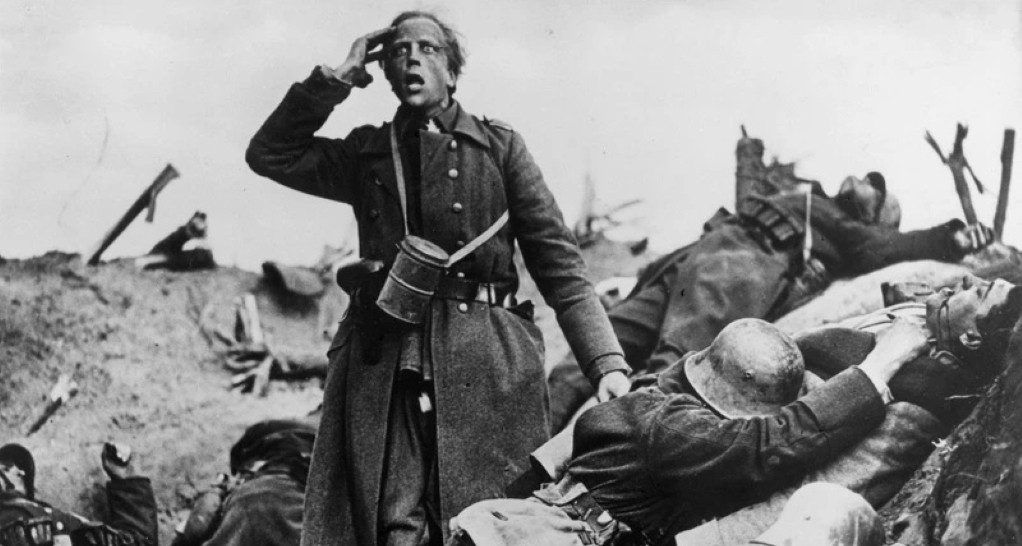
If there is one thing you definitely understand when watching Westfront 1918, it’s the impact of the First World War on ordinary Germans. Westfront 1918 is low on plot and is close to an experience film, following four regular soldiers ground down by the military campaign on the trenches, with horrific psychological and physical injuries which will leave most of them dead (or as good as). Our soldiers are Karl (Gustav Diessl), a husband who discovers his wife has found comfort at home in the arms of the local butcher, the young Student (Hans-Joachim Moebis) in love with Yvette (Jackie Monnier), a rotund Bavarian joker (Fritz Kampers) and the tightly-strung Lieutenant (Claus Clausen) under huge pressure.

The inescapable comparison Westfront 1918 lives with is to All Quiet on the Western Front (shot almost at the same-time). Unfortunately, the novel Westfront 1918 is based on is not as strong as Erich Remarque’s and the film goes for such an allegorical universality in its characters (most of whom don’t get names) that it doesn’t carry the same powerful emotional impact. All Quiet also shows its characters going from hope to disillusionment: what Pabst is going for, with unrelenting grimness, is to show disillusioned men stuck in a pointless slaughter, fighting a distant and faceless enemy.

All they is chaotic uncertainty and the suddenness of death. The story is topped and tailed with different types of incompetence and inadequacy. Our heroes, on a brief leave near the front, are forced to hit the basement after their occupied village is shelled by their own artillery (this fuck-up will be repeated again and again, to the exasperation of the Lieutenant as his men duck in the trenches from their own shells). The film climaxes in an over-crowded, shelled-out church acting as field hospital, with over-worked doctors and inadequate medical supplies struggling to save lives. Stressing how much this is a hell on earth, the camera pans past a shattered Christ statue in the rubble. This dance with death isn’t just pointless, it’s ineptly led.

The combat sequences are shot with a strikingly observant camera, soaking up the detail, the soundtrack (and the ground) constantly peppered with exploding shells. Pabst stages our arrival at the trenches in a striking tracking shot, stressing their narrowness and inhospitality and the flimsy protection they provide. The final battle that closes the film – a French tank advance against hopelessly outmatched Germans – includes brilliant stationary shots that hold a fixed view of the battlefield. In front of us march (and run) troops – but also, when troops are hit, their bodies slump and remain there in shot, sprayed with mud when shells explode. Slowly the frame fills with the detritus of war. It’s an extremely well-done capturing of the grimness of war.

Pabst’s film stresses the unfairness and dismissal of the ordinary soldier by the officers. Senior officers are based miles from the front, fighting a very different war: pushing troops around a map and enjoying fine rations, served by batmen. When the Student struggles into their presence with a message after a harrowing journey, they barely register his presence: he’s left slumped on the floor and only fed when the batman sneaks him some food. Everyone is not equal and the soldiers there is no point volunteering for things (the student has only taken on his hazardous mission in the hope he can steal away afterwards to see Yvette).

The homefront is equally troubled, crowds queuing for low rations and those left behind struggling with the loneliness and shame (as millions die a few miles away). Pabst’s film also treats those on the homefront as victims. When Karl’s wife is found in an adulterous twist with a butcher, Westfront 1918 gives as much sympathy to her loneliness and depression as much as it does Karl’s rage. In fact, if anything, Karl’s fury towards a woman he hasn’t seen in 18 months finding some comfort is held up as his character flaw, something he will spend time deeply regretting later. What does a passing moment like this matter when you could be killed at any time? Pabst’s argues we should stick together as Komarades, not turn on each other.

The film’s main weakness is the characters largely act as ciphers and universally representative figures. Westfront 1918 never quite manages to make them people we really care for in themselves, even as they fall. Which isn’t to say the tough moments don’t land: one character’s fate, drowned in a pool of mud, only his hand sticking limply out after death, is especially tough. The impact of death land (literally so in one shot which drains out the light to leave one character’s face literally looking like a skull) but, unlike All Quiet, we never quite feel like we fully know and understand these men.

This is perhaps why Pabst’s film is now most strongly remembered for its technical innovations. His first sound film, Pabst didn’t want his camera to be restricted into a stationary position so that a sound boom could pick up the sounds. He and cameraman Fritz Arno invented a sound-proof casing for the camera to allow them to move. In doing this, Pabst re-introduced much mobility to sound film-making.

Westfront 1918 is a film full of admirable film-making virtues and a strong streak of humanity. It doesn’t carry quite the same emotional impact as All Quiet – and it will always be remembered as that’s companion piece – but it has moments of haunting, virtuoso film-making. It’s view of war as a pointless grindstone inevitably led to it being banned by the Nazis. But it’s also sad to reflect that Pabst spent the next war (reluctantly) filming propaganda films for Joseph Goebbels. As Westfront 1918 tells us, life is cruel.

The Testament of Dr Mabuse (1933)

The Testament of Dr Mabuse (1933)

Lang’s masterful mix of gangster thriller and supernatural psychological drama is superb

Director: Fritz Lang

Cast: Rudolf Klein-Rogge (Dr Mabuse), Otto Wernicke (Inspector Lohmann), Oskar Beregi Snr (Professor Baum), Gustav Diessl (Thomas Kent), Wera Liessem (Lilli), Karl Meixner (Hofmeister), AE Licho (Dr Hauser), Theo Lingen (Karetzky), Klaus Pohl (Muller), Theodor Loos (Dr Kraum)

Did Fritz Lang invent the concept of the cinematic universe? Or after completing M, did he just wonder what it would be like if his detective Lohmann (Otto Wernicke) took on the dastardly criminal mastermind Dr Mabuse (Rudolf Klein-Rogge) from his earlier epic crime drama. Either way, the hero and the villain from those two very different films face-off in The Testament of Dr Mabuse, a pacey crime melodrama spliced with a spooky ghost story, that rattles its way through a scintillating story tinged with the whiff of the dread of Nazism.

It’s eleven years after Mabuse’s reign of terror ended with him catatonic and under arrest. In a psychiatric hospital under Professor Baum (Oskar Beregi Snr), who sees him as a fascinating case study of deluded genius, Mabuse has not spoken in years instead filling his days with endlessly scribbling a series of blueprints and schemes for the criminal underworld, focused on destabilising the country and corrupting the currency. But, despite being under lock and key, a secret society of criminals is carrying out Mabuse’s scribbles, seemingly under the guidance of the man himself. Can death, when it comes, really take Mabuse? Or are Lohmann’s suspicions that the dread hand of the Great Unknown still controls events, even from beyond the grave, correct?

Lang’s gangster film throws together some of the best elements of all his German films. This is a pulpy gangster thriller, full of action, shoot-outs and explosions mixed with the unsettling double exposure appearance of ghosts and shady, unknown powers manipulating events. It’s Scarface meets A Christmas Carol, with Mabuse as a dreadful Marley’s Ghost causing devastation and chaos even after death. The Testament of Dr Mabuse sees realism meet thriller meet supernatural powers, but brilliantly combines all three up into a propulsive thriller.

And it’s a film, more than any of Lang’s others, about the malign influence of Fascism. For what is Mabuse’s dogmatic lust for chaos and destruction, but a terrible prophecy of the horrors Hitler would unleash. Mabuse, like the Fuhrer, is interested only in destruction wanting to pull the world down to rule over the ashes, to reforge the remains into his ideal vision of reality. His paranoid ramblings – and the spectral, transparent (brilliant use of double exposure at the technical possibilities of cinema, as always from Lang) presence he becomes parroting the same mantra of the nobility of destruction – are about leading the country into a morass of destruction. No wonder The Testament of Dr Mabuse was almost immediately spiked by Goebbels. Hitler’s magnetic powers of persuasion and control were surely the real-world apotheosis of Mabuse’s skills.

Mabuse’s powers are so great that even death can’t slow him down. Today it doesn’t take long to figure out exactly who the real mastermind – or after-death puppet of Mabuse’s – might be. As wardens in the hospital say, even in silence the fixed, controlling glare of Mabuse is enough to bend minds to his will. The rantings of his testament – Mabuse’s Mein Kampf – merely add to the force of his stare. Even the echo of Mabuse’s name will turn former police detective Hofmeister into a gibbering wreck. His power is absolute.

No wonder he appears after death, disfigured post-autopsy, his eyes bulging, to continue to direct his puppets, his ghostly form directing their actions. It’s a wonderful visual expression of the hypnotic control Mabuse had over his victims, that they continue to see his controlling, ranting form – across a desk or guiding them down corridors – even after they’ve gone. Mabuse’s ghostly form will literally emerge out of the body of his underling, crossing to sit opposite him and pour more instructions in his ear.

Ordering his underlings from behind a curtain that hides his true face, Mabuse’s commands are absolute and its threats always delivered. The gang, each a series of cells who work together only when instructed, are nearly all brain-washed fanatics, accepting orders without question. Much like Hitler, Mabuse’s followers cover a vast range, not just common criminals, or trigger-happy loons but also the middle-class and professional, in thrall to the words of a mad man promising a new dawn (sound familiar?) Much like in Mabuse’s hey-day, any deviation from absolute loyalty is met with swift, fatal punishment. What chance does Thomas Kent (Gustav Diessl – a spitting image for the young George Sanders) have when he decides the gang life is too risky for his girlfriend?

Up against this, Lang places his hero from M and his accustomed detailed fascination with the mechanics of investigation. The Testament of Dr Mabuse mixes this analysis of things like the forensic translation of scratches on a windowpane, with this outré pulpy set-up of Wizard of Oz-like criminal masterminds. The world of Lohmann is one of order and methodical investigation, grounded in realism and detail. It’s an adjustment for Lohmann who, in M, was more the jovial face of a failing institution – here he’s the last bastion of reasonable authority.

The Testament of Dr Mabuse is full of shrewd political observations – but it’s also a supremely entertaining film. Few directors were as good at crime drama set-ups than Lang. The film’s opening sequence, showing Hofmeister tracking the gang through a warehouse, is a masterclass of the tension of imminent discovery, then of explosive (literally) violence during a chase. A gorgeously inventive bomb sequence – where a flooded room is the best chance of safety – is another masterpiece of slow burn tension, while the insidious threat of Mabuse’s voice creates a miasma of terror.

That sequence plays beautifully into Lang’s increasing comfort with, and mastery of, sound. The film opens with a pounding heart-beat on the soundtrack as freelance investigator Hofmeister hides in the factory where Mabuse’s men assemble their latest schemes, capturing the fear as he constantly ducks and hides to (unsuccessfully) avoid detection. The sound of machinery grows to overwhelm the film and, as Hofmeister flees, his barracked by the sounds of engines and rolling oil-filled barrels that burst into flames. Sound skilfully stresses mood and bridges scenes, controlling mood and atmosphere and adding to the air of distrust and disturbance.

The technique shines out of several stunning set-pieces. A traffic light assassination – another masterpiece of sound – is a brilliant piece of gangster-ish business, the gangsters using a crescendo of car horns to cover a fatal shot. Watching its slow build-up and the carefully paced release of information to the audience (the presence of the killers, the gun, the tension of the wait) you can see why Lang often felt Hitchcock got a lot of credit for things he had invented.

Fast-paced and thrilling, it’s a perfect extension of both Lang’s previous films, a brilliantly unsettling and disturbing drama wrapped up in a gangster package. It’s supernatural touches are just the right side of psychological drama, a portrait of obsession and a fractured mind. A perfect expression of Lang’s mastery of mixing the high and low brow into an engaging, thought-provoking and thrilling package.