
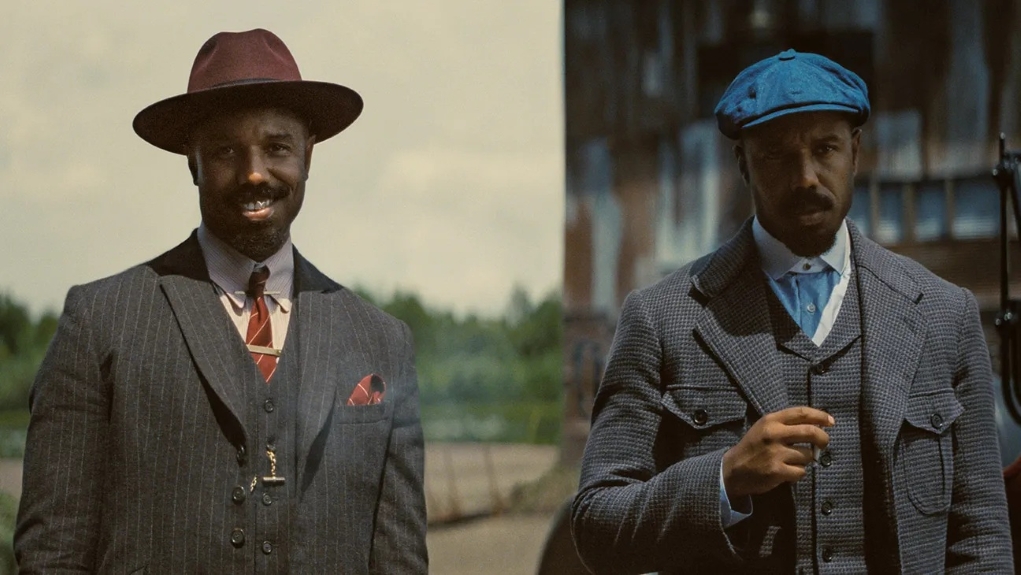
Coogler’s mix of political statement and horror flick is overlong but very effective
Director: Ryan Coogler
Cast: Michael B Jordan (Elijah “Smoke” Moore/Elias “Stack” Moore), Hailee Steinfeld (Mary), Miles Caton (Sammie “Preacher Boy” Moore), Jack O’Connell (Remmick), Wunmi Mosaku (Annie), Jayme Lawson (Pearline), Omar Miller (Cornbread), Delroy Lindo (Delta Slim), Li Jun Li (Grace Chow), Yao (Bo Chow), Buddy Guy (Old Samme)
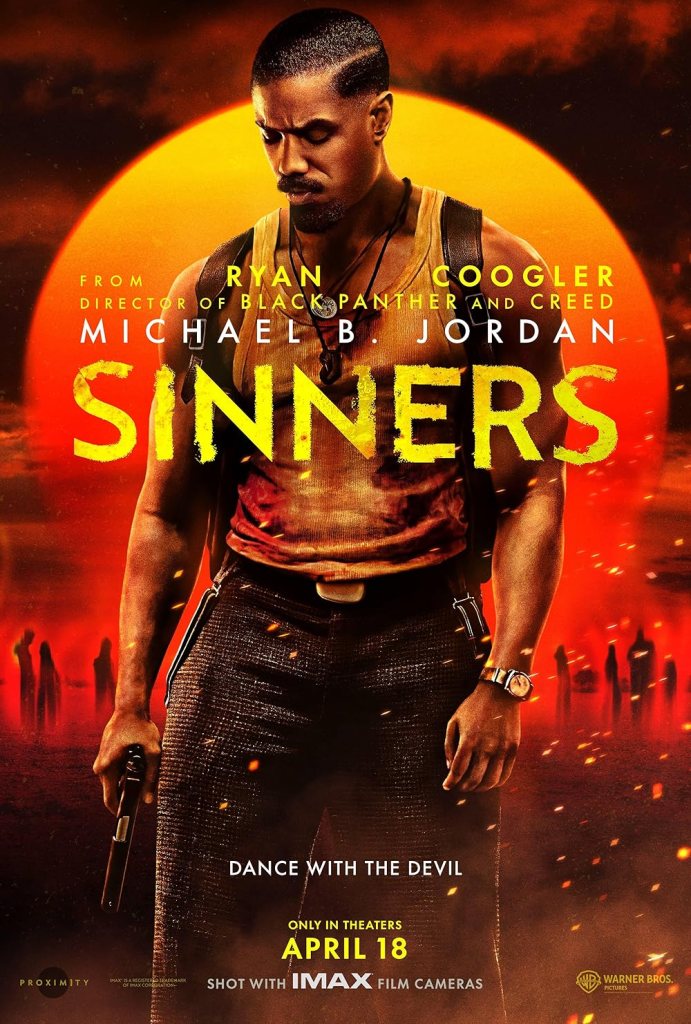
In 1932 twin brothers Smoke and Stack (Michael B Jordan, pulling double duty) return to the racist South of Mississippi after years of war service followed by time spent working for the gangs of Chicago. They dream of setting up a juke joint for the Black community, flying in the face the racism of local Mississippi. But the dangers of the KKK pale slightly, when their opening night coincides with the arrival of vampire Remmick (Jack O’Connell) who dreams of forming a new family of the dead – and wants to recruit Mississippi’s Black community, with promises of equality in his world they could never have in their own. Holed up in their juke joint, can the brothers and their families and friends survive a night long siege until dawn?
The basic set-up of Sinners is, to be honest, familiar. It delights in hueing close to Vampire mythology – garlic, wooden stakes, silver and sunlight are the key weapons here and the vampires are powerless to cross a threshold until they are invited – and the ‘base under siege’ that occupies the film’s final act is essentially taken direct from the sort of set-up John Carpenter excelled at in his heyday. What makes Sinners really stand-out is the richness of its character relationships and its social context.
That social context is, of course, the Jim Crow South. Sinners is a film steeped in the racial injustice of a particular time-and-place. In 1932, Black workers still pick cotton on plantations in exchange for wooden nickels. Families live in shanty towns and use different shops than the white folk (local goods dealers the Chow’s run two convenience stores, on opposite sides of the street, to serve their two clienteles). The danger of lynchings are everyday threats (Delroy Lindo has a haunting monologue, beautifully delivered, as Slim recounts the lynching of a former band partner, who unwisely produced his stuffed wallet at a train station). Virtually the only white people we see (other than Rennick) are KKK members.
In this world of radical injustice, it’s fascinating that Coogler suggests, in some ways, the afterlife of a Vampire is more just and fair than actual life. Rennick, himself the relic of a long-oppressed pagan Irish community, makes solid points about Smoke and Stack facing a losing battle trying to play by the white man’s game as entrepreneurs and would-be local businessmen. He even, genuinely, states he would be happy to kill the entire KKK just to wipe their hatred from the Earth. There is a certain truth in the fact that, in the legions of the undead, all are equal and race means nothing. That getting bit could be a doorway to a new world, free of racial oppression – even if it also seems to mean living in the sort of community Rennick alone crafts.
It becomes a fascinating idea, joined with the fact that Rennick also points out Christianity is a spirituality forced on the Black community. Unlike the blues music, that gifted young cousin to the brothers, Sammie (a lyrical performance in every sense from Miles Caton) plays so well it can cross the bounds of space and time joining Black souls together, the enslaved people didn’t bring Christianity with them across the water. It was forced on them, as much as the labour in the fields. Sinners isn’t quite brave enough to explicitly denounce the Church as just another wing of enslavement (even if Sammie’s preacher father uses trauma to hammer conversion on people, rather than offering comfort). But it does make clear that Sammie’s ‘coming-of-age’ is whether he will choose the culture of his ancestors or the culture of his oppressors.
This is thought-provoking stuff – and Coogler does a superb job of threading it through the blood-spurting, neck-biting, stake-hammering action that fills up a large portion of the film’s conclusion. Sinners is dripping in Blues music, which artfully and beautifully wraps itself around the film to perfectly capture its tone and pitch. The sequence where Sammi’s music fills the juke joint, is transcendent in more ways than one, powerful and transporting in its musicality and passion (Ludwig Göransson’s score, created in partnership with several Blues artists and the actors is exceptional). Coogler matches it with one his trademark, virtuoso, one-take shots, the camera seamlessly weaving in and around the juke joint as our 1930s characters dance alongside modern club dancers and musicians as well as tribal African musicians of the distant past.
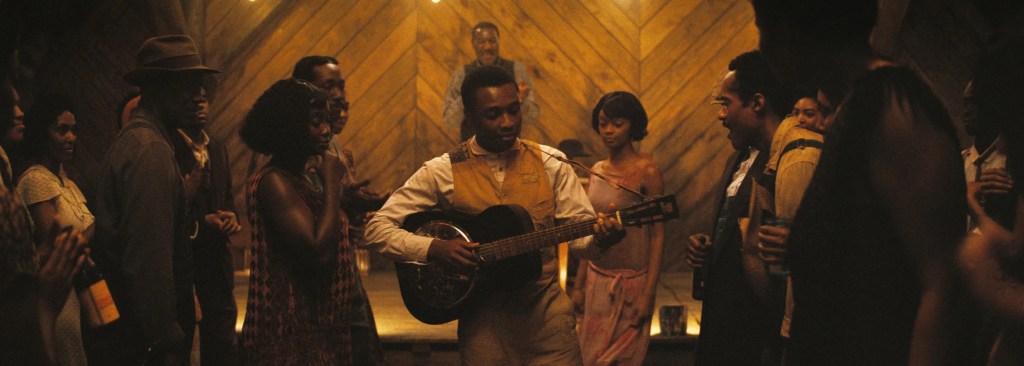
It also rewards more as Coogler takes his time throughout the film’s long opening act to really establish the characters and their relationships. You can argue that Sinners is over-indulgent in the sometimes overlong (well over an hour) long ‘recruitment’ sequence as Smoke and Stack assemble family and friends for their opening night. But this careful exploration of the closeness and warmth between these people – their loving sense of family, loyalty and sometimes painful shared history – pays off in spades when they begin one-by-one to turn to Rennick and then on each other. Coogler then makes these corruptions of the living into the hungry undead really sting, just as we feel the pain of those left among the living who must stake their nearest and dearest.
That carries further impact from the strength of the acting. Jordan, one of the most charismatic actors out there, gives a superb double-performance as the two twins, expertly sketching out their contrasting personalities and their deep love for each other. He makes Stack charismatic, gregarious and fun, and Smoke gruff, reserved but endlessly loyal and protective. They are too sharply humane turns, with Jordan so naturally playing off himself you forget both are played by the same actor.
Equally fine are the rest of the cast. Miles Caton is youthful idealism being shaken by traumatic events on the greatest night of his life. Wunmi Mosaku gives Smoke’s wife Annie a moral authority and deep sense of lingering grief. Hailee Steinfeld is vivacious but similarly burdened by disappointment and pain at chances lost as Stack’s one-time girlfriend that prejudice thwarted. Delroy Lindo’s soulful skill invests Slim with a real grace under the drunkenness. Even O’Connell, at times transformed into an Orlock-like nightmare, has a lonely humanity behind his ruthless, never-ending desire to build a new community (which he controls) around him.
There are powerful subtexts throughout here, even if parts of Sinners could at times benefit from a little tightening. Coogler effectively gives a rich hinterland to some familiar genre settings: and he surprises us with two codas, one rich in satisfying revenge violence the other with a rhapsodic melancholy which feel like natural ends for both their characters. Sinners mixes its Spike Lee influences with its John Carpenter ones with excellent effect, and is another firm reminder of the visual flair and piercing individualism of Coogler as director.



 Movie Musings