
Tag: Haley Joel Osmont

The Sixth Sense (1999)

The Sixth Sense (1999)

Shyamalan’s opus has just enough to reward re-watching after the world learned its secret

Director: M. Night Shyamalan

Cast: Bruce Willis (Dr Malcolm Crowe), Haley Joel Osment (Cole Sear), Toni Collette (Lynn Sear), Olivia Williams (Anna Crowe), Donnie Wahlberg (Vincent Grey), Glenn Fitzgerald (Sean), Mischa Barton (Kyra Collins), Trevor Morgan (Tommy), Bruce Norris (Mr Cunningham)

Does this film have the most famous twist of all time? M. Night Shyamalan’s opus is so dominated by its final reveal (look away now) that Bruce Willis was is in fact a ghost, that every single viewing of it afterwards is focused on watching every second and seeing if you can spot the joins. I’m not sure if that has made for a long shelf-life or not for The Sixth Sense, an otherwise surprisingly sweet Stephen King-ish story of a child coming to terms with a miraculous power. Is there much more to The Sixth Sense by a third viewing though – can the magician’s trick land a third time?

I’d say just about. A year on from the shooting of famed child psychologist Dr Malcolm Crowe (Bruce Willis) by a former patient he failed to help, his traumatised wife Anna (Olivia Williams) has stopped speaking to him and Malcolm needs redemption. Could he find it with the case of troubled ten-year-old Cole Sear (Haley Joel Osment). Cole, despite his obvious good nature, is frequently moody and terrified by curious incidents. His mother Lynn (Toni Collette) despairs as Cole seemingly refuses to talk to her. Can there be truth in Cole’s belief that he can see, and talk with, dead people?

The Sixth Sense has the reputation of a supernatural chiller. But, bar a few jump scares as ghosts walk across screen to sudden, loud musical notes, it’s actually a far more gentle story. In Shyamalan’s world the ghosts are not malevolent or cruel – they are simply confused, lost souls (of course “some of them don’t even know they’re dead”) with unfinished business. They are, in other words, rather like the rest of us – and Cole’s realisation of this is actually rather sweet.

This humanity is the real triumph of the film, helped enormously by the untricksy care Shyamalan unfolds his story with. While almost every film he made since teetered from disappointment to disaster (with ever more desperate attempts to recapture the rug-pull zeitgeist to ever diminishing returns from increasingly savvy audiences), The Sixth Sense is a reminder of the road not taken. If Shyamalan had focused on small-scale, intimate character dramas like this he could have had quite the CV. His camera work is careful, often unobtrusive, gentle in its slow, immersive movement and he backs aware almost entirely from fast cutting. The Sixth Sense is really a spooky fairy tale.

It also creates an environment for four impressive actors to tackle four challenging roles. From Olivia Williams, whose marvellously detailed performance of utterly naturally not reacting goes a huge way to maintaining the film’s delicate tightrope to the (Oscar-nominated) Toni Collette, who superbly channels deep motherly love and pained helplessness under a blowsy exterior.

Bruce Willis (who only took the film on under contractual obligation) gives possibly his finest performance here. Suppressing his natural cocksure confidence into suppressed confusion and guilt, he convinces as an expert plagued with self-doubt. It’s a quiet, expressive performance that’s a tribute to the acting chops Willis had when he was moved beyond smirks.

It’s also a very supportive performance that helps bring the best out of a gifted child actor. Haley Joel Osment carries a large chunk of the film. He’s vulnerable and scared but also older than his years, alternating between the innocent excitement of a child and the weary reflection of a much older man. He creates a character you both want to comfort and also cheer for his growing strength. Shyamalan works with both actors to continually subtly shift the power balance between them without ever showing the film’s hand.

Because, of course, Cole knows the truth from the start – no one is better at spotting these things than him, and his unwillingness to speak to Malcolm within ear shot of others (such as during their first real consultation while his mother prepares dinner in the kitchen) speaks volumes. No wonder he keeps shooting him those looks of pity and concern which we, at first, interpret as fear.

You can’t escape that the film’s pretence, on repeated viewing, demands the viewer to reach some tenuous conclusions on how Ghosts operate. I think there is just enough there to suggest – from the sudden appearance and disappearance of ghosts – that they operate like we do in a dream, suddenly finding themselves in places with no memories of how they got there. They can move some objects, but only if they allow themselves to “see” them. They imagine what their own appearances are (the film implies Malcolm always appears in his blood soaked shirt to Cole, it’s just we see Malcolm’s perception of himself as a suited psychiatrist) and are subconsciously drawn towards people who can see them or who they have unfinished business with. The pretence just about sustains itself.

But is there more to the film than that? Pleasingly – and a little to my surprise – there is. While The Sixth Sense is more spooky than terrifying, that’s because it’s a film where helping and caring for people is the answer. No matter how horrific looking the ghosts seem, they are really scared people looking for help. This realisation – and the way Cole seemingly decides to commit his life to helping them – is actually extremely affecting. It’s a basic message of not judging a poltergeist by its cover, that really works.

It’s these beats that really work on a second or third viewing. I would trade the whole “he’s a ghost” twist for that gorgeous final scene between Collette and Osment in a car, where he finally confesses and shares a family secret from the grave to Collette’s initial confusion, anger and then emotional release. It’s a beautiful scene (it surely nailed Collette an Oscar nomination) and is the finest moment of Shyamalan’s career. It also shows the heart of the film – this is a parent-son film (with two parents), that’s about learning to love and accept. Everything else is really just set-dressing.

The magic trick (and Shyamalan hints at the sleight of hand he’s pulling by having Malcolm perform a similar distraction trick) may lose its mystique, but it then allows you to focus on the emotion that made you care about the trick in the first place. And, let’s be honest, the emotional heart is really what made the film a phenomenon. Any film can have a rug-pull twist – but it only really connects if people already cared about what they were watching. The Sixth Sense focuses on making sure we invest and it’s that which makes the film last, when all the glitz of the trick has faded.
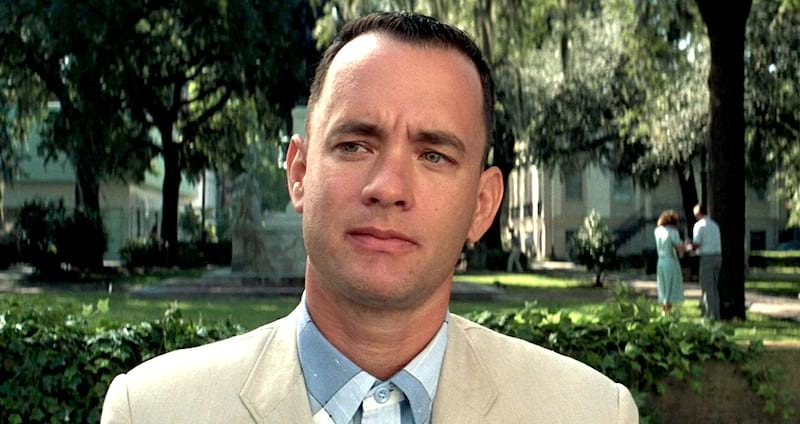
Forrest Gump (1994)

Tom Hanks unleashes some cloying charm in Forrest Gump

Director: Robert Zemeckis

Cast: Tom Hanks (Forrest Gump), Robin Wright (Jenny Curran), Gary Sinise (Lt Dan Taylor), Mykelti Williamson (“Bubba” Blue), Sally Field (Mrs Gump), Haley Joel Osmont (Forrest Gump Jnr)

Oh dear God. It’s worse than I remembered. I hadn’t watched Forrest Gump since maybe 1995. I hadn’t liked it much then. But that might just have been my contrariness: sure I was going to find faults in the film that became a cultural phenomenon. Rewatching it today: actually no, I had good taste. This must be one of the worst films to ever win the Best Picture Oscar – and certainly one of the most unsettlingly twee, sentimental, conservative-minded pieces of feel-goodery to ever come out of Hollywood.

You surely know the plot. Forrest Gump (Tom Hanks, who to do him credit plays this one note character with real charm) is a good-hearted man with developmental difficulties (IQ below the 75 mark) who lives through some of the most turbulent times in American history. From racial violence in the 1950s, to Vietnam, the Cold War, the political turmoil of the 1970s, Forrest lives through it all. And largely lets it wash over him, never letting it intrude on his simple, folksy, homespun gentleness. Although that might mostly be because he also doesn’t really understand most of the things happening around him. He’s quite a contrast with the girl he’s loved since their childhood, Jenny (Robin Wright) who embraces everything the modern world brings (protest, politics, drugs) but of course finds her life much less rewarding and happy than Forrest’s “go-with-the-flow” acceptance.

Just writing it down I can feel my stomach turning again. At the time the filmmakers were very keen to promote the film as stridently apolitical. Yeah sure the film never praises, say Kennedy or Nixon, just as it goes out of its way not to state an opinion on either George Wallace or the Black Panthers. But the film is, at its heart, a large, beating, reassuring lump of rank conservatism.

It looks back at America’s past with rose-tinted glasses, portraying a world which would have all better if they had taken a leaf out of Forrest’s book. If we had all been just as uninvolved, decent, kind and stayed at home where we were happy rather than getting engaged in major social and political issues, everything would have been better. Forrest is a celebration of all-American virtues of honesty, bravery and loyalty – but the film is also an implicit criticism of other all-American virtues like curiosity, scepticism and challenging the status quo. Basically, the film celebrates the cosy attitudes conservatives adore and has nothing good to say about more liberal values. Sure, it doesn’t roll out a banner for Nixon – but you can also see this playing well at a Trump rally, with people saying we would be a happier country if we could all be a bit like Forrest.

That’s really tough on the film – and I imagine Zemeckis and co would be rightly horrified about that very idea – but it’s a film that doesn’t once challenge the audience at all. I was reminded throughout of Being There which took a similar concept: a man with low IQ finds himself at the centre of major events. But while that film was a satire – where the characters invest Chance’s gnomic utterings with profound wisdom – this film is a serious drama which encourages the audience to see a “deeper wisdom” in Forrest, to effectively treat him as a sort of prophet. There is a reason bland nonsense like “life is like a box of chocolates” caught on.

The original book was far more of a satire on the shallowness of modern culture. This instead plays like a sort of holy fool pilgrimage, with Forrest’s interaction with historical figures played for laughs. From showing Elvis how to dance, to (in the film’s most cringing moment) inspiring John Lennon with the lyrics of Imagine (another reason to hate Forrest), the film is crammed with gags like this. While the insertion of Tom Hanks into newsreel footage with Kennedy, Johnson and Nixon is impressive (although it has not aged quite so well), it’s not made with any point. This is because Forrest has no real appreciation of what’s happening around him. He’s merely moving from one event from the next – but this lack of engagement and understanding is held up as a virtue. And the very fact that it is, speaks to the film’s underlying conservatism and love for simple, small-town American ideals that shouldn’t be sacrificed to all that uncomfortable social and political change.

The film is particularly harsh on Jenny, decently played by Robin Wright, who is portrayed as someone succumbing to every trend and popular movement of the era. And whom the film consistently punishes for this by showing her emptiness, shallowness and unhappiness, until it finally consigns her to death from AIDS. Just in case we’ve missed the point, Forrest repeatedly urges her to come home – to stop engaging with the wider world and the problems in it and bury her head back into the sands of home, where everything is simple, safe and nothing changes.

The world of Forrest Gump is one where corruption and war mongering don’t matter because it happened a long time ago. A world where racial politics are too distasteful to mention (although since Forrest’s Granddaddy was a leading member of the KKK – a flashback played for laughs – that clearly wasn’t the case). Where the only black people Forrest encounters are the outsider soldier Bubba (who of course dies in ‘Nam – even in serious films, the Black Guy dies first) and his servile family whose names don’t even merit a mention, but who become the grateful beneficiaries of Forrest’s oblivious generosity. But there is no sense here of the dangers and violence of America (bar some nasty jocks at Forrest’s college) – which considering the film has a cameo from George Wallace of all people is really striking.

But then the problems of the world I guess don’t seem that bad if you just don’t think about them and instead go through life with a smile on your face, blissfully unaware of what’s happening around you. The closest the film gets to giving Forrest an opinion on something is when he is asked to speak at a rally against Vietnam – and even then the sound cuts out meaning we can’t hear him (though it seems to have been profound). A wittier film, like Being There, would have made this a moment for satire. Here it seems more like the magic of Forrest’s simplicity mustn’t be shattered for the audience by daring to suggest he actually has a view on something.

The film is a warm and comforting hug, that tells people the past wasn’t that bad and would have been better still if we’d just been nice to each other. That wanting to change the world is dangerous and greater rewards can come from going with the flow. For all Forrest is bereft by Jenny’s death, the film still rewards him with family, home and friends. It’s sentimental, empty, depressing crap. Well made, but simply dreadful. You may not know what’s in a box of chocolates, but you sure as shit will remember after you’ve vomited them all back up after watching this.