Tag: Harry Andrews

Alexander the Great (1956)

Alexander the Great (1956)

An odd epic, which both loathes its subject and also presents him as a golden-boy

Director: Robert Rossen

Cast: Richard Burton (Alexander the Great), Fredric March (Philip II), Claire Bloom (Barsine), Danielle Darrieux (Olympias), Barry Jones (Aristotle), Harry Andrews (Darius), Stanley Baker (Attalus), Niall MacGinnis (Parmenion), Peter Cushing (Memnon), Michael Hordern (Demosthenes), Marisa de Leza (Eurydice), Gustavo Rojo (Cleitus the Black), Peter Wyngarde (Pausanias), William Squire (Aeschenes)
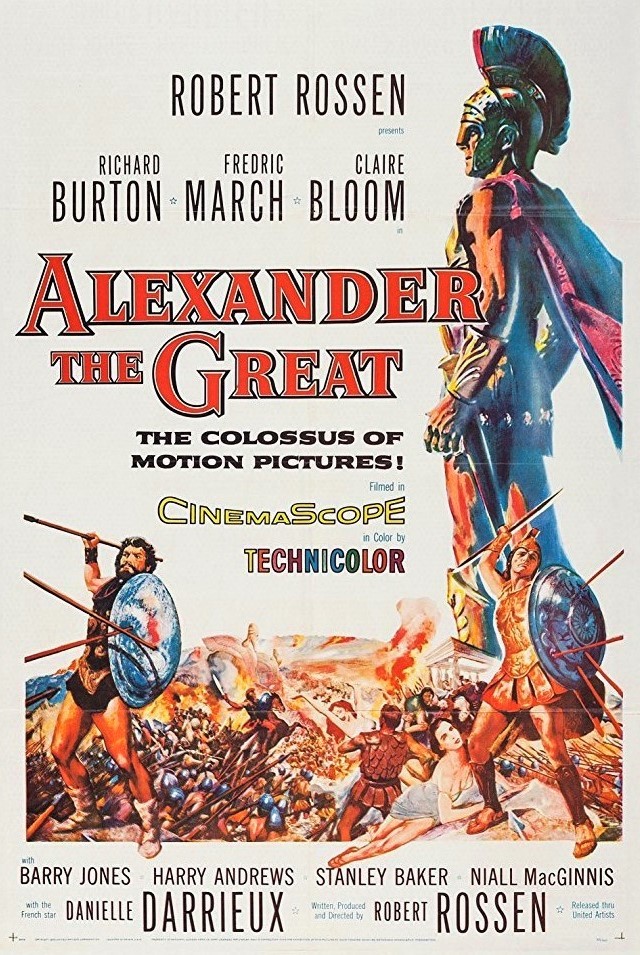
No one in history achieved so much, so young as Alexander the Great. He conquered most of the known world before he was thirty and left a legend that generations of would-be emperors found almost impossible to live up to. He did all this, while remaining a fascinatingly enigmatic figure: either a visionary nation-builder or a drunken man of violence, depending on who you talk to. Alexander the Great, in its truncated two hours and twenty minutes (sliced down from Robert Rossen’s original three-hour plus) can only scratch the surface of his story and that’s all it does.

As the great man, Richard Burton flexes his mighty voice in a film that splits its focus roughly equally between the early days of Alexander and his troubled relationship with both his father Philip II (Fredric March) and his mother Olympias (Danielle Darrieux) and his own kingship and conquest of the known world until his early death. Surprisingly, perhaps because the world is so vast, it’s the first half of the film that’s the most interesting – perhaps because showing up the internecine dynastic squabbles between petulant royals are more up director and writer Rossen’s alley than global dominance.

Perhaps as well because it feels pretty clear Rossen doesn’t particularly seem to like Alexander. Over the course of the film, the pouting monarch will prove to have a monstrous ego (even as a teenager fighting Philip’s wars, he cockily re-names a sacked city after himself), ruthlessly slaughters opponents after battles, is prone to fits of rage, informs his followers with wild-eyes that he’s God himself, leads his army into the dried out hell of the deserts of the Middle East and turns (at best) a blind eye to his mother’s plans to assassinate his father and then murder his father’s second wife and baby son.

The film culminates in a shamed Alexander kicking the bucket more concerned with maintaining his legend for future generations than assuring any kind of future for his kingdom. But the sense of hubris destroying the great man is never quite captured. This is partly because the grand figure we are watching lacks any personal feelings or fear. He can’t seem to experience loss or grief and only understands negative events in terms of their impact on his reputation. And he never seems to truly learn from this – even when he harms friends, his regrets are based around the impact such action will have on how those around him see him. At the same time, Rossen can’t quite follow his heart and make a real iconoclastic epic meaning he instead leaves titbits here and there for the cinema-goer to hopefully pick up among the spectacle.

As such, Alexander is still pretty persistently framed as we expect a hero to be, with a rousing score backdropping Burton’s speeches and poses, even while the film seems deeply divided about whether this guy who conquered most of the known world and lay waste to Babylon was a good or bad thing. While acting half the time like a egomaniac tyrant, the film still carefully partially shifts blame for his character flaws onto his mother’s Lady Macbethesque influence (Darrieux does a good line in whispering insinuation) or Philip’s bombastic egotism (March, growling with impressive vigour).

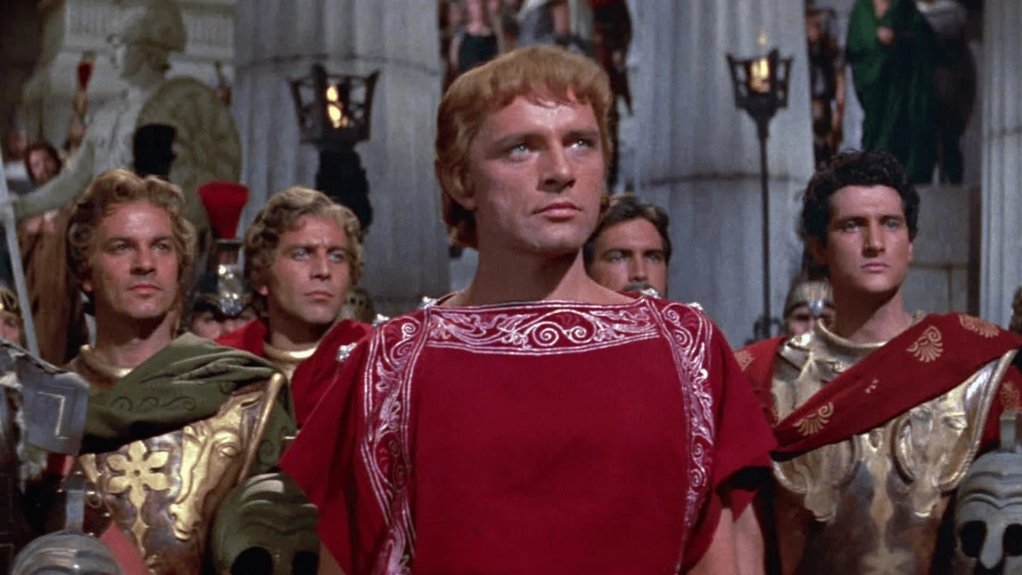
Rossen has far more admiration for people like the fiercely principled Memnon (a fine Peter Cushing) who refuses to compromise only to be rewarded by a post-battle one-sided butchering from Alexander after his offer to surrender and spare the lives of his men is turned down. Even Michael Hordern’s Demosthenes comes across as a man of principle, certainly when compared to Alexander’s Athenian-of-choice Aristotle, interpretated here as a pompous windbag cheer-leader for dictators. Oddly even Harry Andrews (possibly, along with Niall MacGinnis’ wily Parmenion, the films finest performance) as Darius comes across as a man of surprising human doubt under his regal exterior. But, perhaps because of choppy-editing cutting down a complex story into just over two hours, Alexander the Great can’t resist framing its hero as a sun-kissed golden-boy, towering above everyone else in the film.
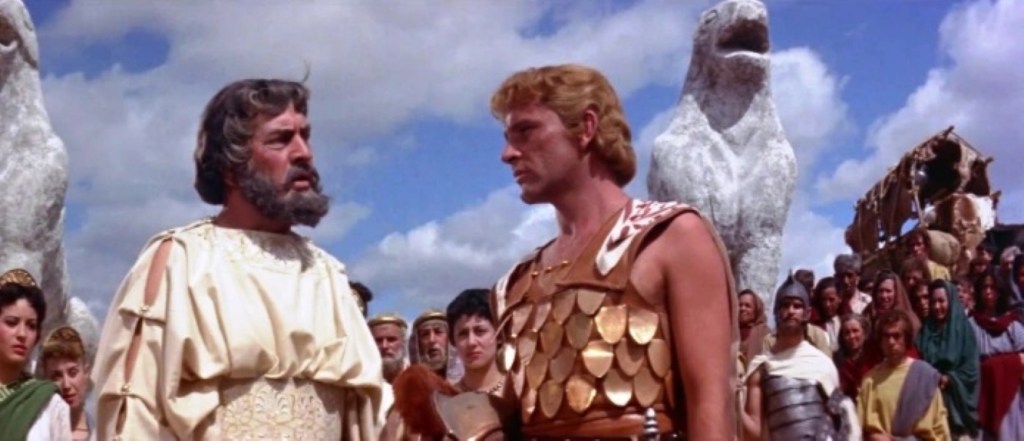
Watching Alexander the Great you get the feeling the film has effectively entombed him as a marble statue, so devoid is he of fundamental humanity. Perhaps this was Rossen’s solution to shooting a film about someone he seemed so devoid of human interest and sympathy for. There is a reason why Charlton Heston – the first choice for the role (can you imagine!) – called Alexander the Great “the easiest kind of picture to make badly”. Frequently Alexander the Great tips into a sort of sword-and-sandles camp made worse by how highly serious it takes itself. Not helped by Burton’s all-too-clear boredom with the part and contempt for the material, Alexander strikes poses and delivers speeches as if he’s been ripped straight out of Plutarch or a bust display in a museum.

Apart from rare moments – usually in the first half as he processes his complex feelings of love and loathing for his overbearing father – he is almost never allowed to be human. His friends – most notably his famed best-friend (and lover) Hephaestion – are reduced to a gang of largely wordless extras and only Claire Bloom’s Barsine is given any scope to talk to him as if he’s a man rather than just a myth. It gets a bit wearing after a while as you long for something human about the man you can cling onto.

It’s also a shame that Rossen seems uncomfortable with shooting the battle sequences. The battles of Granicus and a combined Issus-Gaugamela look rather like damp scuffles over shallow streams than some of the mightiest clashes of the Ancient world. Rossen communicates no visual sense of either strategy or scale (despite the bumper budget). Similarly, the grand sets look too theatrical and never quite as impressive as they should do, despite some fine painterly compositions. Rossen can never quite find a way to make his hundreds of extra seem like thousands and he falls back in the second half to communicating Alexander’s success through a tired combination of map montages, voiceover and repeated shots of men marching left to right and burning cities.

Alexander the Great is a deeply flawed epic. It’s neither swashbuckling fun that bowls you along, or a breath-taking piece of historical spectacle. Nor is it psychologically adept or insightful enough to show you something truly different about its hero. Instead, it tries to straddle both ways of thinking and ends up collapsing in the middle. If only Rossen had found his own Alexanderian solution to cutting this Gordian knot. Instead, the film just ends up a cut-about mess that fades from memory all too soon.

Nicholas and Alexandria (1971)

nicholas-and-alexandra-1971
Michael Jayston and Janet Suzman bring the Romanovs to life in Nicholas and Alexandra

Director: Franklin J Schaffner

Cast: Michael Jayston (Nicholas II), Janet Suzman (Empress Alexandra), Harry Andrews (Grand Duke Nicholas), Tom Baker (Rasputin), Jack Hawkins (Count Vladimir), Ian Holm (Yakovlev), Curt Jurgens (Germany consul), John McEnery (Kerensky), Laurence Olivier (Count Witte), Eric Porter (Stolypin), Michael Redgrave (Sazonov), Irene Worth (Queen Marie Fedorovna), Roderic Noble (Prince Alexei), Ania Mason (Olga), Lynne Frederick (Tatiana), Candace Glendenning (Marie), Fiona Fullerton (Anastasia), Michael Bryant (Lenin), Brian Cox (Trotsky), Maurice Denham (Kokovtsov), Roy Dotrice (General Alexeiev), Julian Glover (Georgy Gapon), John Hallam (Nagorny), James Hazeldine (Stalin), Alexander Knox (US Ambassador), Vivian Pickles (Krupskaya), Diana Quick (Sonya), John Shrapnel (Petya), Timothy West (Dr Botkin), Alan Webb (Yurovsky), John Wood (Colonel Kobylinsky)

When I was growing up, Nicholas and Alexandra was a popular movies in our house. And, as a history buff, I can’t help but be sucked into it’s grand-scale epic scope (a cast of stars play out the beginnings of the Russian Revolution!). You can certainly look at Nicholas and Alexandra and see a film that at times is bloated and lacking flair. But as a representative of a particular type of genre, with grand scale production values covering decades of earth-shattering events in a three hours, it’s a thoughtful and at times even rather moving picture.

Nicholas II (Michael Jayston) is Tsar of all the Russias. With the film starting with his (typically) disastrous decision to fight the Japanese in 1905 (a war that literally sunk Russian naval dominance) we see a parade of misguided, poor and short-sighted-but-well-meaning decisions by Nicholas – encouraged by his strong-minded but politically naïve Tsarina Alexandra (Janet Suzman) – eventually lead to the First World War and a revolution that will overthrow him. On a personal level, the couple also deal with the heartbreaking haemophilia of their son Alexei (Roderic Noble) and Alexandra’s dependence on the destructive Rasputin (Tom Baker). As their lives go from supreme power to imprisonment and eventual murder, the film also covers a host of Russian politicians from statesmen to socialists, all of them wanting to build Russia in their own image.

Franklin J Schaffner’s epic sometimes gets a bit overwhelmed by its impressive reconstruction of Imperialist Russia – the set design and photography is wonderful and the film marshals the inevitable cast of thousands with skilful effect. What the film does very well is marry up the epic with the personal. Because this is both a chronicle of the reasons for the outbreak of the Russian revolution, but also a domestic tragedy of a royal family horrendously ill-suited to the high position birth has called them to.

The film’s vast scope does mean it has to make a frequent resort – particularly in its first half – of feted stage actors explaining events at each other. Particularly rushed are scenes featuring the socialist revolutionaries, where actors like Michael Bryant, Vivian Pickles and Brian Cox have to contend with bullet point dialogue and lines of the “Trotsky, let me introduce you to Stalin, he’s just back from Siberia” variety. Nicholas attends frequent meetings where the likes of Laurence Olivier, Eric Porter, Harry Andrews and Michael Redgrave carefully fill him in on what’s happened and the likely (invariably historically correct) outcomes. At times it does make the film a rushed pageant.

The film however makes it work by continually bringing itself back to the personal story of Nicholas and Alexandra themselves. The film is expertly carried by relative newcomers (at the time) Michael Jayston and Janet Suzman. Jayston – an astonishingly close physical match for Nicholas II – gives a perfectly judged characterisation of the Tsar. He’s a decent, well-meaning, dedicated and hard-working man who would make an excellent bank manager. As a supreme leader he’s a disaster – stubborn and so convinced that it is his holy duty to be father of the nation, while with a weary smile he short-sightedly vetoes any social or political progress what-so-ever. As one character tells him late in the film, he lacks any imagination: he can’t reinvent an absolute monarchy in the modern age, because it’s fundamentally beyond him to picture how anything can be done differently from hundreds of years of precedent.

Rational and calm he’s strangely almost more content out of power, focusing on his family and tending his garden. Not that his flaws depart – he remains an appalling short-sighted judge of character and situations to the very end (nearly every statement he makes is wrong). Jayston tackles a difficult role with ease and assurance – he carries most of the film and I think it’s only that Nicholas remains such a reactive character that Jayston doesn’t get more credit for his work here.

Much of the “nominations” attention went to Suzman, who has the more electric (but in some ways simpler role) as Alexandra. She brings to the marriage all the qualities Nicholas lacks – defiance, determination, ambition – and those are just as destructive. Just like her husband she’s stubborn and a terrible judge of people and situations, who clings loyally to terrible influences (like Rasputin) and puts her family and personal concerns above the preoccupations of the throne and the people. She’s prickly and harder to like than Nicholas (who she clearly dominates with her stronger personality) – but Suzman grounds her confrontationalism in a genuine love for her family.

The film’s second half, which largely focuses on the end of the regime and the last few months of the families lives being shuttled from one inhospitable safe house to another, makes a successful contrast with the grander scope of the first half. With the focus now more intently on the family themselves, particularly quietly contrasting their former supreme power with their new helplessness, it helps to bring out the heart. Schaffner’s film is very good at quietly building the dread as we head towards the inevitable end (the final few moments of the film are almost unbearably tense). In the whole family, only Prince Alexei seems able to comprehend that they are doomed. But removed from supreme power, Nicholas and Alexandra relax into what they would have been happier being: decent, kind, middle-class homebuilders.

Schaffner’s direction may not bring the burst of poetry that he managed with Patton – but he’s very good at building our empathy for these misguided and foolish autocrats. So much so, you’ll be screaming at Nicholas “Of course you should give the people a parliament!” while never actually hating him – because, stubborn and misguided as he is, he means well. However the film doesn’t let us forget what Nicholas is a figurehead of. Sequences demonstrating the sour, resentful poverty of most Russians are common – not just the 1905 march on the palace (that ends in a panicked officer ordering a massacre), but the grim faces of average Russians greeting the celebrations of the centenary of the Romanovs, while pissed aristocrats and Cossacks barrel about throwing empty of bottles of booze around. The tensions of Russia, and the inevitability of disaster, is never forgotten.

The all-star cast throws up several fine performances, backing the quietly assured leads. Olivier brings moral force as Count Witte – with an impassioned speech on the eve of the breakout of the first world war, all but breaking the fourth wall as the rest of the court continue their work around him. Hawkins demonstrates he has one of the most emotive faces in cinema as retainer Vladimir, while Andrews is bluff and loyal as Grand Duke “Nikolasha”. Irene Worth brings a sanctimonious pride to the Queen Mother’s talking truth to power.

There’s also some great work from less recognisable names. John McEnery (who should have become a bigger star) is fabulous as an impassioned Kerensky who finds himself stuck in the same mistakes as the Tsar. John Wood is very good as a Colonel feeling increasingly morally conflicted. Alan Webb is chillingly affable as their final warden. Later to take on the mantle of Doctor Who, Tom Baker gives Rasputin a mixture of restraint tinged with madness (as well as having the most prolonged death scene on film).

Nicholas and Alexandra is, in some ways, grandly old-fashioned. But it’s got a surprisingly strong heart and sense of empathy in it. It acknowledges the dreadful mistakes and stubborn lack of imagination of the Romanovs – and the many that their misguided principles led to poverty and death – but it also acknowledges both their well-meaning intentions as well as presenting their tragic ends. At times it’s a run-down of events of the final years of Tsarist Russia, but it also manages to tell an affecting family story of flawed people. It’s what makes it work.

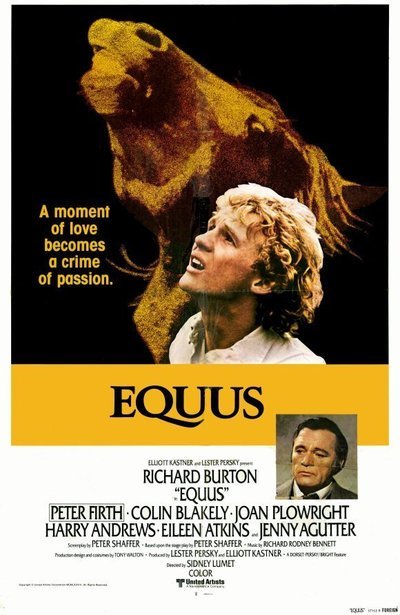
Equus (1977)

Equus (1977)

Clumsy adaptation that presents theatrical invention with the heavy-hand of realism

Director: Sidney Lumet

Cast: Richard Burton (Dr Martin Dysart), Peter Firth (Alan Strang), Colin Blakely (Frank Strang), Joan Plowright (Dora Strang), Harry Andrews (Harry Dalton), Eileen Atkins (Hesther Saloman), Jenny Agutter (Jill Mason)

In a parallel universe somewhere, there is a film version of Equus that doesn’t have a single horse in it. It’s probably a better version than this. Peter Shaffer’s stage play was a sensation in the 1970s in the West End and on Broadway – but Lumet’s film robs it of the mystique that made it work, by introducing a (literally) brutal realism. This helps reduce the play into being a quite self-important piece of cod-psychology, with ideas that increasingly seem more simplistic the longer the play lasts.

Dr Martin Dysart (Richard Burton) is a depressed and discontented child psychologist, who is struggling with a general sense of ennui, not sure what is life is for and stuck in a loveless, functional marriage. These feelings grow in him, as he begins to work on the case of Alan Strang (Peter Firth), a troubled young man who blinded an entire staple of horses in a seemingly random act of brutality. What were the deep-rooted psychological problems that caused Alan to carry out this senseless attack? And, by curing it, will Dysart remove from Alan anything that makes him unique?

Shaffer’s stage play used a combination of impressionistic moments, and mime artists, to create the impression of the horses that dominate the imagination (and desires) of Strang. Moments of horse riding (or eventual blinding) were presented symbolically. Meanwhile, Dysart functions as a quasi-narrator, delivering long speeches to the audience on the case, it’s causes and (increasingly) his own feelings of inadequacy and emptiness. It’s a tightrope, that manages to prevent the at-times portentous dialogue and student psychology from seeing either too self-important or slight. Lumet loses this mesmeric suggestiveness, doubling down on its pomposity. It makes for a bit of a mess.

I can totally see why, on film, it was felt necessary to go for real horses. However, it just plain doesn’t quite work. Watching a nude Peter Firth hug, stroke and eventually ride a horse until he reaches an orgasm mid-canter, might have had a sort of magic acted out on stage with dumb-show, puppets and actors as horses. On film, it’s tiresome and suddenly way too much. That’s as nothing compared to the decision to stage the blinding of the horses at the film’s end by showing us in graphic detail a sickle plunging into the eyes of alarmingly real-looking horses, blood pouring across Firth’s face. As that’s (pretty much) the last impression left on the audience for the film, rather than swept up in symbolism you’ll feel grossed out by the graphic violence. It’s not good for the play.

In fact, overlong and too full of speeches and not enough scenes, you watch this and start to wonder if Equus was much cop in any case. Certainly, the way it’s staged here doesn’t work. When Shaffer worked with Milos Forman on Amadeus that play was radically re-worked, extended and remodelled into an actual film that shared lines and DNA with the play, but was a very different beast. Equus is basically pretty close to an exact filming of the stage script, except on location. The show-stopping speeches by Dysart – brilliantly delivered by Burton as they are – come across heavy-handed, portentous and (in the end) off-putting and alienating.

That’s to mention nothing about the plays take on sex and psychology which feels very tired. Needless to say, Strang’s problem is rooted in his relationship with his parents (they fuck you up, you know). His mother (played with wound-up tension by Joan Plowright) is a holier-than-thou type who thinks sex is something a little dirty, while his father (an equally buttoned-up Colin Blakely) is a deeply repressed man who thinks sex is something to be ashamed off. Bound that up with the parents clashes about religion and you wind up with a boy who sublimates his sexual feeling into a confused horse worship, laced with religious overtones.

Which all sounded more daring then than perhaps it does now. Now this sort of sexual confusion (various theories suggest that the young Colin felt his first ever sexual longings after sharing a ride on a horse with a young man and – ashamed of these homosexual yearnings – transferred the association with sex from the man to the horse) was familiar then – it’s pretty much the first thing we look for now. And the insights the play offers around this, don’t carry nearly enough impact or insight to make you feel you are learning something. Anger, frustration, impotence, fear and shame all rear their heads as expected.

Saying that, Peter Firth – who originated the role at both the National and on Broadway – is excellent as Strang. It’s a full-bloodied, committed performance – but also one that is packed with an acute empathy and insight, a sensitive empathy and vulnerability that makes Strang deeply sympathetic even when he is at his most odd.

Richard Burton – who lost his final Oscar bid with this film – is also very good as Dysart. The rich Burton voice is perfectly used for Dysart’s monologues (all filmed in one day, in consecutive order, by Lumet). Burton’s puffy, unhealthy face also matches up perfectly with the sadness and resignation in Dysart – qualities that Burton again brilliantly conveys, his eyes brimming with regrets and his voice catching behind it oceans of confusion, sorrows and self-accusation. It’s one of Burton’s greatest performances, the ideas and elaborate language being a gift for an actor like him who worked best when challenged with complex material.

Unfortunately, the play itself is bogged down in a grimy, unattractive literalism that grinds the life out of it and ends up making it look very slight (this isn’t helped by its huge length). While the acting is very good – Jenny Agutter is also excellent as a young woman whose attempted seduction of Strang triggers a breakdown – the direction is leaden and the play ends up feeling histrionic and simplistic rather than engrossing and insightful.

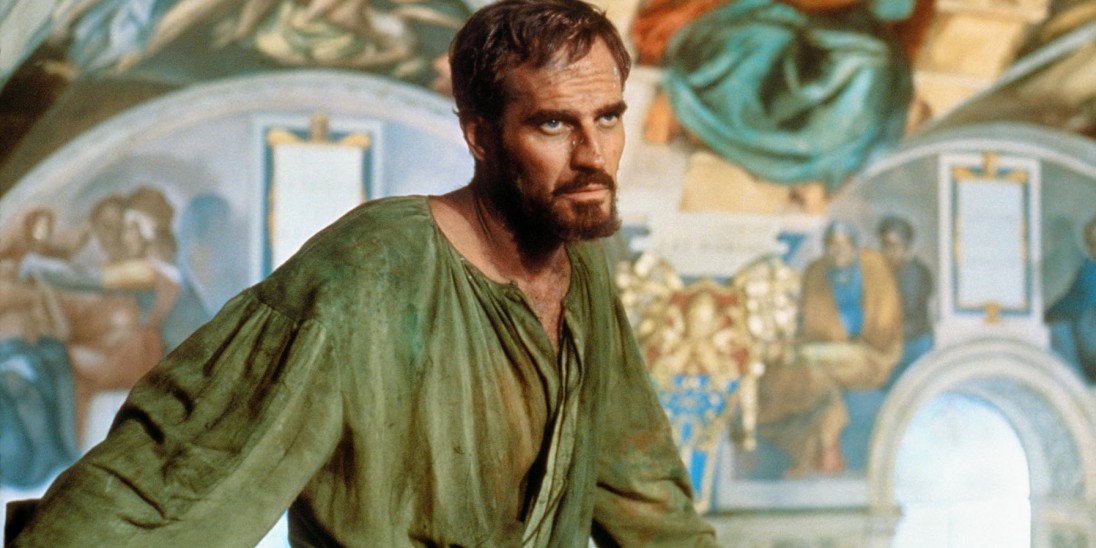
The Agony and the Ecstasy (1965)

Rex Harrison and Charlton Heston debate the creation of art in The Agony and Ecstasy

Director: Carol Reed

Cast: Charlton Heston (Michelangelo Bounarroti), Rex Harrison (Pope Julius II), Diane Cilento (Contessina Antonia Romola de’Medici), Harry Andrews (Donato Bramante), Alberto Lupo (Duke of Urbino), Adolfo Celi (Giovanni de’Medici), Venantino Vanentini (Paris De Grassis), John Stacey (Giulano da Sangallo)

Call a film The Agony and the Ecstasy and you are tempting fate with the critics. Make your recurring dialogue phrase “When will you make an end?” and you are practically writing the negative headlines for them. Your enjoyment of The Agony and the Ecstasy is pretty going to be pretty much directly linked to your level of interest in Renaissance art, the Sistine Chapel and stodgy Hollywood epics. Don’t care for any of those? This probably isn’t the film for you. For me, I love the first two – and I have a terrible weak spot for the third. I know (trust me, I know) films like this aren’t that good really, but they go about their epic work with such earnestness that they always suck me in.

The film, an adaptation of a doorstop novel by Irving Stone, tells the story of Pope Julius II (Rex Harrison) commissioning Michelangelo (Charlton Heston) to paint the Sistine Chapel. It’s a job which Julius expects will be done and dusted in a couple of months: instead it takes almost four years (and that’s just the ceiling, the film doesn’t even cover the artist moving on to The Last Judgement!). Rejecting the original concept, Michelangelo decides to turn fresco painting on its head: and so one of the greatest masterpieces of all time is born.

The Agony and the Ecstasy lost a bucket load of money (despite this is hoovered up five Oscar nominations, most of which focused on its strengths, above all, it’s 1:1 recreation of the Sistine Chapel which is progressively covered in paint as the film progresses). It more often than not tips somewhere between documentary and reverence of God, the Church, the Artist or all three at once. The first 12 minutes of the film is literally a documentary, a run-down of the artist’s career with mid-Atlantic voice-over and reverential visual slide-show of the artist’s greatest hits.

Once the action starts, all too often the film heads into “men in tights” territory, a stilted, personality-free Hollywood version of the Renaissance, all primary colours and dubbed European actors. Directing, with a smooth emptiness, is Carol Reed. Remember when Reed made films like The Third Man and Odd Man Out? How could the man who made films as original and dynamic as those close out his career making such middle-of-the-road fare as this and Oscar-winner Oliver? Reed delivers by-the-numbers. From swelling chords of Alex North’s well-judged score at our first sight of the interior of the (unpainted) Sistine chapel to the pristine pictorial pleasantry of the marble quarry Michelangelo retreats to, there is not a single unique or interesting shot in the film.

The closest the film gets to visual dynamism is the half-way point as Michelangelo heads to the mountains for inspiration, to see the clouds form themselves into (what we recognise as) the Creation fresco from the chapel. But then perhaps Reed reckoned he couldn’t bring us anything as visually striking as the ceiling (and to be fair who can?). So, the film doesn’t compete.

Instead it settles down into demonstrating the mechanics of how the ceiling is completed. While you could get a good dig in here that we see a real time painting of the ceiling, in fact I felt this demonstration of how you go about transferring a design to a ceiling was fascinating. Certainly, you can see why it takes a burden on Michelangelo. The film builds some nominal drama about whether it will ever be finished: but since it’s clear Julius (who at times is a bit of a “why I oughta…” boss, frustrated but amused by a protégé’s shenanigans) and Michelangelo (tempestuous of course, as artists are) have no intention of not finishing it, it’s pretty manufactured. But it doesn’t matter because this is really a story of the glory of fine art – and the burdens of its creation. And on that score it’s very successful and, for all its earnestness, very effective.

Charlton Heston gives a fine performance as the great artist. While there is no hint of Michelangelo’s probable sexual flexibility – Heston claims to have done his research and decided there was no way any of that was going on in the artist’s life – we do get a lot of his prickly bitterness (his surviving correspondence is a never ending stream of bitching about money and barely a mention of art theory, a sign if ever I saw one that great artist’s need to balance the books like the rest of us). Heston’s grandness may seem at time like he is as carved out of marble as the subject’s work (after all this is the actor cast as Moses based on his physical similarity to Michelangelo’s carving), but he does convince.

Rex Harrison has the juicier part as the war-like Pope, the Prince of both the Church and Realpolitik. Harrison famously declined to grow the beard that Julius was famed for, but he captures the brusque playfulness of this man who remodelled the Papacy as a political force. His scenes carry energy and wit in a way most of the rest of the film lacks.

Overall though the film, I am well aware, is (ironically) as slow as watching paint dry. But yet, it pushes my buttons and I rather like it. Again, it’s probably a bias coming into it. And I forgive it a lot for a beautifully judged and played scene where Julius and Michelangelo study the creation fresco and its meanings for faith. It’s wonderfully written and played and carries a profound spiritual intellect. This is when the film comes to life – it’s gives serious space to proper discussions on questions of art and faith, which is often rewarding.

Sure, it sits within a film that is often dry and old-fashioned. But when it zeroes in on the painting itself: how it came about, its inspiration and its meaning – it carries a real impact. It’s a flawed film: but I find myself with a very soft spot for it.

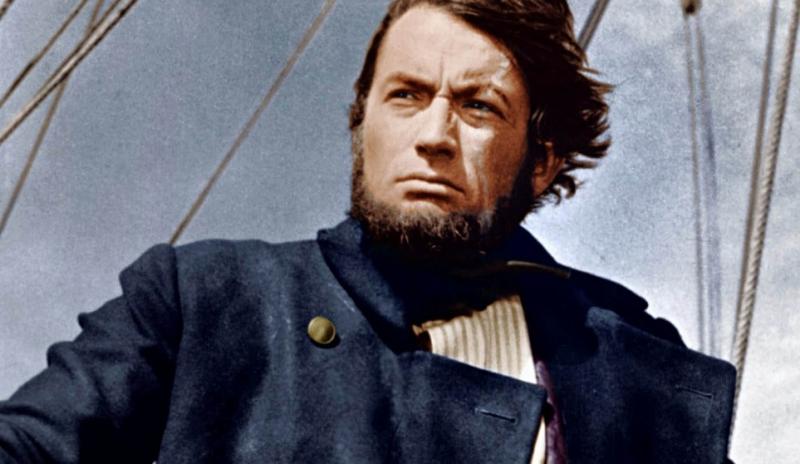
Moby Dick (1956)

Gregory Peck on a voyage of obsession as Ahab hunting Moby Dick

Director: John Huston

Cast: Gregory Peck (Captain Ahab), Richard Basehart (Ishmael), Leo Genn (Starbuck), Orson Welles (Father Mapple), Friedrich von Ledebur (Queequeg), James Robertson Justice (Captain Boomer), Harry Andrews (Stubb), Bernard Miles (The Manxman), Noel Purcell (Carpennter), Edric Connor (Daggoo), Meryn Johns (Pelog), Joseph Tomelty (Peter Coffin), Francis de Wolff (Captain Gardiner)

There might be fewer books that lend themselves less to being turned into a film than Herman Melville’s monumental Moby Dick. Perhaps the greatest of all American novels, its’ the story of New England whaler the Pequod’s Captain Ahab’s obsessive quest to kill Moby Dick, the great white whale that took his leg. But it’s also an intense intellectual and spiritual journey into the nature of humanity, which has thrown the book open to multiple interpretations, even more tempting with a book that defies explanation. Try capturing that on film.

John Huston’s Moby Dick is a noble attempt, more criticised at the time than it probably deserves, with the visual language of film unable to ever capture the metaphorical weight of the original novel. What Huston needed to do is to try and capture some of the spirit of the novel, bring its central story to life and make a film that ideally makes you want to search the book out. I would say Moby Dick succeeds on that score.

Reducing the monumental novel (often described as one of the great “unread” books in people’s homes) to under two hours, brings out the narrative, stressing the surface story as an adventure on the high seas, a doomed quest under an obsessive captain. The detail of the reconstruction of the whaling ship, its operations on the sea (including some graphic slaughter of some, fortunately, fake whales) and the atmosphere of the time is brilliantly reconstructed. The film is staffed by an extraordinary collection of actors, whose faces speak of lives led in salt-spray. 

So, starting with the idea that no film could ever capture the depth and richness of the book, Moby Dick is a decent, smart enough attempt. The key themes are there in strength. It captures obsession and the idea of the ship being a sort of microcosm of society, led astray by a leader who has his own passions at heart, over and above the well-being of the crew, but has enough magnetism to pull the crew with him nevertheless. 

Huston laboured long and hard to bring the film to life, in a wrestle with Melville. Even adapter Ray Bradbury claimed he had “never been able to read the damn thing”, with Huston and Bradbury clashing constantly during the writing process. It works, and Bradbury’s adaptation is beautifully done, but in a way John Huston himself was a sort of Ahab with the book as his whale. 

In fact you could argue – as many have – that Huston himself was the natural casting for Ahab (take a look at Chinatown to see what I mean). A charismatic raconteur, ruthless and fixated on his goals, that’s an Ahab we could buy into. Perhaps in that world, Orson Welles – here giving a neat little cameo that avoids bombast as Father Mapple – would have been the perfect director, marrying mastery of cinema with a wonderful understanding of transforming literature into film.

Gregory Peck is the Ahab we do get. At the time the casting was strongly criticised – people just couldn’t buy the straight-as-an-arrow Peck as the destructively bullying Ahab. Peck himself remained strongly critical of his performance here all his life. Separated from the time, Peck’s performance is stronger than you anticipate, capturing a gruff fixation and magnetic charisma that you can believe pulls people in. Peck may strain a little too hard for the elemental anger, but Peck’s Ahab has a bass richness, a sort of inverted Lincolnish (he even looks a little like Lincoln) self-righteousness that makes you believe he could rouse a ship to choose its own destruction. Peck also brings a spiritually dead look to Ahab, a man turned from hope to destruction. Huston teasingly keeps Ahab in reserve for almost a quarter of the film until his first appearance, allowing the build in the audience’s expectations.

The casting of the crew uses a fine selection of British and Irish actors (the film was shot in Ireland), with Harry Andrews particularly strong as jolly but non boat-rocking first mate Stubb. Leo Genn gets the meatiest material as Starbuck, a decent, working man with a firm sense of principle but who lacks any sense of the charisma needed to swing people to his point of view. The film bumps up Starbuck’s role, centralising his growing unease at Ahab’s madness, opportunities which Genn (nearly underplaying to contrast with Peck’s theatricality) works a treat. Richard Basehart – a good voice for narration but much less of a presence – gets a bit lost as Ishmael. There is an intriguing bit of casting – something that would never happen today – that sees Austrian aristocrat turned actor Friedrich von Ledebur play the Maori-inspired Queequeg, a visual disconnect that is more than a little distracting for a while.

Moby Dick is beautifully filmed and assembled, even if Huston throws in the odd obvious shot – sun beating down on the ship, a close up of the whale’s eye. It has a unique look – on the remastered blu-ray – with the image reflecting the faded, bleached look of whale prints (an effect achieved by superimposing a black-and-white negative over a colour one, draining most of the colours our), which gives it a great deal of visual interest. It’s never going to replace the book – but honestly what could? As an exploration of the ideas at its heart it’s wonderful – and a great prompt to pick it up – but with a marvellous sense of life on sea, a stirring score and a wonderful sense of intelligent construction it more than works.

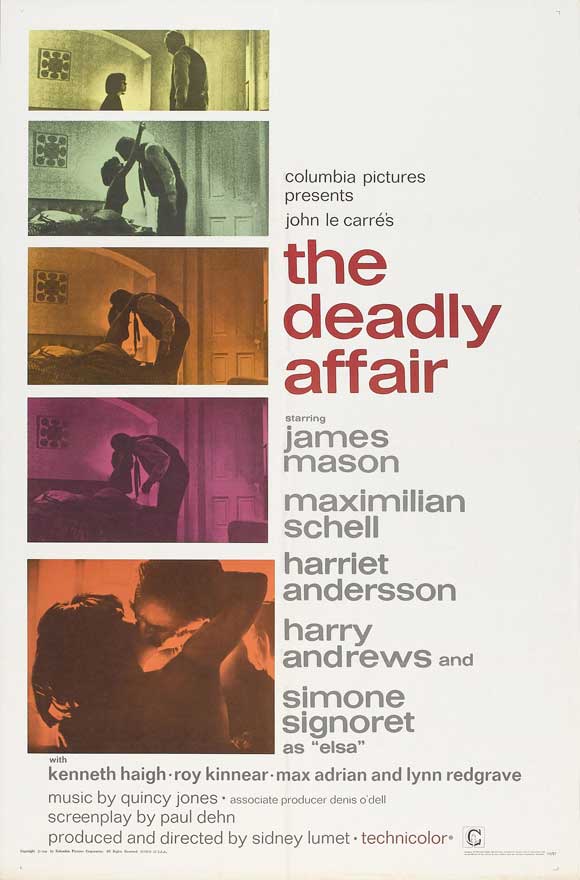
The Deadly Affair (1966)


James Mason deals with marital and professional deception and betrayal in spy thriller The Deadly Affair (in every meaning of the word!)

Director: Sidney Lumet

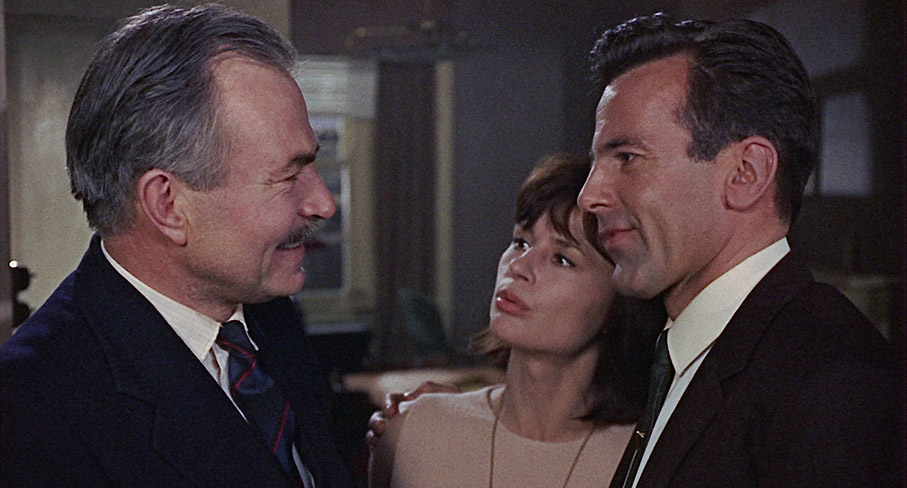
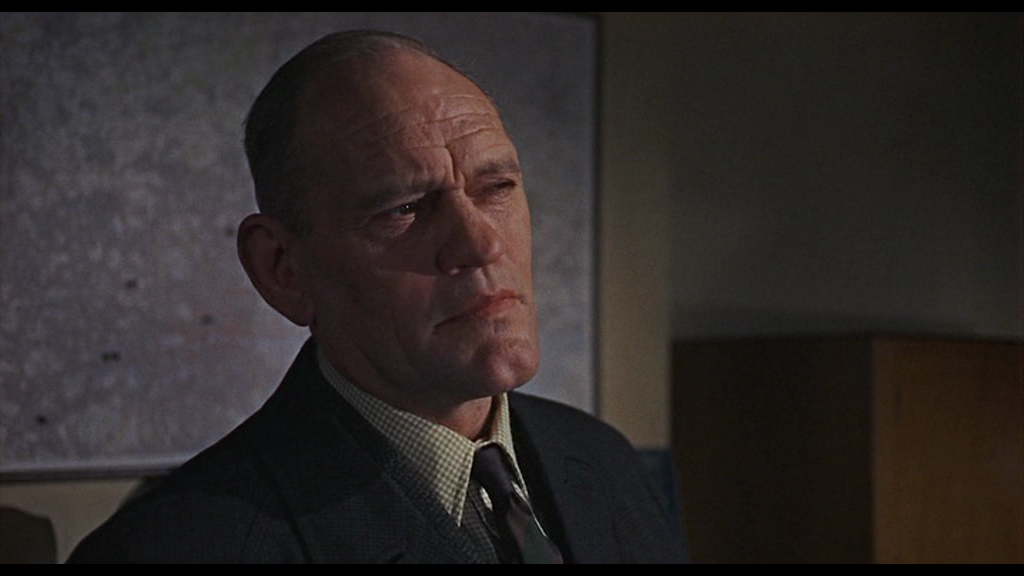
Cast: James Mason (Charles Dobbs), Maximilian Schell (Dieter Frey), Harriet Andersson (Ann Dobbs), Harry Andrews (Inspector Mendel), Simeone Signoret (Elsa Fennan), Kenneth Haigh (Bill Appleby), Roy Kinnear (Adam Scarr), Max Adrian (Adviser), Lynn Redgrave (Virgin), Robert Flemyng (Samuel Fennan), Corin Redgrave (David)

The Deadly Affair is a faithful adaptation of John Le Carré’s first novel, Call for the Dead, that first introduced to both Le Carré’s distinctive vision of espionage (a world where spying is a dirty, depressing business, miles away from Bond), and also his principal recurring hero George Smiley – although Smiley here is renamed Charles Dobbs (Paramount held the rights to several recurring Le Carré characters as it was making The Spy Who Came in From the Cold). The Deadly Affair often gets forgotten in the list of Le Carré films, which is unfair – this is a fine, gripping, character-led thriller.

Charles Dobbs (James Mason), a senior case officer in British intelligence, meets with Samuel Fennan (Robert Flemyng): a civil servant in the Ministry of Defence, who has been anonymously accused of being a Russian agent. Dobbs all but agrees to clear Fennan in a friendly meeting – only for Fennan to go home and commit suicide. Dobbs investigates, but quickly finds that the facts – and the story of Fennan’s wife Elsa (Simone Signoret) – don’t seem to tie up. Working with retired police inspector Mendel (Harry Andrews), Dobbs investigates further – against the wishes of his superiors. This also helps to distract Dobbs from his disastrous home life with his serially unfaithful wife Ann (Harriet Andersson) and her growing closeness to his old war friend Dieter Frey (Maximilian Schell).

The Deadly Affairhas an old-school, unflashy, Hollywood professionalism to it, very smoothly directed by Sidney Lumet. Lumet and photographer Frederick A. Young slightly exposed each shot of the film to give the colours a drained, murky quality, which works extraordinarily well for the grimy Le Carré feeling. Lumet uses a series of careful POV and shot-reverse-shots to involve the audience neatly in the action – we are nearly always seeing events from someone’s perspective, and this helps us empathise with the characters and action. He also uses London locations expertly – everywhere is carefully chosen and shot for maximum impact, creating a world of dingy backstreets that perfectly matches the feeling of the story.

It also helps that Lumet changes very little from what was already an excellent source novel. It’s an intricate “whodunnit” puzzle, twisty and challenging enough to keep the audience guessing. What the film does really well is introduce Dobbs’ wife Ann as a central character in the storyline, and to make marital betrayal and deception a complementary subplot, alongside Dobbs’ involvement in the world of professional bluff and counter-bluff: during the day he practises the very same deception that pains him so much at home. (Le Carré would effectively lift some of the ideas of this film adaptation and reproduce them in later books, most especially Tinker, Tailor, Solider, Spy.)

This marital disharmony becomes a key theme in the movie – two people who are totally reliant on each other but can’t seem to stop hurting each other. Ann is in many ways the hellish wife – serially unfaithful and largely unrepentant – but Dobbs is equally difficult, unnervingly patient and silently (but never vocally or perhaps even consciously) judgemental. They have a complex arrangement, but also a clear understanding of each other, and their conversations sound like careful, familiar routines. Like a scab, Dobbs keeps picking at this wound of his wife’s infidelity – early in the film he returns home after a late call out to find his wife naked in bed. She rises to greet him provocatively, and they kiss, but Dobbs seemingly can’t let go of his own sense of impotence. Later Ann demands Dobbs expresses some rage and jealousy – as if looking for him to show some sort of feeling.

It’s a neat sub-plot for a film that focuses on a series of major personal and professional betrayals – I counted no fewer than five over the course of the film but there are probably more depending on how you define it – and which shows how spying can become wrapped up in personal affairs. Despite Dobbs’ apparent pride at treating his work with a determined coolness, everything is so very personal in this film. Characters react often with emotions rather than cool rational thinking – with the exception of one character who uses the emotions of others very rationally to manipulate them. Even the final confrontation of the film has a sad loss of emotional control at the centre of it – and leads to actions bitterly regretted by the survivors.


James Mason is very good as Dobbs, buttoned-up but slightly run-down, a man who presents a face of calm control and wisdom to the world, but at home is an insecure, deeply pained, impotent mess. Determined and principled in the world of espionage, he is hopelessly in love with his wife, to the extent of practically allowing her free rein to do as she wishes. Despite being in nearly every scene, it’s also a very generous performance, quiet and unshowy, that often cedes the scene to his partners. Harriet Andersson (though clearly dubbed) manages to make Ann someone who feels sympathetic and understandable – even though she is a colossal pain.

Lumet also gets some wonderful performances from the rest of the cast, not least from Harry Andrews who I think steals the movie as a narcoleptic Inspector Mendel, obsessed with facts and possessed of a dry professionalism. The film also gives a gift of a role to Simeone Signoret, a woman with a troubled past and indeterminate motives, bubbling with guilt and resentment. She is given no less than three tour-de-force scenes (one played almost in complete silence) and plays each brilliantly. There are neat cameos as well from Max Adrian (as a campy popinjay running Dobbs’ department) and Lynn Redgrave as an eager stagehand for an amateur theatre company with some vital evidence. 

The film’s conclusion revolves around two masterfully done sequences: one during a performance of Edward II (by the real Royal Shakespeare Company – spot several familiar actors on stage), the second an emotional confrontation at a dock that erupts into violence. It’s a wonderful dwelling on betrayal and its impacts. It also works an absolute treat as a low-key counterpart to Bond at his Swinging Sixties height, while still packing a jazzy score from Quincy Jones (which at first seems completely incongruous but actually helps to establish the mood really well). Directed with professional assurance with a host of fine performances – it’s a little bit of an overlooked gem.