
Tag: Henry Koster

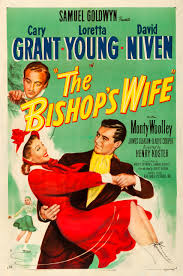
The Bishop’s Wife (1947)

The Bishop’s Wife (1947)

Charming Christmas enjoyment in this rather odd angel comedy that wins you over

Director: Henry Koster

Cast: Cary Grant (Dudley), Loretta Young (Julia Brougham), David Niven (Bishop Henry Brougham), Monty Woolley (Professor Wutheridge), James Gleason (Sylvester), Gladys Cooper (Mrs Agnes Hamilton), Elsa Lanchester (Matilda), Sara Haden (Mildred Cassaway), Karolyn Grimes (Debby Brougham)
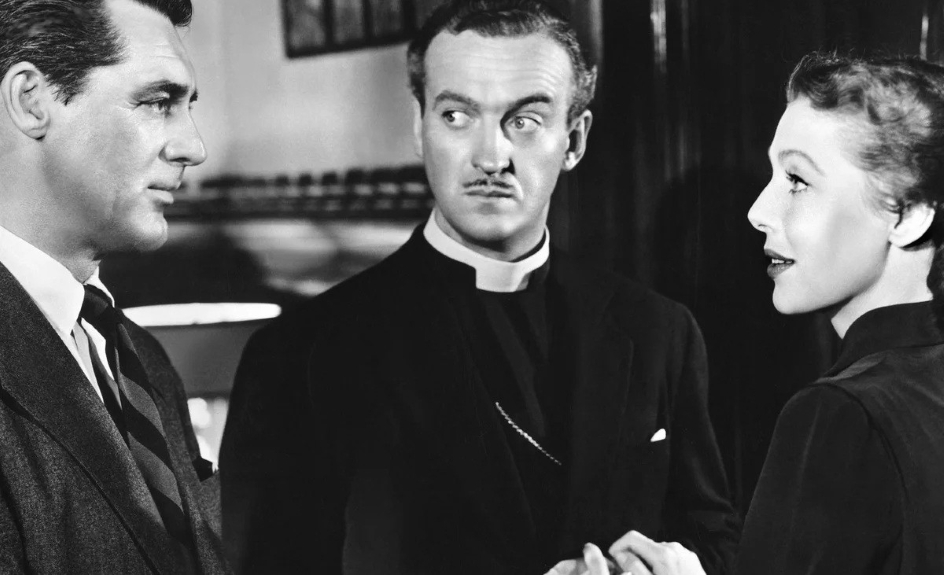
Newly appointed Bishop Henry Brougham (David Niven) is forgetting who he is. Now spending all his time with the hoi-polloi (led by Gladys Cooper’s grande dame Mrs Hamilton) trying to secure funding for a new cathedral he’s rather lost sight of things at home with his devoted wife Julia (Loretta Young). Enter, seemingly in answer to his prayers, angel Dudley (Cary Grant). Taking up a role as Henry’s new assistant – with only Henry knowing the Heavenly background of his guest – Dudley sets about helping those around Henry rediscover their spiritual joy in life.

The Bishop’s Wife is a gentle, unassuming film, all taking place in the week before Christmas. It’s heart-warming, seasonal stuff, competently directed by Henry Koster, who efficiently juggles gentle character conflicts with a reassuring moral message. There are some rather charmingly done magical special effects sprinkled across the film: Dudley uses his angelic powers to instantly sort reference cards, fly decorations onto a chair, dictate to a self-operating typewriter and guide a snowball through the air with all the dexterity of Oliver Stone’s magic bullet. As a gentle piece of seasonal viewing, it gives you everything you could want.

Such is its easy charm and seasonal sweetness, it almost doesn’t matter that it’s quite an odd film. It’s no real surprise Dudley isn’t on Earth to help Henry secure mega-bucks he to build a grand cathedral (especially since principle doner Mrs Hamilton is more interested in making it a tribute to her late-husband rather God) but to help Henry work out his real focus should be the ordinary joes of his community and his marriage. That he should make sure he prioritises a humble choir at small local church St Sylvester’s and keep in touch with the parishioners he used to dedicate his time to. And, above all, that he should find time in his bustling calendar to keep the love in his marriage.

But the methods used by Dudley – away from angelic magic over inanimate objects and his ability to know everyone’s names before they even open their mouths and cross roads in bustling traffic without fear – are a little odd. Aside from shoring up a few people’s spiritual strength, he essentially begins a campaign of seduction, giving Julia the sort of loving attention Henry hasn’t given her in ages. It’s a slightly bizarre holy campaign – the angel who uses the temptations of the flesh to save a marriage – but it’s done with such innocence a viewer almost forgets the odd idea.

It also just about makes a virtue of casting of Cary Grant as Dudley. In a part that feels tailor-made for Bing Crosby, surely Cary Grant is no-one’s idea of an angel (a slightly abashed, heart-of-gold, demon perhaps). Grant, to be honest, slightly struggles with the role – at times the complete decency of Dudley leaves him rather stiff and the Grant twinkle gets one of its most subdued outings in cinematic history. However, Grant’s naughty charm does make us accept a little bit more that Dudley might just feel a little more than he’s saying with his attraction to Julia (even if, the rules of films, tell us there is zero chance of an angel being a seducer).

It still manages to get the goat of Niven’s Bishop, who increasingly resents this overly efficient new presence in his life more focused on charming his wife than getting on with what he presumes he’s there for – securing funds for the Cathedral. Niven (originally cast as the Angel – but his raffish charm would have been as unnatural a fit as Grant’s), does rather well as a decent man crushed under expectations and duty who has forgotten the things that really matter. Niven has a very neat line in quietly exasperated fury, so buttoned-up and English (despite being American!) he can’t give vent to his real feelings but hides it under genteel passive aggression. He also sells a neat joke that he is constantly rendered literally incapable of saying out loud that Dudley is an angel.

Loretta Young, between these two, has the least interesting part, trickly written. It goes without saying that a feel-good product of 1940s Hollywood is not going to have the wife of a Bishop actually, genuinely considering straying from her husband (just as, I suppose, it can only go so far in suggesting Grant’s Dudley is sorely tempted to leave his wings behind). Young’s role leans a little too much into the patient housewife, just eager for her husband to embrace day-to-day joys at home and not lose himself so much in work, but she manages to make it work.

These three lead a cast made up of experienced pros who know exactly how to pitch a fairly gentle comedy like this. Monty Woolley is great fun as a slightly over-the-hill professor, who needs to be befuddled by a never-emptying glass to stop him wondering why he doesn’t remember Dudley from the lectures he claims to have attended all those years ago. James Gleason offers cheeky, down-to-earth humour and sensibility as a friendly taxi-driver, while Gladys Cooper once again proves she can give austere grande dames more depth than anyone else in the business.

It all makes for a gentle, rather sweet and charming film despite that fact that almost nothing in it really make sense. In fact, it frequently falters as soon as you consider any of the plot at all or any of the actions and motivations of its characters. But then, this is basically a sort of Christmas Carol where the Angel arrives to re-focus the (not particularly imperilled) soul of one man, with wit, charm and warmth – and if it feels odd that also involves inspiring envy and jealousy (deadly sins right?!) in a Bishop, I suppose we should go with it. After all, it’s Christmas.
The Robe (1953)


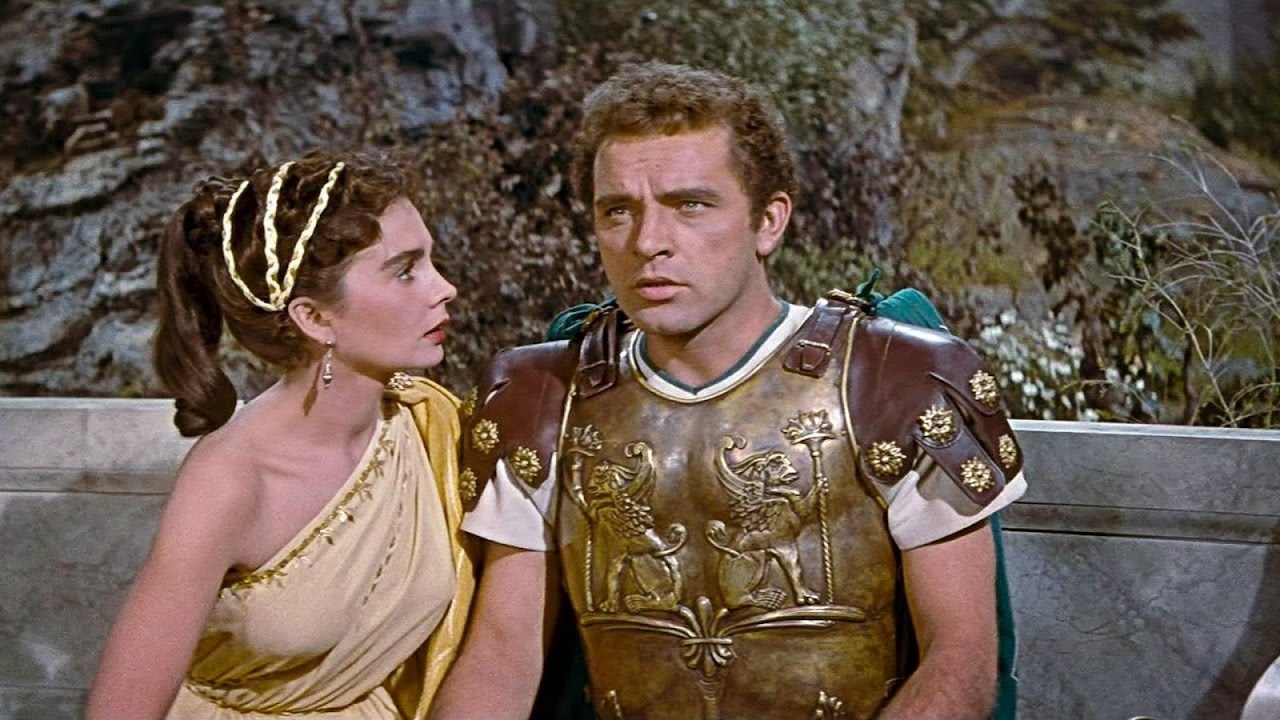
Richard Burton puts on his best “worried with a hint of madness” face as he explains Christianity to Jean Simmons and the viewers.

Director: Henry Koster

Cast: Richard Burton (Marcellus Gallio), Jean Simmons (Diana), Victor Mature (Demetrius), Michael Rennie (Peter), Jay Robinson (Caligula), Dean Jagger (Justus), Torin Thatcher (Senator Gallio), Richard Boone (Pontius Pilate), Betta St John (Miriam), Jeff Morrow (Paulus), Ernest Thesiger (Tiberius)

In 1953, Hollywood was running so scared of TV they needed a magic cocktail to win viewers back to the big screen. They settled on their main advantages over TV – a very big screen, colour and a lot of money. Sweeping epics were born – but in order to get as many people in as possible, gotta make sure it’s an important piece of filmmaking as well. What’s more important than religion?

Marcellus Gallio (Richard Burton) is a carefree playboy Tribune, interested only in splashing his cash on bets and slaves. After betting against heir-to-the-throne Caligula (Jay Robinson) for rebellious slave Demetrius (Victor Mature) – plus charming away Caligula’s betrothed Diana (Jean Simmons), also Marcellus’ childhood sweetheart – he is banished to Palestine. Marcellus is soon ordered to crucify a humble carpenter from Nazareth, leader of a new religion that Demetrius swiftly converts to. After being confronted by his former slave atop Calvary, Marcellus finds himself wracked with guilt about his actions – and on a journey towards conversion and martyrdom. The Robe of the title is the Turin shroud, here a red rag macguffin passed from pillar to post.

By any objective standards, The Robe is a pretty terrible film. It’s long, self-important, slow, talky, episodic, poorly-structured and, above all, boring. Despite its length, nothing much really happens. Marcellus is a waster, he crucifies Christ, he feels guilty, he goes a bit barmy, he converts, he dies. That’s kind of it. When important moments happen, they flash past so quickly you start to think you missed something – I rewound Marcellus’ crucial conversation with St Peter where he finally converts as I assumed I’d missed something he changes his mind so quickly. I hadn’t.

The whole film is full of sudden, juddering changes like this. Marcellus and Diana are estranged for years – next thing we know they are in each other’s arms. Demetrius is a convert after one glance. Within seconds of screentime, Marcellus goes from unconcerned to wracked with guilt over Christ’s death. The whole first scene sets up Caligula as an antagonist only to have him disappear for almost an hour. Demetrius is suddenly being racked in a dungeon in Rome. The film keeps slowing down for lots of Christian reflection on the righteousness of the holy message.

Oh blimey, the Christian message of the film is not subtle. The film drips with sanctimony and wearying self-importance, with no trick missed. Angelic voices, light from the sky, actors staring upwards with awe, impossibly sweet youths frolicking with joy, wise old buffers droning on: it’s all here, every single note you would expect of the classic Hollywood “Swords, sex, sandals and sanctimony” epics. It’s all ridiculously on the nose, with Burton reduced to having to carry the entire weight of Christianity seemingly on his shoulders, with only the most bland and forgettable of lines to support him. Nothing eases up right into the final moments, when Marcellus and Diana walk towards the camera as the background fades away to be replaced by clouds. Yeah we get it: they are off to heaven. The big thing the film struggles to get across in all this is why the Christian message had such appeal to Marcellus and others, or why these people might have put so much at risk for it, but this sort of thing is beneath the film’s clumsy interest, as if any actual analysis would be sinful.

Burton, bless him, struggles through the role with the slightly disconnected air of a man who thinks the entire film is beneath him (he famously called the role “prissy”). He must have been stunned to get an Oscar nomination. But to be fair it’s a really tough part, with Marcellus required to go from a sort of relaxed dissoluteness, via disconnected pride, to a sort of catatonic series of fits before back to serene peace. Saying that, Burton’s fits over the robe itself aren’t going to win any awards for subtlety, done with a wild eyed hamminess that looks impossibly old fashioned today. But it’s all comparable – next to Robert Taylor in Quo Vadis, Burton feels like the height of emotional realism. It’s not helped that he’s paired a lot of the time with Victor Mature, who acts throughout with a sort of balsawood earnestness that requires a great deal of middle distance staring in awe. The video below gives a good idea of both performances. Watch how wildly varied the writing is of Burton’s part and feel a little bit sorry for him.

Very few of the other performances make positive impressions. Jean Simmons as Diana is such a bland, forgettable character that her conversion only really makes sense because we have learnt so little about her over the course of the movie. Jay Robinson goes for overblown as Caligula but instead sounds like a shrieking child in a pretty woeful performance. 

These two failed performances add to the film’s problems. Caligula is such a non-presence for most in the film that, as the nominal antagonist, his lack of impact makes the film shapeless, lacking any “villain” we can hate or provide any sort of obstacle for Marcellus to struggle against. Similarly Diana is so bland and anonymous a personality, that we neither root for their relationship, nor experience any concern for its outcome.

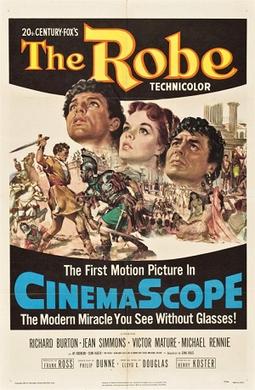
The film is directed and framed in an equally dull way. Its only claim to fame today is its status as the first film to be released in Cinemascope. This ultra-wide screen was intended to be another rival to TV – never mind the little box, look at the mighty vistas! But the importance of widescreen hangs over every creative decision of the film. Nearly every shot in Koster’s turgid direction is either middle or long, with the camera held static, focused on getting as much of the background in as possible, the actors often reduced to focus or foreground interest around the scale. It’s no wonder few performances break through this overbearing backdrop.

Every so often you get moments where you think the film is going to burst in life. They’re rare but they are there. There is a great scene between Demetrius and a man revealed (eventually, but it’s pretty obvious from the start) to be Judas Iscariot fresh form Gethsemane (Michael Ansara as Judas might, in two minutes of screentime, give the best performance in the film). Marcellus has a pretty good (if inexplicable) sword fight with a former rival. A mission is launched to rescue Demetrius. But every time something happens like that, the film immediately doubles back into heavy-handed symbolism and dull, unrevealing chat, all of which is focused on hammering home the message. 

The Robe is an impossibly dated religious epic, worthy, dull and lacking any real interest or reason to watch it. Its star seems a little embarrassed to be there. No-one else makes any impact. It’s directed with a flatness that turns it into a series of lifeless paintings. Its story turns a major moment of history into a boring, inconsequential series of events. It lacks even the campness that many epics of this genre carry that make it a good tongue-in-cheek watch. It’s just a yawnathon from start to finish, a crushingly tedious saga that has all the subtlety of being hit across the face by a prayer book for over two hours.