
Tag: Historical epics

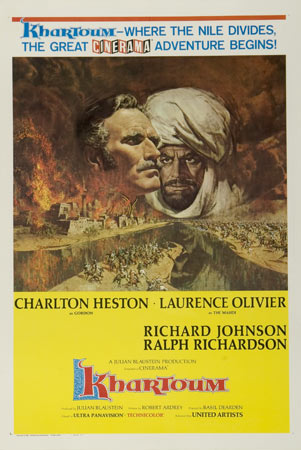
Khartoum (1965)


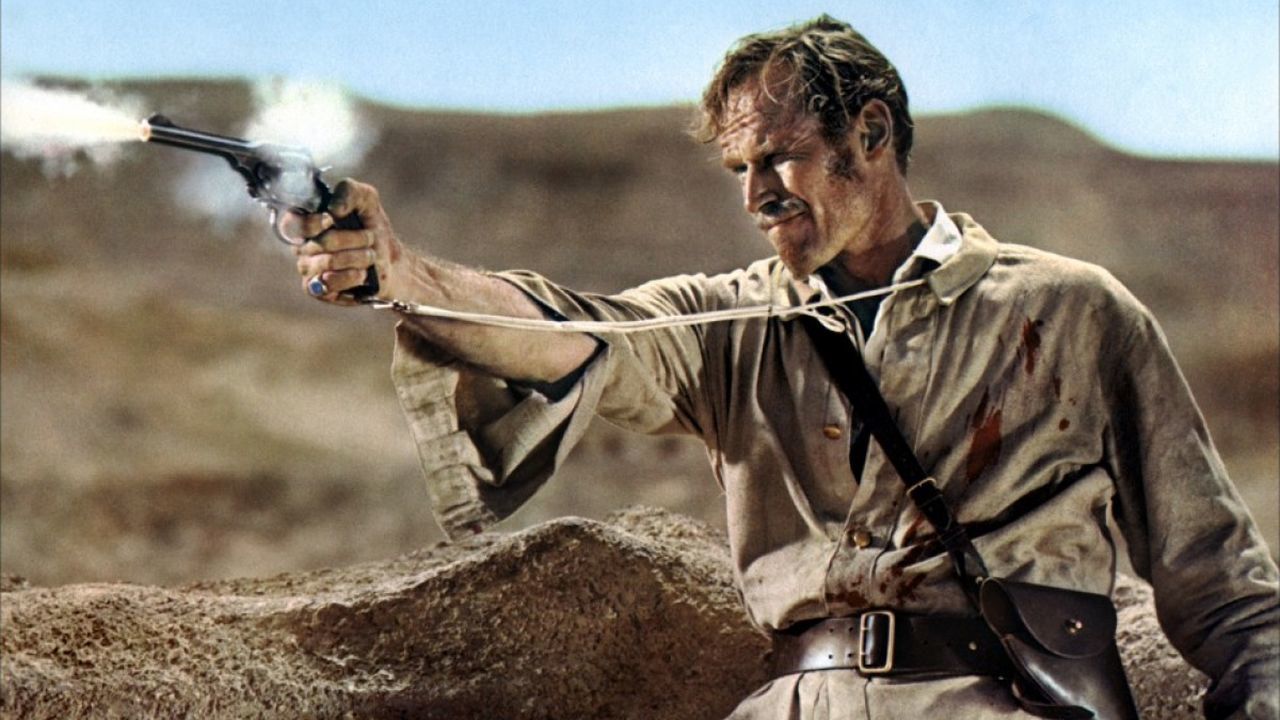
Charlton Heston takes aim in a rare moment of action in Khartoum

Director: Basil Dearden

Cast: Charlton Heston (General Charles Gordon), Laurence Olivier (The Mahdi), Richard Johnson (Colonel John Stewart), Ralph Richardson (William Ewart Gladstone), Alexander Knox (Sir Evelyn Baring), Johnny Sekka (Khaleel), Nigel Green (General Wolseley), Michael Hordern (Lord Granville), Peter Arne (Major Kitchener), Zia Mohyeddin (Zobeir Pasha), Douglas Wilmer (Khalifa Abdullah) 
For me you can’t really beat a big epic film. I love their sweeping vistas, the larger than life personalities, the luxurious running times and the vast array of Brit actors you inevitably find filling out the cast list. There is a lovely Sunday afternoon cosiness about a good epic and, since Hollywood spent large chunks of the end of the 50s and the 60s churning them out, historical events and personages replayed in sweeping panovision, there are plenty to watch.

Khartoum takes as its topic the siege of Khartoum and the death of its commander General Charles Gordon (played here by go-to actor for the big epic, Charlton Heston). Part of the now largely forgotten Sudanese war of the 1870s-80s, the siege was conducted by forces led by The Mahdi (Laurence Olivier) a man convinced that he was a reborn messenger of Muhammed.

Khartoum is a film that means well, but it’s a rather stodgy, po-faced history lesson that struggles with the fact that sieges are rather dull eventless things. Combine this with most of the film’s subplot following faithfully recorded political events back in the UK, and it hardly makes for a event filled spectacular. Instead it’s a slightly muddy lecture, interspersed with invented meetings between characters (Gordon and Gladstone; Gordon and The Mahdi twice!) in which they eloquently talk at each other, mouthing out the writer’s careful research, but give us no real insight into the times or the impact events had on the future.

It’s also rather routinely directed, without any flair or dynamism. It’s clearly aiming to be another Lawrence of Arabia, with everything from its music score to the lingering shots of the desert all aping Lean’s masterpiece. An opening narration (by an uncredited Leo Genn) even mulls over Egyptian and Sudanese history, while lovingly showing the viewer some postcard shots of various Nile attractions, seems particularly dry and dusty.

When the film does allow moments of action (which all seem ill-placed in this seriously serious film) they are rather flat and dull. The final attack on Khartoum has a suddenness about it that works well for the overwhelming force of The Mahdi’s army – and the death of Gordon (inspired by George William Joy’s painting) is rather affecting (although the real Gordon allegedly went down all guns blazing) but this is a film far happier with conversation.

What does work in the film, surprisingly, is Heston, who underplays as an enigmatic Gordon, a quiet, unknowable man addicted to the limelight, a serene soldier with a love of peace and religion, a man of the cloth and accomplished solider. Heston allows his natural charisma to do a lot of the work, and he clearly feels a certain empathy with Gordon, gracing the film with the same determined leadership of the general. Heston is an easy actor to mock, his granite face made for legends, but he’s a quietly assured here.

Olivier’s performance is inevitably more troublesome today, the great man dressed up in blackface and a rum accent as The Mahdi. In fact, as per Hollywood films of the time, most of the major Sudanese characters are played by British actors in blackface. Of course it would never happen today – and it’s tricky not to either gasp or snigger at  Olivier’s first scenes – but looking past that first shock (and his opening speech – “Ohhhhh my belovvvvveed” is too much), Olivier gives a detailed study in ambitious fanaticism which is even more relevant in the age of Al-Qaeda. It’s uncomfortable to see, and Olivier allows the mannerisms too much rein (in particular compared to Heston’s confident underplaying) but it’s a decent performance.

I’ll always have a soft spot for this film as it allows us the chance to see Ralph Richardson as Gladstone, one of my favourite historical figures, and one of the two greatest English statesmen (with Robert Peel) of the 19th century. Richardson would have been brilliant in The Gladstone Story (sadly never made) and he brings to life much of the political scheming back home in Blighty, as a Machiavellian version of the Grand Old Man. Anyway, he’s terrific and the various cabinet room debates are some of the most interesting parts of the film.

It’s a shame that the films gets bogged down too early in Sudanese and Egyptian politics (and still manages to muddle the viewer), before settling into the siege from where, interspersed with slightly repetitive conversations. It’s clear where the film is going, but there isn’t the doom laden dread about this that the film needs. This is a shame, as this story of a colonialist, in love with a colony, killed by colonists while trying to protect other colonists, has a lot to potentially say about the modern world (both now and in the 60s) – it just doesn’t manage to say them.

Note: I was struck in the film by how dangerously many of the horses were thrown about or tackled by soldiers in the battle scenes. “Surely that can’t be safe” I thought as a man knocked over a galloping horse by jumping and tackling its head. Sure enough it wasn’t: allegedly 100 horses bought the farm for this film.

Selma (2014)

Martin Luther King fights the good fight

Director: Ava DuVernay
Cast: David Oyelowo (Martin Luther King), Tom Wilkinson (President Lyndon B. Johnson), Carmen Ejogo (Coretta Scott King), Andre Holland (Andrew Young), Tessa Thompson (Diane Nash), Giovanni Ribisi (Lee C. White), Lorraine Toussaint (Amelia Boynton Robinson), Stephan James (John Lewis), Wendell Pierce (Hosea Williams), Common (James Bevel), Alessandro Nivola (John Doar), Tim Roth (George Wallace), Oprah Winfrey (Annie Lee Cooper)

Tragically, for a while this film seemed to be most famous for being the poster child for “Oscar-Gate” or hashtag oscarssowhite (sorry hashtags are not my thing). Selma was the film that should have been littered with nominations. Instead it got just two – one for Picture, one for Best Song. Of the many, many snubs the most shocking were Ava DuVernay and David Oyelowo, particularly as other contenders up for the awards had certainly done inferior work that year . This film, however, categorically demands to be remembered in its own right – it is a fine, very moving piece of work, a dynamic history lesson that avoids preaching from a pulpit.

A lot of this comes down to the breathtaking work from David Oyelowo, who delivers one of those performances where the actor seems to transcend his skin, not just imitating Martin Luther King but inhabiting him, exploring and expressing every depth and shade. It’s a performance that stands comparison with Daniel Day-Lewis’ Abraham Lincoln. Oyelowo’s King is a big hearted, patient man but also a shrewd political player, a family man who betrays his wife, a political campaigner who holds the big picture and the small in his mind. It’s a totally committed performance that is intensely respectful without ever feeling hagiographic.

Oyelowo’s performance also immeasurably helps the film’s structure, as this is a biography that focuses on one single key moment in its subject’s life, rather than attempting to cover the whole lot in one 2-3 hour sitting. I rather like this, as the important thing about these biopics is to understand the person at the centre, not just to tick off events in their life. Anyway this film focuses on three months in 1965: King is campaigning for equal voting rights, and planning a high-profile march across Alabama from Selma and Montgomery to pressure President Lyndon B Johnson to promote the Voting Rights Act.

This is a very powerful film, humming with a constant sense of the deep rooted injustice and oppression in America at this time. It makes no compromises in showing the violence meted out to Black Americans, but it’s the day-to-day injustice that DuVernay shows particularly well: in the opening scene, Annie Lee Cooper (played by producer Oprah Winfrey) has her carefully prepared application to vote cruelly dismissed by a smalltown clerk, gleefully and casually exploiting a succession of legal loopholes to thwart her. It’s a simple scene but amazingly powerful in its casual (unspoken) racism, and it brings to life in a few strokes the day-to-day experience of millions of people at this time.

It’s also a beautifully shot film, that uses the real-life location of the Selma bridge spectacularly. An assault on the first attempted march by mounted policeman, shrouded in tear gas, is deeply moving in its simplicity, the camera catching the brutal overreaction of the police with a journalistic eye (Wendell Pierce as Hosea Williams is particularly impressive in the build-up to, and aftermath of, this sequence). Other moments of violence are equally shocking, but DuVernay never over-eggs the moment, allowing the events and the story to speak for themselves. We know how terrible some of these events are, and how disgusting the treatment of Black Americans was – the film never uses music or editing to hammer it home to us.

The film ends on the kind of high note you can only feel when injustice has been overcome and decent people triumph (punctured, DuVernay acknowledges, by the fates of some of the characters,  revealed at the end of the film. More than one of these is a gut punch – not least the death of King himself three years later). But it’s never twee, preachy or a history lesson. Instead it’s a living, breathing expression of a moment in history that wraps you up in its story. Oyelowo is of course outstanding, but there is some excellent support, not least from Carmen Ejogo as his wife Coretta (overlooked at the time, but outstanding), Andre Holland, Stephen James, Lorraine Toussaint and Common as King’s fellow Civil Rights leaders. Tom Wilkinson adds a lot of depth to a sometimes thinly written Johnson, while Tim Roth translates his contempt for George Wallace in a performance of slappable vileness. A beautiful and marvellous film.

The Alamo (2004)

“Remember The Alamo!” Problem was the movie going public didn’t

Director: John Lee Hancock
Cast: Dennis Quaid (Sam Houston), Billy Bob Thornton (Davy Crockett), Jason Patric (James Bowie), Patrick Wilson (William Barret Travis), Emilio Echevarría (Antonio López de Santa Anna), Jordi Mollà (Juan Seguin), Leon Rippy (Sergeant William Ward)

“Remember the Alamo!” was the famous war cry of the Texan rebels fighting to make Texas an independent state from Mexican rule. Problem was, fast forward 90 odd years and it seems not enough people did. This lovingly reconstructed re-telling of the doomed attempt to defend The Alamo (a sort of Western Zulu with a downer ending) was a box-office disaster.

In 1836, a civil war raged in Mexico, which then included Texas. American immigrants and other groups fought to make Texas an independent state, with an eye on later joining the United States. A small force is sent to garrison the Alamo, a key fort recently captured from the Mexicans. But the Mexicans and their President Santa Anna are descending on the Alamo in full military force…

The Alamo is a pretty decent film. It’s not a classic and at times it’s a rather staid and straight-laced history lesson, po-facedly cramming in as much as it can within its running time. But it’s got many merits, not least the fact that it’s willing to focus on character rather than action, and embraces the fact that sieges tend to be rather long, dull affairs punctuated by moments of sheer terror.

Billy Bob Thornton gives a sharply intelligent and thought-provoking reading of Davey Crockett, playing him as man painfully aware that he is a legend, and wearily trying to balance this with also being a “normal” person, with the same fears and desires as other men. He plays Crockett as a gentle, even rather sensitive soul, a good listener, sharply self-critical and scared that he can’t live up to the reputation he has. As he says at one point: “If it was just me, simple old David from Tennessee, I might drop over that wall some night, take my chances. But that Davy Crockett feller… they’re all watchin’ him.” At one moment (in a scene that the film overplays by returning to at least twice in flashback), Crockett plays the violin on the ramparts to battle the Mexican drums, giving a brief Shawshank-like moment of freedom through the power of art.

The two main leads don’t disappoint alongside him. I enjoyed Patrick Wilson’s stiff-necked William Travis, whose cold and formal manner slowly reveals a decent man and a brave leader (though no master tactician). Jason Patric also manages to land just the right side of rogueish as a drunken James Bowie, the men’s leader of choice. Dennis Quaid has the dullest, least developed part as a larger-than-life Sam Houston. Impressive as these characterisations are, the film doesn’t really have time for anyone else to make an impression – while Emilo Echevarria’s Santa Anna is little more than cardboard cut-out of villainy.

The film’s main problem is its reverent regard for the moment in history that it is covering. For starters, its makers assume everyone shares this: there is no opening crawl, or scene setting voiceover, to tell us where we are, what’s going on and when. The filmmakers assume us to be as au fait with Texan independence as they are. I had to literally stop the film for a good ten minutes and read some quick timelines of Texan independence, as well as skim a few Wikipedia pages on Texan history, so I could follow the storyline.

Secondly, it’s so keen to cover all the major historical events, that at points it’s more than a little dry. Its slow pace has the upside of really allowing us to get to know the characters at its centre (the original run time was closer to 3 hours, which would have allowed many of the background characters to come to life as well). But with the runtime cut down, combined with the assumptions made about the viewer’s historical knowledge, it sometimes becomes a little tricky to either engage with the drama fully or to completely understand what’s going on.

The recut of the film after disastrous test screenings also means that the film has what feels like a tacked on “happy ending”, with the last twenty minutes given over to the (very shortened) Houston campaign against the Mexicans and Santa Anna’s capture. The film rockets through this, barely pausing to explain tactics or events, seemingly wanting to give meaning to the sacrifice at the Alamo. Some half-hearted attempts are made to contrast slaughter of the Mexican soldiers with that of the Alamo defenders, but not much.

But this is not a bad film by any means, just a fatally compromised one. It’s trying to be an intelligent, grown-up piece of film making – a character study out west – but it’s also trying to be an action film. It doesn’t quite succeed in being either, but it’s at its best as a character study, helped by some really strong, thoughtful performances. Hancock isn’t, to be honest, an original enough director to bring to life the epic scope and sweep that the film needs, but it’s clear he cares about this a lot. In fact that’s the best thing about this film: it’s clear that everyone in the film cared deeply about this story and desperately wanted this film to be a classic.

It’s a shame that this story is one that seems to have less relevance to the masses today, and that this film can’t quite coalesce all the efforts of everyone involved into something really memorable.