
Tag: Honor Blackman

A Night to Remember (1958)

A Night to Remember (1958)

Still one of the definitive Titanic movies, a compelling documentary-influenced look at the disaster

Director: Roy Ward Baker

Cast: Kenneth More (Charles Lightoller), Michael Goodliffe (Thomas Andrews), Laurence Naismith (Captain Edward Smith), Kenneth Griffith (Jack Phillips), David McCallum (Harold Bride), Tucker McGuire (Molly Brown), Frank Lawton (J Bruce Ismay), Richard Leech (William Murdoch), John Cairney (Murphy), John Merivale (Robbie Lucas), Honor Blackman (Liz Lucas), James Dyrenforth (Colonel Archibald Gracie IV), Anthony Bushell (Captain Arthur Rostron)

The sinking of the Titanic on 14 April 1912 is one of the most iconic events in twentieth century history. A Night to Remember brings the ship’s final hours to life in forensic detail, based on Walter Lord’s carefully researched book. Told with documentary-style distance, mixed with admiration for stiff-upper-lip British pluck, the film cemented many people’s perceptions of the night of the sinking and remains one of the best-known films about the disaster.

To tell the story, the production decided it needed a central figure and selected Second Officer Charles Lightoller, recruiting a British star to play the role. And no one did bluff, charismatic middle-class decency better than Kenneth More, born to play roles like this. Lightoller would be placed at the heart of the keep-calm-and-carry-on evacuation of the ship, More’s reassuring presence letting the audience know everyone involved was doing their best under impossible circumstances.

A Night to Remember remains very effective. It’s special effects and recreation of the ship are highly impressive. Even tilting sets were built to replicate the ships list, meaning drinks tilt in glasses and the careering skid of a dinner cart in the dining room was done for real. But where it really scores is its effective capturing of a very particular British mood: the determination to carry-on in terrible, appalling circumstances. While it’s easy to look at this unflappability in the face of disaster as almost comic, what’s so effective in A Night to Remember is that below the surface it’s clear almost every single character is screaming in terror.

You can see it in the shell-shocked disbelief of Captain Smith (a very effective Laurence Naismith, an excellent portrait of man in ultimate authority with no power at all to affect the situation) who stares with shame at the hundreds of people he can’t save. It’s in the guilt of Thomas Andrews (Michael Goodliffe, full of wry humour that slips away leaving him a shell) who blames himself and vainly tries to save others without creating panic. The grim-faced determination of radio operator Jack Phillips (a remarkably restrained Kenneth Griffith) who taps out the SOS until the bitter end. These feelings are carefully hidden and suppressed – for the good of morale – but the screaming panic and despair of the passengers in the final moments of the ship are simply giving voice to hidden feelings earlier.

What comes across very well in A Night to Remember is the utter powerlessness of the situation, matched with the bad luck and poor preparation that condemned more to death. It’s clear to everyone in authority, from the start, that there are insufficient lifeboats and quickly becomes apparent no help is not coming. While not raising enough urgency around the evacuation did contribute to deaths, it’s also clear to the officers it’s the only way they can hope to maintain any sense of order for as long as possible. If they fronted up on the real disaster heading their way, those guns they grab from the armoury would have all been exhausted keeping control.

A Night to Remember subtly suggests the fault is not personal, but somehow systemic: that Titanic is just the rash a whole host of societal problems have come out in. You can see the arrogance and unwillingness to question in the huffy pretension of the man on the train who pulls Lightoller up for mocking a soap advert that celebrates the ship. The behaviour of many of the passengers that safety precautions are at first an imposition, then that their class and position should automatically entitle them to particular treatment. The thudding refusal of many to accept the reality that the unsinkable ship can go down. The stunned look on people’s faces when the truth hits them and, as Lightoller says late in the film, it suddenly feels like they can never trust so blindly again.
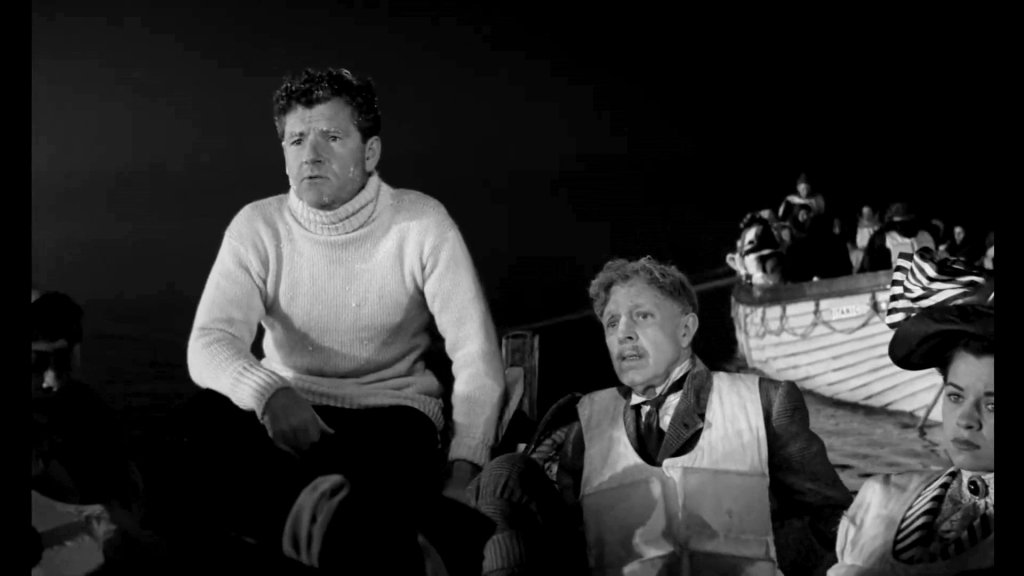
Alongside this, it’s a tribute to bravery and self-sacrifice, often expressed with that classic British reserve and dry humour in the face of imminent disaster. From Lightoller and the sailors who fight, up the final moment, to assemble two collapsible boats even as the deck sinks under water around them to the engineering crew who willingly agree to stay below deck to keep the power on – a certain death sentence (“And it’s my birthday today and all” someone good naturedly moans, while the others gather a water-logged cup of tea). Perhaps uniquely for Titanic films, there isn’t even a villain: it’s one of the few adaptations that doesn’t show Ismay (a never-the-less pompous and weasily Frank Lawton) ordering the ship to go faster. In fact Ismay is shown energetically throwing himself into the evacuation (even told to stop trying to help by Lightoller) who steps into a boat (self-loathing covering his face) only when no one else tries to take one of the available seats.

Despite which, the film doesn’t avoid the fundamental errors. The treatment of the second and third-class passengers is shockingly abrupt and impatient, as if the saving of their lives is an inconvenience on a busy night – by the time they are allowed on deck, one plaintively moans that the lifeboats have already left. A group of bellboys are ordered to remain where they are (and instructed to not smoke!) condemning them. As the scale of the disaster grows, several passengers in under-filled boats complain that they are ‘already too full’ to go back for survivors. Even Lightoller’s decisions (interpreting ‘women and children first’ as ‘women and children only’, a decision that led to half-full boats sent away) are criticised.

A Night to Remember also sprinkles itself with several touching personal stories that carry real impact. The first-class passenger who asks Andrews for a no-bullshit appraisal, then quietly ensures his wife and sleeping children board a lifeboat. The Stausses who refused to separate and go down with the ship. A lost child saved from trampling by a steward, who promises him it will all be over soon as they sink. The young couple crushed by a falling funnel. The heartless card sharp who turns out to have a capacity for calm self-sacrifice.

And it could all have been avoided. More than any other film A Night to Remember focuses on the unquestioning crew of the Californian who watch the sinking from ten miles distance (including the never-ending launch of emergency rockets) but having no instructions or initiative don’t do a thing (they switch their radio off rather than try and find out more). The rigid mindset of the system right there: disasters just don’t happen to British ships (Britannia rules the waves after all) so no reason to rock the boat. They are contrasted with the professional urgency of the Carpethia (who did leave their radio on) who race against hope to help.

A Night to Remember captures this all extremely effectively, remaining a powerful and documentary look at the simple facts of the world’s second most iconic (after Pompeii) disaster. Full of some very fine performances and shot with a pacey assurance by Roy Ward Baker, it remains one of the definitive studies of the diaster.
Goldfinger (1964)

Goldfinger header
Sean Connery defines Bond forever in Goldfinger

Director: Guy Hamilton

Cast: Sean Connery (James Bond), Honor Blackman (Pussy Galore), Gert Fröbe (Auric Goldfinger), Shirley Eaton (Jill Masterson), Tani Mallet (Tilly Masterson), Harold Sakata (Oddjob), Bernard Lee (M), Martin Benson (Mr Solo), Cec Linder (Felix Leiter), Lois Maxwell (Miss Moneypenny), Desmond Llewelyn (Q), Burt Kwouk (Mr Ling), Richard Vernon (Colonel Smithers), Bill Nagy (Mr Midnight)

It took three films, but Goldfinger was when they got the James Bond formula spot-on. So spot-on, that all the James Bond films that followed would employ elements introduced here. This is where we got for the first-time: the pre-credits action sequence, Q, a gadget filled Aston Martin, a bizarre assassination tool, a villainous henchman with a bizarre skill, an outlandish scheme and Bond delaying being saved at the end for a few more moments of rumpy-pumpy. It’s Connery at the height of his powers, has a knock-out song, one brilliant sequence after another and marks the moment where Bond wisely severed any connection with the real world, like a laser slicing through gold towards our hero’s crotch.

On vacation in Miami, James Bond (Sean Connery) has a run in with Auric Goldfinger (Gert Fröbe), gold bullion millionaire and card cheat. During this his romance with Jill Masterson (Shirley Eaton) is cut short when she is killed by being covered completely in gold paint (a fatal case of the not-actually-real ailment “skin suffocation”) by Goldfinger’s silent steel-rimmed hatted manservant Oddjob (Harold Sakata). Bond is hungry for revenge when he is tasked by M (Bernard Lee) to find out how Goldfinger is smuggling Gold bullion. He finds out Goldfinger has an even more fiendish plan in the works, involving Chinese agents, a nasty gas, an all-female flying circus headed by Pussy Galore (Honor Blackman) and the US gold reserve at Fort Knox.

Goldfinger was a massive hit and pretty much lands somewhere near the top of any poll of the greatest ever Bond films. That’s because it’s just a massive explosion of cool fun. It’s exciting, funny, perfectly paced and has one scene after another that are so perfect, Bond films for the next fifty years would more-or-less repeat them again and again (taking it even further, A View to a Kill is virtually a remake of Goldfinger and even Quantum of Solace has a homage to death-by-gold-paint). Goldfinger takes place in a heightened reality of thrills and spills – unlike From Russia with Love or Dr No there is not even the slightest pretence espionage might work something like this – and barrels along with such pace and momentum it becomes a thrill ride you don’t want to get off.

The plot is actually rather close to Fleming’s original. Goldfinger’s plan has been tweaked, but the film still finds time for the classic “Bond takes on the cheating villain at a gentleman’s sport”, with Bond duelling with Goldfinger in a round of match-play golf (I like to think this is where Connery’s real-life obsession with the sport began, cunningly swopping the cheating Goldfinger’s ball on the final hole for default victory). But the film adds a playful, tongue-firmly-in-cheek quality. It manages to mix thrills with not taking itself too seriously, becoming a grandly entertaining thrill ride.

The re-working of the elements of the novel for the screen created an indelible template for Bond. Oddjob became a walking icon, his shadow instantly recognisable, invulnerable with a killing method – a steel rimmed hat he throws with Olympian accuracy – that’s a perfect mix of just-about plausible and utterly ridiculous. And also, of course, perfect to playfully imitate a home. What you can’t imitate is bombing around hill roads in a gadget-stuffed Aston Martin, but you can dream. The car chase is not only a show case for cool driving, it also lets you see each of the super-cool enhancements introduced by Q one-after-another (a pattern the series would follow time and again whenever a gadget-stuffed car appeared) and hammers home Bond’s super-cool confidence.

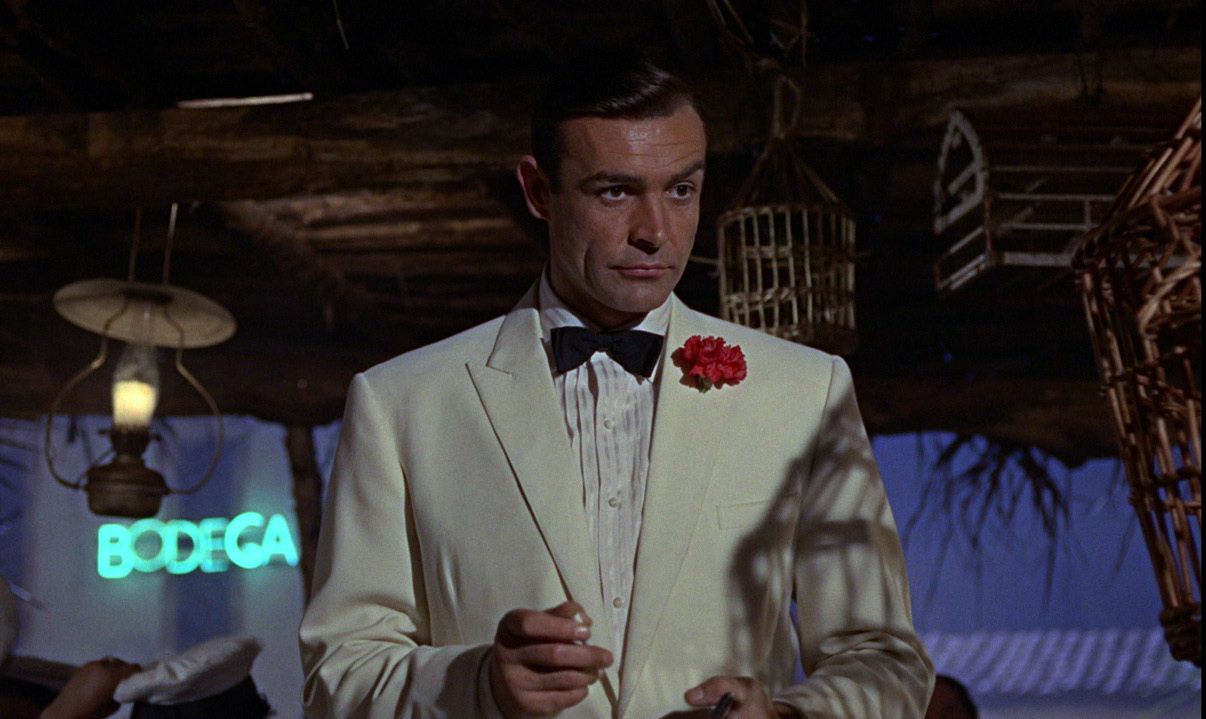
Connery was of course perfect for conveying that. In Goldfingerhe was still interested, clearly enjoying some of the best quips he got as well as just enough acting challenges – from Bond’s sad regret at anger at the death of no less than two Mastersons, to his terror at the prospect of being unmanned by a laser. That sequence has of course gone down in film history – from the striking image to the classic exchange “You expect me to talk?” “No Mr Bond I expect you to die!” – but a lot of it is sold from Connery’s desperate search for the right words to turn that machine off. Connery is cool but still just about vulnerable, cunning, smart and witty but also human. Who wouldn’t want to be so unshakeably cool that he can emerge from a wet suit (with a model seagull on his head!) unzip to reveal a tux, light a nonchalant cigarette while a factory explodes behind him, seduce a woman and then off a killer with a bathtub and a heater (“Shocking!”) – and that’s just the first five minutes!

Every scene in Goldfinger is a doozy. The playful cool of Bond outsmarting Goldfinger in Miami then getting his comeuppance (Connery is so cool in the film btw you forget that Bond is such a staunch conservative, he cheekily disparages the Beatles – that other icon of Swinging Sixties Brit Cool – to Jill as casually as he offs villains). That golf game in Kent (capped by a decapitated statue). Hillside driving with Tilly (with extra dodged bullets). Late night gadget-filled car chase. The first meeting with Pussy Galore (“I must be dreaming…”). Goldfinger’s briefing (his offing of all the attendants makes the whole thing even more funny, since its clearly just Goldfinger enjoying a bit of showing off). Bond dragging a nuclear bomb around an epic Fort Knox set. Oddjob surviving everything but a million volts. Goldfinger earning his wings in the film’s climax. It’s all terrific.

And it all works because it’s got the balance spot-on between cartoon and reality. You can see it come together in Ken Adam’s set for Fort Knox: the inside was all made up (no one would stack gold that high!) but people believed it was the real thing, because it felt like the Fort Knox we shouldhave. Goldfinger is a scowlingly wicked villain, with a little kid’s delight in his own naughtiness. Honor Blackman doesn’t appear until the film is halfway through, but is an assured, forceful, brilliant presence, more than a match for Bond (we’ll gloss over the slightly dated way Bond seems to ‘convert’ her from implied Lesbianism to – well perhaps bisexuality). The briefing sequence with a grumpy, unimpressed Q was so good Desmond Llewelyn would essentially repeat it another 13 times (only OMHSS and Live and Let Die would skip the “Now pay attention 007” sequence between this and TWINE). All of this has the bright, primary colour fun of a rollicking graphic novel.

You can watch Goldfinger about a million times – and anyone who has written a Bond film probably has, it was such a template for the next seventeen films that followed – and it would still thrill, excite and entertain you. Connery’s interest after this went downhill, and the magic wasn’t always recaptured – but this when Bond went from being a cool spy to a cultural phenomenon. Bond became the box-office franchise that would dominate cinemas for decades, the ultimate spy caper that others would be compared to. Goldfinger mixed silliness and seriousness perfectly, thrills and laughs, action and comedy. It’s a superb and hugely influential film. It’s one of the Best Bonds ever: it clearly has the Midas touch.

Jason and the Argonauts (1963)


The Argonauts take on dreadful monsters in Jason and the Argonauts. You gotta love it.

Director: Don Chaffey

Cast: Todd Armstrong (Jason), Nancy Kovack (Medea), Gary Raymond (Arcastus), Laurence Naismith (Argus), Niall MacGinnis (Zeus), Michael Gwynn (Hermes), Douglas Wilmer (Pelias), Jack Gwillim (King Aeëtes), Honor Blackman (Hera), John Cairney (Hylas), Patrick Troughton (Phineus), Nigel Green (Hercules)

Watching this film it’s impossible not to get swept up in childish glee. It’s one of the most gloriously entertaining, wonderfully imaginative and brilliantly enjoyable films ever made. Watch this at the right age and it’s got you for life. Its best remembered of course for its wonderful Ray Harryhausen stop-motion effects – but to be honest the whole film is a brilliantly assembled package from start to finish, full of thrills and spills. I love it, I’ll always love it, and it’s got to be one of the best adventure stories ever filmed. Not much point writing more is there? But I guess I will.

The plot hews fairly closely (give and take) to the mythology. Pelias (Douglas Wilmer) seizes the Kingdom of Thessaly. Terrified of a prophecy that says a child of King Aristo of Thessaly will take the throne from him, he kills Aristo’s daughter at the temple of Hera (Honor Blackman). Outraged, Hera becomes the protector of Aristo’s surviving son Jason (Todd Armstrong), and 20 years later he returns. Jason needs to prove himself if he is to re-take the throne, and decides to find the legendary Golden Fleece in the distant land of Colchius. He builds the greatest ship ever – the Argus – and holds games to find the finest crew in Greece. But danger awaits!

If any film is associated the most with Ray Harryhausen, it’s this one. So it’s almost a shock to realise he didn’t direct it, and that the monster moments are carefully placed only at key moments – and that a lot of the rest of the film relies on human action. Jason and the Argonauts is so good because all these elements are brilliantly put together and superbly staged, with an old-school, boys-own adventurousness. How can you not enjoy this film?

The Harryhausen effects are astonishingly good, and their stop-motion brilliance have a grounded reality to them. The staggering copper monster Talos is fabulous – grinding joints, groaning weight and size. The shrieking harpies that plague Patrick Troughton’s put-upon Phineas have an unpleasant, grasping dirtiness to them. The Hydra guarding the fleece is a rattlesnake-like vicious beast. All brilliant. I love them all – just sequences to dream of.

But the highlight is of course the skeletons’ battle. Oh wow. This sequence still holds up so well. It took Harryhausen years in the making and planning, but really paid off. The skeletons are terrifying in their cold-eyed ferocity. For skulls, Harryhausen gives their faces a lot of expressiveness. I just love this sequence – it speaks to the child in all of us. And there is something extra magical from knowing that the sequence was put together frame-by-frame and the live action shots carefully choreographed to match-up with it. Not for nothing did Tom Hanks namecheck this film when presenting Harryhausen with an honorary Oscar. 

These sequences really work though because the film has a wonderful Sunday-morning-serial briskness to it. Pacily directed by Don Chaffrey, the film motors so swiftly through its plot that you are surprised to find it’s only about an hour and a half. Its story structure is not always perfect: apart from Jason and Arcastus most of the rest of the Argonauts are so briefly introduced (despite the recruitment Olympics montage at the start) you’ll find them hard to tell apart. The arc of the story is often a little messy, and iIn fact it’s easy to forget the film ends on a cliffhanger (the sequel was never made) and that Douglas Wilmer’s sinister Pelias is totally forgotten after the first half an hour. But it’s so well done it doesn’t matter. 

But Chaffey keeps the events moving forward so well, the tone so perfectly balanced between heroics, gods debating and thigh slapping jokiness that the film’s tone and momentum never slackens, with the Harryhausen monster sequences as exciting tent-poles in the film’s action. A lot of this feeling is carried across from Bernard Herrmann’s excellent score, a hummable mixture of bombast and slightly eerie mysticism that reflects and compliments the action throughout.

The film is extremely well-made and put together. The Gods as these gigantic figures living in Olympus (Jason is not a lot bigger than the chess pieces they use to guide the wars of the humanity) are great fun: Niall MacGinnis is a very 1960s idea of Zeus (the gods would be hot younger guys today, not tubby Brits), but gives it a headmasterly briskness. Honor Blackman is very good as a proud but caring Hera – the use of the Argus’ headpiece as her voicepiece works really well. It’s quite something that all this interference from the Gods never feels silly at all.

Todd Armstrong and Nancy Kovacks are, to be honest, pretty wooden as the leads but that seems to be what the film needs. Armstrong does a very neat line in middle-distance staring. Gary Raymond has a lot more fun as a scheming Arcastus. The film also manages to shuffle some perceptions: Nigel Green’s Hercules is more of a roisterer than the great warrior (and, with his meat-headed over-confidence, causes more problem for the Argonauts than most). Other performances are perfect adventure-story ham: Jack Gwillim chews the scenery outrageously as King Aeëtes, which kind of matches up with the overblown hyper-reality of the skeleton fight.

Talking about this film, it’s hard not to treat it as a sequence of scenes that I really love. But every scene in it has something. I love the moment where Hylas proves his worth via clever stone-skimming. The approach to the clashing rocks – and the intervention of Poseidon to hold the rocks apart – is brilliant. Hermes’ disguise being unveiled. Hercules doing something decent by staying behind on an island to look for a missing Hylas. All those brilliant Harryhausen sequences.

There is something about this film that is just endlessly and constantly entertaining. No matter your age, it’s a film for every single generation of children (young and old!) to enjoy. It’s simply marvellous, and Chaffey and Harryhausen deliver it wonderfully. Every scene is exciting, the pace never slackens, the special effects are brilliant. But on top of that, it’s a brilliantly put together, well directed, beautifully scored film. It’s exciting, it’s gripping, it’s wonderfully entertaining. I’m gutted they never made that sequel (although since Jason and Medea’s story is literally all down-hill from here, it’s probably just as well).