Tag: Ian Holm

The Madness of King George (1994)

Nigel Hawthorne and Helen Mirren excel in this masterful adaptation of Alan Bennett’s classic play

Director: Nicholas Hytner

Cast: Nigel Hawthorne (King George III), Helen Mirren (Queen Charlotte), Ian Holm (Dr Willis), Rupert Everett (Prince of Wales) Amanda Donohoe (Lady Pembroke), Rupert Graves (Captain Greville), John Wood (Lord Chancellor Thurlow), Geoffrey Palmer (Dr Warren), Jim Carter (Charles James Fox), Julian Rhind-Tutt (Duke of York), Julian Wadham (William Pitt), Anthony Calf (Captain Fitzroy), Adrian Scarborough (Fortnum), Struan Rodger (Henry Dundas), Caroline Harker (Mrs Fitzherbert), Roger Hammond (Dr Baker), Cyril Shaps (Dr Pepys)
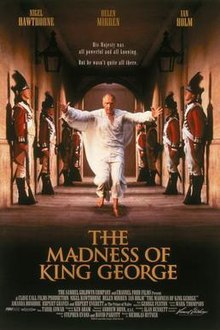
Alan Bennett’s The Madness of George III allegedly changed its name for the film adaptation because producers worried American audiences would feel they missed the first two films in the series. It’s not actually true, but it was a lot of free publicity for Nicholas Hytner’s film debut – a marvellous, accomplished and brilliant theatrical adaptation that will always take a firm place on my list of favourite films. It’s an excitingly well-made, hilarious and heartfelt film that captures forever Nigel Hawthorne’s greatest ever performance.

In 1788 King George III (Nigel Hawthorne) is still fuming over the loss of “the colonies” (the film front and centres talk of the plucky United States, to help sell the film in the land of the free) and the behaviour of his ambitious oldest son George (Rupert Everett). Happily married to his wife Queen Charlotte (Helen Mirren), and the father of 15 children, George is a stickler for form and duty. So imagine the shock of his ministers when his behaviour becomes impulsive, irrational and finally obscene. With the king talking non-stop and impossible to control, the Prince of Wales schemes to become Prince Regent. Desperate, the king’s ministers call in Dr Willis (Ian Holm), a professional doctor of the mad, who claims he can (with time) cure the king. But will it be in time to prevent the regency?

Nicholas Hytner has rather charmingly claimed that he knew so little about film-making he didn’t realise the difficulty of many of the things he asked for, and if he had known he would never have asked. He gives much of the credit to the seasoned pros working on the film pulling out the stops to give him what he asked for. The end result is a brilliantly paced, lusciously filmed epic that is both a wonderfully moving personal story of a crotchety but lovable monarch and a witty look at regency politics. Several scenes are shot with an imaginative brilliance, from shots that throw themselves into the middle of scuffles at court with the unbalanced king, to sweeping landscape shots that make it look like the thing cost millions of dollars.

The other advantage of bringing in Hytner (director of the original stage production) was his brilliant understanding of Alan Bennett. Bennett’s script is superb, crammed with sensational lines and brilliant jokes that never get in the way of the humanity. Bennett is always more than radical than his cosy reputation suggests, and King George is a witty deconstruction of the purpose of the Royal family (politicians frequently comment on their pointlessness and George defines it as “smile and wave” and to act as “a model family”). It’s got a great understanding of the frustrating waiting game of long-serving heirs (being Prince of Wales “is not a position, it is a predicament”). The film even lands a cheeky gag at the end with the suggestion that the King’s condition was hereditary.

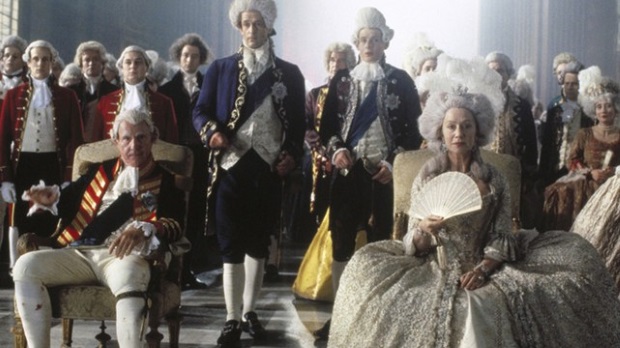
Hytner’s film uses the trappings of royalty brilliantly, contrasting them to great effect with the later degradation of the king – in an inspired moment, George’s first “enthroning” in the restraint chair Willis uses to condition him into behaving is soundtracked to Handel’s Zadok the Priest. George’s court is an uptight, staid place where people can’t relax (or even sit – George is so adamantly opposed to people sitting in his presence even a heavily pregnant woman is not exempt during an interminable bell-ringing version of Handel). George is a constrained figure – so it’s no wonder his insanity displays itself as an increasingly loose-lipped lack of inhibition.

The question of madness is richly handled. As Willis says, many of the mad consider themselves kings, so what does a king fancy himself as? And how can you tell what is normal for a king anyway? George is an eccentric from the start – and even his recovery at the end is basically eccentricity with an element of self-control rather than a full recovery. The film never shies away from making you invest in the rough treatment the king undergoes to wrestle him back to sanity. The doctors get short shrift, either incompetent or scheming (“When will you get it into your head that one can produce a copious, regular and exquisitely turned evacuation every day of the week and still be a stranger to reason” Geoffrey Palmer’s wonderfully dry Warren tells a toilet-obsessed colleague). 
The film is slightly more confused about Willis. Strongly played, with a twinkly chippiness, by Ian Holm (who is just about perfect) the film can’t quite decide if Willis is responsible for the king’s recovery or not. It’s a battle of wills, but is Willis ahead of his time or as medieval as his colleagues? Does Willis’ aggressive conditioning (punishing bad behaviour with restraints) force the king back into sanity? Or is it George’s love of his wife that provides the final push? Or is the king naturally on an upcycle where madness expresses itself in eccentricity rather than incoherence? It’s not clear (maybe this is deliberate) but Willis’ regime of punishment and reward has a slight air of quackery.

What’s pretty deliberate was Bennett and Hytner’s insistence that only Nigel Hawthorne could play the king. Thank god they did, as Hawthorne is simply brilliant. Cheated of the Oscar in 1994, Hawthorne is compelling. He also conveys the natural authority of a king, and the “grumpy old man” side of the king is mined for brilliant comic effect. But it’s also a beautifully heartfelt and hilarious performance, running the gamut from delight in obscenities to teary fury and fear at the treatment from his doctors and loss of mental control. Such a sublime performance.
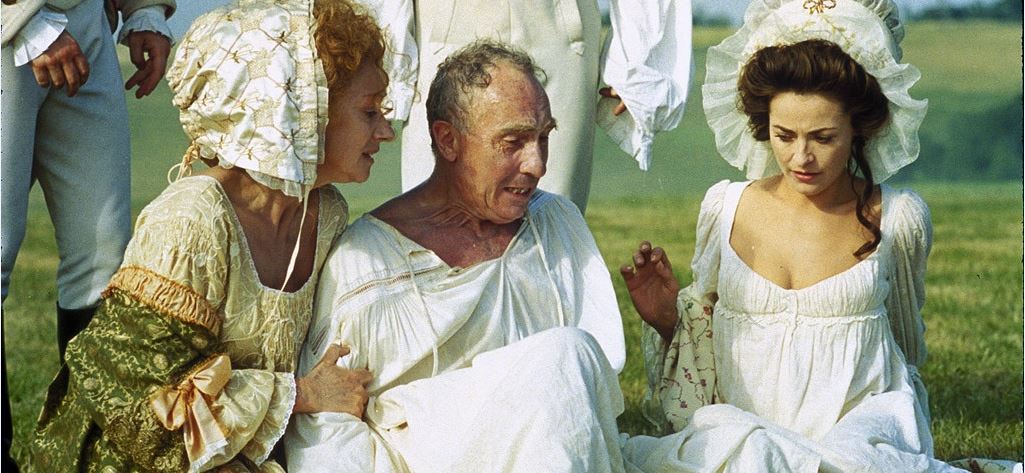
And it surely inspired some top work from the brilliant cast around him, many of whom revived their roles from the stage production (chief among these Wadham’s wonderfully dry Pitt).  Helen Mirren is warm, proud and eventually desperate as Charlotte, while Rupert Everett mines the Prince of Wales for all the comic pomposity and childishness he can. Rupert Graves is excellent as a loyal equerry, while John Wood, Jim Carter and Geoffrey Palmer also excel. You’ve rarely seen such a strong cast of British stage notables, and it’s not surprising they were attracted to perform in a script that has as many good lines as this one.

It’s accomplished and luscious, is brilliantly shot and designed, and is packed full of wonderful sequences. It wears its intelligence lightly, with George as a proto-Lear struggling to hold onto his marbles. The characters even sit and read Lear at one point (“Is that wise?” questions Thurlow. “I had no idea what it was about” says the little-read Willis). George may recover his wits in time, but it’s unclear whether this makes him more or less of a human being. In many ways at the height of his insanity, he’s a warmer, friendlier person (if out of control), then he is as his buttoned-up, stickler-for-duty self. 

The Madness of King George is the sort of film all theatre adaptations wish they could be, brilliantly cast, opening out into something that not only feels compelling to watch but also brings out the great depths of the original play. What is monarchy for? How can we tell if the all-powerful are mad or not? What is sanity anyway? All this and with some superb jokes, and a story that really involves you. With Nigel Hawthorne’s simply brilliant performance at the centre, this is one for the ages.
Mary, Queen of Scots (1971)

Vanessa Redgrave and Glenda Jackson are the feuding queens in Mary, Queen of Scots

Director: Charles Jarrott

Cast: Vanessa Redgrave (Mary, Queen of Scots), Glenda Jackson (Elizabeth I), Patrick McGoohan (James Stuart, Earl of Moray), Timothy Dalton (Lord Henry Darnley), Nigel Davenport (Earl of Bothwell), Trevor Howard (Sir William Cecil), Daniel Massey (Robert Dudley, Earl of Leicester), Ian Holm (David Rizzio), Andrew Keir (Ruthven), Robert James (John Knox), Katherine Kath (Catherine d’Medici), Frances White (Mary Fleming), Vernon Dobtcheff (Duke of Guise)

So here we are, back in the Tudor history craze of late 1960s Hollywood. Charles Jarrott directed, following up his efforts in Anne of the Thousand Days with this professionally mounted, handsome and rather personality-free film adaptation. It occasionally falls a bit too much in love with its luscious romanticism – and it falls hard for Mary herself, surely one of the worst queens ever – but despite all that, it has an entertaining quality that never lets you down.

The film picks up with the recently widowed Mary (Vanessa Redgrave) essentially being chucked out of France after the death of her husband the King, and swiftly being sent back to Scotland to take up the throne there. Problem is: the very Catholic Mary isn’t exactly the choice of the lords of Scotland – led by her bastard brother James Stuart (Patrick McGoohan). Mary’s Catholicism also threatens to destabilise the relationship with Protestant England – particularly because she is the nearest successor to Elizabeth I (Glenda Jackson). But Mary lacks Elizabeth’s tactical understanding of ruling and is guided by her heart – leading her into a disastrous marriage with feckless alcoholic Henry Darnley (Timothy Dalton).

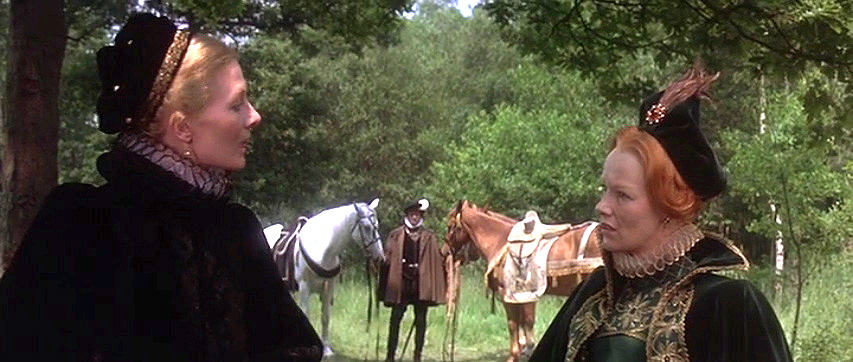
Mary Queen of Scots is a stately picture, which uses its location shots, costumes and production design to tell its familiar story with a sweep and relish that effectively hides the lack of inspiration in its film-making. Just as in Anne of the Thousand Days, Charles Jarrott shows he’s a fine producer of middle-brow entertainment, safe costume dramas that aren’t going to challenge anyone’s perceptions or give you any real wow moments of filming. He’s happy to set the camera up and let the actors do their thing, with the script ticking off the great events.

That’s what you get here. It’s a film that could have been a lot more of an exploration of the rivalries and different life philosophies of its feuding queens. But it doesn’t quite connect with that. This is partly because it can’t quite bring itself to engage with the reality of Mary herself, preferring the popular romantic image. The film doesn’t want to admit that many of Mary’s decisions were, to put it bluntly, completely misguided bordering on wrong. It is in love with her romantic image – and not as enamoured with Elizabeth’s wiser, more pragmatic, manipulative rule. It’s this rule by heart rather than head the film finally holds up for praise.

It doesn’t help that Vanessa Redgrave feels miscast in the lead role. Redgrave is too sharp an actor to convince as someone as easily led and foolish as Mary. She looks too shrewd, she feels too smart. Redgrave compensates by speaking softly and giving a lot of love-struck eyes to various male actors (principally Nigel Davenport’s bluff, masculine Bothwell), but it doesn’t quite work. It’s like she’s struggling to find the character – and to find the balance in a film that doesn’t want her to be seen as too stupid, while the viewer is left slapping their foreheads at every action she carries out.

This feeling stands out all the more with Glenda Jackson’s casting as Elizabeth. Having just finished playing the same role in a landmark six-part TV series, Elizabeth R(which covered a lot of the same ground), Jackson here confirms that she was the definitive Elizabeth. As smart and shrewd an actress as Redgrave, Jackson’s natural firmness marries up very well with these qualities to make the perfect Virgin Queen. There have been so many others who have taken on the role, but Jackson is simply perfect in this role – she becomes Elizabeth. Her Elizabeth is clever, manipulative, cunning but also quick tempered, capable of great wisdom but prone to moments of passionate lashing out.

The rest of the cast is a familiar parade of character actors – British actors of this generation made a living from films like this! Timothy Dalton stands out as a foppish, clearly useless Darnley (here reimagined as a syphilitic bisexual with anger management issues), as does Ian Holm as a cool-headed, would-be power behind the throne David Riccio, who meets a tragic end. Daniel Massey does a decent job as Leicester (though I can’t shake memories of Robert Hardy in the same role in Elizabeth R – was he busy at the time?), Trevor Howard gets saddled with a lot of plot as Burghley. Up in Scotland, Patrick McGoohan has a lot of fun as a scheming Earl of Moray.

All of these actors fit comfortably into the slightly browned, grainy photography style of films of this type, and the screenwriters hammer together plenty of incident alongside dramatic invention. The focus on the soap opera of Mary’s three marriages (she’s widowed in the opening moments of the film) leaves plenty of scope for invention, from Darnley and Riccio’s affair to the inevitable non-historical meeting between Mary and Elizabeth – it seems like every drama going from Schiller onwards has invented a meeting between these two as a dramatic highpoint.

This final scene captures the lack of thematic depth to the film. In a film that had focused more on really comparing the differences between the two, this could have been the culmination of a debate running through the film (can you rule with a brain but not a heart?). Instead it misses the trick, and becomes a final game of one-up-man-ship, which the film allows Mary to win because she is the more romantic figure. 

It’s well mounted and assembled like many other films like this – but it’s not the best of its genre, and you do sometimes wish for something that had a little more meat on its bones.

Greystoke: The Legend of Tarzan, Lord of the Apes (1984)

Christopher Lambert is the lord of the apes in dull Tarzan epic Greystoke

Director: Hugh Hudson

Cast: Christopher Lambert (John Clayton), Ralph Richardson (Earl of Greystroke), Ian Holm (Capitaine Fyllieppe d’Arnot), James Fox (Lord Charles Esker), Andie MacDowell (Jane Porter), Cheryl Campbell (Lady Clayton), Ian Charleson (Jeffson Brown), Nigel Davenport (Major Jack Downing), Nicholas Farrell (Sir Hugh Belcher), Paul Geoffrey (John Clayton Snr), Richard Griffiths (Captain Billings), Hilton McRae (Willy), David Suchet (Buller), John Wells (Sir Evelyn Blount)

For his follow-up to Chariots of Fire, Hugh Hudson settled on this curious mess: part heavy-handed exploration of class and the brutality of man, part picturesque jungle picture with people in ape costumes. If anyone remembers Greystroke today, it’s for an interesting bit of trivia: original director and writer Robert Towne was so annoyed at being removed from the project, he used his dog’s name as his screenwriting credit. When the Oscar nominations were announced, this pooch became the first four-legged Oscar nominee. Strangely fitting for a film about the nobility of animals.

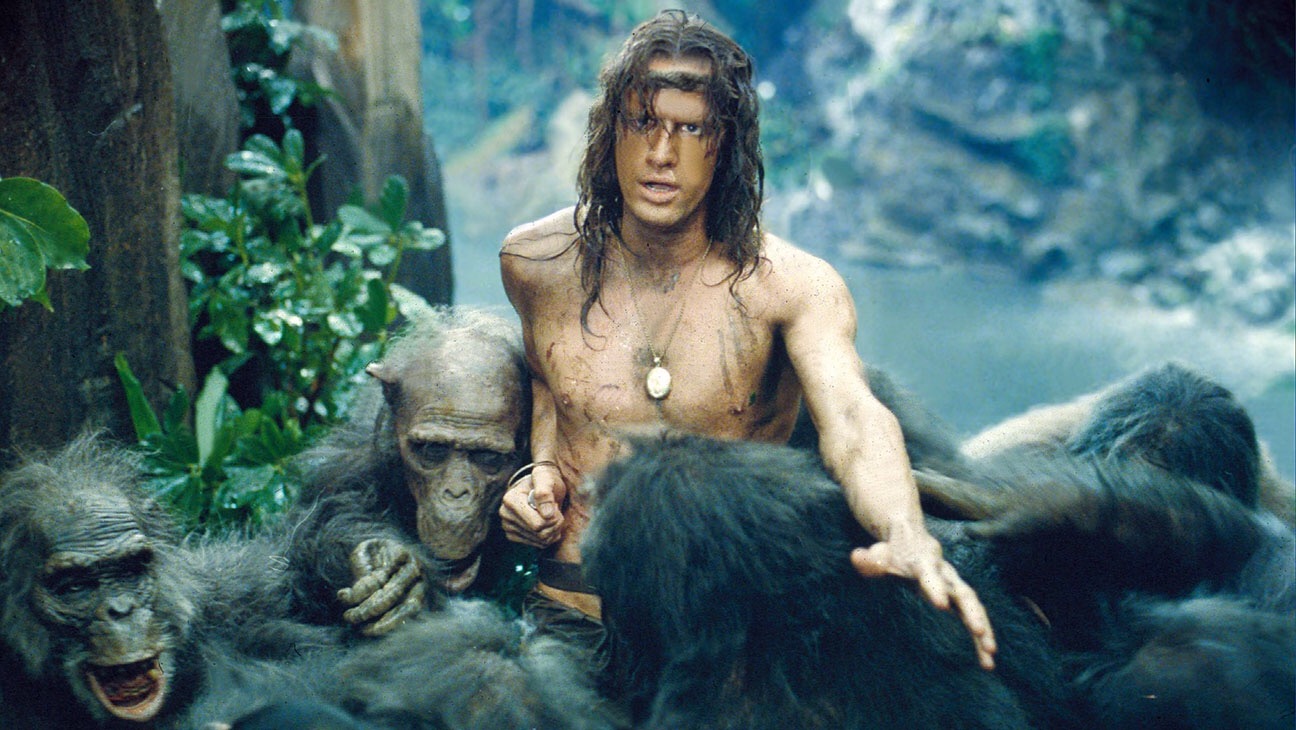
The film is a “real life” version of the Tarzan story. What this basically means is that it is dry and boring with a ponderous self-important message about how the real animal is in man (or something like that). It also of course means that the word “Tarzan” isn’t used except in the title (presumably so that audiences could be lured into the cinema). Anyway, after his parents are shipwrecked off the jungle coast, and die after young John Clayton’s (Christopher Lambert) birth, he is raised by gorillas and becomes one of the leaders of the pack. When a troupe of gung-ho explorers are slaughtered by natives, the only survivor is Belgian Fyllieppe d’Arnot (Ian Holm). Rescued by John, d’Arnot teaches him language and takes him home to the estate of his grandfather the Earl of Greystoke (Ralph Richardson), who is desperate for an heir. But can John adjust to the jungle of the modern world?

So Greystoke is well filmed, looks good and has a couple of decent performances in it. But it’s a dull mess as a film. Watching it you suspect a lot of the runtime ended up on the cutting room floor. There are sudden time jumps. Characters appear and disappear, many serving no real purpose. The film drifts towards a conclusion that neither seems enlightening nor serves any real cathartic summation of what the film might be about. There are many, many lovely shots of the jungle and Scottish countryside, but we never really end up caring about any of the characters within it.

The film is thematically a mess from start to finish. It seems to be making a point about John being totally unsuited, by his upbringing, to adjusting to the world of man. But it never really gives a proper voice to John himself. Of course he’s only just learning language, but even without that you never really feel like you begin to understand him, or get a sense of half-remembered human traits emerging from his ape upbringing. Basically you don’t get a sense of conflict within him as to whether he should stay or go. Without that conflict, there isn’t really much interest in watching him work out the answer.

This is despite the fact the Christopher Lambert is actually pretty good as John Clayton. The role plays to his strengths: it’s highly physical (not just in the acts of athleticism but also in its half-man, half-ape physicality). Lambert also has this rather fine other-worldly quality that constantly leaves him looking a bit lost and vulnerable. The part may be underwritten but he is certainly doing his very best here, and he really does a brilliant job of playing an ape trapped in man’s body.

It’s a shame that the film takes so long to get going that he doesn’t really appear for the first half an hour or so. Instead we get a lot of ape-based action in the forest – and probably too much of his parents. Later in the film, the camera makes a point of returning two or three times to a large painting of Cheryl Campbell as John’s mother – but the film never suggests any link at all between these two characters. A lot of time is wasted setting up the parents’ voyage, while at the same time no time is spent on establishing any emotional link between the Claytons and their son.

Far more time is spent on the apes – which I suppose is the point of a film that wants to celebrate the purity of the world of animals over the corruption of man. Rick Baker’s ape make-up is pretty impressive for the time – and works really well in longshot – but in close-up is all too obviously a series of performers in masks. There is a sense of their natures, but not of them as dangerous or wild animals. In fact the film goes overboard in humanising them – even to the extent of giving them their own language of grunts and groans.

The ape stuff goes on too long – and then means the return to civilisation seems rushed and unclear. Ian Holm is excellent as d’Arnot, the bridge between the two worlds, and his fatherly love for John works extremely well. But the film makes no attempt to tackle the questions it raises of John dealing with his split animal-human relationship. Instead the film loads the decks by making almost every human character – epitomised by James Fox’s flat performance as Jane’s toff fiancée – a heartless uncaring moron.

Ah yes Jane. Played with an openness by Andie MacDowell, she’s dubbed in a painfully obvious way by an uncredited Glenn Close. This is another underwhelming relationship that seems skimmed over – one moment they have just met, the next they seem on the verge of a great love. It’s as rushed and slapdash as the introduction of a mentally handicapped servant – of course, with his childish outlook, he is closer to John than anyone could be – who literally appears out of nowhere.

The film was also Ralph Richardson’s final role – he died shortly after completing it – and his barmy Earl of Greystroke (part lonely old man, part semi-senile eccentric) does lift the film with a certain energy (he was posthumously Oscar nominated). But it’s an easy role for Richardson – and in fact his eccentric, hard-to-define energy kind of sums up the whole messy film pretty well. His character’s death is the final nail in its interest, his eccentric energy sorely missed.

The most damaging thing about Greystoke is it is dull and obvious. Pretty scenery and decent performances can only cover so much when the plot is empty and predictable. The film feels cut down absurdly – half the cast of Chariots appear in roles so tiny you wonder why they bothered – and by the time the film drifts towards its conclusion you’ll probably have stopped caring about what it was all about in the first place. It tries to ask questions about man’s nature, but it doesn’t even seem to notice it never answers them. A poor film.

Chariots of Fire (1981)


Celebrations abound in triumphant running flick Chariots of Fire

Director: Hugh Hudson

Cast: Ben Cross (Harold Abrahams), Ian Charleson (Eric Liddell), Nicholas Farrell (Aubrey Montague), Nigel Havers (Lord Andrew Linsley), Ian Holm (Sam Mussabini), John Gielgud (Master of Trinity), Lindsay Anderson (Master of Caius), Cheryl Campbell (Jennie Liddell), Alice Krige (Sybil Gordon), Struan Rodger (Sandy McGrath), Nigel Davenpot (Lord Birkenhead), Patrick Magee (Lord Carogan), David Yelland (Prince of Wales), Peter Egan (Duke of Sutherland), Daniel Gerroll (Henry Stallard), Dennis Christopher (Charley Paddock), Brad Davis (Jackson Scholz)

Dun-da-da-da da-da dun-da-da-Da-Da DA. Hum that theme tune and you know straight away what film it is: you can’t resist the temptation to mime out running (in slow motion of course), arms swinging gracefully from side-to-side. There aren’t many more movies with more iconic, instantly recognisable themes than Chariots of Fire

If there is one thing everyone remembers, it’s the young athletes running along the beaches of St. Andrews, spray flying up from their bare feet. Nicholas Farrell sprinting with upper-class determination. Nigel Havers wiping spray from his face with glee. Ian Charleson full of serene joy. Ben Cross with fixed, rigid focus. The opening of Chariots is a master-class in quickly established character, tone, mood and era. The cross-fade from the funeral oration from an ageing Nigel Havers into this slow-motion, halcyon-days reflection tells you we are in the land of memory – and sets right up for the feel-good triumph the film becomes.

The film follows the key athletes of the British 1924 Olympics team. Harold Abrahams (Ben Cross) is a second-generation Jewish grammar-school boy who runs to prove he belongs and can excel. Eric Liddell (Ian Charleson) is a Presbyterian Scot, who runs to celebrate God and whose religion prevents him running in a vital Sunday qualifying heat. Both characters are, in their own ways, outsiders – and their underdog status makes them perfect to root for in this extremely well-made crowd pleaser.

Chariots is often seen as a slightly undeserving Oscar-winner. But that’s to overlook the panache it’s made with and how emotionally uplifting and engaging it is. Hugh Hudson had never directed a film before this one. His background was in commercials and he brings many of the strengths of that background to Chariots. The film is wonderfully assembled, a perfect combination of montage, cross-cutting, longer tracking shots and cross-fading. 

That opening scene tells you a lot with its swift economy. But he handles others just as well: Abrahams’ 100m winning race is played first in real time, then again, cross-cut with Abrahams’ reaction to victory. The first moment is one of triumph, but the immediate repeat allows an opportunity for the viewer to understand the mixed feelings that achieving everything you aimed for can bring. Abrahams’ slightly shocked, underpowered reaction gives the slow-motion repeat of the race a hazy, post-match analysis feel – as if Abrahams is still running the race in his mind. As if he knows that his whole life was building to that one moment, and now he needs to find a new focus.

Hudson’s mastery of moments like this is impressive. Sequences are fabulously assembled. The famous “one minute” dash around the Trinity court (actually Eton) is brilliant, and a great example of how the film sells tent-pole moments. It also masters quieter character moments. One of its stand-out moments simply allows Abrahams’ coach Mussabini (a scene-stealing Ian Holm) to react to Abrahams win (a victory he has not seen due to being banned from the stadium) by quietly rising to attention, then sitting on his bed, gleefully punching through his hat and quietly whispering “my son”. Other scenes – such as those where Abrahams confronts quiet anti-Semitism from Cambridge scholars (nice bitchy cameos from John Gielgud and famed director Lindsay Anderson), or Liddell is quietly pressured into running on Sunday – simmer with good acting and restrained direction.

It’s these scenes that really make the film work. Ben Cross is superb as a chippy, frustrated Abrahams who feels he must justify his place in England’s oppressive class system. He’s constantly glowering, tense and uncertain – but Cross mixes this with a boyish charm, a gentleness (most notably in his shy romance with an unrecognisable Alice Krige) – and a warmth and genuineness that he shows with friends. Nicholas Farrell’s boyish Aubrey Montague (a love-struck best friend if ever I saw one!) helps a lot here – if someone as obviously nice as him likes Abrahams, then gosh darn it we should as well.

Ian Charleson is equally impressive as the devout, charming but coolly determined Eric Liddell who has decided his course in life and nothing is going to shake him from it. The film has a refreshingly considerate view of Liddell’s Christianity – and, furthermore, praises him for sticking to his devout principles. Charleson wrote many of his speeches himself, and he brings a charming honesty to his character. How can you not love this guy? He’s the perfect ambassador for the Church.

The film tackles plenty of clashes for Liddell which sizzle in a quiet way. Cheryl Campbell is very good as his partly proud, partly concerned sister, worried that his missionary work is being sacrificed for his running. His confrontation with the Olympic committee over his crucial decision not to run – is there any other film where not working on a Sunday is the dramatic centre piece? – is nicely underplayed. It’s clear that they (including a very good Nigel Davenport as an understanding Chair) want him to run, and it’s equally clear Liddell is determined he won’t.

It’s the moments like this that make the film so triumphantly feel-good. Both Abrahams and Liddell are at heart immensely likeable, the upper classes and elites who frown at them in their way rather boo-able. The running scenes are great (despite the sweetly dated lack of grace!), the film really capturing the exhilarating energy of pushing yourself to the limit. Watching Abrahams training under the expert eyes of Mussabini (worth repeating again that Holm is the heart of this film, as the fatherly, wise trainer struggling against prejudice against both Italians and professionalism), or Liddell winning from behind after being pushed over in a race are simply hugely uplifting.

Strangely the one thing that does seem a little odd today is the Vangelis score. Yes the Chariots march is outstanding – but the 80s electronic beat to the rest of the score now sounds very dated. Yes it is interesting to overlay (then) modern music over a period piece – but nothing dates quicker than music (except perhaps haircuts) and that is the case here. It sounds odd and jarring with the action at times – but then that main theme is so brilliant (but also the most classical of Vangelis’ compositions) that it still sort of works.

The sad thing is that Chariots didn’t lead to great new things for most involved. When he won the Oscar for best original screenplay, Colin Welland famously cried “the British are coming!”. Sadly he wasn’t really right. Within four years two flop films had all but ended Hudson’s career. Producer David Puttnam took over Columbia Pictures, only to be dismissed within a year after disastrous results. Many of the stars of the film never got the breaks this film promised (Charleson died tragically young – the first major star in England to openly acknowledge his cause of death as AIDS). Even the star Americans introduced to play the yank athletes (Brad Davis and Dennis Christopher) never had a hit film again. As David Thomson put it, within ten years of all the major players only Ian Holm “had any professional credibility left”.

But Chariots is still a bit of lightening caught in a bottle. A strange idea to spin an entire film out of an event lasting less than 10 seconds, but which married up so well with universal themes of class and struggle. It knows exactly what it is, and exactly what it is doing. It really worked then and it really works now. It’s not pretending to be high art, or to really make profound statements – just to entertain. And it really does. Fetch your running shoes and start that Vangelis theme!

The Sweet Hereafter (1997)


Sarah Polley and Ian Holm are outstanding in this heartfelt story of grief The Sweet Hereafter

Director: Atom Egoyan

Cast: Ian Holm (Mitchell Stephens), Sarah Polley (Nicole Burnell), Bruce Greenwood (Billy Ansel), Tom McCamus (Sam Burnell), Alberta Watson (Risa Walker), Maury Chaykin (Wendell Walker), Gabrielle Rose (Dolores Driscoll), Stepheanie Morgenstern (Allison O’Donnell), Caethan Banks (Zoe Stephens), Arsinée Khanjian (Wanda Otto), Earl Pastko (Hartley Otto)

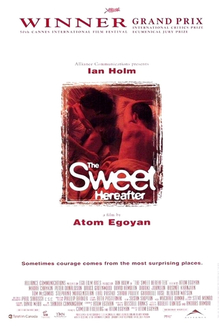
Atom Egoyan’s melancholic, wintery The Sweet Hereafter is a small-scale masterpiece about grief and mourning and the impact a calamitous accident has on a community. Told across three delicately interwoven timelines, it explores how the loss of a child can affect us and how a community can be broken apart by trauma. 

In a remote Canadian town, an accident to a school bus leaves most of the town’s children killed. The only survivors are bus driver Dolores (Gabrielle Rose) and 15-year-old Nicole Burnell (Sarah Polley) who has been left paralysed from the waist. Mitchell Stephens (Ian Holm), is a lawyer looking to start a case against the bus company or the local authority or anyone else he can think of who might be to blame. Stephens himself suffers from the “loss” of his daughter, a hopeless drug addict who contacts him intermittently for money.

Egoyan’s film has a beautiful elegiac quality, the camera mixing intimate close-ups of tormented actors with sweeping vistas of snowy wilderness. The film has a medieval-style pipe score, suggesting an old medieval morality tale. Egoyan builds on this by introducing the recurring theme of the Pied Piper throughout the film – just like Hamelin, the town has lost all its children (bar one child). Nicole seems obviously the one remaining child – but is she more than that? Is Dolores or the bus the pied piper? Is it fate itself? Is Mitchell Stephens another Pied Piper, promising to solve all the town’s problems?

Either way it’s a beautifully heartfelt look at grief, loss and the impact it has on small communities. Everyone is aware of each other’s business, but this town still has secrets, from affairs to suggestions of dark family issues. But the overwhelming feeling is how grief affects us in different ways – how it turns some to depression, some to anger, some to melancholy and some to isolation. It also show how suspicion and resentment can start to bubble up and rend the community – and how finger-pointing and blame can be an inevitable consequence.

This theme is helped by the immaculate acting. There is not a false step in the entire cast. Bruce Greenwood is wonderfully bitter and deeply pained as the father who has lost both his children and his wife in quick succession and wants nothing more than to forget. Alberta Watson is lifeless and going through the motions as a mother who has lost her sole reason for living. Arsinée Khanjian burns with undirected fury at losing her beloved adopted son. The interplay between these and other characters is sublime, Egoyan asking profound questions of love and trust.

Into all this appears our lawyer. In a simply superb performance by Ian Holm, Stephens is both an ambulance chaser and also a man who seems to need this court case to fill a void within himself. Stephens skilfully adjusts his pitch for each member of the town he meets, adroitly recognising and playing on the different emotions he sees to sign them up for a group lawsuit. But how much does his daughter’s own disastrous life tie into his mantra that “someone” is always to blame, that someone has cut corners to save a buck? Does this same mantra help him to deal with his daughter’s failures – that they are not his or hers but some external force? 

Stephens is the classic interloper in the town – it’s easy to see why Greenwood’s Ansell sees him as feeding off the tragedy. Holm leaves the question brilliantly open in a wonderfully subtle performance: how much does he care and how much does he want the money? He talks to the Ottos with real empathy and concern, but then runs to his car in haste to get an agreement for them to sign. Egoyan’s film asks throughout whether Stephen’s presence is, in its way, equally damaging to the town: this Pied Piper offers to take away their pain, but at what price? Will this crusade stop the town from putting the dreadful event behind them?

Interweaving timelines here work very effectively – it’s a good hour into the film before the timeline following the day of the accident finally reaches the accident itself. By this point this accident has so dominated the film that we have become all too familiar with the painful mundanity of grief and the emptiness of carrying on. Egoyan shows us the accident: but not all of it. We see it largely from Ansell’s reaction – and while we see the bus tumbling towards the frozen lake, we never see what makes it swerve. The point perhaps is to put us in the same position as the rest of the town: we can never know if it was an accident, act of God, or if someone was certainly to blame.It’s the balance between blame and moving on that this film dwells on.

The Sweet Hereafter of the film is that netherworld after loss, that “living death” of carrying on after a loved one has left forever. Any doubt that Stephens himself isn’t stuck in the same condition is dispelled in the film’s third contrasting plotline. Two years later, Stephens is a on a plane journey to collect his daughter from another treatment clinic. On the plane he finds himself by chance sitting next to his daughter’s childhood friend. The conversation between them slowly reveals more and more the immense loss, emptiness and longing for family in Stephens. How much of this feeling did he recognise in the town: and how much did his own feelings allow him to exploit the feelings of the town?

Holm is again sublime in these sequences, his eyes little pin holes of sadness, his tight-lipped firmness holding back waves of emotion. In one stand-out sequence, he tells a heart-rendering monologue of a time when his daughter as a child was bitten by a black widow spider. Rushing her to the hospital, Stephens had to keep her calm to prevent her throat swelling up, while simultaneously standing by to perform an emergency tracheotomy. The point of the story for Stephens is his own fear, and the film asks: is this fear also linked to his own regret that this was the last time he could truly keep his daughter safe? And does he also look back on it and wonder why he saved his daughter then so she could die of drug addiction today?

The other daughter in the film is Nicole, played with a mature distance by Sarah Polley. Nicole, the last surviving child, slowly turns into a pivotal figure in the film, her decisions affected by both her relationship with her father (an unsettlingly hipsterish Tom McCamus) and perhaps her wish to do what is best for the town. McCamus is equally good as a loving father whose interest in his daughter is not healthy – and it’s one of many complex questions in the film as to how far Nicole is unsettled or enamoured with his attentions. 

The Sweet Hereafter is a beautifully made, wonderful film – perhaps one of the best you’ll see about small town grief and pity. It may also be one of the best acted films you’ll see – every performance is simply spot-on, heartfelt and true. It may well be Ian Holm’s finest hour, in the most complex leading role he ever got in his career. Egoyan’s emotional and heartfelt story has so much to tell you about grief and mourning that it can’t help but be a sad, melancholic, but thought-provoking and engrossing watch.

The Hobbit: The Battle of the Five Armies (2014)


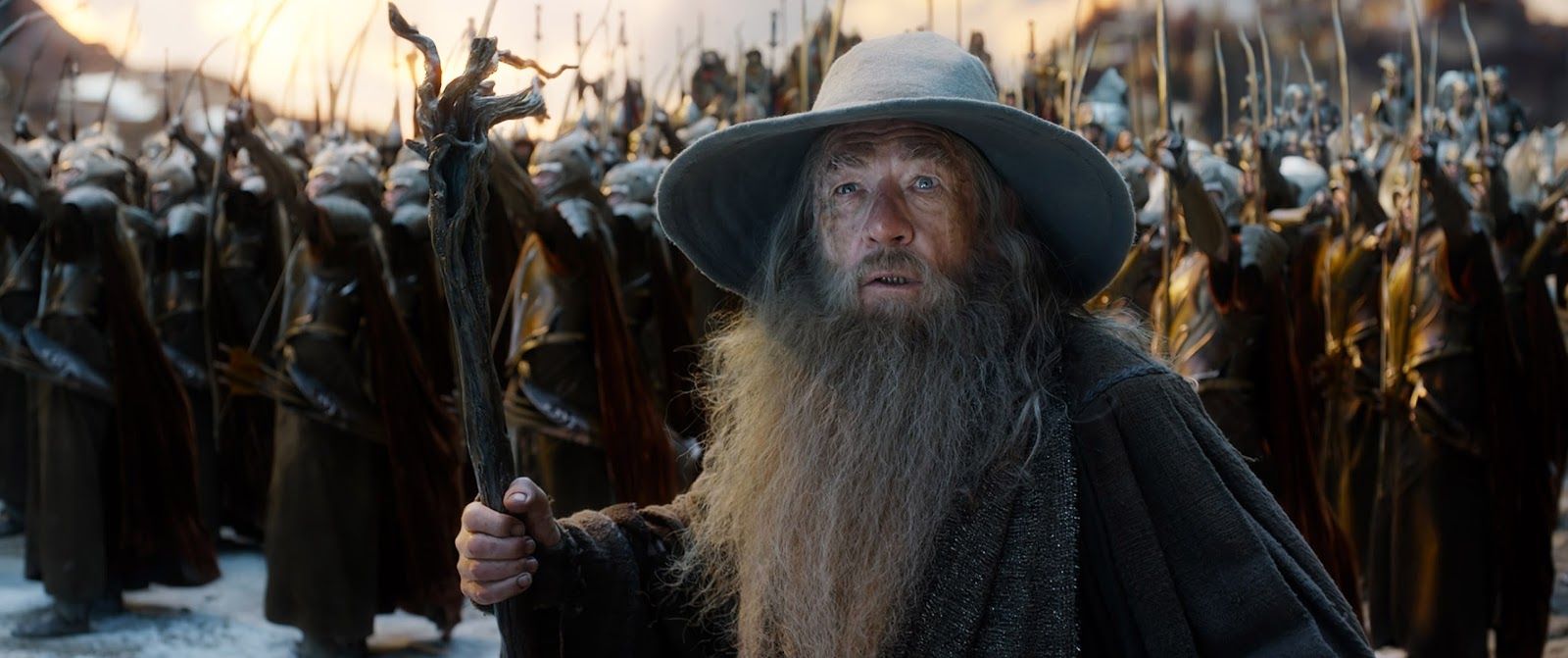
Gandalf prepares to take on many foes – not least the script and editing – in The Hobbit: The Battle of the Five Armies

Director: Peter Jackson

Cast: Martin Freeman (Bilbo Baggins), Ian McKellen (Gandalf), Richard Armitage (Thorin Oakenshield), Luke Evans (Bard), Evangeline Lilly (Tauriel), Orlando Bloom (Galadriel), Aiden Turner (Kili), Lee Pace (Thranduil), Ken Stott (Balin), Cate Blanchett (Galadriel), Ian Holm (Old Bilbo), Graham McTavish (Dwalin), Christopher Lee (Saruman), Hugo Weaving (Elrond)

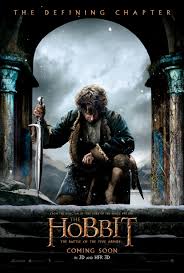
I feel like I’m running out of things to say about this desperately flawed trilogy – but here we go… Peter Jackson finally finishes his great contractual obligation, serving up another film that expands out a slim couple of chapters of a children’s book into something that strains so heavily for the feel of something epic and world shattering, it feels like a constipated man struggling on the loo.

We’ve finally made it to the Lonely Mountain. Smaug is killed by Bard (Luke Evans) during his attack on Lake Town, while Thorin (Richard Armitage) seizes control of the fortune under the mountain. However, the mountain now becomes a struggle point between the dwarves and their allies: Bard and his people and Thranduil (Lee Pace) and his elves, who are all looking to gain control of its treasures. While Bilbo (Martin Freeman) attempts to make an increasingly maddened Thorin see sense, Gandalf (Ian McKellen) brings warning of an imminent attack by an army of Orcs – will this mutual enemy bring our heroes together at last?

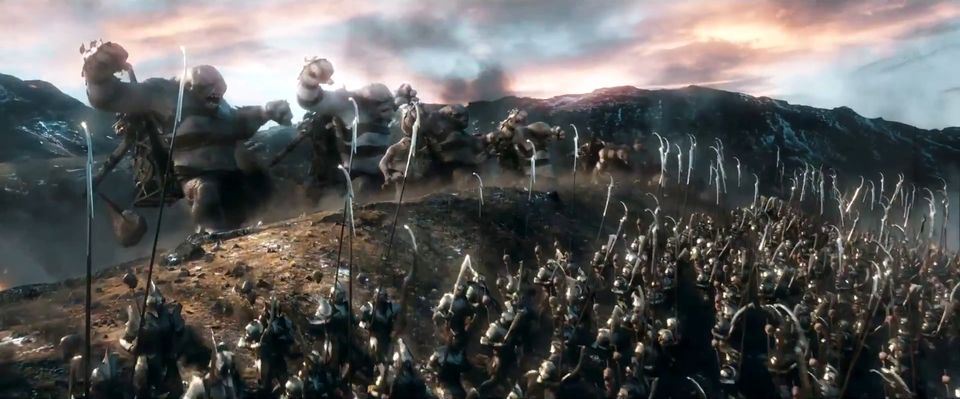
The Battle of the Five Armies is the moment where you knew this sprawling, sausage-fest of a trilogy had lost what soul it had. Almost the entire runtime is given over to battle sequence, seems to go on forever and ever with no respite. We see a host of clashes that carry none of the poetry of The Lord of the Rings, and a host of characters we don’t really know fighting with each other. Frankly, it’s hard to care. It looks great, but it’s just empty spectacle, sound and fury signifying absolutely nothing at all. In fact, it’s all so unclear that watching this movie for a third time I still have absolutely no fucking idea what this battle is even about! What are the Orcs doing? Why are they attacking? 

As always character moments are constantly sacrificed. The dwarf company are ruthlessly trimmed of screen time–even Ken Stott’s Balin doesn’t get much of a look, bizarre as he’s been established previously as Thorin’s confidant. Apparently James Nesbitt nearly wept when he saw this film – not surprising since he must barely be on screen for more than five minutes. Crucial moments that should make us care about these characters are constantly lost: Thorin’s descent into madness occurs completely off camera, Gandalf’s struggle to keep the peace gets glanced over, Bilbo nearly gets completely lost in the shuffle from special effect to special effect.

Tragically, far too much screen time is given to two characters Jackson has parachuted into the film. Weaselly Lake Town official Alfrid is given seemingly endless scenes of “comic relief” – a shame since he’s about as funny as being hit in the mouth by a hammer. I understand Jackson must find this character funny, and that he felt some comic relief was needed amongst all the fighting – but quite frankly he’s wrong. Alfrid is not funny – I think you’d go a long way to find anyone who liked him – and secondly if they needed comic relief characters, why not let one of the dwarves fill that function rather than introducing a new character 2/3rds of the way into the story? 

The second character who gets far too much to do is our old friend Legolas. The elf’s plot line is given never-ending minutes of screen time, his struggles and conflicts given (it feels) even more screentime than Bilbo’s. Do we really need to see Legolas searching for the orcs? Do we really need to see him doing ridiculously impossible feats in the middle of combat? Are we given any reason to care about him at all, other than the fact we remember him from Lord of the Rings?

Legolas’ inclusion demonstrates almost everything wrong in this series. Did Jackson include so much of him because he didn’t need to think quite so much about what to do with the character, being already so familiar with him? When Legolas (at best a secondary supporting character in the story) has his battle with some random Orc, intercut (and even prioritised in the edit) over Thorin’s climactic battle with Azog, the clash the entire trilogy has been building towards, you know something is seriously wrong.

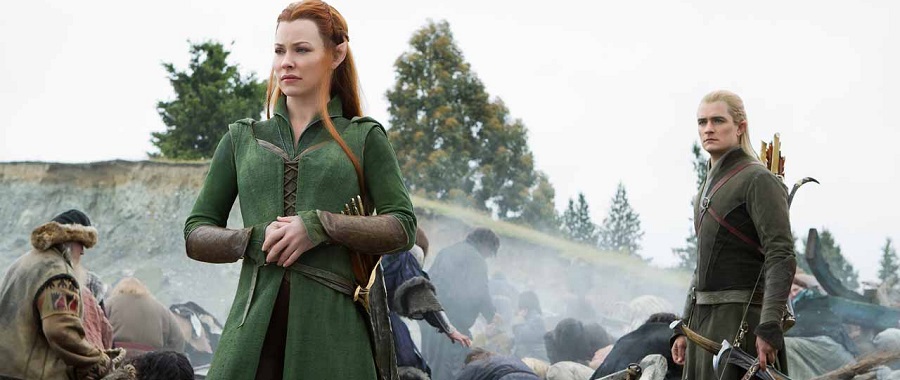
On top of which, Legolas’ inclusion undermines Jackson’s other big invention, the Legolas-Tauriel-Kili love triangle. Really this should be a Tauriel-has-to-marry-Legolas-but-wants-to-marry-Kili structure – that at least would work, right? We’d understand her struggle and division – and it would add a lot more weight to her feelings for Kili. Instead, Jackson is worried this might make Legolas look unsympathetic – so instead Tauriel is sorta in love with both with them, a confused, messy structure that makes no real sense. To add insult to injury, when Tauriel and Kili are threatened by random nasty Orc, who saves the day? Legolas. Who fights Tauriel’s battles for her? Legolas. Jackson introduces a love triangle, and then undermines it because he doesn’t want to criticise his beloved character. He introduces a female character, only to reduce her to a victim obsessed with lurve. It’s a disaster.

You feel Jackson threw in this plot because not a lot actually happens in this movie. Doubly annoying then that so many plots we do care about disappear so swiftly. The Arkenstone, the cause of so much struggle, is completely forgotten half-way through. The fate of Bard and the Lake Town survivors is glossed over. The dwarves get benched from the action for ages. The plotline around the Necromancer is wrapped up with embarrassing and confusing swiftness. Thorin’s plotline is rushed together at the edges, with the focus constantly on getting more fighting in shot.

It’s a real shame that the actors don’t get the time they deserve to really let their performances flourish. Armitage is, as always, superb as a Thorin who loses himself in greed and desire for gold, and becomes cruel and bitter before remembering his nobility. Martin Freeman is still great as Bilbo, honest, normal and delightful despite being given little to do. Ian McKellen still has all the Gandalf qualities of wisdom and grandfatherly authority. Among the rest of the cast, Luke Evans continues to be a stand-out as the noble Bard.

There are moments of action that really work. Smaug’s attack on Lake Town is the film’s dramatic highlight – shame its over in 12 minutes. But it’s brilliantly shot, has moments of heroics and looks great. Thorin and Azog’s battle really works because Thorin is just about the only character in the film we really care about. But much of the rest of the fighting is just silly – gravity-defying bashing (Legolas and Saruman are particularly guilty of this) or never-ending struggles in the battle itself – in which by the way, only men seem to be allowed to be seen doing anything brave.

The Battle of the Five Armies is in many ways a fitting conclusion to the series. Millions of dollars are spent on making a brilliantly designed and shot series of images. But no time is spent on making us care about anything. We invest almost nothing emotionally in the story at all. While we might be a bit sad at seeing people die, we know so little about many of them their deaths hardly stick with us. Why did Jackson not see this? Yes Lord of the Rings was a masterpiece and tough act to follow – but when you see the love and care dripping from every frame of that 12 hour trilogy, and then you move to this mess, you can’t help but think: where did it go wrong? It’s not a complete disaster – the films are always watchable – but they could have been so much more. Instead, they’re the bloated, incoherent footnotes to a great trilogy.
The Hobbit: An Unexpected Journey (2012)


Martin Freeman goes on An Unexpected Journey in the first of Peter Jackson’s deeply flawed trilogy

Director: Peter Jackson

Cast: Martin Freeman (Bilbo Baggins), Ian McKellen (Gandalf), Richard Armitage (Thorin Oakensheild), Ken Stott (Balin), Graham McTavish (Dwalin), Aidan Turner (Kili), Dean O’Gorman (Fili), James Nesbitt (Bofur), Cate Blanchett (Galadriel), Hugo Weaving (Elrond), Christopher Lee (Saruman), Ian Holm (Old Bilbo), Elijah Wood (Frodo Baggins), Sylvester McCoy (Radagast), Andy Serkis (Gollum), Manu Bennett (Azog the Defiler), Lee Pace (Thranduil), Benedict Cumberbatch (Necromancer)

The little-loved Hobbit films are finished now. This may be a controversial statement, but looking back at the three films now, An Unexpected Journey is clearly the best of an average bunch, the only one that feels like it has some sort of story arc, where the padding isn’t too overbearing and we get some character moments. Despite all that, it’s (bless) a bit of a mess. A tragic missed opportunity, which are like bloated windy farts that follow through.

So. It’s three films. We all know it shouldn’t be. We all know it’s a slight kids’ book. So let’s take it as read that even this, the best of the bunch, is an over-extended three hour expansion of six chapters (six bloody chapters!) of the original kids’ fable. Never, at any point, does this feel like it needs to be a long film. Where is the depth and passion in this film? It’s a slow, slow, quick, quick, slow paced splat, which takes ages and ages and ages to get going and then runs through as many set-piece action scenes as possible. 

Why did Peter Jackson make these films? Honestly, watching it you feel he had a gun to his head. He can’t bring any love or depth of feeling to huge chunks of the film. The action scenes feel put together by a choreographer and designed to be as loud and broad as possible, rather than because they are being put together by a storyteller. 

Thirteen dwarves? This is one of the main reasons Jackson was worried about making this film. How could he make these characters distinctive? How could he build plot arcs and storylines for each one? The answer was he couldn’t. So he didn’t even bother. Now I know the Tolkien fans would have hit the roof, but for goodness’ sake would it not have been better for the good of the film to cut the number of dwarves down? So we could get to know them a bit? Because large numbers of these dwarves are indistinguishable from the other. Throughout the course of this film, as a stand-alone viewing experience, only Thorin and Balin stand out in any way as immediately recognisable. They are the only two who you can always identify. The rest? They just all mash into one. They don’t even really have distinctive moments. They are just a mass.

So you watch the overblown, overextended and yawn-worthy action and chase scenes and you just can’t get wrapped up in them. Because all we are doing is watching huge, time-consuming sequences with a mass of characters we can’t tell about, and even when we do, we don’t have any emotional connection to them. The dwarves are all sort of refugees I guess, which gives us some sort of link to them, but it’s the same back story for each one. It’s indistinctive and unclear. If Jackson had gone with his gut and cut some of these out, then the extended running time could have been used to build establishing character moments, to give pay-offs and plot arcs for them. Instead, he kept them all – and never develops any of them.

Those action scenes do go on forever. I know they all come from the book, I get it, but there is no tension in any of them. Dwarves bounce, twirl and fly all over the place. Never at any point do they really feel like they are in danger. A run over the field from some wolves – yawn. The chase sequence through the Goblin kingdom in a mine – double yawn. The second is particularly bad as it brings back strong memories of the LOTR sequence in the Mines of Moria, which had a hundred times the excitement and thrills of this. 

In fact that reminiscence is a big problem for a large chunk of the film. The Hobbit is a kids’ book, but The Lord of the Rings is an adult fantasy novel. The attempt to tie these two different tones and genres of novel is a constant hiccup. So we get the dwarves pratting around and bouncing about, in moments that seem childish and cheap. And then we get doom-laden conversations, and dark over-blown musings about the stakes of the world – stakes that don’t tie in, in any way, with the content of the action, adventure story we are seeing in the film. Then there are blatant, clumsy references back to the original – did anyone else groan when Elijah Wood wandered onto the screen? Appearances from Blanchett, Weaving and Lee are all shoe-horned in. At least Ian Holm gets to do some lovely narration. But all these moments simply remind you that you could be watching a better film trilogy than this.

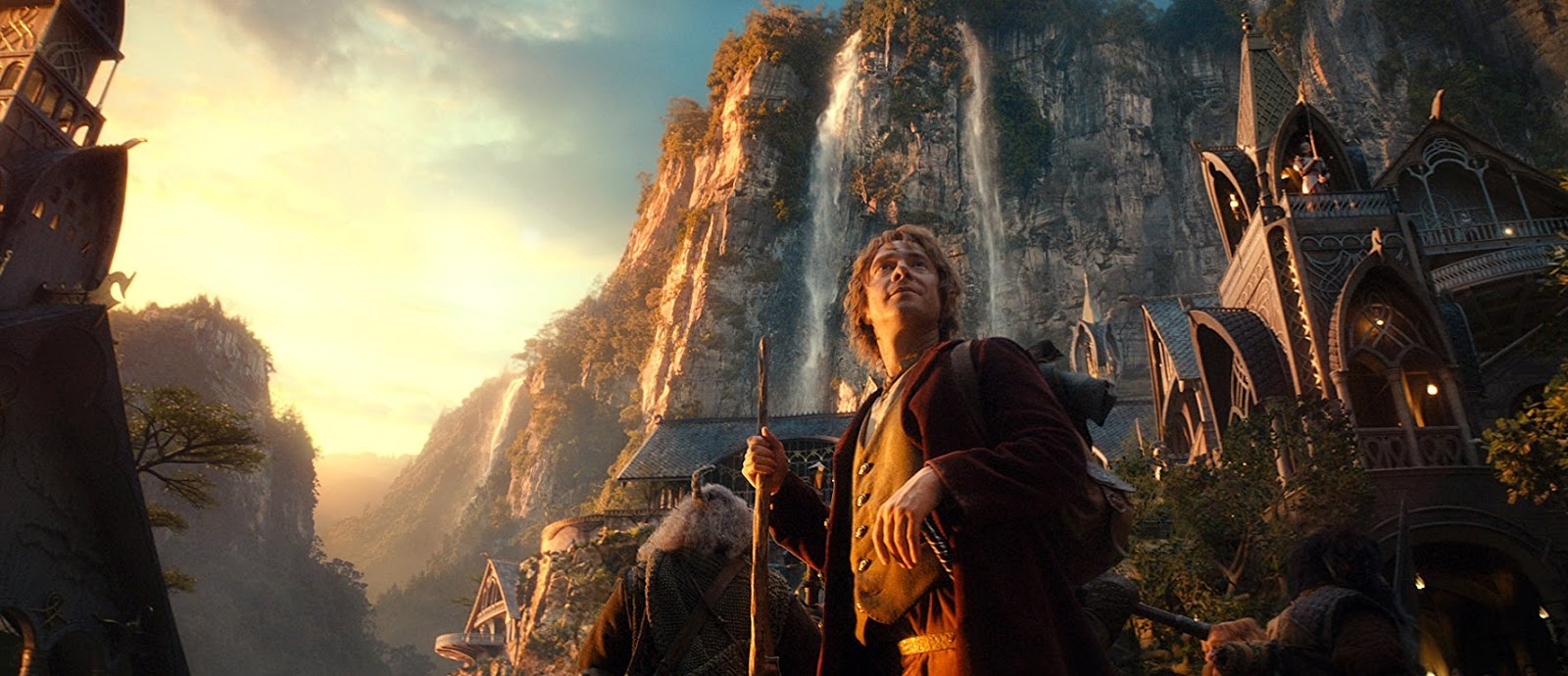
But despite all this, An Unexpected Journey isn’t all bad. Yes it hares about so quickly, with no depth at all, at great over blown length, but it has its moments and it is just about entertaining enough. Jackson can still do some of these moments well – the flashback that opens the film to Smaug’s attack on the mountain is very well done; in fact it has more inspired film-making and tension than nearly anything else that follows. Yes the arrival of the dwarves takes a lot longer to get going than the film needs – but at least it’s pretty charming, and Jackson’s whimsical love of Hobbiton is pretty clear. Shame I don’t think he brought any more invention or sense of charm to much of the rest.

It’s also helped by the fact there are some damn fine performances in there. Martin Freeman is just about perfect casting as Bilbo; he’s charming, vulnerable, slightly-out-of-his depth, brave, very English – he’s great. Ian McKellen practically is Gandalf by now, and he hasn’t lost his understanding of the character’s slightly grubby, grandfatherly charm. Richard Armitage as Thorin is brilliant, mixing a gruff, maverick quality alongside his pride and resolution – and his intense sense of loyalty. Of the rest of the cast, not many get a look-in, being either cameos or underdeveloped, but Ken Stott stands out as the kindly, wise Balin.

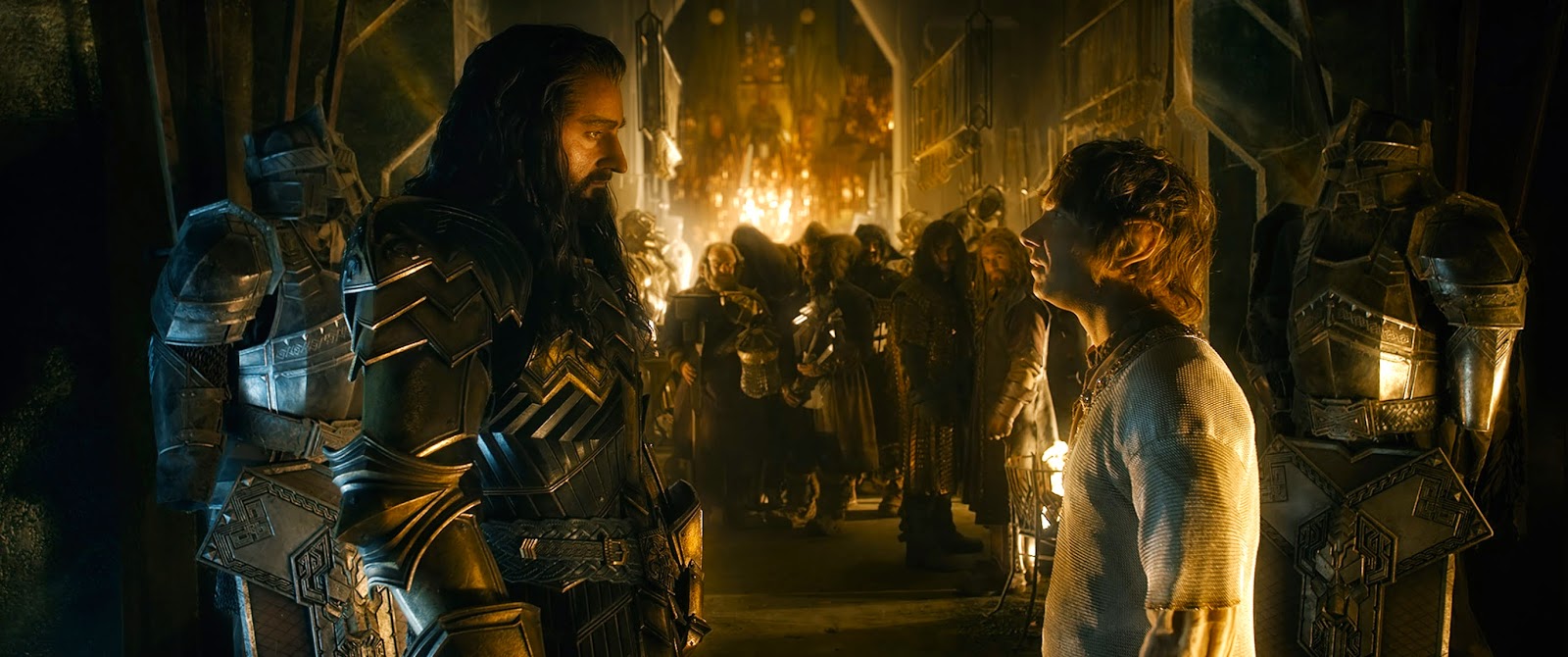
The film is also possibly the only one of the three that truly stands alone in some way. It has some form of plot arc behind it in the relationship between Thorin and Bilbo, and the lack of trust Thorin has for Bilbo, his unwillingness to accept him into the group. Similarly, Bilbo has to learn to embrace his role with the dwarves and his place in the company. This is actually a pretty touching and carefully done dynamic, that culminates not only in the film’s most involving (and tellingly low-key) action sequence, but also a tender moment of acceptance from the previously stand-offish Thorin (brilliantly sold by Armitage). 

This is a great plot arc. It also has a negative impact on the next two films – because this is the emotional climax in many ways of the trilogy – and it came in the first film of three! With this major emotional plot line between two of our core characters resolved by the end of the first third of the sequence, what is there to do with the rest of it? It’s a major loss for the rest of the trilogy. 

But for this stand-alone film it works well. Because it reminds you there is some heart in this film – heart missing from the next two films – because it is founded on an understandable emotional bond. The rest of the company may be indistinguishable, but at least Thorin and Bilbo move us. The best moments in these films are founded on feeling and character investment. Andy Serkis makes a great return as Gollum in an entertaining exchange with Freeman. The clash between Thorin and Azog is the most engrossing in the film because it has a genuine history to it established in the film, that a zillion clashes with the Goblin King, or a pack of wolves or faceless goblins never do. 

The Hobbit: An Unexpected Journey is a decent movie. It has flashes of excellence in it. It’s got some good performances. Peter Jackson is still able to shoot a decent scene, even if you don’t really feel his heart is completely in it. The performances are uniformly good, and some are excellent. But the whole thing feels like an overblown missed opportunity. There was a chance to do something magic here with this Hobbit series. But this wasn’t it. You can’t cast the same trick twice.

Mary Shelley's Frankenstein (1994)


Kenneth Branagh struggles to bring Mary Shelley’s Frankenstein to life

Director: Kenneth Branagh

Cast: Robert De Niro (The Creature), Kenneth Branagh (Victor Frankenstein), Tom Hulce (Henry Clerval), Helena Bonham Carter (Elizabeth), Ian Holm (Baron Frankenstein), John Cleese (Professor Waldman), Aidan Quinn (Captain Robert Walton), Richard Briers (Grandfather), Robert Hardy (Professor Krempe), Trevyn McDowell (Justine Moritz), Celia Imrie (Mrs Mortiz), Cherie Lunghi (Caroline Frankenstein)

In 1994 Kenneth Branagh was the heir of Laurence Olivier: a man who could act, direct and produce, who never had a false step, whose every film was a success. In other words he was ripe for a kicking, and Mary Shelley’s Frankenstein was the stick used to beat him. It was practically the founding text of “Branagh-bashing”, for a time one of the favourite sports of the British press.

Victor Frankenstein (Kenneth Branagh) grows up obsessed with defeating death, traumatised by the death of his mother. Training as a doctor in Vienna, after the murder of his mentor Professor Waldmann (an effectively serious John Cleese), he uses the body of the murderer to create the Creature (Robert De Niro) – but, horrified by what he has created, he flees home to Geneva. While the Creature comes to terms with being an outcast, Victor marries his sweetheart Elizabeth (Helena Bonham Carter) – only for her to become a target when the Creature vows revenge.

Okay the good stuff about this film: the production design is terrific, the Frankenstein house in particular a marvellous set. It’s also a very faithful adaptation, pretty much following the book (apart from a late, horribly melodramatic “Bride of Frankenstein” sequence). Branagh gets some affecting moments out of the film, particularly in the calmer moments – De Niro gives an interesting performance and the retention of the Walton framing device in the Arctic is well done. There is a good film in here. But it’s buried completely under the overblown shouting, swooping cameras and booming music that covers the rest of the film.

Contrary to his reputation as a purveyor of intricate Shakespeare adaptations, Branagh has always been a lover of big movies, who brings an operatic intensity to cinema. The problem is he goes too far here. This is at times so ridiculously overblown and frenetic in its tempo, you start to think Branagh is trying too hard, desperate to make a big budget smash. Wanting to make a big, gory, gothic horror film, he dials everything up to eleven, and the sturm und drang eventually becomes a tale full of sound and fury signifying nothing.

Interestingly, this intensity is particularly overbearing in the Frankenstein scenes, rather than those focusing on the Creature. Several scenes are filmed with the camera swooping round in circles over long intense takes, while the score thunders away. This principally happens in scenes of high emotion – the deaths of Frankenstein’s mother and his mentor Waldmann are both operatically overblown (in the latter Branagh literally cranes up and screams “No!”). Eventually it all becomes too much. You are crying out for everyone to take a breath and just deliver a line calmly.

Now I can see what Branagh is doing here. He’s looking to emulate the high-Gothic semi-camp of 1930s horror films. That’s the charitable explanation for why he spends the entire Creature-birthing scene running round topless (he must have spent ages on that chest), with Patrick Doyle’s score booming away, while the camera swoops and sweeps around him. Branagh is partly channelling Colin Clive’s mad scientist from James Whale (he even bellows “Live!” in pure Clive style twice in the film), but by going for overwhelming bombast in his performance, he misses out on making the character relatable. Now Victor is a selfish asshole of course, but we should at least relate to him a little bit: I’m not sure many people can in this film.

It’s a real shame because there is in fact, under the frantic editing and dizzying camerawork, a quieter, more intelligent film trying to get out. Branagh’s Frankenstein is a man deep in trauma about death, unable to cope with losing people, whose fear becomes a dangerous obsession. The romance between Victor and Helena Bonham Carter’s sweetly innocent Elizabeth has a lot of warmth (the chemistry is also excellent: no surprise to hear that the actors started a long term relationship on the set of this film). There are moments here meditating on life and death, but they constantly get lost in the next ridiculous bloody action scene, or explosion of overblown acting.

Similarly, De Niro mines a lot of confused sympathy from the Creature – probably because he seems the quieter and more “normal” person, for all his scars and acts of murder. The sequence with the Creature looking after the family of a blind man (a decent Richard Briers) sees De Niro mine a great deal of vulnerability and innocence from his situation. The contained camera work and restrained acting make these the finest scenes in the film, more memorable than any of the blood and guts that fill the final half hour.

De Niro and Briers: Your only chance to see Travis Bickle and Tom Good share a scene

And those blood and guts are a problem, because this is not a scary film. Not even one little bit. Instead it’s either ridiculous or juvenile – in a sequence where a character literally has their heart ripped out by the Creature, Branagh can’t resist not only having the Creature holding it up to the camera, but for the camera to jump to a close up of the heart literally beating in its hand. Not scary, not gross, just stupid and childish. At any points of tension we get the pounding music and running around and shouting like a Gothic Doctor Who. If only Branagh had taken a breath and treated the material more calmly and sensibly we could have ended up with something creepy and spooky, rather than garish.

It’s a real, real shame because honestly there are some good things in this movie. I’ve mentioned De Niro, but Tom Hulce is also terrific as Clerval and Bonham Carter very good as Elizabeth. There are moments of real class in the design and production – I’ve lambasted Patrick Doyle’s score a bit, but there are some very good tracks in here. The problem, much as it massively pains me to say it because I love him, is Branagh. His performance and direction is just too much: too giddy, too overblown, too frantic, too overwhelming. The film comes across less as a tribute to old style melodramatic horror movies, more a very intelligent gifted man talking down at fans of the genre, giving them what it appears the genre is about on the surface, rather than the depths that actually appeal to people. Despite its merits, the film is not alive, but dead inside.

Time Bandits (1981)


Time travelling roguery in Time Bandits 

Director: Terry Gilliam

Cast: Craig Warnock (Kevin), David Rappaport (Randall), Kenny Baker (Fidgit), Malcolm Dixon (Strutter), Mike Edmonds (Og), Jack Purvis (Wally), Tiny Ross (Vermin), John Cleese (Robin Hood), Sean Connery (Agamemnon), Shelley Duvall (Pansy), Katherine Helmond (Mrs Ogre), Ian Holm (Napoleon), Michael Palin (Vincent), Ralph Richardson (Supreme Being), Peter Vaughan (Winston), David Warner (Evil), Jim Broadbent (Compere)

After leaving Monty Python, each Python went their own way. Terry Gilliam had been the slightly odd one, the eccentric animator who played the weirdos at the edge of the frame. Time Bandits would be pivotal in repositioning him as an ambitious, visionary director with a striking visual sense. It would also allow him (and co-writer Michael Palin) to create a fairytale fable with something for all ages, a film about a child’s view of the world which adults could embrace.

Kevin (Craig Warnock) is a dreamer, a young kid adrift in his parent’s materialistic world. Until one night a gang of dwarves calling themselves “Time Bandits” emerge out of his bedroom cupboard. They have a map that allows them to travel through time and use it to commit crimes and then escape to different centuries. Kevin joins them in their adventures, but none of them know they have attracted the attention of the Evil Genius (David Warner) who wants to use the map to escape his prison and recreate the world in his own image.

I still remember watching this film when I was younger and really enjoying (I must have watched it dozens of times). I have to say it holds up extremely well. Sure Craig Warnock isn’t the most inspired child actor of all time, but he has a wide eyed innocence and enthusiasm that anchors the film really well. Gilliam’s direction is brilliantly good – wild and inventive, like a punk-rock fairytale. The dwarfs make an inspired grouping, each embracing the once-in-a-lifetime chance of playing leading roles.

The main reason for the film’s success is Gilliam. His work is extraordinarily detailed and imaginative, while his visual sense makes shots that cost hundreds of pounds look like millions. Huge swathes of the film are shot with a low-angle lens that allows us to see everything from the perspective of our heroes, and also makes each of these larger-than-life events seem even more awe-inspiring. The design of the film is extraordinary, with striking images confronting you at every turn, either a recreation of events or the bizarre visuals of the “time of wonder”.

And those visuals are outstanding. Can you think of any other film where a knight on horseback bursts out of a bedroom cupboard, charges around the room in medium shot, and then gallops off through a field that has suddenly replaced the bedroom wall? How about an ogre who lives on a ship that is then revealed to be a hat for a giant who lives underwater? Evil’s Fortress is a swaggeringly brilliant triumph of production design, while his goat skulled, tall, hooded monsters must surely have been playing in JK Rowling’s mind when she came up with the Dementors.

The design also echoes the possibility that this is all a child’s fantasy. A careful look at Kevin’s bedroom shows pictures of everything we encounter. The final confrontation with Evil takes place on a set clearly inspired by the Lego bricks, chess board and toys that litter Kevin’s bedroom. 

The playful tone is also reflected in its lampooning of the “adult” world of technology for its dull materialism: Kevin’s parents watch a bullying gameshow (compered by a demonic Jim Broadbent) while sitting on armchairs still in their plastic wrapping. Evil’s obsessions all revolve around lasers and the microchip.

Away from all this, the film has a simple structure. It’s basically a series of really rather fun historical sketches, linked together by an engaging fantasy narrative. These scenes attracted guest star performers, all of whom excel (though it is odd to see them get top billing – Cleese is on screen for about three minutes, but gets top-billing!). 

The guest stars are terrific – Holm is hilarious as a chippy, height-obsessed Napoleon; Cleese very funny as a visiting-Royal-inspired Robin Hood, treating all around him with condescension; Ralph Richardson brings an absent-minded imperiousness and dry wit to his role as God; Connery sprinkles a touch of movie-star bravado as a kindly, gentle Agamemnon (the uncommented on joke being the movie’s ideal father figure is most famous for sacrificing his daughter…). 

If any performer high-jacks the film it’s David Warner as a dry-witted, viciously ego-maniacal Evil Being, getting most of the best lines. A sequence where he obliterates several underlings for minor transgressions hums with dark humour (and punchlines with the accidental obliteration of another minion off screen, met with a sheepish “Sorry”). On top of that, Warner brings just the right level of sinister child’s-nightmareish quality to the role, helped by a striking costume design that makes him look the love-child of a crocodile and a car engine.

The leads of the film (Kevin and the bandits) are extremely well drawn by Palin’s script, each of them with sharply distinctive personalities. David Rappaport (allegedly incredibly unpopular with the others due to his haughty disregard for them) is perfect as the arrogant self-appointed leader, but Jack Purvis is a stand-out as the warmly brave Wally. More than a few commentators have pointed out that the Bandits all serve as representatives of the members of the Monty Python troop, which adds another level of fun watching the film.

Time Bandits is electric good fun. I have no doubt I might find more to criticise without the memory of enjoying it so much when I was younger. Some of the sketches work less well than others – the scene with the ogre doesn’t quite work, and the ending, twistedly funny as it is, does feel slightly abrupt is. But the film never outstays its welcome, and it’s put together with such glee and accomplishment that there is always a line or an image that sticks with you. It’s a dark fairytale for children of all ages – and making something the whole family can enjoy is really quite a feat. Palin and Gilliam would have put together a sensational series of Doctor Who.

The Day After Tomorrow (2004)

Our heroes undergo one hell of a cold snap

Director: Roland Emmerich
Cast: Dennis Quaid (Jack Hall), Jake Gyllenhaal (Sam Hall), Ian Holm (Professor Terry Rapson), Emmy Rossum (Laura Chapman), Sela Ward (Dr. Lucy Hall), Christopher Britton (Vorsteen), Arjay Smith (Brian Parks), Dash Mihok (Jason Evans), Jay O Sanders (Frank Harris), Adrian Lester (Simon), Kenneth Welsh (Vice President Raymond Becker)

I have to confess there are certain genres I have a weakness for. One of these is the big-budget disaster movie. For some reason, nothing helps me relax or unwind more of an evening than watching some of the great landmarks of the world being destroyed or seeing hundreds of people fleeing before a tsunami/pyroclastic flow/asteroid impact/tornado etc. There is clearly something wrong with me.

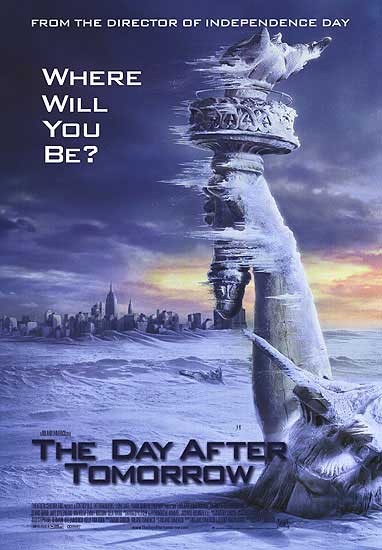
The Day After Tomorrowfits very comfortably into this trope, offering up some totally predictable and entertaining-enough thrills combined with total ‘scientific’ nonsense. Thanks to man’s foolishness, the climate of the Northern hemisphere is changing, and only Professor Jack Hall (Dennis Quaid) knows that it’s happening (although to be fair he does say it will take place across hundreds of years). But gosh darn it doncha know, suddenly those projections are revised to “the next six to eight weeks!” Cue cold snaps of -100°F dealing out death in Scotland, brick sized hail bashing in heads in Tokyo, and a tsunami taking out New York. Of course Hall’s son (a game Jack Gyllenhaal) is trapped in New York so Hall mounts a rescue mission…

The world-destroying scenes are suitably high scale and dramatic, with Roland Emmerich showing his usual efficient martialling of special effects. Emmerich doesn’t get quite the credit he deserves – as a B movie hack director, he’s very good at keeping the viewer fully aware of what’s happening all the time and to whom, and very rarely labours any particularly point. He also has a goofiness about him, when directing this sort of nonsense, that encourages you to disengage critical faculties and join him for the ride. Don’t get me wrong, he’s no Hitchcock – but compared to Michael Bay, he’s David Lean.

The story doles out the expected personal dramas amongst the chaos. Its main issue is that “weather” doesn’t make the most relatable nemesis ever committed to screen. To cover this, some timber wolves are introduced into New York to terrorise Gyllenhaal and his trapped student friends (Emmerich, bless him, carefully stages a scene earlier where befuddled zookeepers stare aghast at an empty wolf pen and comment “The wolves are gone!”). To be honest, though, these animals are a bit dull – what people will really remember are the desperate dashes to get somewhere warm while another “death-on-contact” cold snap speeds towards our heroes. As most of this stuff happens in the first half of the movie, the second half can rather drag – with the Northern hemisphere effectively destroyed early doors, what else is there left to show?

Emmerich does have some fun with politics. One of the joys of the disaster film (I find) is the inevitable crowd of characters who denounce any chance of the disaster occurring. Emmerich goes one better here by having the President and Vice-President vocally and visually imitate then-office-holders Bush and Cheney. The facsimile Bush even defers to his facsimile Cheney. It makes for some heavy-handed digs at their Presidency’s lack of impetus on climate change, and general perceived weakness, but hey at least the film is using blockbusting to make some tongue-in-cheek political points.

The characters are all pulled from the stock. Quaid does his usual decent job as the guy you hire for this sort of film when your first choices are unavailable, but he never lets you down and brings a lot of dignity to the ludicrous concept. Gyllenhaal and Rossum are rather sweet as smart teenagers (gotta like a film where all the young characters are bookish nerds). Smith gives some good comic support. Ian Holm and Adrian Lester manage to keep a straight face and provide a lot of dignity to roles that must have been little more than picking up paycheques.

Disengage brain, settle back and enjoy the carnage. Emmerich is like an eager-to-please student proudly presenting his work on parents’ day. The great thing about him is that you know he is a booky, geeky type (like his heroes here) and he’ll never do anything to offend you.