Tag: Ian McShane

Sexy Beast (2001)

Sexy Beast (2001)

Superb acting motors a gangster film that’s also a nightmare house-guest comedy

Director: Jonathan Glazer

Cast: Ray Winstone (Gal Dove), Ben Kingsley (Don Logan), Ian McShane (Teddy Bass), Amanda Redman (DeeDee Gove), James Fox (Harry), Cavan Kendall (Aitch), Julianne White (Jackie), Álvaro Monje (Enrique)
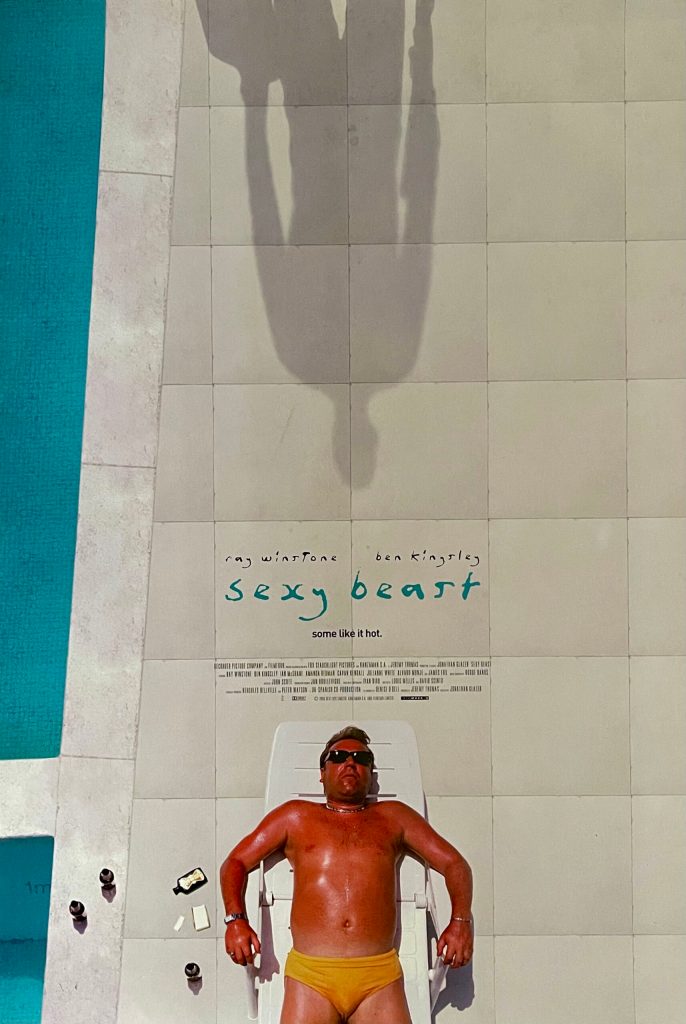
Gal Dove (Ray Winstone) has got it made. He’s baked bronze by the pool in his home on the Costa del Sol, earned after a life as a top safe cracker in London, alongside wife DeeDee (Amanda Redman), best friend (and fellow ex-crook) Aitch (Cavan Kendall) and glamourous Jackie (Julianne White). All that changes when an unexpected visitor turns up: Don Logan (Ben Kingsley). A tightly-wound, terrifyingly unpredictable sociopath, Logan has a job offer to which the only acceptable answer is yes: joining a team to break into a top London bank for crime king-pin Teddy Bass (Ian McShane). How’s Gal going to get himself out of this one?

Sexy Beast seems at points it might settle for being a standard British gangster drama. But Glazer’s becomes a hugely enjoyable mix of that and bizarre black comedy. A houseguest from hell comedy, like a psychotically foul-mouthed The Man Who Came to Dinner, with the added sprinkle of playful psychological theory and touches of darkly sexual content (James Fox brings back memories of The Servant and Performance). There is even an element of Greek drama: Gal really should be paying attention to the parade of ill-events preceding Don’s arrival, not least the boulder that tumbles down a mountain into his swimming pool nearly squashing Gal en route.

That boulder is, it turns out, far less of a danger than Don. If there is one thing that dominates perceptions of Sexy Beast, it’s the intimidating, witty danger of Ben Kingsley. For an actor best known at the time as Gandhi, to say this was a change of pace was an understatement. Kingsley arguably changed his whole career here with this stunningly intense, hilarious, performance. Shirt tucked in, head shaved, Logan might look physically unassuming but the pulsing vein in his head is a sign of him being a tightly wound ball of unprocessed anger and fury. Kingsley makes him superbly unpredictable – snapping on a sixpence from quiet to rabid fury with a terrifying capacity for sudden violence.

Glazer throws him into Gal’s Spanish heaven like a ticking timebomb. There is a great deal of wit in how Glazer shoots Logan, often sitting or standing in a domineering position in rooms while the other characters awkwardly shuffle, uncertain of where to look, hugging the margins. This comedy carries across into Logan’s utter disregard for social rules or niceties – all captured in his blackly hilarious calm refusal to extinguish his cigarette on a plane, followed by his ranting ejection (“I hope this crashes!”) – which sparks shocked laughs. It’s not funny for those around him as Logan sprays matter-of-fact slurs about his hosts, deliberately urinates on their bathroom floor and calmly discusses the time he had sex with Jackie in front of her husband.

There is a strange immaturity about Don, like a maladjusted child who has never grown up, superbly contrasted with Gal’s calm, contented mellowness. Don lacks any emotional maturity and sounds like a sulky teenager. He’s the sort of playschool bully who psyches himself up in the mirror and parrots word-for-word the instructions he’s received about the planned heist from the ‘bigger boys’. He seems to have no friends and a teenage romantic obsession with Jackie (who I would bet money was his only ever sexual experience). This is all captured superbly by Kingsley’s surprisingly complex performance full of terrifying childish unpredictability alongside its dark humour.

The dominance of Kingsley makes it easy to overlook Winstone’s equally fine performance. Any doubts about the power of Kingsley to intimidate is squashed by Winstone’s subtle terror at the former Gandhi. Winstone plays up his more loveable aspects, as an honest man (despite his profession), keen to make the lives of those around him better. He’s completely unsuited now for the life of violence and crime he has left behind. Mumbling, downward looking, Winstone gives Gal some nice hints of the submissive surrender of a life-long victim to his bully.

Glazer skilfully presents these characters as two sides of the same psychological coin. While Don is certainly real, viewers can have fun tying themselves into knots on theories where he is Gal’s terrifying id, an embodiment of the hardened, dangerous criminal he possibly used to be. This makes Don’s intimidating take-over of Gal’s home a visual representation of the repressed violence in Gal. It’s a feeling added to by Gal’s dreams of a satanic satyr figure (who sort of resembles Don). Sexy Beast uses this vibe to subtly suggest the real danger might be Gal’s deeply suppressed criminal psychology. It makes for a neat suggestive undertone, which Glazer carefully never overplays.

Sexy Beast makes an impressive calling card for Glazer’s skill. It’s smartly edited – a Logan monologue explaining the heist’s background is skilfully intercut both with Logan being told of the scheme and Teddy formulating the plan. Glazer mixes interesting camera angles – there are some neat shots where cameras appear to be attached to doors in particular a revolving bank door – and impressive simplicity, not least a quietly staged scene that uses a single shot to track Logan going from calm to berserk in Gal’s kitchen. It’s a sign of the flair and imagination of a consummate visual stylist.

He also stages the heist – masterminded by a dead-eyed and chillingly calm Ian McShane – with an impressive confidence. While Kingsley’s character so dominates the film that it’s hard to get as interested in the crime itself, it offers visual panache and – in the blundering of several of the criminals in a flooded bank vault and their clumsy celebrations afterwards – further sly commentary of the immature dumbness of criminals. The sexually fluid upper class orgy where the crime is born is also staged with a refreshing lack of salaciousness and the bursts of violence, when they come, carry a matter-of-fact brutality that’s much worse than all-out gore.

If Sexy Beast has a major fault, it is that the power and fascination of Kingsley’s character unbalances the film in his favour. Its final act feels like an anti-climax – probably the only time gun-laden, underwater antics have been less exciting than a classically-trained actor spraying f-bombs and the c-word like there’s no tomorrow – but that’s also a tribute to its early power. The first two acts speak to us because, beneath all the gangster shenanigans, we’ve all had to deal with the nightmare of an uninvited house guest from your past and we can all sort of relate to the dark humour of egg-shell tip-toeing the rest of the characters do around the simmering Kingsley-volcano.

It’s why Sexy Beast works best as a black-comedy confined play (a theatrical adaptation, not a TV prequel series, is what it really needs). When it focuses on the superb interplay of Winstone and Kingsley, the film flies. It’s also proof that Glazer, even at the start of his career, could turn familiar tropes into something strikingly different, original and unique in tone. A gangster film like few others.

John Wick: Chapter 4 (2024)

John Wick: Chapter 4 (2024)

It’s got almost no plot but what it does have is mesmeric, balletic fighting – for three hours

Director: Chad Stahelski

Cast: Keanu Reeves (John Wick), Ian McShane (Winston Scott), Donnie Yen (Caine), Bill Skarsgard (Marquis Vincent Bisset de Gramont), Laurence Fishburne (The Bowery King), Clancy Brown (The Harbinger), Hiroyuki Sanada (Shimazu Koji), Shamier Anderson (Mr Nobody), Lance Reddick (Charon), Rina Sawayama (Shimazu Akira), Marko Zaror (Chidi), Scott Adkins (Killa Harkan), Natalie Tena (Katia)

John Wick (Keanu Reeves) wants revenge against The High Table, the shadowy criminal organisation that (for various reasons) wants to punish him for various transgressions. The High Table are raising the stakes, giving the psychotic Marquis (Bill Skarsgard) carte blanche to destroy John, including levelling the Continental hotel of John’s ally Winston (Ian McShane). With destruction all around him, hunted by two deadly assassins the blind (and old friend) Caine (Donnie Yen) and the relentless dog-loving Nobody (Shamier Anderson), John’s only chance of survival is an arcane ritual duel between him and the Maquis.

John Wick: Chapter 4 is, in many ways, less a film and more an experience. Over stretched at nearly three-hours, its effectively three mammoth fights scenes (in Osaka, Berlin and Paris) loosely stitched together with a plot that doubles down on the arcane ritual of the franchise’s criminal underbelly. It was also a massive hit, the franchise’s biggest yet. Why? Because John Wick: Chapter 4 speaks a little bit to all of us who are bored with endless big-budget, special effects filled action films where nothing is real.

In John Wick: Chapter 4 you watch real people – stunt men and actors who have clearly trained for eons – set about a series of awe-inspiring action set-pieces with stunning realism. There is the same visceral thrill of watching Reeves dish out beatings as there was watching Gene Kelly dance steps: in both cases we are watching a master at work, turning his expertise into cinematic realism in front of our eyes.

So, in some ways, it doesn’t matter there is no real plot in John Wick 4 or that the characters are lightly sketched. Because we are here for elaborate, stunt filled fight scenes in the Osaka Continental. To see Donnie Yen move with the fluidic grace of a ballet dancer. To be gripped by Reeves punching his way through a brutal brawl with a fat-suit clad Scott Adkins (a martial arts superstar himself) in a neon lit Berlin nightclub. To watch Reeves fight his way up the Rue Foyatier steps, fall back down them, then fight back up again. Why these things are happening doesn’t really matter. It’s about the beautiful realism of watching actors actually do them.

That’s what powered this film to a record-breaking haul. Its why Reeves spent time in development, Steve McQueen like, ripping lines out of the script (he says little more than 500 words in the whole three hours). Who wants to see a monologue when a Reeves weary half-shrug on having to fight his way back up those stairs speaks volumes? When we need a break from the action, the script throws in some tense verbal show-pieces that Skarsgard chews up as a politely psychotic bully or McShane and Fishburne riff on with cod-Shakespearean grandeur.

It’s all thrown together with a great deal of style by Chad Stahelski, who has grown in cinematic confidence the more of these films he has directed. It takes some balls to effectively open the film with a homage to one of the most famous edits of all time from one of the greatest films ever made, as Fishburne blows out a match to cut to the desert sun rising. But then, I’m here for a film that wears its love for Laurence of Arabia on its sleeve (and even shoots a sequence on the actual location of Lean’s classic). Alongside this, Stahelski continues to find new ways to shoot this mayhem: from tracking shots, Steadicam immediacy to a sprawling birds-eye view (inspired by computer games) that tracks Wick taking out a building full of baddies.

There are a few thematic links in the film that brings the series full circuit. Wick’s two frenemies are reflections of himself. Donnie Yen – very cool – reflects Wick’s love for family, with his “doing the bare minimum” actioning to protect his daughter, while Shamier Anderson’s softly-spoken Nobody reflects Wick’s famous dog love. John Wick: Chapter 4 also hints at the existential crisis of its hero – when you are literally taking on the entire criminal world, leaving hundreds of bodies in your wake, what chance is there that this will ever end?

It’s these little grace notes that keep the film grounded enough for us to care about Wick while he slices his way through another army of thugs. But it’s not why you are there. John Wick 4 can easily – perhaps best – be watched in chunks. Soak in one action scene, have a breather, and then throw yourself into another. Because these are some of the best, coolest, most relentless action scenes you will ever see, executed with a stunning skill. And that is what differentiates John Wick at a time when everything else feels sterile. There might be far too much of it, but at least it is life.

John Wick Chapter 3: Parabellum (2019)

Keanu Reeves, Halle Berry and some very, very mean dogs in John Wick Chapter 3

Director: Chad Stahelski

Cast: Keanu Reeves (John Wick), Ian McShane (Winston), Mark Dacascos (Zero), Laurence Fishbourne (The Bowery King), Asia Kate Dillon (The Adjucator), Halle Berry (Sofia), Lance Reddick (Charon), Anjelica Huston (The Director), Saïd Taghmaoui (The Elder), Jerome Flynn (Berrada)

Early on in the film, John Wick (Keanu Reeves in a role he might have been born to play) builds a gun from scratch components of other weapons to fire some outsized ammunition, throws an axe across a room to take out an assassin, and then effectively reloads a horse, using its rear leg kicks to dispatch two more luckless assassins. It’s a dizzying 20 minutes or so of pure balls-to-the-wall action fun full of invention and black humour. The film never gets near repeating it, despite much trying.

John Wick: Chapter 3 – Parabellum doesn’t have much in the way of plot. Instead it’s effectively a two-hour series of fight sequences. What plot there is pops up around the edges of all this imaginative blood-letting. That plot doesn’t really make much sense, and can basically be summarised as John has been declared excommunicado by “The High Table”, the shady organisation that runs the criminal underworld, meaning he is a target for every assassin in the world, and he is trying to reverse that decision. That’s kind of it, and any other subplots are basically slightly confusing or narratively empty detours from that central idea.

If you cut out all the fight sequences from the film, it wouldn’t run a lot longer than 15 minutes. There isn’t really any interest in the talking stuff or the characters, which seems to be fine for the likes of Laurence Fishbourne, who is wheeled out for three scenes of badass scenery chewing, but does mean that motivations and reasons for why anyone is doing anything at all remain completely unclear. There is a key subplot involving Ian McShane’s management of the Continental, the criminal “neutral zone” hotel in the centre of New York, that involves so many changes of allegiance and intentions that it winds up making no real sense.

But then people ain’t going to this for a character study. They are there for the fights. And, as I say, these are really inventive and entertaining. The first 20 minutes – with John haring through New York, trying to stay one step ahead of a blizzard of killers – is brilliant. It’s designed to be watched with large groups of people in the same mood, encouraging you to laugh, wince and shout out with the people around you. You can’t fault the work that has gone into the filming of this or the commitment of the actors or the genius of the choreographers. All of this is pretty faultless. And, no matter what extended fight you watch, you know you will see something different in every single one.

The problem is, the vast number of fights begins to pummel the audience into submission as well. Seeing Keanu Reeves involved in a series of three-in-a-row mixed martial arts sequences, each lasting well over 5-10 minutes, you start to let the whole thing drift over you. Put bluntly, after the initial explosion of action, the film hits a level it tries to sustain for almost an hour. And it’s too much. You just can’t keep that same level of engagement. I actually nearly dropped off at one point, which is not a good sign. How much action can one film take? 

There needs to be a balance. And without any real investment in what we are seeing, John Wick 3 is another of those films designed for YouTube. I can imagine watching most of these fights as little five-minute videos on the Internet in the future. Actually broken down like this I will probably enjoy it a lot more. But as a single film, there is nothing there to link it together.

The first film had a simple, but very pure, storyline that we could all relate to. A man loses his beloved wife, who on her deathbed gifts him a dog to care for. Said dog is then killed in a senseless break-in by some arrogant criminals. John Wick’s revenge is against those who thoughtlessly took from him the last piece of the only woman he loved. Everyone can relate to that – and it grounded everything we saw and immediately put us on John’s side. This film however is a confused motivation-less mess. If the series originally presented us with a John unwillingly dragged back into this world, since then (and here) he seems like a character with no inner life. 

The film attempts vaguely to add one, suggesting that John must make a choice between being a killer or the better man. Problem is choosing to be the better man isn’t really a platform for fights. So we lose what the film really needs, which is John struggling between his good and bad demons. Instead his motivations are a confused mess and the film spends more time showing us the brutal groin attacks of Halle Berry’s dogs (those things fight with no honour let me tell you) than giving us a lead character with a coherent personality.

It makes John Wick 3 not a lot more than a YouTube compilation, and giving Ian McShane some Latin to drop to explain the film’s title, or trying to change a character in Act 4 into a personal rival for John, doesn’t suddenly give it depth or interest. It’s fun in small chunks, but this is way too long and seems to have lost at least half of what made the first film such a guilty pleasure.

John Wick 2 (2017)

Keanu tools up for my running, jumping and shooting in genial, but perfunctory, sequel John Wick 2

Director: Chad Stahelski

Cast: Keanu Reeves (John Wick), Riccardo Scamarcio (Santino D’Antonio), Ian McShane (Winston), Ruby Rose (Ares), Common (Cassian), Claudia Gerini (Gianna D’Antonio), Lance Reddick (Charon), Laurence Fishburne (The Bowery King), Franco Nero (Julius), Peter Stormare (Abram Tarasov)

It’s that age-old story: every time you think you’re out, they drag you back in. Well that’s what we get with John Wick (Keanu Reeves). Picking up where the last film stopped, Wick is approached by mafioso head Santino D’Antonio (Riccardo Scamarcio) who wants Wick to assassinate his sister, who has been promoted to head of the business over him. Eventually (after much pressure) Wick agrees – and quickly finds himself betrayed and on the run.

The first John Wick has a real charm about it, the sort of film you can really enjoy because tonally it gets itself absolutely spot on. It’s a lot of action fun, it manages not to take itself too seriously and it sets its hero up as someone very sympathetic who only goes on a rampage of violence under extreme provocation. The sequel attempts to double down on all of this and give us more of the same – but not always to the same impact.

Part of the issue is that there just isn’t the same engaging story at the heart of it. I totally understand John Wick in the first film, and completely got what it was that he was doing in the film – that essentially avenging his dog was about getting revenge on those who had taken the only thing he had left from his relationship with his wife. Here the lines are a lot more blurred – John basically saddles up under extreme provocation and blackmail and then basically spends the film killing people left, right and centre – first for someone else, then to get revenge for being betrayed back into this life (or something like that), and then finally because he’s just really pissed.

So that emotional grounding behind all the killing – and the thing that makes John Wick pretty likeable in the first film – gets lost. Instead he’s just a ruthlessly efficient killing machine – and while that is fun to watch, it’s not as immediately engaging as the first film. In fact, the second film (aiming to go bigger and better) is basically just three orgies of gunplay and violence, linked together by a few tongue-in-cheek dialogue scenes.

It’s another of those films made for YouTube clips. The action scenes can pretty much be watched and enjoyed without the burden of trawling through the nonsense plot, so you might as well hunt those down online and watch them alone. They’re really well done, extremely well shot and pretty exciting (if covered in claret). The rest of the film you can take or leave to be honest.

That’s despite all the best efforts of those involved. Keanu Reeves still brings a slacker charm to the role, even if it’s one that doesn’t stretch even his limited acting range. Ian McShane has a decent, fun turn as an influential member of a shadowy criminal organisation. We even get a rather dry Matrix reunion between Reeves and Fishburne. It’s very well directed and there are occasional good jokes.

However, it lacks a decent villain (Scamarcio as a Mafia baddie is singularly uninspiring), it goes on too long and, most of all, it’s just not quite as good as the first film. There the “world building” around the edges of the film was a fun aside from the action. Here it’s the focus – with strange councils and mystical rules all over the place – and that just doesn’t quite work as well.

John Wick 2 is fun, don’t get me wrong. But somehow it feels less charming and more bloated, something that is starting to feel itself a little too important and, in throwing more and more at the screen, means you lose the heart of some of the original.

The Golden Compass (2007)


How did it all go wrong? The disastrous production of Philip Pullman’s The Golden Compass

Director: Chris Weitz

Cast: Dakota Blue Richards (Lyra Belacqua), Nicole Kidman (Mrs Coulter), Daniel Craig (Lord Asriel), Sam Elliott (Lee Scoresby), Eva Green (Serafina Pekkala), Jim Carter (John Faa), Clare Higgins (Ma Costa), Tom Courtenay (Farder Coram), Derek Jacobi (Magisterial Emissary), Simon McBurney (Fra Pavel), Jack Shepherd (Master of Jordan College), Ian McKellen (Iorek Byrnison), Freddie Highmore (Pantalaimon), Ian McShane (Ragnar Sturlusson), Kathy Bates (Hester), Kristin Scott Thomas (Stelmaria)

After the success of The Lord of the Rings, bookshops were stripped of all epic fantasy novels with a cross-generational appeal by film producers, their mouths watering at the prospect of having another billion-dollar licence to print money. Nearly all of these projects bombed, but I’m not sure any of them bombed harder than this, an attempt to kick-start a trilogy of films based on Philip Pullman’s both loved and controversial His Dark Materials books. What went so completely wrong?

Pullman’s trilogy is set in an alternative-Oxford, where people all have Dæmons, part of their soul that lives outside their body in animal form. It’s a world where the Magisterium, a powerful organisation, suppresses all free thought, in particular all investigation into the mysterious particle dust. Lyra Belacqua (Dakota Blue Richards) is an orphan raised in Jordan College, who saves the life of Lord Asriel (Daniel Craig), who is investigating Dust in the North. Leaving the college with the mysterious Mrs Coulter (Nicole Kidman), who may or may not be involved in a series of child kidnappings, she eventually finds herself drawn more and more into setting right the problems of her world.

The Golden Compass is a film that pleased no-one. Fans of the book generally hated it. The people who hated the books hated it. The people who hated what they had been told the book was about hated it. Why did the studio decide to make a film in the first place about a book series they seemed to know was controversial from the start? If they didn’t really want to embrace the themes of the books, why bother? Pullman’s books are partly adventure stories, partly intricate world building, partly spiritual discussions – and yes partly atheist tracts with a strong anti-Establishment-church bent (with a more general regard for genuine faith). To put it bluntly, that’s a lot of ideas to try and squeeze into a film – particularly a film well under two hours.

So The Golden Compass is a mess that feels like it’s been put together by committee. It’s been cut to within an inch of its life – scenes jump incredibly swiftly from event to event, often with the barest of clunky explanation voiceover (“We’re going to see Lord Faa, King of the Gyptians”) to tell you what’s going on. Pages and pages of dialogue and character seem to be lost. We are constantly told Lyra is “special” but never shown anything that supports or explains this. An Eva Green-voiced infodump opens the film: clearly the producers were thinking about Peter Jackson’s masterful opening to The Fellowship of the Ring, which skilfully introduces everything. This introduction though is about removing all the mystery and magic of the story as soon as possible by stating it bluntly up-front.

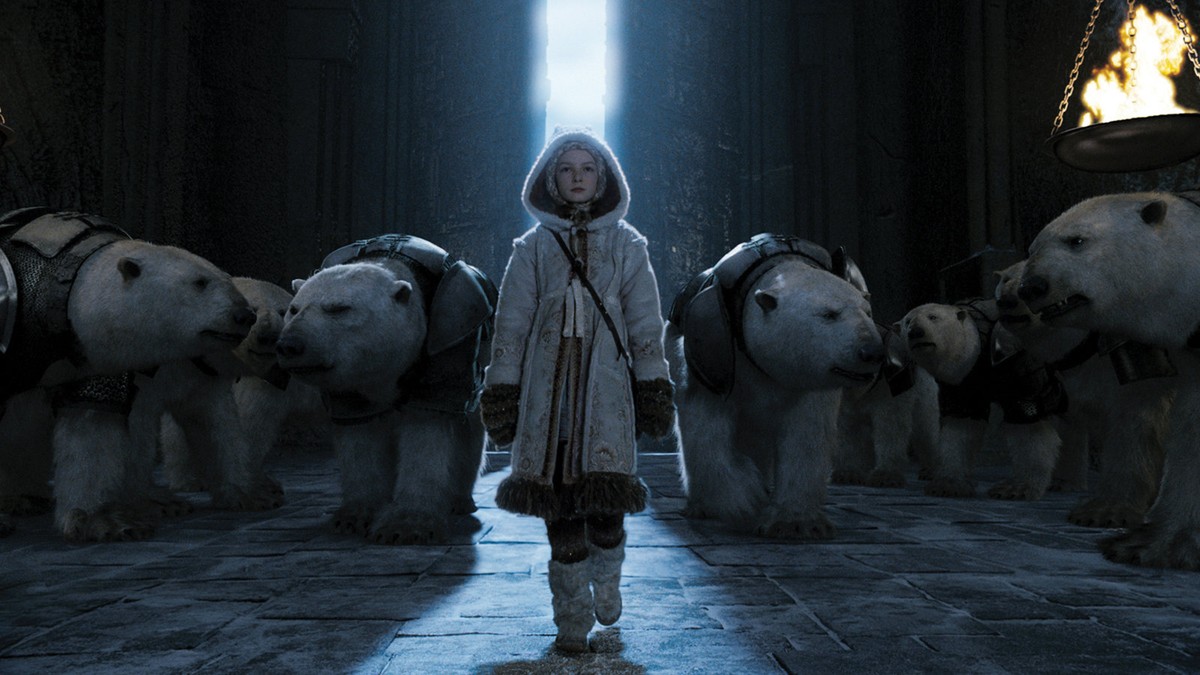
The biggest mess is of course the way the film avoids all reference to Pullman’s religious themes. No reference is made at all to the Magisterium being a church. No reference is made at all to religion or faith. Iorek is clearly being held in a Russian Orthodox painted church – but the building is referred to throughout as an “office”. Derek Jacobi plays one of the principal Cardinal antagonists of the third book – no reference is made to his office. The Magisterium is instead just a “shady organisation” – a controlling gestapo-type organisation, with black uniforms and creepy Albert Speer style buildings. The questions of Dust and original sin – so central to the motivations of the story – are completely unexplained, meaning the child kidnapping and sinister intercission the villains are carrying out makes no sense at all. How on earth they planned to continue not talking about religion in their planned third film is a complete mystery.

This rushing is the problem throughout the film. Stuff just happens really, really quickly for no real reason. Characters pop up to introduce themselves for later films, or to drop clunky exposition. Tom Courtenay explains what an aleitheometer is for us (the film constantly brings up this “Golden Compass” and its future-telling properties, without ever really making them feel important for anything that happens in the film). Eva Green flies in to say she’s a witch and how pleased she is to meet Lyra and promptly flies off. Daniel Craig name checks Dust, gets captured then disappears. Sam Elliott introduces his rabbit Dæmon and shoots a couple of things. None of this gets any chance to grow and develop – and you end up not caring about any of these characters. Nearly every plot event from the first book is kept in – but so rushed you don’t give a toss.

The structure of the film has also been changed from the book, and not for the better. The film (probably thinking about later films) increases the presence of the Magisterium throughout – but without really making their antagonist role clear. Lyra and Iorek’s defeat of Iorek’s usurper Ragnar is moved to before the final defeat of the Gobbler’s ice base – this doesn’t make a lot of sense. If Iorek now commands an army of bears, why doesn’t he bring them along for the final battle? Lyra instead wanders up to the base like an idiot, and the film extends the release of the children from the ice base into a big battle in order to give us a Lord of the Rings style finish. It doesn’t matter that nothing in the film feels like it’s building plotwise or dramatically towards this battle – it’s there you feel, because Lord of the Rings had battles and people loved that, so let’s get one in here. 

In fact the film builds towards nothing, because it has been cut so poorly, and is such a terrible compromised product, that everything the books are building towards has been removed from it. So the entire thing makes no bloody sense. The clash with the church and organised religion doesn’t work because all reference to faith has been cut. There are mutterings about a “war” coming, but no one says what it might be about. There is a loose crusade to save the kidnapped children – but we don’t understand either side of this. The cruelly ironic ending of the book, with Lord Asriel’s real plan revealed, is deleted altogether from the film – because the studio didn’t want a “downer” ending. As a result the film just suddenly ends (after a clunky “We’ll go home one day after this, and this, and this, and this, and this, and after we’ve solved all the problems of the world” speech).

Studio interference reeks off this whole film. It’s been cut to ribbons. Ian McKellen and Christopher Lee were parachuted into the cast in order to make the film feel more like Lord of the Rings. McKellen sounds completely wrong as a mighty armoured bear (original casting Nonso Anozie would have been perfect). Lee chips in a single line in what is painfully obviously an addition from re-shoots. Anything potentially different or interesting is cut out. In fact anything that was unique about Pullman’s original books is cut out: as much is done as possible to make Pullman’s story as identikit and standard as hundreds of other bland fantasy dramas. As if they hadn’t realised the book was potentially really controversial in the more traditional parts of the US market, it seems like the studio only really read the books once the film was shot, suddenly realised they had made a massive mistake, and tried to reduce the danger as much as possible by making the film as bland as they possible could.

Chris Weitz is completely unsuited for directing it – and he actually feels like a hostage the more you read about the film’s turbulent production – but it’s not all bad. Dakota Blue Richards is actually pretty good as Lyra – she’s got a certain magic charisma. The set design is pretty terrific – even if it is a lot more steampunk than I pictured the novel as being. The special effects are pretty goods – the Dæmons are well done, and the puff of gold Dust they turn into when someone dies is striking. Some of the adult casting is pretty good – Kidman is just about perfect, Craig is pretty good, Sam Elliott stands out as Lee Scoresby. There are some neat cameos as well – I would have liked to see Jacobi get to tackle the third book, Eva Green is wasted, Tom Courtenay is pretty good. It just all rushes by so quickly. You don’t get the chance to get to know anyone fully. If the book was a bit episodic, this takes that worst element of it and ramps it up to eleven.

The Golden Compass tanked. It tanked so hard, New Line Cinema didn’t really recover. All plans for future films were scrapped. However, it is important in another way. In presenting such a horrifically neutered, stripped-down version of the story, it persuaded a lot of people that books rich in world building and content like this needed much longer than a traditional film to be brought to life. It helped persuade George RR Martin that TV was the way to go when selling the rights for Game of Thrones. And His Dark Materials will now live again as a 10 part TV series in the near future. For all its many, many failures – we owe it something.

John Wick (2014)


Keanu Reeves: Architect of violence in this witty pulp thriller

Director: Chad Stahleski, David Leitch

Cast: Keanu Reeves (John Wick), Michael Nyqvist (Viggo Tarasov), Alfie Allen (Iosef Tarasov), Adrianne Palicki (Ms. Perkins), Bridget Moynahan (Helen Wick), Dean Winters (Avi), Ian McShane (Winston), John Leguizamo (Aurielo), Willem Dafoe (Marcus), Lance Reddick (Charon)

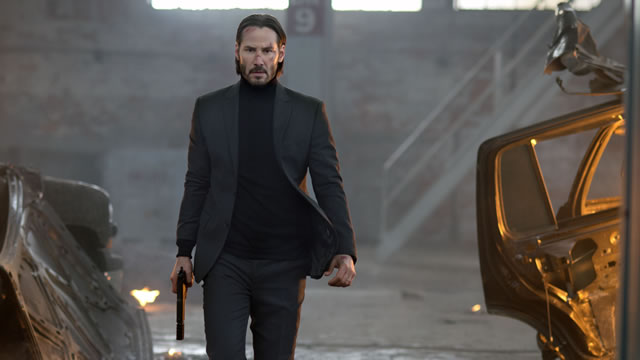
When B-list movie-making works, it can be a treat. John Wick is such a film. Set in a very distinctive criminal underworld, the recently widowed super assassin John Wick (Keanu Reeves) has left the life of crime behind but is dragged back in when the son (Alfie Allen) of a Russian mafia kingpin (Michael Nyqvist) murders his dog, a final gift from his wife. Wanting revenge for the loss of his last link with his wife, Wick undertakes a roaring rampage of revenge.

John Wick is a film all about momentum. It’s sharp and brutal, with fights and events piling on top of each other. However, it’s also a film told with quite a bit of wit and imagination – it’s got a cool sense of humour, and presents a tongue-in-cheek view of its super assassin story. The film’s pace and immersive action is punctured regularly and very effectively with amusing moments that really hit home. The idea of the criminal underworld having its own secret code, rules, havens and even currency is several times expanded wittily to bring an everyday element into the extraordinary. As an exercise in briefly and simply “building a world” you could look at few better examples than the script for this film.

Keanu Reeves is actually a fine choice for the lead role. His limitations as an actor have always been based above all in his flat and unmodulated Dude voice, so it’s only at moments of vocal emotion (there is one such angry outburst that he struggles with in the film) where even the audience feels that awkwardness of watching an actor at the limits of their range. But his best quality has always been his inherent lovability. As an audience member, you can’t help but care about him. Combine that with his physical brilliance and you have the perfect combination required for this role: you can believe totally in him as a ruthless killer, while also feeling a great deal of affection for him.

With Reeves’ physical abilities, the fights are then very well framed to showcase the fact that the actor is doing the stunts himself. If Quantum of Solace is perhaps the most inept example of high-cut frenetic action, this is at the other end of the scale totally. Simple, clear camera set-ups allow us to follow what happens at all times. Establishing shots and tracking shots show us exactly what is going on and where. This means you can relax and settle into the crackingly efficient violence that fills the film. The fights are inventive, shot with wit, and highly enjoyable in their execution without being excessively bloody or violent. The calm angles and stable camera serve to really accentuate the speed of those in the fights, making the fights visually very original. Despite the enormous body count, it never revels in violence. The patient build up to the first burst of violence also serves to really bond us to Wick’s backstory and his grief at his loss.

However, it’s not perfect. Strangely, despite the fact that the film is quite short, it’s still too long. There is a natural culmination point in the film at the end of Act Two that feels like a very natural, thematic stop point. Act Three resets the table hurriedly to reposition another character as a principal villain and to bring us another confrontation: this time however, the motives are less clear, and the action  just a little too much more of the same. It feels less witty and original than some of the other sequences in the film and to be honest I felt my attention drifting it a bit; the motivation for the final clash just isn’t there in the way it is with the initial enemies.

But this is a very enjoyable piece of pulpy film making, its wit and imagination embraced by some very enjoyable performances from the actors. The fight scenes not only have a unique look to them, they get the balance exactly right between violence and enjoyment. It’s almost the definition of a guilty pleasure .