Tag: Idina Menzel

Uncut Gems (2019)

Adam Sandler is desperate to make a score in Uncut Gems

Director: Benny & Josh Safdie

Cast: Adam Sandler (Howard Ratner), Lakeith Stanfield (Demany), Julia Fox (Julia De Fiore), Kevin Garnett (Himself), Idina Menzel (Dinah Ratner), Eric Bogasian (Arno Moradian), Judd Hirsch (Gooey), Keith Williams Richards (Phil), Jonathan Aranbayev (Eddie Ratner), Noa Fisher (Marcel Ratner)
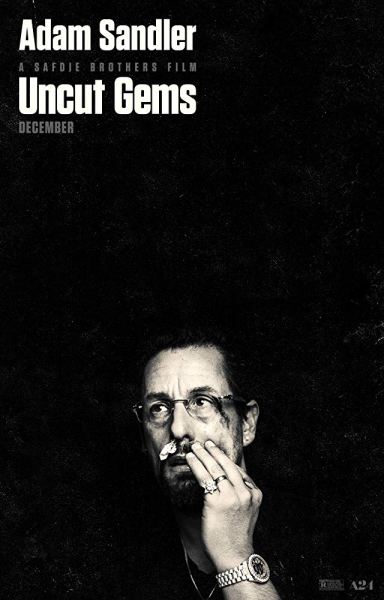
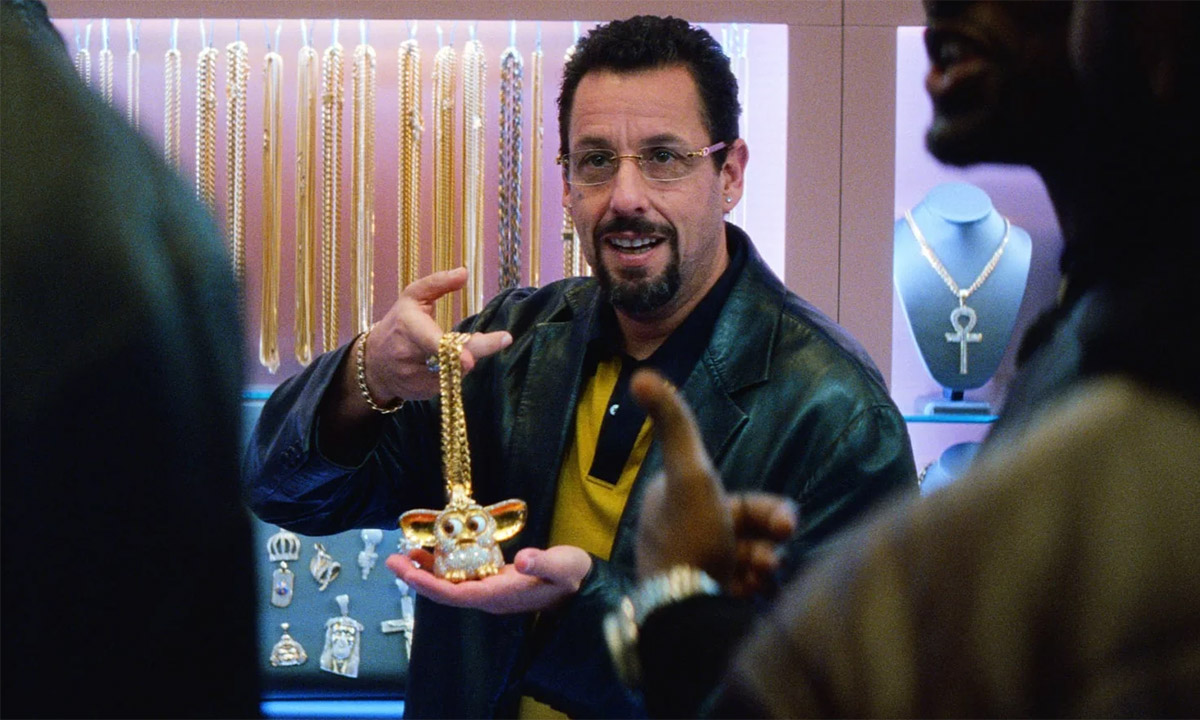
Howard Ratner (Adam Sandler) is a Jewish jewellery dealer in New York. Addicted to gambling, Ratner has a mountain of debts – mostly to his loan shark brother-in-law Arno (Eric Bogasian). Estranged from his wife Dinah (Idina Menzel) and trying to build a new relationship with girlfriend Julia (Julia Fox), Ratner’s life is a mess. His business depends on colleagues like Demany (Lakeith Stanfield) to bring in high-end clients, such as basketball star Kevin Garnett (playing himself). Ratner hopes an auction for a rare uncut diamond from Ethiopia will get him out of the hole. But, after agreeing to loan the diamond as a “good luck charm” to Garnett, Ratner finds himself in a desperate race to get it back in time for the auction, make enough money to clear his debts – and resist the temptation to throw it all on a big accumulator bet on the next basketball game…

The Safdie brothers’ film is an explosion of frantic energy. Shot with hand-held dynamism and cut with adrenalin-fuelled quickness, every scene has life occurring at hundreds of miles an hour, leaving the viewer struggling to keep up. Like Robert Altman walking in Scorsese land, dialogue frequently overlaps, with the buzz of improvisation and rawness of language. The film rips through events with a headlong force, scenes veering from black comedy, to tragedy to violence with unexpected force.

There is an almost Jonsonian or Moliere sprightliness about the film. Ratner feels like a Volpone, a chancer on the make, trying to keep ahead of his schemes long enough to end out on top. The film plays like a dark farce. Often, at the worst possible moments, Ratner’s opponents or friends appear to ruin his current plan. Ratner’s shop is practically a classic farce set, with its backrooms and magnetically controlled door that doesn’t always open when ordered. But it’s a dark farce, which never lets you forget the threat of genuine physical violence.

The Safdie brothers take a superb chance on casting Adam Sandler. With his gallery of grotesques in a low-brow comedies, it’s easy to forget the commitment and transformational quality Sandler brings to any role. With the film teetering towards dark farce, that energy is perfect. Sandler channels the bombast of Al Pacino by way of the sleaze of Gilbert Gottfried, a raspy voiced would-be-but-never-was, a Del Boy of low-rent crime. It’s a high octane, big performance. But it works because Sandler is aware this is a character always performing, and has taken on a persona of such New York Jewishness (the Safdie brothers have said this was their intention) that it almost feels like his true emotional self has been long buried.

He’s a character who struggles with earnestness and honesty – partly because it brings so few benefits to his world, partly because he’s almost forgotten how to behave other than as the high-octane chancer he presents to the world. In many ways, this is very secure role for Sandler, falling very much into his wheelhouse without the crude gags, but with additional tears. Heavily praised by critics – many of whom perhaps couldn’t bear to sit through his more conventional film work – it’s a strong performance, but not a revelation as many suggested. Ratner is an exaggeration and a tour-de-force, but the real stretch for Sandler is in the smaller, quieter moments (of which there are few) where Ratner has to confront the emotional consequences of his appalling choices.

Moments like this are few and far between, amongst the crazed energy of the bulk of the film, but they carry real impact. It would be easy for this jet-black crime dramedy to overlook its heart, but it’s certainly there. Ratner’s relationship with Julia seems to be a typical gold-digger/older man’s folly, but reveals itself to have far greater depths of emotion than first appears. Similarly, the feud between Ratner and his wife is just part of a wider spectrum of genuine affection between them – even if the idea of continuing the marriage is a joke. Even Ratner and his brother-in-law (a world-weary Eric Bogasian) have moments of genuine affection, for all the threat of violence.

The real villain of the piece, if there is one, is Ratner’s own self-destructive streak. He can’t let the chance of a good score pass him by, and his constant habit of shooting himself in the foot and making the wrong call have led him to the brink of destruction. Not that the film is keen to show us too much of this. Interestingly, for a film about a gambling addict, Ratner’s actual bets have a romantic tendency to come off. In fact, for all that he is clearly in dire straits, the film shies away from showing the real damage that addictive gambling can have.

Perhaps it’s because the Safdie brothers clearly feel very protective towards Ratner. For all his wheeler-dealing desperation, the film lends him a perverted sense of nobility. We can see him lose out on a big deal, get punched in the throat, thrown in a fountain and still he keeps on going (Sandler’s fast talking wildness works wonders here). It’s a flaw in the film for me, that it’s nervous of looking at this self-destructive individual with the cold-eyed clarity that the best of the 1970s film this is partly apeing, would do. It’s a bit like making a film about a drunk, but showing every drinking session as being a whale of a time.

The film culminates in a final wide-eyed bet, mixed with a flurried attempted escape from the crooks. The final act throws in some surprising – and affecting – twists to the tale that stands much of what we have been watching on its head. The film’s frenetic style might, at times, make it a hard-watch – it is so eager to impress that it rarely rests but constantly jumps around like an over-active teenager – but it channels Sandler very effectively, and has the sort of edge too many other films can only dream of. Moments try too hard (the bookending shots that burrow, Fincher like, deep into crevices is a flourish too far), but this is still wire-cracker film-making.
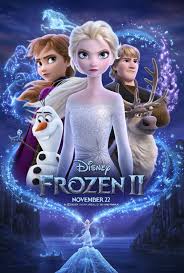
Frozen 2 (2019)

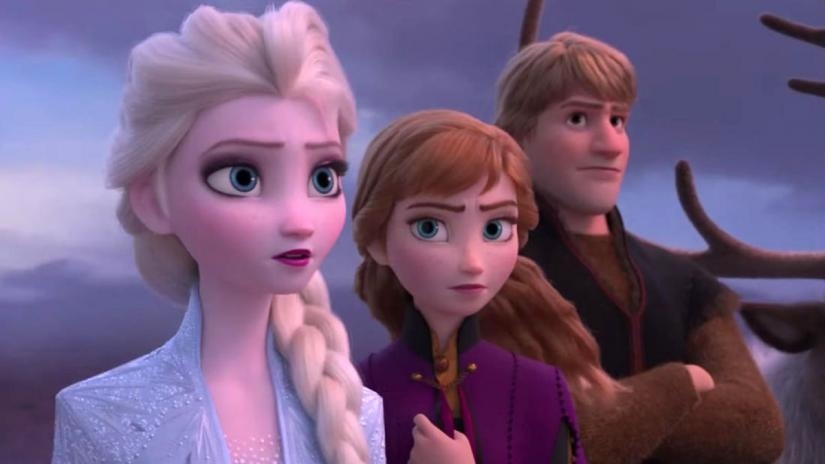
The gang are all back together in Frozen 2

Director: Jennifer Lee, Chris Buck

Cast: Kristen Bell (Anna), Idina Menzel (Elsa), Josh Gad (Olaf), Jonathan Groff (Kristoff), Sterling K Brown (Mattias), Evan Rachel Wood (Iduna), Alfred Molina (Agnarr), Martha Plimpton (Yelena), Jason Ritter (Ryder), Ciaran Hinds (Pabbie), Jeremy Sisto (King Runead), Rachel Matthews (Honeymaren)

Frozen was a phenomenon, a film that seemed to come out of nowhere and seized the imagination (and the passions) of audiences. Why did it work so well? It’s got a great bunch of characters, a focus on sibling affection that is very easy to relate to (and very different from most romance-based Disney films), a well-rounded bunch of characters (so easy to relate to, they inspired a number of fan in-jokes in a way that only characters in films you really care about can) and of course that song. Frozen II works very hard to double down as much as possible on the things that worked, and to give you the chance to spend more time with these characters. If it fails to match the magic of the first film, it still makes for an entertaining trip to the cinema.

Elsa (Idina Menzel) and Anna (Kristen Bell) are now living together in the kingdom of Arendelle, and all is peace and contentment. Until one day a siren call that Elsa keeps hearing from across the water occurs at the same time as a series of elemental events in the kingdom, each harnessing earth, fire, air and water. The sisters quickly work out that this must be connected in some way with the stories their parents told them of the Enchanted Forest, a magical land near to Arendelle that  disappeared after a mysterious feud between the two kingdoms. Accompanied by living snowman Olaf (Josh Gad), Anna’s boyfriend Kristoff (Jonathan Groff) and his reindeer Sven, the sisters head off to find the cause of the disturbances, solve the mystery of the enchanted forest and save Arendelle. Phew!

Frozen 2 is engaging, fun and has some very good jokes. Its main problem is a plot that feels both sprawling and epic and also muddled and confusing. As the film hits its final act, you may well feel more than a little confused about why events are unfolding like this, what the motivations of certain characters are, why some things happen to characters etc. What the film seems to lack is a compelling unfolding of the plot, and a clear structure of how these events link together to form the overall arc.

As such, we seem to head to several locations and constantly encounter a series of magical creatures, but never really get a firm grasp of how they link together. The film has a series of flashbacks and expands the backstory of the series, but then never really pulls together clearly how the events of the past shaped the present. The moment where this is explained feels rushed and murky, and seems to revolve around a sort of “anti-magic” attitude from a key character in the past that has no context with the rest of the film and never feels really clear. 

The plot may not be the strongest, but where the film really does work is in its sense of humour and its fun script, and the engaging riffs Lee and Buck make on the previous film. Fan humour from the first film – not least the close relationship between Kristoff and Sven – is doubled down on in this film with a series of knowing sight gags. Olaf – far more engaging here than in the first film – has a series of excellent fan gags, peaking in a hilarious showpiece moment where he essentially acts out the entire plot of Frozen for the people of the Enchanted forest (all of whom respond like the fans). It’s a hilarious show piece, and a real sign of the film’s strengths, which are often when it is riffing on the first film.

The film also carries across the other things that worked from the first film. The close relationship between the two sisters is central to most of the film’s development (although it also means that Anna seems to have to protest her devotion in virtually every scene). The sense of outsider and isolation in Elsa is also explored further, with her confusion over being happy where she is but still yearning for something more. The film also threads in a charming B-plot of Kristoff’s attempts to propose to Anna, which provides both charm and several moments of comic gold.

The film does struggle to find a replacement song for Let It Go, although Into the Unknown comes close, another inspiring, story-packed, ballad for Idina Menzel to bring to inspired life again. The song also plays well with the several fans who have seen Elsa become a gay icon, with most of the lyrics leaning on the idea of heading out from the safety of knowing where you are to finding your true self in the “unknown”, answering the siren call of your own desires. Also of course, it’s a belting song which you can enjoy on its own merits!

Enchanted (2007)


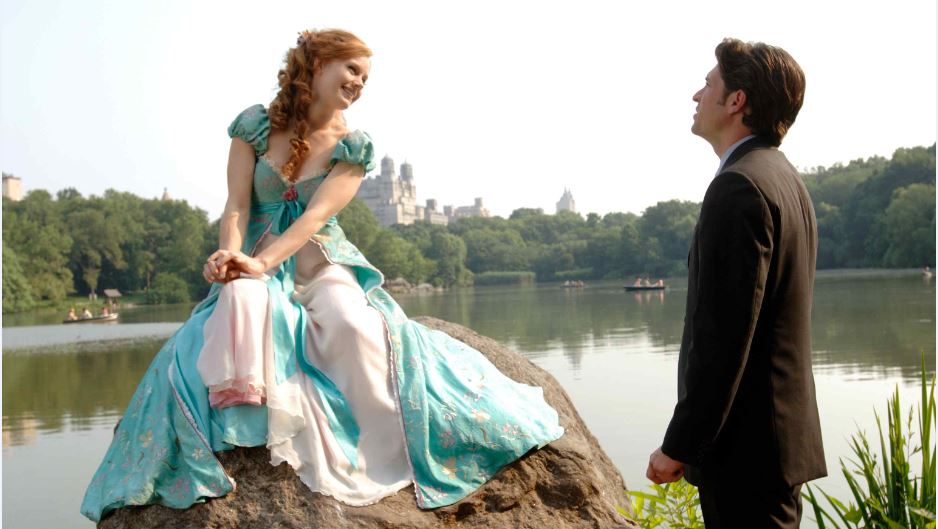
Amy Adams excels as Disney heroine in the real world Giselle in Enchanted

Director: Kevin Lima

Cast: Amy Adams (Giselle), Patrick Dempsey (Robert Philip), James Marsden (Prince Edward), Susan Sarandon (Queen Narissa), Timothy Spall (Nathaniel), Idina Menzel (Nancy Tremaine), Rachel Covey (Morgan Philip)

With Disney devoting themselves full-time to remaking their back catalogue of classics, replacing animation with live actors, it’s nice to be reminded how imaginative combining animation and live actors can actually be. Enchanted is an original story, packed with charm and feel-good warmth – and for my money it’s streets ahead of the production-line remakes churning out of Disney.

In the animated world of Andalasia, Giselle (Amy Adams) is the classic Disney heroine – singing joyfully, talking with animals, all the usual trappings. She falls (instantly, of course) in love with the dashing Prince Edward (James Marsden), but Edward’s cruel step-mother Queen Narissa (Susan Sarandon) is determined to thwart the match so she can retain the crown. On Giselle’s wedding day, Narissa pushes her through a magic well to a place where there are no happy endings: modern day New York. Stuck in the real world, Giselle meets quietly disillusioned family lawyer Robert (Patrick Dempsey) and his 6 year old daughter Morgan – can Giselle adjust to the modern world? Can Edward save her? And will she want to go back?

The star turn is Amy Adams, and she is terrific. This is one of those performances that looks easy, but is in fact extraordinarily difficult. She simultaneously plays a fairytale character in the real world, with a cartoon’s outlook and understanding, but also subtly deepens and enriches this character with real world traits, developing and growing her personality to become someone who feels “real”. She does this without jarring gear changes or sudden swings – and holds both these characterisations together simultaneously. So Giselle’s fundamental personality doesn’t change, while her outlook and understanding changes dramatically. She’s endearing, a wonderful light comedian, and her singing and dancing is terrific. It’s not too much of a jump to say she basically is the movie.

And an enchanting movie it certainly is, one part affectionate recreation of Disney, one part affectionate send-up. Relocating the conventions and style of a Disney movie to the real world allows a lot of fun, as Giselle musters the animals of New York to help her clean (pigeons, rats and flies) or recruits the people of Central Park into an extended song and dance routine while Robert looks on with bemused confusion. It helps that the songs are so well written – Alan Menken and Stephen Schwartz’s tunes are basically classic Disney tunes with a satirical bent, which means it’s perfectly possible to enjoy both for what they are and for the dry commentary they offer on Disney.

In fact that’s why the film works so well: it is so blinking affectionate. There is no cruelty about it and none of the tedious “smarter than thou” referencing of, say, Shrek. Instead it teases Disney, while simultaneously understanding the vast majority of us love these films: that if we had the chance, as Nancy does, we might well jack in the real world for a fairytale. We don’t want “gags for the grown-ups” or dumb film references: if a film concentrates on making itself sincere and engaging, it will engage both adults and children at the same time.

The film really successfully bowls along, full of entertaining charms and gags. In fact the appeal of the fish-out-of-water plotline with Giselle is so effective the sub-plot around the villainous Queen Narissa actually becomes less interesting. While the presence of a villain of this type is a pretty central part of the Disney structure, it never quite comes together here – it feels like something inserted due to the rules of the genre rather than an organic part of the story. Now it is essential there is some peril to propel the story forward, but Narissa just isn’t quite interesting enough (and the final battle with a CGI dragon, while a great recreation of similar moments isn’t really gripping). Fundamentally the emotional and dramatic culmination of the film is Giselle realising what she wants – and it’s this compelling human story that powers the film.

But this is a niggle in a charming and very funny film. Amy Adams is of course the star, but Patrick Dempsey very successfully adds warmth to the “stick-in-the-mud” straight man who flourishes as the film progresses (in a nice touch, he slowly takes on the very singing, dancing, cartooney traits he finds so bemusing in Giselle). James Marsden has huge fun as the gently egomaniacal Prince Edward, providing many of the film’s belly laughs with his unreconstructed fairy-tale hero view of the world.

Enchanted works so well because it’s both a subtle commentary on Disney fairytale films and also a marvellous fairytale itself. With a terrific performance from Amy Adams (how did she not get an Oscar nomination for this?) and some cracking songs, the film is wonderfully entertaining, making some gentle fun of its genre, while also celebrating it. It only wants to entertain and enchant you – and it certainly succeeds.