Tag: Idris Elba

A House of Dynamite (2025)

A House of Dynamite (2025)

Terrifying, compelling and gripping it-could-happen drama about the madness of nuclear war

Director: Kathryn Bigelow

Cast: Rebecca Ferguson (Captain Olivia Walker), Idris Elba (President), Gabriel Basso (Deputy NSA Jake Baerington), Jared Harris (Secretary Baker), Tracy Letts (General Anthony Brady), Anthony Ramos (Major Daniel Gonzalez), Moses Ingram (Cathy Rogers), Jonah Hauer-King (Lt Commander Robert Reeves), Greta Lee (Ana Park), Jason Clarke (Admiral Mark Miller), Malachi Beasley (SCPO William Davis), Brian Tee (SAIC Ken Cho), Renée Elise Goldsberry (First Lady), Kaitlyn Dever (Caroline Baker)
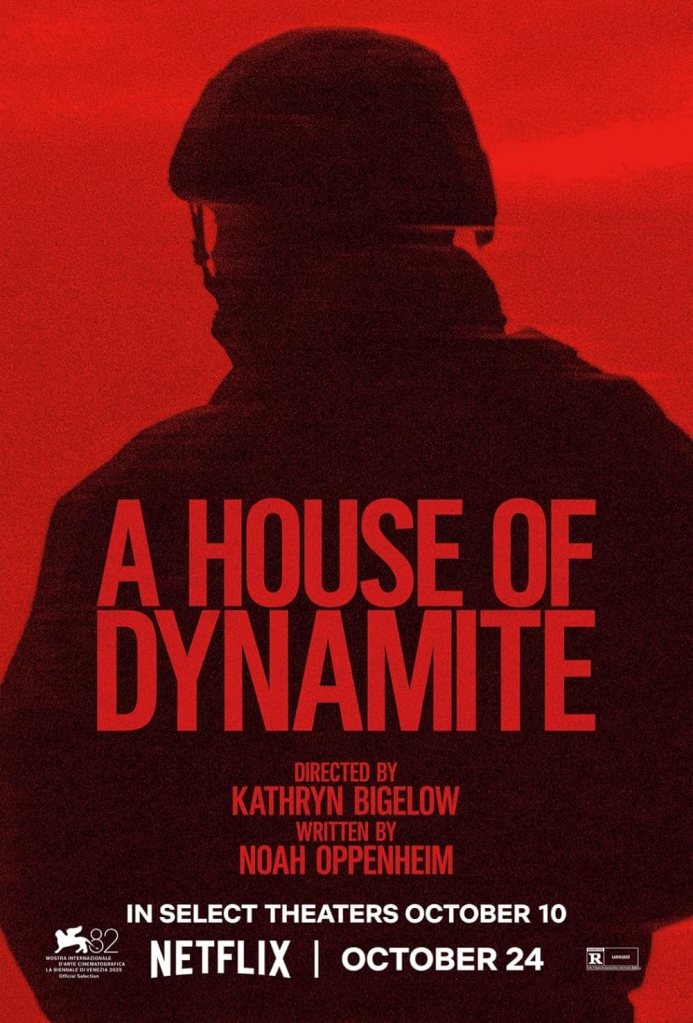
“That’s what $50 billion buys us? A fucking coin toss?” the Secretary of Defence (Jared Harris) plaintively wails as he discovers yet another weakness in the USA’s defence infrastructure. It’s one of many grim realisations filling A House of Dynamite, a relentlessly horrifying look at what might actually happen if a nuclear missile was launched at the United States: and how, in less time than it takes to watch an episode of Friends, the US President (Idris Elba) can go from shooting hoops at a charity event to flicking through menu-style list of world-ending options, being told he has a three minute window to make a decision that could be final for all of us. House of Dynamite makes clear to us all: the fate of the whole world effectively rests on a series of coin tosses we have no influence over.

Bigelow’s intense, brilliantly shot and edited film, plays out the same eighteen-minute scenario from different perspectives. A glitch in the USA’s satellite network misses the launch of an ICBM, somewhere off the coast of Asia, heading for Chicago. Disbelief and panic swiftly sets in at every level of the US administration. Anti-missile defence systems miss (that’s the coin toss, as we’re told it only has a 61% success rate in tests). A decision needs to be taken whether to follow policy and launch a counter-attack before the nuke hits. It plays out from three primary perspectives: Captain Olivia Walker (Rebecca Ferguson), senior officer on duty in the Situation Room; Jake Baerington (Gabriel Basso), deputy NSA covering for his under-anaesthetic boss, begging Russia to stand-down their forces as the US goes to DEFCON1; and finally the President (Elba), out-of-his-depth in a nightmare where he feels powerless and totally unprepared.

Powerless and unprepared become the guiding feelings in US defence, as people slowly release the best cast scenario is only losing 10 million people in Chicago and their worst (most likely) case is everyone dying in a nuclear conflagration. Bigelow’s film, shot with the hand-held intensity of a combat film, grabs you with a vice like grip as it plays out this nuclear nightmare. A House of Dynamite only ever gives us the same information as the fictional administration trying to make impossible choices. Like them we never find out who launched the missile, if it’s the first of a wave or even if it’s fully armed ICBM. All we know is the strike on Chicago quickly becomes inevitable and, with that fact, the world as we know it is over. Bigelow’s film (although it is not as clear in its clarification of US launch policy as it could be) places the system (which offers few choices and no alternatives) as the antagonist.

It also makes clear that nuclear war can happen at a time totally not of our choosing. Here it unfolds on a regular morning. The President is at an inconsequential publicity event, reduced to dialling into a world-shaking video call from a mobile: and he’s barely a month into his administration. The National Security advisor is in an operating studio and his unknown assistant is reduced into running through gridlocked traffic to get into the office. A designated FEMA expert (Moses Ingram) has just been appointed and at first believes the whole thing is a drill. The NSA North Korea expert (Greta Lee) is at a Gettysburg reconstruction with her young son. The Situation Room is undergoing maintenance and the Premiers of Russia and China can’t be raised on the phone.

A House of Dynamite doesn’t land cheap shots: it’s portrait of the members of the administration and the US defence infrastructure stresses their level-headedness and professionalism. Indeed, their competence makes the complete lack of control they have all the more alarming. Tracy Lett’s STRATCOM General keeps a professional level-headedness, even as he dutiful advises sticking to a nuclear policy which will effectively end the world. Rebecca Ferguson’s composed, calm and collected Naval captain finds herself increasingly aghast but only allows herself a few moments of tears after a goodbye phone call to her husband, clutching a toy dinosaur gift from her son. Anthony Ramos’ missile base commander reassures his staff this is what they have trained for: right up until the point where their interceptor missile misses and he slips into near catatonic shock as he realises that life’s training was for nothing.

Politicians are similarly portrayed as decent, but fundamentally unprepared for the situation. Idris Elba’s suave president looks every inch the confident leader, but it’s revealed he’s uncertain, hesitant, terrified of looking weak and his skills of schmoozing the public utterly useless for this situation. Jared Harris’ Defence secretary is only marginally more on-top of his brief (he reveals the nuclear war briefing is less than half an hour because it was seen as so unlikely to happen) and, for all his competence, becomes increasingly distracted at the thought of his estranged daughter (Kaitlyn Dever) facing death in Chicago. Gabriel Basso’s Deputy NSA seems at first absurd, but grows in statue as he desperately tries to salvage global survival.

Bigelow’s film makes clear this is a lose-lose situation. It’s a film about the constricting pressure of panic. Panic leaves assured professionals weeping or vomiting. Superpowers plan world-ending retaliation out of fear that they might be wiped out before they get a chance to fire their nukes. The President becomes overwhelmed, asking the junior aide carrying the nuclear football (Jonah Hauer-King) what he should do. (Hauer-King’s character, acknowledging the way the War Book looks like a nightmare menu, wryly confesses he calls the world-ending options rare, medium and well-done). The Deputy NSA tries everything, including begging, to get Russia to stand down, only for them to refusing to do so until US meet Russia’s own un-meetable conditions.

What we are left with is the realisation that there is no winner here. Many viewers, I feel are missing the point. Who fired the missile, who (or if) America hits back, if Chicago goes up in inferno or not, is not the point. Just firing the starting trigger in this race means you lose, because when the nuclear buttons is pressed by anyone there is no turning back, no way of unringing that bell. This is the chilling message of Bigelow’s compelling film – made all the more chilling as she finds so much humanity in the people forced to make these terrible calls.

What we end up with is a different type of coin toss: one man, in most cases with almost no preparation what-so-ever, making a decision that could go either way on virtually no conclusive information at all, in an impossibly small window, about whether to risk ending the world or not. What A House of Dynamite makes clear is that’s all nuclear deterrent really is: a coin toss for individuals who feel they have to always call heads. That’s possibly the most terrifying about it.
Thor (2011)

Thor (2011)

Branagh lives his dream by making the most comic-book, bombastic Shakespeare-homage ever

Director: Kenneth Branagh

Cast: Chris Hemsworth (Thor), Natalie Portman (Dr Jane Foster), Tom Hiddleston (Loki), Anthony Hopkins (Odin), Stellan Skarsgård (Dr Erik Selvig), Kat Dennings (Darcy Lewis), Clark Gregg (Phil Coulson), Rene Russo (Frigga), Colm Feore (Laufrey), Ray Stevenson (Volstagg), Idris Elba (Heimdall), Jaimie Alexander (Sif), Josh Dallas (Fandral), Tadanobu Asano (Hogun), Jeremy Renner (Hawkeye)

If you’d told people after Henry V that one day Kenneth Branagh would direct a high-octane comic book movie about a Norse God who bashes things with a hammer, you’d have been laughed outta town. But Branagh was who Marvel called to launch the Thor franchise – and doncha know it turned out to be a pretty shrewd choice.

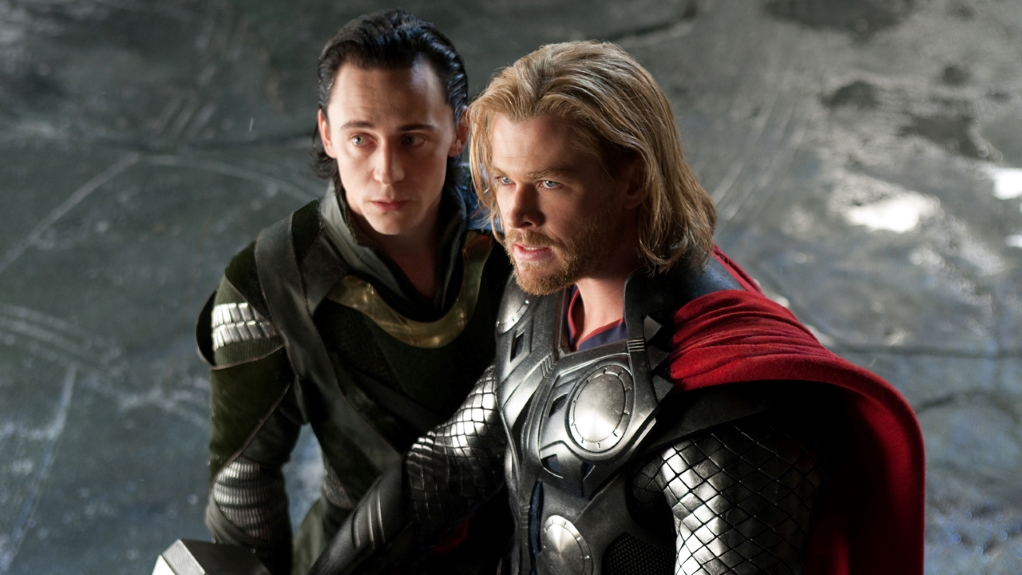
Thor (Chris Hemsworth) is the arrogant son of Odin (Anthony Hopkins) and heir to the throne of Asgard, the planet that keeps peace in the Universe. After an attempt by Asgard’s old enemies, the Frost Giants, to re-capture a stolen super-weapon, Thor leads a reckless attack on their homeworld that threatens to shatter a hard-won peace. Disappointed and furious, Odin strips Thor of his powers and banishes him to Earth, where the fallen God of Thunder must learn humility to be worthy of regaining his powers. On Earth, he falls in love with gifted scientist Jane Foster (Natalie Portman), while on Asgard the realm falls under the control of his brother Loki (Tom Hiddleston), who manipulates events to make his own claim for both the throne and their father’s love.

You can sort of see the Shakespearean bits bubbling away there. Fathers and sons, ambition and power, tragic flaws. Destiny verses desire. Loki as a mix of Edmond, Iago and Cassius. Thor as a Prince Hal earning the maturity to lead. Odin as a kindly Lear. Hell, you could see Thor washing up on the shores of New Mexico, like Twelfth Night’s Viola, forced to pretend to be something he isn’t. He even has his own mini-Falstaff, in gluttonous warrior Volstagg. It’s a heightened story of Kings and Queens, Tempest-style magic and Hamlet­-style family intrigue. Marvel, of course, partly hired Branagh to bring attention to this (effectively, paying Branagh for his Shakespeare-street-cred to make an otherwise snigger-worthy concept of Norse Gods in space get taken seriously), Thor does a great job of bringing this out without drowning the fun.

And of course, for those paying attention, Branagh had been dying to do bombastic nonsense for years. Shakespeare had disguised that Branagh adored loud crashes, big bangs, showy camera work (half of Thor is done in Dutch angles, apeing comic books) and pounding soundtracks. His Hamlet is crammed with half a dozen genres, from romance to action and Mary Shelley’s Frankenstein showed he could fly over the top with the best of them. But he’s also an actor’s director, and he draws performances here from Hemsworth and Hiddleston in particular that would lay the groundwork for making these two of the most popular actors in the whole damn franchise.

Thor above all does a brilliant job of making us care for a lead character initially presented as a likeable but arrogant, immature and cocky hit-first-think-later warrior, cavalier about people’s lives. There is a very funny humiliation conga inflicted upon Thor on arriving on Earth (a classic rule-of-three gag) leaving him successively tasered, tranquilised by a syringe in the ass and knocked over by reversing car. It’s a brilliant way of breaking the haughty – the Mighty Thor, who trashed an army of Frost Giants, laid low by a middle-aged doctor yanking down his hospital pants. But it all sets us on a path for caring about him, helped by how chivalrous and polite he is with Portman’s winning Dr Foster. Sure, he’s still dripping with hubris – assuming once he gets his hands on his hammer Mjolnir again, everything will be as it was – but at wider traces of humanity emerge we start to care for him.

It’s cemented by a very effective scene where Branagh proves his worth as a director of actors. After failing to lift said hammer – being, at this point, unworthy due to having not really learned anything – Thor sits alone in an interrogation room, visited by a disguised Loki. Hemsworth is very good in his scene: he suddenly makes Thor humbled, fragile, accepting his failures, not lashing out but tearfully apologising for his past behaviour, meekly asking to just be allowed to come home then bravely accepts his permanent banishment. It’s actually an effectiveportrait of overcoming hubris: Thor’s true heroism isn’t trashing Loki’s rent-a-robot that is the film’s penultimate foe. It’s accepting, in his depowered state, his role in the battle is to stay out of the way and help get people out of the way before offering his own life as a sacrifice if he will end the robot’s rampage.

If Thor, in Hemsworth’s gently sweet and funny performance, overcomes hubris, Loki succumbs to it. Tom Hiddleston’s charisma here (cemented by his excellent turn in The Avengers) helped him become Marvel’s most popular anti-hero. Like Thor, he’s a complex character: a second brother who secretly resents his brother’s prominence, wants his father’s love, learns things about his past which make him lean into his worst instincts, all to try and be what he mistakenly thinks his family wants. Hiddleston carries all this angst and tragedy with real skill, while also filling the role with wit and playfulness: it’s a great, star-making turn.

It’s a sign of the film’s surprising complexity that it’s hero and villain switch perspectives over its course. Thor starts by dreaming of destroying the Frost Giants to impress Odin while Loki counsels restraint. He ends it by making enormous personal sacrifices to protect them from a genocidal plan unleashed by Loki who wants to prove he’s as tough as Thor. The film ends not with a hero triumphant, but alone and grieving losses. It’s stuff like this that makes Thor a truly interesting, engaging film in a way other MCU outings are not.

And a lot of it comes from Branagh’s skill with actors. Thor might not offer the greatest acting challenges to the rest, but Hopkins in particular was better here than he had been for years (he credited Branagh with helping him rediscover his passion for acting) and Portman and Skarsgård bring a lot of humanity to thinly written roles. Sure, in other ways Thor is less special: it’s action set-pieces are, by and large, fairly uninspired and run-of-the-mill, the small town trashed by a robot looks and feels like a backlot stunt show, some of the comedy lands flatly. But when it focuses on the character drama of two contrasting brothers and their love for their father it’s feels more real and engaging than a host of more technically adept comic book movies.

Thor gets over-looked in the MCU rankings. But it’s a surprisingly thoughtful, well drawn character study about worthiness not being about muscle and force, but on your wisdom, compassion and humility and putting other people before your own needs and desires. All captured in a magic hammer that is otherwise impossible to pick up. Branagh’s film gets that, with added bombastic comic book thrills. Thor has entertained me each time I’ve seen it and will go on doing so.

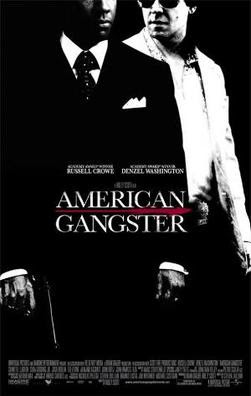
American Gangster (2007)

Denzel Washington leads his brothers in a life of crime in American Gangster

Director: Ridley Scott

Cast: Denzel Washington (Frank Lucas), Russell Crowe (Richie Roberts), Chiwetel Ejiofor (Huey Lucas), Josh Brolin (Detective Trupo), Lymari Nadal (Eva), Ted Levine (Captain Lou Toback), Robert Guenveur Smith (Nate), John Hawkes (Freddie Spearman), RZA (Moses Jones), Yul Vazquez (Alfonsa Abruzzo), Malcolm Goodwin (Jimmy Zee), Ruby Dee (Mama Lucas), Ruben Santiago-Hudson (Doc), Carla Gugino (Laura Roberts), John Ortiz (Javier J Rivera), Cuba Gooding Jnr (Nicky Barnes), Armand Assante (Dominic Cattaneo), Joe Morton (Charlie Williams), Idris Elba (Tango), Common (Turner Lucas), Jon Polito (Russo), Ric Young (Chinese General), Clarence Williams III (Bumpy Johnson)

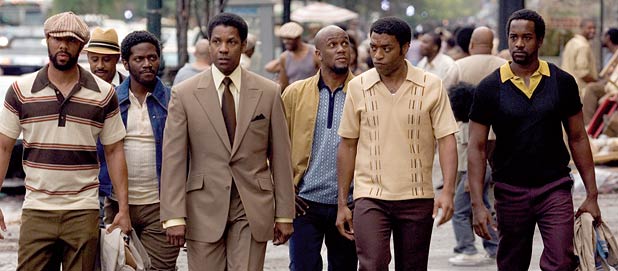
In 1970s New York there was only one organisation that ran crime: the mafia. The idea that anyone else could get a look in was unthinkable: to the cops, the government and the criminals themselves. Frank Lucas (Denzel Washington) was the guy who was going to shake that up: a resident of Harlem and former right-hand man of crime boss “Bumpy” Johnson (Clarence Williams III), Lucas saw an opening to bring in cheap, high-quality drugs from Vietnam (hidden in the temporary coffins of deceased servicemen). With this product he could take over crime in New York – and run it as he thinks it should be run, with the mentality of a FTSE 500 company and a gun. Frank is helped by the fact no one knows who he is. But that is all about to change as honest cop Richie Roberts (Russell Crowe) sets up a task force dedicated to finding, and arresting, the drug kingpins in New York. He’s as surprised as anyone to find the trail leads to Harlem.

Based on a true story, Scott’s American Gangster is assembled with Scott’s usual professionalism and assured touch, using top actors in well-assembled, well-shot scenes. It’s glossy, entertaining and enjoyable. But it’s not quite inspired or stand-out. Despite everything, it doesn’t really show us anything new and lacks either the fire of inspiration or the sort of poetry and energy the likes of Spike Lee, Quentin Tarantino or Steve McQueen could have bought to it. It tells an interesting story, but manages to be pretty much by the numbers – albeit those numbers are flashed up with as much pizzazz, drama and entertainment as you could wish.

The most interesting themes are questions of class and racial politics. The film’s version of Frank Lucas is successful because he runs his crime empire not like a gang but like a company. He dresses plainly and simply, so as not to draw attention (unlike the flamboyant criminals played by Idris Elba and Cuba Gooding Jnr). He talks in terms of supply and demand, brand loyalty and being a chairman. In one particularly well managed scene, he pontificates to his brothers on his ideology of business, excuses himself to walk across the street and shoot a rival in the head, then returns to calmly finish his breakfast. It’s the ideas of Wall Street applied to gangster crime. Lucas is all about bringing a smooth, modern, professional thinking to crime – but with the gun still up his sleeve.

But another reason why Frank Lucas needs to be as professional as he is, is because he’s loathed by all other parts of the criminal system. It’s a system that is racist from top-to-bottom, where black men are unwelcome as anything other than foot-soldiers. The elite criminals – most of them tracing many generations back to Sicily – smile at Frank for his money, but never see him as an equal. Even the government can’t begin to imagine a black man could be running such a huge empire – Robert’s AG boss spews out a racist diatribe, rubbishing any idea that a black man could achieve something the Mafia has failed to do. Frank though is just as wary of the flashy ostentatiousness of most black criminals in New York, telling his brother that the quietest man in the room is the most powerful.

It’s those brothers who Frank relies on – only family can be trusted. They’ll also be his Achilles heel. Because even his most competent brother (played by a sharp Chiwetel Ejiofor) is as much a liability as he is a good lieutenant. His brothers are innocents turned by their brother into tools for his crime empire. Frank hands out beatings to cousins who are unreliable. He’s bitterly disappointed when his nephew chucks in a baseball career because crime looks more fun. As his mother – an impassioned performance from an Oscar-nominated Ruby Dee – tells him, the rest of the family looks to him and follows his lead. There is a clear tension between this family – whose benefactor is also its corrupter – but it doesn’t quite come into focus.

This is partly because the film is covering a lot, and partly because it finds itself falling a bit in love with Frank Lucas. Not surprising when the part is played by Denzel Washington at his most magnetic – if strangely not quite as energised as you might expect. Washington gives Frank a dignity and cool that the real Frank – by all accounts a much cruder, ruder, less able man – never had. The film doesn’t really want to explore the darker side of Frank. Instead it invites us to sympathise with him, as an outsider made good. To feel sorry for him when he makes a fatal error (wearing an ostentatious fur coat to the Ali/Frasier “Fight of the Century” – an act that blows his carefully preserved anonymity). The film doesn’t want us to feel the damage of the drugs Frank is pouring into New York, since it might damage our respect for his triumph against the odds.

The barriers that Frank has to overcome – from arrogant Mafia kingpins, to local crime lords and corrupt cops (Josh Brolin has fun as a prowling bullying detective) – are in the end more interesting than the procedural struggles of Russell Crowe’s Richie Roberts (on solid form). Roberts is also given a rather cliched (and fictional) custody battle that hardly justifies its screentime. The cops definitely get the short end of the stick – and a stronger film might have focused just on Frank Lucas and really explored the struggles of a black man in white crime world, dealing with racism and trying to apply Wall Street ideals to street violence.

American Gangster doesn’t quite succeed with its dark commentary on the American dream – but it’s as entertaining as you could hope and while it lacks in inspiration, it’s also hard to find too much fault with. One of Scott’s most solid works, with a charismatic Washington doing decent work.

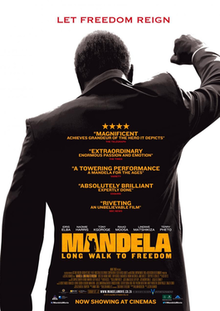
Mandela: Long Walk to Freedom (2013)

Idris Elba and Naomie Harris reconstruct the life of Nelson Mandela in illustrated slide-show movie Mandela: Long Walk to Freedom

Director: Justin Chadwick

Cast: Idris Elba (Nelson Mandela), Naomie Harris (Winnie Mandela), Tony Kgoroge (Walter Sisulu), S’Thandiwe Kgoroge (Albertina Sisulu), Riaad Moosa (Ahmed Kathada), Zolani Mkiva (Raymond Mhlaba), Jamie Bartlett (James Gregory), Simo Mogwaza (Andrew Mlangeni)

In the 1980s, hagiographic epic biopics that aimed to tell the story of the subject’s whole life were all the rage. In fact they were frequent Oscar behemoths. It’s easy to imagine that, if it had been released 20 years earlier, Mandela: Long Walk to Freedom would have been garlanded with awards for its attempt to capture every major moment in Nelson Mandela’s life from birth to his becoming President of South Africa. Sadly for the film, it wasn’t.

The fashion nowadays, for biographical films about major figures like Mandela, is to make a focused story about one key incident in their lives and from that build up an understanding of what made the man. Spielberg’s Lincoln focused on the immediate struggle to get the abolition bill passed. Du Vernay’s Selma looked at Martin Luther King’s involvement in the Selma marches. Eastwood’s Invictus looked at a newly-elected Mandela trying to use the Rugby World Cup to bring a nation together. Mandela: Long Walk to Freedom ironically goes the opposite way and tries to sprint through every single event of Mandela’s life. Doing so, it manages to be a less affecting, less involving and less engaging film than Invictus.

The rush is so intense to get through events that every scene feels like it has been cut down to deliver the vital bullet points and nothing more. Scenes rarely go over a couple of minutes, and most are comfortably under a minute. The general structure of most of them is roughly the same: a character will argue with Mandela (if black) or say something distasteful or racist (if white), Mandela will say something wise and inspiring that sounds like a direct quote from the book. Cut to the next scene.

This means that events fly by with little context and no real understanding. In fact, it feels like without having read the book and boned up on South African history in advance, most of it will mean nothing to you. Years can go by with a single snip of the editor’s scissors. Clashes and riots – particularly in the final third of the film – take place, but we are given no idea why or what the root causes of them were. 

Other events skim by so quickly that they lose all meaning or dramatic impact – in about 15 minutes of the film we cover Mandela arriving at Robben island, ill treatment and contempt from the guards, Mandela’s resolution that they will gain the right to wear proper trousers as a step towards being treated as humans, abuse from the prison governor, Mandela learning to control his anger, the prison governor leaving, a new governor arriving off camera, the regime lightening and finally the prisoners celebrating getting their trousers. If you think that sounds rushed here, imagine what it feels like watching it. All the narrative links between the scenes are severed – how did Mandela win the right to wear trousers? We have no idea. It sounds like a little thing, but it’s symptomatic of the problems of the film. 

This is despite a promising start, with a young Mandela fighting for justice and against prejudice in the courts of South Africa (winning cases because the racist whites refuse to be questioned by a black lawyer). The film is quite daring in showing the warts and all of the younger Mandela – his affairs, his ill-treatment of his first wife, his flirtations with violence – and there are flashes later on in the increasingly troubled relationship with his second wife, Winnie. But it soon loses these humanising touches under the pressure of ticking off events.

Justin Chadwick’s direction is largely flat – hamstrung as well by the film being cut so tightly to the bone. He fails to add any real epic sweep to the story, and largely struggles to convey the huge social and political issues that were tearing South Africa apart. As such, he’s often forced into holding a largely static camera in place to capture the four or five speeches that form each scene.

The  main bright spark in the film is the two lead performances. Idris Elba captures Mandela’s mannerisms and voice perfectly, but also brings a real humanity and empathy to the role – he largely manages to defy the film’s attempt to turn Mandela into a lofty marble carving of a man, not letting the human realism of his story escape. It’s a performance that feels very real and human – which is a far harder achievement than it sounds. Naomie Harris is all fiery radicalism and growing fury as Winnie (even more striking since she starts so young and naïve). One of the film’s real disappointments is that it rushes so fast through events that we never get a real, clear picture of the turbulent ups and downs of their marriage (the film is reduced to throwing some Mandela dialogue on his feelings into voiceover).

When the film finally ends it feels more like a sprinter with a stitch, too worn out to run any further through more years, than because it feels like it has made a point. It really wants to be Gandhi – but that film, despite its school-boy history faults, was patient, well paced, more focused and (crucially) an hour-plus longer. Mandela: Long Walk to Freedom compounds its feeling of being old-fashioned with being rushed and confused. For all Idris Elba’s admirable efforts, Mandela deserved better.

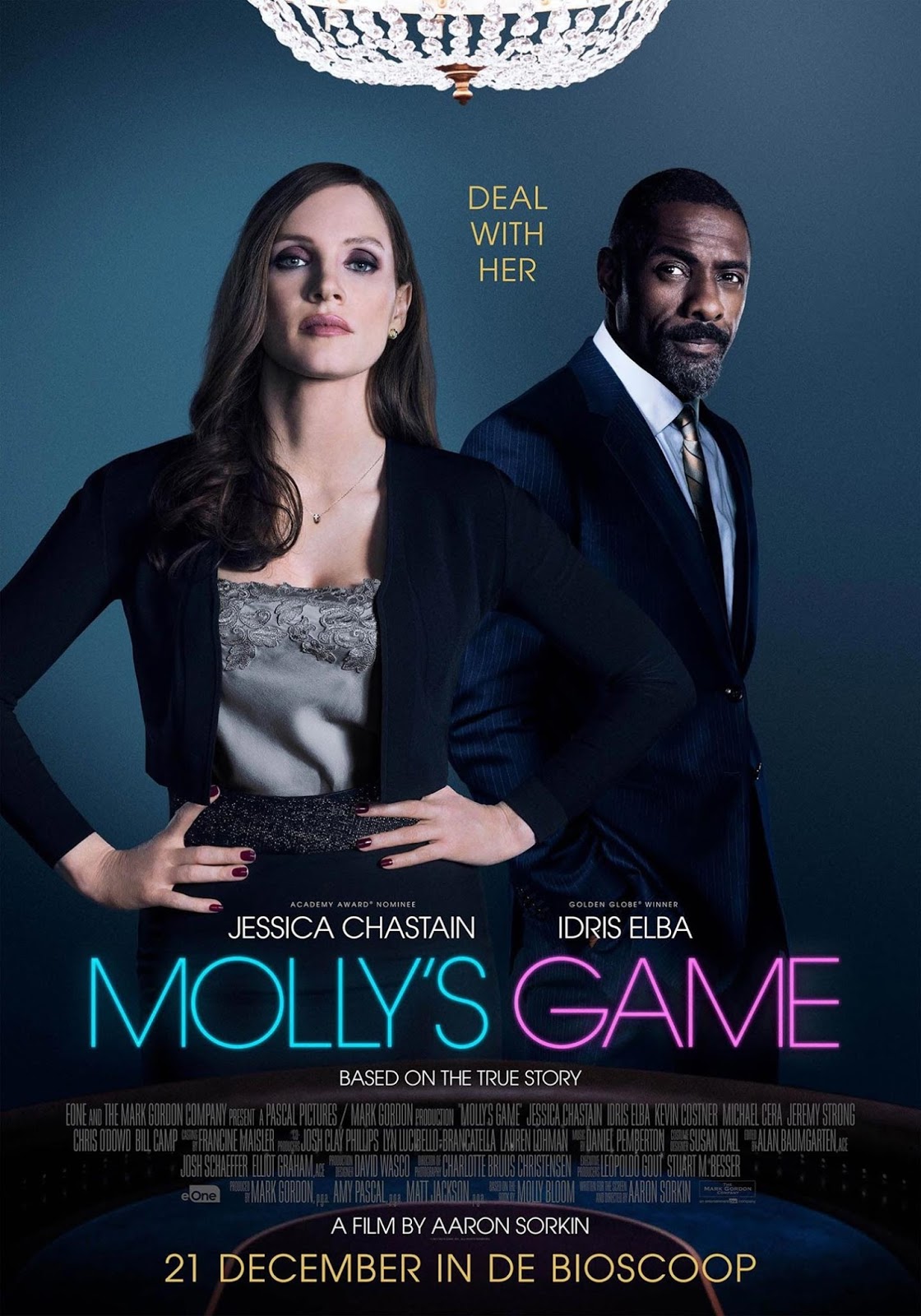
Molly's Game (2017)


Jessica Chastain and Idris Elba excel in Aaron Sorkin’s dynamically scripted Molly’s Game

Director: Aaron Sorkin

Cast: Jessica Chastain (Molly Bloom), Idris Elba (Charlie Jaffey), Kevin Costner (Larry Bloom), Michael Cera (Player X), Brian d’Arcy James (Brad), Chris O’Dowd (Douglas Downey), JC MacKenzie (Harrison Wellstone), Bill Camp (Harlan Eustace), Graham Greene (Judge Foxman), Jeremy Strong (Dean Keith), Angela Gots (B)

Molly Bloom (Jessica Chastain) is all set to join America’s Winter Olympics team, under the guidance of her ultra-demanding psychiatrist father Larry (Kevin Costner), when a freak accident ends her career. So she heads to LA and becomes embroiled in the world of high-stakes poker, eventually setting up and running her own high stakes games in LA and New York, earning millions. But, over a decade later (in a parallel plotline) she has had a millions seized and is battling against imprisonment for her connections to the mob, with only lawyer Charlie Jaffrey (Idris Elba) on her side.

Sorkin’s zippy new drama has plenty of sparkling dialogue – as you could expect! Sure this film probably also proves he’s not really a director (it’s over-long, a little flabby, and structurally not very clean) but the guy can certainly put a speech together. My main issue with Molly’s Game is I’m just not quite sure what its point is. Maybe it only exists to entertain, but it feels like it wants to put together a touching story about family, faith and the value of your word. I’m not sure it really manages to achieve any of this. 

The parallel plotlines don’t always do the film a lot of favours. The present-day plotline of Molly and Jaffey working to clear her from the various charges she has been accused of, continually hints at some serious gangsterism set-ups later on: largely these never really transpire. Actually, the film heads into pretty standard “my-Daddy-didn’t-love-me” territory. It shy’s away from being something different and interesting about excess and punishment into psychiatry solving our problems.

Sorkin doesn’t always get the structure right, as if he hasn’t got the patience to actually make sure the fundamental plot information was clear enough, so eager was he to get on with the verbal pyrotechnics. Time is spent carefully exploring several poker hands – but the exact nature of the illegality of what Molly does running her poker games gets glossed over in seconds. 

But then this is a film that isn’t really that interested in plot dynamics, or even in over-arching themes. What it’s interested in is sizzling dialogue, and letting actors deliver it. The camera sits back and watches. So it’s not a surprise the most memorable scenes feature Jessica Chastain and Idris Elba (both superb) in a room, talking (or arguing) with each other. It’s the moments like these where the film really works – and Sorkin the director basically stays out of the way, using a two-camera set-up to record the scenes, like a filming of a Broadway play. 

Those two actors dominate the film. Chastain is excellent as Molly – ambitious, driven, playful but also vulnerable and ever-so-slightly bitter, who gets where she is through her own intelligence and hard work. Chastain also embraces playing a character with such a strong moral code – she’s terrifically warm and human in the part. Elba is equally fine, a wry professional with his own strong moral code (yup, The West Wing writer still loves those liberals of great conscience), an articulate (of course!), passionate advocate who is far warmer than he first appears.

The rest of the film never quite lives up to this, maybe because the poker games are never really that interesting, or because the life Molly leads among the rich and famous seems ill-defined (she has possibly the least impactful drugs addiction seen on screen). For someone who remains loyal to the end to her clients, we are never really clear why other than a suggestion of her basic sense of honour. Her projects are all set-up with ease, and the film builds towards a solution buried in psychiatry speak that similarly feels a little too easy.

Because while it is great that Molly is not defined by a romantic relationship – she is defined by men in virtually every other way. Her entire career is based on pleasing rich, middle-aged men (from whom she frequently has to bat away expressions of devotion or sexual interest). Three times she falls victim to senior male partners in business relationships. Above all, she is defined by her relationship with her overbearing father (well-played by a low-key Kevin Costner). The scene where this comes to a head, a father-daughter exchange late at night on a snowy New York bench, is so well-written and played you almost overlook its pattness.

Sorkin’s script is the most important thing here – and the film is built around it. Like Scorsese’s Casino(a film he must have seen a couple of times!) most of its opening act is structured heavily around Chastain’s expertly delivered voiceover. The actors get to enjoy delivering his engaging rat-a-tat dialogue, the expert playing and sharp dialogue ends up carrying a lot of uplifting moments in the film. It’s a film that embraces Sorkin’s scripting, and doesn’t worry about being too filmic about it: the zippiest moments of editing are so because the dialogue or voice-over demands it.

Some of the roles aren’t quite so well drawn: Michael Cera is just plain miscast in a role that needed a young Rob Lowe as an absurdly glamourous Hollywood poker addict (I can’t imagine people crossing a street let alone a continent to play cards with Cera). The rest of the women in the script get short shrift – even Molly’s mother is little more than a walk-on part. 

Molly’s Game is a lot of fun, even if it’s probably about 15 minutes too long. It’s got some great dialogue and, if Sorkin turns out not to be the best interpreter of his own work, he’s certainly no dud as a director. Overall, the themes and plot don’t quite come together as well as they should. But it’s very well acted – Elba and above all Chastain are absolutely terrific – and it has more than enough sparkle to it for an enjoyable Friday night.

Pacific Rim (2013)


Idris Elba, Charlie Hunnam and Rinko Kikuchi are cancelling the Apocalypse in Pacific Rim

Director: Guillermo del Toro

Cast: Charlie Hunnam (Raleigh Becket), Idris Elba (General Stacker Pentecost), Rinko Kikuchi (Mako Mori), Charlie Day (Dr Newt Geiszler), Max Martini (Hercules Hansen), Robert Kazinsky (Chuck Hansen), Ron Perlman (Hannibal Chau), Clifton Collins Jnr (Tendo Choi), Burn Gorman (Dr Gottleib), Diego Klattenhoff (Yancy Beckett)

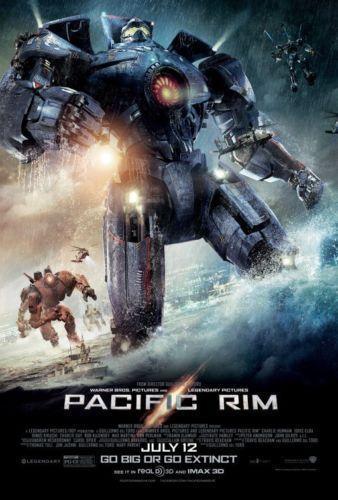
Film can be a beautiful and thought-provoking art-form. But sometimes, gosh darn it, you just want to leave the works of the great artists behind and watch a big, loud film in which giant robots hit giant monsters. Over and over again. In lurid, glorious, high colour detail. That’s pretty much the life and career of Guillermo del Toro. Make something like Pan’s Labyrinth. Then follow it up with something so wildly, tonally different you won’t believe it’s from the same guy: Pacific Rim.

In 2013, huge monsters (Kaiju) emerge from an interdimensional portal at the bottom of the Pacific Ocean. As they destroy cities left, right and centre, mankind is pushed to the limit. Eventually they develop Jaegers – giant robots controlled by two pilots, whose minds are linked together and used to drive the Jaeger’s movements. In 2020, Raleigh Becket (Charlie Hunnam) leaves the Jaeger force, commanded by General Stacker Pentecost (Idris Elba), after his brother and co-pilot is killed by a Kaiju. By 2025, the world governments decide to cut the funding of the Jaeger programme – forcing Pentecost to call Becket out of retirement and team him with his adopted daughter Mako Mori (Rinko Kikuchi) to launch a final, desperate, assault on the portal with the few remaining Jaegers, in an attempt to stop the ever-increasing number of Kaijus for good.

Pacific Rim is loud. It is silly. Its plot is a collection of clichés and offcuts from other movies. Some of the acting in it is ludicrously bad, over-the-top, poorly accented or all three. It looks and sounds like a direct-to-DVD movie made on a massive budget. Yet, despite all this, it’s really, really good fun. The ultimate guilty pleasure. Deafeningly dumb, but somehow it sort of knows this, and it knows you know it, so it just gives you what you wanted when you sat down – bangs, bashes and silly dialogue. Maybe this all works because Del Toro is actually a real director: he can shoot this nonsense with a sense of flair and scale, and is confident enough as a storyteller to just accept he’s making a dumb film and doesn’t need to try and pile some spurious depth on it, but just run with the emptiness.

Pacific Rim gives you this: some truly sublime robot vs. monsters battling in a variety of beautifully shot locations, in particular downtown Hong Kong. I mean, who wouldn’t love seeing this smashy super-action? The robots basically look really cool, the monsters are really imaginative, it’s tonnes of fun. Of course the battles are silly, there is always “one more weapon” to use that is bigger and better than anything they’ve used before (so why not do that from the start?). Del Toro also shoots the fights with a surprisingly calm camera, that makes the action the frantic lead, rather than the normal thing you see in these films, with the camera flying around all over the place. They’re edited really well. The score is great. The battles don’t overstay their welcome, and the characters at the centre of the Jaegers are always kept front-and-centre. Who wouldn’t love them?

The plotline of the film has a B-movie directness, which del Toro manages to fill with some depth. It’s a film about co-operation and learning to work together. This should be pretty wearingly obvious – okay it is – but somehow it strangely moving in the film. The Jaegers literally need two people to work together so closely they share a mind to operate it. The whole Jaeger programme only works from intimate co-operation. Characters feud and argue – but the film is about them learning to overcome these differences and work together. The film hammers home the fatality rate of this war with kaijus so well, that you end up really caring for sacrifices and risks these people are running. When Jaeger pilots start dying, I find it actually rather moving in its brutal suddenness. 

At lot of this comes from the wonderful, hero-worshipping, film style del Toro uses. Look at shots such as when (in flashback) Idris Elba’s Penthouse climbs out of a Jaeger, framed by the sun behind him – he looks like some sort of ultimate hero. The Jaeger pilots all have their own distinctive themes, and are framed and shot with idealism and adoration. Sure their personal issues are the most rampant form of clichéd melodrama – but it’s sold with complete conviction, and told with such unabashed simplicity, that you end up caring for it. 

This is despite the fact that most of the acting is pretty below par. Idris Elba is the one major exception – the only one with the charisma to sell such basic plots as “dying of brain tumour” and to make chuckle worthy lines like “we are cancelling the apocalypse” sound like rallying cries, rather than seriously awful crap. Charlie Hunnam, by comparison, has nowhere near that level of charisma and Raleigh Becket is probably the most forgettable lead character you’re going to see in a movie like this. Robert Kazinsky is pretty awful as his rival Jaeger pilot (his accent is dreadful). Charlie Day and Burn Gorman are hit-and-miss as the comic sidekick scientists. Rinko Kikuchi is however pretty good – and with her “drift” memory loss she has probably the film’s most affecting sequence.

But this isn’t a film of subtle character work or sharp scripting. It’s got a B-Movie aesthetic, but it delivers it totally honestly. Basically, Guillermo del Toro is a good enough director to be comfortable with making a really, really good bad movie, Pacific Rim is deeply silly and stupid, but it is a lot of fun and its characters (despite their pretty forgettable or clichéd nature) are still people you really invest in. Del Toro pulls off a neat trick filming this, perhaps because the film is so sweetly honest, and unabashed, about what they are doing here. It’s got a heart-warming message about co-operation. It never feels exploitative. It’s got a childish sweetness about it, a real family robot basher. It’s the best bad movie you’ll ever see.

Thor: Ragnarok (2017)


Thor and Hulk: It’s the buddy movie you’ve been waiting for

Director: Taika Waititi

Cast: Chris Hemsworth (Thor), Tom Hiddleston (Loki), Cate Blanchett (Hela), Idris Elba (Heimdall), Jeff Goldblum (Grandmaster), Tessa Thompson (Valkyrie), Karl Urban (Skurge), Mark Ruffalo (Bruce Banner/Hulk), Anthony Hopkins (Odin), Benedict Cumberbatch (Doctor Strange), Rachel House (Topaz), Taika Waititi (Korg)

The Marvel franchise is now on to 17 films. That’s 17 films all in the same universe, with at least three more to come in the next year or so. The weight of franchise backstory has started to feel overbearing, with so many other films to tie into and characters to set up that the individual film itself is left with barely any identity or purpose. How refreshing then to have a film that cuts loose and takes a slightly different tone: a genuine action comedy. Thor: Ragnarok is so tonally different from the other Thor films (let alone the other films in the series) it actually manages to feel like its own beast – it’s as close to a director-led vision as the franchise has got.

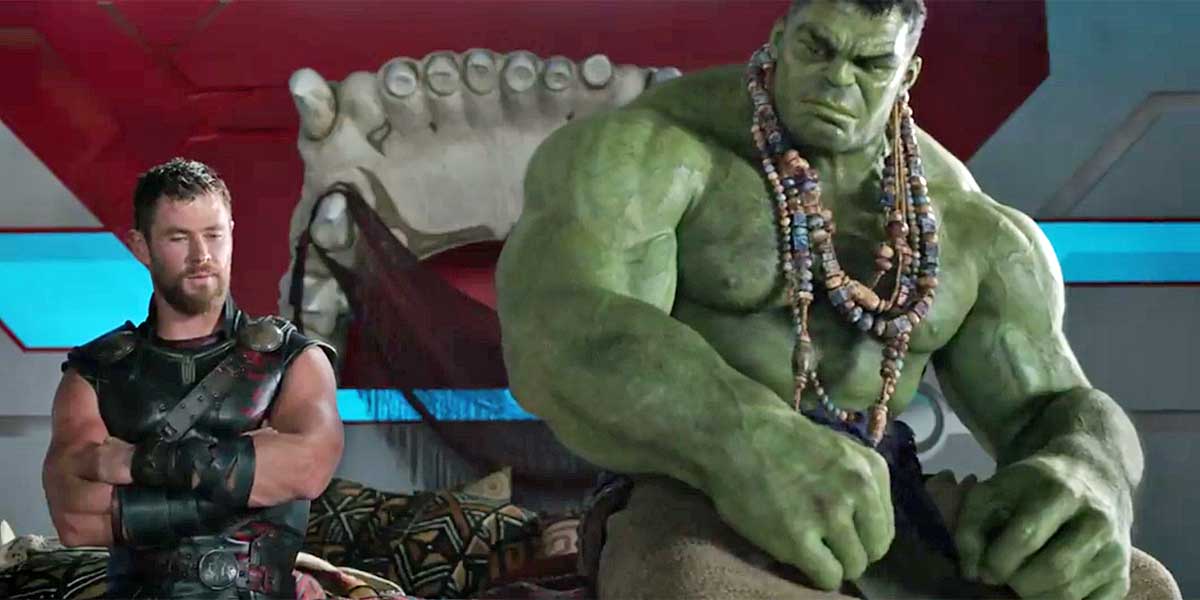
Thor (Chris Hemsworth) has been all over the universe, working to stop Ragnarok (the prophesised end of Asgard). Returning to Asgard, he unmasks his troublesome step-brother Loki (Tom Hiddleston) who has been disguised as Odin (Anthony Hopkins). Travelling to Earth to rescue their dying father, they arrive in time to see his death. Unfortunately, this releases their elder sister Hela, Goddess of Death (Cate Blanchett). While Hela ruthlessly conquers Asgard, Thor is trapped on the planet Sakaar and forced to enter a deadly gladiatorial contest – against his Avenger ally the Hulk (Mark Ruffalo) – all while trying to escape back to Asgard to stop Hela.

Thor: Ragnarok has a plot that ambles at points rather than sprints. But this hardly matters, as its main focus is on entertaining the audience. Waititi creates a sort of punk 1980s wildness, mixed with a fun-loving wit. The result is a film with action, and high stakes – but never takes itself too seriously. It perfectly understands how to puncture grandeur or pomposity of the Asgardian gods with a neat one-liner or a bit of everyday conversational inanity (a lot of the latter comes from Waititi himself, hilariously playing chilled out rock gladiator Korg).

Waititi also allows Hemsworth to let rip with his comic timing rip in a way he’s scarcely been allowed to do since Branagh’s original. It drops the faux-Shakespearean seriousness of Thor: The Dark World, and Hemsworth repositions the character in a more relaxed and charming style. From his opening introduction, undercutting the monologing of a fire demon with a dry series of puns while dangling from a ceiling in chains, he finds a neat balance between seriousness and charisma. Waititi is also (like Branagh) not afraid to let Asgard’s mightiest warrior be the butt of a few sight gags – one laugh out loud moment involving a very strong window is a stand out. Hemsworth demonstrates here he’s a far more accomplished comedian (physically and verbally) than he gets credit for.

This more relaxed Thor is perfect for the rock-and-roll feel of the film. Expertly scored (there is particularly fine use of Led Zeppelin’s Immigrant Song) it has a groovy, 1980s feel. The planet Sakaar is a primary-coloured, odd-alien filled, campy explosion of energy and vibrant punky fun. Said planet is run by the Grandmaster, played by Jeff Goldblum at his most Jeff Goldblumiest ever – if you can picture that you’ve got the tone of the whole planet. This neon lit style is reminiscent of everything from Flash Gordon to The Last Starfighter

The film’s loose comic style also allows a series of fun match-ups, from Thor and Loki (a wonderfully weaselly, fun Tom Hiddleston – still one of the best things in this whole franchise), to Thor and Strange (a lovely cameo from Cumberbatch), Thor and Valkyrie (a neat mixture of drunken self-loathing and female Thor-ness from Tessa Thompson) and lastly Thor and Hulk. The latter provides a lot of the film’s comic gold, the Hulk finally turned into some sort of character with achildish vulnerability and swagger (though the film still finds time for a Hulk penis gag). Waititi also throws in some nice call-backs to previous films – the bunch here set themselves up as the Revengers, while there are multiple references to the mantra used to calm the Hulk in Avengers: Age of Ultron – without making it feel in-jokey. 

There is so much fun in the film, you almost forget the main plot of the film is fairly heavy-going, end-of-the-world stuff. For a Marvel film there is a large body count of recurring characters (at least four bite the bullet here), while Hela’s plot encompasses mass slaughter and destruction. Scenes with Hela are kept short (structurally the film effectively strands her on Asgard to contain her invincibility), so it’s just as well the part is played with such charismatic dryness and imperious arrogance by Cate Blanchett (easily the best Marvel villain since Loki). She’s ably backed up by Karl Urban, adding a lot of complexity to reluctant cowardly turncoat Skurge. Waititi shoots Hela’s rampage of destruction with an exciting dynamism – it’s an action scene that feels different, no mean feat in a franchise that has had so many fights.

In fact most of the action feels very fresh, the fights never out-stay their welcome, and there are some brilliant visual flourishes – the final battle in particular throws in some almost painterly images as Thor and his allies take on Hela’s zombie army. The arena fight between Hulk and Thor is about a million times more interesting than the dull Hulkbuster battle between Iron Man and Hulk in the past Avengers film as Watiti keeps the focus on character rather than pummelling. The film also manages to keep the stakes high – there are always innocent people our heroes fight to protect.

Thor: Ragnarok might well be the most entertaining, fun film Marvel has produced. It’s almost certainly the best Thor film. While The Dark World failed dismally to build on the mixture of earnestness and comedy in Branagh’s original, this one feels like a natural progression of the first, amping everything up into a vibrant, 1980s styled cocktail of action and fun. It’s terrifically entertaining, well paced, anchored in characters we care about, and it just wants to entertain the viewer. You’d have to be pretty cold for it not to succeed.