Tag: Irvin Kershner

The Last Temptation of Christ (1988)

Last Temptation of Christ header
Willem Dafoe plays the Son of God in Scorsese’s supremely controversial The Last Temptation of Christ

Director: Martin Scorsese

Cast: Willem Dafoe (Jesus Christ), Harvey Keitel (Judas), Barbara Hershey (Mary Magdalene), Harry Dean Stanton (Saul), David Bowie (Pontius Pilate), Verna Bloom (Mary), Barry Miller (Jeroboam). Irvin Kershner (Zebedee), Victor Argo (Peter), Andre Gregory (John the Baptist), Nehemiah Persoff (Rabbi), Tomas Arana (Lazarus), Gary Barsaraba (Andrew), Juliette Caton (Girl Angel)
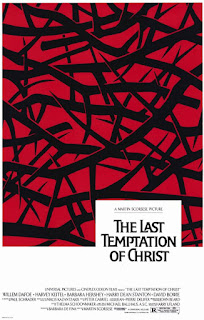
There are few films as controversial as this. Scorsese’s earthy adaptation of Nikos Kazantzakis’ The Last Temptation of Christ has lived its whole life under the shadow of the parade of traditionalists, conservatives and evangelists who have called for everything from the negative being destroyed to the death of its director. All this is rooted in the film’s quest – as in the book – for the human in Jesus, the saviour who was both mortal and divine. As part of this, it showed him expressing anger, doubt and of course, presented him with temptation and threw him into the dirty, working-class world where he made his ministry.

The film follows the life of Jesus (Willem Dafoe) pretty much as per the Gospels, with several interjections and reinterpretations (some of which seem designed to piss off the faithful). We meet Jesus as a carpenter who crafts crosses for Roman crucifixions by day, plagued by voices and fits at night. He knows he has a purpose but is scared of what it might be. Eventually he finds it, encouraged by Judas (Harvey Keitel) his most faithful disciple and a passionate campaigner against the Romans. The last temptation itself fills the final act of the film. On the cross, a disguised Satan comes to Jesus and offers him the chance to leave behind being the messiah and live a normal life: marriage, children and content old age surrounded by family.

The Last Temptation of Christ is Scorsese’s wrestling with his faith. It’s a highly personal, defiantly modern and daring version of the gospels that strongly invests in the notion that true faith is only possible if we also have doubt to overcome. And it applies this logic to Jesus, who is shown here as far more grounded, human and flawed than He has ever been in the movies (or anywhere else). Voiceovers communicate His constant doubts and insecurities – and even His resentments about not understanding what God intends for him.

Where other Biblical epics are old, stodgy and stiff, The Last Temptation profoundly challenges its viewers. This is not a picture postcard world. Jesus’ surroundings are humble and dirty. His disciples are simple men – Judas, the only one with any form of intellect, attacks them as clueless yes-men. But it’s a film that stresses the humanity of Jesus. It wants us to admire him even more, because He needed to overcome the same internal demons we all confront. This is not a saviour unbent in purpose, but battling always. It asks us to try and relate ourself to Jesus in a new way, to ask how we might have felt and whether we would have been strong enough to take on that mantle.

Played with extraordinary passion and fire by Willem Dafoe, this is a Jesus who is scared, reluctant, shows flashes of bitterness and anger but struggles to put all this aside to embrace His destiny and purpose as the Messiah. On other words, He’s far more human than we’ve seen before. He’s also rough and unprepared, in many ways, for His ministry. We see His first attempt at preaching – having, with half-confidence, half-apprehension told Judas He’s sure God will give Him the words – which is carefree, impassioned and amateurish but full of inspirational fire. He doesn’t quite convey the message He’s aiming for, but it is enough to win the devotion of several of the men who will become his disciples.

Scorsese shoots this, as he shoots many of the scenes among the crowds, with an immediacy and urgency, using a mobile camera and throwing us in among those listening to Jesus’ words. John the Baptist’s ministry by the lake is a near-orgy of religious ecstasy (with added nudity), full of wild emotion and jubilant singing – all of which drops out on the soundtrack to just the lapping of the river, as Judas and John meet. (It’s a brilliant moment that shows the world-stopping impact of revelation). Scorsese mixes this with scenes of a spiritual stillness and gentle mysticism. During his time in the desert – during which Jesus sits inside a perfect circle, which He draws free hand in the dirt – He encounters, in scenes of haunting unknowability, temptation from Satan in the form of a snake, a lion and a jet of fire.

It’s a starting point for Jesus’ embarking on a series of miracles and world-changing preaching. Controversially, even now, He is still uncertain of what He is meant to – he tells Judas (who remains a constant confidante) that God only gives Him small parts of the total picture as He needs them. He comes from the desert inviting his disciples to war – against Satan, and to bring God’s word to the world. It seems another provocative image – Jesus brandishing an axe in one hand, His own heart (plucked from His chest before the disciples) in the other – and it’s one of the points in the film where I feel Scorsese overplays his hand. I’m not quite sure what he is suggesting here, as Jesus calls his disciples to war, unless it’s a campaign of muscular Christianity.
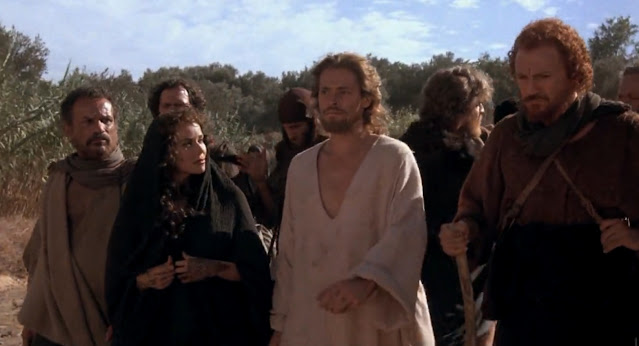
It competes with several other images and sequences that infuriated many. Some of these are too much: Jesus crafting crosses and even helping the Romans (in the film’s opening) nail a victim too one is far too much, a tasteless attempt to show a flawed man. Waiting to apologise to Mary Magdalene (a delicate Barbara Hershey) for his part in this, He sits while she services a roomful of men one after another. Moments like this always feel a little too much, even if it’s a more genuine insight into what Mary Magdelene’s life was actually like than we normally get.

But the Temptation itself is fascinating and moving – if a little too long. There was of course outrage at seeing Jesus marry and make love to Mary Magdelene, rejecting his purpose for a life of normality. Surely, if Jesus could be tempted by anything it might have been this: the man who never knew a moment of the life you and I lead, given a chance to experience it. With Satan – passing himself off as a young female guardian angel – guiding him, the vision sees Jesus age into an old man. Satan presents a plausible argument: man and Earth can live in a simple happiness, if they forget the demands of God in heaven.

The very idea of Jesus either deceived by Satan for a time – or seriously considering abandoning His divine purpose – is anathema to many, but again it re-enforces Scorsese’s view that doubt is essential for faith. That we can only commit the supreme act of commitment to God, if we are uncertain about doing it in the first place. And Jesus’ re-devotion at the end to his mission truly gives a sense of “It is being accomplished” in a way few other films have managed.

Ideas like this – and the earthy, vigorous nature of Jesus’ world – dominate the film and dare and push the viewer. Dafoe is superb – and Harvey Keitel excellent as a politically committed Judas, here not betraying Jesus, but taking on the harder role (that of betrayer – Jesus even tells him he is not strong enough for such a role, so has the easier part in dying). It’s shot with a brilliant modernism and has a superb score from Peter Gabriel, stuffed with lyrical etherealism and making use of several contemporary instruments. It sometimes overplays its hand, but as a personal work of a director juggling his own doubts, fears and faith on screen, it’s perhaps one of the most extraordinary religious films ever made.
The Empire Strikes Back (1980)

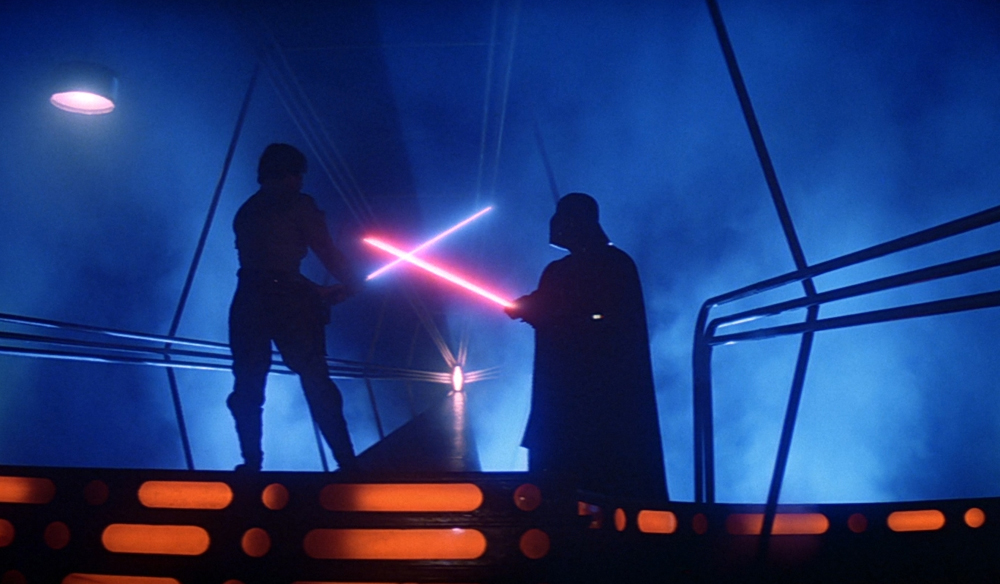
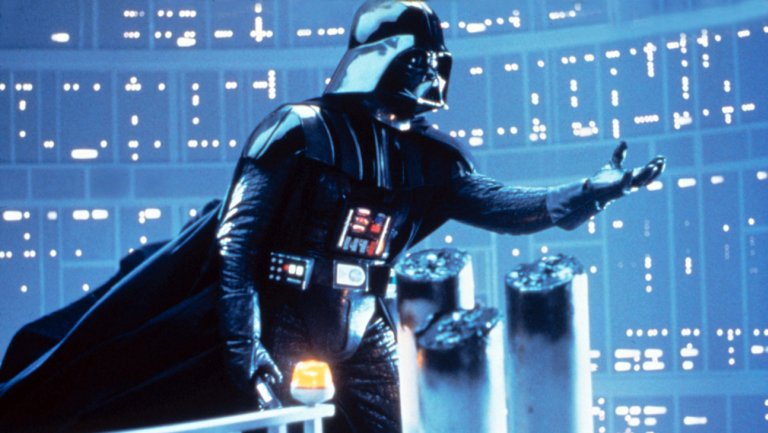
Darth Vader in the film that really made him an icon: the flawless The Empire Strikes Back

Director: Irvin Kershner

Cast: Mark Hamill (Luke Skywalker), Harrison Ford (Han Solo), Carrie Fisher (Leia Organa), Billy Dee Williams (Lando Calrissian), Anthony Daniels (C-3PO), David Prowse & James Earl Jones (Darth Vader), Peter Mayhew (Chewbacca), Kenny Baker (R2-D2), Frank Oz (Yoda), Alec Guinness (Obi-Wan Kenobi), Denis Lawson (Wedge Antilles), Kenneth Colley (Admiral Piett), Michael Sheard (Admiral Ozzel), Jeremy Bulloch (Boba Fett), Ian McDiarmid (Emperor)

As Star Wars sprawls into a massive Disney money-spinning franchise, for both fans and producers alike the original trilogy is increasingly becoming like Holy Texts, the events and characters of which must guide all future films. And of all these, none of them is holier than The Empire Strikes Back. It’s odd to think that the initial reaction to this sequel was a bit mixed at the time, since this is not only the very finest of all the Star Wars films, but also one of the best genre films ever made, one of the greatest sequels ever made – in fact one of the best, most consistently rewarding films you are ever going to see. It’s going to be loved forever, any critical view is almost superfluous. And the reason for that is surely linked to the fact that I’ve seen it hundreds of times and I still love every frame of it.

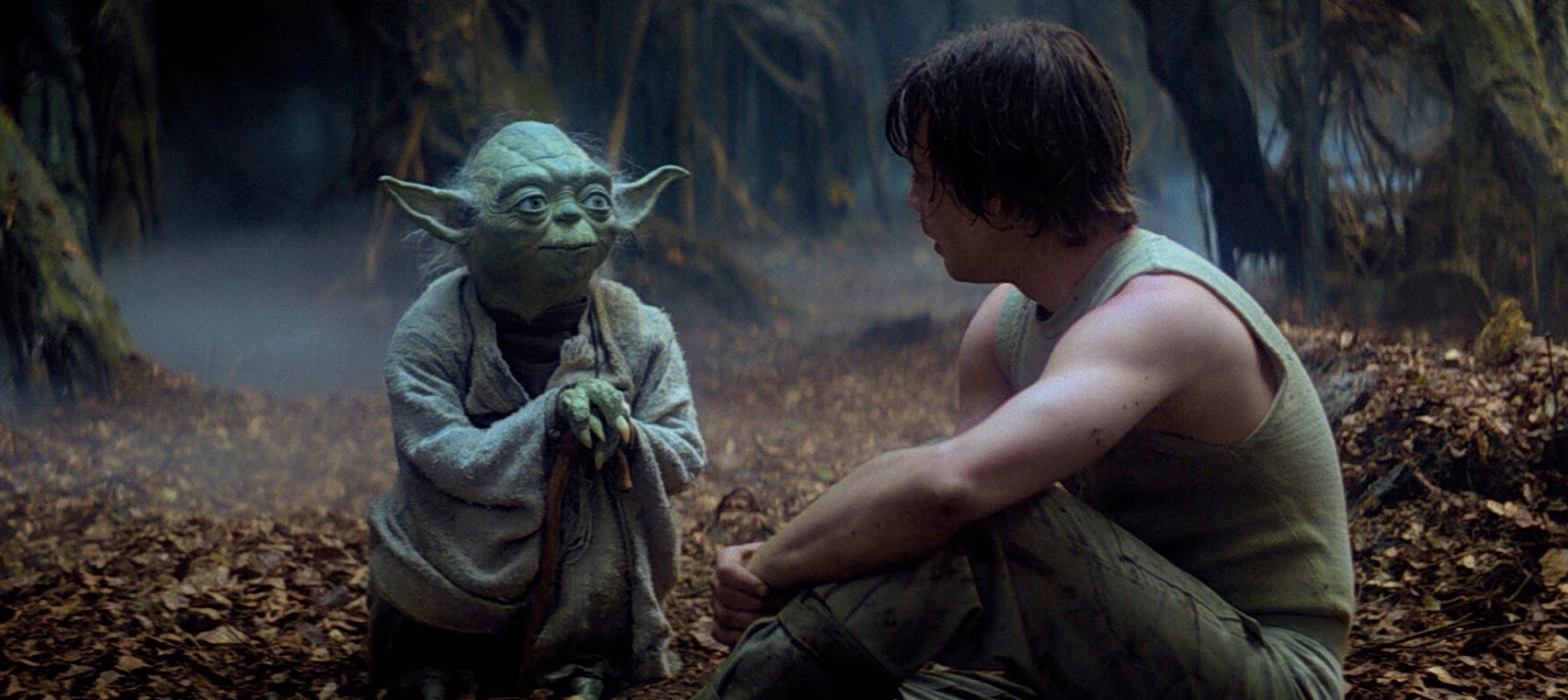
Anyway, nearly everyone must know the story. Some time has passed since the rebels successfully took out that Death Star. Now they are secure in a new base on the ice planet Hoth, being hunted by the empire in an operation commanded by the feared Darth Vader. When the Empire locates the base, our heroes are separated in the ensuing escape: Luke (Mark Hamill) is guided by the force and the ghost of his mentor Obi-Wan (Alec Guinness) to seek out the legendary trainer of Jedi Yoda (Frank Oz). Meanwhile, Han (Harrison Ford) and Leia (Carrie Fisher) are on the run in a malfunctioning Millennium Falcon, dodging Star Destroyers and eventually taking refuge in the Cloud City of Bespin, run by an old friend of Han’s, Lando Calrissian (Billy Dee Williams). But is this a safe refuge? And what is the secret reason why Vader is so determined to hunt down Luke?

So what is it that makes The Empire Strikes Back so damn good? Well it takes everything from the first film and deepens and enriches all the characters and themes that that film explored. While you could say Star Warsis the quintessential romantic space opera – part Western, part fairy tale legend – it’s also a feel-good fun ride. Empireis a rich, complex and endlessly rewarding film that takes all its characters and turns them into fully rounded and intriguing personalities. When you think about the turmoil and struggles each of them goes through in this film – from Luke, through Vader even down to C-3PO – it’s not hard to see why these characters have worked their way into the hearts of every viewer. We see them all go through huge amounts and we learn and discover things about them in every frame. It’s fascinatingly well done storytelling and brilliantly structured character building.

In fact the whole film is a triumph of investment. Even more than the first one, we get a real sense of the mighty ruthlessness of the Empire (staffed exclusively it seems by British character actors from 1970s TV), of its resources, its willingness to do anything. Even more than in the first film, the odds seem piled against the rebellion, with the limited ship, tiny fire power, the fact that our heroes spend virtually the entire film either running, hiding or captured – how can you not feel the pull of wanting to take up this romantic cause eh? 

Perhaps it works so well as Lucas handed over much of the on-the-ground-floor creativity over to other people (you only have the watch The Phantom Menace to see what happened when he took all these reins back up again). The witty, energetic, fun script – packed full of lines that trip off the tongue, and character moments that feel real and human – is by Lawrence Kasdan. Directing meanwhile is handled by Irvin Kershner, a middle-of-the-road director who taught Lucas at film school but here seems to transcend his abilities to deliver a true masterpiece, with all the thrill of a teenager finally given the keys to the big car. 

Kershner can handle all the spectacle, but like no other movie in the series Empire works because it’s rooted in the small-scale, in the reaction shot, in the camera soaking up the actors. There are so many shots of actors looking at things in this movie (I think they all have significant moments of this) while we see their thoughts and emotions play across their faces. Kershner never forgets that this is a story about people not about bangs and whizzes in space. In doing that, in making this a brilliant character drama, he really turned Star Wars into not just an adventure but a series where we invested heavily in these people. There is a reason why the modern films come back time and time to the characters from this film: Empire really made us care about them, turned them into family members, people we’d seen through highs and lows. We see them in a modern film and it’s like greeting long lost friends.

And it helps that the stars give their best work here. Harrison Ford may never have been so cocksure, so cool but also strangely vulnerable and lovable. While in Star Wars he was used to puncture the grandeur, here he’s got a put-upon vulnerability to him, a bravado in his courtship with Leia that hides his touchiness. Not to mention we are constantly reminded he’s a wanted man. Ford also gets massive comic mileage from his exasperation with the constantly malfunctioning Falcon. All this and he never looks flustered: “Never tell me the odds!” indeed! And he gets possibly the best loved line in the whole series with “I know”.

Fisher is equally good as a prickly Leia, who is afraid to let down the imperious commanding cool to let any hint of feeling and emotion show. Mark Hamill does a very easy to overlook job of emotional commitment as Luke Skywalker – particularly as he spends a large chunk of the film interacting only with a robot prop and a puppet. He sells the conflict Luke is feeling, the clash between doing action that feels right now and having the patience to build his skills. And of course, he sells the anguish of finding out that twist.

Ah yes the twist. Empire was perhaps one of the first films to impose such strict pre-production secrecy onto its key plot development. On set, only Irvin Kershner and Mark Hamill knew that Vader was Luke’s father (no spoiler warning – I think Lucasfilm have well and truly spoilt that one themselves). Dave Prowse, who was not trusted to keep it to himself, to was given a line around Obi-Wan killing Luke’s father (he must have been slightly surprised at Hamill’s reaction, which does seem a bit OTT to that news). But this moment again really, really, really works because it is both a surprise AND something that makes total sense. It doesn’t feel like hints have been dropped through the whole film in advance, but when you hear it you spot them all over the place. It’s also such a brilliant narrative rug pull it has also effectively powered the creation of the prequels and is still central to the new trilogy.

Away from all this, the film is also a masterpiece in pacing and action sequences. It took a lot of guts to put the major space battle at the start of the film, but it works an absolute treat – while also being something completely different from anything in the first film. It looks and feels really cool. And it contrasts perfectly with the smaller scale, more intimate desperation of the escape from Besbin that ends the film, matched with Luke’s battle with a never-more-imposing Vader. I’ll also mention as well that John Williams’ score for all these sequences is practically perfect in every way, adding no end of tension, emotion and excitement to all these sequences.

And it’s the fact that you get all this, mixed with a real, genuine investment in all the characters (good and bad), that really makes the film work in a way that no other Star Wars film has quite managed since, and that makes this the crown jewel in the franchise. It’s one of those serendipity projects where everything fell into place, everyone brought their best to it, and the stars aligned. It’s lightening in a bottle, and the franchise has used it ever since as its setter for everything from tone to plot developments. You will rarely find anything as fun, or widely loved, as this film.