
Kurosawa’s dust-filled samurai actioner is a very Japanese Western and huge fun
Director: Akira Kurosawa
Cast: Toshiro Mifune (“Kuwabatake Sanjuro”), Eijirō Tōno (Gonji), Tatsuya Nakadai (Unosuke), Seizaburo Kawazu (Seibei), Kyū Sazanka (Ushitora), Isuzu Yamada (Orin), Daisuke Katō (Inokichi), Takashi Shimura (Tokuemon), Hiroshi Tachikawa (Yoichiro), Yosuke Natsuki (Farmer’s Son), Kamatari Fujiwara (Tazaemon), Atsushi Watanabe (Coffin maker)

An unknown stranger arrives in a dust-filled border town and finds himself stuck in the middle of a long-running feud between two gangs with only his wits and skill with his weapon for any advantage. If you had any doubt about the influence American Westerns had on Akira Kurosawa, look no further than Yojimbo. Perhaps the most purely enjoyable movie Kurosawa ever made, Yojimbo can also lay claim to being one of the greatest Westerns ever made, given greater depth with Kurosawa’s subtle social satire on Japanese samurai culture. This is Kurosawa at his best: stripped-back and dynamic with a weight behind the fun.
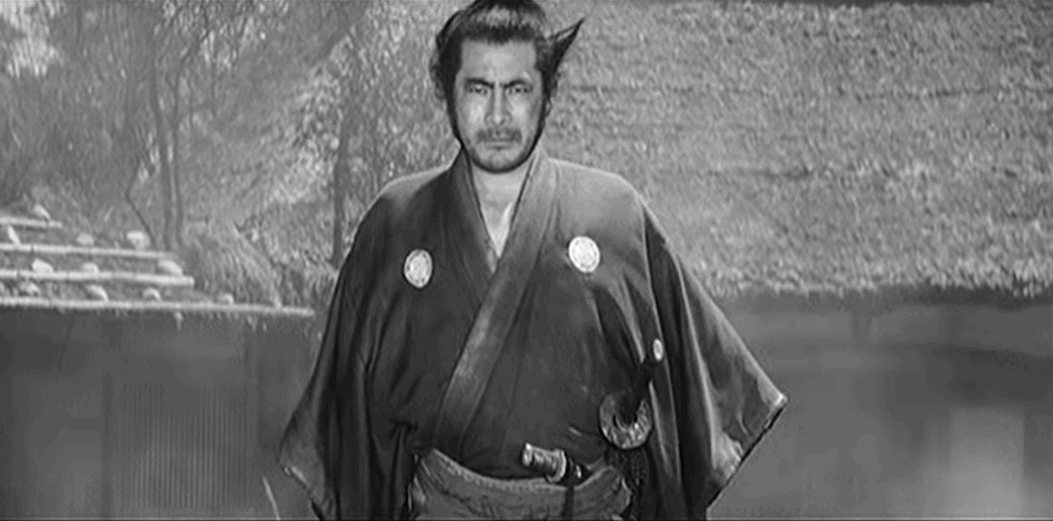
Our unnamed samurai is (Toshiro Mifune), now a wandering ronin. The gangs: on one side Seibei (Seizaburo Kawazu) the town’s long-term boss, whose ruthless wife Orin (Isuzu Yamada) is the power behind a throne she intends to pass to their timid son Yoichiro (Hiroshi Tachikawa). On the other: Ushitora (Kyū Sazanka), Seibei’s former number two furious at being passed over as heir apparent, backed by his brothers, dim but strong Inokichi (Daisuke Katō) and would-be gunslinger Unosuko (Tatsuya Nakadai). The rivalry has bought the town to the edge of ruin and our unnamed samurai – giving himself the spontaneous pseudonym “Kuwabatake Sanjuro” (literally “Mulberry Field aged Thirty”) – use his wit and ingenuity to play both sides against each other to get rid of them.
The Western influences in Yojimbo are immediately obvious. The town looks like a Fordian dustboal frontier towns, Kurosawa delighting in the widescreen, windswept streets the site of so many slow-burn face-offs. Rivals meet on main street, facing each other at opposite ends, like High Noon. Seibei operates out of a worn-out brothel, Sanjuro stays in a saloon run by a weary old-timer, a local sheriff is a hopelessly inept foreluck-tugger, Sanjuro has the same gruff excellence with a sword as John Wayne and Alan Ladd had with a gun. By the time Unosuko turns up clutching the town’s only gun and preening like Jack Palace in Shane, it’s impossible to miss we are in the Old Japanese West.
This is a town in total breakdown, where the coffin-maker makes a huge income creating piles of tombs for the rival gangsters who fall in constant duels. Both gangs are in, their way, pathetic. Far from intimidating, Seibei (a hilariously whiny Seizaburo Kawazu) is a puffed-up old man, easily brow-beaten by his wife. Unosake has more swagger and guts, but he’s as cluelessly inept as Seibei. Both gangsters have crews stuffed with fighters but lack almost anyone with any actual skill. When the gangsters are first manipulated into facing-off, they posture and feint at each other like blow-hard school bullies then seem relieved when the arrival of a local official leads to a sudden ceasefire.
Parodying the old Samurai class, Sanjuro is a million miles from the sort of elite honour-bound soldier we expect. In one of his finest performances, Toshiro Mifune is scruffy, cynical and works very hard to give the impression he’s more interested in his immediate needs than any higher purpose. Mifune is gruff, constantly scratching or chewing: he’s a prototype Clint Eastwood (and Yojimbo was ripped off by Leone for A Fistful of Dollars, leading to a Toho Studios legal case), a morally ambiguous figure who does the right thing when it coincides with his own interests. His motives are unknowable. Why does he set-out to destroy both gangs? Is it sympathy for the mess of the town, or is it because he sees a chance to make a quick buck from the mess? Is it because he’s bored (and eventually annoyed) and does it for his own amusement?
The brilliance of Mifune’s shaggy-dog performance is that it could be all or none of these things. Sanjuro does just one, unmistakeably, decent, selfless thing in the film: saving Ushitora’s unwilling mistress and her downtrodden family. What does it get him? Their near suicidal deference and ostentatious gratitude drives him nearly to distraction and leads to a near-fatal beating. But it really rankles Sanjuro because it’s possible he despises the idea of decency in himself, an intriguing insight into what could be unknown darknesses in his past. Does he know selfless acts can become the only chink in your armour?
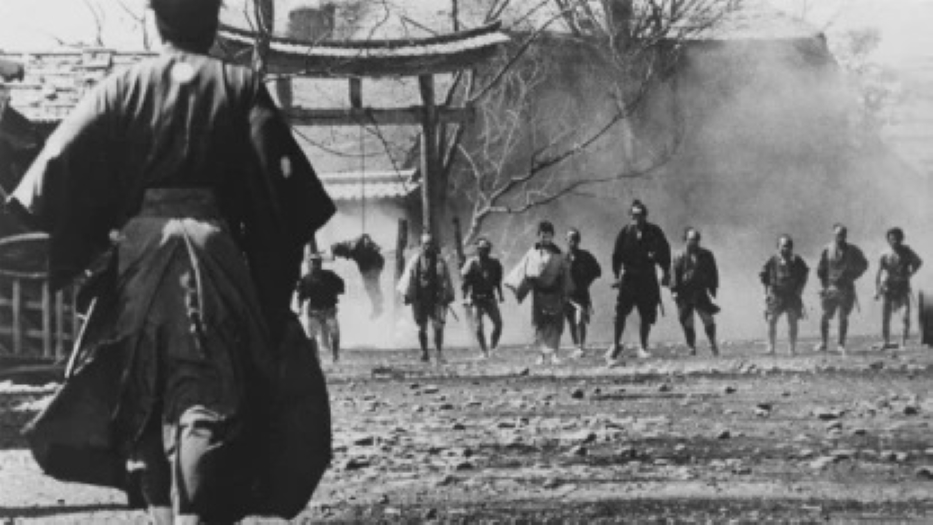
Aside from that, his mastery of the situation is hugely entertaining. Never mind two steps, he seems a marathon ahead of the rest. Provoking a pointless early clash with Ushitora’s heavies, he bests them in seconds with a series of lightning fast sword strokes (Star Wars Mos Eisley-based Kenobi swordplaywas clearly inspired by this), establishing in seconds he’s the alpha both sides need to compete over. When action kicks in, Sanjuro is unmatched by the Dickensian collection of street thugs both sides have amassed, his swift reflexes and expert slices reducing even a hideously outnumbered fight into a curb-stomp clash. You can see Kurosawa’s influence over Leone here: clashes in Yojimbo have long build-ups and explosive, sometimes violently bloody outcomes (an arm severed here, a spray of blood there, characters bleeding out).
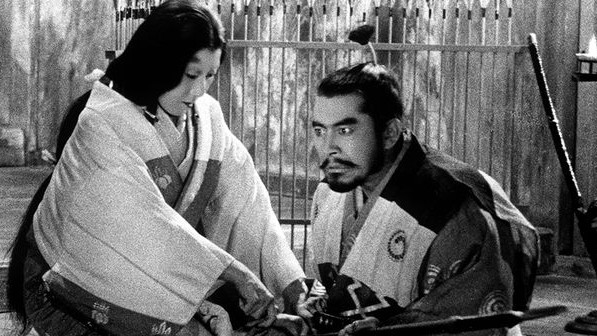
But Sanjuro’s other skill is his ability to appraise rivals instantly. None of them disappoint in their transparent greed and shortsightedness. Kurosawa visually embodies Sanjuro’s shrewdness by frequently having him climb up a tower platform on the main street to literally look down on the results of his manipulations. No one can match him. Orin – a pleasing twist on her Throne of Blood role as an ineffective Lady Macbeth by Isuzu Yamada – thinks she’s smart enough to double-cross him, but her brains only look impressive matched against the mediocrities of the town. Daisuke Katō’s Inokichi – so dim he can’t even count with the aid of his fingers – literally believes anything he’s told by the last person who spoke to him. Only Tatsuya Nakadai’s smug Unosuke is in anyway threat, but he’s a preening show-off whose only qualification for being the toughest guy in town is because he owns the only gun (which he can’t help fetishistically stroking at every opportunity).
The gun is another sign of a culture at crossroads – the major threat to Sanjuro comes not from any human, but from a distance-killing tool that could wipe out his vastly superior tactical and fighting ability in a second. Yojimbo is showing us a Japan tipping over the edge into a future where ruthless gangs, with more brawn than brain, will drive towns like this into the ground – but our hero, a symbol of a bygone age of heroics, isn’t traditionally heroic either: he’s a scruffy, self-interested loner, who despises nobility. Our other samurai, Seibei’s pet-trainer, is hardly a great advert for samurai either, peddling his skills for cash and huffily walking out when his value is not recognised.
All this is wrapped up in a film that is undeniably hugely entertaining. The action, when it comes, is truly exciting. Mifune is superb, charismatic, likeable with a wry charm and scruffy smile. Kurosawa’s dust-blown pseudo-western is brilliantly assembled, and its wry social satire on an increasingly disorganised Japan falling into chaos (with a golden age that wasn’t that golden behind it) never buries the thrills and spills of his masterfully constructed action drama. Yojimbo is certainly his most purely entertaining film, stripped back and avoiding the overindulgence and bombast of his less successful films. It’s a treat.
 Movie Musings