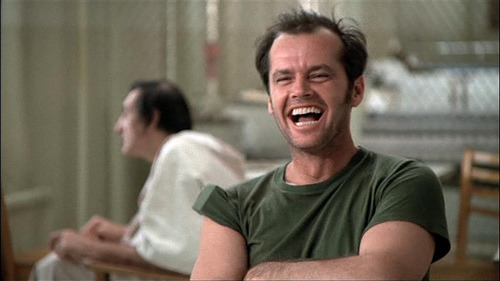
Tag: Jack Nicholson

One Flew Over the Cuckoo's Nest (1975)

Jack Nicholson is superb as McMurphy in One Flew Over the Cuckoo’s Nest

Director: Milos Forman

Cast: Jack Nicholson (Randle P McMurphy), Louise Fletcher (Nurse Ratched), Will Sampson (“Chief” Bromden), William Redfield (Dale Harding), Brad Dourif (Billy Bibbit), Sydney Lassick (Charlie Cheswick), Christopher Lloyd (Max Taber), Danny DeVito (Martini), Vincent Schiavelli (Bruce Frederickson), Dean Brooks (Dr John Spivey), William Duell (Jim Sefelt), Scatman Crothers (Turkle)

One Flew Over the Cuckoo’s Nest is one of the landmark films of the 1970s, one of those films that’s on everyone’s list for great masterpieces. It lifted all five of the Big Oscars (Picture, Director, Actor, Actress and Screenplay), one of only three to do so. It’s widely loved for its celebration of rebelliousness and individualism, but there is more to the film than that. It’s as interesting for the things it doesn’t explore as much as the things it does.

Randle McMurphy (Jack Nicholson) has himself sent to a mental institution rather than a prison farm, under the belief that serving his time in the institution will be far easier than doing hard labour. However, he finds the ward he is locked into is under the authoritarian control of Nurse Ratched (Louise Fletcher), a passive-aggressive bully with a strict interest in the rules at the cost of all humanity. The inmates are cowed, but McMurphy encourages them to express themselves and seize their freedoms – little realising that his freedom is dependent on being signed off by the doctors, not the length of his original short sentence, and he has made no friends in the hospital authorities – or that Ratched is determined to break his influence over the other patients.

Forman was a perfect choice for directing a film that directly echoes his own iron-curtain upbringing. OFOTCN is a film that celebrates the freedom of the individual – but also recognises that authority and the state always wins out in the end. The hospital ward is cold, oppressive, a white-lined world where Ratched observes and quietly controls everything from her booth, softly issuing directives that carry a quiet menace. The film rotates around clashes between McMurphy wanting to do his own thing and Ratched stridently reinforcing a fixed hospital agenda. At one point Forman’s camera tracks from McMurphy on the basketball court, up to Ratched watching behind a full length window like an imposing Stasi officer. Forman totally understands the struggle of expression and free will in oppressive regimes, and it’s this that has given the film such a rich life – who doesn’t want to land on the side of freedom?

It helps as well that representing freedom we have possibly Jack Nicholson’s finest performance as McMurphy. A roaring, bubbling, manic, burst of nature, an impish anti-authority figure who rips through every scene with intense energy. It’s a marvellous, inspiring performance. And it makes McMurphy exactly the sort of rebel without a cause we would like to be, the guy who can inspire and lead through force of will alone, who refuses to be cowed or crushed. 

Nicholson’s performance however is a perfect mixture of larger-than-life drama and moments of reflection. The film splices in a few conversations between Nicholson and the doctors that, over the course of the film, change more and more from spry defiance and mockery towards a quieter, more despairing resignation as he slowly begins to realise how trapped he is. Not that he wants to show any of that to his fellow inmates, or to Ratched with whom he keenly engages in a battle of wills.

Ratched herself is exactly the sort of cold, rules-bound, inflexible authority figure we are naturally placed to hate. Louise Fletcher is wonderful, with her softly spoken iciness matched with certainty about her moral position. Is she even interested in curing the patients? Her focus seems to be completely on controlling and running the patients’ lives rather than changing the status quo. 

This battle of wills drives the film, but it’s interesting as well for what it tells us about McMurphy. He seems to have no understanding of the fact that, while his fellow inmates are cowed, they are all to some degree mentally ill and certainly all frightened and unpredictable. McMurphy sees them as people who need to be encouraged to seize their own destinies, but these are people who are incapable of really understanding what McMurphy is trying to do or have any interest in it. He shakes up their world, but has little real impact on them in the long term.

It’s not a film that engages in any great understanding of mental illness, but suggests that perhaps McMurphy and Ratched are in their own ways as insane as the people they are fighting over in the asylum. McMurphy is a self-destructive force who pushes for small things with huge passion, but then drifts through the major things. He acts without thinking and doesn’t try to understand the people around him. Ratched meanwhile is so obsessed with controlling her own small universe, she has defined her entire life around her governance of the ward.

The film has a slightly troubling relationship with women – which is not necessarily a criticism, but an observation since the film’s only prominent female character is Ratched and all the inmates are men. The things that Ratched stops the men from doing are the sort of typically “male” activities that McMurphy delights in – gambling, sports, girls – while McMurphy himself is (in what is the only truly dated moment in the film) in the slammer partly for having under-age sex with a girl, which he eagerly describes to his doctor. McMurphy pushes all the inmates to become more like the sort of man he understands men should be, and while it is a freedom of expression, it’s also one that has little place for women in it, other than as sex objects.

But that’s not the real aim of the film, so you can forgive it. McMurphy is not an intellectual or a man on a mission, he’s an unthinking burst of energy that burns up the world around him and demands the freedom to not be told what to do. That’s what gives the film its real emotional impact and why it spoke so much to Vietnam era America, and continues to speak to us today. And of course it’s linked to the fact that the film is a massive tragedy.
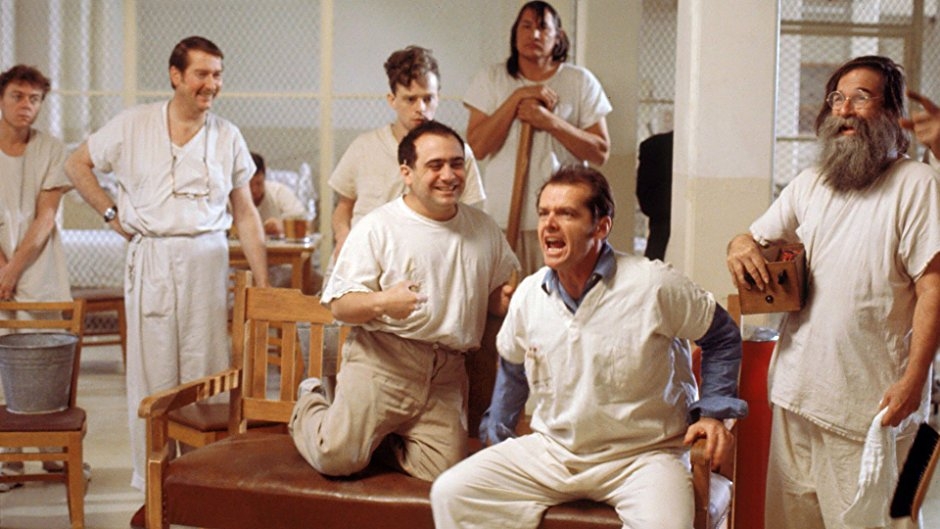
Because in the end the forces of oppression do win and McMurphy’s spirit is crushed. Sure McMurphy more than contributes to his own failures – he allows his own to drift away, and his pushing of his own agenda of what he feels men should want dooms poor Billy Babbit (a stuttering slice of timidity played by Brad Dourif). The film has a Pyrrhic victory in his inspiring the “Chief” (William Sampson), a giant native American flying under the radar by pretending to be deaf and dumb, into carrying out McMurphy’s dreams.

But for our hero it’s a bust. Forman’s film is a brilliant celebration of the energy and futility of lords of misrule like McMurphy, with a commanding performance from Jack Nicholson that’s one for the ages. A wonderful piece of ensemble playing in a set that becomes a metaphor for oppressive regimes, it’s remained remarkably undated and a force to be reckoned with on any top ten list.
The Passenger (1975)

Maria Schneider and Jack Nicholson hit the road in Antonioni’s partly frustrating, partly masterful The Passenger

Director: Michelangelo Antonioni

Cast: Jack Nicholson (David Locke), Maria Schneider (The Girl), Ian Hendy (Martin Knight), Jenny Runacre (Rachel Locke), Charles Mulvehill (David Robertson), Steven Berkoff (Stephen)

Ever wanted to jack in your life and have a go at being someone else? It’s a temptation we’ve all felt at one time or another, that chance to make a completely fresh start free of all those burdens and expectations of our own lives. 

It’s a temptation thrown in the way of David Locke (Jack Nicholson) a British-American journalist, trying to make contact with rebel groups in the deepest Sahara deserts of Chad. Returning, after a failed excursion, to his ‘hotel’ in the tiny, beat-up village in the middle of the desert he finds that the only other resident, an Englishman, has died of a heart attack. The two man have a physical similarity, enough for Locke to decide to swop places with the dead man and leave Chad under a new identity as David Robertson. Curious to follow the details left in Robertson’s appointment diary, Locke finds that he has taken the identity of an arms dealer – making sense immediately of why Robertson was also in the hotel at the time – forcing Locke to stay one-step ahead of both the arms dealers and his wife Rachel (Jenny Runacre) and producer Martin (Ian Hendry) keen to talk to him about ‘Locke’s’ death.

If that sounds like it might be an action packed thriller – you’d be wrong, because let’s not forget that this is an Antonioni film, and if there is one thing you can expect from the revered auteur of the Art-House, it’s that his films are mysteries wrapped in enigmas. The Passenger is no exception, a slow, intriguing mood piece that only partially allows the audience even half a chance to puzzle out what it’s about, mixed with striking images and haunting sequences of fundamental unknowingness. Despite the paragraph above there is almost no plot in The Passenger, with the film instead focused on themes of alienation, existentialism, destiny, fate and identity. In other words all the big stuff.

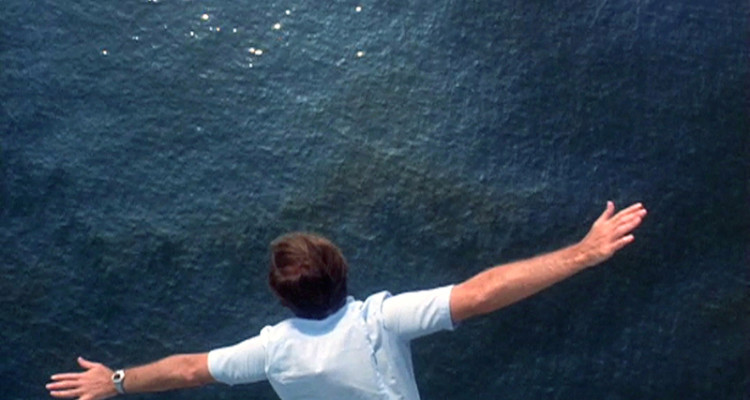
Much of this is captured in the character of Locke. Played by Jack Nicholson in a stripped-down, purged style a million miles away from the “Jack” of legend, Locke is a blank. We spend almost the entire film with him, but learn virtually nothing about him. What desires or miseries or depressions drive him to abandon his life and head out into a new life? We have only vague whispers about an unhappy marriage (with a wife having an affair with someone else) and a general listless dissatisfaction with his own life and career. Locke is a character yearning for some kind of release, some kind of higher meaning – the happiest he seems to be in the movie, is hanging over the side of a cable car, arms outstretched, pretending to fly over the waters below. It’s a freedom like that – some sort of total unshackling from the modern world altogether – that he seems to want or need.

So why doesn’t he go for it? Why doesn’t he just junk Robertson’s appointment diary and escape properly into the wide world, well beyond the reach of Chad rebels, curious wives and BBC Producers? Perhaps because he is a Passenger himself, a man who lacks the essential will and freedom of purpose to make his own destiny, to escape the structure of a world he finds so constricting? Instead, he seems bound of a wheel of fire, compelled somehow to continue following some sort of structure unable to yank himself fully free of the chains of this modern world. He wants to be a free spirit, but he remains a little man, to whom events happen, who is approached by people, who follows directions not forging his own path.

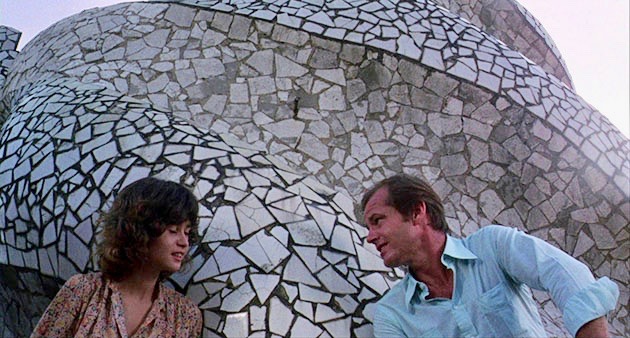
He gets as close as he can to opening up by talking to a passenger of his own, a mysterious girl (played with an unaffected naturalness by Maria Schneider that is part graceful reality, part wooden stiffness but works perfectly) he encounters while following Robertson’s trail. He first spots her sitting on a bench in London, then sees her again atop Guadi’s La Pedrera in Barcelona. Is this coincidence? Is this fate? Destiny? Or is this a curious suggestion that the girl may be more than she seems? None of these questions is answered by the film, but it fits perfectly in with the unknowing vagueness and quizzical unpredictability of its events. Hammering home the blank unknowability of Schneider’s character, she isn’t even named in the film. She joins Locke on his journey, but her motivations are as vague as his – is it escape, a bohemian lark, a curiosity that guides her? Who knows?

The film continues in this vein, showing Locke drifting from Chad to the UK to Berlin, Barcelona and Seville, never seeming to allow Locke more than a few seconds of freedom. Is the film asking if there is any such thing as true freedom, that even after swopping lives Locke still finds himself locked down into following a series of pre-arranged duties, like a train on a line? It’s not clear, but it’s beautifully filmed. Antonioni’s mastery of the camera shines throughout the film, and it’s full of haunting and immersive imagery, not least in his skilful use of locations and framing, with Locke and the Girl frequently positioned oddly or even dwarfed by the architecture and locations around them, from the plains of the desert to the towers of Gaudi.

Antonioni also saves for this film some sequences which are simply breathtaking in their cinematic mastery and beauty. His control of technique is near faultless – while his art house vagueness might have you pulling your hair out at points, these sequences will have you winding the film back just to relax in their skill and confidence again. Early in the film, we see Locke sit and fake his passport in his Chad hotel – oh for the days when identity theft was as simple as glueing a new photo into a passport – the camera smoothly moves around him, while he listens to recordings of Robertson and he meeting, until it settles onto the balcony (all this in one take) at which point Robertson walks into frame and continues the conversation, Locke following him and, there we go, Antonioni has taken us suddenly into the past. Without a single cut, the camera follows the conversation before panning back round to Locke sitting once again writing.

It’s a sequence that cineateases would be raving about, if it wasn’t dwarfed by the film’s penultimate shot, a stunning seven-minute single take that would be simplicity itself to make with CGI and Steadicam today, but was somewhere achieved without the invention of others. Starting on a single shot of Locke’s Seville hotel room, the pan slowly focuses on events outside the grilled window, the camera slowly zooming in on the outside until it passes through the grill and rotates 180 degrees back to see the room from the outside, while the Girl and other mysterious people arrive and leave outside. It’s a beautiful, brilliant, sublime, masterful piece of cinema. It’s compelling, surely one of the greatest “one-take” shots in all of cinema. Simply perfect. Directors could sit and dream of making such a shot. 

Antonioni’s masterful direction and wilfully obtuse exploration of his themes makes for a film that is at time frustratingly unreadable, but also crammed with opportunities for the viewer to insert their own views and interpretations, something that is only going to become more tempting (and rewarding) with repeated viewings. Alongside that, it’s a simply beautiful and sublimely made piece of cinema – and if for no other reason deserves your time.

About Schmidt (2002)

Jack Nicholson is superb as beaten down Warren Schmidt in About Schmidt

Director: Alexander Payne

Cast: Jack Nicholson (Warren R Schmidt), Kathy Bates (Roberta Hertzel), Hope Davis (Jeannie Schmidt), Dermot Mulroney (Randall Hertzel), June Squibb (Helen Schmidt), Howard Hesseman (Larry Hertzel), Len Cariou (Ray Nichols)

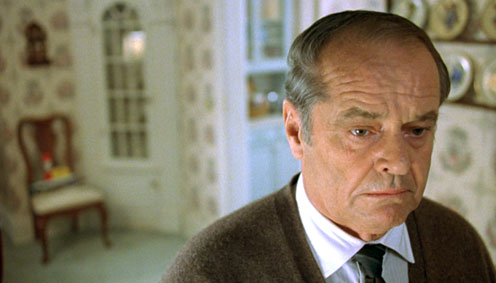
When you think about About Schmidt, it’s almost impossible not to think about Jack Nicholson. For so long Nicholson has been JACK, a personality so large, so present in the public conscious as the ultimate raging lothario, that most of his performances have been unable to escape it. He has blasted through so many films as a force of nature that what’s almost most surprising about About Schmidt is that Nicholson is so feeble, worn-out, uncharismatic and beaten down in the lead role. Did I also mention he was brilliant?

Nicholson is Warren R Schmidt, a recently retired actuary with an Insurance company in Omaha. As a young man he dreamed of a golden future, but his life has been one of crushing mundanity and boredom (albeit, I will say, clearly very well paid!). Schmidt has become a cowed, average, hollow man – the sort of man who urinates sitting down because his wife insists he does so and whose idea of defiance is to pop out for a milkshake. After his wife (June Squibb) suddenly dies, he is forced to deal with the fact that he is actually largely estranged from his idealised daughter Jeannie (Hope Davis) and that he despises her decent-but-no-hoper fiancée Randall (Dermot Mulroney). Can he make her abandon the wedding?

Alexander Payne has excelled in this style of film: a slightly off-centre social comedy with a mix of a lemony sharpness, satirical wit and genuine warmth for its characters. He perfectly captures the hopes and dreams of small-town America and the trap of mediocrity and disappointment that these sort of suburban, unremarkable lives can have. About Schmidt does this brilliantly, by counterpoising the Schmidt’s feelings of depression and being trapped with the clearly empty dreams of his daughter’s would-be husband. Not to mention taking shots at the overbearing try-too-hard irritability of Randall’s bohemian family (who seem to celebrate the very failures Warren believes his life has been made of).

Payne works in perfect synchronicity with Nicholson, keeping all the actor’s OTT gestures and mannerisms well in check and pushing him to create a quiet, timid, worn-out man who is beginning to reflect (with some bitterness) on what his life has been and been to suspect (with some dread) what it might be for his daughter. Nicholson’s comic timing and his sense of empathetic sadness are both absolutely perfect. The film uses a brilliant device to let us hear Schmidt’s inner monologue via his writing a series of letters to the African child Ndugo he is sponsoring (hilarious in that he unleashes on this no doubt uncomprehending young boy a series of bitter, reflective and sad cries from the heart).

The film is about the disappointments of life, but each point is told with a dark or wry humour. From Schmidt’s retirement party (an event that everyone seems to attend only out of duty) to the death of his wife (who collapses mid hoovering) there is a dark sense of humour throughout. Nicholson plays these moments with a world-weary sadness that keeps the character grounded. At other moments, he can let rip with a more overt comic touch as he struggles with the distaste and alarm he is far too polite to show as he stays with Randall’s bohemian family (Kathy Bates is very good as the matriarch of this clan, a woman whose laissez-faire attitude is a front for her tyranny).

The film’s plot is brilliantly simple, and is fundamentally about how far Schmidt can go in re-evaluating and re-claiming his life, giving his final years (with his actuary head on he believes he has between 10-12 years left) some sense of individuality. These attempts rotate from sad starry-night imagined conversations with his late wife to awkwardly comedic encounters with a nice couple at a camping site, whose signals he completely misreads. Schmidt is angry – and those moments when it bursts out to Ndugo are hilarious – but as much with himself as anyone else. After all, who do we have to blame more than ourselves? 

Schmidt isn’t even a bad guy. He’s spot on about Randall, a decent enough guy but a hopeless businessman and incompetent chancer. A large chunk of the film’s final act hinges on us knowing that Schmidt is right, knowing that is daughter is making a huge mistake, but also knowing that we’d be as powerless about it as Schmidt is. Because the film, in its darkly comic way, is saying that nearly all of us are on this treadmill – and that nearly all of us can see that others are as well – but we can’t do anything about it or help them get off. We can only watch the gears shifting on.

It’s a brilliant, thought-provoking film, very funny in places – and Jack Nicholson gets to remind us all that he a marvellous, clever and subtle actor, in one of his finest performances since the 1970s. Nicholson’s control and likeability are vital to making Schmidt someone whom we warm to and pity, even while he frustrates. And Payne’s wonderfully directed, empathetic story illustrates a life of tragedy without meaning and dreams, but never scoffs at those who lead them – instead it’s only wistfully sad for what might have been.

The Last Detail (1973)


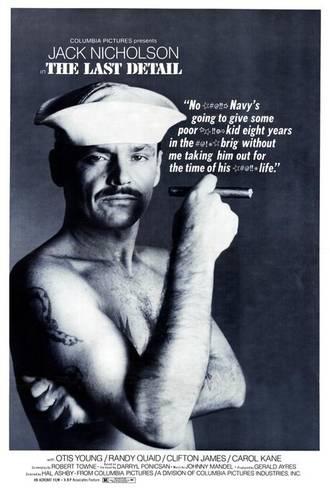
Randy Quaid, Jack Nicholson and Otis Young are sailors on a wild week in the classic The Last Detail

Director: Hal Ashby

Cast: Jack Nicholson (Signalman Billy Buddusky), Otis Young (Gunner’s Mate Richard Mulhall), Randy Quaid (Seaman Laurence Meadows), Clifton James (MAA), Carol Kane (Young Prostitute), Michael Moriarty (Marine Duty Officer), Nancy Allen (Nancy), Luana Anders (Donna)

When you see Jack Nicholson in a film from his late period – basically the 90s onwards – it’s easy to wonder what all the fuss is about. It’s sometimes hard when you see him eating the scenery to remember that in the 1970s Nicholson did a run of such mighty, landmark performances that he basically earned the right to do what he wanted for the rest of his life. The Last Detail is an often overlooked classic from the 1970s – and Nicholson is simply outstanding in it.

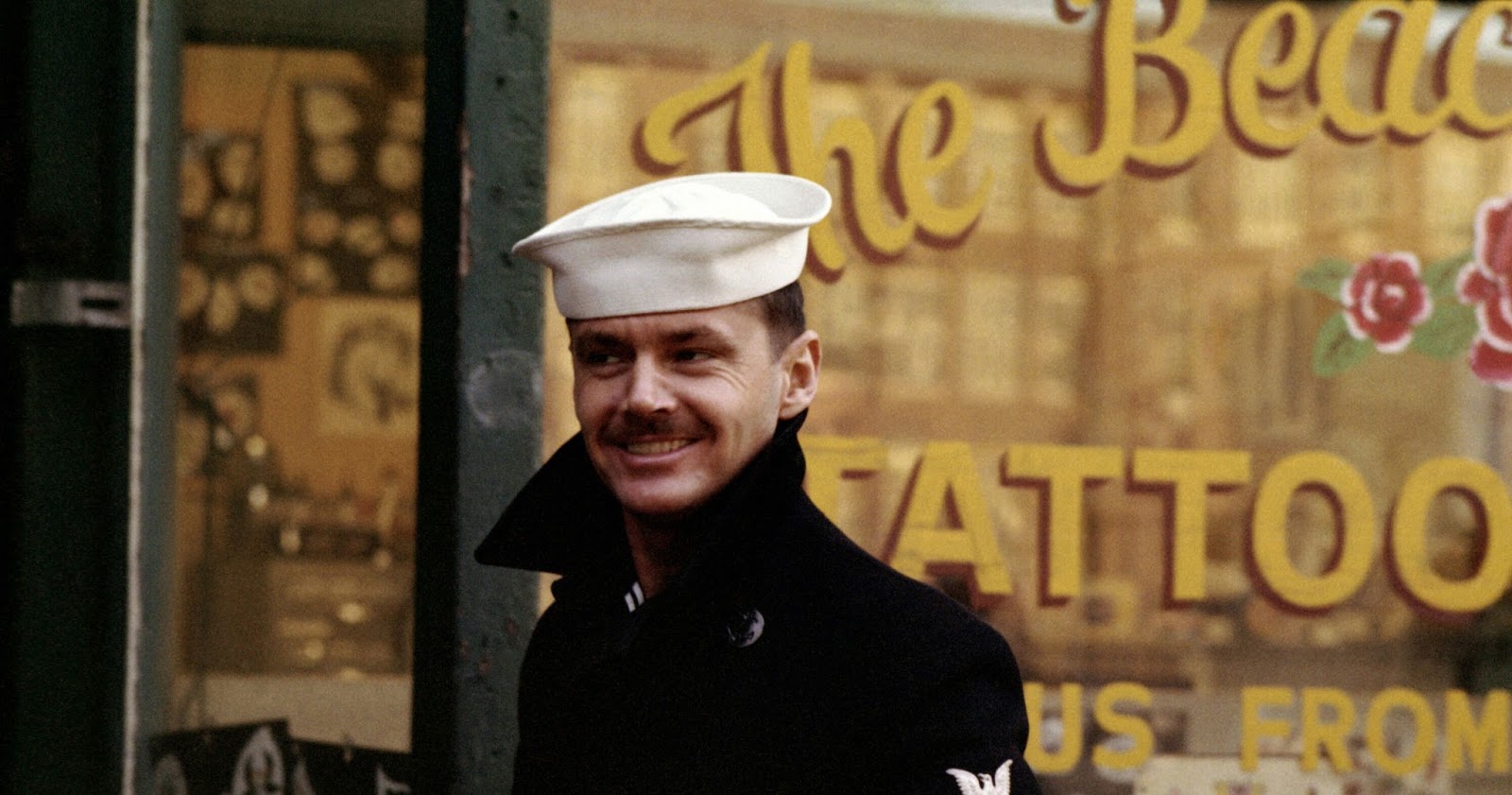
Buddusky (Jack Nicholson) and Mulhall (Otis Young) are “lifers”, career sailors who are ordered to take a young sailor, Meadows (Randy Quaid), from Virginia to Portsmouth Naval Prison in Maine. Meadows will serve eight years for stealing $40. Given a week to make the journey, Buddusky and Mulhall at first plan to get Meadows there as soon as possible so they can have a leisurely return and spend their per diems on a blow-out. However, feeling sorry for Meadows’ harsh punishment and lack of life experience, they decide instead to take their time on the journey and show Meadows a good time – including drinking, whoring and general hi-jinks.

The Last Detail is a brilliant slice of 1970s filmmaking, an episodic road movie with a script to die for and a simply superb performance from Nicholson. Hal Ashby’s film is both a celebration of the rebellious attitudes of the 1970s and a sad acceptance of their failure. It’s a heartfelt film where we discover and understand more and more about each character and find out more about the age as well. It’s also a lovely story of bromance – of three men who come together, find themselves developing a very close bond, but are trapped by the rigid organisation they are part of.

The film is completely Nicholson. This is the sort of tour-de-force that cements him in any list of the greatest screen actors ever. It’s just a marvellous performance, near perfect. Buddusky is the ultimate impotent rebel, a man with a natural rough leadership quality over those at his level, but who basically lives within a societal prison that he can’t really imagine breaking free from. Buddusky will let rip – never better than the marvellous sequence where he erupts against a racist barman who also refuses to serve the underage Meadows (“I am the MOTHERFUCKING SHORE PATROL” he suddenly screams, after almost a minute of slow tension build-up) – but he’s also quiet and thoughtful. Watch Nicholson’s reaction shots when he listens to Meadows reminisce on his childhood dreams of being a vet. What a masterclass of quiet acting – Budduksy is enchanted, irritated, sad, bored, confused, moved – all at once and more. 

Buddusky feels a brotherly affection for Meadows – perhaps also, a reflection of his own sense of being trapped. Nicholson alternates between affection and frustration with a touch of self-loathing. At one point during a drunken night at a motel, he demands Meadows punch him out, because he is the one taking him to prison. Meadows refuses – sweetly these guys are the best (only?) friends he’s ever had – Buddusky reacts by punching a cupboard repeatedly in fury. Later, during a fumbled sexual encounter for Meadows with a prostitute, he is kindly and understanding. It’s a fascinating performance of frustration, confusion and unaimed anger. There is nothing he can’t do.

Young is excellent as Mulhall (there is a great sequence where Mulhall berates Buddusky for his risky attitude, revealing Mulhall’s basic conventional outlook), while Quaid’s Meadows is an endearingly innocent figure: a kleptomanic with no friends, a sad family background (a visit to his abandoned family home reveals his mother to be an alcoholic), a sad, lonely boy who (unwisely) looks to a prostitute for emotional connection, and holds an unfulfilled dream of becoming a Master Signalman. He still takes on the others’ confidence through – just watch how Meadows grows in assurance as the film goes on. All three of these actors spark off each other brilliantly.

Ashby’s camera drifts gently, allowing the actors a great deal of freedom. Ashby shot the film in chronological order which works brilliantly – not least in that you see Randy Quaid grow in confidence as an actor just as the character emerges from his shell. Scenes are allowed to loosely continue, often past the point you might expect, which really allows the actors to breathe and the characters to grow: scenes of the characters drinking (rather feebly) in a carpark (as they can’t get into a bar) feel organic and almost improvisational. Ashby uses a lot of dissolves and fades to mark the passage of time – often in the middle of conversations to move us from one point to another – which also work really well.

This works perfectly for Nicholson, as it allows us to learn more about Buddusky’s shallow rebellion. Buddusky may rail against the oppression of the navy but he’s totally reliant on the grounding it gives him. Mulhall is more open about this – as a black man, it has given him some standing and a steady income to support his mother – but Buddusky is adrift in the real world. Watch him flirting with a college girl at a party. He’s hopeless, falling back on how navy work is man’s work, repeating it several times like a mantra before a crude joke. Nicholson’s first introduction is him (hungover) telling a soldier where his superior officer can stick his summons. Next time we see him, he’s arrived to see that officer. Buddusky badmouths everything and boasts of being “a badass” all the time – but every time he’s with an officer Nicholson seems to shrink and clam up. He can rebel only in words, on his downtime. On the clock he just has to fit in with the rest.

Part of the visual genius of the casting is Young and Quaid are both over six feet, making Nicholson look smaller and stunted. It’s a really neat visual metaphor for his sense of rebellion. He and Mulhall may bitch and moan about the injustice of the navy – but there is never really any question that they won’t carry out the task they are doing. Neither man has any real aim or goal in life, nor any particular insight or any plan. They just want not to be told to do things they don’t want to do. Meadows is off to prison – but Mulhall and Buddusky are also “lifers”. They ain’t going nowhere. They might not always like it, but they’d rather do that than drop out – when they meet genuine counter-culture types, none of them can understand or relate to them at all.

But the film is not depressing – it’s actually rather moving and lovable – because the bromance between the men is so well drawn. They grow to care a great deal for each other. They may not always have much in common, but they clearly have a whale of a time in each other’s company. The laughter feels genuine and grows from the actors’ own obvious rapport – I’m pretty sure they are near corpsing a few times – and it’s infectious. There is a dream-like freedom to the film – for its duration, reality is suspended and they can be free. They’re like children allowed out of school for the day. It’s hugely, engrossingly enjoyable and moving.

The Last Detail is a simply brilliant film. Ashby is a partly forgotten film maker, but films like this have a quiet, unflashy poetry to them. Robert Towne’s script is perfect – foul-mouthed and barbed, but full of unexpected emotional depths and beautiful character beats. Young and Quaid are excellent – but oh man Nicholson. He is so good in this film, it has to be seen to be believed. He is a living, breathing force of nature – he burns up the screen, but it never feels like showmanship. He’s sublime – it might be his greatest ever performance. And this is a great film that, in demonstrating the weakness of the rebellious feelings of the 1970s, might just understand that era better than many other films. An overlooked masterpiece – you should make it your mission to seek it out.