Tag: James Donald

The Great Escape (1963)

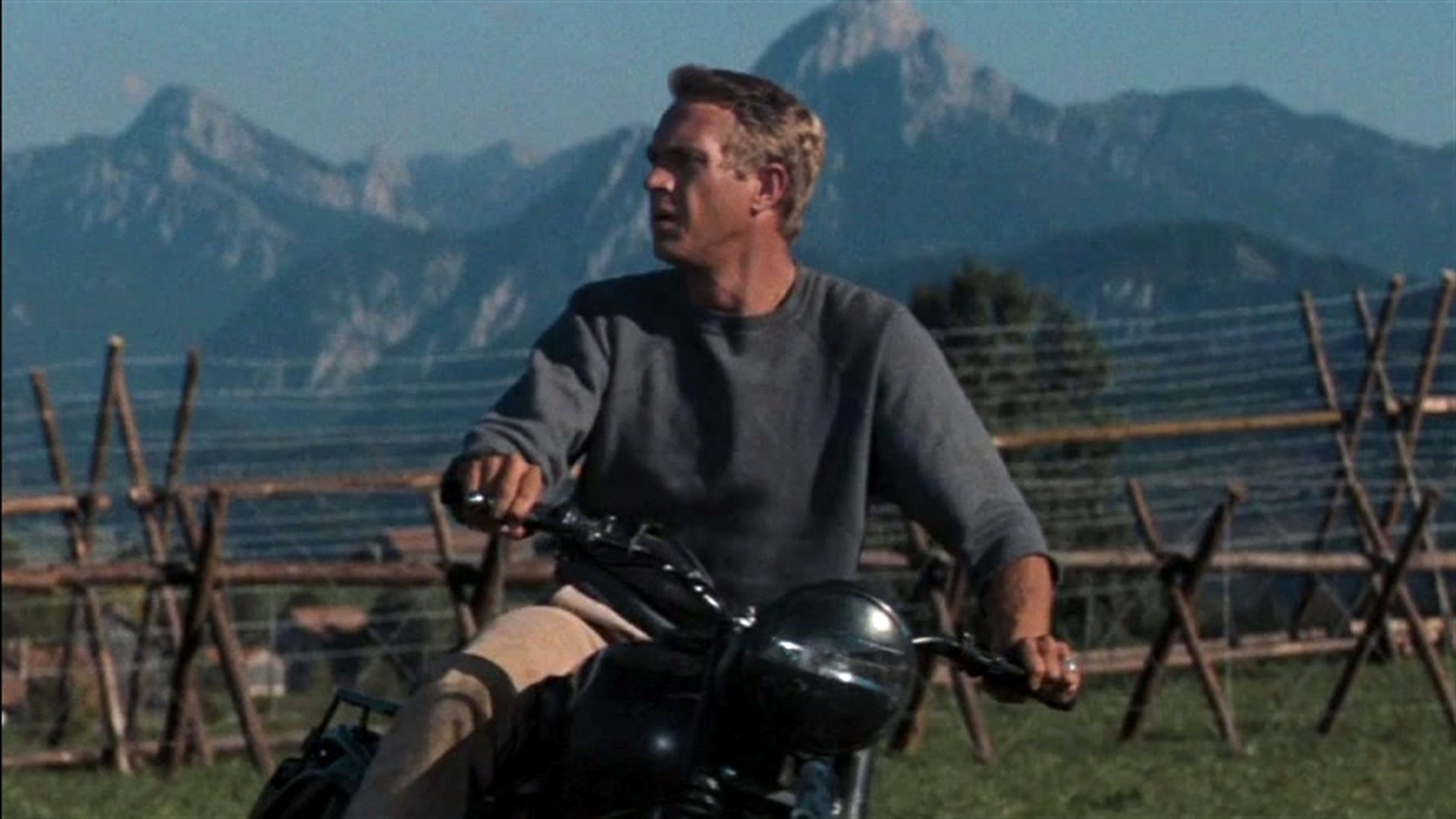
Steve McQueen is the Cooler King (King of Cool?) in The Great Escape

Director: John Sturges

Cast: Steve McQueen (Captain Virgil Hilts), James Garner (Flight Lt Bob Hendley), Richard Attenborough (Sqd Leader Roger Bartlett), James Donald (Group Captain Ramsey), Charles Bronson (Ft Lt Danny Welinski), Donald Pleasance (Flt Lt Colin Blythe), James Coburn (FO Sedgwick), Hannes Messemer (Oberst von Luger), David McCallum (Lt-Commander Eric Ashley-Pitt), Gordon Jackson (Ft Lt Andy MacDonald), John Leyton (Ft Lt Willie Dickes), Angus Lennie (FO Archie Ives), Nigel Stock (Ft Lt Dennis Cavendish), Robert Graf (Werner)

Is there a film in Britain more associated with holidays than The Great Escape? While I was growing up it felt like a day-off wasn’t complete unless the BBC screened it as part of their afternoon schedule. In Britain is has a status as a sort of cosy uncle, a part of the furniture of many people’s filmic lives. There is always something comforting and reassuring about The Great Escape. So much so, people forget it ends with a large bodycount and the majority of our heroes further away from freedom than when they started.

But it doesn’t really matter, because The Great Escape is one of the last hurrahs of effective, nostalgic war-films. The sort of hugely enjoyable caper that recognises the cost of war, but also celebrates the pluck, ingenuity and guts of Allied servicemen, running rings around those dastardly cheating Nazis. Where we would all like to look back and remember those days when men-were-men and worked together towards a common goal. Sturges has created a marvellous tapestry of a movie, that pulls together several striking scenes, characters and snippets of dialogue into a true ensemble piece that reflects the camaraderie and unity that exists between the prisoners as they work towards their escape.

In some ways, The Great Escape is such good fun, such well-packaged entertainment and telling such an exciting, uplifting and (in the end) moving story that it’s almost immune to criticism. You’d have to have a pretty hard heart not to enjoy it. And you’d have to be pretty cynical not to enjoy the way it presents a series of obstacles and then carefully demonstrates the fascinating and rewarding ways the prisoners resolve these. It’s also notable that, aside from the shadowy Gestapo types, the film doesn’t really have an antagonist. The enemy is that fence. Most of the Germans are just regular soldiers doing a job – it’s only the brutal final-act Gestapo who are aren’t playing this eccentric game. But this helps us sit back and enjoy the film as a caper – just as it makes the burst of machine-gun fire that (nearly) ends the film even more impactful and shocking.

Sturges’ gets the tone of the film spot-on, and also draws a series of perfectly balanced performances from his all-star cast. I think it’s fair to say a lot of the film’s success was connected to Steve McQueen’s casting in the crucial role of Hilts. McQueen channels a sense of 1960s anti-establishment cool into the film (unlike the rest of the POWs, he seems to be wearing basically his own clothes in t-shirt, chinos and bomber jacket). Iconically bouncing his ball against the wall in a cooler, a natural loner (who of course still does his bit), with a cocky sense of defiance and some exceptional motor-bike skills, Hilts is undeniably cool. He’s the face of the film – and the one you walk away wanting to be.

He also gets the film’s definitive claim to fame, with a series of daring motorbike stunts as he races across Germany to escape. Mostly performed by McQueen himself (although not the most famous fence jump, done by a stuntman) this last act chase is a gripping, action counter-point to the more cagey, paranoid runs of the other escapees. It’s so exciting and feel-good, it’s a surprise to remember that Hilts actually gets caught. But then, if he hadn’t, we’d have lost McQueen’s cool, wry shrug of acceptance as he and his mitt were sent back to the cooler in the camp for another 20 days.

The film tees up plenty of sub-plots for the rest of the cast, with Sturges’ spreading the love very effectively. Charles Bronson gets perhaps the best plot as “tunnel king” Danny Welinski who holds back his crippling claustrophobia almost long enough. I think this might be Bronson’s finest hour, giving a real vulnerability to Danny, with genuinely quite affecting whimpers and fear at confronting the tunnel – making his struggle all the more moving. Bronson makes a wonderful double-act with John Leyton as fellow tunneller Willie Dickes, the two of them forging an affecting bond of loyalty.

A similar bond also forms between James Garner’s suave and playful scrounger Jack Hedley and Donald Pleasance’s professorial forger Colin Blythe (has there ever been a more “Colin” Colin on film than Pleasance?). The final moments between this pair carry perhaps the biggest gut-punch of a film that has a surprising large number of them. Pleasance’s sad attempts to hide and combat growing blindness are genuinely affecting, while Garner is a master at conveying depth beneath a light surface. Sturges’ film taps into the nostalgic memories most of us have (or have picked up) of this war being one where life-long friendships were formed against horror and adversity.

Attenborough does most of the thankless heavy-lifting as Big X, but the film uses his Blimpish authority well. Gordon Jackson has a memorial role as the number #2 famously caught out by his own vocal trap (the sort of irony films like this love). Fans of the TV show Colditz can enjoy seeing David McCallum in a very similar role as a daring young escapee. James Donald channels British reserve as the senior officer. The film’s single truly bizarre performance is from James Coburn, with an Australian accent from the Dick van-Dyke school of ineptitude, so terrible even Sturges surely noticed it when cutting the film.

The Great Escape marshals all these cards extremely well. Any combination of any of these actors produces fireworks. It’s one of the best boys own adventure you can imagine. It in fact gets the perfect balance: you can spend a large chunk of the film thinking that being locked up in a German POW camp looks like the best time ever – and then it chillingly reminds you with its sad coda of the terrible cost of war. But it’s that first hour and half and its celebration of grit, guts, determination and ingenuity that really works – and it’s so entertaining that it solves immediately any mystery as to why any public holiday you’re 10-1 to find this popping up on your afternoon TV listings.

The Vikings (1958)

Kirk Douglas has a whale of a time as one of The Vikings

Director: Richard Fleischer

Cast: Kirk Douglas (Einar), Tony Curtiz (Eric), Ernest Borgnine (Ragnar Lodbrok), Janet Leigh (Morgana), James Donald (Egbert), Alexander Knox (Father Godwin), Maxine Audley (Enid), Frank Thring (Aella of Northumbria), Eileen Way (Kitala), Dandy Nichols (Bridget), Edric Conner (Sandpiper), Orson Welles (Narrator)

There’s a big market for stories about Vikings. Perhaps there is something attractive in our more staid world for a “noble savage” culture, with warriors romantically travelling far and wide. Perhaps a race of brave warriors just seems rather cool. Either way, despite their reputation for ravishing and raiding, Vikings often get a decent deal from films, usually positioned as a race of anti-heroes. That’s definitely what we get from Richard Fleischer’s enjoyable swashbuckler, which has a nodding acquaintance with history.

After the King of Northumbria is killed by fearsome Viking Ragnar Lodbrok (Ernest Borgnine), his queen is raped by Ragnar. Northumbria name a new King, the corrupt Aella (Frank Thring), while the queen sends her baby son (who she knows is Ragnar’s son) to Italy for his protection. Jump forward twenty odd years and, wouldn’t you know it, that young boy turns up as Eric (Tony Curtis) a slave of Ragnar’s, loathed by his unknown half-brother Einar (Kirk Doouglas), Ragnar’s son. The only person who knows who Eric is, is exiled Northumbrian load Egbert (James Donald). Things get even more complex when Aella’s intended Morgana (Janet Leigh) is kidnapped in a raid, and both Eric and Einar fall in love with her….

The Vikings is a great deal of fun, its tongue stuck firmly in its cheek. The plot veers from scene-to-scene from being too dense (various complexities around the rightful king of Northumbria get so confusing the film eventually abandons them) too being shunted off to the sides in favour of the action. But then it’s more about broad, brightly coloured action (very handsomely filmed by Jack Cardiff) with its stars having a good time fighting and shouting.

It’s interesting watching the film as almost a dry run for Spartacus, where Douglas and Curtis would re-unite. Here the film revolves around a rivalry between the two that turns into an alliance of mutual self-interest. Douglas clearly has a whale of a time playing a semi-baddie with depth, his Einar a typical “Viking’s Viking” who drinks hard, fights hard and wants a life of adventure on the high seas. But he’s also got a strange sense of nobility about home and – even though he makes a half-hearted attempt to rape her – he seems to fall genuinely in love with Morgana. Even his eventual comeuppance comes from a moment of decency. It makes for a villain more complex than normal, while Douglas roars through the movie.

Curtis is left with the duller part as the noble son-of-a-king. Looking rather too pampered for a life of serfdom, Curtis feels like a slightly too modern, New Yorkish presence for period pieces (Spartacus would use his pampered prissiness to better effect) but he charges into the sword swinging, high romance of the story with relish, while also shining during Eric’s several moments of brave principle. Morgana, very well played by his real-life wife Janet Leigh, sees a character who could have been a victimised love-interest turn into an independent and strong-minded woman, brave enough to take a stand on the things she believes in.

But the film’s real interest is in the world of the Vikings. There has been some very impressive historical research into their culture and shipping, while the battles and scenes of drunken merriment are well staged and carry a lot of boozy buzz. Most of the cast enter into relish, following Douglas and Ernest Borgnine’s lead (Borgnine, playing Douglas’ father, was at best a few months older) with plenty of shouting, ale swallowing and axe throwing. While the film’s score makes a number of odd choices – this really needed a Goldsmith or Morricone rather than the odd mix we get here – Fleischer’s direction is crisp and adept and keeps things charging forward.

The politics at the Northumbrian court gets a bit forgotten about, with Alan Thring turning Aella into a sneering, unprincipled villain who barely gets much of a look-in. However, the savage punishments that Aella meets out to his rivals – and his ruthless condemnation of anyone seen as being against him – makes a neat contrast with the Vikings who, for all their blood-curdling violence, do at least have some sort of nominal sense of justice and some willingness to compromise.

But the film’s heart is in the action. Douglas, acting as producer, jumped at the chance to take on as many of the stunts as possible – including famously walking across the oars of a Viking longboat while it is at sea (he nearly falls in twice, but it has the sort of excitement of seeing the star doing something for real that you still get with Tom Cruise). He and Curtis eagerly take part in assorted sword battles, while balancing a love/hate relationship (well probably mostly hate) that keeps the film powering forward. All in it makes for some really enjoyable B-movie shenanigans.

The Bridge on the River Kwai (1957)


Alec Guinness is the British Colonel in captivity whose principles are sadly misguided in The Bridge on the River Kwai

Director: David Lean

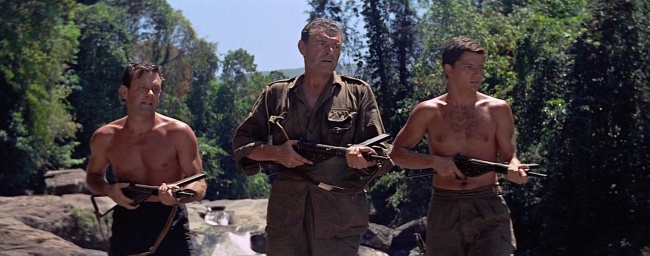
Cast: William Holden (Commander Shears), Alec Guinness (Lt Colonel Nicholson), Jack Hawkins (Major Warden), Sessue Hayakawa (Colonel Saito), James Donald (Major Clipton), Geoffrey Horne (Lt Joyce), André Morell (Colonel Green), Peter Williams (Captain Reeves), John Boxer (Major Hughes)

“Madness! Madness!”Are there many better final lines of films – or any delivered with more emphatic, meaningful gusto than James Donald manages at the close of this David Lean classic? The Bridge on the River Kwai is a constantly reliable, wonderfully assembled classic film, and a never-ending joy to watch. It’s not only a gripping epic, it’s also a wonderful psychological study of a series of men and the impact war has on their psyches. It’s all madness after all.

In 1943, Colonel Nicholson (Alec Guinness) and his men arrive in a Japanese prisoner of war camp in Burma. Camp Commander Colonel Saito (Sesse Hayakawa) has been tasked with building a bridge over the river Kwai, and demands officers and men go to work. When Nicholson adamantly refuses to allow officers to do manual labour (as per the Geneva Convention), he and Saito are set for a clash of wills, in which the iron-willed, rigid certainty of Nicholson eventually triumphs. However, once Nicholson is released from solitary confinement, he is so horrified by the decline in discipline of his men, he decides building the bridge is the perfect opportunity to rebuild morale and demonstrate British character=. So he sets upon building a better, stronger bridge than the Japanese had designed. Meanwhile, fellow prisoner American Commander Shears (William Holden) escapes from the camp back to Allied headquarters – only to be forced to return to the jungle on a commando raid to destroy the bridge, led by Major Warden (Jack Hawkins).

Wow this is one hell of a film. It was garlanded with seven Oscars, and totally deserves each and every one of them. Kwai is a deeply engaging, wonderfully structured epic that balances perfectly the sweep of Hollywood cinema with a keen understanding of the complexities of psychologies under pressure. Because like Clipton says, this is a film about madness. Virtually everyone in this is mad in some way. Lean brilliantly positions these psyches in a series of conflicts and clashes: we have Nicholson vs. Saito, Nicholson vs. Shears, Shears vs. Warden – in every relationship in the film there is conflict and disagreement. It makes for extraordinary drama.

Pile on top of that the fact that David Lean is a consummate film maker. Every moment of Kwai is a display of wondrous visual storytelling, from the arrival of the British in the prison camp – a triumph of defiance, pride and hubris – to the final attack on the bridge. The final sequence around the bridge is exquisitely assembled. The editing is flawless, the tension build-up (nearly 20 minutes!) never flags, but carefully establishes the who, what, why and where. The sequence itself builds up both events and problems with daunting skill. In between, every sequence of the film has some masterful work in it.

The heartbeat is Alec Guinness, simply marvellous as Nicholson. It’s hard to believe watching it that he was not the first choice – in a parallel universe Charles Laughton starred opposite Cary Grant’s Commander Shears! – because he is superb in this Oscar-winning role. Guinness’s Nicholson is mad. Not in the cuckoo way or a cruel or arrogant way. He’s blinded by the rule book, by the middle-class values of duty, order and dignity that govern his life. Mad because he takes a task from his Japanese enemies and does it better than they ever could have: “Must we work so well? Must we build them a better bridge than they could have built themselves?” Clipton asks of him. Too true. Nicholson’s response? That one day people will remember the bridge was built not by “a gang of slaves, but soldiers, British soldiers…even in captivity”. 

So Nicholson doesn’t see it that way. It doesn’t match his narrow world view of a place for everything and everything in its place. Because he has no vision beyond his own immediate circumstances. The important thing for him is to build the bridge, because it’s his duty to keep his men together, and demonstrate British resolve. So it’s Nicholson who visits Clipton’s sick bay and gently questions the wounded men, encouraging them to go back to work on the bridge so it can be finished on time (they ironically march through the graveyard of the camp on the way). For Nicholson the bridge is everything – and Guinness’ eyes are full of rigid monomania (needless to say, by the end of the film Nicholson himself off-handedly informs Clipton with pride that the officers have volunteered to work on the bridge to make sure it will be finished before the deadline).

His manner contrasts fascinatingly with Sesse Hawakaya’s Colonel Saito. Saito, a bank manager type if ever you saw one, clearly struggles with holding his command together and to deliver the bridge as planned. He has the strength of office, but not the strength of character of Nicholson. Hawakaya plays a weak man – and it’s fascinating how Lean charts the shift in power from Saito to Nicholson. Nicholson stands for principle and simply cannot imagine backing down – and then, with a sense of certainty and natural authority that governs his life, swiftly takes over the entire planning of the bridge from Saito. Poor Saito is a broken, weakened man: and in his own form of madness, is left with Nicholson alone as a confidant (the two of them talk more to each other about their loneliness and uncertainties than they do anyone else – Nicholson in particular gets a marvellous speech about the sad transience of the soldier’s life – “it’s a good life, but still there are times…”).

The madness doesn’t stop there. Jack Hawkins’ Major Warden is as fanatical as Nicholson: the mission is everything. Hawkins is excellent, turning Warden into a sort of over-grown schoolboy, playing at soldiers but with an adolescent aggressive willingness to sacrifice the pieces for the greater good. For Warden, no life in the team is sacred (including his own), and everything must be about the target. Warden’s gung-ho, take-no-prisoners attitude, his lack of empathy for the lives of those around him, makes him as much of an insane danger as Nicholson, perhaps more so.

Holden’s more humane Shears is the counterbalance with these three lunatics. Of course, Shears is sucked even more into the madness than anyone else – who else would escape from a prison camp, only to be forced to head back into the jungle on a fool’s errand? Holden is damned impressive as the naturally anti-authoritarian Shears, a man who never seems to have seen a boss without questioning him, who recognises the insanity of the war around him but when push comes to shove throws himself into the mission he has been given. 

He’s the big addition to the original source material – but it’s an idea so good that Pierre Boullé said he wished he had thought of it himself. Boullé won the screenplay Oscar, but the writers of the script were really the black-listed Michael Wilson and Carl Foreman. These two put together a superb script, and the structure contrasting Shears with Nicholson works perfectly. These two are mirror images, but never really antagonists. Their final meeting towards the end of the film has a poetic sadness about it. It adds a whole extra dimension to the film – while one storyline sees the bridge being built, a parallel one prepares for its destruction.

All these threads come together beautifully on the morning of the bridge’s opening, after a triumphant celebration by the prisoners on the completion of the bridge – a moment Nicholson describes to them as “turn[ing] defeat into victory”. He is of course both right and wrong – and the triumph of the film is that you can’t help but share Nicholson’s desire to save this bridge that we have seen so much work, effort and love go into constructing. 

“Madness”. That’s how Clipton sees it – James Donald is by the way wonderful as the one sane man – and yes of course he’s right. It’s all part of what is a masterful film made by a master storyteller, beautifully filmed and edited. Alec Guinness gives a performance for the ages as stubborn, small-minded man whom we somehow still end up strangely admiring and respecting. Holden, Hawkins and Hayakara offer intelligent, engaging portrayals. The Bridge on the River Kwaiis a film that you can watch again and again. In fact you should, because Lean here marries an epic scale with a story that feels small, personal and deeply felt – that places the psychology of real people at the centre of an epic stage. It’s simply a classic.

In Which We Serve (1942)


Noel Coward takes command in stirring British wartime drama In Which We Serve

Director: Noël Coward, David Lean

Cast: Noël Coward (Captain E.V. Kinross), Bernard Miles (CPO Walter Hardy), John Mills (Shorty Blake), Celia Johnson (Alix Kinross), Joyce Carey (Kath Hardy), Kay Walsh (Freda Lewis), Michael Wilding (Flags), Leslie Dwyer (Parkinson), James Donald (Doc), Philip Friend (Torps), Frederick Piper (Edgecombe), Richard Attenborough (Young Stoker)

Only the British would make a wartime propaganda film about a sunk ship where over half the crew gets killed (the Navy nicknamed the film In Which We Sink). It says something about this endearingly muddle-headed country that the stories that appeal most to us are those that celebrate our struggles against adversity. It was filmed in the aftermath of the Battle of Britain but before the Battle of El Alamein – the British considered themselves safe from invasion, but still saw victory was a long way off. In that climate, the film’s attitude of knuckling down and doing your duty to achieve a distant dream must have resounded profoundly with millions of people.

Based on the early war career of Louis Mountbatten, this “story of a ship” revolves around the Torin, a destroyer captained by E.V Kinross (Noël Coward). The ship is dive bombed and sunk by the Luftwaffe, and the captain and survivors cling to a lifeboat, waiting for rescue. While they wait, the crew remember their lives back home in flashback – in particular the captain, CPO Hardy (Bernard Miles), and able seaman ‘Shorty’ Blake (John Mills). Can you imagine an American propaganda film with a plot like that?

It’s easy to mock a film like In Which We Serve today. Its stiff-upper-lipped, duty-led, hierarchical world has been lampooned countless times since Peter Cook’s pitch-perfect Bernard Miles impersonation in Beyond the Fringe. (Early in the film, watching Kinross at home, I remembered Eddie Izzard’s spoof: “Don’t go to the war Daddy / I must they won’t start without me…”). The first 30 minutes, with its clipped dialogue, fast-paced delivery and stiff-backed, formal playing style takes a while to tune into. But it’s worth it, as the establishment of this carefully controlled exterior is what makes the later sections, with strong emotions just below the surface, so moving.

Coward was of course primarily a man of the theatre, and this was his only original film script. His collaboration with experienced film-makers produced a stirring, skilfully crafted epic that reflects on several levels of British rank and society, and not only shows us “why we fight” but also “why we should fight”. Coward is credited as the principal director, but much of the direction (and the film’s skilfully constructed structure in the editing suite) comes from his co-director David Lean, here making his directing debut.

Lean’s expressive hand is clear in the brilliantly composed sequences on board the ship itself, both in action and at ease. An example of the fluid editing, is where the camera follows the progression of a missile through the ship, passed from crew member to crew member, each given some brief moments to show their quiet determination and resolve. Similarly, the sequences on the drifting lifeboat have a claustrophobic intensity about them. The flashbacks are carefully placed to allow our understanding of the characters and their backgrounds to grow each time.

The scenes back home are remarkable for their dramatic simplicity. Coward understood the stories that move are those of normal people. The sailors’ home lives – from the captain down – are domestic, calm, happy and above all normal. Very little happens: one sailor gets married, the captain plays with his children, the Petty Officer teases his wife. This regularity makes their courage under fire all the more stirring: truly ordinary people doing the extraordinary. Some critics have called Coward’s attitude to the working classes snobbish, but there is no disdain at all here – instead there’s a paternal admiration with genuine warmth.

This warmth extends even to a stoker who cuts and runs during action. It would be easy to use this moment to amplify the braveness of the others. Instead, in a moving speech to the men, the captain takes the blame onto himself for not supporting the young man earlier. The mortified stoker, in a wonderful little scene, struggles to express his shame to a barmaid, not in anger but in a quiet, confused guilt. The film never condemns or judges him – he is quietly shown returning to his duties. There is no explicit moment of redemption, just a sense of a man who has let himself down, resolving quietly to do better.

The opening sequence covers the lifespan of the ship – from its construction and commissioning, to its launch, early actions and sinking, with the implication of a nation coming together. Later scenes mix theatrical touches with documentary realism. A marvellous sequence covers Dunkirk, which feels incredibly real but also showcases a few wonderful flourishes, from Kinross’ speech praising the soldiers’ bravery to Shorty’s affectionately wry remark on the rivalry between soldiers and sailors. The final sequence brings us full circle, with the construction and launch of another battleship under Kinross’ command. We may lose a battle, but we are never beaten.

Coward takes on the lead role. To be honest, it’s a striking piece of miscasting that somehow works out – Noël Coward is no-one’s idea of a hard-nosed naval veteran. He lacks the range in particular for his scenes of domestic life, coming across as too detached and distant – particularly noticeable since his wife is played brilliantly by the radiant Celia Johnson, conveying layers of emotion under a controlled exterior. But, his quiet, buttoned-up professionalism and clipped Englishness work perfectly for the quietly emotional speeches he delivers. These he nails perfectly, his voice just giving the hint of cracking. It’s a curiously stagy, and in no way naturalistic, performance – but as a representation of a particular type of Britishness it’s perfect.

And Kinross is just the sort of man you would follow to the end – distant and authoritarian, but just and warm. Rescued from the ocean, he goes immediately to his men, moving quietly from wounded man to wounded man, collecting addresses, issuing quiet words of unexpressive comfort (“I’ll tell her you did your duty”). His closing speech (heavily based on Mountbatten’s own address to his crew) throbs with emotion just below the surface as he thanks his men – and it’s hard not to feel it as he shakes the hand of each man and is overcome with emotion, he can only nod a brief acknowledgement to his officers. Lean trains the camera on his back, as we see his shoulders seem to swell to support the pride, respect and love for his men. It’s peculiarly British, but this unspoken affection is hugely powerful.

The more naturalistic performances from the rest of the cast help to anchor the film – and also allow Coward’s more stylised acting to work effectively. John Mills is wonderful as Gunner “Shorty” Blake, a plucky, kind and witty man. He’s just the sort of unexpressive hero we’d all like to be, and his homespun love story with Kay Walsh is genuinely engaging and moving for its everyday normality. Mills also carries much of the film’s humour.

It’s the final sections of the film that really, really work. I can’t get through the scenes of the surviving crew being saved, the quiet courage of the dying men and the austere warmth of the captain, the speeches that burst with pride and respect under a reserved veneer, without feeling a lump in the throat. It’s a masterful piece of quietly powerful film-making, that pays off precisely because so much of what has gone before has been so normal. The fact that we’ve seen the lives of these people – and can see what, in their quiet way, they are fighting for – I found increasingly moving.

In Which We Serve is a wonderful piece of film-making, very well written by Coward and strongly directed (largely) by Lean. Coward himself, in the lead role, is far better at the speeches than as either a captain or husband, but the rest of the cast is excellent with Mills and Johnson both outstanding. It’s truly the stuff of spoofery in many ways today, but tune yourself up to the accents and the repressed Britishness and this is a heartfelt and deeply moving film. Perhaps one of the finest propaganda films you’ll ever see – and still so very British.