Tag: James Mangold

A Complete Unknown (2024)

A Complete Unknown (2024)

Engaging but traditional biopic, very well-made and full of knock out performances

Director: James Mangold

Cast: Timothée Chalamet (Bob Dylan), Edward Norton (Pete Seeger), Elle Fanning (Sylvie Russo), Monica Barbaro (Joan Baez), Boyd Holbrook (Johnny Cash), Scoot McNairy (Woody Guthrie), Dan Fogler (Albert Grossman), Norbert Leo Butz (Alan Lomax), PJ Byrne (Harold Leventhal), Will Harrison (Bob Neuwirth), Eriko Hatsune (Toshi Seeger), Charlie Tahan (Al Kooper)

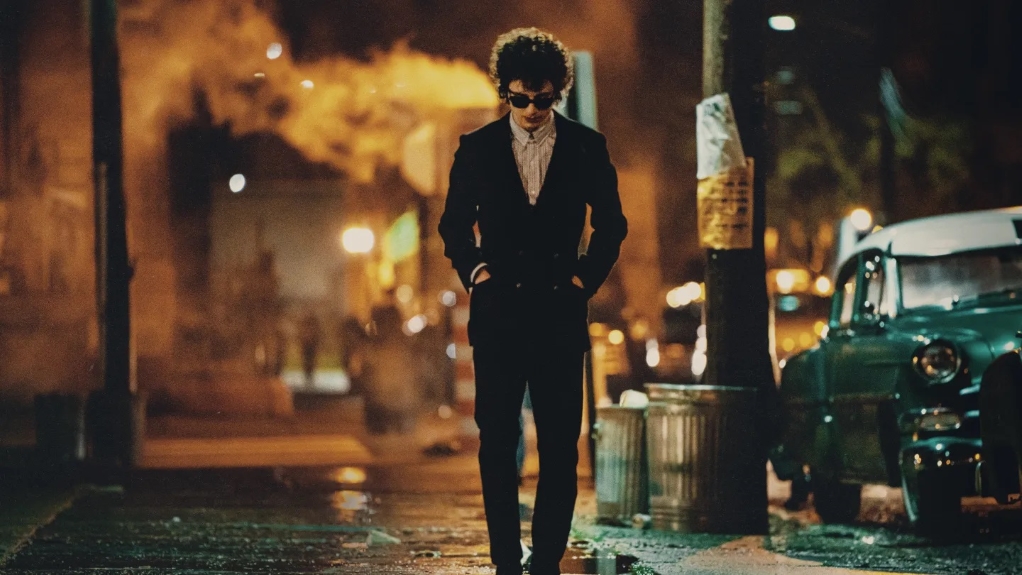
In 1961 Bob Dylan seemed to emerge from nowhere – or, if you like, from being A Complete Unknown – to become the big star of American music and the centre of a battle for the soul of American folk music. On one side, were the traditionalists – they loved Dylan’s thoughtful, lyrical ballads and use of guitar, harpsichord and other instruments. They believed Dylan could lead a whole new generation to traditional American music. On the other side were the modernists, inspired by rock and roll, and the new (electric) sound. A Complete Unknown is about Dylan’s – inevitable – journey towards exploring new music sounds, culminating in his strum-heard-around-the-world as he played an electric set at the Newport Folk Festival (to a mixed reaction to say the least).

That’s the meat of James Mangold’s traditional, but very well-made and enjoyable musical biography, a spiritual sequel to Walk the Line (with a decent, but drink-addled Cash here played by Boyd Holbrook). Much like that film, this tweaks and amends some historical facts, but manages to get close to the spirit of its subject all within a familiar biography set-up of early success, mid-way struggles and triumphant (of a sort) resolution. There is nothing in A Complete Unknown to surprise you but it’s still a highly enjoyable, very professionally assembled journey.

Its main success is the depth and insight with which it penetrates Dylan’s character. A Complete Unknown embraces Dylan’s enigmatic quality, not to mention his stubborn, relentless and obsessive focus on his music and the austere distance he can treat the world. This all comes across beautifully in Timothée Chalamet’s superb performance – not only a pin-point physical and vocal and impersonation, but also a soulful rendering of a poet who constantly pushed against being classified and categorised, bristling against ideas he should play certain songs certain ways.

The roots of the culture clash that will dominate the film are clear from the start when Dylan and Pete Seeger (Edward Norton) drive from visiting visited Dylan’s hospitalised idol Woody Guthrie (Scoot McNairy) and Dylan flicks through radio channels. Dylan finds interest in all the different music they encounter; Seeger smiles pleasantly and nods his head, but clearly can’t hide his patient disregard for the electric beats of rock and roll. It’s the platform for the surly discontent Chalamet so perfectly embodies as Dylan is expected to pigeon hole himself as a folk singer, who (as he puts it) stands with his acoustic guitar at a mic and sings Blowin’ In the Wind for the rest of his life. A Complete Unknown falls in love with Dylan’s passionate self-expression, his search for his own sound.

That search frequently makes Dylan a difficult person to spend time with. Awkward and hesitant with other people – Chalamet’s Dylan is constantly cautious about exposing too much of his inner thoughts and feelings – the poetic writer mumbles in monosyllables and responds to fame with a grudging disdain that seems him rarely remove his sunglass shield between him and the world. He has no interest in fame and is positively alarmed at adulation from strangers (there is a neat line when he is unrecognised by a street vendor and asked if he has kids to which he wearily replies ‘Yeah, thousands’). Match that with his ruthless determination to put his artistic calling above anything else, and you’ve got a man who verges on using other people.

It feeds into Dylan’s relationships. At his request, his girlfriend Suzie Rotolo is very-lightly disguised as Sylvie Russo, played with an emotional richness by Elle Fanning. The film skips the more difficult parts of their break-up – Dylan stated the only song he regrated was one he wrote about Rotolo’s abortion, calling himself a shmuck for doing so. But in doing so, the film steams off Rotolo’s contribution to Dylan’s writing and much of her own dynamic and interesting qualities. The original Rotolo, an artist, was an important sounding board: we don’t see a jot of that here, as she is repackaged into offering Dylan much-needed stability and security, dealing with movie-girlfriend insecurity about Dylan’s attraction to collaborator Joan Baez.
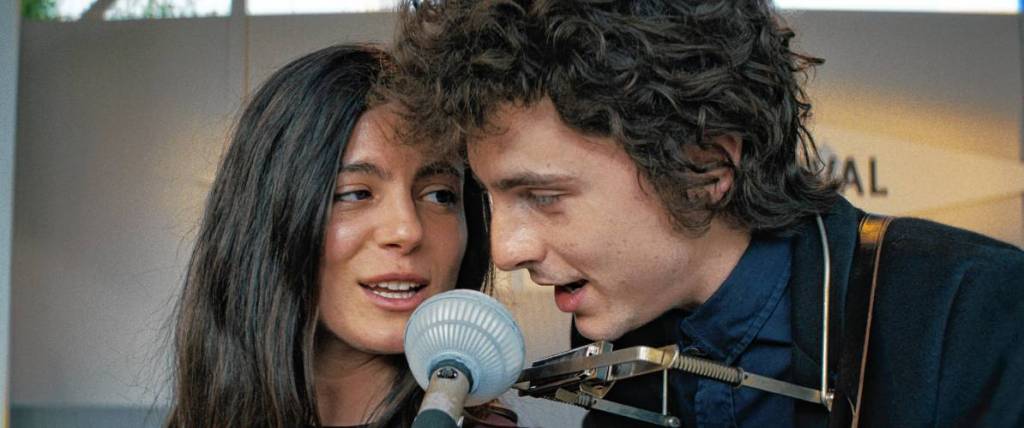
Dylan returns to Russo when he needs comfort at times of stress (from dropping in on her apartment – and waking her new boyfriend – late at night, to bringing her with him to the folk festival when he intends to turn electric) but Chalamet’s simmering self-focus makes clear Dylan at this stage can’t settle into a mutual relationship. It also comes between him and Joan Baez, played with dynamic charisma by Monica Barbaro, Despite their attraction and musical synchronicity, Dylan never sees her as a true artistic partner, even calling round one night for a booty call followed by private song writing using her guitar (she throws him out). On tour together, Dylan archly points out he writes the song and he leaves Baez hanging at a concert when he flat-out refuses to play the advertised favourites. The chemistry however is still there, within when it tips into aggression.

Dylan goes his own way, and if that means turning against surrogate fathers Peter Seeger and Woody Guthrie, then he will. A Complete Unknown features one of Edward Norton’s finest performances as a warm, tender and heartbreaking Pete Seeger (matched with a wonderful performance from Eriko Hatsune as Pete’s wife Toshi). Norton is brilliant at making Seeger – an environmentalist and gentle, accommodating advocate of folk music – a portrait of inevitable disappointment-in-waiting. There is a heart-rending moment where Norton beams as if all his dreams have come true as Dylan plays his first Newport festival: heart-breaking because we know Dylan’s next performance (where a guilty Dylan brusquely shrugs off Seeger’s gentle pleading to stay acoustic for just one more day) will see these dreams left in shattered pieces.

A Complete Unknown is a handsome, very well-mounted film from James Mangold, who has proved time-and-again that he can explore classic Americana with a freshness and energy few other directors can match. The film is perhaps overlong – probably due to the innumerable recreations of performances from Dylan, Seeger and Baez, all excellent but there are far too many – and it’s biopic approach is relentless traditional. But it’s filled with a parade of rich performances (with Chalamet outstanding), rolls along with energy, carries an emotional impact and will leave you engaged and entertained throughout.
Indiana Jones and the Dial of Destiny (2023)

Indiana Jones and the Dial of Destiny (2023)

Is there a place for Indy in the 2020s? The nostalgia-tinged would-be epic doesn’t provide an easy answer

Director: James Mangold

Cast: Harrison Ford (Indiana Jones), Phoebe Waller-Bridge (Helena Shaw), Mads Mikkelsen (Jurgen Voller), Antonio Banderas (Renaldo), John Rhys-Davies (Sallah), Toby Jones (Basil Shaw), Boyd Holbrook (Klaber), Ethann Isidore (Teddy Kumar), Karen Allen (Marion Ravenwood), Shaunette Renée Wilson (Mason), Thomas Kretschmann (Oberst Weber), Olivier Richters (Hauke)

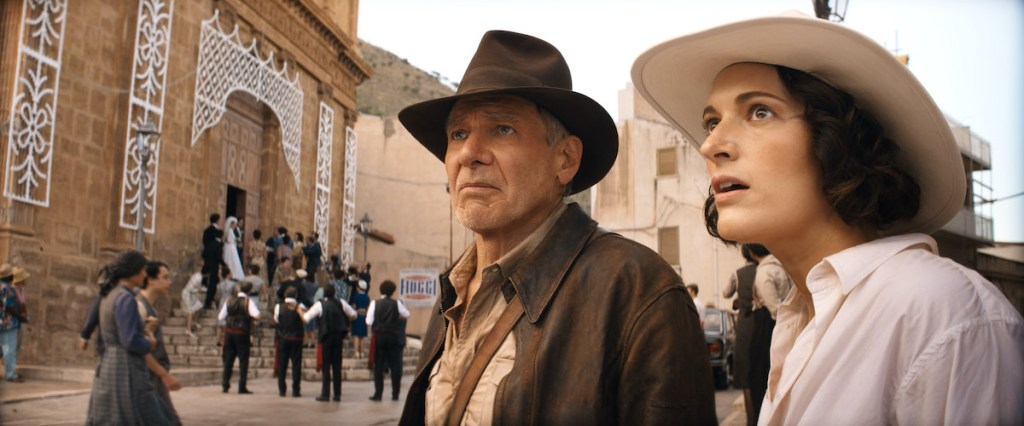
Okay let’s get the elephant out of the room: It’s better than The Kingdom of the Crystal Skull. Yes folks, we have a new fourth-best Indiana Jones film. Is that something to celebrate? Indiana Jones and the Dial of Destiny makes some of the same errors as the previous valedictory effort, but at least it learned a few things and it’s been made by people who clearly love Indy. But they loved it too much, creating an often overblown, hellishly overlong, everything-but-the-kitchen-sink film which never just jump when it can flip, spring, bounce then explode at the end of it.

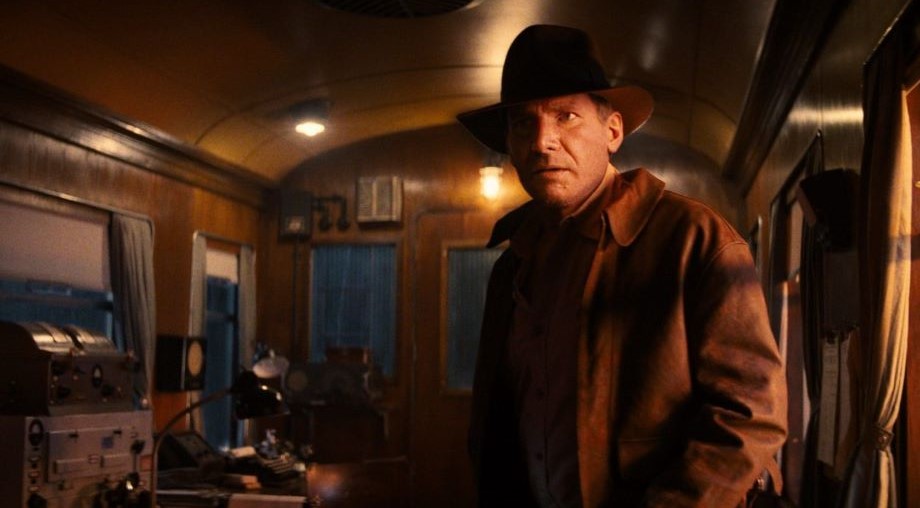
It opens with a (younger) Indy (Harrison Ford) battling Nazis in the dying days of the Second World War, trying to save a train full of precious artefacts. After defeating them, we flash forward to 1969 with Indy now a retiring archaeology professor to disinterested students in New York’s Public University, out of a place in an era where man has stepped on the moon. Grouchy, separated and fed-up, Indy’s life gets disrupted one more time when his god-daughter Helena Shaw (Phoebe Waller-Bridge) turns up on the hunt for Archimedes’ Dial. Indy knows about this dial as it was also the obsession of Nazi physicist Jurgen Voller (Mads Mikkelsen), last seen on that train in 1945 and now the brains behind the NASA moon landings. Indy and the unscrupulous Helena end up in a duel with Voller to find the dial – the prize being what Voller believes is a chance to change history.

Back in the day, Raiders of the Lost Ark was largely made so Spielberg and Lucas could show they could make an action-packed, crowd-pleaser quick and cheap. Today The Dial of Destiny is one of the most expensive films ever made (lagging only behind assorted Avengers films, the recent Star Wars trilogy and various other franchise entries). So much mony to make something less than half as good.

What this has allowed is Mangold and co to act like kids given the keys to their parents’ car. The Dial of Destiny is an explosion of Indy ideas, all rammed into the film willy-nilly. It’s made by people who feel this is their only chance to make an Indy film and don’t want to miss the opportunity to include every idea they’ve ever had.

We end up with a film that feels both far too long and yet strangely rushed. The Dial of Destiny would be immeasurably improved if about twenty minutes (at least) had been cut from its run-time and its poorly sketched thematic ideas condensed down. Its narrative structure has one too many quests, with Indy and Helena forever searching for a thing that leads to a thing that leads to yet another thing. An entire sequence, involving a pointless cameo from Banderas as a one-legged diver, would have been better slashed to ribbons or cut altogether. Every single one of the mega-budget chase sequences go on at least 2-3 minutes too long, straining the interest.

At the same time, the film manages to feel rushed. Ideas are presented and then taken nowhere at all. We see Indy tipping most of a bottle of whisky into his coffee in the morning – this suggested alcoholism never rears its head again. Voller is working in partnership (it seems) with the CIA, but their motives for this are never explained and Voller calmly ditches them part way through the film. Indy is framed for murder, but this plot thread is judicially abandoned by the time we get to the end. John Rhys-Davies literally pops up to drive Indy to an airport and make a trailer-friendly speech.

Most strikingly, all the films blaring action and endless bangijg stuff buries the most interesting plot thread of a tired, depressed Indy who no longer knows his place is in the world. The film solves Shia LaBeouf’s toxic unpopularity by having Mutt die in Vietnam, giving Indy a burden of guilt and grief. This is an Indy who has fallen from his Princeton heights, as ancient to his students as the artefacts he lectures about. It’s a thread though that the film only intermittently remembers, so crowded out is it by overlong chases, so that when the film’s conclusion returns to it as a major motivator for Indy it feels forced.

In any case, the film’s action set-pieces peak with the 1945 opening section with a digitally de-aged Ford and Mikkelsen facing off on a speeding train. I think the de-aging effect is very well done (though Indy speaks with Ford’s current 80-year-old voice), and this sequence has a sort of nostalgic charm to it and at least it feels of a piece with the originals. Not that its perfect: it’s overlong and overblown of course – a castle explodes, Indy runs over the top of a speeding train – and looks like something created with blue-screens and digital effects rather than in reality. (It’s also clear a digitally de-aged Ford head has been placed on a stunt double at key points.)

But it’s a bright-spot. There are others: Harrison Ford, again, is perfect for the role – crusty, resigned but still with the glamour of excitement in his eyes. He and the film don’t back away from his advanced age – Indy looks more vulnerable than ever – and Ford sells the moments he’s allowed in the film’s breakneck speed to reveal Indy’s emotional turmoil. He also has a great chemistry with Phoebe Waller-Bridge, who effectively channels Han Solo as an immoral adventurer who learns about decency. Mikkelsen’s mastery makes him an impressive villain.

I’ve been really hard on this film. It is fun I promise. I laughed and at times I was thrilled. But it is too much. Even the settings of the chases offer a sensory and time overload: a chase around a ticker-tape parade in New York onto a subway (with Indy on a horse) has an overload of visual details. A chase through the streets of Marrakesh goes on forever – and is over-built with our heroes chasing Voller while also being chased by Helena’s gangster-former-fiancee. film culminates in a final sequence which is just about not as silly as aliens – but by any other score is incredibly silly.

Essentially The Dial of Destiny is undermined by fan love. Mangold is a good director but doesn’t know where to stop. The film leans into nostalgia too hard but, above all, it offers far too much bang for your buck. The film is frequently at its most effective in its quieter, character-driven moments. Like Crystal Skull, it mistakes bigger for better. It’s still a more entertaining and a better film than Crystal Skull – but, somehow, its excessive overindulgence makes you feel strangely disappointed.

Ford v Ferrari (Le Mans '66) (2019)

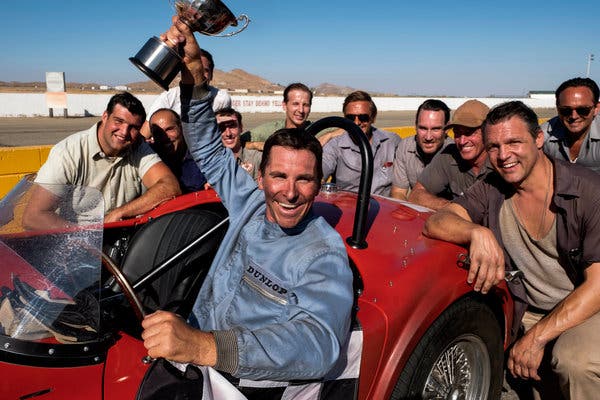
Christian Bale as maverick driver Ken Miles in the functional but fun Ford v Ferrari

Director: James Mangold

Cast: Matt Damon (Caroll Shelby), Christian Bale (Ken Miles), Jon Bernthal (Lee Iacocca), Caitriona Balfe (Mollie Miles), Tracy Letts (Henry Ford II), Josh Lucas (Leo Beebe), Noah Jupe (Peter Miles), Remo Girone (Enzo Ferrari), Ray McKinnon (Phil Remington), JJ Feild (Roy Lunn), Jack McMullen (Charlie Agapiou)

There are few more exhilarating things than going really, really damn fast. It’s a primal glee that James Mangold’s racing film Ford v Ferrari (or Le Mans ’66 as it seems to be known over here) taps into, roaring with exciting, fast-paced energy lashed onto a good old buddy movie as two plucky underdogs get the chance to overturn the champs and claim the title. It’s the story of any number of sports movies, but it still works here. It ain’t broke, after all.

It’s the early 1960s and the sales of the Ford Company are down: the baby boomers don’t want to be driving the dull, safe cars of their parents. They want something super sexy. Despite his hesitation Henry Ford II (Tracy Letts) is persuaded the best way to get that sexy image is to get a racing car – and if he can’t buy Enzo Ferrari’s (Remo Girone) company, then by hell he’ll spend whatever it takes to give Ford the best racing team in the world. Targeting the Le Mans 24 hour race, he recruits retired-driver-turned-designer Caroll Shelby (Matt Damon) to mastermind building a car – and Shelby recruits demanding, prickly, maverick Brit driver Ken Miles (Christian Bale) to help him design it and then drive the thing. But what to do when Miles’ blunt plain-speaking and individuality looks like it won’t make him the best spokesman for selling Ford cars?

On the surface Ford v Ferrari is pretty much your standard Sports film. Two teams, an underdog and a champion, a pair of mavericks who think outside the box, the struggle for success – met with initial failure before victory – all told through a familiar structure of brothers-in-arms, obstructing suits, supportive wives at home and plenty of carefully detailed expert recreation of sporting events. It’s a collection of familiar ingredients, but very well mixed together by Mangold (one of Hollywood’s finest middle-rank directors, a sort of heir to Lumet).

The real twist however is that the rivalry is not really about Ford and Ferrari. In fact the film might have been better titled Ford vs Ford. Because the main thing standing in the way of Shelby and Miles isn’t Ferrari – with whom they actually have a rivalry built on mutual respect – but with the bottom-line, sales-first suits who are backing them. It’s a parallel with everything where sales and the buck count more than anything, but you feel Mangold might well have related it most to Hollywood producers. What is Ken Miles, but the genius auteur director who the money-men just won’t trust to churn out the mass-market product they need to lift the share price? Henry Ford (very drily played by Tracy Letts) may have one visceral moment of excitement when placed in the passenger seat of a fast car – but fundamentally he doesn’t give a damn about the sport at all, except how it could help him shift a few more Mustangs.

Shelby and Miles’ struggles are not with the car, the engineering problems or Ferrari – they’re with the Ford VPS (in particular Josh Lucas’ incomparably smarmy Leo Beebe, a corporate man to his fingertips who probably bleeds stock tips) who want a product they can sell, far more than a product that can win. Obstacles are constantly thrown towards Shelby and Miles from their bosses – everything from engine design to race strategy receives a series of notes, comments and instructions from the Ford hierarchy. The choice of driver is most important of all – and they don’t want the demanding Ken Miles behind the wheel of their car. Because mavericks like that don’t sell Mustangs.

As Miles, Christian Bale gives a performance of pure enjoyment. Juggling a version of his own natural accent (which sounds odd – part cockney, part scouse – but works brilliantly) Bale gives the part just the right amount of that peculiar chippy Britishness, that resentment of people in authority, that hostile reaction to the stench of bullshit. Driven, determined but totally unwilling to suffer fools – exhibited almost immediately with him dressing down a prat who isn’t a good enough driver to handle the sports car he’s purchased – Miles is clearly never going to be the company man Ford wants. But with his passion for “that perfect lap”, his determination to work night and day to achieve that and – in a nice change – his warmth for his family and equal decision making with his wife (a slightly thankless part for Catriona Balfe) he’s a character you quickly take to your heart. It’s a great, charisma-led performance from Bale, who also gets nearly all the best lines.

It does suck a bit of the oxygen from Damon, who plays the straight-man as Shelby who is just as passionate but can (just about) speak Corporatese. With a Texan drawl, Damon does the legwork of the movie extremely generously, quietly driving many of the scenes and handling much of the more emotional arc of the movie. The two actors form a superb chemistry – peaking with a hilarious fight scene, your chance to see Batman clobber Jason Bourne with a loaf of bread (both actors, famous for muscular fight scenes, clearly enjoy a fight scene straight out of Bridget Jones). It’s a bromance that really works – and carries at certain points a genuine emotional force.

Mangold packages this material perfectly – and the racing sequences are brilliantly done, engrossing, speaker-shaking displays of racing, fabulously edited. The film itself is probably too long, and the sections away from the race track are sometimes so familiar in their structure and tone that they sometimes drag a little bit, as if the fierce momentum of the racing scenes can’t carry across to the rest of the film. But with fine performances and expert handling, this is certainly a number you’ll be happy to test drive.

The Wolverine (2013)

Hugh Jackman brings out the claws once more for The Wolverine

Director: James Mangold

Cast: Hugh Jackman (Logan/Wolverine), Hiroyuki Sanada (Shingen Yashida), Tak Okamoto (Mariko Yashida), Rila Fukushima (Yukio), Famke Janssen (Jean Grey), Will Yun Lee (Kenuichio Harada), Svetlana Khodchenkova (Dr Green/Viper), Haruhiko Yamanouchi (Ichiro Yashida), Brian Tee (Noburo Mori), Ken Yamamura (Young Ichiro Yashida)

Before James Mangold and Hugh Jackman teamed up for their triumphant 2017 Wolverine capper Logan, they first made The Wolverine. Adapting one of the most popular comic books to feature the clawed superhero, The Wolverine is set in Japan where Logan’s Ronin-like personality comes into contact with a culture he has more than a little sympathy for. 

Opening with the bombing of Nagasaki in 1945, Logan saves the life of young soldier Ichiro Yashida. Over 60 years later, the ageing Ichiro (Hauhiko Yamanouchi), now a tech billionaire, asks Logan to see him before he dies. He offers Logan the chance to give up his regenerative powers and live a “normal” life. Logan is unsure – but when Yashida dies, he suddenly finds his power gone and that he is embroiled in an inheritance war between Ichiro’s son Shingen (Hiroyuki Sanada) and granddaughter Mariko (Tak Okamoto), with uncertain aid/opposition from Yashida retainers Yukio (Rila Fukushima) and Harada (Will Yun Lee).

The Wolverine wants to be a dark character study, an attempt to drill down into the psyche of its hero. It doesn’t really succeed in doing this. Following on directly from the little-loved X-Men: The Last Stand, the present day section of the film opens with Logan still consumed with guilt over his euthanasia of Jean Grey (Famke Janssen), haunted by dreams of her. Living rough – and of course with the beard of tragedy looming large – the film aims to use the Japanese setting to bring Logan into a greater understanding of himself. In other words to accept the two halves of his personality: Logan and Wolverine. It’s no surprise to say this is what happens, but it fails to really get a sense of the clash between the two halves, or a sense of internal struggle of Logan wanting to reject the Wolverine personae.

Put simply, the film doesn’t manage to give us an idea of the internal war in Logan. He talks of wanting to leave violence behind him, but the sort of existential torment this requires would get in the way too much of the sort of claw-slashing action the fans are handing over their ticket money to see. On top of this, the sort of Samurai-inspired, still semi-feudal Japanese setting (with established families and loyal retainers) doesn’t really end up relating too much to the action. The sort of “masterless samurai” story the film is trying to tell requires a sense of deep honour and duty – themes which are there but don’t really come together into something really coherent. 

Basically, Japanese culture is, by and large, pretty irrelevant to the actual setting. Samurai culture is trivialised down to something that lacks any real thematic depth – the only thing that really matters is Logan learning a Japanese sword is a two-handed weapon – and the clash between Western greed and old-fashioned values of duty, honour and service is barely more than inferred. Effectively, for all the locations, the film could basically have been set anywhere at all, the entire cast replaced with Russians or Ghanaians or French and barely a word of the script would have needed to change.

Alongside this, the action, when we see it, has been watered down to the safest, PG-rated level you can imagine. There is barely any blood seen on the screen. Characters are hacked and slashed but all of it with smooth cleanliness. Action scenes switch between being shot far too closely, and with too much of an admiring air for choreography, or with a super-shiny gloss of special effects. There is a pretty good sequence on top of a bullet train, with Logan and his opponents tumbling and buffeted in the wind, but even this feels a little over produced. By the time the film hits its final battle, it’s hard not to be a little bit bored as Logan takes on a massive special effect, in a battle where the stakes are not altogether clear.

But then that’s the problem of this film, a sort of overly-complex Diet Coke of a film. The film has no fewer than three potential villains, none of whom end up being particularly interesting. It heads towards a final resolution that doesn’t feel like it helps us – or Logan – learn anything new about themselves. “I am the Wolverine” Logan growls at one point – but this claiming of his identity never really feels that earned. It’s a statement, a suggestion of depth, rather than depth itself.

This is hard on the film, and really there is nothing that wrong with it. It’s perfectly entertaining and passes the time. But it leaves the viewer with nothing after it finishes. It happens and then it is not happening and to be honest you won’t really notice the difference. It lands fairly in the middle of the franchise, a bland but not offensive effort that had the potential to be something greater but ends up firmly safe and middle-brow, avoiding diving too far down into its lead character’s psyche or showing us real action. Jackman is still good, much of the cast are fine, and Mangold is a solid director – but it never sets alight. Perhaps the sense of missed opportunity here is what ended up powering a much darker, grittier and engrossing film in Logan?

Logan (2017)


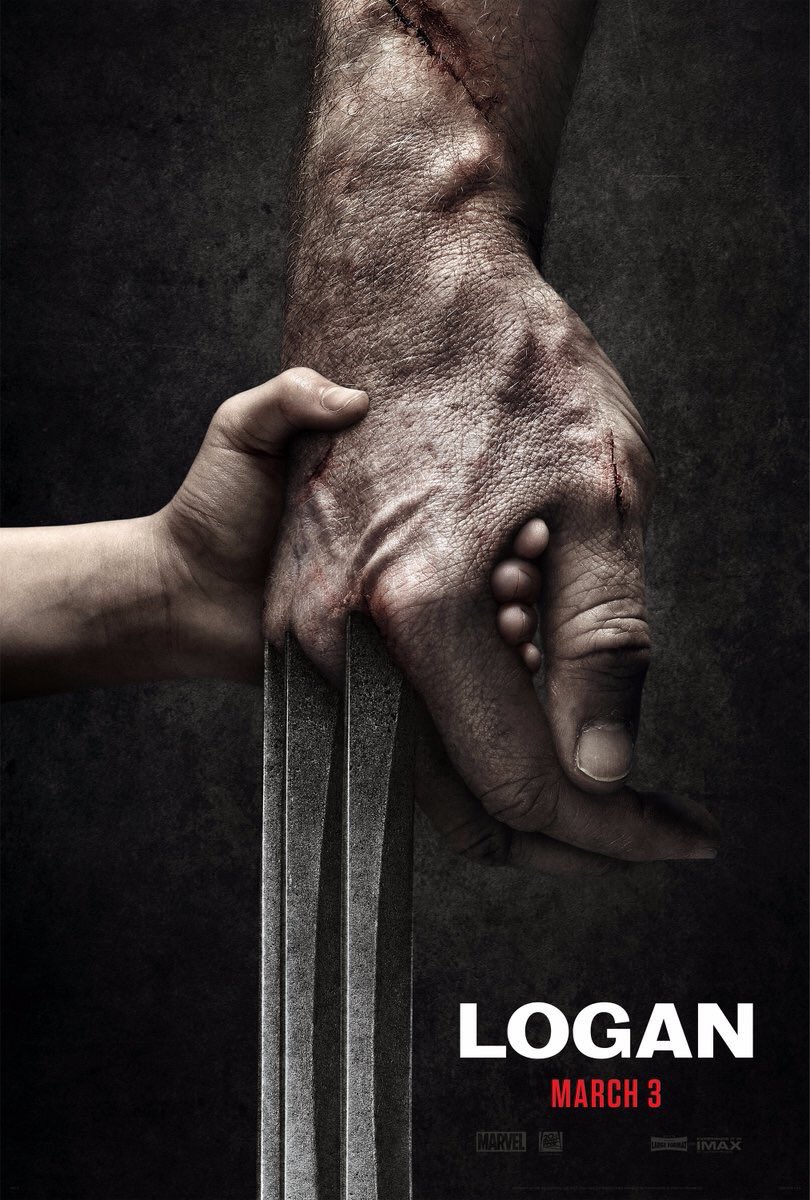
One looks at the past, the other their potential future in bleak superhero thriller Logan

Director: James Mangold

Cast: Hugh Jackman (Logan), Patrick Stewart (Charles Xavier), Boyd Holbrook (Donald Pierce), Stephen Merchant (Caliban), Richard E. Grant (Dr Zander Rice), Dafne Keen (Laura), Eriq La Salle (Will Munson), Elisa Neal (Kathryn Munsun), Elizabeth Rodriguez (Gabriela Lopez)

What were you doing 17 years ago? Personally, I was still at school: but Hugh Jackman was being parachuted into X-Men to take on the role of Wolverine after Dougray Scott’s shooting schedule on Mission Impossible 2 forced him to drop out. Since then he has appeared in eight films as the clawed superhero, some good, some shockingly bad – and this is his swansong. Taking a paycut, Jackman wanted to make the Wolverine “you’ve seen in the comics”: did he succeed?

The year is 2029 and mutants are nearly extinct. Logan (Hugh Jackman) lives in Mexico on an abandoned farm, caring for former X-Men leader Charles Xavier (Patrick Stewart), now suffering dementia and brain seizures with lethal effects on those around him. When young mutant Laura (Dafne Keen) arrives needing their help, Logan and Charles find themselves (reluctantly in Logan’s case) on one last adventure, travelling to reunite Laura with other new-born mutants – with a band of lethal mercenaries on their tail. Naturally a string of bodies follows in their wake.

Firstly I think its fair warning to say this is a bone-crunchingly, head-skeweringly, blood-spurtingly violent film. It’s easily more violent than every other X-Men film put together quadrupled. It’s also littered with strong swearing. To be honest, I’m surprised it’s not an 18 certificate – lord knows what strings they had to pull. Mangold’s intention is to show us what battle would actually be like if you were fighting with impossibly sharp knives for hands: limbs are hacked off, chests ripped to pieces, heads are punctured, bits of brain litter the floor. 

There is no romanticism of any of this violence – and the film needs to show it, as its primary theme is the impact a life full of this sort of extreme slaughter would have. Even Logan, his regenerative powers severely decayed, stumbles and limps through the action, often totally outmatched by those he fights – even a gang of car thieves get the jump on him in the opening scene. In fact, that scene serves to establish the mood of the film very quickly: Logan is slow and out of shape and eventually has to resort to extreme and brutal violence to desperately end the fight as quickly as possible. 

The action in the film is impressively filmed but never triumphalist in execution, and the overriding emotion is pain and sorrow. In many ways, it’s a bleak and depressing film, with precious little hope (it does find some peace and optimism in the final frames, but it’s almost the first time this happens). It has a huge body count, and many of the deaths hit home as both deserving and undeserving suffer. In this world there are no good decisions – whatever Logan decides to do, people around him suffer: and it’s the truth of this throughout his life that has led to such pain behind his eyes. The film’s comparatively small scale compared to previous films in the franchise helps keep the focus intimate and personal.

Its setting of course brings Westerns to mind, but also in its sense of the grim passing of an age. Emotionally, both Logan and Charles are exhausted and struggling under impossible burdens of guilt and sorrow., it’s a nihilist Western, a homage to especially perhaps to Shane and The Searchers. Mangold’s direction seizes these contrasts and infuses every frame of the film with visual and stylistic homages to this iconic American genre: even the inclusion of X-Men comic books “in-universe” gives the heroes the feeling of being, Wyatt Earp style, living legends, struggling to carry that burden.

Interestingly this is probably one of the first films that feels like a post-Trump movie. The future America it shows is grim and depressing, with big corporations ruling the roost and the little guy trodden down. The health system is a mess. The film is set partly across the border in Mexico (with brutally tight border control preventing easy passage). A large section of the plot even revolves around a desperate attempt to flee across a border before it is closed down. Of course it’s probably just part and parcel of the standard cinematic crapsack future, but right now the tone and mood of the film feels very much in sync with modern America. 

Hugh Jackman is of course front and centre in this film, and you can see straight away this project is a deeply felt one for him. Unlike any other X-Men film before, this is a character study and allows Jackman to first and foremost act. And he is terrific. With Logan’s powers failing, not only is he able to offer a very different physical performance than ever before, he also allows the character’s vulnerability, defensiveness and fear to come to the fore. Jackman explores the continual conflict in the character between his rage and isolation and his empathy and desire to be good. His protectiveness of Charles is balanced throughout by his deliberate distancing himself from Laura, as if he knows anyone whom he allows to get close will suffer. Jackman makes Logan feel old and beaten down, without losing the sense of fire under the surface.

There are in fact terrific performances throughout the film. Patrick Stewart similarly has never had a better written X-Men role in 17 years, and he makes the witty, profane, bitter but still optimistic and kindly Charles Xavier a stand-out. The interplay between him and Jackman is superb, drawing on the emotion of that years of working together on these films. Dafne Keen is a real find as Laura, convincingly feral and never less than compelling, even though she barely speaks for 2/3rd of the film – Mangold’s direction of her is perfect, drawing maximum impact from her performance. She perfectly captures the sense of being a younger version of Logan, struggling to understand the world and the impact of killing: is it any wonder Logan feels uncomfortable looking at her? Boyd Holbook is very good as a dry mercenary while Richard E Grant draws the maximum from limited screentime as a frightingly calm “mad” scientist.

While this is something very different from previous X-Men films, it’s not a perfect film. In terms of violence, I would argue it sometimes goes too far, like an excited child looking to see how far it can push us. It’s main problems are with narrative: far too many plot devices in the film are signposted like Chekov’s Guns, drawn to our attention in a forced way (often twice in case we forgot) so that most audiences could guess where events are going (there is only one real surprise in the film, and that one I defy you to really see coming). Similarly, while the film’s debt to classic Westerns is clear, to have the characters actually sit down and watch Shane seems a little too much (as well as giving a massive hint about the eventual destination this film is heading towards). Mangold’s direction is good but he lacks the profoundity of a Christopher Nolan to give these comic book happenings a shattering depth – their emotional impact comes from our familiarity with these actors in these roles over many years, not quite so much the film itself.

Saying all that, this is something strikingly different and showpieces some terrific performances. It also feels like it has something it wants to tell us about the burdens of violence on a man and how the past always eventually catches up with us.

Walk the Line (2005)


Reese Witherspoon and Joaquin Phoenix excel in this star-crossed lovers musical biopic

Director: James Mangold

Cast: Joaquin Phoenix (Johnny Cash), Reese Witherspoon (June Carter), Ginnifer Goodwin (Vivian Liberto), Robert Patrick (Ray Cash), Dallas Roberts (Sam Phillips), Shelby Lynne (Carrie Cash), Waylon Payne (Jerry Lee Lewis)

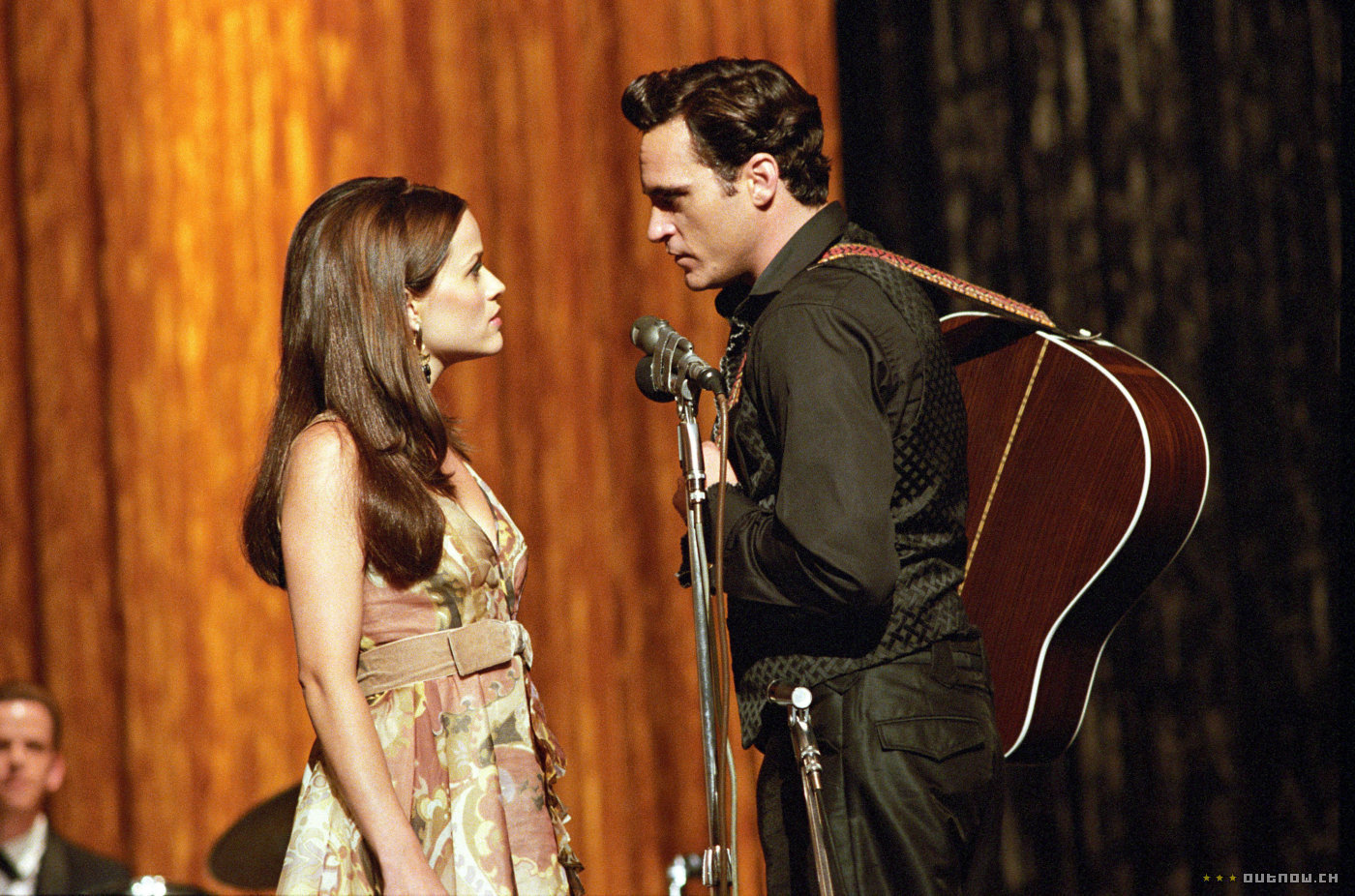
Walk the Line focuses on Johnny Cash’s early career, from 1955-1968, culminating in his live performance at Folsom Prison and the tour it kickstarts. The main element in this story is the long-running courtship/friendship/disagreements between Cash (Joaquin Phoenix) and June Carter (Reese Witherspoon) and their more-than-a-decade-long journey to turn an immediate attraction into a relationship. It’s a very endearing, well directed biopic with a lot of heart at its centre as well as capturing a great deal of the feeling behind the music.

The thing about biopics like this is that they have a standard format, particularly it for music stars: the difficult childhood, the early struggle for success, the glory years, the troubled years (addiction usually rears its head here) before a triumphant rebirth. Walk the Line doesn’t really stray away from this format at all. You also have to acknowledge it was made with the close co-operation of John and June’s son (a co-producer) so there possibility that maybe some of this has been improved for fiction (although there seems no doubt about the strength of the relationship at its centre), even if it doesn’t shy away from Cash’s womanising or addiction to prescription pills during this period.

Well I’m not sure if it is good history, but its damn good story telling. This is a hugely sweet romance, which carefully builds the ups and downs of its central relationship without coating the whole thing with treacle. I certainly found myself very moved by it and deeply invested in seeing the two lead characters finally embrace their feelings for each other. The film does a very good job of establishing the immediate attraction between both Johnny and June, while also carefully demonstrating why it took them so many years to finally be together. It does this without feeling contrived or manipulative, which is quite an accomplishment.

What’s also quite satisfying is that, throughout, Cash plays the “weaker” role – he is the needy one, the one who spirals into depression and moping after rejection, the one who thrives on attention and affection. These traits in his personality are a running theme in the film. It’s a piece of cod psychology to connect these to the death as a child of his older brother, but it makes sense: Cash in this film spends his life trying to find an emotional replacement for this loss, from his over-hasty first marriage to his alternatingly shy and overeager pursuit of June. I also felt that June’s mixed feelings over Johnny – guilt over the attraction, rejection of his sometimes childish behaviour, worry about the public perception of her failed marriages or being accused of being a home-wrecker – also make perfect sense as presented in the film.

If you want to criticise the depiction of the relationship, you could say that it fits neatly into the trope of the female character being hugely supportive and caring over the troubled male genius. However, I think it avoids this – it makes clear that June did consider some of Johnny’s behaviour (both flirting on stage and his drug-taking in particular) unacceptable. At the same time, it also makes clear her affection for him from the start – and in that situation who wouldn’t help someone they care for when he is at his lowest point?

Focusing as it does on the romantic relationship, this film is pretty close to a two-hander. Every scene features either Johnny or June and the majority include them both. Phoenix and Witherspoon are both sensational in the roles. Phoenix’s physical and vocal mannerisms are spot on, but he also seems to have a deep understanding of the feelings of guilt, loneliness and anger that bubble under the surface of Cash, as well as his childish enthusiasm and sweetness. Witherspoon is similarly radiant as June, showing the contrasts between her girl-next-door stage persona and the more complex person below the skin, intelligent and resourceful but anxious about the implications of starting a relationship. Both performances are something quite special.

Alongside all of this, the film is highly accomplished technically, particularly in recreating a series of live performances of Johnny Cash hits. Phoenix and Witherspoon, who do all their own singing, do wonderful vocal and physical imitations, capturing the vibrancy and energy of live performance. Somehow there is something extremely real about seeing Phoenix’s sweating face in close-up, animatedly covering Cry Cry Cry, which manages to get across the excitement of live performance in a way lip-synching couldn’t. The recreation of the era is brilliantly well done – the Folsom Prison sequence is a particular stand out. 

Of course this film is slightly formulaic, and yes it tells a pretty safe story of love conquering all – but damn it when it’s put together with as much heart and skill as James Mangold manages here, who gives a damn. This is very moving, stirring material and I defy you to watch the final 15 minutes without a big grin on your face.