Tag: James Robertson Justice

Moby Dick (1956)

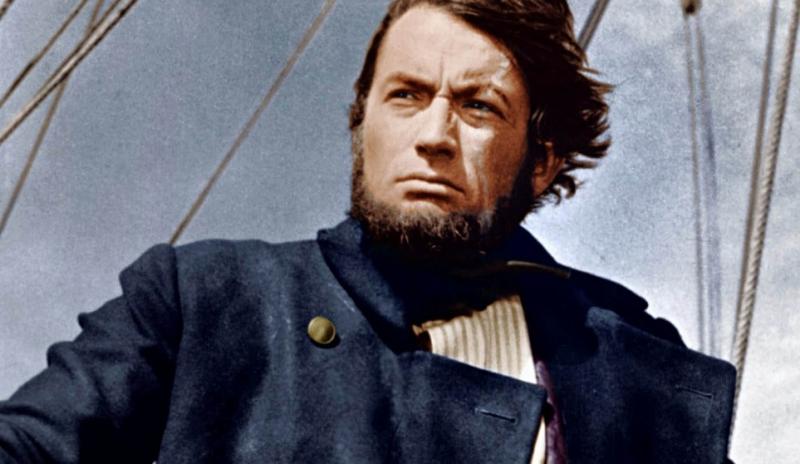
Gregory Peck on a voyage of obsession as Ahab hunting Moby Dick

Director: John Huston

Cast: Gregory Peck (Captain Ahab), Richard Basehart (Ishmael), Leo Genn (Starbuck), Orson Welles (Father Mapple), Friedrich von Ledebur (Queequeg), James Robertson Justice (Captain Boomer), Harry Andrews (Stubb), Bernard Miles (The Manxman), Noel Purcell (Carpennter), Edric Connor (Daggoo), Meryn Johns (Pelog), Joseph Tomelty (Peter Coffin), Francis de Wolff (Captain Gardiner)

There might be fewer books that lend themselves less to being turned into a film than Herman Melville’s monumental Moby Dick. Perhaps the greatest of all American novels, its’ the story of New England whaler the Pequod’s Captain Ahab’s obsessive quest to kill Moby Dick, the great white whale that took his leg. But it’s also an intense intellectual and spiritual journey into the nature of humanity, which has thrown the book open to multiple interpretations, even more tempting with a book that defies explanation. Try capturing that on film.

John Huston’s Moby Dick is a noble attempt, more criticised at the time than it probably deserves, with the visual language of film unable to ever capture the metaphorical weight of the original novel. What Huston needed to do is to try and capture some of the spirit of the novel, bring its central story to life and make a film that ideally makes you want to search the book out. I would say Moby Dick succeeds on that score.

Reducing the monumental novel (often described as one of the great “unread” books in people’s homes) to under two hours, brings out the narrative, stressing the surface story as an adventure on the high seas, a doomed quest under an obsessive captain. The detail of the reconstruction of the whaling ship, its operations on the sea (including some graphic slaughter of some, fortunately, fake whales) and the atmosphere of the time is brilliantly reconstructed. The film is staffed by an extraordinary collection of actors, whose faces speak of lives led in salt-spray. 

So, starting with the idea that no film could ever capture the depth and richness of the book, Moby Dick is a decent, smart enough attempt. The key themes are there in strength. It captures obsession and the idea of the ship being a sort of microcosm of society, led astray by a leader who has his own passions at heart, over and above the well-being of the crew, but has enough magnetism to pull the crew with him nevertheless. 

Huston laboured long and hard to bring the film to life, in a wrestle with Melville. Even adapter Ray Bradbury claimed he had “never been able to read the damn thing”, with Huston and Bradbury clashing constantly during the writing process. It works, and Bradbury’s adaptation is beautifully done, but in a way John Huston himself was a sort of Ahab with the book as his whale. 

In fact you could argue – as many have – that Huston himself was the natural casting for Ahab (take a look at Chinatown to see what I mean). A charismatic raconteur, ruthless and fixated on his goals, that’s an Ahab we could buy into. Perhaps in that world, Orson Welles – here giving a neat little cameo that avoids bombast as Father Mapple – would have been the perfect director, marrying mastery of cinema with a wonderful understanding of transforming literature into film.

Gregory Peck is the Ahab we do get. At the time the casting was strongly criticised – people just couldn’t buy the straight-as-an-arrow Peck as the destructively bullying Ahab. Peck himself remained strongly critical of his performance here all his life. Separated from the time, Peck’s performance is stronger than you anticipate, capturing a gruff fixation and magnetic charisma that you can believe pulls people in. Peck may strain a little too hard for the elemental anger, but Peck’s Ahab has a bass richness, a sort of inverted Lincolnish (he even looks a little like Lincoln) self-righteousness that makes you believe he could rouse a ship to choose its own destruction. Peck also brings a spiritually dead look to Ahab, a man turned from hope to destruction. Huston teasingly keeps Ahab in reserve for almost a quarter of the film until his first appearance, allowing the build in the audience’s expectations.

The casting of the crew uses a fine selection of British and Irish actors (the film was shot in Ireland), with Harry Andrews particularly strong as jolly but non boat-rocking first mate Stubb. Leo Genn gets the meatiest material as Starbuck, a decent, working man with a firm sense of principle but who lacks any sense of the charisma needed to swing people to his point of view. The film bumps up Starbuck’s role, centralising his growing unease at Ahab’s madness, opportunities which Genn (nearly underplaying to contrast with Peck’s theatricality) works a treat. Richard Basehart – a good voice for narration but much less of a presence – gets a bit lost as Ishmael. There is an intriguing bit of casting – something that would never happen today – that sees Austrian aristocrat turned actor Friedrich von Ledebur play the Maori-inspired Queequeg, a visual disconnect that is more than a little distracting for a while.

Moby Dick is beautifully filmed and assembled, even if Huston throws in the odd obvious shot – sun beating down on the ship, a close up of the whale’s eye. It has a unique look – on the remastered blu-ray – with the image reflecting the faded, bleached look of whale prints (an effect achieved by superimposing a black-and-white negative over a colour one, draining most of the colours our), which gives it a great deal of visual interest. It’s never going to replace the book – but honestly what could? As an exploration of the ideas at its heart it’s wonderful – and a great prompt to pick it up – but with a marvellous sense of life on sea, a stirring score and a wonderful sense of intelligent construction it more than works.

Scott of the Antarctic (1948)

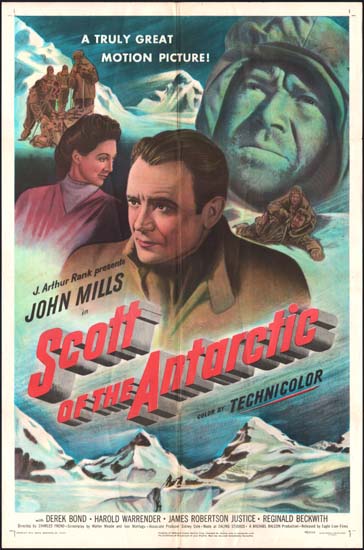
Scott of the Antarctic (1948)

Captain Scott’s tragic end is bought to life with low-key hero worship

Director: Charles Frend

Cast: John Mills (Robert Falcon Scott), Diana Churchill (Kathleen Scott), Harold Warrander (Dr Edward Wilson), Anne Firth (Oriana Wilson), Derek Bond (Captain Laurence Oates), Reginald Beckwith (Lt Bowers), James Robertson Justice (PO “Taff” Evans), Kenneth More (Lt Teddy Evans), Norman Williams (William Lashly), John Gregson (Tom Crean), James McKechnie (Dr Edward Atkinson), Barry Letts (Apsley Cherry-Gerrard), Christopher Lee (Bernard Day), Clive Morton (Herbert Ponting)

There are perhaps few more controversial figures in historical discussion than Robert Falcon Scott. The great polar explorer was, for most of his career, and for a long period after his death in 1912, a national hero, the man who – with stiff-upper-lip bravery – gave his life struggling against the elements to conquer the South Pole. Scott’s reputation only began to be questioned in the late 1970s, with a series of biographies culminating in a near-vicious – but compelling – anti-Scott argument laid out by Roland Huntford in his book Scott and Amundsen. Scott’s many flaws – both personal and in planning – set a new landscape for seeing his achievements as carrying too high a cost, especially in an atmosphere where the extreme sacrifice was seen as something to be avoided if at all possible, rather than an everyday fact of life for post-war generations.

In this context, watching this Ealing Studios 1948 Scott biopic – one of the biggest box-office hits of its year in the UK – is an interesting experience. While the film’s tone and its depiction of Scott are essentially fairly heroic, the film flirts at points with the errors and misjudgements that led to Scott leading himself and his companions into an icy immolation in a tent eleven miles away from a depot that could have given them a chance to survive.

Frend’s film is very well made and beautifully shot – so perfectly does it capture the look and feel of the Antarctic, and the extreme cold, that you overlook the fact that at no point can you see the actors’ breath – and it covers the main points of the expedition very well. It’s in some ways, today, almost hilariously stiff-upper lip, with the expedition members marching dutifully (and with a self-deprecating smile) to certain death, and the ladies at home speaking with such cut-glass primness you have to keep checking that Celia Johnson isn’t in the film.

There are some strong performances, not least from Mills (a very close physical likeness for Scott himself). Mills was the perfect choice for this role –overflowing with a sense of duty, but with a slight edge of idee fixe pride where it’s clear that he’s not willing to budge from anything to do with his mission. Harold Warrander also makes a strong impression as an artistic spirited scientist, Dr Wilson, who quietly hides his premonitions of disaster and later feelings of regret due to a sense of personal loyalty to Scott. Reginald Beckwith, James Robertson Justice and Kenneth More also give decent performances.

But the main appeal is the glorious technicolour look of the film. The film used no fewer than three photographers and brilliantly mixes together painted backdrops, studio locations and some genuine location footage with skilful and glorious aplomb. The technicolour tinge to the shots is wonderful – watching it in high definition, it’s like a series of polar expedition photos brought skilfully to life. The film in fact apes several of the famous photos from the expedition with such beauty that you feel like they could be printed and framed.

The plot however is more concerned with checking off the events of the expedition – from its conception, through its financing and recruitment, initial excursions and the final (futile?) march to the pole and the death march home. Frend’s film is clearly largely intended to be hagiographic – the men are by-and-large totally committed to the journey, there is nary a cross word between them, and the film never really questions the point or purpose of the journey – or if it was worth the lives of five men to achieve it.

However, there are moments where the film leans towards a more interesting criticism of Scott’s planning and leadership. The funding campaign is largely a disaster, bailed out only by a last minute donation. Scott ignores advice from famed explorer Nansen to take dogs (man hauling is of course more noble) and places far too much faith in motor sledges (he is shown ruefully staring at one after it breaks down). Equipment – not least the vital fuel canisters kept at depots – is shown to be inadequate. The dogs perform extremely well – far better than the horses. The film doesn’t avoid the grisly fate of the horses either – I’ve never understood Scott defenders who claim it would have been cruel for Scott to take dogs to the pole, but never question the working to death and shooting of ponies in conditions they were totally unsuited for. 

The film skirts around the moral responsibility Scott bore for the death of the men who entrusted their lives to his planning. It does show – faithfully – the final depot being placed one degree less further south than originally planned (a shortfall that would contribute heavily to dooming the men later on). But as first Evans then Oates pass away, the film focuses on the tragic loss rather than the planning, preparation and “cut to the wire” contingences Scott was working with that contributed to this (not least his last minute decision to expand his polar party to five from the original number of four, sending three men back to base – with all rations and provisions having been packaged for two teams of four). 

The film is less interested in this, more keen on showing the heroic progression of events. It gives us moments, but the main purpose of the film is to sing the praises of Scott. This means, for me, the film becomes more and more deficient as time goes on and the histographical debate around Scott becomes all the richer and more engaging. For all the qualities of the film itself technically, it doesn’t have anything to contribute towards this and just offers up the straight printing of the legend.

For me, by the way, Scott is almost the ultimate expression of Edwardian amateurness, taking on the most challenging environments of the world with a superb confidence in a “special role” for the British in history. While Huntford’s personal dislike for Scott stings too much, there are legitimate points to be made about Scott’s poor planning, his obsessive disregard for learning from his mistakes and his refusal to engage with or embrace the sort of Inuit techniques that Amundsen learnt from. And, at the end of the day, while you could say Scott was unlucky compared to Shackleton, whose equally disastrous expedition at least saw all his men return alive, the fact remains that Scott’s old-school, old-fashioned, Britain-shall-prevail-attitude led not only to his own death but the deaths of four other people in hellishly cold conditions thousands of miles away from their families. Say what you like for his bravery, but don’t forget the price that others also paid for it.

The Guns of Navarone (1961)


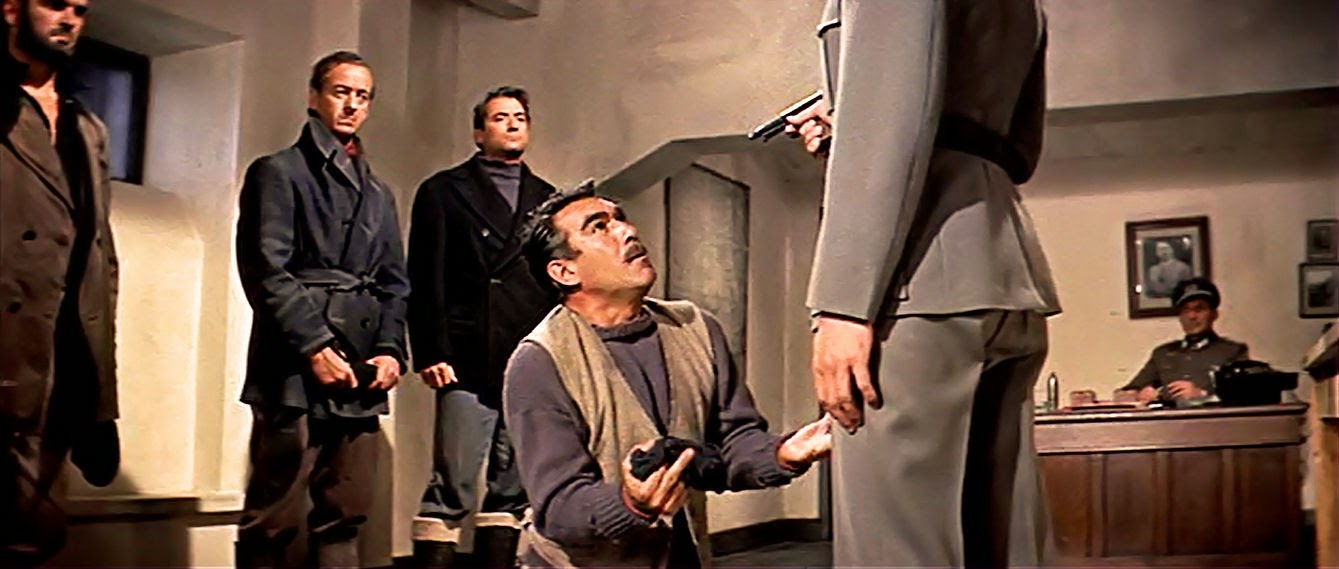
Gregory Peck leads one of the first men-on-a-mission films in The Guns of Nararone

Director: J. Lee Thompson

Cast: Gregory Peck (Captain Keith Mallory), David Niven (Corporal Miller), Anthony Quinn (Colonel Andrea Stavrou), Stanley Baker (Private “Butcher” Brown), Anthony Quayle (Major Roy Franklin), Irene Papas (Maria Pappadimos), Gia Scala (Anna), James Darren (Private Spyro Pappadimos), James Robertson Justice (Commodore Jensen), Richard Harris (Squadron Leader Barnsby), Bryan Forbes (Cohn), Allan Cuthbertson (Major Baker), Walter Gotell (Oberleutnant Meusel), George Mikell (Hauptstaumführer Sessler)

The Guns of Navarone is the archetypical “men on a mission” classic – it was the first major film to feature a team of specialists, all played by famous actors, going behind the lines to carry out some impossible task, leaving a trail of explosions and dead Nazis in their wake. Guns of Navarone was lavished with box-office success – and Oscar nominations, surprisingly – and although it’s a little too long, and a little weakly paced at times (as Thompson himself has admitted) it’s still got a cracking, bank holiday afternoon enjoyability about it. It’s not perfect, but honestly who could resist it?

In 1943, 2,000 British soldiers are stranded on the Greek island of Kheros. The Royal Navy plans to rescue them – but the way is blocked by two massive, radar controlled guns, in an impenetrable mountain base. The air force can’t take it out: so it’s up to Commando leader Major Roy Franklin (Anthony Quayle) to put together a team to do it. Recruiting mountaineer-turned-intelligence-agent Keith Mallory (Gregory Peck), explosives expert Miller (David Niven) and Greek-resistance leader Andrea Stavrou (who else but Anthony Quinn?), Franklin leads the team in. But when he is injured, the ruthless Mallory takes command – and leads the team in a perilous behind-the-lines raid.

I’d not seen Guns of the Navarone for a few years, and I’d forgotten what a brilliantly fun, boys-own-adventure thriller it is. I’d also forgotten what a lot of time is given early on into establishing what a team of bad-asses this group are. There seems to be no limit to their ruthless, knife wielding, gun running, cold-eyed killer bravery. And they hired a hell of a cast to play it as well – so damn good that you completely forget Peck, Niven, Quayle and Quinn are all just a little bit too over-the-hill for the derring-do they are called on to carry out.

Guns of Navarone brilliantly explains the mission aims, all the stakes and introduces each of the characters and their basic backstory, before the film basically gives us a series of action set-pieces – on a boat, at the coast, on a cliff, in a village, in a German cell, in Greek ruins, in a German base. It covers everything, and each scene is directed with real verve and increasing tension, with a simplicity to camera-work and editing that really lets the action breathe. The final sequence, waiting for the booby trap to explode among the guns, is a brilliantly done “rule of three” waiting game, with the tension building up each time.

The film is also rattling good fun, and gives each of its actors’ set-piece moments. Gregory Peck grounds the film perfectly as the increasingly ruthless Mallory, willing to sacrifice a number of pawns to achieve the target, but has a war weariness that still makes him sympathetic (as a side note, Peck’s German accent was so woeful all his German was dubbed). Niven plays Miller as a mixture of louche whiner, chippy middle-class man and natural-born troublemaker – and gets some knock-out speeches on the morality of war (Niven by the way nearly died after catching pneumonia during the boat wreck sequence).

Anthony Quinn had a monopoly on playing exotic roles at the time – from Mexicans to Arabs, from Gaugain to Zorba the Greek – so no great surprise he plays the Greek colonel here. He’s terrific though, a cold-eyed ruthless killer – and the sequence where he pretends to be a cowardly awkward fisherman is wonderful (not least for Stavrou’s reaction to Miller’s praise for his performance – a half shrug and a “so-so” hand gesture, one of my favourite ever “character” touches in the movies). Irene Papas is perfect as his female equivalent, while Anthony Quayle puts together another of his “decent army officer chaps” as boys-own adventurer Franklin. Baker and Darren don’t get huge amounts to do, but Baker does well with a “lost my taste for this killing malarkey” sub-plot.

Many of the character beats were so well-done they basically became archetypes for every “group on a mission” film since (the austere leader, the difficult whiner, the old-school traditionalist, the ruthless warrior, the maverick, the one who’s lost his nerve – and, uh, I guess James Darren is the “sexy” one). The actors play off each other superbly. There are also some great cameos – Robertson Justice is great as “the man in charge”, Walter Gotell very good as an archetypical “worthy adversary” German – there is even a slightly bizarre cameo from Richard Harris as an Aussie pilot (yup you read that right). 

Navarone’s pace doesn’t always quite work – the gaps between the action sequences do lag. It takes nearly 45 minutes for our heroes to even get to Navarone. The film also can’t quite decide its stance on warfare. We get Miller’s passionate speeches on the pointlessness of missions when wars are always going to happen anyway. The unmasking of a traitor leads to a long debate on the morality of killing them or not. Several of the characters question the point and morality of war. But then, the film spends plenty of time on Alistair MacLean thriller beats: there is killing-a-plenty of German soldiers, gunned down with ruthless efficiency (not quite as many as Where Eagles Dare but pretty close!). There are small references to Greek villages paying a heavy price in retribution for the gang’s action – but these considerations never even slow them down, or make them stop to think.

Not that it really matters – this is a boy’s own action film, full of hard-as-nails actors grimly “doing what a man’s gotta do” throughout. And, despite being a little too long and aiming for a depth it doesn’t always follow through on, it’s brilliantly assembled, the action sequences are tightly directed, and the acting has a square-jawed confidence to it. Niven is pretty much perfect as the slightly dishevelled Miller, and the clashing relationship between him and Peck growing into respect, has fine bromance to it. Navarone is the first of its kind, and it’s still (and always will be) one of the best – really exciting, really thrilling, really damn good fun.